Built-in Budgeting: Always Know the Numbers
Clearly define budgets within proposals faster than ever with estimate section templates. Instantly know project labor and material hard costs with Projul. Estimated revenue, payroll costs, and more.
Schedule a Demo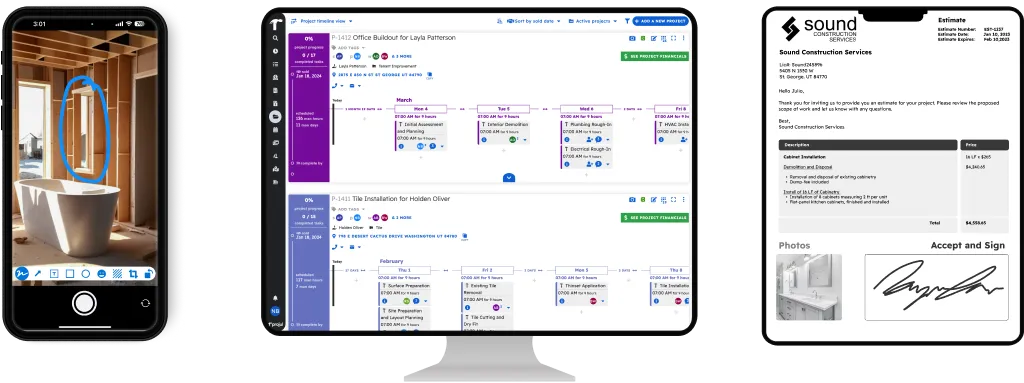
Why most contractors don’t know their real costs
Here’s something nobody talks about: most contractors don’t actually know if they’re making money on a job until it’s over. And by then, it’s too late to do anything about it.
Projul’s construction budgeting software tracks labor, material, and subcontractor costs against your estimate in real time. Contractors see exactly where each job stands financially as work happens, not after the fact. Projul offers flat-rate pricing with no per-user fees for construction companies of all sizes.
The problem is usually the same. Labor hours get tracked on paper or not at all. Material costs live in a pile of receipts. Sub invoices show up weeks after the work is done. By the time you add it all up, you’re guessing at your margins.
Construction budgeting software fixes this by tracking costs as they happen, not after the fact. When your crew logs time in Projul, that cost hits the budget immediately. When you enter a material expense, your margins update in real time. No spreadsheets. No end-of-job surprises.
Over 5,000 contractors use Projul to know exactly where every dollar goes while the job is still in progress.
How budget tracking prevents profit leaks
Profit leaks are the small overruns that add up to big losses. An extra day of labor here. A material order that came in 15% over the allowance there. A sub who billed more than the original quote. Individually, they seem manageable. Added up across a full project, they can wipe out your margin.
Contractor budget tracking catches these leaks in real time. Here’s how Projul makes it work:
Real-time cost vs. estimate. Every line item in your estimate has a budget. As costs come in, Projul shows you the gap between what you planned and what you’ve spent. Green means on track. Red means something needs attention.
Labor costs update automatically. When your crew logs hours through Projul’s time tracking, those hours convert to dollars based on your labor rates. You don’t wait for payroll to find out you’re over on labor.
Material and sub costs in one place. Enter material expenses and sub invoices as they come in. Projul rolls them into your project budget so you see the full financial picture, not just pieces of it.
Catch overruns while you can still act. The difference between a profitable job and a money loser is often just one early correction. If you know you’re trending over on framing labor by Tuesday, you can adjust by Wednesday. If you don’t find out until the job is done, that money is gone.
Building budgets from your estimates
Projul’s budgeting starts where every project starts: the estimate. When you build an estimate in Projul, each section carries labor hours, material costs, and subcontractor allowances. Once that estimate is approved, those numbers become your project budget automatically.
You don’t create the budget separately. You don’t copy numbers from one screen to another. The estimate IS the budget. That means your budget reflects exactly what you told the customer the job would cost, broken down by every scope of work you quoted.
Here’s why that matters. When your budget comes directly from your estimate, there’s no gap between what you sold and what you’re tracking. Every dollar you quoted has a matching budget line. As work progresses and costs roll in, you see exactly how reality compares to what you planned.
If you use estimate templates, your budgets get even more consistent. Templates lock in your standard labor rates, material costs, and markup percentages. Every estimator on your team builds bids with the same numbers, and every project budget starts with those same numbers. No more one estimator quoting framing at $8 a square foot while another quotes $12.
For contractors running multiple projects at the same time, this is a game changer. You stop guessing which jobs are making money and start knowing.
Real-time cost tracking that actually works
The whole point of construction budgeting software is seeing your numbers while you can still do something about them. Projul gives you a live dashboard showing every project’s financial health at a glance.
Here’s what updates in real time:
Labor costs. Every time a crew member clocks in through time tracking or geo-fenced time tracking, their hours multiply by their labor rate and hit the budget. By lunchtime, you know how much today’s labor is costing you on every active job.
Material costs. When you record a material expense or a purchase order comes through, the budget updates. You see the impact on your margins before the materials are even installed.
Subcontractor costs. Sub invoices get entered against the project and category they belong to. No more lumping all sub costs into one bucket and hoping the total looks right.
Overhead and equipment. Track equipment costs and overhead allocations against specific projects so your job cost numbers reflect the true cost of doing the work.
The dashboard shows green for on-track items and red for anything that needs attention. You can check it from your desk or pull it up on your phone from the jobsite. Either way, you’re looking at today’s numbers, not last week’s guesses.
Labor vs. material breakdowns you can trust
Knowing your total cost on a job is helpful. Knowing where that cost is coming from is what actually helps you make decisions.
Projul breaks down every project budget by category. You see labor on its own, materials on their own, subs on their own, and any custom categories you’ve set up. This matters because the fix for a labor overrun is completely different from the fix for a material overrun.
If labor is running hot, maybe you need to reassign crews, adjust the schedule, or have a conversation with your foreman about efficiency. If materials are over budget, maybe your supplier raised prices since you bid the job, or maybe someone ordered more than the estimate called for.
Without category-level breakdowns, you just see a big red number and have no idea where to start fixing it. With Projul, you see exactly which category is causing the problem and by how much.
This also makes your future estimating better. When you finish a job and see that your drywall labor consistently runs 15% over your estimates, you adjust your templates for the next bid. Over time, your estimates get tighter, your budgets get more accurate, and your margins get more predictable.
How change orders affect your budget
Construction projects change. Clients add scope. You find surprises behind walls. Weather pushes your timeline. Every one of these changes has a financial impact, and your budget needs to reflect that impact in real time.
When you create a change order in Projul through estimates and change orders, the budget adjusts automatically. The new labor, materials, and costs from the change order get added to the project budget. Your financial picture stays accurate without anyone manually updating a spreadsheet.
This is critical because change orders are where a lot of contractors lose money. You agree to extra work, send a change order to the client, but forget to update the budget. Now your cost tracking is comparing actual costs against the original estimate, which no longer reflects the real scope of the project. Everything looks over budget when it’s actually on track for the revised scope.
Projul eliminates that problem. The budget always reflects the current scope of work, including every approved change order. You see your true financial position at all times.
Variance alerts that save your margins
Projul doesn’t just show you the numbers and hope you notice when something’s off. When a cost category starts trending past its budgeted amount, you see it flagged immediately. Red indicators show up on your dashboard so you can address overruns before they become disasters.
Think about what that means on a busy week when you’re juggling 10 active projects. Without alerts, you’d need to manually check every budget line on every project to catch a problem. That’s not realistic when you’re also answering calls, running crews, and meeting with clients.
With Projul’s visual indicators, problems surface on their own. You open the dashboard, see two red flags across your active projects, and know exactly where to focus your attention. Maybe the electrical labor on your Main Street project is running 20% over. Maybe materials on the Henderson remodel came in higher than expected. You see it, you act on it, and you save your margin.
Profitability reporting that drives better decisions
Tracking costs is only half the equation. The other half is turning that data into reports that help you run a better business.
Projul’s reporting tools pull from your budget data to show profitability by project, by crew, by cost category, and by time period. You can see which types of projects make you the most money, which crews are most efficient, and which cost categories consistently run over.
Here’s what contractors typically discover when they start using Projul’s profitability reports:
Some project types are more profitable than others. You might think your biggest jobs make the most money, but the reports often show that mid-size projects have better margins because they’re simpler to manage.
Certain crews are more efficient. When you see labor costs broken down by crew, patterns emerge. Maybe one crew consistently finishes framing under budget while another always runs over. That’s actionable data you can use for training, scheduling, and bidding.
Material waste is a bigger problem than you thought. When you compare material budgets to actual costs across 20 projects, you start seeing where waste happens and how to prevent it.
These reports feed directly into your estimating process. The more jobs you complete in Projul, the more historical data you have to bid accurately on the next one.
Projul budgeting vs. spreadsheets
If you’re still using spreadsheets or clipboards to track job costs, you’re finding out about budget problems too late. Spreadsheets don’t update themselves. By the time you enter last week’s numbers, the damage is already done.
Projul updates your budget in real time as work happens. You always know your hard costs, margins, expected revenue, payroll, and more. That’s the difference between guessing at your profit and knowing it.
Here’s a practical comparison:
Spreadsheet workflow. Your foreman writes down hours on paper. Someone collects the paper at the end of the week. An office person types the hours into a spreadsheet. Another person cross-references receipts for materials. By Friday afternoon, you have numbers that are already five days old. And if someone made a typo, your data is wrong without anyone knowing.
Projul workflow. Your crew clocks in on their phones. Hours hit the budget instantly. You enter a material receipt and the cost shows up on the dashboard. By 9 AM Monday, you’re looking at real-time data for every active job. If something’s over budget, you know before the next dollar is spent.
Contractors who switch to Projul from spreadsheets typically save 2+ hours daily on cost tracking and reconciliation. That time goes back into running jobs and growing the business.
Turn budget data into invoices and reports
When it’s time to bill, your budget feeds directly into invoicing and service invoicing so every dollar is accounted for. Pull detailed reports to see profitability by project, crew, or time period.
Use live construction costs to monitor spending across all active projects from one dashboard. Spot the jobs that are bleeding money before they finish. When you have real-time cost data at your fingertips, billing becomes faster and more accurate because you’re invoicing based on actual tracked costs, not estimates from memory.
Sync with QuickBooks automatically
Projul integrates with both QuickBooks Online and QuickBooks Desktop so your project financials sync to your accounting software without double entry. Your accountant gets clean data. You get accurate job costs. Nobody enters the same number twice.
The sync runs in the background. Create an invoice in Projul based on your budget data, and it shows up in QuickBooks. Accept a payment, and it syncs too. Your books stay current without anyone switching between systems or copying numbers manually.
Control material costs with purchase orders
Purchase orders tie directly to your project budget, so every material order updates your costs automatically. You’ll see the impact on your margins before the materials even arrive.
Pair this with estimates and change orders to keep your budget accurate as the scope changes. When a client adds work, the budget adjusts to reflect the new reality. Your financial picture stays honest from the first estimate through the final invoice.
How job costing works in construction
Job costing is the process of tracking every dollar you spend on a project and comparing it to what you estimated. That’s it. No fancy accounting degree required. You just need a system that captures four types of costs as they happen: labor, materials, subcontractors, and equipment.
Here’s how it works in practice. You bid a bathroom remodel at $28,000. Your estimate breaks down into $9,000 for labor, $11,000 for materials, $6,000 for subs (plumber and tile guy), and $2,000 for equipment and overhead. Those numbers become your budget.
As the job progresses, real costs come in. Your crew logs 120 hours of labor at $35/hour, that’s $4,200 so far against your $9,000 labor budget. You’re 47% through the labor budget. But are you 47% through the labor? If you’re only 30% done with the work, you have a problem. If you’re 60% done, you’re ahead.
That comparison, budgeted vs. actual at every stage of the job, is what job costing gives you. It answers the question every contractor needs answered: “Am I making money on this project right now?”
The four cost buckets you need to track:
Labor. This is usually the biggest variable. Crew members work at different speeds. Weather delays add hours. Rework adds hours. If you’re not tracking labor hours against your estimate in real time, you won’t know you’re over budget until payroll hits. Projul’s time tracking captures hours as your crew clocks in, converts them to dollars, and posts them against the job budget automatically.
Materials. Material costs seem straightforward, but they creep up fast. Price increases between your bid date and your order date. Extra trips to the supply house. Waste that exceeds your allowance. When you track materials through purchase orders, every order hits the budget before the materials hit the jobsite.
Subcontractors. Sub costs are usually fixed by contract, but not always. Back charges, extras, and scope changes can push sub costs past your budget. Tracking sub invoices against the original allowance keeps you honest about where each sub stands financially.
Equipment and overhead. Tool rentals, dumpster fees, permit costs, fuel for the truck. These smaller costs add up, especially across multiple jobs running at the same time. Assign them to specific projects so your job cost numbers reflect what each project actually costs to build.
The goal is simple: know where you stand on every job, every week, so you can make corrections before it’s too late. Contractors who track job costs consistently report tighter margins, fewer surprises, and better bids on future work.
The real cost of not tracking job costs
If you don’t track job costs, you’re flying blind. And flying blind in construction means you find out whether a job was profitable after the last check clears. By then, there’s nothing you can do about it.
Here are the real costs of skipping job cost tracking:
You finish jobs and have no idea if you made money. You deposited $50,000 from the client. You paid your crew, your subs, your suppliers. There’s money left in the account, so it must have been profitable, right? Maybe. But if you didn’t track the actual costs against your estimate, you don’t really know. That “profit” might disappear when you factor in the extra week of labor, the change order you forgot to bill, and the second dumpster you didn’t budget for.
Untracked change orders eat your profit. Picture a $50,000 kitchen remodel. The homeowner asks for upgraded countertops, an extra outlet, and a relocated gas line. You handle the work but never send a formal change order for the smaller items. Those “small” additions add up to $5,000 in untracked costs. Your $8,000 profit just became $3,000, and you didn’t notice until the job closed out.
You underbid future work because you don’t have real data. Without historical job cost data, your next estimate is based on memory and gut feel. You think framing took 200 hours on your last project, but it actually took 260. You bid the next one at 200 hours and lose money again. This cycle repeats until you either start tracking or stop taking that type of work.
You can’t tell which jobs are profitable. Maybe your new construction work makes great margins but your remodels consistently lose money. Or maybe it’s the opposite. Without job-level cost data, you’re guessing which types of work to pursue and which to avoid. You could be chasing the wrong work for years without knowing it.
Your bids get less competitive over time. Contractors who don’t track costs tend to pad their estimates “just to be safe.” That padding makes your bids higher than competitors who know their actual costs and can price accurately. You lose bids you should have won because your numbers are based on fear instead of data.
Cash flow problems sneak up on you. When you don’t know your true costs, you can’t predict cash flow. You take on a new project thinking you have plenty of margin, but three open jobs are all running over budget at the same time. Suddenly you’re juggling payments and hoping the next draw comes through before payroll is due.
The fix for all of this is the same: track your costs as they happen and compare them to your estimate. Projul’s reporting tools make this automatic. You don’t need to build reports manually. The data flows in from timesheets, purchase orders, and expense entries, and your job cost reports update on their own.
Job costing software vs. spreadsheets
A lot of contractors start with spreadsheets. It makes sense. Excel is familiar, it’s flexible, and it feels like enough when you’re running two or three jobs. But as your business grows, spreadsheets break down in ways that cost you real money.
Here’s where spreadsheets fall short:
Spreadsheets require manual entry after the fact. Someone has to collect timesheets, gather receipts, and type everything into the right cells. That usually happens at the end of the week, which means your cost data is always days old. In construction, a lot can go wrong in a few days. By the time the spreadsheet is updated, you’ve already spent money you shouldn’t have.
Spreadsheets can’t pull live data from other systems. Your crew tracks time in one app. Purchase orders go through email. Sub invoices arrive by mail. None of that data flows into a spreadsheet automatically. You’re the connection point, and when you’re busy running jobs, data entry falls to the bottom of the list.
There are no alerts when you’re over budget. A spreadsheet will happily show you a negative number, but it won’t send you a notification at 7 AM that your framing labor is 20% over budget. You have to open the file, scroll to the right row, and notice the problem yourself. On a busy week with 8 active projects, that just doesn’t happen consistently.
Formulas break and nobody notices. One wrong cell reference and your totals are off. Someone accidentally deletes a row and the budget doesn’t add up anymore. These errors compound silently. You could be looking at incorrect margins for weeks before someone catches it.
Spreadsheets don’t connect to your accounting software. After you manually track costs in Excel, you still have to manually enter those numbers into QuickBooks. That’s double the data entry and double the chance for errors. Your bookkeeper and your project manager are working from different numbers, and reconciling them eats hours every month.
Job costing software tracks costs as they happen. When a crew member clocks in through Projul’s time tracking, those hours convert to dollars and hit the project budget instantly. When a purchase order is created, the committed cost shows up before the materials are delivered. When a sub invoice is recorded, the budget adjusts in real time.
The difference comes down to timing. Spreadsheets tell you what happened last week. Job costing software tells you what’s happening right now. And in construction, “right now” is the only time you can actually do something about a budget problem.
Contractors who switch from spreadsheets to Projul typically save 2+ hours a day on cost tracking and catch budget overruns days or weeks earlier than they would have with manual tracking. That time savings alone pays for the software many times over.
How Projul connects job costs to QuickBooks
Tracking job costs in your project management software is only half the picture. The other half lives in your accounting software. If those two systems don’t talk to each other, someone on your team is entering the same numbers twice, and your financial reports are only as accurate as the last manual entry.
Projul’s QuickBooks integration connects your job costs directly to your accounting software. Here’s how the data flows:
Timesheets to labor costs to QuickBooks. Your crew logs hours in Projul. Those hours calculate labor costs based on your rates and post against the project budget. When you run payroll or sync to QuickBooks, the labor data is already categorized by job and cost type. Your bookkeeper doesn’t need to manually allocate payroll hours to projects.
Purchase orders to material costs to QuickBooks. When you create a purchase order in Projul, it commits that cost to the project budget. When the PO is fulfilled and the expense is finalized, it syncs to QuickBooks as a job cost. Materials are categorized correctly without anyone re-entering receipt data.
Invoices to revenue to QuickBooks. When you create an invoice in Projul based on your budget and completed work, it syncs to QuickBooks as a receivable. Payments sync too. Your revenue is tied to the same job as your costs, giving you a complete profit and loss picture by project in QuickBooks.
One source of truth for your bookkeeper. The most common complaint from construction bookkeepers is getting incomplete or conflicting data from the field. The project manager says the job cost $42,000. The receipts add up to $38,000. The timesheet totals don’t match payroll. With Projul feeding data directly to QuickBooks, everyone works from the same numbers. Your bookkeeper reconciles faster, your financial reports are more accurate, and you spend less time in meetings trying to figure out why the numbers don’t match.
QuickBooks classes and jobs stay organized. Projul maps your projects to QuickBooks classes or jobs so your chart of accounts stays clean. You can pull a profit and loss by job in QuickBooks and see numbers that match what Projul shows on the project dashboard. No discrepancies. No manual mapping. Just consistent data from the field to the books.
What this means for your business. You stop paying someone to enter the same data twice. Your monthly financials close faster because the data is already there. Your CPA gets clean reports at tax time. And most importantly, you can trust the numbers when you’re deciding whether to take on another project, hire another crew, or invest in new equipment.
The contractors who grow consistently are the ones whose financial data is accurate and current. Projul’s QuickBooks connection makes that possible without adding administrative overhead to your team.
Stop losing money on jobs that looked profitable
Whether you’re a general contractor, a remodeling company, or a commercial contractor, the contractors who grow consistently aren’t the ones who bid the most work. They’re the ones who know their numbers on every job, every week. Projul’s budgeting tools give you that visibility without the spreadsheet headaches.
Build budgets from estimates. Track costs in real time. See labor, material, and sub breakdowns by category. Get alerts when something’s off. Pull reports that help you bid better next time. That’s what construction budgeting software should do, and that’s exactly what Projul delivers.
Over 5,000 contractors use Projul to protect their bottom line. At $4,788/year with no per-user fees, your entire team gets access to the same real-time financial data. Stop guessing at your margins and start knowing them.