Construction CRM Software. Built by construction pros with honest pricing.
Projul keeps your customers happy by tracking everything from leads to invoices in one place.
- Over 5,000 contractors track their whole project in Projul, from lead through to invoicing
- Save time with estimate templates and fast approval
- Manage many projects at the same time, including detailed timelines and Gantt views
Your sales process should make you money, not waste your time
Projul’s construction CRM software gives you a clear view of every lead and customer in one place. Over 5,000 contractors use Projul to track the right information and close more deals.
Projul’s construction CRM tracks leads, customers, estimates, and projects in one platform built by contractors. Over 5,000 construction companies manage their entire sales pipeline and job lifecycle without switching between apps. Projul offers flat-rate pricing with no per-user fees for construction companies of all sizes.
Put prospects “On Hold” to focus your sales effort on the hottest leads. Projul was built by experienced construction pros who know what matters in a sales process. You don’t need a fancy system. You need one that works the way you already think about your business.
- Custom built for construction companies to track their pre-sales leads
- It’s easy to manage hundreds of prospects without feeling overwhelmed
- Stay on top of hot leads by scheduling follow-up tasks
Why generic CRMs don’t work for contractors
Most contractors who’ve tried Salesforce, HubSpot, or another generic CRM have the same story: they spent weeks setting it up, paid a consultant to customize it, and their team still hated using it. Here’s why.
Generic CRMs were built for software salespeople. They track deals, meetings, and email sequences. That’s great if you’re selling SaaS subscriptions. It’s useless if you need to attach cost codes to a job, handle a change order mid-project, or schedule a concrete crew for next Tuesday.
Construction has workflows that generic tools don’t understand. Your “deal” doesn’t end when the customer signs. It’s just getting started. You need to track that customer through estimating, scheduling, materials, time tracking, job costing, and invoicing. A generic CRM stops at the sale and leaves you scrambling for separate tools to manage the actual work.
Here’s what falls apart with a generic CRM:
- No construction estimating. You can’t build a proper bid in Salesforce. You end up exporting to Excel or buying a separate estimating tool.
- No crew scheduling. Generic CRMs don’t know what a crew is. They definitely don’t know how to schedule one across multiple jobsites.
- No job costing. Without cost codes, budget tracking, and real-time cost updates, you have no idea if a project is profitable until it’s over.
- No change order management. Construction projects change constantly. If your CRM can’t handle change orders natively, you’re tracking them in email threads and hoping nothing gets missed.
- Per-user pricing kills you. When you have office admins, project managers, estimators, and 30 field workers who all need access, per-user pricing turns a $50/month tool into a $2,000/month problem.
Whether you’re a roofing contractor, a general contractor, or a remodeling company, you shouldn’t have to force-fit your construction business into software designed for a tech startup’s sales team. If you want a full breakdown of what to look for, read our construction CRM guide.
What to look for in a construction CRM
If you’re shopping for a contractor CRM, don’t just read feature lists. Here’s what actually matters when you’re picking software your team will use every day.
It should cover the full job lifecycle
The best construction CRM takes a lead from first contact all the way through to final payment. That means lead capture, estimates, scheduling, project management, invoicing, and payment processing in one system. If you have to buy three separate tools and connect them with duct tape and Zapier, that’s not a solution. That’s a headache.
Your whole team needs access
Any CRM that charges per user is going to cause problems. You’ll start limiting who gets access to save money, and suddenly your field crews are out of the loop. Look for flat-rate pricing so everyone, from the office to the jobsite, can log in without blowing your budget.
It has to integrate with your accounting
Your books have to be right. If your CRM doesn’t sync with QuickBooks or your accounting platform, someone on your team is double-entering data. That’s a waste of time and a recipe for errors.
Mobile access is non-negotiable
Your crews aren’t sitting at desks. They’re on ladders, in attics, and on rooftops. If the CRM doesn’t work well on a phone or tablet, it doesn’t work for construction. Period.
It should be easy to learn
The best feature in the world means nothing if your team won’t use it. You should be able to get your crew up and running in a day, not a month. Projul is rated 4.9 out of 5 on G2 for ease of use because we built it for people who’d rather be on a jobsite than watching training videos.
How Projul’s CRM compares to alternatives
There are a lot of construction CRM options out there. Here’s how Projul stacks up against what you’ll find when you start comparing.
Projul vs. generic CRMs (Salesforce, HubSpot)
Generic CRMs give you a contact database and a sales pipeline. That’s it. You’ll need separate tools for estimating, scheduling, time tracking, and invoicing. Then you’ll need integrations to connect everything. Then you’ll need someone to maintain those integrations when they break. Projul gives you the full lifecycle in one platform.
Projul vs. other construction software
Some construction tools focus on one thing, like estimating or scheduling, and tack on a basic CRM as an afterthought. Others try to do everything but charge per user, so costs spiral as your team grows. Projul is built specifically for contractors, covers everything from lead to payment, and charges a flat monthly or annual rate with no per-user fees.
Where Projul wins
- No per-user fees. Your whole team gets access at one price. Add 10 field workers tomorrow and you pay no per-seat charges. Your bill changes only if you move to a plan with a higher user limit.
- Built by a contractor. Projul’s founder ran a construction company. The software was built to solve real problems, not theoretical ones.
- Full lifecycle coverage. Lead management, estimates, scheduling, time tracking, job costing, invoicing, and QuickBooks integration are all included, with job costing and QuickBooks integration on Core+ and Pro.
- G2 rated 4.9/5 for ease of use. Your crew picks it up fast. Less training, less frustration, faster results.
Get paid for all your work with reliable estimates and invoicing
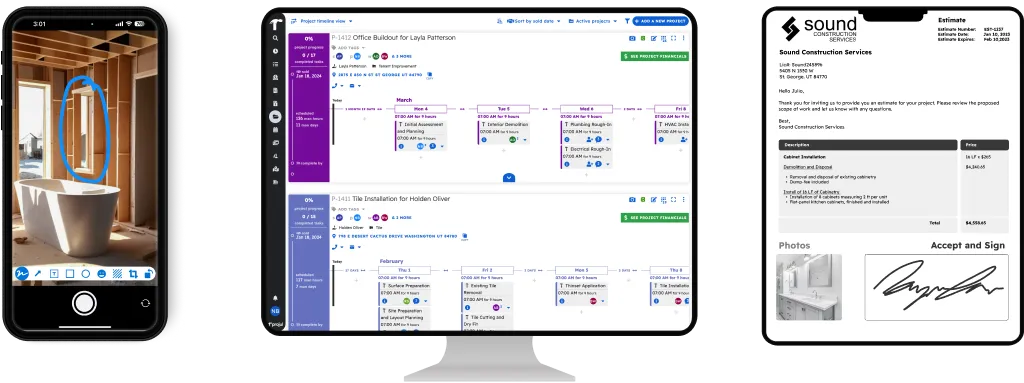
Projul’s templates and branding create professional estimates that impress your clients. Fast approval and digital signature are built right in, no extra tools needed. Starting at $2,388/year, Projul gives you estimates, invoicing, and payment processing in one platform.
Invoicing is just as simple. From deposit through to final invoice, Projul makes it easy to send and collect. Integrated payment processing means your customer can pay with a click.
- Get paid for all your work, including progress payments and change orders
- Make life easier for your accountant with our QuickBooks integration
- Save time by taking advantage of our estimate templates
Manage tasks across many projects without dropping the ball
Projul handles 1 or 100 projects with the same ease. Create and schedule tasks, assign them to crews, and keep things running on time. With unlimited projects and no per-user fees on the $4,788/year Core plan, Projul scales with your business.
Track progress through project timelines, Gantt schedules, and multiple other views. Your field workers upload photos and documents directly to Projul, so nothing gets lost and you don’t need external storage.
- Keep everyone in the loop by scheduling tasks and assigning them to workers
- Manage projects of all sizes in Projul
- Keep everything safe with secure photo and document uploads
Capture more leads without the busywork
Projul’s lead management tools organize every prospect so nothing slips through the cracks. Add a lead capture form to your website and new leads flow straight into your pipeline automatically.
When a homeowner fills out your form at 10 PM on a Saturday, that lead is already in your system Monday morning. No manual entry. No lost sticky notes. Just leads waiting for you to follow up.
Not every lead comes in through a form. On the Pro plan, Projul AI Connect lets ChatGPT, Claude, or another AI assistant turn a voicemail into a new lead with the address and a summary, add clients without creating duplicates, and move leads through your pipeline. Ask which estimates need a follow-up this week and your assistant pulls the list straight from Projul.
From lead to paid, all in one platform
When a lead is ready, create a professional estimate in minutes and send it for digital signature. Once they approve, convert it to an invoice with one click and get paid faster.
That’s the power of a construction CRM that covers the whole job. You’re not copying data between systems or re-entering customer info in three different apps. One system, one source of truth, from the first phone call to the final check.
How a Construction CRM Keeps Your Sales Pipeline Full
The biggest reason contractors leave money on the table isn’t bad work - it’s bad follow-up. A homeowner calls for a quote, you’re busy on a jobsite, and by the time you circle back, they’ve already hired someone else. That’s not a marketing problem. It’s a CRM problem.
A construction CRM fixes this by giving every lead a place in your sales pipeline. When a new inquiry comes in through your website, phone, or lead capture form, it lands in your system with a timestamp, contact info, and project details. Nothing gets scribbled on a napkin. Nothing lives only in your text messages.
From there, you move each lead through stages that match how you actually sell. Maybe it’s “New Lead,” “Estimate Sent,” “Follow Up,” and “Won” or “Lost.” The point is you can see every active opportunity at a glance. On Monday morning, you open Projul and know exactly which leads need estimates, which ones need a follow-up call, and which ones are ready to sign.
This matters more than most contractors realize. According to industry data, the average close rate for residential contractors sits between 30-40%. That means 60-70% of your leads go cold. A construction CRM helps you tighten that gap by making sure no lead gets forgotten.
Projul also helps you figure out where your best leads come from. Are referrals closing at 50% while online leads close at 15%? You’ll see that in your reporting and you can adjust your marketing spend to match. If you want a deeper dive into building a real pipeline, check out our construction sales pipeline guide.
The contractors who grow aren’t always the ones with the biggest ad budgets. They’re the ones who follow up on every lead, send estimates fast, and stay organized. A construction CRM built for the trades - not for tech companies - makes that possible without adding hours to your week.
Building lasting client relationships goes beyond the sale. Our construction customer journey mapping guide shows how to design a great experience from first contact to project completion. For practical tips on starting new projects on the right foot, read our construction client onboarding guide. And when issues arise, knowing how to handle customer complaints in construction and how to work with difficult construction clients can protect both your reputation and your margins. Even a simple gesture like a thank-you letter for customer feedback can turn a one-time client into a repeat customer.
How Construction CRM Differs from Generic CRM Software
You’ve probably heard someone say, “Just use Salesforce” or “HubSpot has a free CRM.” And technically, they’re right. Those tools exist. But using a generic CRM for a construction business is like using a sedan to haul lumber. It technically moves, but it’s the wrong tool and you’ll pay for it in wasted time.
Here’s the core difference: generic CRM software was designed around a sales rep sitting at a desk, sending emails, booking demos, and closing deals over Zoom. Construction doesn’t work that way. Your sales process involves driving to a property, walking a job site, measuring a roof or a foundation, building a detailed estimate with materials and labor, and then following up while you’re also managing three active projects.
Construction needs project-linked contacts. In Salesforce, a “deal” is a dollar amount attached to a company. In construction, a deal is a specific project at a specific address with specific scope. You need your CRM to connect a customer to their job site, their estimate, their approved scope, and eventually their invoices and payment history. Generic CRMs don’t think in terms of job sites.
You need estimate tracking built in. Generic CRMs track “proposals” as PDF attachments or links to a separate tool. A construction CRM like Projul lets you build detailed estimates with line items, cost codes, and materials right inside the system. When that estimate gets approved, it flows directly into the project. No exporting to Excel. No copy-pasting numbers between apps.
Trade-specific pipeline stages matter. A SaaS company’s pipeline might be “Demo Scheduled > Proposal Sent > Negotiation > Closed Won.” Your pipeline looks more like “New Lead > Site Visit Scheduled > Estimate Sent > Follow Up > Contract Signed > Job Scheduled.” Those stages reflect how construction sales actually work, and your CRM should match them without hours of customization.
Job site context changes everything. When a homeowner calls to ask about their project, you need to pull up their record and see the estimate, the approved scope, the schedule, any change orders, and the notes your project manager left after the last site visit. A generic CRM shows you a timeline of emails and call logs. That’s not enough.
The bottom line: a CRM built for construction speaks your language. It knows what an estimate is. It knows what a change order is. It connects your sales process to your actual project work so you’re not running two separate systems that never talk to each other.
From Lead to Signed Contract: Managing Your Sales Pipeline
Let’s walk through what a typical contractor sales process looks like when you’re using a CRM that actually fits your workflow.
Step 1: The lead comes in
A homeowner visits your website and fills out your lead capture form. Or they call your office after seeing your truck in their neighbor’s driveway. Or a past client sends a referral your way. However the lead arrives, it lands in your Projul CRM automatically. The contact name, phone number, email, project type, and any notes are captured right away.
No sticky notes. No “I’ll add them to the spreadsheet later.” The lead exists in your system the moment it arrives.
Step 2: Qualify the lead
Not every inquiry is worth your time. Some people are just price shopping. Some projects are outside your service area or trade. A construction CRM lets you quickly review new leads and decide which ones deserve your attention.
In Projul, you can mark leads as hot, warm, or put them on hold. This keeps your lead management focused on the opportunities most likely to close. You’re not wasting Tuesday morning chasing a lead who wants a $500 handyman job when you’re a commercial GC.
Step 3: Schedule the estimate visit
For most contractors, you can’t price a job without seeing it first. Your CRM should make it easy to schedule a site visit and attach it to the lead record. In Projul, you set a follow-up task with a date and time. Your calendar shows it. Your team sees it. Nobody forgets.
Step 4: Send the estimate
After the site visit, you build your estimate. With Projul, you create it right inside the same system where the lead lives. Use estimate templates to save time on common job types. Add your line items, materials, labor, and markup. Send it to the homeowner with a professional presentation and digital signature built in.
The estimate is linked to the lead record, so when you check the pipeline, you can see exactly which leads have received estimates and which ones are still waiting.
Step 5: Follow up
This is where most contractors lose deals. You send the estimate, the homeowner says “let me think about it,” and then life gets busy. Two weeks later, they’ve hired someone else because you never called back.
A CRM solves this. Projul lets you set follow-up reminders so you get a notification to check in. You can see how long ago the estimate was sent and whether the customer has looked at it. Instead of guessing who needs a call, you open your pipeline and the answer is right there.
Step 6: Close the deal
The homeowner signs your estimate digitally. The lead converts to a project. Their contact record, estimate details, and approved scope all carry forward. You don’t re-enter anything. You just start scheduling the work.
This is the full cycle, and it all happens in one system. No switching between a CRM for leads, a spreadsheet for estimates, and a calendar app for scheduling. Every step connects to the next, and nothing falls through the cracks.
Why Most Contractors Outgrow Spreadsheets for Lead Tracking
If you’re tracking leads in Excel or Google Sheets right now, you’re not alone. Most contractors start there. It’s free, it’s familiar, and it works fine when you’re juggling five or ten leads at a time.
But spreadsheets break down fast once your business grows. Here’s where the pain starts:
No reminders or follow-up alerts. A spreadsheet doesn’t tap you on the shoulder and say, “Hey, you sent that estimate three days ago and never heard back.” You have to manually scan every row, check dates, and remember who needs attention. When you’re busy running jobs, that doesn’t happen.
No history of what happened. Did you call this lead last week or the week before? What did they say? Who on your team talked to them? A spreadsheet gives you a row of data with no context. A CRM like Projul stores every note, every interaction, and every status change so you can pick up any conversation exactly where it left off.
Lost follow-ups cost you money. Studies consistently show that speed to lead matters. The contractor who responds first and follows up consistently wins the job more often than the one with the lowest price. When leads slip through the cracks of a spreadsheet, you’re not just losing a row of data. You’re losing $10,000, $50,000, or $100,000 jobs.
No reporting or visibility. How many leads did you get last month? What’s your close rate? Which lead source brings in the best jobs? A spreadsheet can technically answer these questions if you spend an hour building pivot tables. A CRM answers them in seconds with built-in reporting.
Version control nightmares. When two people edit the same spreadsheet, data gets overwritten. When someone sorts a column without selecting all the data, rows get scrambled. When the file gets too big, it slows to a crawl. These aren’t edge cases. They happen every week in busy contractor offices.
No connection to the rest of your business. Your spreadsheet doesn’t talk to your estimating tool, your scheduling software, or your accounting system. Every time a lead becomes a project, someone has to manually re-enter all the information somewhere else.
A construction CRM is the natural next step when spreadsheets can’t keep up. You don’t lose the simplicity you liked about spreadsheets. You gain the organization, automation, and visibility that growing businesses need. If you want to capture leads directly from your website instead of manually typing them in, check out Projul’s lead capture form.
CRM That Connects to Your Whole Business
The real power of a construction CRM isn’t just managing leads. It’s connecting your leads to every other part of your operation. When your CRM talks to your estimating, scheduling, invoicing, and job costing tools, you stop wasting time on data entry and start running a tighter business.
Here’s how that works in Projul:
One contact record from start to finish. When a lead comes in, you create a contact record. That same record follows the customer through every stage of the relationship. When they approve an estimate, their record is linked to the project. When you send an invoice, it’s tied to the same customer profile. When they call two years later for another job, their entire history is one click away.
Estimates connect to projects. You don’t build an estimate in one tool and then re-create it somewhere else to start the project. In Projul, the approved estimate becomes the foundation of the project. Line items, scope, budget, and customer approval all carry over automatically.
Scheduling connects to your team. Once a project is live, you assign tasks and schedule crews right inside Projul. Your field teams see their assignments on their phones. Changes show up in real time. You’re not texting five people separately or printing out a paper schedule that’s outdated by noon.
Invoicing connects to the work. When it’s time to bill, your invoice pulls from the approved estimate and any change orders. You’re not guessing what to charge or flipping through emails to find the agreed price. One click turns completed work into an invoice that your customer can pay online.
Job costing connects to reality. As your team logs time and you track material costs, Projul shows you how the actual spending compares to your estimate. You know whether a job is profitable before it’s done, not three months later when your accountant runs the numbers.
This connected workflow is what separates a real construction CRM from a basic contact list or a generic sales tool. Every piece of information enters the system once and flows where it needs to go. Your team spends less time on paperwork and more time on the work that actually makes you money.
When your CRM, estimating, scheduling, and invoicing all live in one platform, you eliminate the gaps where mistakes happen and money gets lost. That’s not a nice-to-have. For growing contractors, it’s the difference between running a business and being run by one.
Stop paying for software that doesn’t understand construction
Most contractor CRM software either does too little or charges too much. You shouldn’t need five subscriptions and a computer science degree to run your business.
Projul was built by a contractor who lived these problems. The result is construction CRM software that fits the way you actually work, with pricing that doesn’t punish you for giving your team access. Over 5,000 contractors already made the switch. See why it works for them.