Slide Project Schedules
Problems occur, customer scope creep happens, and tradesmen get sick. Projul timeline and schedule slide technology will change your life! It's never been easier to make lots of changes to a project schedule.
Schedule a Demo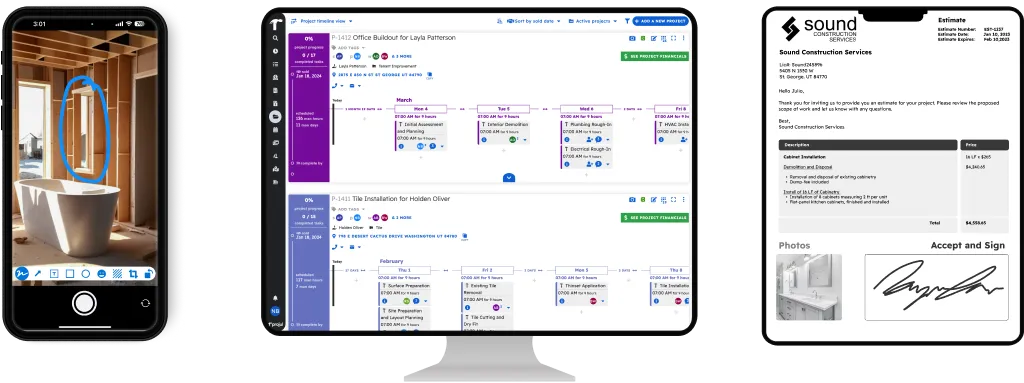
Absolutely Painless Construction Project Rescheduling
Rain on Monday. A sub who can’t show up until Thursday. A client who wants to add a bathroom to the scope. Material delivery pushed back a week. If you’ve run construction projects for more than a month, you know that schedules change constantly.
The question isn’t whether your schedule will change. It’s how fast you can adjust when it does.
Projul’s project sliding feature lets you push or pull an entire schedule, or any group of tasks, in just a couple of clicks. Every task moves together, your sequence stays intact, and your crew gets notified automatically. What used to take an hour of spreadsheet editing and a dozen phone calls now takes about 30 seconds.
Projul’s Project Sliding lets contractors push or pull an entire construction schedule in seconds when delays hit. All tasks move together, sequences stay intact, and crews get notified automatically. Projul offers flat-rate pricing with no per-user fees for construction companies of all sizes.
Over 5,000 contractors use Projul to handle the schedule disruptions that happen on every job. Rated 4.9 out of 5 on G2 for ease of use, it’s built for the reality of construction, not the fantasy of a schedule that never changes.
What Happens When Rain Delays Hit
Let’s walk through a real scenario. You’re running a residential remodel. The schedule has demolition starting Monday, framing on Wednesday, and rough-ins the following week. Then the forecast calls for three days of rain starting Monday.
Without Projul, here’s your morning: Open the spreadsheet. Move every task forward three days. Recalculate the end date. Check which subs are affected. Call your framing crew. Text your electrician. Email the client. Hope nobody missed the memo. That’s an hour of work, minimum, and you’ll probably still get a call from someone who didn’t get the update.
With Projul, here’s your morning: Open the project. Select the tasks. Drag them three days forward. Done. Projul moves every connected task, keeps the sequence intact, and sends automatic notifications to every assigned worker. Your framing crew knows they’re starting Thursday instead of Wednesday. Your electrician knows the rough-in moved to the following Thursday. Your client gets updated. And you spent 30 seconds instead of 60 minutes.
That’s construction project rescheduling the way it should work.
How Project Sliding Keeps Everything Aligned
The real power of project sliding isn’t just moving dates. It’s keeping your entire schedule aligned when those dates change.
Construction schedules have dependencies. You can’t do rough-ins before framing. You can’t paint before drywall. When one task moves, everything downstream needs to move with it. Do that manually and you’re bound to miss something. A sub shows up on the wrong day. Materials arrive before the site is ready. Your client expects a completion date that’s no longer realistic.
Projul’s slide feature moves connected tasks together. When you push the framing out three days, the rough-in, drywall, and paint all slide with it. The sequence stays intact. The gaps between tasks stay the same. You’re not manually recalculating every downstream date.
And it works for partial slides too. If a material delay only affects one phase of the project, select just those tasks and slide them. The rest of your schedule stays put. This kind of precision matters when you’re running 10 or 20 projects at once and can’t afford to disrupt jobs that are running fine.
The Smart Timeline View
Projul’s timeline gives you a visual overview of every active job in one place. It’s where most contractors start their day, checking crew assignments, spotting conflicts, and planning ahead.
The timeline shows all your projects side by side. You can see at a glance where your crews are, which jobs have gaps in coverage, and where schedule conflicts are developing. When you need to slide a project, you do it right from this view. Drag the tasks to new dates and watch everything update in real time.
With 26+ feature areas connected to the timeline, you can shift schedules, add tasks, check estimates, and communicate with your crew without leaving the page. It’s your daily command center.
Automatic Crew Notifications
One of the biggest headaches with rescheduling isn’t the scheduling itself. It’s making sure everyone knows about the changes.
When you slide a construction schedule in Projul, every assigned worker receives automatic notifications about their updated dates. No group texts. No phone trees. No “hey, did you tell the plumber we moved to Thursday?” conversations.
This works because Projul doesn’t charge per user. With no per-user fees, every crew member, sub, and team lead can be in the system. That means when a schedule changes, everyone who needs to know finds out immediately. Not just the three people you remembered to call.
For contractors managing large crews across multiple job sites, this alone saves hours per week. Slide the schedule and trust that the communication is handled.
Project Sliding vs. Manual Rescheduling
Here’s what construction project rescheduling looks like without Projul:
- Open your spreadsheet or calendar
- Figure out which tasks need to move
- Manually adjust each date, one by one
- Recalculate the project end date
- Check for conflicts with other projects
- Call or text every affected worker
- Update the client
- Hope you didn’t miss anyone
Total time: 30 minutes to an hour per project. And that’s for a simple delay. A big change can eat half your day.
With Projul’s slide feature:
- Select the tasks
- Drag to the new dates
- Done
Your crew gets notified. Your timeline updates. Your interactive Gantt view reflects the changes instantly. Total time: about 30 seconds.
Contractors who use Projul’s scheduling tools report saving 2+ hours daily on schedule management. Project sliding is a big part of that.
Sliding for Multi-Project Contractors
If you’re running 5, 10, or 20 projects at the same time, schedule changes on one job ripple across your whole operation. A crew that was supposed to finish at one site and move to the next is now delayed. Your sub who was scheduled for two jobs in the same week suddenly has a conflict.
Projul’s timeline view lets you see these ripple effects before they become problems. When you slide one project, you can immediately check how it affects crew assignments on your other jobs. Spot the conflict, slide the second project if needed, and keep everything running without surprises.
This kind of visibility is impossible with spreadsheets. You’d need to cross-reference multiple files, check every crew member’s assignments, and do the math in your head. Projul shows it all on one screen.
Why Schedule Changes Are Inevitable in Construction
If you’ve been in construction for any amount of time, you already know this: no schedule survives first contact with reality. It doesn’t matter how carefully you plan. It doesn’t matter how detailed your Gantt chart is. Something will change, and usually sooner rather than later.
This isn’t a failure of planning. It’s the nature of the work. Construction happens outdoors, involves dozens of people and suppliers, depends on government inspections, and serves clients who sometimes change their minds halfway through a project. Schedule disruptions aren’t the exception. They’re the rule.
Here are the most common reasons your construction schedule is going to change:
Weather delays
Rain, snow, extreme heat, high winds - Mother Nature doesn’t care about your timeline. A three-day rain event can push your entire exterior schedule by a week or more once you factor in dry-out time. In some regions, you might lose weeks of productive days during certain seasons. You can check the forecast all you want, but eventually the weather is going to throw a wrench in your plans.
And it’s not just outdoor work that gets affected. Heavy rain can make job sites inaccessible. Frozen ground stops excavation. High humidity slows paint and finish work. Even interior trades get delayed when the site can’t be climate-controlled yet.
Material delays
Supply chain issues aren’t new, but they’ve gotten more unpredictable in recent years. A window order that was supposed to take four weeks suddenly takes eight. The specific tile your client picked is backordered. Lumber prices spiked and your supplier is rationing deliveries.
When materials don’t show up on time, the crews scheduled to install them have nothing to do. You either send them to another job (if you have one ready) or you lose that labor day entirely. Either way, your schedule needs to shift.
Inspection holds
You can’t move to the next phase until the inspector signs off on the current one. And inspectors work on their own timeline, not yours. You might be ready for a framing inspection on Tuesday, but the earliest available slot is Friday. That’s three days of dead time where your crew either sits idle or gets pulled to another project.
In busy markets, inspection delays can stretch even longer. Some jurisdictions are weeks behind. And if you fail an inspection, you’re looking at rework time plus another wait for the re-inspection. Your carefully planned schedule just took a hit that no amount of planning could have prevented.
Subcontractor conflicts
Your electrical sub is also working three other jobs. Your plumber had a family emergency. The HVAC crew you booked two months ago just called to say they’re running behind on their current project and can’t start yours until next week.
Subcontractor scheduling is one of the hardest parts of running construction projects. You’re coordinating with independent businesses who have their own clients, their own crews, and their own problems. When one sub can’t make their window, it often affects every trade that comes after them.
This is especially painful on projects with tight sequencing. If your electrician can’t do the rough-in until Thursday instead of Monday, your insulation crew, drywall crew, and everyone downstream gets pushed too. One phone call can rearrange your entire month.
Client change orders
“Actually, can we move that wall?” “We decided we want hardwood instead of carpet.” “My wife wants to add a powder room in the hallway.”
Change orders are part of the business. Some contractors love them because they add revenue. But every change order affects the schedule. New work means new materials, new labor, and often new inspections. A “simple” addition can add days or weeks to a project timeline.
The worst part is that change orders rarely come at convenient times. They show up mid-project, when your schedule is already tight and your crews are committed. You need a way to absorb these changes without blowing up everything else on the calendar.
Crew illness and turnover
People get sick. People quit. Key team members take vacation at the worst possible time. When your lead carpenter is out for a week with the flu, the rest of the crew might not be able to keep the same pace. Or the whole task stalls until he’s back.
Crew changes are especially disruptive on specialty work. If your only licensed electrician is unavailable, that phase stops completely. You can’t just swap in somebody else. You need to slide that work to when your specialist is available, and everything that depends on it has to move too.
Permit and approval delays
Beyond inspections, permits themselves can cause delays. A permit revision that was supposed to take a week sits on someone’s desk for three weeks. A zoning question comes up that requires an additional review. Your client’s HOA needs to approve the exterior color before you can order siding.
These administrative delays are completely outside your control, but they affect your schedule just the same. You need tools that let you adjust quickly when the approval finally comes through, without spending hours rebuilding the plan from scratch.
The takeaway
Schedule changes aren’t a sign that something went wrong. They’re a sign that you’re doing real construction work in the real world. The question is whether your tools can keep up with the pace of change, or whether every disruption turns into a half-day administrative headache.
The Domino Effect: What Happens When One Task Moves
Here’s where schedule changes get really painful. In construction, tasks don’t exist in isolation. They’re connected. They depend on each other. When one task moves, it pulls other tasks with it - whether you realize it or not.
Think about a typical residential build. You can’t frame until the foundation is cured. You can’t run electrical until the framing is done. You can’t hang drywall until electrical, plumbing, and HVAC rough-ins pass inspection. You can’t paint until the drywall is finished. Every phase depends on the one before it.
So when your foundation pour gets pushed back three days because of rain, it’s not just the foundation that moves. It’s framing, rough-ins, drywall, paint, trim, flooring, and final inspections. One three-day delay at the beginning of a project can push your completion date by a week or more once you factor in sub availability and inspection scheduling.
This is the domino effect, and it’s the reason schedule management in construction is so much harder than it looks.
Downstream impacts multiply
A single delay rarely stays contained. If your framing crew gets pushed from Monday to Thursday, they might not finish until the following Tuesday instead of Friday. Now your rough-in trades, who were scheduled for the following Monday, need to move to Wednesday. But your electrician already has another job starting Wednesday, so now they can’t come until the week after that.
What started as a three-day weather delay has turned into a two-week schedule shift. And every day that project runs long, you’re burning overhead, delaying the next job, and testing your client’s patience.
Resource conflicts across projects
If you’re running multiple projects - and most contractors are - a schedule change on one job creates conflicts on your other jobs. The crew you were going to move from Project A to Project B on Friday is now stuck at Project A until next Wednesday. Project B is sitting idle, waiting for workers.
Your scheduling tools need to show you these conflicts across all your projects, not just the one that changed. Otherwise, you’re playing whack-a-mole with crew assignments, and somebody is going to show up at the wrong site on the wrong day.
Deadline shifts and client expectations
When tasks slide, your completion date slides too. And that’s a conversation you need to have with your client sooner rather than later. Nothing damages a client relationship faster than a surprise delay at the end of a project. If your schedule tool doesn’t automatically recalculate the end date when tasks move, you might not even realize the deadline has shifted until it’s too late.
Why spreadsheets and whiteboards can’t handle this
Let’s be honest about what most contractors are still using to manage schedules: Excel spreadsheets, Google Sheets, whiteboards, or paper calendars. These tools work fine when nothing changes. The problem is that everything changes, all the time.
When you manage a construction schedule in a spreadsheet, every task is just a row with a date. There are no real connections between tasks. When you move one date, nothing else updates. You have to manually find every downstream task, recalculate its dates, check for conflicts, and update your crew. For a 30-task project, that’s 30 minutes of tedious work. For a complex commercial job with 200+ tasks, it’s a nightmare.
Whiteboards are even worse. They look great on Monday morning, but by Wednesday they’re covered in erasure marks and sticky notes. Good luck figuring out the current schedule when three different people have made changes in three different colored markers.
And neither spreadsheets nor whiteboards send notifications to your crew. Every schedule change requires a round of phone calls, texts, or emails. Miss one person and you’ve got a sub showing up on the wrong day, charging you for a wasted trip.
The domino effect in construction schedules is real, it’s constant, and it demands a tool that understands task dependencies and can move connected tasks automatically. That’s exactly what project sliding does.
How Project Sliding Works in Projul
Now that you understand why schedule changes happen and how they cascade through a project, let’s walk through exactly how Projul’s project sliding handles it.
Step 1: Open your project timeline
Start from Projul’s scheduling view or the interactive Gantt view. You’ll see all your tasks laid out visually with their start dates, end dates, and dependencies clearly shown. Tasks that depend on other tasks are linked, so you can see the chain of work at a glance.
Step 2: Select the tasks you want to move
You’ve got options here. You can select the entire project and slide everything at once. Or you can select a specific group of tasks - maybe just the framing phase, or everything from rough-ins forward. This flexibility matters because not every delay affects the whole project. Sometimes only one phase needs to shift.
Step 3: Drag to the new dates
Click and drag. That’s it. Grab your selected tasks and pull them forward or backward on the timeline. As you drag, you’ll see the dates updating in real time. You can see exactly where tasks will land before you commit.
Step 4: Watch dependencies auto-adjust
This is where the magic happens. When you drop those tasks on their new dates, every dependent task downstream adjusts automatically. Pushed framing out three days? The rough-in, drywall, paint, and trim all slide forward three days too. The gaps between tasks stay the same. The sequence stays intact. You didn’t have to touch a single downstream task manually.
If you have tasks that aren’t dependent on the ones you moved, they stay right where they are. Your site work schedule doesn’t move just because you pushed the interior finish back. Projul is smart enough to know what’s connected and what isn’t.
Step 5: Review the updated schedule
Take a quick look at your updated Gantt view to make sure everything looks right. Check your new completion date. Scan for any resource conflicts with your other projects. Projul’s timeline view shows all your active jobs side by side, so you can spot problems before they happen.
Step 6: Automatic notifications go out
Once you confirm the slide, Projul sends automatic notifications to every crew member and subcontractor assigned to the affected tasks. They get updated dates on their phone immediately. No phone calls. No group texts. No “did anybody tell the tile guy?” moments.
Because Projul has no per-user fees, everyone on your team can be in the system. That means your notifications actually reach the people who need them, not just the two or three people you remembered to add to the expensive software.
Step 7: Get back to work
The whole process takes about 30 seconds. Compare that to the hour or more you’d spend updating a spreadsheet, making phone calls, and sending emails. That’s real time back in your day - time you can spend on the job site, closing new business, or actually managing your projects instead of wrestling with admin work.
A real-world example
Let’s say you’re running a kitchen remodel. The cabinets were supposed to arrive on March 10th, but the manufacturer just called and said they won’t ship until March 17th. That one-week delay affects cabinet installation, countertop templating, countertop fabrication, backsplash tile, final plumbing connections, and appliance installation.
In a spreadsheet, you’d need to find every one of those tasks and move them individually. You’d need to check if your countertop fabricator can still make the new date. You’d need to verify that your tile installer doesn’t have a conflict. That’s 30 to 45 minutes of work, easy.
In Projul, you select the cabinet installation task and everything downstream. Drag it one week forward. Every dependent task moves with it, keeping the same spacing. You can immediately see the new completion date and check for crew conflicts across your other projects. Total time: about a minute, including the review.
On the Pro plan, you can make the same change without opening the timeline. Tell ChatGPT, Claude, or Gemini that the cabinets slipped a week, and Projul AI Connect shifts the schedule in Projul for you. Then ask it to check the week ahead for any double bookings the delay created.
What makes this different from just moving dates on a calendar
The key difference is dependencies. A calendar or spreadsheet lets you move individual dates, but it doesn’t understand that Task B can’t start until Task A finishes. Projul does. When you slide tasks in Projul, the software respects every dependency chain in your project. It moves what needs to move and leaves everything else alone.
This also means you can experiment. Wondering what happens if you push the start date back a week? Slide it and see. Don’t like the result? Slide it back. The interactive Gantt view gives you immediate visual feedback so you can play with different scenarios until you find the schedule that works for your crew, your subs, and your client.
Stop Rebuilding Your Schedule Every Time Something Changes
How much time do you spend each week rebuilding schedules? If you’re like most contractors we talk to, the answer is “way too much.”
Every rain day means reworking the schedule. Every late material delivery means calling subs and shuffling dates. Every change order means recalculating the timeline from scratch. It adds up fast. Contractors tell us they spend anywhere from 5 to 15 hours per week on schedule management alone. That’s time you’re not spending on the job site, not closing deals, and not growing your business.
The real cost of manual rescheduling
It’s not just your time. It’s the mistakes that come with manual work. When you’re updating 30 tasks across a spreadsheet at 6 AM because rain just cancelled your morning, you’re going to miss something. Maybe you forget to update the drywall start date. Maybe you text the wrong date to your plumber. Maybe you don’t notice that pushing Project A’s finish date now conflicts with Project B’s start date.
These mistakes cost real money. A sub who shows up on the wrong day charges you for the trip. A missed inspection window costs you days of idle time. A client who finds out about a delay through the grapevine instead of from you loses trust in your operation.
Time savings that compound
Projul contractors report saving 2+ hours per day on schedule management. That’s not just from project sliding - it’s from the combination of sliding, the interactive Gantt view, automatic notifications, and having all your project management in one place.
But let’s focus on the sliding piece. If you deal with 3 schedule changes per week (a conservative estimate for most active contractors), and each one takes 45 minutes to handle manually versus 2 minutes in Projul, that’s over 2 hours saved per week just from sliding. Over a year, that’s more than 100 hours. What would you do with an extra 100 hours?
Fewer miscommunications
When schedule changes happen manually, communication becomes a game of telephone. You tell the project manager. The project manager texts the lead. The lead tells the crew. Somewhere along the way, the message changes. The electrician thinks he’s starting Monday when he should be starting Wednesday. The client thinks the project is finishing in April when it’s really going to be May.
With Projul, the schedule is the single source of truth. When it changes, everyone sees the same updated dates. There’s no game of telephone because nobody needs to relay the information. It’s right there in the app, on everyone’s phone, updated the moment you slide the schedule. Your crew can check their daily logs and to-dos and see exactly what’s expected of them and when.
Keeping the whole team aligned automatically
Alignment is the difference between a project that runs smoothly and one that’s constantly fighting fires. When your office staff, field crew, subcontractors, and clients are all looking at the same schedule, problems get caught early. Conflicts get resolved before they cause delays. Everyone knows what’s happening and when.
Projul’s project sliding keeps that alignment intact even when the schedule changes. Instead of the schedule change creating confusion and miscommunication, it creates a clean, updated plan that everyone can trust.
And because Projul connects your schedule to your estimates and change orders, budgeting, and time tracking, a schedule change doesn’t just update dates. It keeps your entire project picture current. Your live construction costs reflect the actual timeline. Your budget accounts for the extra days. Everything stays connected.
You didn’t get into construction to fight spreadsheets
You got into construction to build things. To run a crew. To deliver great work for your clients. Every hour you spend manually rescheduling projects is an hour stolen from the work that actually matters.
Project sliding gives you that time back. Not by eliminating schedule changes - those are going to happen no matter what. But by making those changes fast, accurate, and automatic. Slide the schedule, let Projul handle the details, and get back to building.
When Plans Change, Your Schedule Should Change in Seconds
Construction is unpredictable. Weather, material delays, sub availability, client changes. The contractors who succeed aren’t the ones with perfect schedules. They’re the ones who adjust fast when plans change.
Projul’s project sliding gives you that speed. Slide construction schedules in seconds instead of hours. Keep your sequence intact. Notify your crew automatically. And get back to running the job instead of fighting with a spreadsheet.
Your adjusted schedule syncs across project management and the interactive Gantt view so every team member sees the same updated dates, whether they check from the office or the job site.