Plumbing Software. Pump up profits, and increase cash flow with next-level project management tools.
As Plumbing contractors, automating and simplifying project management is key to achieving record profits. Contractors using Projul report a 32% average profit increase. With Projul's plumbing software you can:
- Win more bids with professional and fast estimates
- Stay on track with complete job management
- Get paid fast with powerful invoicing
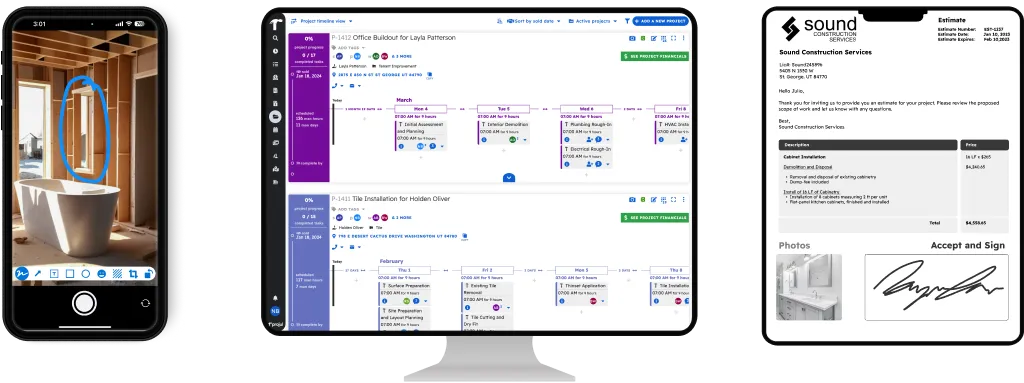
What Is Plumbing Software?
Plumbing software is a business management platform built for plumbing contractors that combines estimating, scheduling, dispatching, job costing, and invoicing into one system. It replaces spreadsheets, paper tickets, and disconnected apps so you can run your entire plumbing operation from a single login.
Projul’s plumbing software gives plumbing contractors one system for estimating, dispatching, and job costing, replacing spreadsheets and paper tickets with a platform built by people who have run construction businesses. Projul offers flat-rate pricing with no per-user fees for construction companies of all sizes.
If you run a plumbing company, your day looks nothing like a typical office job. You start with a schedule, then an emergency call blows it up. A tech needs a part that’s in the other van across town. An inspector cancels and you have to rebook before the permit expires. A homeowner wants a quote for a water heater while your estimator is already buried in a new construction bid. Meanwhile, new leads sit in your voicemail because nobody is tracking follow-ups in your lead management system.
Plumbing software exists to bring order to that chaos. Not by changing how you work, but by connecting every piece of your business so nothing falls through the cracks.
Manage Plumbing Jobs Without Drowning in Paperwork
Plumbing contractors handle everything from emergency service calls to new construction rough-ins, often on the same day. One moment you’re dispatching a tech to a burst pipe, and the next you’re reviewing fixture counts for a commercial tenant improvement.
Projul helps plumbing businesses manage the service queue alongside project work, track materials per job, and get invoices out before the customer forgets who fixed the leak. Over 5,000 contractors use Projul to keep their operations organized and their cash flow healthy.
The problem with most plumbing business software is that it was designed for either service work or project work, but not both. Service-focused tools give you dispatching but no real estimating. Project management tools handle construction bids but choke on same-day service calls. Projul handles both because plumbing contractors need both.
Win More Bids With Fast, Professional Estimates
Plumbing estimates are different from general construction bids. You’re pricing fixture counts, pipe runs, labor for rough-in versus finish work, and often breaking out service work separately from project work in the same proposal. A water heater swap needs a quick flat-rate quote. A bathroom remodel needs itemized fixtures, supply lines, drain work, and labor. A new construction rough-in needs per-fixture pricing across dozens of drops.
Projul’s estimating tools let plumbing contractors build detailed proposals for all of these scenarios. Use assemblies to price common configurations in seconds. A standard water heater install assembly might include the unit, supply lines, gas flex, expansion tank, drain pan, and labor. Save it once, adjust the specifics per job, and send the bid from your truck.
Quoting Service Work vs. Project Work
Service calls and project bids are fundamentally different, and your plumbing software should handle both without forcing you into the wrong workflow.
For service work, you need speed. The homeowner wants a price now, not tomorrow. Projul lets you pull up saved assemblies, adjust quantities, and send a quote in minutes. The customer approves with a digital signature through the client portal on their phone and you start the work.
For project work, you need detail. A commercial repipe or a multi-bathroom remodel needs line items, quantities, markup, and sometimes multiple phases. Projul’s estimating tools let you build that level of detail without starting from scratch every time. Save templates for your most common project types and customize them for each bid.
Plumbing contractors using Projul report a 32% average profit increase because bids go out faster and job costs stay visible from start to finish.
Service Call Dispatching That Handles the Unexpected
Emergency calls are the heartbeat of most plumbing businesses. They also wreck your schedule if you don’t have a system for handling them.
A slab leak comes in at 10 AM. Your techs are already on jobs. Without plumbing contractor software, you’re making phone calls, checking the whiteboard, and trying to remember who’s closest and who can be pulled without creating a bigger problem somewhere else.
Projul’s scheduling board shows you every tech’s assignment in real time. See who’s almost done, who’s closest to the emergency, and reassign with a drag. The affected tech gets the new job details on their phone instantly. The customer whose job just got bumped gets rescheduled, and their record stays updated.
This matters because how you handle emergencies defines your reputation. Respond fast and you become the go-to plumber in your market. Fumble the dispatching and you lose both the emergency customer and the one you bumped.
Balancing the Service Queue and Project Schedule
Most plumbing companies run service and project work side by side. Your service techs handle calls while your project crews work on new construction or remodels. But in reality, the lines blur constantly. A project crew tech might get pulled for a big emergency. A service tech might fill a gap on a project when the call board is light.
Projul puts both types of work on the same schedule so you see the full picture. No more toggling between a dispatch board and a project calendar. One view. One system. Full visibility into your crew’s capacity.
Permit and Inspection Tracking
Plumbing work lives and dies by permits and inspections. A missed inspection means your crew can’t move to the next phase. A forgotten permit renewal means work stops entirely. In commercial plumbing, the inspection schedule can make or break your timeline.
Track permit status and inspection dates inside each project in Projul. Attach permit documents to the job record. Set tasks for inspection milestones so nothing gets missed. When the inspector passes your rough-in, mark it complete and the project moves forward automatically.
Backflow Testing and Compliance Records
Commercial plumbing contractors deal with backflow prevention testing, annual certifications, and compliance documentation. These records need to be accessible, organized, and tied to the right property.
Use Projul’s document management to attach test results, certifications, and compliance records to each job. When the property manager calls asking for last year’s backflow test report, you pull it up in seconds instead of digging through a filing cabinet.
Warranty Tracking That Protects Your Business
Plumbing contractors deal with manufacturer warranties on water heaters, fixture warranties, and labor warranties on their own work. When a customer calls six months later saying their water heater is leaking, you need to know what’s covered.
Track warranty details inside the original job record in Projul. Record the install date, warranty terms, and serial numbers. When the callback comes, pull up the job, check the warranty status, and know whether it’s a warranty claim or a billable service call before you roll a truck.
Fleet and Van Management for Plumbing Companies
Your vans are your mobile warehouses. Every truck carries a different mix of fittings, fixtures, and parts. Knowing what’s on each van and where each van is located saves you from wasted trips across town.
Projul’s GPS time tracking shows you where every crew is working. Combined with job-level material tracking, you can see which parts were used on which job and plan restocking accordingly. When a tech needs a specific fitting, you check which van has it rather than sending someone to the supply house.
Parts Inventory Across Multiple Vans
One of the most common frustrations for plumbing company owners is the parts problem. You stock your vans, your techs use parts but don’t always log them, and by Friday you have no idea what’s on which truck. You end up buying duplicates or sending techs to the supply house in the middle of a job.
Projul’s material tracking ties parts usage to specific jobs. When a tech logs materials used on a service call, the inventory picture updates. It’s not a full warehouse management system, but it gives you the job-level visibility that most plumbing contractor software completely ignores.
Managing Apprentices and Growing Your Team
Plumbing companies are always training. Your apprentices need supervision, your journeymen need to stay productive, and your master plumber’s time is your most expensive resource. Putting the right person on the right job matters more in plumbing than almost any other trade.
Use Projul’s scheduling tools to assign work based on skill level. Route your apprentices to jobs with a journeyman already on site. Keep your master plumber focused on the work that requires a license. Track hours per employee per job so you know exactly what your labor costs look like at every level.
Task lists inside each project let you break work into steps an apprentice can follow. Instead of your journeyman explaining the same rough-in sequence for the tenth time, the task list walks through it. Your experienced plumbers spend less time supervising and more time producing.
Residential vs. Commercial Plumbing
Running residential and commercial plumbing work requires different approaches, but you shouldn’t need different software for each.
Residential plumbing moves fast. The homeowner wants a quote today and the work done this week. You’re pricing individual fixtures, short pipe runs, and straightforward labor. The client makes decisions quickly and pays at completion.
Commercial plumbing is a longer game. You’re bidding on spec, working with general contractors, managing phased inspections, and billing through progress payments. The fixture counts are higher, the code requirements are stricter, and the paperwork is heavier.
Projul handles both. Build a residential service quote in five minutes or a commercial bid with phased pricing over an afternoon. Schedule a single-day faucet swap next to a three-month tenant improvement. Your plumbing software should flex with your business, not force you into one lane.
Water Heater and Remodel Project Management
Water heater replacements and bathroom remodels are bread-and-butter work for plumbing contractors. They’re also the jobs that benefit most from good project management because they involve coordination, multiple trades, and customer communication.
A water heater swap seems simple, but it still involves permitting in most jurisdictions, possible code upgrades, disposal of the old unit, and customer follow-up. Track all of this inside the job record. Attach the permit, log the serial number, document the install with photos, and send the invoice before you leave.
Bathroom remodels are more complex. You’re coordinating with tile setters, electricians, and the GC. Your rough-in has to pass inspection before anyone else can proceed. Use Projul to schedule your phases, track your costs against the estimate, and communicate with the GC through the project record.
Job Costing That Shows You the Truth
Every plumbing contractor has finished a job thinking they made money, only to discover they didn’t when they finally added up the receipts. The water heater install seemed profitable until you counted the two extra trips to the supply house and the callback to fix a fitting.
Projul’s job costing tracks estimated costs versus actual costs on every job in real time. See your labor hours, material costs, and any extras as they happen. If a repipe job is running over on labor at the halfway point, you know now, not after you’ve already eaten the cost.
This real-time visibility is what separates plumbing software from a basic scheduling app. Scheduling tells you where your crew is. Job costing tells you whether you’re making money.
Time Tracking With GPS Verification
Plumbing crews work across multiple job sites every day. Paper timesheets filled out from memory on Friday don’t cut it when you’re trying to track labor costs per job.
Projul’s time tracking includes geofencing. Your techs clock in from the mobile app, and the system verifies they’re at the right job site. Hours tie directly to the job for accurate labor costing. When payroll comes around, the data is already clean.
For plumbing companies running service and project work, this is especially valuable. You can see exactly how much labor went into that “quick” service call that turned into a three-hour ordeal. That data helps you price future service calls more accurately.
Get Paid Quickly With Built-In Invoicing
Slow invoicing is the number one cash flow killer for plumbing businesses. Your tech finishes a job on Monday, the paperwork sits on your desk until Wednesday, the invoice goes out Thursday, and the customer pays in two weeks if you’re lucky. That’s three weeks of floating the cost of materials and labor.
Projul’s invoicing tools let plumbing contractors bill for service calls and project work in the same platform. Send invoices from the truck after finishing a repair, and let clients pay by card or ACH directly from the invoice. Track who’s paid and who hasn’t across every active job.
For project work, invoice in phases. Bill for rough-in when it passes inspection. Bill for finish work at completion. Add change orders to the invoice with one click. Your QuickBooks syncs automatically so your books stay current without double entry.
Rated 4.9/5 on G2 for ease of use, Projul makes invoicing fast enough to do before you leave the driveway.
Send Invoices From the Driveway
Your plumbers finish a water heater install and head straight to the next call. Projul’s native iOS and Android app lets them clock in with geofencing, mark tasks complete, and send the invoice before they leave the driveway. No more waiting until Friday to bill for work you finished Monday.
The mobile app was built for the field. Big buttons, simple navigation, works on a dusty phone with one bar of signal. Your techs are using it by lunch on day one. From the app, they can clock in, view their schedule, update task status, take photos, log materials, and send messages. Everything syncs to the office in real time.
QuickBooks Integration
Double-entering financial data is a waste of time and a source of errors. Projul integrates with QuickBooks Online so your invoices, payments, and customer records sync automatically. When you send an invoice in Projul, it shows up in QuickBooks. When the client pays, both systems update. Your bookkeeper doesn’t need to re-enter anything.
Why Plumbing Contractors Switch to Projul
Most plumbing contractors come to Projul after trying one or two other platforms. The story is usually the same. The last software was built for general contractors and didn’t understand plumbing workflows, or it was a service dispatch tool that couldn’t handle project work.
Here’s what makes Projul different:
- Built by a contractor. Kurt Clayson started Projul after years of running his own construction company. Every feature exists because a real contractor needed it.
- Flat-rate pricing. Core is a flat $4,788 per year for up to 10 users. No per-user fees. Your estimators, techs, office staff, and apprentices all get full access.
- Service and project work in one platform. Dispatch a service call and manage a new construction rough-in from the same login. No more juggling separate tools.
- Rated 4.9/5 on G2. For both ease of use and quality of support. That’s contractors voting with their reviews.
- Over 5,000 contractors. From one-truck operations to companies with 200+ employees. The platform scales with you.
Honest Pricing for Plumbing Contractors
Most plumbing software charges per user. That pricing model punishes growth. Hire another tech? More money. Add an apprentice? More money. Give your office manager access? Even more money.
Projul starts at $2,388 per year, and Core covers up to 10 users for $4,788 per year, no per-user fees. Your estimators, crew leads, and office staff all get full access without inflating the bill. Over 5,000 contractors use Projul to manage their operations, and plumbing contractors consistently report saving 2+ hours daily on admin work. G2 users rate Projul 4.9/5 for ease of use and 4.9/5 for quality of support.
Plumbing Project Management Software That Handles the Whole Job
Most plumbing project management software was built for general contractors and then relabeled for plumbers. You can tell because the workflows do not match how plumbing jobs actually move. A new construction rough-in has different phases than a kitchen remodel, and both look nothing like a slab leak emergency. Your software should know the difference.
Projul was built by a contractor who ran jobs in the field. That means the project management tools follow real construction workflows, not some developer’s guess at how a plumbing company operates. When you create a project in Projul, you set up phases that match your actual work - rough-in, top-out, trim, test, and punch list. Each phase has tasks your crew checks off from their phone. Your office sees progress without calling anyone.
Connecting Bids to Jobs to Invoices
The biggest time killer in plumbing project management is re-entering data. You build a bid in a spreadsheet, win the job, then type the same information into your scheduling tool. When the job finishes, you type it again into your invoicing system. Three rounds of data entry for one project.
Projul eliminates that cycle. Your estimate converts directly into a scheduled project. The line items become your job cost budget. When you finish a phase, you invoice from the same record. One entry. One system. No copy-paste errors that cost you money.
For plumbing contractors running 10 to 50 active projects, this connection between estimating, scheduling, and invoicing saves hours every week. That time goes back into bidding more work or actually being on the job site instead of behind a desk.
Why Plumbing Companies Outgrow Spreadsheets
Spreadsheets work fine when you have three jobs going. They fall apart at ten. By the time you hit twenty active projects, you are spending more time managing the spreadsheet than managing the work. Formulas break. Tabs get out of date. Nobody trusts the numbers.
Plumbing project management software like Projul gives you a single source of truth for every active job. Your schedule updates in real time. Your job costs track against estimates automatically. Your crew updates progress from the field. When you open Projul in the morning, you see exactly where every project stands without making a single phone call.
Plumbing contractors using Projul report saving 2+ hours daily on admin work. Over a year, that is over 500 hours back in your pocket - time you can spend winning bids, training apprentices, or leaving the office before dark.
Plumbing Guides for Growing Your Business
Rough-in work is where most plumbing callbacks originate. Our plumbing rough-in guide for residential projects covers pipe sizing, fixture placement, and inspection prep so your crews get it right the first time.
Whether you are a one-truck operation or scaling past your first million, the strategies for landing more work stay the same. Our guide on how to grow a plumbing business covers marketing, hiring, and operational improvements that drive sustainable growth.
Service Call Dispatch and Routing That Saves Hours Every Day
Every plumbing company owner knows the drill. Your phone rings at 7:30 AM with a burst pipe. By 8:15 you have three more calls stacked up. Your whiteboard schedule is already wrong because the job from yesterday ran over, and now you are trying to figure out which tech is closest to the emergency while also keeping your scheduled work on track.
The real cost of bad dispatching is not just the wasted drive time, though that adds up fast. It is the lost calls. When a homeowner with a leaking water heater calls three plumbing companies and you are the one who shows up four hours later, you already lost. The company that arrived in 90 minutes got the job and probably the next five calls from that neighborhood.
Projul’s scheduling board gives you a real-time view of every tech, every van, and every job in progress. When that emergency call comes in, you see who is finishing up nearby and who has capacity. Drag the new call onto the right tech’s schedule. They get the notification on their phone with the address, customer name, and job details. The customer whose appointment shifted gets an updated time automatically.
For plumbing companies running five or more trucks, routing matters as much as dispatching. Sending a tech from the north side of town to the south side for a $200 service call while another tech drives past that address on their way to the next job is money you are throwing away. Projul’s GPS tracking through geo-fenced time tracking shows you where every crew is right now, not where they were supposed to be according to the morning schedule.
Build your dispatch workflow around response time tiers. Emergency calls (burst pipes, sewer backups, no hot water in winter) get priority routing to the nearest available tech. Scheduled service calls (dripping faucets, running toilets, slow drains) fill the gaps between emergencies. Project work (repipes, remodels, new construction) stays on its own track unless you need to pull a tech for a true emergency.
The dispatch data you collect in Projul over time becomes one of your most valuable business assets. After six months, you can see which zip codes generate the most calls, which types of calls are most profitable, and how long each call type actually takes versus what you estimated. That data drives better pricing, smarter marketing, and tighter scheduling. Read our dispatch management guide for a full breakdown of how to build a dispatch system that grows with your company.
Track your callback rate by tech and by job type. If one technician generates more callbacks than others, you have a training opportunity. If a specific type of repair generates frequent callbacks, you might need to change your parts supplier or your repair method. Projul’s project records give you the data to spot these patterns before they cost you customers.
Backflow Testing and Compliance Documentation
Backflow prevention testing is steady, predictable revenue for plumbing contractors who set up the systems to manage it. Commercial properties, irrigation systems, and fire suppression lines all require annual backflow testing in most jurisdictions. The problem is that managing hundreds of annual tests across dozens of properties turns into an administrative nightmare without the right tracking system.
The typical backflow testing workflow looks like this: the municipality sends notices to property owners requiring annual testing. The property owner or manager calls you to schedule. You send a certified tester. They test each assembly, record the results, and submit the paperwork to the water authority. You invoice the customer. Simple in theory, but when you are managing 200 tests across a four-month testing season, things fall through the cracks. Tests get missed. Paperwork gets lost. The water authority sends violation notices to your customers, and those customers blame you.
Projul lets you build backflow testing into your workflow as recurring scheduled tasks. Set up each commercial customer with their backflow assemblies listed in the project record. Include assembly type, location, serial number, and last test date. When the testing season starts, create the test tasks from your template. Assign them to your certified tester. Track completion, results, and submission to the water authority.
Attach the actual test reports to the job record using photos and document management. When a property manager calls asking for last year’s test results for their insurance audit, you pull them up in seconds. When the water authority questions a submission, you have the original report with the tester’s signature and all readings.
For plumbing companies building a backflow testing division, the recurring nature of this work is the real prize. Once you test a property’s backflow assemblies, you are the natural choice for next year’s test. Set annual reminders in Projul so you reach out to each customer before the municipality sends their notices. Being proactive means you book the work before your competitor even makes the call.
Compliance documentation extends beyond backflow. Commercial plumbing contractors deal with medical gas certifications, grease trap maintenance records, RPZ testing, and cross-connection surveys. Each of these has its own documentation requirements and renewal schedules. Track all of them inside Projul’s project records so your compliance paperwork is organized by customer, by property, and by date. When an inspector shows up asking for records, you are not digging through a filing cabinet. You hand them a phone with every document organized and searchable.
The revenue impact is real. A plumbing company managing 300 annual backflow tests at $75 to $150 per test generates $22,500 to $45,000 in predictable annual revenue with minimal material costs. That is pure service revenue that requires almost no parts inventory, and it puts your techs inside commercial properties where they spot repair and replacement opportunities.
New Construction Rough-In Scheduling
New construction plumbing is a scheduling puzzle. Your rough-in has to happen after the framing is complete but before insulation and drywall. Your top-out ties into the roofing schedule. Your trim happens after paint. Miss any of these windows and you either hold up the entire project or you are working around other trades in a way that costs you extra hours.
The challenge multiplies when you are running rough-ins on five or ten houses at the same time for the same builder. Each house is at a different stage. House one needs top-out tomorrow. House three is ready for rough-in next week. House seven needs trim on Thursday. Keeping this straight in your head or on a whiteboard works until it does not, and when it fails, you have a crew showing up to a house where the framing is not done yet.
Projul’s scheduling tools let you map your new construction plumbing schedule to the builder’s master schedule. Create each phase as a task: underground, rough-in, top-out, trim, and final test. Set dependencies so rough-in cannot start until you confirm the framing is ready. When the builder pushes a framing date, adjust your schedule and your crew sees the change on their phone before they leave the shop. On the Pro plan, Projul AI Connect makes those adjustments faster: tell ChatGPT, Claude, or Gemini that framing on lots 3 and 7 slipped a week, and it shifts your rough-in tasks in Projul.
For multi-lot work, use Projul’s project management to track each house as a separate project with its own schedule, budget, and cost tracking. Your reporting tools show you how each house performs against your bid. If house three took 20% more labor on rough-in because the architect put the master bath on the opposite side of the house from the utility room, you know that before you bid the next phase.
Material staging is the other scheduling challenge on new construction. You need to have the right fixtures, pipe, and fittings at the right house at the right time. Too early and materials get damaged or stolen from the job site. Too late and your crew stands around waiting. Build material delivery tasks into your project schedule. Your purchase orders tie materials to specific jobs so your supply house delivers to the right address.
The rough-in inspection is your critical milestone. Everything stops until it passes. Schedule the inspection as a task with a hard due date. Assign it to your crew lead so they know the inspection is booked and the work needs to be ready. Attach your plumbing rough-in checklist to the task so nothing gets missed before the inspector arrives. A failed inspection costs you a return trip, a rescheduled inspection, and potentially days of delay on the builder’s schedule. Builders remember which subs pass inspections on the first try, and that reputation is how you keep getting called for the next subdivision.
Track your inspection pass rate in Projul. If you are passing 95% of rough-in inspections on the first try, you are doing well. Below 90% and you have a quality control issue that is costing you money and reputation. Use the data to identify whether the failures are coming from specific crews, specific inspectors, or specific types of installations.
Commercial Plumbing Bid Management
Commercial plumbing bids are a different animal from residential work. You are reading architectural plans, doing fixture takeoffs, calculating pipe runs from riser diagrams, and often competing against five or six other plumbing contractors on the same project. The bid that wins is usually not the lowest. It is the one that is complete, accurate, and submitted on time with all the required documentation.
The biggest risk on commercial plumbing bids is leaving money on the table through sloppy takeoffs. Miss a floor drain on a 40-unit apartment building and you are eating the cost of 40 floor drains plus the labor to install them. Forget to account for fire stopping at every floor penetration and you are buying firestop material and paying your crew to go back through the building. These are not small numbers on commercial work.
Projul’s estimating tools let you build commercial plumbing bids with the level of detail these projects demand. Start with your fixture takeoff and build line items for each fixture type: water closets, lavatories, urinals, sinks, floor drains, roof drains, and cleanouts. Add your pipe material by type and size. Add your labor for rough-in, top-out, and trim. Include your overhead, markup, and bond cost if required.
Save assemblies for commercial fixture installations. A standard commercial water closet installation includes the closet, supply stop, closet flange, wax ring or gasket, supply line, and labor. A commercial lavatory includes the sink, faucet, supply stops, supply lines, P-trap, and labor. Save these as assemblies and pull them into your bid by quantity. A 40-unit apartment bid that would take you two days with a spreadsheet takes half a day with saved assemblies.
For bid day management, Projul keeps your bid organized and accessible. Attach the plans, specifications, addenda, and sub quotes to the project record. When the GC calls an hour before bid time asking if you included the roof drain leaders, you pull up your bid in Projul and give them an answer in seconds. Our bid day management guide covers the full process of organizing your bid workflow so nothing gets missed under pressure.
Track your bid history in Projul. After six months of commercial bidding, you have data that tells you which types of projects you win, which GCs give you the best hit rate, and where your estimates tend to miss. If you consistently lose bids to one competitor on medical office work but win most of your restaurant bids, that tells you something about your pricing structure and your strengths. Refer to our guide on bidding strategies for approaches to different project types.
The follow-up after bid submission is where many plumbing contractors drop the ball. You submit the bid and move on to the next one. Meanwhile, the GC has questions, wants clarifications, or needs a revised number for a value engineering exercise. Track each bid as a project in Projul with follow-up tasks and reminders. When the GC calls back three weeks later asking if you can sharpen your number on the water heater package, you pull up the bid instantly and give them a revised figure the same day. That responsiveness wins work as often as the lowest number does.
Stop Running Your Plumbing Business From a Clipboard
If you’re still managing your plumbing company with clipboards, whiteboards, and group texts, you already know it’s not working. Service calls slip through the cracks. Estimates sit on your desk. Invoices go out late. You have no idea whether last month’s work was actually profitable.
Software for plumbers like Projul isn’t about adding technology for its own sake. It’s about running a tighter operation so you can handle more calls, protect your margins, and stop spending your evenings on paperwork.
Over 5,000 contractors have already made the switch. They’re spending less time on admin, catching cost overruns early, and getting paid faster. Your competition is probably one of them.