Construction Daily Logs and To-Dos That Actually Get Used
Give your crew clear task lists. Get real-time progress updates. Keep a daily record of every job site without paper forms.
Schedule a Demo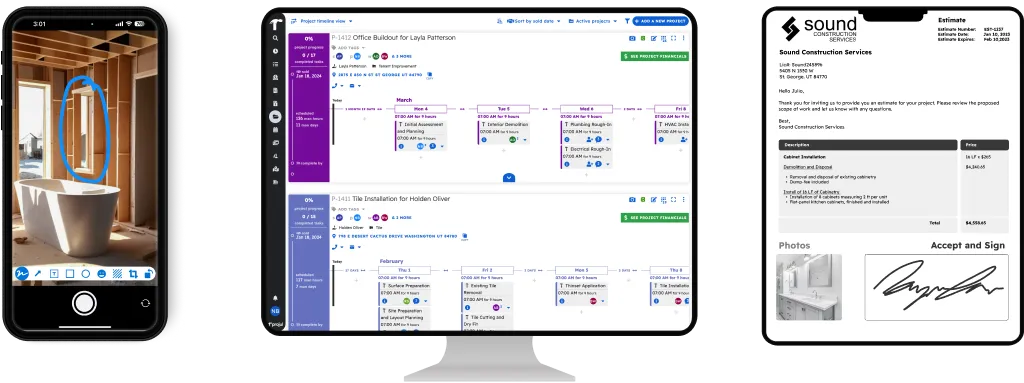
Nothing Missed Means Happier Customers
Missed steps are costly. A forgotten punch list item means a callback. A missed inspection means a delay. A skipped safety check means a liability. When small things slip through the cracks, they become big problems fast.
Projul’s To-Dos and Daily Logs give construction crews clear checklists and timestamped job site records with photo attachments. Document progress, weather, and conditions daily from any mobile device. Projul offers flat-rate pricing with no per-user fees for construction companies of all sizes.
Projul’s to-do system keeps every team member on track with clear task assignments and automatic reminders. Over 5,000 contractors use Projul to manage tasks across their crews. Steps and to-do items attach to any task in Projul, keeping workers focused on what needs to get done and giving management a clear picture of what’s actually getting done.
When your framing crew finishes for the day, they check off their to-dos in the app. You see the progress from the office. No phone calls, no texts, no “how far did you guys get today?” conversations.
How To-Dos Work in Projul
To-dos in Projul are the smaller checklist items inside a task. Think of it this way: a task is “Install kitchen cabinets.” The to-dos inside that task might be:
- Verify cabinet delivery matches order
- Check wall layout and mark stud locations
- Install upper cabinets
- Install base cabinets
- Install hardware
- Check alignment and adjust
- Clean up work area
Each to-do can be checked off by the assigned worker from the mobile app. As items get completed, the task progress updates automatically. Your project manager sees the progress without asking for an update.
This structure keeps your crew organized without micromanaging. The worker knows exactly what’s expected. The PM knows exactly where things stand. And neither one has to pick up the phone to find out.
Creating To-Dos
Creating to-dos is fast. Open a task, type the steps, and they’re ready. Crew leads can also add to-dos from the field as job conditions change. If they get to the job site and realize there’s prep work that wasn’t on the list, they add it right from their phone. Management sees the update in real time.
Assigning and Tracking
To-dos attach to tasks, and tasks get assigned to workers. When a worker opens their task for the day, they see the full list of to-dos. They work through the list, checking items off as they go. The progress bar on the task updates with each completed item.
For crew leads running a team, this means less explaining and less follow-up. The list tells the crew what to do. The completed items tell the lead what’s done.
Why Daily Logs Matter More Than You Think
Most contractors know they should keep daily logs. Fewer actually do it consistently. And even fewer do it in a way that’s useful six months later when a dispute comes up.
Daily logs are your record of what happened. Who was on site. What work got done. What the weather was like. Whether materials showed up or didn’t. If an inspector came by and what they said. If there was a delay and what caused it.
Legal Protection
When a homeowner claims the work wasn’t done on a certain date, your daily log says otherwise. When an insurance adjuster asks for documentation of site conditions, you’ve got timestamped photos and notes. When a sub says they were on site for three days and you only saw them for two, the log settles it.
Courts and insurance companies take documented records seriously. A timestamped digital log with photos carries real weight. A paper form stuffed in a filing cabinet does not carry the same credibility, especially if it’s illegible or undated.
The contractors who get burned in disputes are the ones who didn’t document. Daily logs aren’t busywork. They’re protection.
Client Communication
Daily logs also make client updates easy. Instead of writing a separate email to the homeowner about what happened today, you can reference your log. Some contractors share daily log summaries with clients to keep them informed and reduce the “when will it be done?” phone calls.
Crew Accountability
When everyone knows the daily log gets submitted at the end of the day, the standard of work goes up. Crews are more careful when they know their work is being documented. Not in a surveillance way, but in an “everyone’s professional and we keep records” way.
It also helps with crew disputes. If two workers disagree about who was on site or what got done, the log provides an objective record. No he-said-she-said.
What Projul’s Daily Logs Capture
Projul’s daily log feature is structured to capture what matters for construction projects. Every log entry includes:
Weather conditions. Temperature, precipitation, wind. This matters for scheduling, concrete pours, paint application, and roofing. It also matters for disputes about delays. If the log shows rain for three straight days, you have documentation for why the project fell behind.
Crew on site. Who showed up, how many workers, and what trades were represented. This feeds into your labor records and helps verify payroll against actual attendance.
Work completed. A summary of what got done that day. Specific enough to be useful but not so detailed that your crew won’t fill it out. “Completed second floor framing. Began roof sheathing on south side.” That’s enough.
Notes and issues. Anything unusual. Material delays, inspector visits, client requests, safety concerns, subcontractor no-shows. These notes become your record of everything that didn’t go according to plan.
Photos. Crews snap photos directly from their phone and they attach to the daily log automatically. Progress photos, site conditions, material deliveries, problems, completed work. Photos are tied to the specific project and date, so they’re always findable.
Equipment on site. What equipment was used or delivered. Useful for rental tracking and job costing.
The structured format keeps logs consistent across all your projects and all your crews. Whether it’s your most detail-oriented PM or your least tech-savvy crew lead, the log captures the same information every time.
Digital vs. Paper Daily Logs
Paper daily logs have been the standard in construction for decades. They also have some serious problems that cost you time and put you at risk.
Paper sits in a truck until someone remembers to turn it in. Sometimes that’s the next day. Sometimes it’s the next week. Sometimes it’s never. By the time it reaches the office, the details are fuzzy and the information is stale.
Handwriting is illegible. Your crew works with their hands all day. Their handwriting reflects that. If you can’t read the log, it’s useless.
Paper gets damaged. Coffee stains, rain, mud. Construction sites aren’t kind to paper. A daily log that got left on the dash and faded in the sun isn’t going to help in a legal dispute.
Paper is hard to search. Need to find the daily log from a specific date eight months ago? Good luck digging through file boxes. With Projul, you search by date, project, or crew member and find it in seconds.
Paper can’t include photos. At best, someone prints a photo and staples it to the form. That never happens consistently. In Projul, photos are part of the daily log, attached and timestamped automatically.
Paper has no backup. If the filing cabinet gets damaged, the logs are gone. Projul’s digital logs are stored in the cloud and backed up automatically.
The switch from paper to digital isn’t about being tech-forward. It’s about protecting your business and saving your office staff from chasing down paper forms that should have been submitted days ago.
Task and To-Do Alerts
Projul sends automatic mobile notifications when tasks and to-do items are scheduled or overdue. With no per-user fees and unlimited projects, every crew member gets alerts without extra cost per person.
Workers forget. Sticky notes get lost. Things slip through the cracks on busy days. Projul organizes your projects and keeps your whole team engaged. Workers with clear task assignments and automatic reminders are more efficient and more productive.
When a to-do item is overdue, Projul flags it. Your crew lead can see which items are behind and address them before they snowball into bigger problems. And because the alerts go to the worker’s phone, they don’t need to check a whiteboard or ask the foreman what’s next.
Upcoming task reminders give workers time to prepare. If tomorrow’s task requires specific materials or tools, the reminder gives them a heads-up to get ready. No more showing up to the job site and realizing you left the tile saw at the other job.
Real-Time Progress Tracking
Projul automatically updates project progress as tasks and to-dos are completed. No chasing down workers or combing through jobs to figure out where things stand. The progress bar moves as work gets done.
This matters for several reasons:
Progress billing. When you can see that a project is 60% complete based on actual task completion, you have justification for a progress payment. You’re not guessing or estimating completion. You have data.
Client updates. Homeowners want to know how their project is going. Real-time progress tracking gives you an answer without making phone calls or visiting the job site.
Identifying problems early. If a phase is falling behind, you see it in the progress tracking before it becomes a crisis. You can reallocate resources, adjust the schedule, or have a conversation with the crew lead while there’s still time to fix it.
Reducing status meetings. A lot of contractors waste time on daily or weekly status meetings where each PM reports on their projects. When progress is tracked in real time, those meetings get shorter or go away entirely. The data speaks for itself.
Contractors using Projul save 2+ hours daily that used to go toward manual status checks and follow-ups. The project timeline and Gantt view always show overall progress, making it easy to see where every job stands at a glance.
Compliance Documentation Made Simple
Many jurisdictions require daily documentation on construction sites, especially for commercial work. OSHA regulations, local building departments, and general contractors on large projects often mandate daily logs as part of compliance.
Projul’s daily logs give you a consistent, timestamped record that satisfies these requirements. Photos, crew counts, weather data, and work summaries are all in one place and easy to export or share when an inspector or GC asks for documentation.
For contractors working on government projects or as subcontractors on large commercial jobs, having reliable daily documentation isn’t optional. It’s a contract requirement. Projul makes it simple enough that your crews actually do it.
Building a Culture of Documentation
The hardest part of daily logs isn’t the software. It’s getting your crew to do it consistently. Here’s what works.
Make it part of the routine. Daily logs happen at the end of every work day, just like cleaning up the job site. It’s not optional. It’s part of the job.
Keep it quick. Projul’s daily log takes about two minutes to fill out. Weather, crew count, work summary, a photo or two, and any notes. That’s it. If it took 20 minutes, nobody would do it.
Show the value. When a daily log saves you in a dispute or helps you answer a client question in 10 seconds, share that story with your crew. They’ll understand why it matters.
Lead by example. If the PM fills out logs for their projects, the crew leads follow. Documentation starts at the top.
Why Daily Logs Matter More Than Most Contractors Think
Here’s the thing about daily logs - most contractors understand they’re “a good idea.” But understanding and actually doing them are two very different things. And the gap between those two things is where lawsuits, lost insurance claims, and blown budgets live.
Daily logs aren’t just a best practice. They’re a business protection tool. Every day you skip writing one is a day you can’t prove what happened on your job site. And in construction, what you can’t prove might as well not have happened.
Legal Protection in Disputes
Construction disputes happen. They happen with homeowners, with general contractors, with subs, with suppliers, and with municipalities. When they do, the question is never “what actually happened?” The question is always “what can you prove happened?”
A daily log is your proof.
Say a homeowner takes you to court claiming you didn’t start their kitchen remodel until two weeks after the agreed date. Without a daily log, it’s your word against theirs. With a daily log showing your crew on site, materials delivered, and work completed on the start date - along with timestamped photos - you have evidence that holds up.
Or say you’re a sub on a commercial project and the GC claims your crew caused damage to another trade’s work. Your daily log from that day shows exactly where your crew was working, what they completed, and photos of the area when they left. That’s the difference between eating a $15,000 repair bill and walking away clean.
The log you didn’t write is the one that costs you $50,000 in court. That’s not an exaggeration. That’s a number pulled from real contractor disputes where the outcome hinged on documentation - or the lack of it.
Attorneys who represent contractors will tell you the same thing: the best evidence in a construction dispute is a contemporaneous record. That’s a fancy legal term for “something written down when it happened, not reconstructed from memory months later.” Daily logs are exactly that.
Proof of Work for Insurance Claims
Insurance adjusters love documentation. They love timestamps. They love photos. When you file a claim - whether it’s damage to your equipment, a weather event that destroyed work in progress, or a theft from the job site - the adjuster’s first question is going to be about documentation.
If you can pull up your daily log from the day before the incident showing what was on site, what condition it was in, and what the weather was like, your claim gets processed faster and with fewer questions. If you can’t, the adjuster starts wondering what else you don’t have records for.
For workers’ comp claims, daily logs showing who was on site, what work was being performed, and what safety measures were in place can make the difference between a clean claim and a contested one. Your insurance carrier is your partner right up until they have a reason to question your documentation. Don’t give them that reason.
Weather Documentation for Delay Claims
Weather delays are one of the most common sources of conflict in construction. The contract says the project should be done by a certain date. You’re three weeks behind. The client wants to know why.
If your daily logs show rain on eight of the last twenty work days - with specific notes about why work couldn’t proceed on those days - you have a documented, defensible explanation for the delay. If you don’t have logs, you’re saying “trust me, it rained a lot” to someone who’s already frustrated about their project timeline.
For commercial work with liquidated damages clauses, weather documentation in your daily logs can literally save you thousands of dollars per day. The contract may allow for weather delays, but only if you can prove them. Your daily log is that proof.
Temperature matters too. Concrete won’t cure properly below certain temps. Paint won’t adhere in high humidity. Roofing materials behave differently in extreme heat. When you log weather conditions daily, you’re building a record that explains every decision your crew made about when to work and when to wait.
Tracking Subcontractor Hours and Presence
If you use subcontractors, you already know the billing disputes that come up. A sub says they had four guys on site for eight hours. You’re pretty sure it was three guys for six hours. Without a daily log noting who was actually on site, you’re stuck either paying the inflated bill or starting a fight you can’t win.
Daily logs that track sub presence give you an objective record. When the sub’s invoice comes in, you compare it against your daily logs. The numbers either match or they don’t. If they don’t, you have documentation to back up the conversation.
This also helps with coordinating trades. When your electrician says they couldn’t work because the plumber wasn’t done, your daily log shows whether the plumber was actually on site that day and what they were working on. No more finger-pointing. Just facts.
For GCs managing multiple subs on a commercial project, daily logs with sub tracking are essential. They’re how you verify billing, resolve scheduling conflicts, and maintain an accurate picture of who’s doing what on your job site every single day.
The Real Cost of Not Logging
Most contractors who skip daily logs do it because they think it takes too long or because they’ve never been burned by not having them. The problem is that when you do get burned, the cost is enormous compared to the few minutes a day it would have taken to prevent it.
A $50,000 dispute that you lose because you can’t prove your side? That’s years of daily log entries you could have written in the same amount of time. A denied insurance claim because you couldn’t document pre-loss conditions? That’s money you’ll never get back.
The math is simple. Two minutes a day to fill out a daily log in Projul. Maybe five minutes if you’re thorough and attach a few photos. Over a year, that’s roughly 20 hours of total effort. Compare that to even one dispute that goes sideways because you didn’t have documentation. The return on investment isn’t close.
What to Include in a Construction Daily Log
A daily log is only useful if it captures the right information. Too little and it won’t help you when you need it. Too much and your crew won’t fill it out. The sweet spot is a structured format that covers the essentials in about five minutes.
Here’s what belongs in every construction daily log, and why each piece matters.
Weather Conditions
Start with the weather. Temperature, sky conditions (clear, overcast, rain, snow), wind, and humidity if it’s relevant to the work being done. This takes about 10 seconds to note and it pays off in three ways.
First, it explains delays. If the log shows rain all morning, nobody has to ask why framing didn’t start until noon.
Second, it supports quality decisions. If you poured concrete at 38 degrees, the log shows the temperature and justifies whatever cold-weather measures you took. If a client later claims the concrete wasn’t done right, you have documentation of the conditions and your response.
Third, weather patterns across a project tell a story. If you’re behind schedule and the client is unhappy, thirty days of weather logs showing twelve rain days and four days below working temperature make your case without any argument.
Crew on Site - Names and Hours
Document who was on site each day. Names, trades, and hours. This doesn’t have to be a formal timesheet - that’s what time tracking is for - but a daily record of who was present and roughly when they arrived and left.
This matters for payroll verification, sub billing disputes, safety incident documentation, and workforce planning. If you’re trying to figure out why a project is over budget on labor, your daily logs showing crew size day by day will tell you a lot.
For safety incidents, knowing exactly who was on site at the time of an incident is critical. OSHA may ask. Your insurance carrier will definitely ask. Having it in a daily log means you don’t have to reconstruct it from memory.
Work Completed
Describe what got done. Be specific enough to be useful but brief enough that your crew will actually write it. “Completed second floor framing, south and east walls” is good. “Worked on framing” is too vague. “Completed second floor framing on south and east walls, installed 47 studs at 16-inch centers with Simpson Strong-Tie connectors at every junction” is more detail than a daily log needs. Save that for quality control reports.
The work completed section is what you’ll reference most often. It’s what tells the story of the project’s progress, what supports progress billing, and what proves work was done on a specific date if there’s ever a question.
Materials Delivered
Note any materials that arrived on site. What was delivered, how much, and whether it matched the order. If something was wrong - wrong quantity, damaged, wrong spec - note that too.
Material delivery documentation prevents disputes with suppliers. If you noted in your daily log that the lumber delivery was short by 20 boards, you have a timestamped record to reference when you call the supplier. Without it, you’re having a he-said-she-said conversation three days later.
It also helps with job costing. When you can see exactly when materials hit the site, you can compare that against your budget timeline and catch cost overruns early.
Safety Incidents and Observations
Any safety incident, near-miss, or observation goes in the daily log. Even minor ones. Especially minor ones. A near-miss today could become an incident tomorrow, and your documentation of the near-miss shows that you were aware and took action.
For actual incidents, the daily log entry becomes part of your incident report. Time, location, who was involved, what happened, what action was taken. This protects you with OSHA, with your insurance carrier, and in any potential legal proceedings.
Safety observations include things like noting wet conditions that required extra precautions, identifying a tripping hazard that was corrected, or documenting that safety equipment was inspected and in good condition. These entries build a record of your safety culture.
Visitor Log
Note anyone who visited the site who isn’t part of your regular crew. Inspectors, clients, architects, engineers, supplier reps, utility company workers, curious neighbors. Document who they were, when they came, and any relevant notes about their visit.
Inspector visits are especially important to log. Note what they inspected, whether it passed, and any corrections requested. This becomes your record of the inspection process and protects you if there’s ever a question about code compliance.
Client visits are worth noting too. If a client visited the site and requested a change - even verbally - documenting that in the daily log creates a record that can prevent disputes about change orders later.
Photos
This is the part that turns a good daily log into a great one. Photos attached to your daily log provide visual proof that no amount of written description can match.
Take photos of work completed, site conditions at the start and end of the day, material deliveries, any damage or issues, and anything unusual. In Projul, photos taken from your phone attach directly to the daily log entry. They’re timestamped, geotagged, and tied to the project permanently.
A photo of the job site at 7 AM before work starts and another at 4 PM showing what got done that day tells a story that words alone can’t tell. When a client questions your progress or an adjuster asks about site conditions, a photo is worth more than a thousand words of explanation.
The Five-Minute Habit That Protects Your Business
All of this might sound like a lot, but in practice, filling out a daily log in Projul takes about five minutes. Weather takes 10 seconds. Crew list takes 30 seconds if your regulars are already saved. Work completed is a few sentences. Notes for anything unusual. Snap two or three photos. Done.
Five minutes at the end of every work day. That’s it. That’s the habit that protects your business from disputes, supports your insurance claims, satisfies compliance requirements, and gives you a searchable record of every project you’ve ever worked on.
The contractors who make daily logs a habit don’t think of it as paperwork. They think of it as protection. Because that’s exactly what it is.
To-Dos That Actually Get Done
Every contractor has a system for tracking what needs to happen on a job. For a lot of them, that system is a combination of sticky notes, text messages, mental notes, and hoping for the best. And for a lot of them, things fall through the cracks because of it.
The problem isn’t that contractors don’t know what needs to get done. The problem is that the “system” for tracking it doesn’t create accountability. A sticky note on the dash doesn’t ping you when it’s overdue. A text message gets buried under 47 other texts. A verbal instruction gets forgotten by lunch.
Projul’s to-do system is built to solve exactly this problem. Not with complexity, but with structure and accountability.
Assign Tasks to Specific Crew Members
The number one reason things don’t get done on a job site is that nobody was specifically responsible for doing them. “Somebody needs to call the inspector” turns into nobody calling the inspector. “We need to order more flashing” turns into the flashing not being there when you need it.
In Projul, every to-do gets assigned to a specific person. Not a crew. Not a trade. A person. When you assign a to-do to Mike, Mike knows it’s his responsibility. His name is on it. He gets notified. And when the PM checks the project, they can see that Mike has an open to-do and whether it’s done or overdue.
This changes the dynamic from “someone should do this” to “Mike is doing this.” That’s the difference between a wish and a plan.
For crew leads managing multiple workers, assignment means you can distribute tasks across your team and see at a glance who has capacity and who’s overloaded. You stop piling everything on your best worker and start building a team that shares the load.
Set Due Dates That Mean Something
A to-do without a due date is a suggestion. A to-do with a due date is a commitment. In Projul, every to-do can have a due date, and that due date drives visibility and accountability.
When a to-do is approaching its due date, the assigned worker sees it. When it’s overdue, it gets flagged. The PM can filter for overdue items across all projects and address them before they cascade into bigger problems.
Due dates also help with sequencing. If the drywall to-dos are due on Thursday and the paint to-dos are due on Monday, everyone knows the expected flow of work. There’s no confusion about what comes first or when it should be finished.
For time-sensitive items like inspection calls, permit pickups, or material orders with lead times, due dates are critical. Missing a two-day window to call for an inspection can push your project back a week. A to-do with a due date and a notification makes sure that call happens on time.
Attach Photos or Notes for Context
“Fix the trim in the master bedroom” is a to-do. “Fix the trim in the master bedroom - see photo of the gap at the corner by the window” is a to-do that actually gets done right the first time.
Context is what turns a vague instruction into a clear action item. In Projul, you can attach photos, notes, and details to any to-do. When the worker opens it, they know exactly what they’re looking at and what’s expected.
This is especially valuable for punch list items. Instead of a list that says “touch up paint - living room,” you attach a photo showing exactly where the touch-up is needed. The worker doesn’t have to hunt for it or guess what you meant. They open the to-do, see the photo, do the work, and check it off.
For new workers or subs who aren’t familiar with your standards, photo attachments on to-dos serve as visual instructions. They reduce questions, reduce mistakes, and reduce the back-and-forth that wastes everyone’s time.
Push Notifications So Nothing Falls Through the Cracks
Push notifications are what turn Projul’s to-do system from a list into an accountability engine. When a to-do is assigned, the worker gets notified. When it’s approaching the due date, they get a reminder. When it’s overdue, it gets flagged for the PM.
This is the piece that sticky notes and text messages can’t replicate. A sticky note doesn’t tap you on the shoulder at 7 AM and say “this is due today.” A text message from three days ago doesn’t resurface when you forget about it. Push notifications do.
For crew leads, notifications mean you don’t have to verbally remind your guys about every task. The system does it. You focus on the work, not on being a human reminder app.
For PMs managing multiple projects, overdue notifications are your early warning system. When a to-do goes overdue on Project A, you see it before it delays the next phase. You can step in, reassign, or adjust the schedule while there’s still time.
The Difference Between a Sticky Note and an Accountable Task
A sticky note says “do this.” An accountable task in Projul says “Mike needs to do this by Thursday, here’s a photo of what it looks like, and the system will flag it if it’s not done.”
That’s not a small difference. That’s the difference between hoping things get done and knowing they will. It’s the difference between a business that runs on memory and a business that runs on systems.
Every contractor who’s ever had a punch list item get missed, a material order get forgotten, or an inspection call get skipped knows the cost of things falling through the cracks. It’s callbacks, delays, unhappy clients, and money out of your pocket.
Projul’s to-do system doesn’t just help you remember things. It creates a structure where forgetting isn’t really possible. The task is assigned, dated, visible, and tracked. If it doesn’t get done, everyone knows.
Tie your to-dos into project management and you’ve got a system where every small task feeds into the bigger picture. The to-do gets checked off. The task progress updates. The project timeline reflects reality. And the PM can see all of it without making a single phone call.
How Daily Logs and To-Dos Work Together in Projul
Daily logs and to-dos are powerful on their own. But when they work together inside the same system, tied to the same projects, accessible to the same team - that’s when you start running a seriously well-documented operation.
Here’s what a typical day looks like when you’re using both features in Projul.
Morning: Check Your To-Dos
Your crew lead opens Projul on their phone at 6:45 AM. They see the to-dos assigned to their crew for the day. Install bathroom vanities in units 3 and 4. Call for rough-in inspection on unit 2. Receive and verify the tile delivery scheduled for 10 AM.
Each to-do has context - notes from the PM about what to watch for, a photo showing the vanity placement, the inspector’s phone number attached to the inspection to-do. The crew lead knows exactly what the day looks like before anyone picks up a tool.
They share the list with their crew during the morning huddle. Everyone knows their assignments. No confusion, no “what are we doing today?” conversations. The list is the plan.
During the Day: Work and Check Off
As work gets done, crew members check off their to-dos. Vanity installed in unit 3 - done. Inspector called, rough-in inspection scheduled for 2 PM - done. Tile delivery arrived, verified against order, short by two boxes of the subway tile - noted in the to-do with a photo of the packing slip.
The PM back at the office sees the progress updating in real time. No phone call needed. No text asking “how’s it going?” The to-do list tells the story as it happens.
If something comes up that wasn’t on the list - a leak found behind the wall in unit 2, a client stopping by to ask about a change - the crew lead adds a to-do on the spot. “Get plumber to assess leak in unit 2 wall” with a photo and a due date of tomorrow.
End of Day: Log What Happened
At the end of the day, the crew lead spends five minutes on the daily log. Weather was clear, 62 degrees. Four crew members on site from 7 AM to 3:30 PM. One sub (plumber) on site from 10 AM to 1 PM.
Work completed: vanities installed in units 3 and 4, rough-in inspection passed in unit 2, tile delivery received (short 2 boxes of subway tile - supplier notified).
Notes: found moisture behind drywall in unit 2 bathroom during rough-in prep. Plumber assessing tomorrow. Client visited at 11 AM and asked about changing the kitchen backsplash tile - told them to discuss with PM.
Photos: four attached. Vanity installs in units 3 and 4, passed inspection sticker in unit 2, moisture damage behind wall in unit 2.
Done. Five minutes. The entire day is documented.
Everything Tied to the Project
Here’s what makes this powerful: every to-do and every daily log entry is tied to the project. The to-do about the vanity install lives under the “Unit 3 - Bathroom” task. The daily log entry lives under the project date. The photos are attached to both.
Six months from now, if anyone has a question about unit 2 - when the moisture was discovered, what was done about it, who was on site that day - you pull up the project in Projul and it’s all there. The daily log. The to-dos. The photos. The notes.
You can search across all your projects to find specific entries, dates, crew members, or notes. Need to find every daily log that mentions a moisture issue? Search for it. Need to see every to-do assigned to a specific sub across all projects? Search for that too.
The Compound Effect of Consistent Documentation
One day of to-dos and daily logs is useful. A week is more useful. A month is very useful. A year of consistent documentation across all your projects? That’s a business asset.
You start seeing patterns. Which projects run smoothest? Which subs are always on time? Which types of work consistently take longer than estimated? Where do problems tend to show up?
This data isn’t just about looking backward. It’s about making better decisions going forward. When you bid your next project, you can look at actual daily logs from similar past projects to see how long things really took, what problems came up, and how much labor you actually used. That’s better than any estimating formula.
Your daily logs and to-dos become your company’s institutional memory. When a new PM joins your team, they can look at past projects and understand how your company operates, what standards you hold, and what a well-run project looks like. That knowledge doesn’t walk out the door when someone leaves.
It’s Not About Perfection - It’s About Consistency
You don’t need perfect daily logs. You don’t need every to-do to have a photo attached. You need consistency. A simple daily log every work day is better than a detailed one twice a week. A basic to-do list for every project is better than an elaborate one for some projects and nothing for others.
Projul makes consistency easy because the tools are simple, fast, and accessible from any phone. Your crew doesn’t need training. They don’t need to learn complicated software. They open the app, check off their to-dos, fill out the daily log, and get on with their day.
That’s the goal. Not to add work to your crew’s day, but to protect your business with five minutes of documentation that takes no training and no special effort. Just a simple habit that pays for itself the first time you need it.
Attach Photos and Track Time From Your To-Dos
Add photos to any task or daily log right from the field. Your crew snaps a picture of the finished work, the material delivery, or the problem they found, and it’s attached to the project permanently. No more digging through camera rolls or text threads to find that photo from two weeks ago.
Pair it with time tracking so your crew logs hours against the same tasks they’re checking off. When labor hours and task completion are tied together, you get accurate job costing without any extra effort from your crew.
To-Dos That Feed Your Schedule and Projects
Every to-do ties into project management and scheduling. When a task gets completed, your project progress updates automatically. No status meetings required. No separate spreadsheet to update. The work gets done, the progress bar moves, and everyone can see it.
At $4,788/year with no per-user fees, your entire team has access to to-dos, daily logs, and every other feature in Projul. Your crew lead creates to-dos from the field. Your PM reviews daily logs from the office. Your workers check off items from their phones. Everyone is working in the same system, and nothing gets lost between the field and the office.