Convert Estimates to Tasks in One Click
Schedule a Demo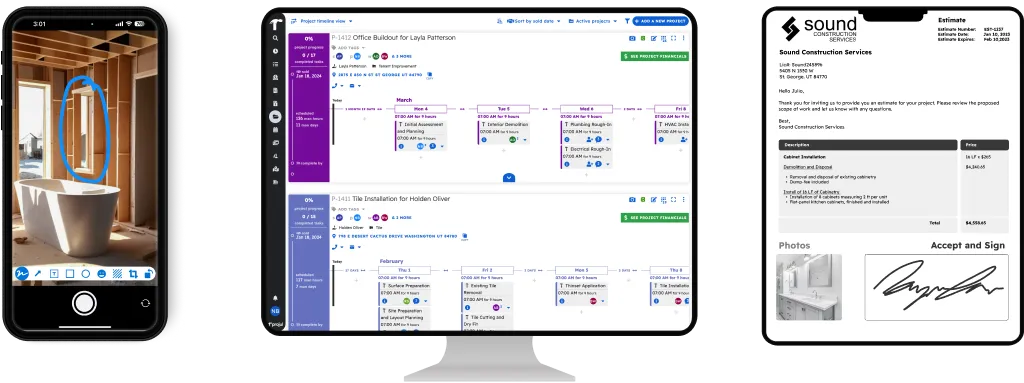
Stop Retyping Your Estimates Into Your Schedule
Every contractor has done it. You spend an hour building a detailed estimate with 20 labor line items. The client approves it. And then you open your scheduling tool and type all of those line items again as tasks.
That’s double entry. It’s tedious, it’s error-prone, and it wastes time you don’t have.
Projul’s estimate to task conversion eliminates that step entirely. When a client approves your estimate, you click one button and every labor line item becomes a task on your project. No retyping. No copying from a printout. No spreadsheet in between.
Projul’s Estimate to Task Conversion turns approved estimate line items into scheduled project tasks with one click. No retyping, no double entry. Contractors save hours per week by eliminating manual data transfer. Projul offers flat-rate pricing with no per-user fees for construction companies of all sizes.
Over 5,000 contractors use Projul, and this is one of the features they mention most. Because it solves a problem every contractor deals with and nobody else talks about.
Why Double Entry Is Killing Your Productivity
Double entry isn’t just annoying. It’s expensive. And it’s probably happening more than you realize.
Think about your current process. You build an estimate in one tool, maybe Excel, maybe an estimating app, maybe a yellow legal pad. The client says yes. Now what? You open your scheduling software, your whiteboard, or another spreadsheet and start typing the same scope of work all over again. Framing. Electrical rough-in. Drywall. Paint. Trim. Every line item, re-entered by hand.
Every time you manually recreate information that already exists somewhere else, you’re spending time on work that adds zero value to the project. Your estimate already has the scope of work broken down into line items. That’s essentially your task list. Typing it again doesn’t make it better. It just takes 30 to 45 minutes you could have spent on the job site, following up with a client, or going home on time.
And then there are the mistakes. When you’re retyping 15 tasks by hand, you skip one. Or you type the wrong duration. Or you forget a subtask that was clearly spelled out in the estimate. Now your schedule doesn’t match your estimate, and no one catches it until the crew shows up and asks “are we supposed to do the trim work this week?”
Here’s what double entry actually costs you:
Time. On a job with 20 line items, manual task creation takes 30 to 45 minutes. Multiply that by the number of jobs you start each month. If you start 10 jobs a month, that’s 5 to 7 hours just re-entering data.
Accuracy. Manual re-entry introduces errors. A missed task means work falls off the schedule. A wrong duration means your timeline is off. A mistyped description means confusion on the job site.
Consistency. When the estimate says one thing and the schedule says something slightly different, your crew works off the wrong information. The homeowner asks about a line item, and your PM has to pull up the estimate separately because the schedule doesn’t match.
Morale. Nobody got into construction to type things into a computer twice. Your project managers and office staff want to manage projects, not do data entry.
Projul makes the estimate the single source of truth. The approved scope becomes the project schedule in one click. The line items match. The descriptions carry over. Nothing gets lost in translation.
How Estimate-to-Task Conversion Works
Here’s the actual workflow in Projul, step by step:
-
Build your estimate with labor line items broken out by task. Framing, electrical rough-in, drywall, paint, trim, whatever the scope requires. Use Projul’s estimate templates to speed this up if you bid similar jobs regularly.
-
Send the estimate to your client for approval. They get a professional, branded document they can review on their phone or computer.
-
The client approves it digitally with a tap. No printing, no scanning, no waiting for a signature page to come back in the mail.
-
Open the approved estimate in Projul and click “Export Labor to Tasks.”
-
Projul creates an unscheduled task for every labor line item on the estimate. Task names, descriptions, and details carry over from the estimate automatically.
-
Open your schedule and drag the unscheduled tasks onto the crew and dates you want. Projul’s drag-and-drop scheduler makes this fast and visual.
-
Workers get mobile notifications with their assignments. They know what to do, where to be, and when to start.
That’s it. From approved estimate to fully scheduled project in under a minute. On a job with 20 line items, you just saved yourself 30 to 45 minutes of manual entry. On 10 jobs a month, that’s nearly a full workday saved.
And because the tasks came directly from the estimate, your project schedule matches the approved scope exactly. When a homeowner asks “is that included in the price?”, you can point to the estimate line item and the corresponding task on the schedule. They match because they’re the same data.
The Estimate Becomes Your Project Plan
This feature changes how you think about estimating. When you know your estimate will become your project schedule, you naturally build better estimates. Your line items become clearer because they’re going to turn into task assignments. Your descriptions become more detailed because your crew will see them in the field.
The result is better estimates and better project plans, built from the same data in one step instead of two.
Here’s an example. Say you’re bidding a kitchen remodel. Your estimate has these labor items:
- Demo existing kitchen
- Rough plumbing
- Electrical rough-in
- Framing modifications
- Drywall and tape
- Cabinet installation
- Countertop installation
- Tile backsplash
- Paint
- Trim and finish carpentry
- Final plumbing fixtures
- Final electrical
- Punch list and cleanup
That’s 13 tasks. In the old way, you’d type each one into your scheduling tool after the estimate is approved. With Projul, you click one button and all 13 tasks appear on your project, ready to schedule.
Now drag them onto your calendar, assign your crews, and the project is planned. Your plumber gets notified about rough plumbing on Tuesday. Your electrician knows rough-in is Wednesday. Your drywall crew sees they’re up next Thursday. All from one click.
Change Orders Work the Same Way
Jobs change. That’s construction. A homeowner decides they want an extra outlet in the garage. The inspector flags something that needs to be addressed. The client adds a bathroom to the scope.
When a change order gets approved in Projul, you handle it the same way as the original estimate. Click the export button and the new labor items become tasks on your existing schedule.
Your crew sees the updated work immediately through mobile notifications. The budget adjusts automatically because the change order was already priced. And the schedule reflects the new scope without you having to rebuild anything.
This is especially helpful on remodels and custom homes where change orders happen weekly. Instead of manually updating your task list every time the scope changes, Projul keeps the schedule in sync with the approved work. The estimate is always the source of truth, and the schedule always reflects it.
Drag-and-Drop Scheduling After Conversion
Once your tasks are created from the estimate, scheduling them is simple. Projul’s drag-and-drop scheduler lets you pull unscheduled tasks onto the crew member and date you want.
Need to move a task to next week? Drag it. Need to slide an entire phase forward because materials are delayed? A couple of clicks. Need to swap two tasks because the sub is available a day early? Drag and drop.
The visual scheduler shows you your entire week or month across all your projects and crews. You see conflicts before they happen. You see gaps in the schedule where you can fit more work. And you see which crews are overloaded and which ones have capacity.
Over 5,000 contractors use Projul’s scheduling tools to keep crews on track without spreadsheets or whiteboards. When the schedule starts from your approved estimate, the whole process is faster and more accurate.
Real-Time Project Progress After Conversion
As workers mark tasks and steps complete in the mobile app, Projul updates your project progress automatically. You see the overall completion percentage, which tasks are done, which ones are in progress, and which ones haven’t started.
Because the tasks came from the estimate, the progress you see directly reflects the approved scope. If the estimate had 13 labor items and 8 tasks are complete, you know the project is roughly 60% through the scope. That’s useful for progress billing, client updates, and knowing when to line up the next job.
With 26+ features connected, Projul brings the job status to you whether you’re in the office or on the road. No chasing anyone down for updates. No end-of-day phone calls asking “how far did you get?”
How This Connects to Job Costing
When your tasks come from your estimate, you have a direct link between what you bid and what you scheduled. As your crew logs time against those tasks using time tracking, you can compare actual labor hours to what you estimated.
This feeds into Projul’s job costing so you can see in real time whether a project is on budget. If you estimated 16 hours for drywall and your crew has already logged 14 hours with 60% of the task complete, you know you’re going to go over. You find out now, not at the end of the job.
This kind of visibility only works when the estimate, the schedule, and the time tracking are all connected. In Projul, they are, because the task started as an estimate line item and carries that connection all the way through.
What Contractors Get Wrong About Estimating Software
A lot of contractors treat estimating as a standalone process. Build the bid, send it out, get it signed, file it away. Then start the project from scratch in a different tool.
That approach makes the estimate a dead document. Once it’s signed, it sits in a folder and nobody looks at it again until there’s a dispute about scope.
In Projul, the estimate stays alive. It becomes your tasks. Those tasks become your schedule. Your schedule drives your daily work. Your daily work feeds your job costing. And your job costing ties back to the original estimate. It’s one continuous flow of data from bid to closeout.
That’s not just convenient. It’s how you protect your margins. When every hour your crew works is tracked against the line item you originally bid, you know exactly where you’re making money and where you’re losing it.
Why This Feature Matters for Growing Companies
When you’re running two or three jobs, double entry is annoying but manageable. When you’re running ten or fifteen jobs at the same time, it becomes a bottleneck that limits your growth.
Every new job means another round of re-entering data. Every change order means more manual updates. Your PM spends their day on data entry instead of managing the project. Your office staff drowns in admin work instead of supporting the field.
Estimate-to-task conversion removes that bottleneck. It scales with your business because the effort to convert an estimate is the same whether it’s your second job this month or your twentieth. One click. Done. Your PM goes back to managing the actual work.
Contractors who use Projul’s conversion feature consistently say the same thing: it’s one of those features that saves a small amount of time on each job but adds up to a massive difference over the course of a year. When you multiply 30 minutes saved per job by 100 jobs a year, that’s 50 hours your team gets back. That’s more than a full work week.
The Gap Between Winning a Job and Starting It
There’s a moment in every construction project that nobody talks about. The client signs the estimate. You celebrate. Maybe you tell the crew there’s a new one coming. And then you sit down at your desk, open your scheduling tool, and stare at a blank project.
Now what?
You’ve got an approved estimate sitting in one window with every line item spelled out - demo, framing, plumbing rough-in, electrical, drywall, paint, trim, the whole scope. And you’ve got an empty task list in another window. Your job is to rebuild the entire scope of work by hand, line by line, in a completely different place.
This is the gap. It sits between winning the job and actually starting it, and it costs you more than you think.
What Happens in the Gap
Most contractors handle this gap the same way. They print the estimate or pull it up on one screen, then start typing tasks into their project management tool on the other screen. Some use a whiteboard. Some use a legal pad. Some text the foreman a photo of the estimate and say “figure it out.”
However you do it, the result is the same. You’re manually recreating information that already exists. And every time a human re-enters data by hand, things go wrong.
Line items get skipped. On a 20-item estimate, it’s easy to miss one. Maybe you forget the rough plumbing because it was sandwiched between two electrical line items. Maybe you skip the punch list because it felt obvious. But if it’s not on the schedule, it doesn’t get planned. And if it doesn’t get planned, it either gets rushed at the end or forgotten entirely.
Details get lost. Your estimate might say “install 12 recessed lights per plan, LED retrofit cans, IC-rated for insulated ceiling.” Your task list says “install lights.” Your electrician shows up and asks which lights, how many, and where. Now someone has to dig up the estimate again to answer questions that should have been baked into the task from the start.
Costs disconnect from tasks. The estimate has dollar amounts tied to each line item. When you manually create tasks, those cost connections don’t carry over. Your task list says what to do but has no link to what it should cost. That makes job costing nearly impossible until you manually reconnect the dots later - if you ever do.
The Ripple Effect
The gap doesn’t just cost you time at the desk. It ripples through the entire project.
Your project manager spends 30 to 45 minutes per job recreating the task list. That’s time not spent managing the jobs already in progress. On a busy month with 10 new jobs, that’s 5 to 7 hours of pure data entry.
Your schedule starts with errors baked in. If you missed a line item during the transfer, the schedule is wrong from day one. Your crew follows the schedule, not the estimate. So when the schedule is missing a task, that work gets discovered mid-project instead of being planned for.
Your foremen lose trust in the system. When the schedule doesn’t match the estimate - and it won’t, because manual re-entry always introduces drift - your field team stops relying on the schedule. They go back to calling the office, texting the PM, or just figuring it out on their own. At that point, why even have a scheduling tool?
And the client experience suffers. When a homeowner asks “what’s happening this week?” and your answer doesn’t match what’s on the estimate they signed, it creates confusion. They signed off on a specific scope. They expect the project to follow it. When your internal systems don’t match each other, that disconnect eventually shows up in client conversations.
Why the Gap Exists
The gap exists because most construction software treats estimating and project management as separate functions. You build the estimate in one tool. You manage the project in another. Even when both tools live inside the same platform, they often don’t talk to each other in a meaningful way.
The estimate is treated as a sales document. Once the client signs it, its job is done. It gets filed away, and the project starts fresh with a blank slate.
But that’s backwards. The estimate is the most detailed description of the project scope that exists at the point of sale. It has every line item, every material, every labor task, and every cost. It’s not just a sales document - it’s a project plan waiting to be activated.
The problem isn’t that contractors are lazy or disorganized. The problem is that the tools they use force them to do the same work twice. Projul was built to close that gap.
The Cost of the Gap Over a Year
Let’s put some real numbers on it. Say you start 8 new jobs per month. Each job takes 35 minutes to manually convert from estimate to task list. That’s 4.6 hours per month, or about 56 hours per year, spent on pure re-entry.
But that’s just the direct time cost. Factor in the errors:
- Missed line items that get discovered mid-project and require scrambling to fit into the schedule
- Incorrect task descriptions that lead to confusion on the job site and wasted trips
- Cost disconnects that make job costing inaccurate, which means you can’t tell if you’re making money on a job until it’s too late
- Schedule drift that compounds throughout the project as the gap between the estimate and the task list widens
The indirect cost of these errors easily doubles or triples the direct time cost. You’re not just losing an hour of data entry per week. You’re losing margin on every job because the project starts with incomplete, inaccurate information.
That’s the gap. And Projul closes it with one click.
How Estimate-to-Task Conversion Works in Projul
The concept is simple. Your approved estimate already has the scope of work broken into line items. Those line items are, essentially, your task list. Projul just makes the connection automatic.
When you click “Export Labor to Tasks,” Projul reads every labor line item on the approved estimate and creates a corresponding task on the project. The task name comes from the line item name. The description carries over. The cost data stays linked. You don’t re-enter a single thing.
The Mechanics, Step by Step
Here’s what happens behind the scenes when you hit that button:
Projul scans the estimate for labor line items. Your estimate likely has a mix of materials and labor. The conversion focuses on labor items because those are the things your crew actually does. Materials stay on the estimate for purchasing and cost tracking - they don’t clutter up your task list.
Each labor line item becomes an unscheduled task. The tasks land in your project’s unscheduled task queue. They’re ready to go but not yet assigned to a date or crew member. This gives you full control over scheduling without losing any of the estimate data.
Task names and descriptions match the estimate. If your estimate line item says “Install 42 linear feet of crown molding - paint grade, two-piece build-up,” that’s exactly what the task says. Your trim carpenter sees the same description in the field that you put in the estimate. No telephone game.
Cost data stays connected. The estimated cost for each labor item travels with the task. When your crew logs time against that task using time tracking, Projul can compare actual costs to estimated costs in real time. This connection is what makes accurate job costing possible.
The estimate remains the source of truth. After conversion, the estimate doesn’t disappear or become obsolete. It stays linked to the project. If a client asks “was that included in the price?”, you pull up the estimate and point to the line item - and show the corresponding task on the schedule. Everything matches because it’s the same data.
What Carries Over (and What Doesn’t)
It helps to be clear about what the conversion does and doesn’t transfer:
Carries over:
- Labor line item names (become task names)
- Line item descriptions (become task descriptions)
- Estimated costs (linked for job costing)
- The connection back to the original estimate line item
Stays on the estimate (not converted to tasks):
- Material line items (these aren’t tasks your crew performs)
- Material costs (tracked separately for purchasing and cost reporting)
- Client-facing notes and terms
- Markup and margin data
This separation is intentional. Your task list should reflect what your crew needs to do, not what you need to order. Materials and labor serve different purposes in project management, and Projul keeps them where they belong.
Working With Your Existing Estimate Workflow
You don’t have to change how you estimate to use this feature. However you build your estimates and change orders today in Projul - whether you use templates, assemblies, or build from scratch - the conversion works the same way.
If you already break your labor into detailed line items, you’ll get detailed tasks. If your labor items are broader categories, you’ll get broader tasks that you can break down further after conversion. The output matches your input.
Many contractors find that this feature actually improves their estimating habits over time. When you know the estimate line items will become your project tasks, you naturally write them with more clarity and detail. Your estimates get better because they’re doing double duty.
How This Connects to Project Management
Once the tasks exist on your project, they behave like any other Projul task. You can:
- Add steps and checklists to break tasks into smaller pieces
- Assign specific workers or crews
- Set durations and deadlines
- Add notes, photos, and files
- Reorder tasks to match your preferred construction sequence
- Group tasks by phase or trade
The conversion gives you the starting point. From there, you customize the tasks to match how your team actually works. Some contractors use the converted tasks as-is. Others add sub-steps and details after conversion. Either way, you skip the part where you type everything from scratch.
Why This Matters for Job Costing
Here’s where estimate-to-task conversion pays for itself many times over. When your tasks come directly from your estimate line items, you get something most contractors never have: a clean, automatic connection between what you bid and what you’re spending.
The Job Costing Problem Most Contractors Face
Job costing in construction is notoriously hard. Not because the math is complicated, but because the data is scattered.
Your estimate lives in one place. Your schedule lives in another. Your time tracking is somewhere else. Your material receipts are in a shoebox, a folder, or maybe a shared drive. To figure out if you’re making money on a job, you have to pull data from four different sources and manually line it up.
Most contractors don’t bother. They know they should track costs against their bid, but the effort required to connect everything is so high that it doesn’t happen. They find out if a job was profitable after it’s done - sometimes weeks or months after - when the final numbers come in.
By then, it’s too late to do anything about it. You can’t un-spend money. You can’t recover hours that were wasted. The best you can do is learn from it and hope the next job goes better.
How Connected Tasks Fix This
When Projul converts your estimate line items into tasks, it creates a direct data pipeline from bid to field. Here’s what that means in practice:
Every task knows what it should cost. Because the task was born from an estimate line item, it carries the budgeted cost with it. When you open the task, you can see what you bid for that scope of work. No pulling up a separate document. No hunting through spreadsheets.
Time tracking feeds directly into cost comparison. When your crew logs hours against a task, Projul calculates the actual labor cost based on their pay rates. Because the task also knows the estimated cost, you get a real-time comparison. Are you over or under budget on framing? You can see it while the framing is still happening, not three weeks later.
You catch overruns before they eat your margin. If you estimated 24 hours for drywall and your crew has logged 20 hours with half the work remaining, you know right now that you’re going to blow the budget on that line item. You can make decisions - bring in another crew member, adjust the scope, talk to the client about a change order - before the damage is done.
Your budgeting becomes automatic. Because every task ties back to an estimate line item with a dollar amount, your project budget builds itself. You don’t have to manually set up a budget in a separate tool. The budget is the estimate, and the tasks are the tracking mechanism.
Tracking Actual vs. Estimated Costs
Let’s walk through a concrete example. You bid a bathroom remodel with these labor items:
| Estimate Line Item | Estimated Cost |
|---|---|
| Demo existing bathroom | $1,200 |
| Rough plumbing | $2,800 |
| Electrical rough-in | $1,600 |
| Waterproofing and tile prep | $900 |
| Tile installation | $3,200 |
| Fixture installation | $1,400 |
| Paint | $800 |
| Trim and accessories | $600 |
Total estimated labor: $12,500.
You click “Export Labor to Tasks.” Now you have 8 tasks on your project, each linked to its estimated cost. As the job progresses:
- Demo comes in at $1,100. You’re $100 under budget on that line item.
- Rough plumbing hits $3,200 because of an unexpected reroute. You’re $400 over.
- Electrical rough-in finishes at $1,500. Back on track.
You see all of this in real time through Projul’s live construction costs. Not at the end of the job. Not when the accountant reconciles everything. Right now, while the work is happening. Every dollar is traceable back to the original bid.
Why Every Dollar Needs to Be Traceable
When you can trace every actual cost back to the line item you originally bid, you get three things:
Accurate project profitability. You know your real margin on every job, broken down by task. Not an estimate. Not a guess. The actual numbers.
Better future estimates. When you can see that you consistently under-bid rough plumbing by 15%, you adjust your template for the next job. Your estimates get more accurate over time because you have real data, not gut feelings.
Defensible numbers for disputes. When a client questions a cost or a change order amount, you can show them exactly what was bid, what was spent, and where the variance came from. That level of detail builds trust and resolves disagreements before they become problems.
Job costing only works when the data is connected. When you manually create tasks with no link to the estimate, that connection doesn’t exist. Projul builds the connection automatically, the moment you convert the estimate to tasks.
From Estimate to Schedule in Minutes
Getting tasks on a project is only half the battle. Those tasks need to land on a calendar with dates, crews, and dependencies so your team knows what’s happening and when.
When you convert estimate line items to tasks in Projul, those tasks are immediately ready to schedule. They show up in your unscheduled task queue, and from there, they go straight onto your schedule with a simple drag and drop.
Building the Schedule From Converted Tasks
Here’s what the scheduling workflow looks like after conversion:
Open your Projul schedule. You’ll see the newly created tasks in the unscheduled sidebar. Each one is named exactly as it appeared on the estimate.
Drag tasks onto your calendar. Projul’s visual scheduler shows your crews across the top and dates along the side (or vice versa, depending on your view). Grab a task and drop it on the crew and date where it belongs.
Set task durations. Each task gets a start date and duration. If you know rough plumbing takes two days and electrical rough-in takes a day and a half, set those durations and the schedule calculates end dates automatically.
Assign crews and workers. Drop tasks on specific crew members or teams. They get mobile notifications the moment you assign them, so they know what’s coming up.
Set dependencies. Rough plumbing has to finish before drywall starts. Framing has to be done before electrical rough-in. Set these dependencies and Projul makes sure your schedule respects them. If one task slides, the dependent tasks adjust automatically.
In most cases, you can go from an approved estimate to a fully scheduled project in under five minutes. For a simple job with 10 to 15 tasks, it takes closer to two minutes. Compare that to the 30 to 45 minutes it takes to manually build a task list from scratch and then schedule each item individually.
The Gantt Chart View
For contractors who want to see the full project timeline at a glance, Projul’s interactive Gantt view shows every task on a horizontal timeline. Dependencies appear as lines connecting tasks. The critical path is visible. And you can drag tasks to reschedule them right from the Gantt chart.
The Gantt view is especially useful for longer projects - custom homes, large remodels, commercial buildouts - where you need to see how tasks overlap and where the bottlenecks are. Because your tasks came from the estimate, every item on the Gantt chart traces back to a specific line item on the approved bid. There’s no mystery about why a task exists or what it covers.
What This Looks Like on a Real Project
Say you win a whole-house remodel with 25 labor line items on the estimate. Here’s the timeline from approval to scheduled project:
Minute 0: Client approves the estimate digitally.
Minute 1: You open the approved estimate in Projul and click “Export Labor to Tasks.” 25 tasks appear in your project’s unscheduled queue.
Minutes 2 through 5: You open the scheduler, drag tasks onto your calendar, assign crews, and set dependencies. Demo first, then framing, then rough-ins in parallel, then insulation, drywall, and so on down the line.
Minute 5: The project is scheduled. Your framing crew gets a notification about their start date. Your plumber sees the rough-in window. Your electrician knows when to show up. The drywall sub can plan around your timeline.
Five minutes. From signed estimate to complete project schedule. No retyping, no spreadsheets, no back-and-forth emails asking “when do you need me there?”
Handling Schedule Changes
Projects don’t always go according to plan. Materials get delayed. Weather shuts you down for a day. A sub reschedules. The inspection takes longer than expected.
When you need to adjust the schedule, Projul makes it easy because all the task relationships are already set up. Move one task forward and the dependent tasks shift with it. Drag a task to a different crew because the original crew got pulled to an emergency. Extend a duration because the scope turned out to be more complex than expected.
Because the tasks still link back to the estimate, these schedule changes don’t break your cost tracking. The budget connection stays intact regardless of when or how the work gets scheduled. You can reschedule the drywall three times and the estimated cost for that line item doesn’t change - it’s still tied to the original bid.
Why Starting From the Estimate Matters for Scheduling
The alternative to estimate-based scheduling is building the schedule from memory, from notes, or from a printout of the estimate sitting on your desk. That approach has the same problems we talked about earlier - missed items, lost details, disconnect from costs.
But there’s an additional scheduling-specific problem: when you build the schedule by hand, you tend to work from high-level categories rather than detailed line items. Instead of 25 specific tasks, you create 8 or 10 general phases. “Rough-ins” instead of separate tasks for plumbing, electrical, and HVAC rough-in. “Finishes” instead of separate tasks for paint, trim, hardware, and final clean.
That lack of detail causes problems. You can’t assign a general “rough-ins” task to three different subs. You can’t set meaningful dependencies when tasks are lumped together. And you can’t track progress accurately when one task covers three different scopes of work.
Starting from the estimate gives you the right level of detail from the beginning. Each line item becomes its own task, which means each task can be independently scheduled, assigned, tracked, and costed. Your schedule is as detailed as your estimate, and your estimate was detailed enough to win the job.
From Approved Estimate to Scheduled Project
Your approved estimates and change orders turn into tasks that land right on your schedule. Drag them onto your crew’s calendar and the job is planned. No spreadsheet, no retyping, no double entry.
The process takes less than a minute for most jobs. And because everything is connected, your project management, scheduling, notifications, and job costing all start from the same data.
Full Visibility Across the Project
Converted tasks feed into project management so you can track progress, assign workers, and see completion status all in one place. The estimate, the schedule, and the project record all stay connected because they were built from the same data.
At $4,788/year with no per-user fees, Projul gives your entire team access to this workflow. Your estimator builds the bid. Your project manager converts it to tasks and schedules the work. Your field crew sees their assignments on the mobile app. And you see the big picture from wherever you are. One platform, one price, one source of truth from estimate to closeout.