Construction Invoicing Software - Send Invoices in Clicks, Get Paid Faster
- Create invoices quickly, at any stage of the project
- Make life easy for your accountant by syncing with QuickBooks
- Get paid faster by accepting card payments straight from the invoice
Copy and pasting line items? You’ve got more important things to do.
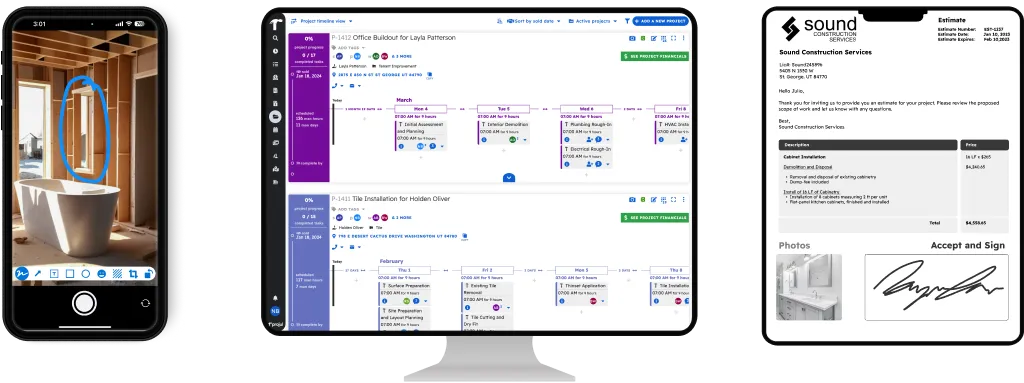
Projul creates invoices directly from your estimates or change orders, automatically pulling in all the important information. Understanding when to use estimates vs quotes vs proposals helps you invoice accurately from the start. Contractors using Projul report saving 2+ hours daily by eliminating manual data entry like this.
Projul’s construction invoicing software lets contractors create invoices from estimates in clicks, accept credit card and ACH payments, and sync with QuickBooks automatically. Built by a contractor for real job site workflows. Projul offers flat-rate pricing with no per-user fees for construction companies of all sizes.
You can do this directly from the documents themselves, or from the shortcut on the dashboard. Projul also syncs invoices with QuickBooks to avoid double entry with your accounting system.
- Create invoices from estimates AND change orders
- Automatically add line items and rates
- It only takes a few seconds
Why Construction Invoicing Is Different
Construction invoicing isn’t like sending a bill for a one-time service. You’re dealing with deposits, progress payments, change orders, retainage, and final invoices spread across weeks or months. A single project might have five or six invoices before closeout.
Most invoicing tools weren’t built for this. They’re designed for businesses that send one invoice per job and move on. But when you’re billing a kitchen remodel across four phases, or tracking change orders on a commercial build, generic invoicing falls apart fast.
Here’s what makes construction invoicing unique:
You bill in stages, not all at once. A progress invoice at 30% completion looks different from the final invoice. You need software that understands progress billing and tracks what’s been billed versus what’s still outstanding.
Change orders change everything. When the scope changes mid-project, your invoicing has to reflect that. If you’re manually adjusting numbers in a spreadsheet, you’re going to miss something. With Projul, change orders flow directly into your invoices so the math is always right.
Retainage adds complexity. Holding back 5% or 10% until punch list completion is standard in construction. Your invoicing software needs to track retainage automatically and release it when the work is done.
You need proof of what was agreed on. Construction disputes happen. When a client questions an invoice, you need to trace it back to the original estimate and any approved change orders. Projul keeps that chain of documentation intact.
Common Invoicing Mistakes That Cost Contractors Money
Most contractors don’t lose money because they do bad work. They lose it because they invoice poorly. Here are the mistakes we see most often.
Waiting too long to send invoices
This is the big one. You finish a phase, get busy on the next job, and that invoice sits for a week. Or two. Every day you wait is a day you’re funding someone else’s project with your own cash. Knowing how to write an invoice is the first step, but Projul lets you create one from an estimate in seconds, so there’s no excuse to wait.
Not billing for change orders
It happens all the time. The client asks for an extra outlet here, a different fixture there. You do the work, but never invoice for it because you forgot or felt awkward bringing it up. Those small additions add up to thousands over a year. In Projul, change orders are tracked and invoiced automatically.
Manual data entry errors
Typing line items by hand is a recipe for mistakes. Wrong rates, missing items, math errors. One wrong decimal point can cost you hundreds on a single invoice. Projul pulls line items directly from your estimates, so the numbers match every time.
No visibility into outstanding invoices
If you don’t have a clear picture of what’s been invoiced, what’s been paid, and what’s still open, money slips through the cracks. Projul’s dashboard shows every open invoice, its status, and the total amount outstanding, all in one view.
Not offering easy payment options
If your client has to write a check, find a stamp, and mail it, you’ll wait longer to get paid. It’s that simple. Projul’s integrated payment processing lets clients pay by credit card or ACH right from the invoice. Less friction means faster payments.
What to Look for in Construction Invoicing Software
Not all construction invoicing software is the same. Some tools check a few boxes but miss the features that actually matter on the job. Here’s what you should be evaluating.
Invoice creation from estimates and change orders
This is non-negotiable. If you’re re-typing line items from your estimate into a separate invoice, you’re wasting time and creating errors. Your invoicing tool should pull directly from your estimates and approved change orders with a couple of clicks.
Support for multiple invoice types
Construction projects need deposit invoices, progress invoices, percentage-based invoices, and final invoices. If the software only supports one type, it’s not built for construction.
Integrated payment processing
Your clients should be able to pay directly from the invoice. Credit card and ACH options mean faster payments and fewer excuses. Projul partners with JustiFi for secure, integrated payment processing on every invoice.
QuickBooks sync
Double data entry kills productivity. Your invoicing software needs to sync with QuickBooks so your accounting records stay accurate without extra work. Projul’s two-way sync keeps everything in line.
Real-time dashboard and reporting
You need to see every open invoice, every paid invoice, and your total outstanding at a glance. Good reporting also ties into budgeting so you know how each project is tracking against your original estimate.
Flat-rate pricing
A lot of construction software charges per user. That’s a problem when you have project managers, office staff, and field supervisors who all need to see invoice status. Projul charges a flat annual rate with no per-user fees, so your whole team has access.
From deposit through to final invoice, we’ve got you covered.
Projul supports every invoice type a contractor needs: deposit, progress, final, percentage-based, and change order. Over 5,000 contractors use Projul to send the right invoice at the right stage and get paid the way they want.
Projul partners with JustiFi for integrated payment processing. Enable credit card or ACH payments on any invoice, and your clients can pay from any device.
- Deposit
- Progress
- Final
- Percentage-based
- Change order
Turn tracked hours into invoices with Service Invoicing
If your crew tracks time on projects, Service Invoicing lets you pull those approved time logs directly into invoices. Every billable hour gets captured, itemized with task details and comments, and your default markup applies automatically.
It’s built for T&M work too. Import labor hours and add materials to the same invoice so your client gets one clean, itemized document. Available on the Pro plan.
Build estimates faster with Assemblies
Tired of adding the same group of line items to every estimate? Assemblies let you create reusable cost groups, like a standard bathroom rough-in or a deck framing package, and drop them into any estimate with one click. Those estimates flow directly into your invoices, so you’re billing accurately from day one.
Let clients pick finishes with Selections
When your clients need to choose tile, fixtures, paint colors, or other finishes, Selections gives them an online portal to browse options and make their picks. Those choices feed into your estimates and invoices automatically, keeping the numbers accurate without back-and-forth emails.
Get a 360° view of your active invoices, using the overview dashboard
Projul’s invoice and estimate dashboard shows you every open invoice and its status at a glance. Contractors using Projul see a 32% average profit increase partly because they stop losing track of money owed to them.
View all the key information at a glance. Visualize the progress of every project and every invoice. Built-in revenue forecasting helps you keep your cashflow optimized and see the money on the table.
- Stay on top of every invoice and estimate
- Quickly check the progress using visualizations
- Filter and sort the invoice cards to suit your needs
How Construction Invoicing Software Improves Your Cash Flow
Cash flow is the lifeblood of any construction business. You’ve got materials to buy, crews to pay, and subs waiting on checks. When invoicing is slow or sloppy, the whole operation feels the squeeze.
Here’s how the right construction invoicing software keeps cash moving:
Faster invoice creation. When you can build an invoice from an existing estimate in seconds, invoices go out the same day the work is done. No more end-of-week invoice marathons.
Instant payment options. Clients pay from their phone the minute they open the invoice. Credit card, ACH, done. No waiting for checks in the mail.
Automatic reminders. Projul can send payment reminders on your schedule so you don’t have to make awkward phone calls. The system follows up, you focus on the work.
Accurate records. When every invoice ties back to an estimate and syncs with QuickBooks, you always know where you stand. No surprises at tax time, no missing revenue.
The contractors who get paid fastest aren’t the ones doing the best work (though that helps). They’re the ones with the best invoicing process. Projul gives you that process out of the box.
Construction Invoicing for Every Project Type
Different projects need different invoicing approaches. Here’s how Projul handles each one.
Custom homes and remodels. Home builders and remodeling contractors typically involve a deposit, multiple progress invoices tied to milestones, change orders along the way, and a final invoice at closeout. Projul handles the entire sequence and tracks what’s been billed versus what’s remaining.
Commercial construction. Commercial projects often require formal progress billing with percentage-of-completion invoicing. Retainage tracking is critical. Projul supports all of this, so you’re not managing it in a spreadsheet.
Service and T&M work. Hourly work with materials needs a different approach. Projul’s service invoicing pulls time entries and material costs directly into the invoice, so every billable item is captured.
Multi-phase projects. When you’re running a project that spans months with distinct phases, you need invoices that reflect each phase accurately. Projul ties invoices to specific phases of your estimate so nothing gets confused.
No matter what type of work you do, the goal is the same: send accurate invoices quickly and get paid without chasing anyone. That’s what Projul delivers.
Why Contractors Need Dedicated Invoicing Software
Generic invoicing tools like FreshBooks, Wave, or even QuickBooks invoicing were built for service businesses, freelancers, and retail. They work fine when you send one invoice per job. But construction doesn’t work that way.
A typical construction project involves an estimate with dozens of line items, one or more change orders, a deposit invoice, multiple progress invoices, retainage holds, and a final invoice at closeout. That’s five or six billing events on a single job, and each one has to tie back to the original scope.
Generic tools can’t do that. They don’t understand progress billing percentages. They don’t track retainage. They can’t pull line items from a change order into an invoice automatically. And they definitely don’t support AIA billing formats that commercial projects require.
That’s why contractors need software built specifically for how they bill. Projul was built by a contractor who lived these problems firsthand. Every invoicing feature exists because it solves a real pain point on real job sites.
AIA Billing and Progress Billing Explained
If you work on commercial, institutional, or government projects, you’ve probably dealt with AIA billing. AIA G702 and G703 forms are the industry standard for progress billing on larger jobs. They break down the contract into line items, track the percentage completed on each, calculate the amount due for the current period, and account for retainage.
Filling these out by hand or in a spreadsheet is slow and error-prone. One wrong percentage and your payment application gets kicked back, delaying payment by weeks.
Projul’s progress billing feature handles this for you. You set up your schedule of values from your estimate, update completion percentages as work progresses, and Projul generates the billing document. Retainage is tracked automatically. Everything syncs with QuickBooks so your accounting stays clean. For a deeper look at how progress billing works in construction, check out our progress billing guide.
Projul vs Generic Invoicing Tools
Contractors often start with QuickBooks invoicing or another generic tool and hit a wall within a few months. Here’s where those tools fall short and how Projul fills the gap.
Estimates to invoices. In QuickBooks, you create an estimate and then manually build an invoice from it. In Projul, you click a button and the invoice is created with all the line items, rates, and quantities already filled in. Change orders are included automatically.
Progress billing. Generic tools send one invoice per job. Projul supports deposit, progress, percentage-based, and final invoices on the same project. You can bill 30% at framing, 30% at rough-in, and 40% at completion without creating separate line items each time.
Change order tracking. When a client adds scope mid-project, generic tools make you manually adjust your invoice. Projul ties change orders directly to invoicing so nothing gets missed and the paper trail is automatic.
Construction-specific reporting. Projul’s dashboard shows open invoices, paid invoices, outstanding balances, and ties everything back to your project budgets and job costs. Generic tools give you a list of invoices with no project context.
Field to office connection. Your project managers and field team can track progress, log time, take photos, and update the job from the field. That data flows into invoicing so the office knows exactly what to bill.
QuickBooks is still great for accounting. Keep using it. But pair it with Projul for the construction side, and let the two-way sync keep everything connected. For tips on making QuickBooks work better alongside your construction tools, read our QuickBooks integration best practices guide.
Payment Processing That Gets You Paid Faster
Sending an invoice is only half the job. Getting paid is the other half. That’s why Projul includes integrated payment processing on every invoice.
Your clients can pay by credit card or ACH directly from the invoice. They open it on their phone, click “Pay,” and you’ve got money moving. No checks in the mail, no trips to the bank, no “I’ll get to it next week.”
For contractors dealing with cash flow challenges, this is a game changer. Faster payments mean you’re not floating material costs or dipping into your line of credit to cover payroll. It also means you can set clear payment terms and enforce them without awkward conversations.
Projul partners with JustiFi for secure payment processing. Rates are competitive, setup is simple, and everything is tracked inside your Projul dashboard. When the payment comes in, it syncs to QuickBooks automatically.
How Progress Billing Works in Construction
If you bill for the entire project upfront, most clients won’t go for it. If you wait until the end, you’re funding the whole job yourself. That’s why progress billing exists. It lets you bill in stages as work gets done, so cash keeps flowing throughout the project.
Here’s how it works in practice:
Set up a billing schedule tied to project phases. Before work starts, you break the contract into phases or milestones. A residential remodel might look like this: 20% deposit, 25% at rough-in, 25% at drywall, 20% at finishes, and 10% at final walkthrough. Each phase has a dollar amount tied to your estimate.
Send partial invoices as each phase wraps up. When your crew finishes framing, you send an invoice for that phase. You don’t wait until the whole job is done. In Projul, you select the phase, and the invoice is built from the line items in your estimate. No retyping, no math errors.
Track what’s been billed versus what’s remaining. This is where most contractors lose visibility. On a $200,000 project with six billing phases, you need to know exactly how much has been invoiced, how much has been paid, and how much is still outstanding. Projul’s dashboard tracks all of this in real time so you never have to dig through old emails or spreadsheets to figure out where you stand.
Handle retainage automatically. On commercial jobs, the client or GC typically holds back 5% to 10% of each progress payment until the project passes final inspection. Tracking retainage by hand is messy and easy to forget. Projul calculates retainage on every progress invoice and tracks the total held amount so you know exactly what’s owed when punch list is complete.
Account for change orders along the way. Projects rarely go exactly as planned. When the client adds scope mid-build, those change orders need to show up in your billing. Projul ties approved change orders directly to your invoice schedule, so added work gets billed at the right phase without falling through the cracks.
Progress billing protects both you and your client. Your client pays for work that’s actually been completed, and you get cash in hand to cover materials, labor, and overhead as the project moves forward. It’s the standard billing method on commercial and large residential projects for good reason.
Getting Paid Faster: Tips for Construction Invoicing
You did the work. Now you need the money. Here are practical steps to shorten the gap between finishing a job and seeing payment hit your account.
Send invoices the same day the work is done
The longer an invoice sits unsent, the longer you wait to get paid. Every day of delay adds a day (or more) to your payment timeline. When you finish a phase or close out a job, send that invoice before you leave the site. With Projul, you can create an invoice from your estimate in a few clicks, so there’s no reason to wait until Friday or the end of the month.
Accept multiple payment methods
If you only take checks, you’re at the mercy of your client’s schedule. They have to write the check, find an envelope, get to the mailbox, and then you wait for the mail. Offer credit card and ACH payments through Projul’s payment processing, and your clients can pay from their phone the minute they open the invoice. Less friction means faster money.
Use automated reminders
Nobody likes making collection calls. But unpaid invoices don’t pay themselves. Projul’s automated client reminders send follow-up emails on your schedule. You set the timing and the message, and the system handles the rest. Your client gets a polite nudge, and you don’t have to be the bad guy.
Add clear payment terms to every invoice
“Due upon receipt” is vague. “Net 30” gives clients a month to sit on it. Be specific: “Payment due within 7 days of invoice date.” Include your accepted payment methods and any late fees. When your terms are clear from the start, clients know what to expect and you have something to point to if payment is late. Our payment terms guide covers how to set terms that protect your business.
Invoice from your estimate, not from memory
When you create invoices from scratch, you forget things. That extra material run, the upgraded fixture the client requested, the half-day your crew spent on site prep. Projul builds invoices directly from your estimates and change orders, so every approved line item makes it onto the bill. You capture the full amount you’re owed, every time.
Make your invoices easy to understand
A confusing invoice leads to questions. Questions lead to delays. Break your invoices into clear line items with descriptions your client can follow. Instead of “Labor: $4,500,” write “Framing labor, 3 days, 2-person crew: $4,500.” When clients understand what they’re paying for, they pay faster.
Construction Invoicing Mistakes That Cost You Money
You can do great work and still lose money if your invoicing process has holes. Here are the most common mistakes contractors make and how the right software prevents each one.
Delayed invoicing
This one costs contractors more than any other mistake. You finish a phase, move to the next job, and that invoice doesn’t go out for a week or two. Meanwhile, you’re covering material costs and payroll out of pocket. The fix is simple: send invoices the day the work is done. Projul makes this possible because your invoice is pre-built from your estimate. A few clicks and it’s in your client’s inbox.
Unclear scope descriptions on line items
When your invoice says “Misc work: $2,300,” your client is going to call you. They want to know what that covers. Vague descriptions lead to disputes, and disputes delay payment. Pull line items from your estimate where the scope is already defined, and your invoices are detailed from the start.
Missing change order charges
This is the silent profit killer. The client asks for an upgrade, you agree on the spot, the crew does the work, and nobody sends an invoice for it. Over the course of a year, missed change orders can add up to tens of thousands of dollars. When you track change orders in Projul and they flow into your estimates and invoices automatically, nothing gets left off the bill.
Not tracking retainage
On commercial projects, retainage is standard. But if you’re not tracking it carefully, you might forget to invoice for the held amount after punch list is done. That’s money you earned sitting in someone else’s account. Projul tracks retainage on every progress invoice and flags the outstanding balance so you remember to collect it.
Sending invoices with no payment link
You send a PDF invoice via email. Your client opens it, sees the amount, and then has to figure out how to pay you. Maybe they write a check next week. Maybe they forget. When your invoice includes a “Pay Now” button with credit card and ACH options through Projul’s payment processing, the path from “invoice received” to “payment sent” is one click. Remove every barrier between your client and their wallet.
No follow-up system for overdue invoices
If you don’t have a process for following up on late payments, some clients will take advantage of that. But manual follow-up is time-consuming and awkward. Set up automated reminders in Projul to send polite follow-ups at intervals you choose. The system does the chasing so you can focus on the work.
Invoicing Software vs Paper Invoices and Excel
If you’re still writing invoices by hand or building them in Excel, you’re spending more time and getting paid slower than you need to. Here’s how dedicated invoicing software compares.
Time to create an invoice
Paper or Excel: 15 to 30 minutes per invoice. You’re looking up line items, typing rates, doing math, formatting the document, and double-checking totals. Multiply that by 10 to 20 invoices per month, and you’re spending a full workday just on invoicing.
Projul: Under 2 minutes. Click “Create Invoice” from your estimate, select the line items or phase, and send. The rates, quantities, and totals are already there.
Payment speed
Paper or Excel: You email a PDF or print and mail it. The client pays by check, which takes 7 to 14 days on average. Add mail time and bank processing, and you might wait three weeks.
Projul: Clients pay by credit card or ACH directly from the invoice. Many contractors report same-day payment on residential jobs. Even on commercial projects, digital payment cuts days off the cycle.
Professional appearance
Paper or Excel: Your invoice looks like a spreadsheet because it is one. Some clients won’t mind. Others will question whether they’re dealing with a professional operation.
Projul: Every invoice has consistent branding, clear formatting, and a professional layout. Your clients see a business that has its act together.
Automatic reminders
Paper or Excel: You have to remember to follow up manually. That means checking your records, writing an email or making a call, and hoping the client responds.
Projul: Set up automated reminders once, and the system follows up on every overdue invoice on your schedule. No manual tracking required.
Payment tracking
Paper or Excel: You’re updating a spreadsheet every time a payment comes in. If you miss one, your records are wrong and you might not even know it.
Projul: Payments are tracked automatically. When a client pays through the invoice, the status updates instantly. Your dashboard shows exactly what’s open, what’s paid, and what’s overdue.
QuickBooks sync
Paper or Excel: You create the invoice in one place, then manually enter it into QuickBooks. Double entry means double the chance for errors, and your books are only as current as your last manual update.
Projul: Every invoice syncs to QuickBooks automatically. Create it in Projul, and it appears in QuickBooks within minutes. No double entry, no data gaps, no angry calls from your accountant.
The bottom line: paper and Excel invoicing costs you time, delays your payments, and creates errors. Switching to Projul pays for itself in faster payments and recovered hours within the first few months.
Ready to Fix Your Invoicing Process?
If you’re still copying line items into spreadsheets, chasing checks, or losing money on forgotten change orders, it’s time to switch to invoicing software built for construction.
Projul gives you everything in one place: estimates, change orders, invoicing, payment processing, progress billing, scheduling, CRM and lead management, and QuickBooks sync. All for a flat annual rate with no per-user fees.
Plans start at $4,788/year for Core. Start your free trial today and see why over 5,000 contractors trust Projul to run their business.