iOS, Android, Windows & Mac
Manage your company like a Pro in the office or on the go. Projul was designed with both the office desktop and mobile-first attitude to make you and your team more productive anytime and everywhere.
Schedule a Demo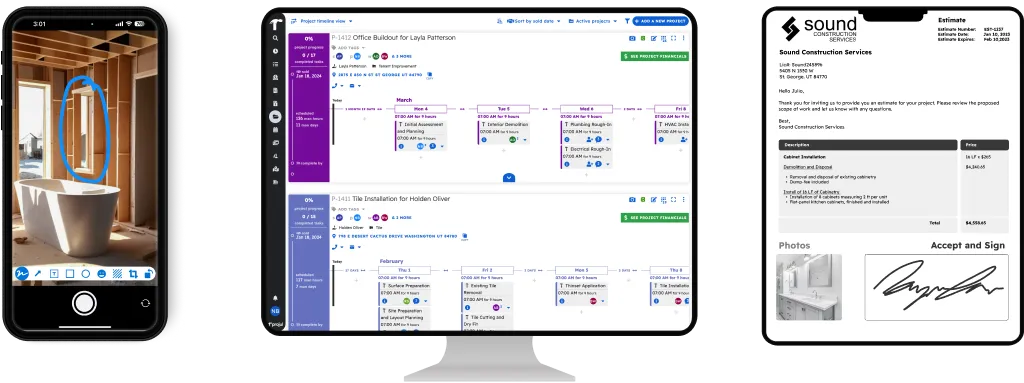
Designed to Be Powerful on the Go or in the Office
Projul’s mobile apps were built to be just as powerful in the field as they are in the office. Over 5,000 contractors use Projul on their phones, tablets, and desktops every day to manage schedules, track time, send estimates, and communicate with their crews.
Projul runs on iOS, Android, Windows, and Mac with native apps on the App Store and Google Play. Contractors manage their entire business from any device with full feature access, not a limited mobile version. Projul offers flat-rate pricing with no per-user fees for construction companies of all sizes.
Projul was designed from the ground up using the latest cloud, app, and browser technologies. You get optimized displays and performance on Android, iOS, tablets, laptops, and desktops, all from a single platform.
Why Cross-Platform Access Matters for Contractors
Construction doesn’t happen at a desk. Your estimator works from a MacBook at the kitchen table. Your project manager runs between job sites with an iPhone. Your office admin manages the schedule on a Windows desktop. Your crew lead checks tasks on a Samsung phone between cuts.
If your software only works well on one platform, someone on your team is stuck with a bad experience. And a bad experience means they stop using it. When half your team stops using the system, you’re back to phone calls, texts, and guessing.
Projul runs on every platform your team uses. iPhone, iPad, Android phone, Android tablet, Windows PC, Mac, Chromebook. Dedicated native apps for iOS and Android. Full browser access on everything else. One login, same data, same features, on whatever device is in your hand.
Available on iPhone, iPad and Android Devices
Projul’s native apps are available in both the Apple App Store and Google Play Store. Download it, sign in, and your entire business is in your pocket. Projects, contacts, schedules, documents, and photos. With a 4.9 out of 5 G2 rating for ease of use, your crew will be up and running fast.
The mobile apps are built specifically for each platform, not a web page crammed into an app shell. That means:
- Fast performance. The app loads quickly and responds like you expect a phone app to work. No waiting for web pages to render.
- Native camera access. Snap photos from the app and they attach directly to the project. No saving to your camera roll first, no uploading later.
- Reliable push notifications. Task assignments, schedule changes, and reminders pop up on your lock screen like a text message.
- GPS and geofencing. The app accesses your phone’s GPS hardware for accurate geo-fenced time tracking. Clock-ins are verified by location, not just the honor system.
- Background sync. Data syncs in the background so your entries don’t disappear when you lose signal for a few minutes.
For the best experience with all of Projul’s features, use the dedicated apps or run Projul in Google Chrome on any device.
Browser Support on Any Device
Not everyone needs to install an app. Your office staff, bookkeeper, or estimator might prefer working in a browser on their desktop or laptop. Projul supports all modern browsers including Chrome, Edge, Safari, and Firefox on Windows, Mac, Linux, iOS, and Android.
The browser experience gives you the full set of features. Scheduling, estimating, reporting, project management, and everything else works in your browser without installing anything. This makes it easy to get new team members started. Send them a link, they log in, and they’re working.
With no per-user fees on any plan, your estimator on a MacBook, office manager on a Windows desktop, and foreman on a Samsung tablet all use Projul without extra cost. No per-device charges. No platform surcharges. One price for everyone.
How Projul’s Cross-Platform Sync Works
When your crew lead marks a task complete on his Android phone at the job site, your project manager sees the update on her Mac in the office within seconds. When you adjust the schedule on your Windows desktop, your crew gets mobile notifications on their phones immediately.
Projul shows the same projects, documents, and schedules on every device. There’s no “mobile version” with fewer features and no “desktop only” functions your field crew can’t access. The data is the same everywhere because it lives in the cloud and syncs in real time.
Here’s what that looks like in practice:
Morning. Your project manager builds the week’s schedule on a desktop in the office. She assigns tasks to crews, sets dates, and adds notes about material deliveries.
7:00 AM. Your crew lead opens the Projul app on his iPhone and sees today’s tasks. He knows which job site to go to, what work is planned, and which materials should be there.
9:30 AM. A crew member snaps photos of the completed demo work from his Android phone. The photos upload to the project automatically and appear on the PM’s desktop.
11:00 AM. The PM gets a call from the client asking to add a task. She updates the project on her Mac. The crew lead gets a notification on his iPhone with the new scope.
3:00 PM. You check project progress from your iPad while waiting for an inspector. Every task, every photo, every time entry is current.
That kind of seamless handoff only works when the platform runs the same way on every device. Projul makes that happen.
Why a Real App Matters More Than You Think
Not all “mobile apps” are created equal. Some construction platforms use Progressive Web Apps (PWAs) instead of native apps. A PWA is basically your web browser pretending to be an app. You open your browser, save a bookmark to your home screen, and it looks like an app icon. But under the hood, it’s still a web page.
Here’s why that matters for contractors:
Geofencing requires native GPS access. Geofencing sets a virtual boundary around your job site and automatically verifies that crew members are on-site when they clock in. This requires direct access to your phone’s GPS hardware, which only a native app can provide. Browser-based solutions can request location once, but they cannot run persistent background location tracking needed for reliable geofencing.
Offline functionality requires native storage. When your crew is at a rural site with no signal, a native app stores clock-in data on the device and syncs it when service returns. Browser-based apps depend on cache, which can be cleared by the phone’s operating system at any time. If the cache clears, your crew loses their time entries.
Photo documentation requires native camera access. Native apps connect directly to your phone’s camera for fast photo capture, automatic project tagging, and background uploads that don’t fill up your crew’s personal photo storage. Browser-based apps use a file picker, which adds extra steps and doesn’t support background uploads.
Push notifications are reliable only on native apps. Schedule changes, task assignments, and time reminders need to reach your crew immediately. Native push notifications on iOS and Android are consistent and reliable. Browser-based notifications on iOS are limited and frequently missed.
App store distribution means easy setup. Your crew opens the App Store or Google Play, searches for Projul, taps Install, and they’re set. No walking someone through “open Safari, tap the share button, scroll down, tap Add to Home Screen.” That process might work for tech-savvy office workers, but it’s a non-starter for a crew member on a ladder who just wants to clock in.
Projul’s native apps for iOS and Android are built specifically for each platform. They’re available in the Apple App Store and Google Play Store, and they give your field crew the same tools your office team uses on a desktop.
Field Workflows vs. Office Workflows
Different roles use Projul differently, and the platform adapts to both.
What field crews do on mobile
Your field workers use Projul on their phones throughout the day. Their workflow typically includes:
- Clock in and out using geofenced time tracking. The app verifies they’re at the right job site.
- View today’s tasks and see what’s assigned, what’s due, and any special instructions.
- Mark tasks and steps complete as work gets done. Progress updates flow back to the office automatically.
- Snap photos of completed work, material deliveries, problems, or anything that needs documentation. Photos attach directly to the project.
- Add daily log entries with notes about weather, crew count, work completed, and any issues.
- Receive notifications about schedule changes, new assignments, and reminders.
- Communicate with the office and other crew members through Projul’s messaging system.
What office staff do on desktop
Your office team uses Projul on desktops and laptops for the heavier planning and management work:
- Build and send estimates using templates, cost libraries, and professional formatting.
- Schedule crews with drag-and-drop scheduling across multiple projects and timelines.
- Review daily logs and photos submitted from the field.
- Track job costs against budgets in real time.
- Generate reports including WIP, profit and loss, and labor analysis.
- Manage the sales pipeline from lead capture through to sold jobs.
- Send invoices and track payments.
- Sync with QuickBooks to keep accounting current.
Both workflows feed into the same data. A photo taken on an Android phone in the field shows up in the project record on a Mac in the office. A schedule change made on a Windows desktop triggers a notification on an iPhone at the job site. It’s one system, used differently depending on the role.
Cross-Platform Access vs. the Old Way
Before Projul, most contractors ran separate systems. Desktop software at the office, a different app on the phone, and paper in the field. Information got lost between the gaps. Your foreman would text photos that ended up buried in someone’s camera roll. Job notes lived in a notebook in someone’s truck. The schedule was on a whiteboard that nobody updated after Tuesday.
Projul eliminates that disconnect. One platform on every device. The information your crew enters in the field is the same information your office team sees on their screens. No translation layer, no manual sync, no “did you get my text?”
Contractors report saving 2+ hours daily just by having their entire business accessible from wherever they are. That’s time not spent on phone calls asking for updates, searching for photos in text threads, or re-entering data from paper forms.
Device Requirements
Projul keeps device requirements simple so your crew doesn’t need the latest flagship phone:
- iPhone/iPad: iOS 15 or later. Available on the Apple App Store.
- Android: Android 8.0 or later. Available on Google Play Store.
- Windows/Mac/Linux: Any modern browser. Chrome recommended for the best experience.
- Internet: Broadband or cellular data connection. Mobile apps are optimized for low-bandwidth environments.
Most phones from the last four to five years will run Projul without any problems. Your crew doesn’t need new devices to get started.
Getting Your Crew Set Up
One of the biggest hurdles with any new software is getting your field crew to actually install it and start using it. Projul makes this as simple as possible.
For iPhone and iPad users, open the App Store, search “Projul,” and tap Install. For Android users, same thing in Google Play. Sign in with the credentials your office provides, and everything is there. Projects, tasks, schedule, contacts. No configuration required on the worker’s end.
Most crews are up and running within their first day. Projul is rated 4.9 out of 5 on G2 for ease of use, and that rating comes from real contractors and real field workers, not just office staff who had time to learn the system.
Stay Connected With Your Crew in the Field
Real cross-platform access means mobile notifications actually reach your crew on whatever device they’re carrying. Pair that with construction communications and your team stays coordinated without constant phone calls, whether they’re on an iPhone at the job site or a Windows desktop in the office.
Track Time and Documents From Any Device
Your field workers can clock in with geo-fenced time tracking right from their phones, and snap job site photos that upload automatically to the project. It all syncs instantly, so your office team sees everything in real time on their desktops.
Tips for Getting Your Field Crew to Actually Use the App
Buying software is the easy part. Getting your crew to use it is where most contractors struggle. Here are practical steps that work based on what we see from thousands of construction teams using Projul every day.
Start with time tracking, not everything at once. Your crew already has to clock in somehow. Replace the paper timesheet with the app on day one. Once they are opening the app every morning to clock in, adding task updates and photos becomes natural. Trying to roll out every feature at once overwhelms people and gives them a reason to push back. For a complete rollout strategy, our construction mobile app adoption strategies guide covers how to get buy-in from resistant crews and maximize adoption rates.
Set up the app on their phones during a morning meeting. Do not email instructions and hope for the best. Take 15 minutes on a Monday morning. Have everyone download the app, log in, and clock in for that day. Walk through it once with the phone in their hands. Most crews get it in one session because Projul was designed for people who build things, not people who sit at computers.
Pick one crew lead as your champion. Find the person on your team who picks up technology fastest and get them comfortable first. When the rest of the crew has questions in the field, they go to that person instead of calling the office. This cuts your support burden dramatically.
Do not run two systems. The biggest mistake is letting the crew keep using the old paper timesheet “just in case.” If there is a fallback, they will use the fallback. Pick a cutover date, remove the old system, and commit. The first week is bumpy. The second week is fine.
Use the scheduling view to show crews their week. When your field workers open the app and see exactly where they are going and what they are doing for the next five days, the app becomes useful to them, not just useful to the office. That shift in perspective is what turns reluctant users into daily users.
Your office team can track live construction costs from any desktop browser while field crews update progress from their phones. This real-time connection between office and field is where the biggest time savings come from. General contractors running multiple trades especially benefit from having every crew member on the same platform regardless of what device they carry.
Why Cross-Platform Matters for Construction Teams
Here’s the reality of construction companies and technology: nobody picks the same device. Your office manager runs Windows because that’s what the accounting software has always been on. Your project manager uses a MacBook because she’s had Macs for years and isn’t switching. Two of your crew leads carry iPhones. Your newest hire has a Samsung Galaxy. The plumbing sub uses a cheap Android tablet he picked up at Walmart. And your estimator just bought an iPad because he wanted to mark up plans on the screen.
That’s six different devices across five people. And that’s a small team.
Go talk to any construction company with 15 or 20 people and you’ll find a mix that would make an IT department cry. Windows desktops in the office, a random Mac here and there, iPhones and Androids scattered across every crew, and maybe a Chromebook someone’s kid outgrew. Nobody sat down and decided “we’re an Apple shop” or “we’re a Windows company.” People just use what they use.
This is a problem that most software companies ignore. They build for one platform first - usually desktop - and then bolt on a mobile version later that’s missing half the features. Or they build a great iPhone app and tell your Android users “sorry, that feature is coming soon.” Or the whole thing only runs in Chrome on a laptop and your field crews are out of luck.
When your construction software doesn’t work on every device your team carries, one of two things happens. Either people stop using it, or they find workarounds. Both are bad. The guy who stops using it goes back to texting photos and writing hours on a napkin. The guy who finds workarounds creates a shadow system that nobody else can see.
The real cost of platform gaps
Think about what happens when your crew lead can’t access the schedule from his phone. He calls the office. Your office manager stops what she’s doing to look it up and relay the information. That’s two people interrupted for something that should take 10 seconds on a screen. Multiply that by five calls a day across three crews and you’ve lost hours of productive time every week.
Or think about what happens when your estimator builds a quote on his Mac but the client wants to sign on site. If the software doesn’t work on his phone, he has to drive back to the office, print the estimate, drive back to the client, and get a wet signature. That’s half a day gone for a five-minute task.
Construction teams don’t standardize on devices - and they shouldn’t have to
Some industries can standardize. A law firm can issue everyone the same laptop. A call center can set up identical workstations. Construction doesn’t work that way. Your crew members bring their own phones. Your subs bring their own devices. Your office staff has whatever was there when they started. Telling a framing crew to switch from Android to iPhone so they can use your scheduling app is not going to happen.
Your software needs to meet your team where they are. That means working on every phone, every tablet, every laptop, and every desktop your team already owns. No new hardware purchases. No “minimum device requirements” that exclude half your crew. No features that only work on one platform.
Projul was built this way from the start. Not as an afterthought, not as a “mobile companion” to a desktop product, but as a single platform that runs the same way on everything. Your office manager on Windows sees the same data as your crew lead on his iPhone. Your estimator on a Mac has the same tools as your project manager on her Android tablet. One platform, every device, every feature.
What happens when everyone is on the same system
When your entire team - office and field - uses the same platform on whatever device they have, things change fast. Communication gets simpler because everyone is looking at the same information. Updates happen in real time because there’s no translation layer between the field app and the office software. And accountability goes up because every action is logged, timestamped, and visible to the people who need to see it.
You stop asking “did you get my message?” because you can see that they viewed the task update. You stop wondering if the schedule change reached the crew because the notification was delivered to their phone five seconds after you made the change. You stop losing photos in text threads because every image is attached to the project it belongs to.
That’s what cross-platform really means. Not just “it opens on different devices.” It means your whole team, on every device they own, working in the same system with the same data at the same time.
What You Can Do From Your Phone
A lot of construction software companies talk about their “mobile app” like it’s a bonus feature. Something extra. A lighter version of the real thing that lets you check a few things while you’re away from the office.
That’s not what Projul’s mobile experience is. When you open Projul on your phone, you get the same tools you have on your desktop. Not a stripped-down version. Not a read-only view. The actual working platform, designed for a smaller screen.
Here’s what that means in practice.
Create and send estimates from the job site
You’re standing in a client’s kitchen talking about a remodel. They want a number. With Projul on your phone, you can build that estimate right there. Pull up your cost library, select line items, adjust quantities, add notes, and send it to the client before you leave the driveway.
No driving back to the office. No “I’ll get you a quote by Friday.” You close the deal while you’re still in front of them. Contractors who send estimates within the first hour of a site visit close at significantly higher rates than those who wait days. Your phone makes that possible.
Update schedules on the fly
Plans change on construction projects. That’s not a bug - that’s the industry. When the concrete pour gets pushed, when the inspector cancels, when the material delivery is late, you need to adjust the schedule and make sure everyone knows.
From your phone, you can drag tasks, change dates, reassign crews, and add new work items. The second you save the change, everyone affected gets notified. Your crew lead at another job site sees the updated schedule on his phone. Your office manager sees the change on her desktop. Nobody is working off yesterday’s plan.
Take and attach photos directly to projects
Your phone’s camera is one of the most important tools on a job site. Progress photos, punch list items, safety concerns, material deliveries, damage documentation - all of it needs to be captured and stored where people can find it later.
With Projul’s native mobile app, you tap the camera icon, snap the photo, and it’s attached to the project. No saving to your camera roll first. No emailing it to the office. No uploading it later when you remember. The photo goes straight into the project record with a timestamp and the user who took it. Your photos and document management system keeps everything organized automatically.
This matters more than you think. When a client disputes whether something was done, or an inspector asks for documentation, or you need to show your insurance company what happened - those photos are right there in the project file, taken on the day, by the person who was on site.
Send invoices without waiting until you’re back at your desk
Job’s done? Send the invoice from the parking lot. Projul lets you create and send invoices right from your phone. Select the project, review the line items, add any final charges, and hit send. The client gets a professional invoice in their email while you’re driving to the next site.
Faster invoicing means faster payment. Every day you delay sending an invoice is a day you delay getting paid. When you can invoice from your phone the minute the work is complete, you shorten your accounts receivable cycle without any extra effort.
Track time from anywhere
Your crew members clock in and out from their phones using time tracking with GPS verification. The app confirms they’re at the right job site using geofencing, records their hours, and syncs everything to the office in real time.
No paper timesheets to collect on Friday. No guessing who was where. No arguments about hours. The data is clean, verified by location, and ready for payroll processing. Your office manager doesn’t have to chase down a single timesheet.
Approve change orders on the spot
A client wants to add a feature while you’re on site. Instead of writing it on a sticky note and hoping you remember to process it later, you can create the change order on your phone, get the client’s approval right there, and the entire team sees the updated scope and budget immediately.
Change orders that sit in limbo cost you money. Either you do the work without capturing it (and eat the cost) or the project stalls while you wait to formalize the change. Handling it on your phone, on site, in the moment, keeps the project moving and keeps your margins intact.
Everything else, too
Beyond the big features, you can do all of this from your phone:
- View and update task lists and to-dos
- Check project budgets and costs in real time
- Access client contact information
- Review and respond to messages from your team
- Look at daily logs and field notes
- Pull up subcontractor information and agreements
- Check material lists and specifications
- View project documents and files
The point is simple: your phone is not a secondary device. For most contractors, it’s the primary device. Projul treats it that way.
Office to Field: How Projul Keeps Everyone in Sync
The biggest time killer in construction isn’t bad weather or slow inspectors. It’s information that exists in one place but not another. The office knows something the field doesn’t. The field captured something the office can’t find. And everybody wastes time playing telephone to close the gap.
Projul kills that gap. Not with end-of-day syncs. Not with batch uploads. Not with “it’ll update when you’re back on Wi-Fi.” Real-time, instant sync between every device on your team.
How real-time sync actually works
When anyone on your team makes a change in Projul - on any device - that change is visible to everyone else within seconds. Not minutes. Not “when the app refreshes.” Seconds.
Here’s what that looks like across a normal day:
Your project manager updates the schedule on her laptop at 6:45 AM. She moves the framing crew from the Henderson project to the Oak Street remodel because the permit came through late yesterday. The second she saves the change, your framing crew lead gets a push notification on his iPhone. He sees the new assignment before he’s finished his coffee. No phone call needed. No confusion at 7 AM when he shows up at the wrong site.
Your crew member logs four hours on his iPhone at 11:30 AM. He clocks out for lunch and those hours appear on your office manager’s Windows desktop immediately. She doesn’t have to wait until Friday to see timesheets. She doesn’t have to call the site to ask “who’s there today?” She can see exactly who clocked in, when, where (verified by GPS), and to which project.
A subcontractor marks their scope complete on their Android phone at 2:00 PM. Your project manager gets a mobile notification on her Mac. She reviews the work photos the sub uploaded, checks the task against the schedule, and sends the client a progress update - all before the sub has even left the site.
You approve a change order from your iPad at a client dinner. The updated project scope, budget, and task list are live across the entire team. Your crew lead sees new tasks on his phone. Your bookkeeper sees the budget adjustment on her desktop. Nobody needs to be “caught up” tomorrow morning.
No end-of-day sync means no end-of-day surprises
A lot of construction platforms batch their updates. Data entered in the field gets uploaded when the phone connects to Wi-Fi, or when the user manually hits a sync button, or at the end of the day. That means for most of the workday, the office is looking at stale data.
Stale data leads to bad decisions. Your PM looks at the schedule and thinks the demo is still in progress because the crew hasn’t synced yet. She doesn’t schedule the plumber because she thinks the site isn’t ready. But the demo was actually finished at 10 AM - the app just hasn’t uploaded that update yet. Now you’ve lost a day on the plumbing rough-in because the data was hours old.
With Projul, the update happens the moment the crew member taps “complete.” No sync button. No waiting for Wi-Fi. If they have any cellular signal at all, the data is live. And Projul’s mobile apps are built for low-bandwidth environments, so even a weak signal is enough to push updates through.
Everyone sees the same thing at the same time
This sounds simple, but it changes how your company operates. When everyone is looking at the same data in real time, you get:
- Fewer phone calls. Your crew doesn’t need to call the office for updates because the updates are already on their screen.
- Faster decisions. Your PM can react to field changes immediately instead of waiting for the end-of-day report.
- Better accountability. When every action is logged with a timestamp and a user, there’s no ambiguity about who did what and when.
- Accurate job costing. Hours, materials, and costs update in real time so your budget numbers are current, not yesterday’s numbers.
- Smoother client communication. When a client calls asking about progress, you can give them an accurate answer because your data is up to the minute.
The chain reaction of real-time data
Here’s something contractors don’t always think about: when one piece of data updates in real time, it triggers a chain of other updates.
A crew member marks a task complete. That updates the project progress percentage. That updates the schedule timeline. That triggers a notification to the PM. That allows the PM to schedule the next trade. That sends a notification to the next crew. All of that happens in seconds, without a single phone call.
Compare that to the old way: crew member tells the foreman the task is done. Foreman tells the PM at the end of the day. PM updates the schedule tomorrow morning. PM calls the next sub to schedule them. Sub shows up two days later. You just lost a day or two because information moved slowly.
Real-time sync doesn’t just save time on communication. It compresses your entire project timeline because decisions happen faster when data moves faster.
Field to office, office to field - and field to field
Sync isn’t just between the office and the job site. It’s between job sites, too. If you have three crews on three projects, each crew can see their own assignments and progress. Your PM can see all three projects at once on her laptop. And if you need to move a crew member from one project to another mid-day, the reassignment shows up on their phone immediately.
This is especially important for general contractors managing multiple trades. When your electrical sub finishes early on one site, you can reassign them to another project and they see the new assignment on their phone before they’ve even packed up their tools.
No App Store Hassle: How Projul Works on Every Device
If you’ve ever waited for an app update to fix a bug, you know the frustration. You report the problem. The company fixes it. But then the fix has to go through the Apple App Store review process, which takes anywhere from a few hours to a few days. Android’s review is usually faster, but it’s still a delay. Meanwhile, you’re stuck with the bug.
This is where Projul’s architecture gives you an advantage.
Web-based means instant updates
Projul’s core platform runs in the cloud and is accessible through any web browser. When the team pushes an update - a new feature, a bug fix, a performance improvement - it’s live immediately. You open your browser, and you have the latest version. No app store review. No waiting for approval. No downloading an update and restarting.
This matters more than most people realize. Some construction platforms push major updates quarterly and minor fixes monthly. That means if they break something, you might wait weeks for the patch. With Projul’s web-based platform, fixes can ship the same day the issue is found.
No version compatibility headaches
Here’s another problem with app-store-only software: version fragmentation. Your office is running version 4.2, your crew lead hasn’t updated to 4.1 yet, and your sub is still on 3.8 because his phone won’t run the latest version. Now you have three people on three different versions, and features don’t work the same way for everyone.
With Projul’s web platform, everyone is always on the latest version. There’s nothing to update. The browser loads the current version every time. Your entire team - from the office desktop to the cheapest phone on the crew - runs the same code.
Works on any device with a browser
Got a browser? You can run Projul. Chrome, Safari, Edge, Firefox - pick your favorite. Windows, Mac, Linux, Chromebook, iPad, Android tablet - it doesn’t matter. If the device can open a web page, it can run Projul.
This is huge for construction companies because it means:
- No minimum device requirements that exclude crew members. That three-year-old Android phone your laborer carries? It runs Projul in Chrome just fine.
- New team members start immediately. Send them a link. They log in. They’re working. No app installation, no setup, no waiting.
- Borrowed and shared devices work. If someone grabs a tablet off the truck to check the schedule, they just open the browser and log in. No installing apps on every shared device.
- IT headaches disappear. No managing app deployments, no forcing updates, no troubleshooting why version X won’t install on device Y.
Native apps when you want the full mobile experience
All that said, Projul also offers native mobile apps for iOS and Android. These aren’t required - you can do everything in the browser - but they add capabilities that browsers can’t match:
- Push notifications. Real push notifications that hit your lock screen like a text message. Browser notifications on mobile devices (especially iPhones) are unreliable at best and non-existent at worst. The native app gives you consistent, reliable alerts for task assignments, schedule changes, and time tracking reminders.
- Camera access. The native app connects directly to your phone’s camera for fast photo capture. Tap the button, take the photo, it’s attached to the project. No file picker, no extra steps, no saving to your camera roll first.
- GPS and geofencing. Background location access for geo-fenced time tracking only works through a native app. The app can monitor your location in the background and verify clock-ins at the job site - something a browser simply cannot do reliably.
- Offline resilience. If you lose signal, the native app caches your data locally and syncs when connectivity returns. Browser-based caching is less reliable because the operating system can clear it without warning.
- Performance. Native apps load faster and feel snappier than browser-based interfaces on mobile devices. When your crew is tapping through tasks and photos all day, that speed difference adds up.
The best of both worlds
Projul gives you a choice that most platforms don’t. Use the web version when it makes sense - quick logins on shared devices, office desktops, laptops, Chromebooks. Use the native app when you want the full mobile experience with push notifications, camera access, geofencing, and offline support.
Both connect to the same account. Both show the same data. Both update in real time. You’re not choosing between two different products. You’re choosing the interface that fits the moment.
Your estimator might use the browser on his Mac at the office and the native app on his iPad in the field. Your crew lead might use the native app on his iPhone all day. Your bookkeeper might never leave the browser on her Windows desktop. They’re all in the same system, seeing the same data, using the access method that works best for them.
That flexibility is what makes Projul work for real construction teams with real device diversity. No forcing everyone onto one platform. No leaving anyone behind because they have the wrong phone. Just one system that works everywhere, however you want to access it.
One Price, Every Device, Your Whole Team
Projul includes no per-user fees, unlimited projects, and no per-device or per-platform charges. Plans start at $4,788/year, and your field guys, estimators, and office staff all work from the same system without extra licensing headaches. Add 10 crew members tomorrow and your bill doesn’t change. That’s flat-rate pricing built for construction companies that need their whole team connected.