Timesaving Templates
Schedule a Demo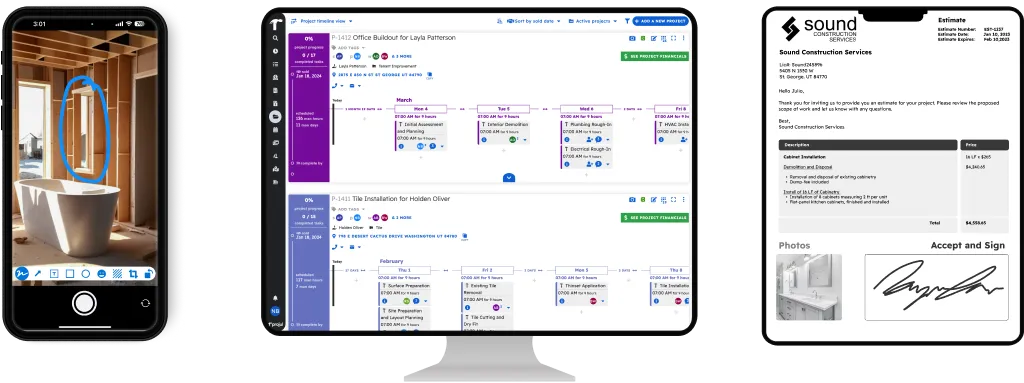
Construction estimate templates that save hours on every bid
If you’re building estimates from scratch every time, you’re wasting hours you don’t have. And if you’ve got multiple estimators each pricing things differently, you’re losing money on inconsistent bids.
Projul’s construction estimate templates let contractors save detailed estimates, sections, schedules, and entire projects for reuse. Every estimator bids with the same materials, labor rates, and markup to keep pricing consistent across jobs. Projul offers flat-rate pricing with no per-user fees for construction companies of all sizes.
Projul’s construction estimate templates let you write a great estimate once, save it, and apply it to new projects in seconds. Materials, labor costs, hard costs, and markup are all baked in. Your whole team bids the same way every time, and your profit margins stay protected.
Over 5,000 contractors use Projul to speed up their estimating process. Templates are one of the biggest reasons why users save 2+ hours daily on admin work.
Why templates save hours on every estimate
Think about what goes into building an estimate from scratch. You’re looking up material prices, calculating labor hours, adding markups, double-checking line items, and making sure you didn’t forget anything. For a detailed estimate, that’s easily 30 minutes to an hour. For complex projects, it could be half a day.
Now multiply that by every bid you send out. If you’re sending 10 estimates a week, that’s 5 to 10 hours just on estimating. And most of those estimates share a lot of the same line items, materials, and labor calculations.
Contractor templates solve this by letting you do that work once. Build a detailed estimate for a common project type, save it as a template, and the next time you bid a similar job, you start from that template instead of a blank page. Change the quantities, adjust for the specific scope, and you’re done.
With Projul, you can template entire estimates or just sections. Running a roofing company? Template your tear-off section, your underlayment section, your shingle section, and your cleanup section separately. Then mix and match to build estimates for different roof types in under a minute.
That’s not just faster. It’s more accurate. Templates don’t forget line items. They don’t use outdated pricing. And they don’t vary from one estimator to the next.
Estimate templates by trade
Every trade has its own standard scopes of work. A roofer’s estimate looks nothing like an electrician’s. A general contractor needs to pull from multiple trades on a single bid. That’s why Projul lets you build and organize templates by trade and project type.
Here’s how contractors in different trades use estimate templates:
Roofing. Template sections for tear-off, underlayment, shingle installation, flashing, ridge vents, and cleanup. Mix and match for different roof types and sizes. A full roofing estimate that used to take 45 minutes now takes 3.
Electrical. Template your rough-in, panel upgrade, fixture installation, and low-voltage sections. When you bid a new home, pull in the sections you need and adjust quantities. Every bid uses current material costs and your standard labor rates.
Plumbing. Template rough plumbing, fixture installation, water heater replacement, and sewer line sections. Plumbing bids are detail-heavy, and templates make sure nothing gets missed.
HVAC. Template ductwork, equipment installation, thermostat setup, and startup/commissioning. HVAC estimates involve expensive equipment with specific model numbers. Templates keep those details consistent.
General contracting. This is where section-level templates really shine. A GC bidding a kitchen remodel pulls in the demo section, framing section, electrical section, plumbing section, drywall section, finish section, and cleanup section. Each section comes from a tested template with accurate pricing. The full estimate comes together in minutes instead of hours.
Painting. Template interior painting, exterior painting, prep work, and specialty finishes. Painting estimates are volume-based, so templates with per-square-foot pricing make bidding fast and consistent.
The more templates you build, the faster your estimating gets. After a month of saving your best estimates as templates, you’ll have a library that covers 80% of your common project types.
Project templates: plan the whole job in seconds
Estimate templates get the most attention, but project templates might save you even more time. When you win a job, you still have to set up the project: create tasks, assign crews, set timelines, and define dependencies. For a complex project, that setup can take 30 minutes to an hour.
Project templates let you save an entire project structure and apply it to a new job with a few clicks. All the tasks, subtasks, dependencies, and default assignments carry over. You adjust the start date, swap in the right crew members, and your project is planned before you leave the office.
Here’s a practical example. You run a bathroom remodel company and most of your projects follow the same general structure: demo, rough plumbing, rough electrical, framing, drywall, tile, fixture install, paint, cleanup. You’ve done this project 50 times. Why rebuild it from scratch every time?
Save your best bathroom remodel project as a template. Next time you win a similar job, apply the template, adjust the dates, and assign your crews. A project that used to take 30 minutes to plan now takes 30 seconds.
Project templates also enforce consistency in how your team executes work. When every bathroom remodel follows the same task structure, nothing gets skipped. Your crews know what comes next. Your project managers can compare progress across jobs using the same framework.
Task templates for repetitive work
Not every job needs a full project template. Sometimes you just need to add a standard set of tasks to an existing project. That’s where task templates come in.
Save a group of related tasks as a template and drop them into any project when you need them. For example:
- A punch list template with your standard final walkthrough items
- An inspection preparation template with tasks for code compliance checks
- A site prep template with clearing, grading, and utility marking tasks
- A closeout template with final documentation, warranty handoff, and client walkthrough
Task templates work alongside project templates and estimate templates to give you layers of reusable content. Use a project template for the overall structure, section templates for the estimate, and task templates for specific phases that need additional detail.
How templates protect your profit margins
Inconsistent pricing is one of the biggest margin killers in construction. When two estimators bid the same type of job and come back with different numbers, one of them is wrong. Either you’re leaving money on the table or you’re underbidding and eating into your profit.
Templates fix this by locking in your standard pricing. Material costs, labor rates, hard costs, and markup percentages are all set in the template. Every estimator who uses that template bids with the same numbers.
Here’s what that looks like in practice:
Materials. Your template includes the specific materials you use, at the costs you’ve negotiated with your supplier. No estimator is going to accidentally use retail pricing when you’ve got a contractor discount.
Labor rates. Your templates use your actual labor rates, including burden and overhead. Nobody forgets to account for workers’ comp or payroll taxes on a bid.
Hard costs. Permits, dumpster rentals, equipment costs, and other hard costs that apply to every job are already in the template. They don’t get left off by accident.
Markup. Your standard markup percentage applies to every section in the template. No more one estimator marking up 20% while another marks up 35% on the same type of work.
When your pricing is consistent, your margins are predictable. You know what a kitchen remodel should cost to build because every bid uses the same template with the same numbers. If a job ends up costing more than expected, you can compare actual costs to the template to figure out exactly where the variance happened.
Customization without starting over
Templates aren’t rigid. They’re starting points. Every template in Projul is fully customizable once you apply it to a new project or estimate.
Need to add a line item the template doesn’t include? Add it. Need to remove a section that doesn’t apply to this particular job? Delete it. Need to change quantities, swap materials, or adjust labor hours? Change whatever you need.
The template gives you a solid foundation. Customization lets you adapt it to the specific job. You get the speed benefit of starting from a template and the accuracy benefit of tailoring it to the actual scope.
This is especially important for contractors whose projects are similar but not identical. A general contractor might use the same kitchen remodel template for every kitchen, but each one has different cabinet styles, countertop materials, and appliance packages. The template handles the structure and standard items. The customization handles the details.
Building a template library that works
The best template library isn’t built in one day. You build it as you go, saving your best estimates as templates whenever you finish a solid bid. After a few weeks, you’ve got a library that covers most of your common project types.
Here’s how smart contractors set up their Projul templates:
Start with your bread-and-butter projects. Whatever you bid most often, template those first. If 60% of your work is kitchen remodels, build a detailed kitchen remodel template with all the standard line items, labor rates, and materials.
Template sections, not just full estimates. Projul lets you save individual estimate sections as separate templates. This is a huge time-saver for contractors whose projects overlap but aren’t identical. A bathroom section here, a framing section there, mixed together into a custom bid.
Use assemblies inside your templates. Assemblies group common materials and labor into reusable blocks. Drop them into your templates and you’ve got a detailed, accurate bid ready to go. Change the quantity and everything recalculates automatically.
Lock in your pricing. Templates protect your profit margins by keeping material costs, labor rates, and markup consistent. When you update pricing, update it in the template and every future estimate uses the new numbers. No more estimators using last year’s lumber prices.
Let every estimator use the same library. This is where templates really pay off. If you’ve got two or three estimators, they should all be bidding from the same templates. That way your pricing is consistent no matter who builds the estimate. No more one guy bidding 10% lower because he forgot a line item.
Schedule templates: plan projects in seconds
Construction estimate templates get all the attention, but schedule templates are just as valuable. If you build similar projects, your timelines probably look similar too. Why rebuild the schedule from scratch every time?
Save a project schedule as a template in Projul, and apply it to the next similar job. Pick the new start date, and Projul shifts every task and dependency to the correct dates. Choose whether to keep the same crew assignments or pick new ones. A project that used to take 30 minutes to schedule now takes seconds.
Schedule templates are especially powerful for contractors who run the same types of projects repeatedly. A custom home builder who builds 10 houses a year uses the same general schedule structure for each one. A remodeling company that does bathroom renovations every week follows the same sequence of trades. Template the schedule once and apply it to every new job.
Your schedule templates work alongside your estimate templates. Template the bid, win the job, apply the schedule template, and your project is planned before you even leave the office.
Pair templates with assemblies for even faster estimates
Assemblies let you group common materials and labor into reusable blocks. Drop them into your estimate templates and you’ll build detailed, accurate bids in under a minute.
Think of assemblies as building blocks and templates as the blueprint. Assemblies define what goes into a section. Templates define how the whole estimate is structured. Together, they turn a 45-minute estimate into a 3-minute one.
And because assemblies and templates both track live construction costs, your pricing stays current. When material costs change, update them in one place and every template and assembly that uses those materials updates automatically.
Templates on mobile: bid from anywhere
Like everything else in Projul, templates work on mobile devices. You’re at a client’s house doing a walkthrough and they ask for a ballpark. Pull out your phone, apply your estimate template for that project type, adjust the quantities based on what you see, and show them a professional estimate before you leave the driveway.
Over 5,000 contractors use Projul’s mobile tools to get work done without being tied to a desk. Templates on mobile mean you can bid jobs, plan projects, and set up schedules from anywhere. The days of driving back to the office to build an estimate are over.
From template to invoice in clicks
Your templated estimate becomes a signed contract, then a project, then an invoice. Projul connects the whole workflow so you’re not re-entering data at any step.
That’s the real payoff of a good template system. It doesn’t just speed up estimating. It speeds up everything that comes after, because the data flows from estimate to project to invoice without anyone retyping numbers.
Think about the full lifecycle of a job:
- Apply an estimate template and customize it for the project
- Send the estimate for client approval and digital signature
- Win the job and convert the estimate to a project
- Apply a schedule template to plan the work
- Track time and costs against the budget that came from the estimate
- Generate invoices based on the work completed
At every step, the data carries forward. No re-entry. No copy-paste errors. No information lost between stages. Templates start the process, and Projul’s connected workflow finishes it.
How to Maintain Your Template Library Over Time
Building templates is the first step. Keeping them accurate is what separates contractors who save hours from contractors who send out bids with last year’s prices. Here’s how to maintain your templates so they keep working for you.
Review pricing quarterly. Material costs shift constantly, especially lumber, copper, and concrete. Set a reminder every three months to audit your most-used templates against current supplier pricing. Update the material costs in the template and every future estimate automatically uses the right numbers. This is easier than catching a pricing error after you’ve already signed a contract.
Delete templates you don’t use. After a year, you’ll have templates for project types you no longer bid. A cluttered library slows your team down because they have to scroll past irrelevant options. Archive or delete anything you haven’t used in six months. Keep the library tight and relevant.
Version your templates by year. When you update a template with new pricing, note the year in the template name or description. This makes it easy to spot if someone accidentally uses an outdated version. “Kitchen Remodel 2026” is clearer than “Kitchen Remodel” when you’re scanning a list.
Get feedback from your estimators. Your estimators use these templates every day. Ask them what’s missing, what’s redundant, and what slows them down. A template that makes sense to the owner might confuse the estimator who actually builds the bids. Five minutes of conversation saves hours of rework.
Tie templates to your project management workflow. Your estimate template should map cleanly to how you actually run the job. If your estimate has 8 sections but your project setup has 12 phases, there’s a disconnect. Align your estimate templates with your project templates and schedule templates so data flows from bid to build without manual translation.
Track template performance with reports. Which templates produce the most accurate bids? Compare your estimated costs to actual job costs using Projul’s budgeting tools. If a template consistently underbids labor by 10%, fix the labor rates in the template. Data tells you which templates need attention and which ones are dialed in.
How to Build a Reusable Estimate Template
Building your first template takes about the same time as building a regular estimate. The difference is that you only do it once, and then it pays you back on every bid after that. Here’s a step-by-step walkthrough of how to create a reusable estimate template in Projul that your whole team can use.
Step 1: Pick your most common project type. Look at the last 20 jobs you bid. What project type shows up the most? That’s your first template. For most contractors, it’s something like a bathroom remodel, a roof replacement, or a standard service call. Start there because you’ll get the most immediate return on your time.
Step 2: Build the estimate like you normally would. Open a new estimate and build it out with every line item you’d include on a real bid for that project type. Add your materials with current quantities and unit costs. Add your labor with hourly rates and estimated hours. Include hard costs like permits, dumpster rentals, or equipment fees. Don’t skip anything, because the whole point of the template is that nothing gets forgotten.
Step 3: Organize your line items into sections. Group related items together under clear section headers. For a bathroom remodel, your sections might be: Demo, Rough Plumbing, Rough Electrical, Framing, Drywall, Tile, Fixtures, Paint, and Cleanup. Clean sections make the estimate easier to read for your client and easier to customize for your estimators.
Step 4: Add assemblies for common work packages. If you have groups of materials and labor that always go together, save them as assemblies. A “toilet rough-in” assembly might include the closet flange, wax ring, supply line, shutoff valve, and 30 minutes of labor. Drop the assembly into your estimate instead of adding each item one at a time. When you change the quantity, everything in the assembly recalculates together.
Step 5: Set your default markups. Apply your standard markup percentage to each section or to the estimate as a whole. Projul lets you set markup at the line item, section, or estimate level. Lock in your margins now so every bid that comes from this template protects your profit.
Step 6: Save it as a template. Once you’re happy with the estimate, save it as a template in Projul. Give it a clear name like “Standard Bathroom Remodel” or “Roof Replacement - Asphalt Shingle.” Add a note about what the template covers so other estimators on your team know when to use it.
Step 7: Test it on a real bid. The next time a similar project comes in, apply the template instead of starting from scratch. Adjust quantities, swap materials if needed, and see how much time you save. Most contractors report that their second bid using a template takes less than 5 minutes compared to 30 to 60 minutes without one.
One template saves you time on every future bid for that project type. If you bid 10 similar jobs a month and each template saves you 30 minutes, that’s 5 hours back every month from a single template. Build five templates and you’re saving 25 hours a month. That’s more than three full workdays you can spend on jobsites, client meetings, or simply going home earlier.
Template Ideas for Every Trade
The best way to understand how templates work is to see how contractors in different trades set theirs up. Here are specific template examples you can use as a starting point for your own library.
Bathroom Remodel Template. Sections: Demo (gut existing fixtures, flooring, and drywall), Rough Plumbing (relocate supply lines, install new drain lines, shower valve), Rough Electrical (new GFCI outlets, exhaust fan, vanity lighting circuit), Waterproofing (membrane, cement board, and backer), Tile (floor tile, shower tile, accent tile with labor per square foot), Fixtures (toilet, vanity, faucet, shower head, mirror, towel bars), Paint (primer and two coats on walls and ceiling), and Cleanup (haul debris, final clean, protect adjacent rooms). This template works for 80% of bathroom jobs. For high-end renovations, add sections for heated floors, frameless glass enclosures, or custom cabinetry.
Kitchen Renovation Template. Sections: Demo, Rough Plumbing (sink relocation, dishwasher line, ice maker line), Rough Electrical (dedicated circuits for appliances, under-cabinet lighting, pendant lighting), Framing (any wall modifications or island framing), Drywall and Patching, Cabinetry (base cabinets, wall cabinets, island), Countertops (measured and installed, with cutouts for sink and cooktop), Backsplash (tile with labor per square foot), Appliance Installation, Finish Plumbing (sink, faucet, garbage disposal, dishwasher hookup), Finish Electrical (outlets, switches, plate covers), Paint, and Cleanup. Kitchen remodels have more line items than almost any other residential project. A good template here saves the most time because there’s the most to forget.
Roof Replacement Template. Sections: Tear-Off (remove existing shingles, underlayment, and damaged decking by the square), Decking Repair (replace rotted plywood, priced per sheet), Underlayment (ice and water shield in valleys and at eaves, synthetic felt on field), Shingle Installation (by the square, including starter strip and ridge cap), Flashing (step flashing at walls, counter flashing at chimneys, pipe boots, drip edge), Ventilation (ridge vent, intake vents, or powered vents), and Cleanup (magnetic sweep, debris hauling, gutter cleanout). Roofing estimates are highly quantity-driven, so the template focuses on per-square and per-linear-foot pricing that adjusts with roof size.
Deck Build Template. Sections: Site Prep (layout, dig footings, pour piers), Framing (ledger board, beams, joists, blocking, joist hangers), Decking (boards by square foot, with waste factor), Railing (posts, balusters, top rail, post caps by linear foot), Stairs (stringers, treads, risers, and railing by the step), Hardware (structural screws, hidden fasteners, post bases), and Finish (sealer, stain, or paint). This template adapts to pressure-treated lumber, composite, or hardwood by swapping the material line items while keeping the labor hours consistent.
HVAC Install Template. Sections: Equipment (condenser, air handler or furnace, coil, thermostat, line set), Ductwork (supply runs, return air, flex duct, rigid duct, registers, and grilles by linear foot or per opening), Electrical (disconnect, whip, breaker), Refrigerant (charge by the pound), Startup and Commissioning (system test, airflow balancing, refrigerant pressure check), and Permits. HVAC estimates involve specific equipment model numbers and efficiency ratings. Lock those into the template so every bid references the exact equipment you’ve priced from your distributor.
Each of these templates adapts to different project sizes by adjusting quantities. The structure stays the same. Your pricing per unit stays the same. You just change the numbers that are unique to each job, and the estimate recalculates automatically. That’s the power of building templates around your actual work.
Templates vs Starting From Scratch Every Time
Here’s the math on why templates matter. Take a contractor who sends out 10 estimates per week. Building each estimate from scratch takes about 45 minutes on average. That’s 7.5 hours per week just on estimating, or 30 hours per month.
Now switch to templates. The same contractor applies a template, adjusts the quantities and scope for the specific job, and sends the estimate. That process takes about 10 minutes. At 10 estimates per week, that’s less than 2 hours per week, or about 7 hours per month.
The difference: 23 hours per month. That’s almost three full workdays you get back every single month.
But time savings are only part of the story. Here’s what else changes when you switch from scratch estimates to templates.
Consistency. Every estimate follows the same structure with the same line items. Your clients see a professional, organized bid every time. Your estimators don’t accidentally leave out the cleanup section on Tuesday’s bid because they were rushing.
Pricing accuracy. Your template has current material costs, your negotiated supplier pricing, and your actual labor rates baked in. When you start from scratch, you’re looking up prices, pulling from memory, or guessing. Templates remove the guesswork and keep every number grounded in your real costs.
Professional appearance. A template-based estimate looks polished. Sections are organized logically. Line items are complete. Totals are accurate. Clients notice the difference between a detailed, well-organized bid and a thrown-together number on a napkin. The contractor who sends a better-looking estimate wins more work at higher margins.
Fewer costly mistakes. Every forgotten line item on an estimate comes out of your profit. Forget to include permits on a $30,000 remodel? That’s $500 to $2,000 coming straight out of your margin. Forget to account for dumpster fees on a demo job? There goes another $400 to $800. Templates don’t forget. They include every line item you built into them, every time.
Faster follow-up. When you can build an estimate in 10 minutes instead of 45, you get bids out faster. The contractor who sends the estimate first often wins the job. Speed matters, and templates are the fastest way to go from walkthrough to proposal.
If your estimating process feels slow, inconsistent, or error-prone, the fix isn’t working harder. It’s building templates that do the repetitive work for you.
Assemblies: The Secret to Fast, Accurate Estimates
Assemblies are one of the most powerful features in Projul, and they work hand in hand with your estimate templates. An assembly is a pre-built group of materials, labor, and costs that you save once and drop into any estimate with a single click.
Think of it this way: a template is the structure of your whole estimate. An assembly is a building block inside that structure. Templates organize the big picture. Assemblies handle the details.
Example: Standard Bathroom Rough-In Assembly. You rough in a bathroom the same way on almost every job. The materials and labor are predictable. So you save an assembly called “Standard Bathroom Rough-In” that includes:
- 3/4” copper supply lines (12 linear feet)
- 1/2” copper branch lines (18 linear feet)
- PVC drain lines, 2” and 3” (20 linear feet)
- Closet flange
- Shower drain assembly
- P-traps (2)
- Shutoff valves (4)
- Supply line fittings and couplings
- Plumber labor: 6 hours at your standard rate
- Apprentice labor: 6 hours at your standard rate
- Markup: your standard percentage applied to all items
That’s roughly 12 separate line items, each with a quantity, unit cost, and labor component. Without an assembly, your estimator types every one of those items manually on every bathroom bid. With the assembly, they click once and all 12 items appear with correct quantities, current pricing, and your markup already applied.
How assemblies multiply the power of templates. Your bathroom remodel template might have 8 sections. Each section might contain 2 to 5 assemblies. The rough plumbing section has the bathroom rough-in assembly. The electrical section has a “bathroom electrical rough-in” assembly. The tile section has a “shower tile” assembly with cement board, waterproofing membrane, thinset, grout, and tile labor per square foot.
When you apply that template to a new job, every assembly inside it populates with the correct items and current pricing. You adjust the quantities for the specific bathroom and the entire estimate recalculates. A detailed, 50-line-item estimate comes together in minutes because you built it from assemblies inside a template.
Keeping assemblies accurate. Assemblies pull from your live construction costs in Projul. When copper prices go up, you update the cost in one place and every assembly that uses copper updates automatically. Same for labor rates. Raise your plumber’s rate and every assembly with plumber labor reflects the new number.
This means your templates stay accurate without you manually editing every line item across every template. Update the cost database, and the assemblies and templates that reference those costs stay current. It’s pricing that maintains itself.
Building your assembly library. Start with the work packages you repeat most often. If you’re a plumber, build assemblies for a toilet install, a shower valve rough-in, a water heater replacement, and a kitchen sink hookup. If you’re an electrician, build assemblies for a panel upgrade, a circuit rough-in, a recessed lighting package, and a ceiling fan install.
Each assembly captures the materials, labor, and markup for that specific task. Drop them into templates or standalone estimates whenever you need them. Over time, your assembly library becomes a pricing database that reflects your real costs and your real labor productivity.
The combination of assemblies and templates is what turns Projul into an estimating system that gets faster and more accurate the more you use it. Every assembly you build and every template you save adds to a library that makes your next bid quicker and more precise than the last.
Stop building estimates from scratch
Every estimate you build from a blank page is time you could have spent on a jobsite or with a client. Projul’s templates give you a faster, more accurate, more consistent way to bid work, plan projects, and get your team moving. At $4,788/year with no per-user fees, your entire team can access the template library, build estimates, and manage projects from one platform.