
AccuLynx Pricing 2026: What It Really Costs
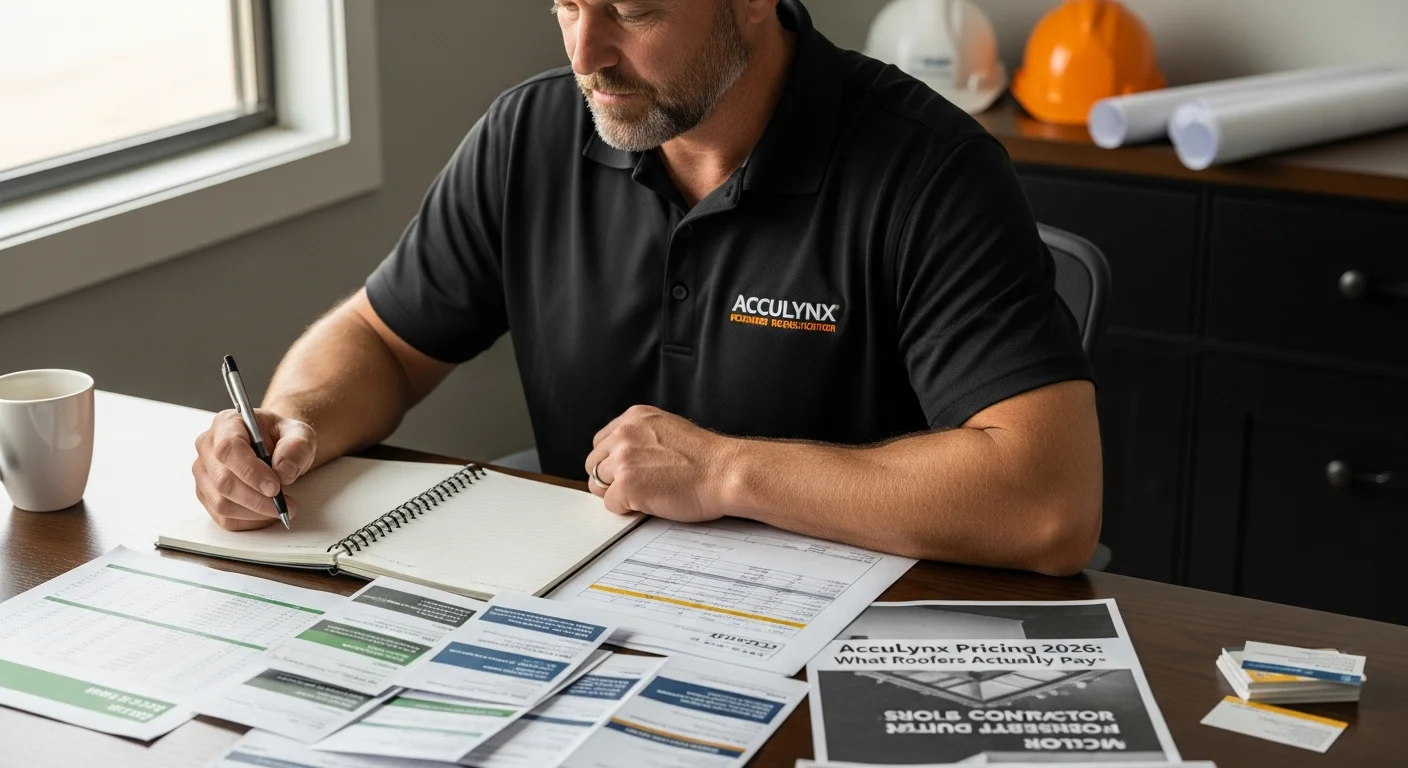
AccuLynx Pricing 2026: What Roofers Actually Pay
If you have tried to find AccuLynx pricing online, you already know the frustration. There is no pricing page. No monthly cost listed anywhere on their website. Just a button that says “Request a Demo” and the understanding that you will need to sit through a sales pitch before you find out what the software costs.
That is a problem for contractors who just want to compare options and make a decision. You should not need to block off 45 minutes with a sales rep just to find out if a tool fits your budget.
We put together this pricing breakdown based on what roofing contractors have reported paying, along with publicly available information about AccuLynx’s pricing model. Then we will compare it to what you would pay with Projul, where all the pricing is published right on the website.
AccuLynx’s Pricing Model: What We Know
AccuLynx uses a per-user pricing model. That means every person on your team who needs access to the software adds to your monthly bill. The more people you add, the more you pay.
Here is what contractors have reported about AccuLynx’s pricing structure:
Per-User Costs
Based on contractor feedback and industry reports, AccuLynx pricing falls in the range of $55 to $75+ per user per month, depending on the plan and features you need. Some contractors have reported higher rates for premium tiers.
AccuLynx has historically offered multiple plan levels. While the exact plan names and feature breakdowns shift over time, the structure generally includes:
- A base plan with core construction CRM software and project management features
- A mid-tier plan that adds features like aerial measurement integrations and supplier ordering
- A premium plan with the full feature set including advanced reporting and automation
Each tier costs more per user. So you are not just paying for more users, you are also paying more per user if you want the better features.
Setup and Onboarding Fees
AccuLynx typically charges setup fees on top of the subscription. These can range from a few hundred dollars to over a thousand, depending on the level of onboarding support and data migration involved.
Some contractors have reported that the onboarding process includes training sessions and account configuration, which is helpful. But the added upfront cost is something to factor into your first-year budget.
Annual Contracts
AccuLynx generally requires annual contracts. Month-to-month billing is either not available or comes at a significant premium. This means you are committing to a full year before you have had much time to evaluate whether the software actually works for your business.
If you sign up and realize three months in that AccuLynx is not the right fit, you are likely on the hook for the remaining nine months.
What a Real Team Pays
Let’s do the math on what a roofing company actually pays for AccuLynx based on the per-user model.
Small team (5 users) at $65/user/month:
- Monthly: $325
- Annual: $3,900
- Plus setup fees: roughly $4,400 to $5,000 in year one
Medium team (10 users) at $65/user/month:
- Monthly: $650
- Annual: $7,800
- Plus setup fees: roughly $8,300 to $9,000 in year one
Larger team (20 users) at $65/user/month:
- Monthly: $1,300
- Annual: $15,600
- Plus setup fees: roughly $16,100 to $16,800 in year one
Large team (30 users) at $65/user/month:
- Monthly: $1,950
- Annual: $23,400
- Plus setup fees: roughly $23,900 to $24,600 in year one
And remember, those numbers assume the mid-range per-user rate. If you need premium features, the per-user cost goes up and those totals climb accordingly.
The Problem With Per-User Pricing
Per-user pricing sounds fair on the surface. You pay for what you use, right? But in practice, it creates some ugly incentives for construction companies:
It Punishes Growth
Every time you hire someone, your software bill goes up. Brought on two new crew leads? That is another $130 per month. Hired an office manager? Another $65. Gave your foreman access so he can check the schedule? More money.
This creates a situation where business owners start gatekeeping access to their own software. “Does the new guy really need a login?” becomes an actual conversation. That is backwards. Your team should have the tools they need without you doing cost-benefit analysis on every login.
It Discourages Full Adoption
When every seat costs money, you end up with half your team using the software and the other half working off texts, spreadsheets, and sticky notes. The whole point of construction management software is getting everyone on the same page. Per-user pricing works against that goal.
It Makes Budgeting Unpredictable
Your software cost is tied to your headcount. During busy season when you add temporary crew members or bring on extra help, your software bill spikes. During slow months, you are paying for seats that are not being used but are still under contract.
Why Hidden Pricing Is a Red Flag
Let’s talk about the elephant in the room: AccuLynx does not publish its pricing anywhere.
There are really only two reasons a software company hides its pricing:
-
They want to charge different customers different amounts. If you do not know what other contractors are paying, you cannot push back on a higher quote. The sales rep has all the power in that conversation.
-
They want to get you into a sales conversation first. Once you have invested 30 to 45 minutes in a demo, you are more likely to buy even if the price is higher than you expected. It is a well-known sales tactic.
Neither of those reasons benefits you as the buyer.
Transparent pricing lets you compare options on your own terms. You can look at the numbers, talk it over with your business partner, and make a decision without pressure. When pricing is hidden, you are making a buying decision in a controlled environment designed to get you to say yes.
Projul Pricing: The Transparent Alternative
Projul takes the opposite approach. All pricing is published on the website. No sales call required. No guesswork.
Here is exactly what Projul costs:
Core: $4,788/year
The Core plan is built for smaller crews that need to get organized. You get project management, estimating, scheduling, and the tools to run your jobs from one platform. Roofing contractors can also grab our free roofing estimate template to get started quickly.
Core+: $7,188/year
Core+ is for growing companies that need more features. You get everything in Core plus additional capabilities like job costing for managing a bigger operation with more moving parts.
Pro: $14,388/year
The Pro plan is for established contractors running complex operations. Full feature set, advanced tools, and everything you need to manage a serious construction business.
What Makes Projul Different on Pricing
Flat-rate, not per-user. Whether you have 5 people or 50 people on your team, you pay the same monthly rate. Add crew members, office staff, subcontractors. The price does not change.
No setup fees. The price you see is the price you pay. No hidden onboarding costs.
Month-to-month available. You are not locked into an annual contract if you do not want to be.
Published and transparent. You can see the pricing right now, compare it to your budget, and make an informed decision without talking to anyone.
Side-by-Side Cost Comparison
Let’s compare what a 10-person roofing company would pay for each platform:
AccuLynx (estimated at $65/user/month):
- Monthly: $650
- Annual: $7,800
- Year one with setup: approximately $8,500 to $9,000
Projul Core:
- Monthly: $399
- Annual: $4,788
- Year one: $4,788
Projul Core+:
- Monthly: $599
- Annual: $7,188
- Year one: $7,188
Projul Pro:
- Monthly: $1,199
- Annual: $14,388
- Year one: $14,388
At 10 users, Projul Core saves you roughly $3,000 to $4,000 per year compared to AccuLynx. And that gap widens as your team grows, because Projul’s price stays flat while AccuLynx charges for every additional user.
At 20 users, AccuLynx could run $15,600 per year while Projul Core is still $4,788. That is over $10,000 in savings.
At 30 users, AccuLynx could cost $23,400 per year. Projul Core is still $4,788. The difference is staggering.
Total Cost of Ownership: A Real 10-Person Team Over 3 Years
The sticker price only tells part of the story. What really matters is how much you spend over time, including all the costs that show up after you sign the contract.
Let’s walk through a realistic comparison. You run a roofing company with 10 people who need software access: you (the owner), an office manager, two sales reps, a project manager, and five crew leads or foremen.
AccuLynx: 10 Users at $65/User/Month
Year one:
- Subscription: $65 x 10 users x 12 months = $7,800
- Setup and onboarding fee: $500 to $1,200
- Training time (conservative estimate, 40 total team hours at $30/hr): $1,200
- Year one total: roughly $9,500 to $10,200
Year two:
- Subscription (with a typical 5% to 10% annual increase): $8,190 to $8,580
- You hired two more people during the year, so add 2 users for 6 months: $780 to $900
- Year two total: roughly $8,970 to $9,480
Year three:
- Now at 12 users with another price bump: $9,360 to $10,296
- Year three total: roughly $9,360 to $10,296
3-year AccuLynx total for a growing 10-to-12 person team: roughly $27,830 to $29,976
Projul: Flat Rate, No Per-User Fees
Year one (Core at $4,788/year):
- Subscription: $399 x 12 = $4,788
- Setup fee: $0
- Training time (same 40 hours at $30/hr): $1,200
- Year one total: $5,988
Year two (still $4,788/year, same price for 12 users):
- Subscription: $4,788
- Year two total: $4,788
Year three (still $4,788/year, still flat):
- Subscription: $4,788
- Year three total: $4,788
3-year Projul Core total: $15,564
That is a difference of $12,000 to $14,000 over three years on the Core plan alone. Even on the Pro plan at $14,388/year, you would pay $14,388 per year, which comes to $28,164 over three years with training included. Still less than AccuLynx, and you get unlimited users the entire time.
The point is simple. With per-user pricing, your software cost grows every time your business grows. With flat-rate pricing, your cost stays the same whether you have 10 people or 25. That is real money you can put back into trucks, tools, or marketing.
Think about what $12,000 to $14,000 buys your roofing business. That is a solid used work truck. That is a full season of Google Ads bringing in new leads. That is new equipment for a second crew. When you save that kind of money on software every three years, you can invest it in things that actually grow your revenue.
And here is the part that really stings with per-user pricing: during storm season or a busy spring, you want your whole team in the system. You want every foreman checking schedules, every sales rep logging leads, every crew lead uploading photos from the jobsite. But with per-user pricing, adding those five extra seasonal workers means an extra $325 per month. With Projul, you just add them. No extra cost. No awkward conversations about who “really” needs access.
What About Core+ for Mid-Size Teams?
If you want more features than Core but do not need the full Pro package, Core+ at $7,188/year gives you job costing and additional tools for $7,188 per year. Over three years, that is $20,964 with training, still saving you roughly $7,000 to $9,000 compared to AccuLynx.
Hidden Costs Contractors Miss
Software companies are good at making the base price look reasonable. The real expense often hides in places you would not think to look until you are already locked in.
Onboarding and Implementation Fees
AccuLynx charges for setup and onboarding. That is standard in the industry, but the amounts vary wildly. Some contractors report paying $500. Others have paid over $1,000 for data migration and custom configuration. With Projul, onboarding is included. No extra charge.
Integration Costs
Your software does not exist in a vacuum. You need it to talk to QuickBooks, your payment processor, your lead sources, and maybe your material suppliers. Some platforms charge extra for certain integrations or require third-party connector tools that carry their own monthly fees.
Before you sign anything, ask: which integrations are included, and which ones cost extra? Projul includes QuickBooks two-way sync and online payment processing in the base price. No surprise add-ons.
Annual Price Increases
This one catches a lot of contractors off guard. You sign up at $65 per user, and the next year it quietly bumps to $68. Then $72. Then $75. Over three to five years, your per-user cost can climb 15% to 25% without you ever upgrading your plan.
Annual increases are common across SaaS companies, but they hurt more with per-user pricing because the increase multiplies across every seat. A $5 per-user increase across 15 users is an extra $75 per month, or $900 per year, for the exact same software.
Ask any vendor you are considering: what is your history of annual price increases? If they dodge the question, you have your answer.
Seat-Sharing and Workarounds
When per-user pricing gets expensive, contractors start sharing logins. Two crew leads use one account. The office manager logs in under the owner’s credentials. This causes real problems: you lose individual accountability, your audit trail is useless, and you cannot track who did what on which job.
With flat-rate pricing, everyone gets their own login. No workarounds needed. Your foreman, your sales team, your office staff, and even your subs can have access without you doing math on whether they are “worth” a seat.
The Cost of Switching Later
If you pick the wrong tool now, switching later is expensive. You will spend time exporting data, retraining your team, and dealing with downtime during the transition. Some contractors stick with software they have outgrown just because switching feels too painful.
That is why getting the pricing model right from the start matters more than saving $20 a month on the initial subscription.
Features Locked Behind Higher Tiers
Some platforms advertise a low starting price, but the features you actually need are only available on the more expensive plan. Estimating might be included, but detailed job costing sits behind a paywall. Or you get basic scheduling, but advanced reporting costs extra.
Before you commit, make a list of the features your business needs on day one. Then check which plan actually includes all of them. Do not assume the base plan covers everything you saw in the demo. Sales reps often demo the premium version while quoting you the starter price.
Support and Ongoing Help
Some platforms include phone and chat support in every plan. Others limit support to email-only on lower tiers or charge for priority access. When your team is stuck on a Friday afternoon trying to send an invoice, “email us and we will get back to you in 24 to 48 hours” is not going to cut it.
Ask about support before you sign. What channels are available? What are the response times? Is there a cost difference between plans? Projul includes support on every plan because your team should not have to pay extra just to get help when they need it.
What You Get for the Money
Price only matters in context. A cheap tool that does not do what you need is a waste of money at any price. So what do you actually get?
AccuLynx Features
- Roofing-specific CRM and lead management
- Aerial measurement integrations (EagleView, SkyMeasure)
- Material ordering through ABC Supply and Beacon
- Estimating and proposals for roofing jobs
- Job scheduling and crew management
- Invoicing and QuickBooks integration
- Photo documentation
- Mobile app
Projul Features
- Estimating for any construction type
- Scheduling with drag-and-drop calendar
- Invoicing with online payments
- QuickBooks two-way sync
- Project management across all trades
- Client portal and communication tools
- Document management
- Time tracking
- Mobile app for field crews
- CRM and lead tracking
AccuLynx gives you roofing-specific tools. Projul gives you construction-wide tools. If you are a roofer who also does siding, gutters, or general contracting, Projul covers all of it in one platform. AccuLynx only covers the roofing part.
Making the Right Choice for Your Business
Here is the honest advice:
If you are a small, roofing-only company with 3 to 5 users and no plans to grow beyond roofing, AccuLynx may work fine. The per-user cost stays manageable at that size, and the roofing-specific features like aerial measurements and supplier ordering add genuine value.
If you are a growing roofing company adding users regularly, the per-user pricing will start to hurt. Every new hire bumps your software cost. Projul’s flat-rate model is built for companies that are scaling up.
If you do roofing plus other work, AccuLynx simply does not support your full business. You will end up running two systems, which means double the cost and double the headache. Projul handles everything in one place.
If transparent pricing matters to you (and it should), Projul lets you see exactly what you are paying before you ever talk to anyone. AccuLynx makes you go through a sales process first.
See the Pricing for Yourself
You do not have to take our word for it. Projul’s pricing page shows you exactly what each plan costs and what is included. No demo required, no sales pitch, no guesswork.
And if you want to see the platform in action, you can schedule a demo on your own terms. Pick a time that works for you, see the features, ask your questions, and make a decision without any pressure.
Your software should work for your business, not the other way around. And you should always know what it costs before you commit.
📚 Related: See our best AccuLynx alternatives and AccuLynx vs Projul comparison. Compare with Projul’s transparent pricing. For a wider look at what the industry charges, read our full construction software pricing guide.
Ready to Stop Overpaying for Software?
Here is what you can do right now:
-
Check the pricing. Visit Projul’s pricing page and see exactly what each plan includes. Core starts at $4,788/year for unlimited users.
-
Do your own math. Count the number of people on your team who need access. Multiply that by $65 (or whatever AccuLynx quotes you). Then compare it to $399, $599, or $1,199 flat. The numbers speak for themselves.
-
Book a demo on your schedule. No pressure, no hard sell. Just a walkthrough of estimating, job costing, scheduling, invoicing, and everything else Projul does. Schedule your demo here and see why thousands of contractors have already made the switch.
You deserve to know what your software costs before you buy it. You deserve a pricing model that does not punish you for growing. And you deserve a platform that gives every person on your team the tools they need without charging you extra for each one.
Frequently Asked Questions
How much does AccuLynx cost per month?
Does AccuLynx charge per user?
Is there a free trial for AccuLynx?
Why doesn't AccuLynx publish its pricing?
How does Projul pricing compare to AccuLynx?
Related Articles

CoConstruct vs Projul 2026: Which Construction Software Fits Your Business?
CoConstruct was once a favorite among custom builders. But after Buildertrend acquired it in 2023, development stalled...
Read More →
6 Best Fieldwire Alternatives for Contractors in 2026
Fieldwire is solid for field management, but it won't run your whole business. If you need more than task tracking and...
Read More →
JobNimbus vs Projul 2026: Which Is Better for Your Crew?
JobNimbus is a CRM built for roofing and exterior contractors. Projul is full construction management for any trade....
Read More →