Residential Contractor Software. Built by construction pros with honest pricing.
Residential construction is rewarding, but also brings plenty of challenges. Homeowners expect clear communication, accurate timelines, and quality results. Without the right tools, it is easy to lose time and money. Projul, trusted by 5,000+ contractors, keeps your business on track, helping you win more jobs and deliver successful projects with confidence.
- Impress your prospects using our detailed lead pipeline management
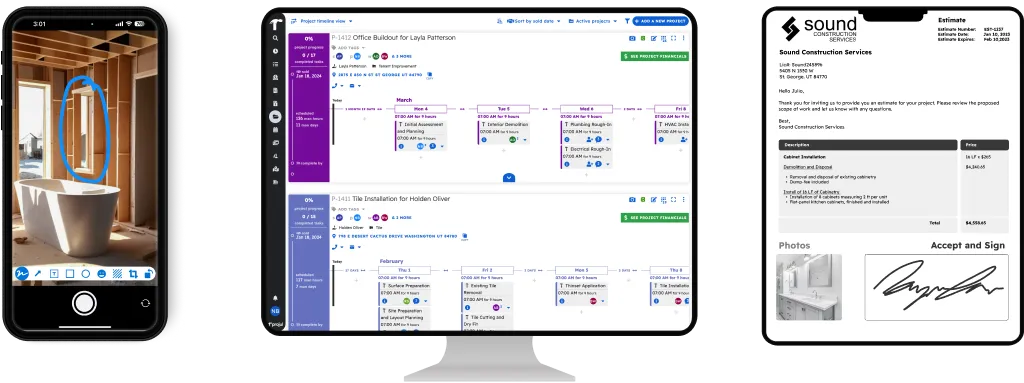
- Send estimates, and convert them into scheduled tasks when the project starts
- Invoice throughout the project, including change orders
What Is Residential Construction Software?
Residential construction software is a platform that helps home builders and remodelers manage every phase of a project, from first lead through warranty work, in one system. It connects estimating, scheduling, job costing, client communication, and invoicing so nothing gets lost between the field and the office.
Projul’s residential construction software connects estimating, scheduling, job costing, and client communication in one platform built by contractors who have managed home builds from first lead to warranty work. Projul offers flat-rate pricing with no per-user fees for construction companies of all sizes.
Residential projects carry a layer of complexity that commercial work does not. You are building or remodeling someone’s home. The stakes feel personal to every client. They want updates, opinions on finishes, clear pricing, and a timeline they can trust. Residential construction software exists to handle the business side so you can focus on building and on keeping your homeowners happy.
Manage Residential Projects and Client Relationships Together
Residential contractors work in people’s homes, which means managing both the project and the client relationship at the same time. A missed update or forgotten follow-up costs you more than time. It costs you referrals. Projul helps residential contractors keep homeowners informed, schedule crews efficiently, and make sure every job stays profitable from estimate to final payment. Over 5,000 contractors run their businesses through Projul.
Most home builder software on the market was designed by tech companies and sold to contractors as an afterthought. You can feel the difference when you use it. Buttons in the wrong place. Workflows that skip how a real residential project moves. Features nobody asked for and missing ones everybody needs.
Projul started on a job site, not in a Silicon Valley office. Kurt Clayson built it while running his own residential construction company because nothing else fit.
Build Your Residential Pipeline
Projul’s lead management tools organize every residential inquiry from first contact through signed contract. See which estimates are out, which need follow-up, and which clients are ready to book. Set automatic reminders so your sales process works even during your busiest weeks. Convert signed estimates directly into scheduled projects with one click.
Residential contractors using Projul report a 32% average profit increase by closing more leads and keeping their pipeline organized. That starts with knowing exactly where every prospect stands without digging through emails.
Custom Home Builds: Keep Complex Projects on Track
Custom homes are the most demanding residential projects you can take on. Dozens of selections, rolling change orders, lender draw schedules, and homeowners who want to be involved in every decision. Without residential construction software built for this level of detail, things fall apart fast.
Selections Tracking and Allowances
Every custom build has a selections process. Countertops, flooring, lighting, hardware, paint colors. When selections happen on time, the project flows. When they don’t, your framing crew is standing around waiting for window specs.
Projul lets you organize selections by category, assign allowance amounts, and track what the homeowner has picked versus what is still outstanding. When a selection runs over the allowance, the overage rolls into a change order automatically. Your client sees the cost impact before you proceed, and your budget updates without manual number crunching.
Selection delays are one of the top reasons residential projects fall behind schedule. With Projul, you can flag overdue selections and send reminders directly through the customer portal. Your homeowner sees what is holding things up, and you have a paper trail showing when you asked.
Draw Schedules and Lender Coordination
Most custom home builds run on construction loans with draw schedules tied to completion milestones. If your documentation does not match what the lender needs, the draw gets delayed. Delayed draws mean you are floating the cost of materials and labor out of your own pocket.
Projul tracks project milestones tied to your budget, so when the lender asks for proof of completion on the framing phase, you pull a report showing completed tasks, actual costs, and progress photos. Everything the bank needs, generated from data you already entered while running the job.
Residential contractor software that connects your schedule, budget, and documentation to draw milestones saves you from scrambling every time a lender inspection comes up.
Remodels and Additions: Control Scope Creep
Remodels and additions are where scope creep lives. The homeowner sees the opened-up wall and decides they also want to move the kitchen island. Or they visit a tile showroom and change their entire bathroom design mid-build.
These changes are not bad for business if you capture them. They are only bad when they happen verbally, your crew does the work, and nobody documents the cost. That is how you lose money on a job you thought was profitable.
Change Orders That Protect Your Margins
Projul tracks every change order inside the project record. When a homeowner requests additional work, you document the scope, attach a price, and send it through the customer portal for approval. Once signed, the change order updates your job cost budget and your invoice automatically.
No more end-of-project arguments about what was included in the original estimate. No more eating costs because you cannot prove the work was extra. Residential construction software should make change orders easy to create, easy to approve, and impossible to lose.
Managing Homeowner Expectations
The biggest complaint homeowners have about contractors is not the quality of work. It is communication. They want to know what is happening, when it will be done, and how much it costs. When they feel left in the dark, they get anxious. Anxious clients call constantly, show up on site, and second-guess decisions.
Projul’s customer portal gives homeowners visibility without giving them access to your internal notes or margins. They see the schedule, approved estimates, change orders, and invoices. When something shifts, they see the updated timeline. When a phase wraps up, they see progress photos.
On the Pro plan, Projul AI Connect can help with the weekly check-in, too. The AI assistant you already use (ChatGPT, Claude, or Gemini) reads the project’s notes, schedule, and files and drafts a recap for the homeowner. Someone on your team reviews it and sends it.
This level of transparency turns nervous homeowners into your best referral sources. They tell their friends about the contractor who kept them informed the entire time.
New Construction: Run Multiple Builds at Once
Running three to ten new construction projects at the same time requires a system that shows you everything at a glance. Which houses are on schedule? Which are waiting on inspections? Where is your framing crew next week?
Projul’s dashboard gives you a bird’s-eye view of every active project with status, budget health, and upcoming tasks. Drag-and-drop scheduling across multiple job sites means you can reassign crews when a rain day pushes one project and opens up time on another.
Software for home builders should scale with you. Whether you are building two custom homes a year or twenty spec homes, Projul handles the volume without slowing down.
Permit Management for Residential Projects
Residential permits vary by municipality, and missing an inspection window can stall your project for days or weeks. Projul lets you track permit status, inspection dates, and approval documents inside each project record. Your superintendent sees which inspections are coming up, and your office staff can pull permit docs without digging through filing cabinets.
Keeping permit management inside your residential construction software means you never lose track of where a project stands with the building department.
Give Homeowners the Transparency They Expect
Projul’s customer portal lets homeowners check their project schedule, view approved estimates, and access invoices at any time. When a material delay pushes the timeline, update the schedule and the client sees it without a text thread. Residential contractors using Projul report fewer disputes and more repeat business because clients feel respected and informed.
Photo Progress Updates for Homeowners
Homeowners love seeing progress on their project, especially when they are not living on site during a build. Projul makes it easy for your crew to snap photos from the mobile app and attach them directly to the project record. These photos show up in the customer portal, giving your homeowner a visual timeline of their build.
Progress photos also serve a practical purpose. They document conditions behind walls before drywall goes up. They prove completed milestones for lender draw requests. And they give you a visual record if a warranty claim comes up months later.
Your crew takes photos anyway. Projul just puts them somewhere useful instead of buried in a camera roll.
Warranty Management After the Build
The project does not end at final payment. Residential contractors know that warranty callbacks are part of the business. A nail pop here. A door that sticks there. How you handle warranty work defines whether that client refers you or warns their neighbors.
Projul lets you create warranty items tied to the original project. Track what was reported, when you addressed it, and what the resolution was. When a homeowner calls about a crack in the grout six months after move-in, you pull up the project, see the original install photos, and schedule the repair without starting from scratch.
Organized warranty tracking shows homeowners that you stand behind your work. It also protects you from unreasonable claims because everything is documented.
Manage Jobs From the Job Site, Not the Office
Your crew leads bounce between houses all day. Projul’s native iOS and Android app lets them check today’s schedule, clock in with GPS geofencing, and snap progress photos for the homeowner portal without heading back to the office. Everything syncs in real time so your office staff sees updates the moment they happen.
The app was designed for the field first. Big buttons. Simple navigation. It works on a dusty phone with one bar of signal. Your crew picks it up by lunch on day one.
Time Tracking With GPS Verification
Time tracking in residential construction is a mess at most companies. Paper timesheets filled out from memory at the end of the week. Guys rounding up. No way to verify anyone was actually on the job site they claimed. If payroll accuracy is a priority, see our guide to the best construction payroll software.
Projul’s time tracking includes geofencing. Your crew clocks in from the mobile app, and the system verifies they are at the right job site. The labor hours tie back to specific projects and tasks, feeding your job costing numbers automatically.
Job Costing That Tells You the Truth
Can you answer this question right now: am I making money on the Smith remodel?
If that requires an hour in a spreadsheet, your system is broken. Projul tracks estimated costs versus actual costs on every project in real time. You see where labor dollars are going, which material line items are running over, and whether the project is on pace to hit your target margin.
Residential construction software should warn you at week two that labor is trending over budget, not surprise you with a loss after the final walkthrough.
Contractors using Projul report a 32% average increase in profitability. That number comes from catching cost overruns early while you can still do something about them.
Invoicing That Gets You Paid Faster
Slow invoicing is slow money. In residential construction, cash flow is everything. If you wait until the end of a project to send an invoice, you are financing someone else’s home with your cash flow.
Projul lets you invoice throughout the project. Send deposit invoices before work starts. Bill for completed phases as you go. Add change orders to the invoice with one click. Clients pay online directly from the invoice, which means faster payments with less chasing.
QuickBooks Integration
Double-entering data into your accounting software is a waste of time. Projul integrates with QuickBooks Online so your invoices, payments, and customer records sync automatically. When you send an invoice in Projul, it shows up in QuickBooks. When the client pays, both systems update. Your bookkeeper stays happy, and your financial data stays accurate.
Why Residential Contractors Switch to Projul
Most residential contractors come to Projul after trying one or two other platforms. The story is usually the same: the last tool was too expensive, too complicated, or too disconnected from how residential projects actually work.
Here is what makes Projul different:
- Built by a contractor. Kurt Clayson started Projul after years of running his own residential construction company. Every feature exists because a real contractor needed it.
- Flat-rate pricing. Plans start at $2,388 per year, and Core is $4,788 per year for up to 10 users. No per-user fees. Your estimators, crew leads, and office coordinator all get access.
- All-in-one platform. CRM, estimating, scheduling, job costing, time tracking, invoicing, and client portal. One login. One place.
- Rated 4.9/5 on G2. For both ease of use and quality of support. That is contractors voting with their reviews.
- Over 5,000 contractors. From one-truck operations to companies with 200+ employees.
Honest Pricing for Residential Contractors
Most home builder software charges per user. That pricing model punishes growth. Hire an estimator? More money. Give your crew leads access? Way more money.
Projul starts at $2,388 per year for your residential company. No per-user fees. Your estimators, crew leads, office staff, and field workers all get full access without inflating the bill.
Over 5,000 contractors use Projul to manage their operations, and residential contractors consistently report saving 2+ hours daily on admin work. G2 users rate Projul 4.9/5 for ease of use and 4.9/5 for quality of support.
Residential Construction Software vs. the Old Way
Still running your residential business with spreadsheets, text threads, and a whiteboard in the office? Here is what that actually costs you.
Estimating by spreadsheet: You spend 45 minutes to an hour per estimate. Formulas get overwritten. You send a bid with a pricing error and either eat the cost or lose the client. With residential construction software, you build an estimate in 15 minutes using saved templates, and the math is always right.
Scheduling on a whiteboard: It works until you have more than three active jobs. Then someone erases the wrong line, a crew shows up at the wrong house, and your morning disappears into phone calls. Residential contractor software puts the schedule on everyone’s phone and updates it in real time.
Job costing after the fact: You finish a project, add up the receipts, and discover you lost money. That knowledge does not help you on a job that is already done. Real-time job costing warns you at week two, not month four.
Invoicing from Word documents: You format an invoice, email it, and hope the client pays. No online payment option. No automatic reminders. No connection to your accounting software. Projul invoices include online payment, automatic QuickBooks sync, and a payment status you can check in three seconds.
The math is simple. The time you waste on manual processes costs more than the software. Most contractors make back their Projul subscription in the first month from time savings alone.
Coordinating Subcontractors on Residential Job Sites
Most residential contractors do not self-perform every trade. You might frame with your own crew but sub out electrical, plumbing, HVAC, and tile. On a typical kitchen remodel, you could have four to six subs rotating through the same space over a three-week window. When one sub runs late, every trade behind them shifts, and your completion date slides.
The real problem is not that subs run late. It is that nobody tracks the ripple effect until the homeowner asks why the project is behind. By then, you are making phone calls, rearranging schedules, and absorbing costs you did not plan for.
Projul puts your subcontractor schedule on the same timeline as your in-house crew. When you assign a plumber to rough-in on Tuesday and an electrician to follow on Thursday, both trades see their window. If the plumber pushes to Wednesday, you shift the electrician on the same drag-and-drop calendar and everyone gets notified automatically through the app.
You can also track sub costs against your estimate in real time. If you budgeted $4,500 for electrical rough-in and the sub’s invoice comes in at $5,200, Projul flags the variance before you send the homeowner their next progress bill. That early warning is the difference between adjusting your approach on the next phase and discovering a margin problem after the final walkthrough.
For contractors running five to ten residential projects at the same time, sub coordination is where jobs either stay on track or fall apart. Your project management dashboard shows which subs are on which job, who is behind, and where the bottlenecks are, all without a single phone call. Read our full guide on subcontractor management for more on keeping subs accountable and your projects moving.
Seasonal Scheduling to Maximize Year-Round Revenue
Residential construction has a rhythm that follows the calendar. Spring brings a flood of remodel inquiries from homeowners who spent the winter planning. Summer is peak production when daylight hours are long and weather cooperates. Fall brings a rush to close out exterior projects before the cold hits. Winter slows down exterior work but opens up interior remodels for contractors who plan ahead.
The problem is that most contractors ride this wave reactively. They scramble to hire help in June and lay people off in December. Revenue swings wildly from month to month. Overhead stays constant while income does not.
Smart residential contractors use their slow season to book interior work: bathroom remodels, basement finishes, kitchen renovations, and other projects that do not depend on weather. The key is having a scheduling system that shows your capacity months in advance so you can sell into open windows before they turn into idle weeks.
Projul’s scheduling tools give you a season-level view of your project pipeline. See which months are packed and which have gaps. When a homeowner calls in September asking about a bathroom remodel, you can book them into January when your crew would otherwise be sitting at home. That January revenue might be the difference between a profitable year and breaking even.
Production home builders face a different seasonal challenge. Permit timelines, foundation pours, and framing schedules all shift based on weather and municipality backlogs. A wet spring can push your entire build calendar by three weeks. Projul lets you shift project timelines with one action, automatically updating every task and every trade’s scheduled window downstream. Your subs see the revised dates on their phones without you making fifteen phone calls.
For a deep look at planning your marketing and sales around seasonal patterns, check out our seasonal marketing calendar guide. Pairing a solid sales calendar with a scheduling tool that shows real capacity is how residential contractors keep revenue steady all twelve months.
Managing Material Delays and Backorders on Home Builds
Every residential contractor has a story about a material delay that wrecked a project timeline. Custom windows with a twelve-week lead time. A discontinued tile that the homeowner already approved. Cabinets that show up damaged and need to be reordered. When materials do not arrive on schedule, your crew either sits idle or you start shuffling tasks to keep them productive, both of which cost you money.
The first step is knowing what you ordered, when you ordered it, and when it is supposed to arrive. That sounds basic, but on a project with forty line items from eight different suppliers, it is easy to lose track. Projul ties your material orders to your project timeline so you can see which deliveries are on track and which are running behind.
When a delay hits, the question becomes: what can your crew work on instead? With Projul’s task-level scheduling, you can pull forward interior trim work while waiting for exterior stone delivery. Or move your crew to a different project for two days while the replacement cabinets ship. The schedule updates in real time and everyone, your crew, your subs, and the homeowner, sees the revised plan.
Material price changes are another headache. You bid a project in January with lumber at one price, and by the time you start in April, the cost has jumped 15%. Projul tracks your estimated material costs against actual purchase prices so you see the margin impact as it happens. If the variance is significant enough to warrant a conversation with your client, you have the documentation to support it. Our guide on material price escalation covers strategies for handling these situations without damaging client relationships.
For contractors who furnish some materials and let homeowners supply others, Projul keeps both categories organized in the project record. You know which items are on your plate and which are waiting on the homeowner. When the client’s special-order faucet has not shipped with two weeks until plumbing trim, you can flag it through the client portal and document that the delay is not on your end. That paper trail matters when the homeowner asks why the project took longer than expected.
Tracking Punch List Items and Post-Completion Service Calls
The last five percent of a residential project takes the most effort per dollar. Punch list items, touch-up paint, a cabinet door that does not close right, a grout line that needs repair, caulking that was missed in the master bath. These small items determine whether the homeowner pays the final invoice happily or holds your retention and drags their feet.
Most contractors track punch lists on paper or in a notes app. Items get missed. The homeowner mentions a scratch on the hardwood during the walkthrough, you write it on a piece of paper, and three weeks later nobody can find that note. Meanwhile, the client is frustrated because they already mentioned it once.
Projul lets you create punch list items as tasks within the project. Each item has a description, a photo, an assigned crew member, and a due date. During the final walkthrough, enter items directly into the app as you and the homeowner walk through each room. The homeowner sees the list in their portal and knows exactly what you are going to address. If you would rather jot notes during the walkthrough and sort them later, Pro users can hand those notes to their AI assistant and get the punch list tasks built in Projul.
After move-in, service calls are part of the residential contractor’s reality. A door sticks when humidity changes. Caulking shrinks and needs a touch-up. A nail pop appears as the framing lumber dries. These are normal, but how you handle them defines your reputation. Our warranty management feature lets you log each service request, tie it to the original project, and track it through completion.
Contractors who handle post-completion work quickly and professionally get referrals. Contractors who let punch items and callbacks drag on for months get bad reviews. The difference often comes down to whether you have a system that tracks these items or whether they live in someone’s text message history. Projul keeps every callback, every punch item, and every service visit documented in one place so nothing slips through the cracks.
For more on building a warranty process that protects your business and satisfies your clients, read our construction warranty management guide.
Keeping Residential Budgets Visible Across Multiple Active Projects
When you are running six to twelve residential projects at the same time, budget visibility is the first thing that disappears. You know roughly how the Smith kitchen remodel is going, and you have a sense that the Jones addition is running hot on labor, but you cannot say with confidence which of your twelve active projects will finish profitable and which ones will not.
That uncertainty costs you money because you cannot fix what you cannot see. A project that runs 8% over budget on labor in week two is manageable if you catch it. That same overage in week eight, after you have already billed the client based on your original estimate, is a loss you absorb.
Projul’s live cost tracking gives you a dashboard view of every active project’s budget health. Green means on track. Yellow means watch closely. Red means act now. You do not need to open each project individually and add up receipts. The numbers update automatically as labor hours post from time tracking and material costs post from purchase records.
For residential contractors, the most common budget killers are labor overruns on finish work (trim carpentry, tile, paint touch-ups), material price increases between estimate and purchase date, and scope additions that were not captured as change orders. Projul flags all three. When your trim carpenter spends 30 hours on a job you estimated at 20, you see it the same week it happens. When your lumber cost jumps between the estimate date and the order date, the variance shows up in your cost report. When the homeowner asks for an extra closet organizer and your crew does it without a change order, the labor hours still post to the project, and the budget shows the overage.
Catching these issues early is worth thousands of dollars across a year of projects. Residential contractors using Projul report a 32% average profit increase, and budget visibility across multiple projects is one of the biggest drivers of that number.
Managing Allowances and Upgrade Selections Without Delays
On custom home builds and higher-end remodels, the selections process can make or break your schedule. The homeowner needs to choose flooring, countertops, tile, cabinet hardware, light fixtures, plumbing fixtures, and paint colors, sometimes across forty or more individual decisions. When selections happen on time, the project flows. When they do not, your tile installer shows up with nothing to install and your electrician cannot set fixtures because nobody picked them yet.
The root of the problem is that most contractors manage selections through email chains, text messages, and verbal conversations. The homeowner says they picked the countertop last Tuesday. Your office has no record of it. The supplier says they never received the order. Meanwhile, your cabinet installer is scheduled for next week and cannot finish without knowing the countertop dimensions.
Projul’s selections tracking tools organize every decision by category with allowance amounts, chosen products, and approval status. The homeowner sees their outstanding selections in the client portal with deadlines tied to the construction schedule. When a selection is overdue, the system flags it before it causes a delay.
Allowance management is the financial side of selections. You set a $3,000 allowance for kitchen countertops in the estimate. The homeowner falls in love with a $5,500 slab of quartzite. That $2,500 overage needs to become a change order before the stone gets fabricated, not after. Projul connects allowances to change orders so overages are captured, approved, and added to the invoice automatically. No more end-of-project surprises where the homeowner owes $8,000 more than they expected because nobody tracked the overages along the way.
For production builders running spec homes, selections are simpler but still need tracking. Standard finish packages with defined options keep the process moving. Projul lets you set up templates for each finish level (builder grade, mid-range, premium) so your team pulls the right package for each home without rebuilding the selections list from scratch.
The bottom line is that selections drive both your schedule and your budget. A contractor who manages selections proactively keeps the project moving on time. A contractor who chases decisions reactively spends half their day on follow-up calls and rework. The difference comes down to having a system that puts deadlines on selections and ties them to the construction schedule. Projul does exactly that, and your homeowners appreciate the structure because it helps them make decisions without feeling rushed or overwhelmed. For more on how to keep your residential projects running without selection-related bottlenecks, see how Projul’s to-dos and daily logs keep your entire team aligned on what needs to happen each day.
Documenting Communication for Dispute Prevention
Residential construction disputes almost always come down to one thing: “I said this” versus “they said that.” The homeowner claims you agreed to include crown molding in the master bedroom. You are sure it was discussed as an add-on. There is no written record either way, so the argument becomes about who remembers the conversation correctly.
These disputes are preventable, but only if you document communication as it happens. Projul’s communication tools keep a record of messages between your team and the client. When a homeowner requests a change through the client portal, it is timestamped and stored on the project record. When you send a schedule update, the notification is logged.
Beyond the portal, make it a habit to follow up verbal conversations with a written summary in Projul. “Per our conversation today, we discussed adding recessed lighting in the kitchen. I will prepare a change order for your review.” That takes thirty seconds and saves you a $2,000 argument later.
For residential contractors, the most expensive disputes are not about defective work. They are about scope. Did the estimate include that item or not? Was the change order approved or just discussed? Who was supposed to supply the light fixtures? Projul creates a documented trail for every decision so when a disagreement arises, you have the facts, not just your memory.
Our construction communications guide shows how to set up consistent client communication workflows that prevent misunderstandings from turning into costly disputes. The contractors who document everything are the ones who rarely end up in mediation. And even when a disagreement does arise, having the full conversation history accessible in seconds means you resolve it quickly instead of spending weeks going back and forth. That kind of operational clarity is what separates contractors who grow steadily from contractors who stay stuck dealing with the same preventable problems year after year.
Stop Losing Money on Residential Projects
If you are still managing your residential construction company with spreadsheets, group texts, and a filing cabinet full of change orders, you already know it is not working. You are losing time, losing money, and losing details every single day.
Residential construction software like Projul is not about adding technology for its own sake. It is about running a tighter operation so you can take on more work, protect your margins, and actually go home at a reasonable hour.
Over 5,000 contractors have already made the switch. They spend less time on admin, catch budget problems earlier, and get paid faster. Your competition is probably one of them.