
Clean Room and Controlled Environment Construction for Pharmaceutical and Tech Facilities | Projul
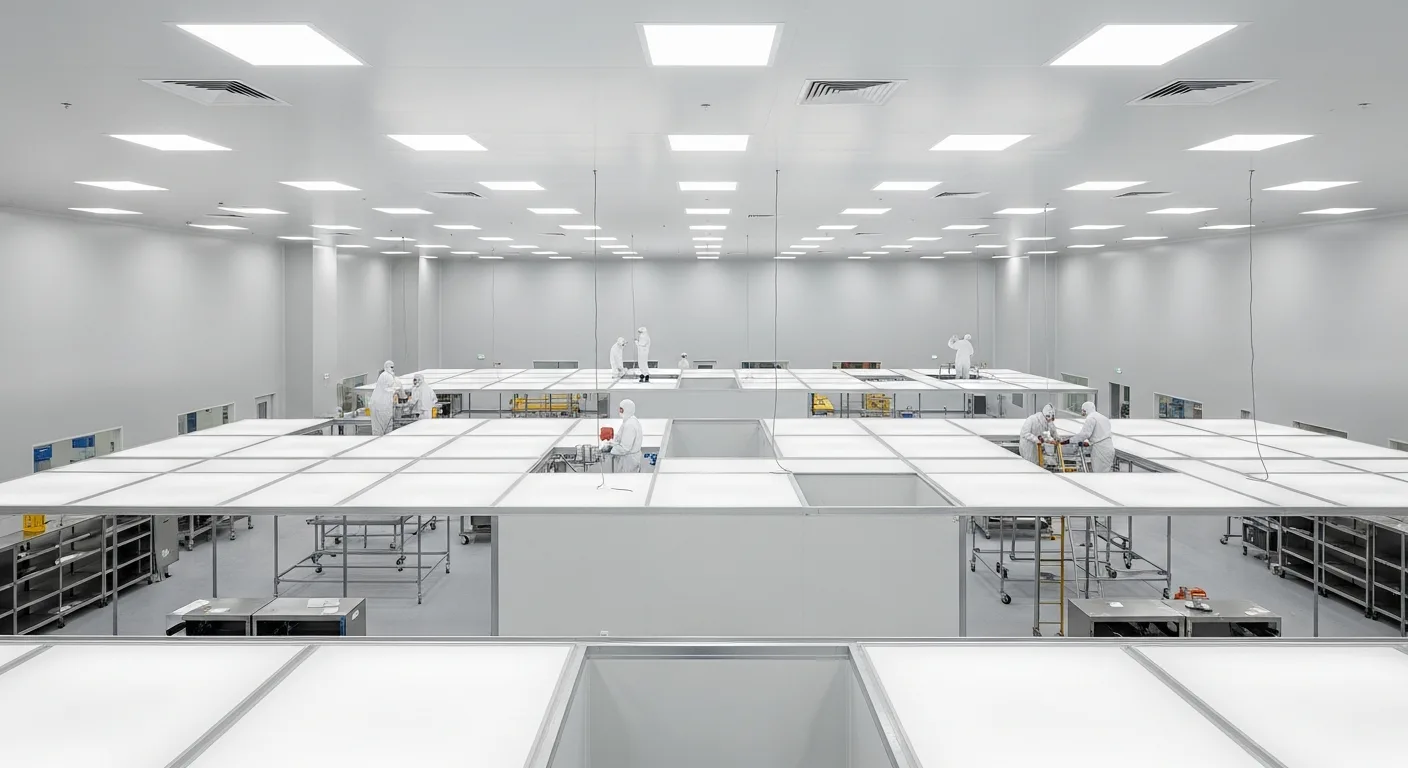
Clean room construction is a completely different world from standard commercial building. Every surface, every joint, every duct connection, and every square inch of ceiling matters. Particle counts that would be invisible in a normal building can shut down a semiconductor fab or contaminate a pharmaceutical batch.
If you are a general contractor taking on your first clean room project, or an experienced builder looking to tighten up your process, this guide covers the construction fundamentals you need to know.
Understanding Clean Room Classifications
Clean rooms are classified by the maximum allowable number of airborne particles per cubic meter. The current standard is ISO 14644-1, which replaced the old Federal Standard 209E (Class 100, Class 1000, etc.) that many people in the industry still reference.
ISO Classification Quick Reference
| ISO Class | Max Particles per m³ (at 0.5 μm) | Old FS 209E Equivalent | Typical Applications |
|---|---|---|---|
| ISO 1 | 10 | Class 1 | Advanced semiconductor |
| ISO 2 | 100 | Class 10 | Semiconductor, nanotechnology |
| ISO 3 | 1,000 | Class 100 | Semiconductor fab |
| ISO 4 | 10,000 | Class 1,000 | Semiconductor, LCD |
| ISO 5 | 100,000 | Class 10,000 | Pharma sterile, semiconductor |
| ISO 6 | 1,000,000 | Class 100,000 | Pharma, optical assembly |
| ISO 7 | 10,000,000 | (none) | Pharma compounding, medical device |
| ISO 8 | 100,000,000 | (none) | General pharma, electronics assembly |
Note: Actual particle counts at 0.5 microns for ISO 5 are 3,520 per cubic meter, not 100,000. The table above uses the 0.1 micron counts for the lower classes. Always reference ISO 14644-1 directly for precise limits at each particle size.
The classification drives almost every construction decision, from the HVAC system size to the wall finish to the gowning room layout. A higher classification (lower ISO number) means tighter construction tolerances and higher costs.
HVAC: The Heart of the Clean Room
The HVAC system is the single most critical and expensive component of any clean room. It does three things: filters the air, controls temperature and humidity, and maintains pressure relationships between rooms.
Air Handling Units
Clean room air handling units (AHUs) are larger and more complex than standard commercial units. Key differences:
- Higher static pressure to push air through HEPA or ULPA filters (1.0 to 2.5 inches w.g. across the filter bank alone)
- Redundancy requirements, often N+1 fan configurations for critical spaces
- Precise temperature control within plus or minus 0.5 to 1.0 degrees F
- Humidity control within plus or minus 2% to 5% RH, using steam humidifiers and cooling coils for dehumidification
- Energy recovery systems to manage the massive energy consumption of high air change rates
Ductwork
Clean room ductwork must be sealed to SMACNA Seal Class A (all joints and seams sealed). Leaky ductwork defeats the purpose of HEPA filtration by introducing unfiltered air downstream of the filters.
Duct materials are typically:
- Galvanized steel with sealed joints for most applications
- Stainless steel for pharmaceutical and corrosive environments
- Specialty coatings for acid or solvent exposure
All ductwork should be cleaned and sealed at the factory or on-site before installation. Protect open duct ends during construction with sealed caps, not just tape that falls off.
HEPA/ULPA Filter Ceilings
For ISO Class 5 and cleaner, the ceiling is essentially a bank of HEPA or ULPA filters. Coverage typically ranges from 25% to 100% of the ceiling area depending on the classification:
- ISO Class 5: 25% to 35% HEPA coverage (non-unidirectional) or 80% to 100% (unidirectional)
- ISO Class 4 and below: Near 100% ULPA coverage with unidirectional (laminar) airflow
- ISO Class 6 to 8: Individual HEPA filter modules at 5% to 15% coverage
The filter ceiling grid, often called a fan filter unit (FFU) ceiling, needs precise structural support. Each 2x4-foot FFU weighs 30 to 50 pounds and generates vibration from its internal fan. The ceiling grid must be level within 1/8 inch over its full span and rigid enough to prevent vibration transfer.
Pressurization
Clean rooms operate under positive pressure relative to less-clean surrounding spaces. This prevents contaminated air from flowing into the clean area when doors open.
Typical pressure differentials:
- Between ISO classes: 0.03 to 0.05 inches w.g. per classification step
- Clean room to corridor: 0.02 to 0.05 inches w.g.
- Corridor to general building: 0.02 to 0.03 inches w.g.
Maintaining these differentials requires:
- Automatic pressure controls (variable air volume dampers)
- Proper door sealing (gaskets on all four sides)
- Pass-throughs instead of direct openings between classified spaces
- Airlocks or gowning rooms between the clean area and uncontrolled spaces
Return Air Paths
Air returns in clean rooms are typically at the floor level through perforated raised floor panels or low wall returns. This creates a top-down airflow pattern that sweeps particles away from the work zone and toward the return path.
Raised access floors are common in semiconductor fabs, with a plenum depth of 18 to 36 inches below the floor panels. The floor panels must be rated for the expected loads (equipment, personnel, material transport) and must not generate particles themselves.
Wall and Ceiling Systems
Clean room surfaces must be smooth, non-porous, cleanable, and resistant to the chemicals used in the specific process. Every crack, crevice, or rough surface is a place for particles to accumulate and later become airborne.
Modular Panel Systems
Modular clean room wall systems are the industry standard for ISO Class 7 and cleaner. These systems use aluminum extrusion frames with flush-mounted panels that create a smooth, sealed surface.
Advantages:
- Factory-fabricated for consistent quality
- Fast installation compared to conventional construction
- Easy to reconfigure when process needs change
- Integral window frames, door frames, and pass-throughs
- Flush surfaces with minimal ledges and crevices
Panel materials include:
- Painted steel (most common, cost-effective)
- Stainless steel (pharmaceutical wet areas, corrosive environments)
- Fiberglass reinforced plastic / FRP (chemical resistance)
- Aluminum (lightweight, non-corrosive)
Panel joints are sealed with flush gaskets or silicone sealant. The goal is zero gaps, zero ledges, and zero exposed fasteners on the clean side.
Conventional Construction
For ISO Class 8 and some Class 7 applications, conventional gypsum board walls with epoxy or polyurethane paint can work. Requirements:
- All joints taped and finished to a Level 5 finish (skim coat over entire surface)
- Two coats of epoxy or high-performance polyurethane paint
- Coved base where walls meet floors (no square corners that trap particles)
- Sealed penetrations for conduits, pipes, and ductwork
Conventional construction costs less upfront but is harder to reconfigure and may not achieve the same surface smoothness as modular panels.
Ceilings
Non-HEPA ceiling areas use flush, gasket-sealed ceiling panels in a concealed grid system. The ceiling must be sealed to the wall system at the perimeter. Any penetration (sprinklers, lights, speakers) needs a sealed, flush-mounted trim ring.
Lighting fixtures for clean rooms are recessed, sealed, and have smooth lenses that are easy to wipe down. Standard lay-in fluorescent troffers are not acceptable because they create ledges and gaps where particles collect.
Flooring
Clean room floors must be seamless, chemical-resistant, and easy to clean. Common options:
- Sheet vinyl or PVC: Welded seams, coved at walls. The most common choice for pharmaceutical clean rooms.
- Epoxy or polyurethane coatings: Applied to concrete, 40 to 125 mils thick. Good chemical resistance but requires careful surface preparation.
- Raised access floor with vinyl or HPL panels: Used in semiconductor fabs for underfloor air return and cable management.
All flooring must be installed by specialists who understand clean room requirements. A poorly welded vinyl seam or a pinhole in an epoxy floor becomes a contamination source.
MEP Coordination
The mechanical, electrical, and plumbing systems in a clean room are more complex and more tightly coordinated than in standard construction. Here is where careful project management really matters.
Electrical
- Clean power: Sensitive equipment often requires dedicated power with voltage regulation and harmonic filtering.
- Emergency power: Critical clean rooms need generator backup to maintain pressurization and temperature during power outages.
- Lighting: LED fixtures with smooth, sealed lenses. Typical illumination levels are 50 to 75 footcandles at work surfaces.
- Grounding: Static-sensitive environments (semiconductor) require comprehensive ESD grounding systems in the floor, workstations, and equipment connections.
Plumbing
- Process piping: Ultra-pure water (UPW), process gases, and chemical distribution systems are separate from building plumbing and require specialized installation.
- Drain systems: Chemical waste drains must be compatible with the chemicals used. Double-contained piping is common for hazardous materials.
- No exposed piping: All plumbing within the clean room must be concealed in the walls, ceiling, or raised floor. Exposed pipes collect particles and are impossible to clean properly.
Fire Protection
Sprinkler systems in clean rooms need special attention:
- Recessed, flush-mounted heads with clean room trim rings
- Pre-action or dry-pipe systems to prevent accidental discharge in sensitive areas
- FM Global or Factory Mutual guidelines for clean room fire protection (especially semiconductor fabs)
- Coordination with the HEPA ceiling because sprinkler heads must be located between filter modules
Process Utilities
Beyond standard MEP, clean rooms for semiconductor and pharmaceutical use require:
- Process vacuum
- Compressed dry air (CDA) and nitrogen
- Specialty gases (silane, ammonia, etc. for semiconductor)
- Chilled water for process cooling
- Steam for sterilization (pharmaceutical)
Each of these systems has specific material, cleanliness, and testing requirements that differ from building utilities.
Construction Sequencing and Contamination Control
Building a clean room requires construction practices that anticipate the end use. You cannot build a particle-free environment using particle-generating methods and expect to clean it up at the end.
Phased Approach
- Shell construction: Build the surrounding structure (walls, roof, slab) using conventional methods.
- MEP rough-in: Install ductwork, piping, conduit, and cable tray above the clean room ceiling level.
- Clean room envelope: Install the modular wall system, ceiling grid, and floor system. Seal all penetrations.
- HVAC startup: Start the air handling system and bring the room under positive pressure.
- Interior finish work: Complete all remaining work inside the clean room (equipment installation, final connections) under controlled conditions.
- Cleaning and wipe-down: Professional clean room cleaning before validation testing.
- Validation testing: Particle counts, airflow measurements, pressure differential verification.
Construction Protocols
Once the clean room envelope is sealed and pressurized, all work inside must follow contamination control protocols:
- Workers wear clean room gowns, gloves, and shoe covers (or full bunny suits for higher classifications)
- All materials entering the clean room must be cleaned and de-particled in an anteroom
- No cardboard boxes inside the clean room (cardboard is a major particle generator)
- Use clean room-compatible tools and equipment
- Limit the number of workers inside at any time
- Track who enters and exits
These requirements slow down construction work significantly. Plan your schedule accordingly. What might take one day in a normal building can take three days in a clean room environment.
Validation and Testing
A clean room is not a clean room until it passes validation testing. This is where you prove the room meets its design classification.
ISO 14644-3 Testing
The standard testing protocol includes:
- Particle count testing at specified locations and heights using calibrated particle counters
- Airflow velocity and uniformity measurements at filter faces and work surfaces
- HEPA/ULPA filter integrity testing (DOP or PAO aerosol challenge to detect leaks in filters and filter seals)
- Pressure differential measurements between rooms
- Temperature and humidity uniformity measurements
- Recovery testing to verify how quickly the room returns to classification after a contamination event
Three Stages of Testing
- As-built: Room complete, HVAC running, no equipment or personnel
- At-rest: Equipment installed and powered but not in production
- Operational: Normal production conditions with personnel
Each stage may produce different results. A room that passes as-built may fail at-rest if equipment generates more particles than expected. Build margin into your design.
Project Management for Clean Room Construction
Clean room projects involve tight tolerances, specialized trades, and strict sequencing requirements. Missing a single seal detail can cause a validation failure that delays the entire project.
This is where having a solid construction management system makes a real difference. Projul helps you coordinate the multiple specialty contractors (HVAC, modular walls, flooring, validation, process piping) that a clean room project requires. Track submittals, manage RFIs, and keep your schedule updated in real time so that every trade knows exactly when they need to be on-site and what needs to happen before they start.
If you are managing clean room or other specialty construction projects, take a look at Projul’s pricing to find the right plan for your team. Or request a demo to see how it handles the complex coordination that these projects demand.
Common Clean Room Construction Mistakes
Ignoring the gowning room: The gowning room is part of the contamination control system. It needs its own air handling, proper size for the number of personnel, and a logical flow from dirty side to clean side.
Skipping the construction protocol: Allowing standard construction practices inside a sealed clean room envelope means a longer and more expensive cleaning phase before validation.
Underestimating the HVAC: The air handling system for even a small ISO Class 5 room is enormous compared to standard commercial HVAC. Make sure the building can support the size and weight of the equipment, the electrical load, and the ductwork routing.
Poor sealing at penetrations: Every conduit, pipe, and duct that passes through a clean room wall or ceiling needs a proper seal. Expanding foam or standard caulk is not acceptable. Use clean room-rated sealants and test for leaks.
Not involving the validation firm early: The validation team should review the design before construction starts, not just show up at the end to test. Their input on sampling locations, airflow patterns, and pressure cascades can prevent costly rework.
Wrapping Up
Clean room construction requires a level of precision and contamination awareness that goes well beyond standard building practices. From the HVAC system design to the last silicone bead on a wall panel joint, every detail affects whether the room will pass validation and perform as intended.
Plan your schedule with extra time for the controlled construction phase. Budget for the specialized materials and labor. And keep every trade tightly coordinated because in a clean room, one contractor’s oversight becomes everyone’s problem.
Frequently Asked Questions
What is an ISO Class 5 clean room?
How much does it cost to build a clean room?
What HVAC air change rate is needed for a clean room?
What is the difference between HEPA and ULPA filters?
How long does clean room validation take?
Can you retrofit an existing building into a clean room?
What wall systems are used in clean rooms?
Do clean rooms need positive or negative pressure?
Related Articles

BIM Clash Detection: How to Catch Conflicts Before They Cost You on the Jobsite
BIM Clash Detection: How to Catch Conflicts Before They Cost You on the Jobsite Every contractor has a story about the...
Read More →
Asphalt Paving and Compaction Guide: Mix Types, Laydown Temperatures, and Quality Testing
Asphalt paving looks straightforward from a distance. A truck dumps material, the paver lays it down, and rollers...
Read More →
Construction Jobsite Wi-Fi & Connectivity Guide: Setting Up Reliable Internet in the Field
A practical guide to getting reliable internet on construction job sites. Learn about cellular hotspots, mesh networks,...
Read More →