
Clean Room Construction for Pharma and Tech
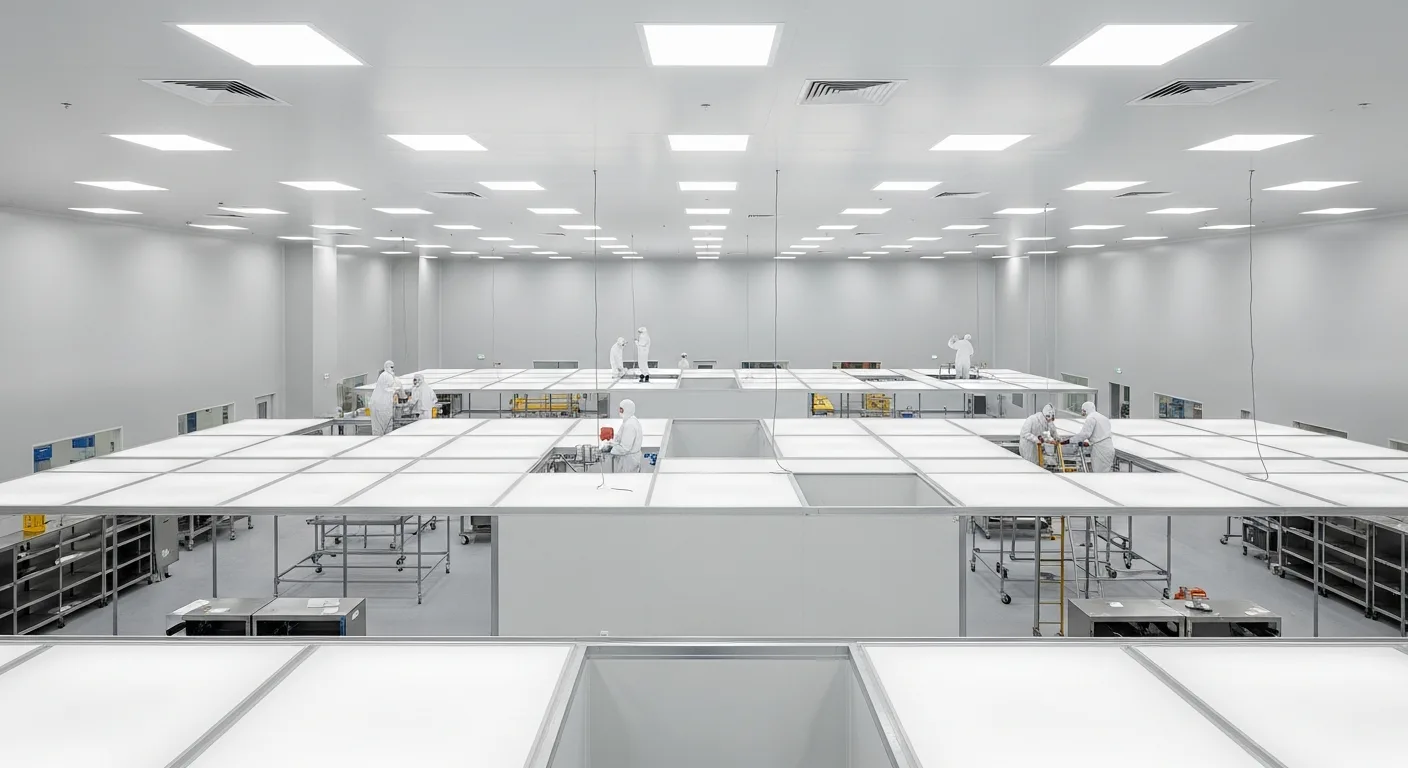
Clean room construction is a completely different world from standard commercial building. Every surface, every joint, every duct connection, and every square inch of ceiling matters. Particle counts that would be invisible in a normal building can shut down a semiconductor fab or contaminate a pharmaceutical batch.
If you are a general contractor taking on your first clean room project, or an experienced builder looking to tighten up your process, this guide covers the construction fundamentals you need to know.
Understanding Clean Room Classifications
Clean rooms are classified by the maximum allowable number of airborne particles per cubic meter. The current standard is ISO 14644-1, which replaced the old Federal Standard 209E (Class 100, Class 1000, etc.) that many people in the industry still reference.
ISO Classification Quick Reference
| ISO Class | Max Particles per m³ (at 0.5 μm) | Old FS 209E Equivalent | Typical Applications |
|---|---|---|---|
| ISO 1 | 10 | Class 1 | Advanced semiconductor |
| ISO 2 | 100 | Class 10 | Semiconductor, nanotechnology |
| ISO 3 | 1,000 | Class 100 | Semiconductor fab |
| ISO 4 | 10,000 | Class 1,000 | Semiconductor, LCD |
| ISO 5 | 100,000 | Class 10,000 | Pharma sterile, semiconductor |
| ISO 6 | 1,000,000 | Class 100,000 | Pharma, optical assembly |
| ISO 7 | 10,000,000 | (none) | Pharma compounding, medical device |
| ISO 8 | 100,000,000 | (none) | General pharma, electronics assembly |
Note: Actual particle counts at 0.5 microns for ISO 5 are 3,520 per cubic meter, not 100,000. The table above uses the 0.1 micron counts for the lower classes. Always reference ISO 14644-1 directly for precise limits at each particle size.
The classification drives almost every construction decision, from the HVAC system size to the wall finish to the gowning room layout. A higher classification (lower ISO number) means tighter construction tolerances and higher costs.
HVAC: The Heart of the Clean Room
The HVAC system is the single most critical and expensive component of any clean room. It does three things: filters the air, controls temperature and humidity, and maintains pressure relationships between rooms.
Air Handling Units
Clean room air handling units (AHUs) are larger and more complex than standard commercial units. Key differences:
- Higher static pressure to push air through HEPA or ULPA filters (1.0 to 2.5 inches w.g. across the filter bank alone)
- Redundancy requirements, often N+1 fan configurations for critical spaces
- Precise temperature control within plus or minus 0.5 to 1.0 degrees F
- Humidity control within plus or minus 2% to 5% RH, using steam humidifiers and cooling coils for dehumidification
- Energy recovery systems to manage the massive energy consumption of high air change rates
Ductwork
Clean room ductwork must be sealed to SMACNA Seal Class A (all joints and seams sealed). Leaky ductwork defeats the purpose of HEPA filtration by introducing unfiltered air downstream of the filters.
Duct materials are typically:
- Galvanized steel with sealed joints for most applications
- Stainless steel for pharmaceutical and corrosive environments
- Specialty coatings for acid or solvent exposure
All ductwork should be cleaned and sealed at the factory or on-site before installation. Protect open duct ends during construction with sealed caps, not just tape that falls off.
HEPA/ULPA Filter Ceilings
For ISO Class 5 and cleaner, the ceiling is essentially a bank of HEPA or ULPA filters. Coverage typically ranges from 25% to 100% of the ceiling area depending on the classification:
- ISO Class 5: 25% to 35% HEPA coverage (non-unidirectional) or 80% to 100% (unidirectional)
- ISO Class 4 and below: Near 100% ULPA coverage with unidirectional (laminar) airflow
- ISO Class 6 to 8: Individual HEPA filter modules at 5% to 15% coverage
The filter ceiling grid, often called a fan filter unit (FFU) ceiling, needs precise structural support. Each 2x4-foot FFU weighs 30 to 50 pounds and generates vibration from its internal fan. The ceiling grid must be level within 1/8 inch over its full span and rigid enough to prevent vibration transfer.
Pressurization
Clean rooms operate under positive pressure relative to less-clean surrounding spaces. This prevents contaminated air from flowing into the clean area when doors open.
Typical pressure differentials:
- Between ISO classes: 0.03 to 0.05 inches w.g. per classification step
- Clean room to corridor: 0.02 to 0.05 inches w.g.
- Corridor to general building: 0.02 to 0.03 inches w.g.
Maintaining these differentials requires:
- Automatic pressure controls (variable air volume dampers)
- Proper door sealing (gaskets on all four sides)
- Pass-throughs instead of direct openings between classified spaces
- Airlocks or gowning rooms between the clean area and uncontrolled spaces
Return Air Paths
Air returns in clean rooms are typically at the floor level through perforated raised floor panels or low wall returns. This creates a top-down airflow pattern that sweeps particles away from the work zone and toward the return path.
Raised access floors are common in semiconductor fabs, with a plenum depth of 18 to 36 inches below the floor panels. The floor panels must be rated for the expected loads (equipment, personnel, material transport) and must not generate particles themselves.
Wall and Ceiling Systems
Clean room surfaces must be smooth, non-porous, cleanable, and resistant to the chemicals used in the specific process. Every crack, crevice, or rough surface is a place for particles to accumulate and later become airborne.
Modular Panel Systems
Modular clean room wall systems are the industry standard for ISO Class 7 and cleaner. These systems use aluminum extrusion frames with flush-mounted panels that create a smooth, sealed surface.
Advantages:
- Factory-fabricated for consistent quality
- Fast installation compared to conventional construction
- Easy to reconfigure when process needs change
- Integral window frames, door frames, and pass-throughs
- Flush surfaces with minimal ledges and crevices
Panel materials include:
- Painted steel (most common, cost-effective)
- Stainless steel (pharmaceutical wet areas, corrosive environments)
- Fiberglass reinforced plastic / FRP (chemical resistance)
- Aluminum (lightweight, non-corrosive)
Panel joints are sealed with flush gaskets or silicone sealant. The goal is zero gaps, zero ledges, and zero exposed fasteners on the clean side.
Conventional Construction
For ISO Class 8 and some Class 7 applications, conventional gypsum board walls with epoxy or polyurethane paint can work. Requirements:
- All joints taped and finished to a Level 5 finish (skim coat over entire surface)
- Two coats of epoxy or high-performance polyurethane paint
- Coved base where walls meet floors (no square corners that trap particles)
- Sealed penetrations for conduits, pipes, and ductwork
Conventional construction costs less upfront but is harder to reconfigure and may not achieve the same surface smoothness as modular panels.
Ceilings
Non-HEPA ceiling areas use flush, gasket-sealed ceiling panels in a concealed grid system. The ceiling must be sealed to the wall system at the perimeter. Any penetration (sprinklers, lights, speakers) needs a sealed, flush-mounted trim ring.
Lighting fixtures for clean rooms are recessed, sealed, and have smooth lenses that are easy to wipe down. Standard lay-in fluorescent troffers are not acceptable because they create ledges and gaps where particles collect.
Flooring
Clean room floors must be seamless, chemical-resistant, and easy to clean. Common options:
- Sheet vinyl or PVC: Welded seams, coved at walls. The most common choice for pharmaceutical clean rooms.
- Epoxy or polyurethane coatings: Applied to concrete, 40 to 125 mils thick. Good chemical resistance but requires careful surface preparation.
- Raised access floor with vinyl or HPL panels: Used in semiconductor fabs for underfloor air return and cable management.
All flooring must be installed by specialists who understand clean room requirements. A poorly welded vinyl seam or a pinhole in an epoxy floor becomes a contamination source.
MEP Coordination
The mechanical, electrical, and plumbing systems in a clean room are more complex and more tightly coordinated than in standard construction. Here is where careful project management really matters.
Electrical
- Clean power: Sensitive equipment often requires dedicated power with voltage regulation and harmonic filtering.
- Emergency power: Critical clean rooms need generator backup to maintain pressurization and temperature during power outages.
- Lighting: LED fixtures with smooth, sealed lenses. Typical illumination levels are 50 to 75 footcandles at work surfaces.
- Grounding: Static-sensitive environments (semiconductor) require full ESD grounding systems in the floor, workstations, and equipment connections.
Plumbing
- Process piping: Ultra-pure water (UPW), process gases, and chemical distribution systems are separate from building plumbing and require specialized installation.
- Drain systems: Chemical waste drains must be compatible with the chemicals used. Double-contained piping is common for hazardous materials.
- No exposed piping: All plumbing within the clean room must be concealed in the walls, ceiling, or raised floor. Exposed pipes collect particles and are impossible to clean properly.
Fire Protection
Sprinkler systems in clean rooms need special attention:
- Recessed, flush-mounted heads with clean room trim rings
- Pre-action or dry-pipe systems to prevent accidental discharge in sensitive areas
- FM Global or Factory Mutual guidelines for clean room fire protection (especially semiconductor fabs)
- Coordination with the HEPA ceiling because sprinkler heads must be located between filter modules
Process Utilities
Beyond standard MEP, clean rooms for semiconductor and pharmaceutical use require:
- Process vacuum
- Compressed dry air (CDA) and nitrogen
- Specialty gases (silane, ammonia, etc. for semiconductor)
- Chilled water for process cooling
- Steam for sterilization (pharmaceutical)
Each of these systems has specific material, cleanliness, and testing requirements that differ from building utilities.
Construction Sequencing and Contamination Control
Building a clean room requires construction practices that anticipate the end use. You cannot build a particle-free environment using particle-generating methods and expect to clean it up at the end.
Phased Approach
- Shell construction: Build the surrounding structure (walls, roof, slab) using conventional methods.
- MEP rough-in: Install ductwork, piping, conduit, and cable tray above the clean room ceiling level.
- Clean room envelope: Install the modular wall system, ceiling grid, and floor system. Seal all penetrations.
- HVAC startup: Start the air handling system and bring the room under positive pressure.
- Interior finish work: Complete all remaining work inside the clean room (equipment installation, final connections) under controlled conditions.
- Cleaning and wipe-down: Professional clean room cleaning before validation testing.
- Validation testing: Particle counts, airflow measurements, pressure differential verification.
Construction Protocols
Once the clean room envelope is sealed and pressurized, all work inside must follow contamination control protocols:
- Workers wear clean room gowns, gloves, and shoe covers (or full bunny suits for higher classifications)
- All materials entering the clean room must be cleaned and de-particled in an anteroom
- No cardboard boxes inside the clean room (cardboard is a major particle generator)
- Use clean room-compatible tools and equipment
- Limit the number of workers inside at any time
- Track who enters and exits
These requirements slow down construction work significantly. Plan your schedule accordingly. What might take one day in a normal building can take three days in a clean room environment.
Validation and Testing
A clean room is not a clean room until it passes validation testing. This is where you prove the room meets its design classification.
ISO 14644-3 Testing
The standard testing protocol includes:
- Particle count testing at specified locations and heights using calibrated particle counters
- Airflow velocity and uniformity measurements at filter faces and work surfaces
- HEPA/ULPA filter integrity testing (DOP or PAO aerosol challenge to detect leaks in filters and filter seals)
- Pressure differential measurements between rooms
- Temperature and humidity uniformity measurements
- Recovery testing to verify how quickly the room returns to classification after a contamination event
Three Stages of Testing
- As-built: Room complete, HVAC running, no equipment or personnel
- At-rest: Equipment installed and powered but not in production
- Operational: Normal production conditions with personnel
Each stage may produce different results. A room that passes as-built may fail at-rest if equipment generates more particles than expected. Build margin into your design.
Project Management for Clean Room Construction
Clean room projects involve tight tolerances, specialized trades, and strict sequencing requirements. Missing a single seal detail can cause a validation failure that delays the entire project.
This is where having a solid construction management system makes a real difference. Projul helps you coordinate the multiple specialty contractors (HVAC, modular walls, flooring, validation, process piping) that a clean room project requires. Track submittals, manage RFIs, and keep your schedule updated in real time so that every trade knows exactly when they need to be on-site and what needs to happen before they start.
If you are managing clean room or other specialty construction projects, take a look at Projul’s pricing to find the right plan for your team. Or request a demo to see how it handles the complex coordination that these projects demand.
Budgeting and Cost Estimation for Clean Room Projects
Clean room projects blow budgets more often than almost any other type of specialty construction. The reason is straightforward: contractors who are used to pricing standard commercial work underestimate how much the classification requirements affect every single line item. A wall is not just a wall. A ceiling is not just a ceiling. And the HVAC system is going to cost more than most owners expect, no matter how many times you tell them.
Cost Drivers by ISO Classification
The ISO classification is the single biggest factor in project cost. Each step up in cleanliness (lower ISO number) roughly doubles the HVAC complexity and significantly increases the finish requirements.
For a rough starting point:
- ISO Class 8: $150 to $250 per square foot. This is the entry point for controlled environments. Standard AHU with HEPA terminals, painted gypsum or basic modular panels, sheet vinyl floor. Think of this as a very clean office build with better air handling.
- ISO Class 7: $250 to $450 per square foot. More HEPA coverage, tighter sealing requirements, modular wall systems become the norm, and the AHU gets bigger. Gowning rooms and airlocks add square footage that does not directly produce revenue for the owner but is absolutely required.
- ISO Class 6: $400 to $700 per square foot. Now you are dealing with significant HEPA ceiling coverage, higher air change rates, and tighter construction tolerances on every surface.
- ISO Class 5: $500 to $1,000+ per square foot. Unidirectional airflow, near-complete HEPA ceiling coverage, raised access floors in many cases, and every penetration becomes a major coordination item.
- ISO Class 4 and below: $1,000 to $2,000+ per square foot. These are highly specialized facilities where the construction tolerances approach what you would see in aerospace manufacturing.
These numbers include the room construction and HVAC but not the process equipment, which is the owner’s responsibility in most contracts.
Hidden Costs That Catch Contractors Off Guard
The gowning room and airlock square footage. A 1,000 square foot clean room might need 200 to 400 square feet of supporting gowning rooms, airlocks, and pass-throughs. Owners sometimes forget this when they talk about their clean room “footprint,” and contractors who bid only the clean room itself find themselves eating the cost of these support spaces.
Electrical infrastructure. The HVAC system for even a modest clean room draws serious power. A 2,000 square foot ISO Class 5 room might need 100 to 200 tons of cooling, which translates to substantial electrical service requirements. If the existing building’s electrical service cannot handle the load, a new transformer and switchgear can add $100,000 or more to the project.
Validation costs. Third-party validation testing is not cheap. Depending on the room size and classification, validation can run $15,000 to $75,000 or more. This is often a separate contract, but the general contractor needs to budget for the time it takes. Validation cannot happen until everything is perfect, and any failure means rework followed by retesting.
Extended schedule for controlled construction. Once the clean room envelope is sealed, every hour of work inside costs more because of gowning requirements, material decontamination, and reduced productivity. Experienced clean room contractors build a 2x to 3x productivity factor into their labor estimates for work inside the controlled environment. If you are new to this, use 3x until you have your own data.
Consumables. Gowns, gloves, shoe covers, tacky mats, clean room wipes, and IPA (isopropyl alcohol) for cleaning add up fast over a multi-month construction phase. Budget $5,000 to $15,000 per month for a medium-sized project.
How to Structure Your Estimate
Break your estimate into clear categories that the owner can understand:
- Building shell and structure (if new construction or major retrofit)
- Clean room envelope (modular walls, ceiling grid, flooring, doors, windows, pass-throughs)
- HVAC system (AHU, ductwork, HEPA/ULPA filters, controls, commissioning)
- Electrical (power distribution, lighting, ESD grounding, clean power if needed)
- Plumbing and process piping (building plumbing plus any process utilities)
- Fire protection (pre-action systems, clean room sprinkler heads)
- Controls and building automation (BMS integration, pressure monitoring, alarms)
- Construction contamination control (gowning, cleaning, protocols during build)
- Cleaning and validation support (final wipe-down, validation coordination)
- Contingency (10% to 15% is reasonable for a first clean room project; 5% to 10% if experienced)
Using a tool like Projul’s estimating features to build these categories into a structured estimate helps you track costs against each phase as the project progresses. Clean room projects have a habit of shifting costs between categories as design details get finalized, and you need to see those shifts in real time rather than discovering a budget overrun at the end.
Selecting and Managing Specialty Subcontractors
Clean room construction is not a one-contractor show. You are going to need specialty subs for the modular wall installation, HVAC, process piping, validation, and possibly the flooring and electrical. Finding the right subs and managing them through a project with zero tolerance for error is one of the hardest parts of being the GC on a clean room job.
Key Specialty Trades
Modular clean room wall and ceiling installers. These firms specialize in the aluminum-frame panel systems from manufacturers like Terra Universal, Plascore, PortaFab, or AES Clean Technology. This is not general drywall work. The installers need to understand gasket compression, panel alignment tolerances, and how to integrate door frames, windows, and pass-throughs without creating particle traps. Ask for references from validated clean rooms, not just “controlled environment” work.
Clean room HVAC contractors. Standard mechanical contractors can handle some clean room HVAC work, but the ductwork sealing, filter ceiling installation, and controls integration require experience. The HVAC contractor needs to understand SMACNA Seal Class A requirements, fan filter unit installation, and how to commission a system to maintain precise pressure differentials. If your mechanical sub has never done a clean room, pair them with a consultant who has.
Validation firms. The validation contractor is not really your subcontractor in most cases (they report to the owner or the owner’s quality team), but you will work closely with them. Bring them in during design to review your plans. Their input on sampling locations, airflow visualization, and pressure cascade design can save you from building something that looks right but fails testing.
Process piping contractors. If the clean room involves high-purity water, specialty gases, or chemical distribution, you need a process piping contractor with specific experience in orbital welding, high-purity fittings, and the relevant piping standards (ASME BPE for pharmaceutical, SEMI standards for semiconductor). This is not standard plumbing work.
ESD flooring specialists. For semiconductor clean rooms, the static-dissipative flooring system requires installers who understand grounding, resistance testing, and the specific adhesives and coatings used. An improperly grounded ESD floor can damage millions of dollars in semiconductor wafers.
Vetting Your Subs
For clean room work, the standard vetting process is not enough. In addition to the usual checks (license, insurance, references, financial stability), you need to verify:
- Specific clean room project history. Ask for a project list with ISO classifications, square footages, and facility types. Call the GCs and owners on at least two of those projects.
- Workforce training. Do their installers have clean room protocol training? Have they worked in gowned conditions before? A mechanical sub who sends standard field hands to work in a clean room is going to cause problems.
- Quality documentation. Clean room subs need to provide detailed installation records, test results, and as-built documentation. If they are not used to that level of paperwork, they are going to struggle or push back when you require it.
- Availability of specialty equipment. Validation firms need calibrated particle counters, aerosol generators, and anemometers. HVAC subs need duct leakage testing equipment. Make sure they own or lease the right tools and that calibrations are current.
Coordination Between Trades
The sequencing section above outlines the general order of work, but the coordination details matter more in a clean room than in almost any other construction type. Here is where it gets tricky:
The modular wall installer needs a finished, level floor slab but also needs to coordinate with the HVAC contractor on the location and size of every wall penetration. The HVAC contractor needs to coordinate with the electrical contractor on conduit routing above the ceiling grid. The flooring contractor needs everyone else to be done before they can install the final floor (especially for sheet vinyl with welded seams, which cannot tolerate foot traffic from other trades).
This cascading dependency chain means a delay in one trade delays everyone else. Projul’s scheduling tools can help you map these dependencies and give every sub visibility into their actual start dates, not just the dates you wrote into the original schedule six months ago. When the modular wall installer runs three days late because of a material delivery issue, your HVAC sub needs to know immediately, not when they show up on-site and find the walls are not ready.
Communication Protocols
Establish clear communication rules at the preconstruction meeting:
- Daily coordination calls during the clean room envelope phase (15 minutes max, no exceptions)
- Single point of contact for each trade on-site. You do not want the HVAC foreman telling the wall installer to move a panel without going through the GC’s project manager.
- Written change documentation for every field change, no matter how small. In clean room construction, moving a penetration six inches to the left affects the airflow pattern, the HEPA filter layout, and the validation sampling plan.
- Photo documentation of every sealed penetration, every duct joint, and every wall panel gasket before it gets covered up. If something fails validation, you need to be able to trace back to the installation records.
Using Projul’s daily logs and photo documentation features makes this paper trail automatic rather than something your PM has to remember to do at the end of a long day.
Regulatory and Compliance Considerations
Clean room construction does not just have to meet building codes. Depending on the industry, the clean room may need to comply with FDA regulations, cGMP requirements, SEMI standards, or EU Annex 1 guidelines. Understanding which regulatory framework applies and how it affects construction is critical for any GC taking on this type of work.
Pharmaceutical Clean Rooms: cGMP and FDA Requirements
If you are building a clean room for pharmaceutical manufacturing, the FDA’s current Good Manufacturing Practice (cGMP) regulations (21 CFR Parts 210 and 211) set the baseline. These regulations do not specify exactly how to build the room, but they require:
- Adequate lighting, ventilation, temperature, humidity, and pressure controls
- Smooth, hard surfaces that are easy to clean and maintain
- Separation of operations to prevent contamination and mix-ups
- Written procedures for cleaning and maintenance
The word “adequate” does a lot of heavy lifting in FDA regulations. What it means in practice is determined by the FDA’s inspection history, industry guidance documents, and the company’s own quality team. The owner’s quality department will translate these requirements into specific construction specifications. Your job as the GC is to build exactly what those specifications call for and to document everything.
For sterile pharmaceutical manufacturing, FDA’s Guidance for Industry on Sterile Drug Products Produced by Aseptic Processing provides more specific requirements for clean room design, including airflow patterns, pressure differentials, and monitoring systems. The EU’s Annex 1 (Manufacture of Sterile Medicinal Products), revised in 2022, is even more prescriptive and increasingly influences US practice as well.
Key takeaway for contractors: In pharmaceutical clean room construction, every deviation from the approved design needs to go through a formal change control process. You cannot make field decisions the way you might on a standard commercial job. If a duct route needs to change, that change needs to be reviewed by the owner’s quality team and documented before the work happens. This slows things down, but it is non-negotiable.
Semiconductor Clean Rooms: SEMI Standards
Semiconductor manufacturing clean rooms follow SEMI (Semiconductor Equipment and Materials International) standards rather than FDA regulations. Key standards include:
- SEMI S2: Environmental, health, and safety guidelines for semiconductor manufacturing equipment
- SEMI E49.1 through E49.8: Guide for high-purity and ultra-high-purity gas distribution systems
- SEMI F1 through F81: Facilities standards covering clean room design, gas and chemical distribution, and water purity
Semiconductor fabs also typically follow FM Global guidelines for fire protection, which are more stringent than standard building codes due to the large quantities of flammable chemicals and gases used in semiconductor processing.
Documentation Requirements
Regardless of the industry, clean room construction generates far more documentation than a standard project. Expect to produce and maintain:
- Material certifications for every product installed in the clean room (panels, sealants, flooring, gaskets, filters)
- Installation qualification (IQ) protocols that verify each system was installed per design specifications
- Operational qualification (OQ) protocols that verify each system operates within specified parameters
- Weld logs and inspection records for process piping
- Duct leakage test results for all sealed ductwork
- Filter integrity test results for every HEPA and ULPA filter
- Pressure differential logs during construction and commissioning
- Cleaning verification records from the final wipe-down
This documentation package becomes part of the facility’s validation master file and will be reviewed during regulatory inspections for the life of the facility. Incomplete or missing records can trigger inspection findings years after you finish the project.
If your current documentation process involves paper binders and spreadsheets, a clean room project will bury you. Digital project management tools that capture photos, test results, and inspection records in real time are not optional for this type of work. This is one of the reasons contractors who handle commercial construction projects successfully make the switch to purpose-built tools before taking on their first clean room job.
Retrofitting Existing Buildings for Clean Room Use
Not every clean room starts from a greenfield site. Many pharmaceutical companies and contract manufacturers need to add clean room capacity inside existing buildings. Retrofits bring their own set of challenges that go beyond what you face in new construction.
Evaluating the Existing Building
Before you commit to a retrofit project, do a thorough assessment of the existing building:
Ceiling height. A clean room with a HEPA filter ceiling needs significant space above the finished ceiling for the air handling plenum, ductwork, piping, and cable tray. For an ISO Class 5 room, you typically need 6 to 10 feet of interstitial space above the clean room ceiling, plus 8 to 10 feet of finished ceiling height, plus the raised floor depth if applicable. That means you need at least 16 to 20 feet of clear height in the existing building, and preferably more. An existing building with 12-foot ceilings is probably not a candidate for anything below ISO Class 7.
Structural capacity. The HVAC equipment for a clean room is heavy. A rooftop AHU for an ISO Class 5 room can weigh 15,000 to 30,000 pounds. Fan filter units in the ceiling add distributed load. Raised access floors with heavy semiconductor equipment require structural slabs that may exceed the capacity of the existing floor. Get a structural engineer involved early to evaluate the roof, floor, and column capacity.
Electrical service. As mentioned in the budgeting section, clean rooms need serious power. A 5,000 square foot ISO Class 5 room might require 500 kW or more for HVAC alone. If the existing building’s electrical service is 400 amps at 480V, you may need a service upgrade, which means coordinating with the utility company and potentially running new feeders from the street.
Vibration. Semiconductor fabrication is extremely sensitive to vibration. If the existing building is near a highway, railroad, or has vibration-generating equipment nearby, the clean room may need vibration isolation systems (spring-mounted slabs, isolated foundations) that add significant cost and complexity.
Access for construction. Can you get the AHU, ductwork, and wall panels into the building? Existing buildings often have doorways, corridors, and elevators that are too small for clean room components. You may need to create temporary openings in walls or the roof to get equipment in, then seal them back up.
Phasing Retrofit Work Around Existing Operations
In many retrofit projects, the owner needs to keep existing operations running while the clean room is built. This adds a layer of complexity:
- Dust and vibration containment. Construction generates particles and vibration that can affect adjacent clean rooms or production areas. Temporary containment barriers with HEPA-filtered negative air machines are essential.
- Utility shutdowns. Connecting new HVAC, electrical, and plumbing systems to existing building infrastructure requires planned shutdowns. These may need to happen during nights or weekends to avoid disrupting production.
- Noise restrictions. If adjacent areas are occupied, construction noise needs to be managed. Core drilling through concrete at 7 AM next to an operating clean room will not go over well.
- Contamination risk to existing clean rooms. If the building already has operational clean rooms, construction dust from your retrofit project is the enemy. The owner’s quality team will have strict requirements about construction containment, and you may need to install temporary monitoring to prove you are not affecting their particle counts.
When a Retrofit Does Not Make Sense
Sometimes the existing building simply cannot support the intended clean room classification at a reasonable cost. Signs that a retrofit is going to be more trouble than it is worth:
- Ceiling height below 14 feet for anything cleaner than ISO Class 8
- Structural slab that cannot support the HVAC equipment without major reinforcement
- Electrical service upgrade that requires utility company involvement with a 6 to 12 month lead time
- Building envelope (roof, walls) in poor condition, because water intrusion is the enemy of clean rooms
- Column spacing that creates awkward room layouts with too many obstructions
In these cases, it is better for everyone if you tell the owner upfront that a purpose-built addition or a new building will give them a better result for similar or lower total cost. Good contractors know when to walk away from a retrofit that is going to become a money pit. That honest conversation builds trust and often leads to you getting the new construction contract instead.
For more on managing complex construction scheduling and keeping retrofit projects on track, having a system that handles dependency chains and resource conflicts is essential. These are not projects where you can wing it with a whiteboard and a spreadsheet.
Common Clean Room Construction Mistakes
Ignoring the gowning room: The gowning room is part of the contamination control system. It needs its own air handling, proper size for the number of personnel, and a logical flow from dirty side to clean side.
Skipping the construction protocol: Allowing standard construction practices inside a sealed clean room envelope means a longer and more expensive cleaning phase before validation.
Underestimating the HVAC: The air handling system for even a small ISO Class 5 room is enormous compared to standard commercial HVAC. Make sure the building can support the size and weight of the equipment, the electrical load, and the ductwork routing.
Poor sealing at penetrations: Every conduit, pipe, and duct that passes through a clean room wall or ceiling needs a proper seal. Expanding foam or standard caulk is not acceptable. Use clean room-rated sealants and test for leaks.
Not involving the validation firm early: The validation team should review the design before construction starts, not just show up at the end to test. Their input on sampling locations, airflow patterns, and pressure cascades can prevent costly rework.
Wrapping Up
Clean room construction requires a level of precision and contamination awareness that goes well beyond standard building practices. From the HVAC system design to the last silicone bead on a wall panel joint, every detail affects whether the room will pass validation and perform as intended.
Plan your schedule with extra time for the controlled construction phase. Budget for the specialized materials and labor. And keep every trade tightly coordinated because in a clean room, one contractor’s oversight becomes everyone’s problem.
Frequently Asked Questions
What is an ISO Class 5 clean room?
How much does it cost to build a clean room?
What HVAC air change rate is needed for a clean room?
What is the difference between HEPA and ULPA filters?
How long does clean room validation take?
Can you retrofit an existing building into a clean room?
What wall systems are used in clean rooms?
Do clean rooms need positive or negative pressure?
Related Articles

How Construction Teams Use AI to Cut Admin Time
Most contractors lose a full day every week to paperwork. AI now handles the repetitive admin work that used to eat...
Read More →
Concrete Tilt-Up Construction: A Contractor's Complete Field Guide
Tilt-up construction accounts for roughly 15 percent of all industrial and commercial buildings in North America. This...
Read More →
How to Implement Construction Software Without Losing Your Mind
Most construction software rollouts fail. Not because the software is bad, but because the rollout was rushed. Here are...
Read More →