
Climbing Formwork and Slip Form Construction: Methods, Equipment, and Best Practices | Projul
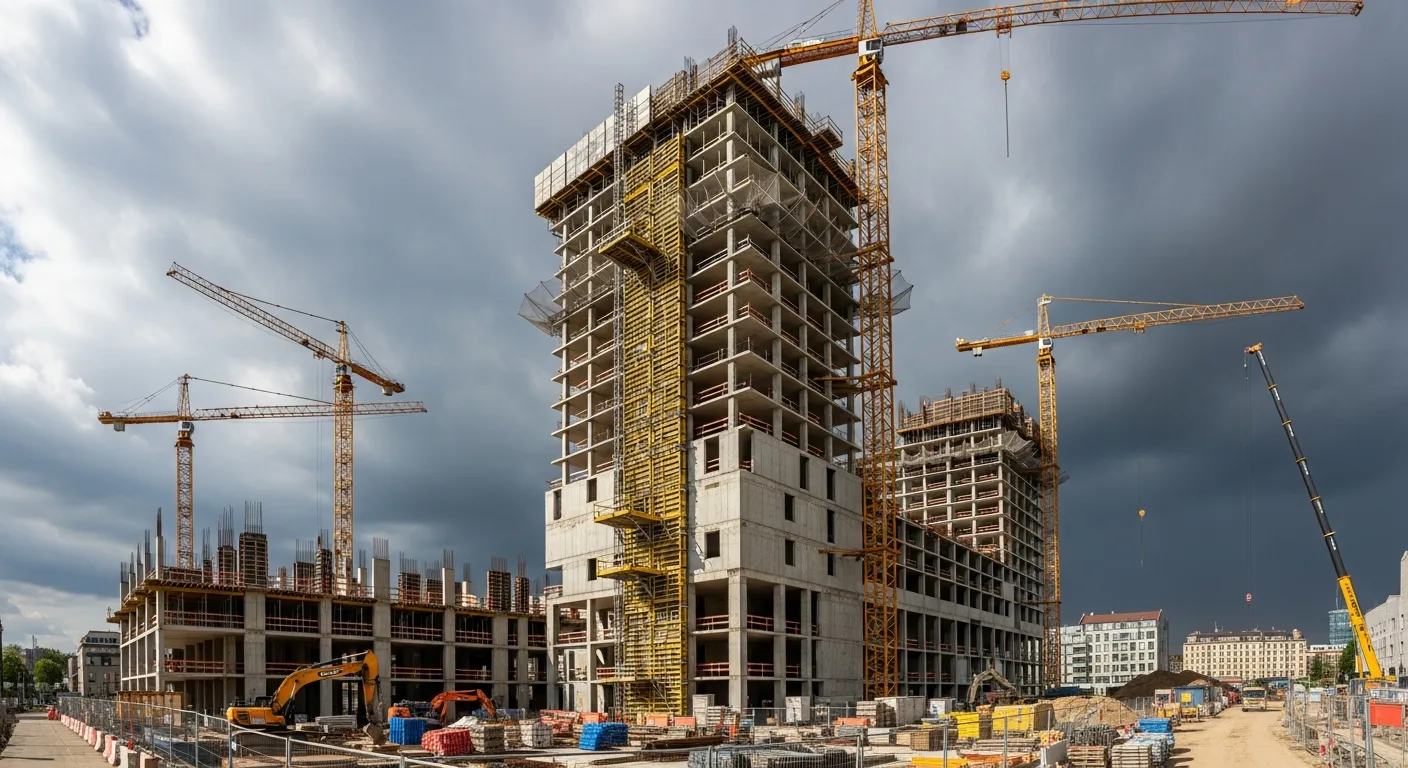
When a structure needs to go straight up, floor after floor of identical concrete walls, conventional formwork becomes slow and expensive. Setting up wall forms, pouring, waiting for the concrete to cure, stripping the forms, moving them up, and repeating the process at every level eats time and labor. Climbing formwork and slip form construction solve this problem by keeping the forms moving upward, either in discrete jumps or in a continuous crawl.
These methods are not for every project. They require specialized equipment, experienced crews, and careful planning. But for the right structure, they can cut months off the schedule and produce better concrete than conventional methods.
Understanding the Two Approaches
Climbing Formwork (Jump Form)
Climbing formwork pours concrete in lifts, typically one story at a time. After each lift reaches sufficient strength, the entire form assembly, including work platforms and safety screens, is raised to the next level. The process repeats for each floor.
There are two main types:
Crane-climbed formwork uses a tower crane to lift each form panel or gang form from one level to the next. The crane picks the form, the crew guides it into position, and it is secured to brackets attached to the previously poured concrete. This is the simpler and less expensive option, but it ties up the crane during form moves.
Self-climbing formwork uses hydraulic jacks or climbing mechanisms built into the form system to raise itself without a crane. Climbing rails or brackets are anchored to the cured concrete, and hydraulic cylinders push the form assembly upward. This frees the crane for other work and is faster for tall buildings where crane time is precious.
Slip Formwork
Slip formwork is a continuous process. The form, typically 4 to 5 feet tall, is filled with concrete at the top while it moves slowly and steadily upward on hydraulic jacks. As the form rises, the concrete that was placed first exits the bottom of the form, having gained enough strength to be self-supporting.
Slip form operations run 24 hours a day, 7 days a week, without stopping. The form cannot stop because the concrete would bond to the form panels and lock everything in place. This continuous operation is both the method’s greatest advantage (speed) and its greatest challenge (logistics and crew management).
Climbing Formwork in Detail
System Components
A typical climbing formwork system includes:
Form panels. Steel-framed panels with a plywood or steel face that creates the concrete surface. Panels are designed to be ganged together for the full wall height of each lift (typically 10 to 14 feet).
Climbing brackets (shoes). Steel brackets that bolt to anchor points cast into the previously poured concrete. The form panels hang from or sit on these brackets.
Work platforms. Multiple platform levels provide access for different operations:
- The upper platform is for rebar tying, embed installation, and concrete placement
- The middle platform is at the form face for form alignment and connection work
- The lower platform is for stripping, cleaning, patching, and curing of the previously poured lift
Safety screens. Enclosures around the work platforms protect workers from falls and wind, and prevent dropped objects from reaching workers below.
Hydraulic climbing mechanism (self-climbing systems). Rails, cylinders, and control units that raise the entire assembly. A typical self-climbing system can raise one floor height in 30 to 60 minutes.
The Climbing Cycle
Each floor follows the same sequence:
- Close and align the forms. Adjust form panels to the correct position, checking plumb, line, and dimensions. Install form ties to hold the opposing panels at the correct wall thickness.
- Install reinforcement. Tie rebar per the structural drawings, including dowels that extend above the pour to provide continuity with the next lift. Install embeds, blockouts, and MEP sleeves.
- Inspection. The special inspector and the engineer verify rebar placement, form dimensions, and embed locations before concrete placement.
- Pour concrete. Place concrete by pump or bucket, vibrating in lifts per the specification (typically 18 to 24 inch lifts). Monitor form pressures and watch for movement.
- Cure. Allow the concrete to reach the required stripping strength, confirmed by cylinder tests or maturity monitoring.
- Strip and climb. Remove form ties and release the forms. Activate the climbing mechanism (self-climbing) or rig the forms for crane picks (crane-climbed). Raise the entire assembly to the next floor.
- Patch and cure. On the lower platform, patch tie holes, repair minor defects, and apply curing compound to the exposed concrete surface.
- Repeat.
A well-run climbing formwork operation on a typical high-rise can cycle one floor every 3 to 5 days for the core walls.
Advantages of Climbing Formwork
- Flexibility in wall geometry. Each lift can have different openings, blockouts, and wall thicknesses. Changes from floor to floor are accommodated by adjusting the form panels.
- Construction joints are controlled. Each joint between lifts can be properly prepared with roughened surfaces, waterstops, and dowels.
- Work can stop. Unlike slip form, you can pause a climbing formwork operation for weekends, holidays, or weather without damaging the work.
- Quality control. Each lift is formed, inspected, poured, and cured independently, allowing thorough quality verification.
Limitations
- Crane dependency (crane-climbed systems). Form moves require crane time, which may conflict with other lifting demands.
- Cycle time. Even efficient operations take 3 to 5 days per floor for forming, reinforcement, pouring, and curing. Slip form is faster for simple structures.
- Equipment cost. Self-climbing systems have high rental costs, though they pay for themselves on buildings above 15 to 20 stories.
Slip Form Construction in Detail
How the Slip Form Works
The slip form assembly consists of:
Form panels. Steel or wood-faced panels, typically 4 to 5 feet tall, configured to match the structure’s cross-section (circular for silos, rectangular for elevator cores, etc.). The panels taper slightly outward from top to bottom so that the rising concrete does not bind against the form.
Yokes. Steel frames that span across the top of the form, holding the inner and outer panels at the correct spacing. Yokes carry the vertical loads from the work platforms and transmit them to the jacking rods.
Jacking rods. Smooth steel rods (typically 1 to 1.25 inches in diameter) that are embedded in the concrete as the form rises. Hydraulic jacks mounted on the yokes grip the rods and push the entire form assembly upward. The rods remain permanently embedded in the finished concrete.
Hydraulic jacks. Each yoke has one or more hydraulic jacks connected to a central pumping system. The jacks operate in small increments (about 1 inch per stroke) and are synchronized to keep the form level as it rises.
Work platforms. The working deck on top of the form is where rebar is placed, embeds are installed, and concrete is poured. A hanging scaffold (finisher’s platform) below the form allows workers to finish, patch, and cure the exposed concrete as the form moves past.
The Slip Form Operation
Once the slip form starts, it does not stop until the structure reaches its full height. A typical operation looks like this:
Start-up. The form is assembled on the foundation or starting slab. The first 4 to 5 feet of concrete is placed with the form stationary. Once the concrete at the bottom of the form reaches adequate strength (usually 15 to 25 psi), the jacks are started and the form begins to climb.
Continuous operation. Concrete is placed into the top of the form while the form moves upward at a controlled rate. Workers on the deck continuously:
- Place and tie rebar ahead of the concrete
- Install embeds, anchors, and blockouts
- Place concrete by pump or bucket, vibrating each lift
- Monitor the concrete exiting the bottom of the form for proper consistency
Monitoring. The operation requires constant monitoring of:
- Climbing rate vs. concrete set time. Too fast and the concrete slumps when it exits the form. Too slow and the concrete bonds to the form panels.
- Vertical alignment. Checked every 1 to 2 hours using plumb lines or laser instruments.
- Level. The form must stay level as it climbs. Differential jacking rates can cause the form to tilt.
- Concrete temperature. Ambient temperature changes (especially the day-to-night cycle) affect set time and require adjustments to the climbing rate or mix design.
Finishing. Below the form, workers on the hanging platform smooth the concrete surface, fill jacking rod holes (if required), patch defects, and apply curing compound.
Crew Organization for Slip Form
A slip form operation runs in shifts, typically two 12-hour shifts or three 8-hour shifts. Each shift needs:
- A slip form superintendent who controls the climbing rate and monitors alignment
- Ironworkers placing rebar and embeds ahead of the concrete
- Concrete placement crew operating the pump and vibrators
- Finishers on the hanging platform below the form
- A batch plant or concrete delivery crew maintaining supply
Total crew size for a medium slip form operation is typically 20 to 40 workers per shift, depending on the structure’s complexity.
What Slip Form Does Well
- Speed. A slip form can gain 10 to 20 feet of height per day (24 hours). A 200-foot silo might take 10 to 15 days of continuous operation.
- Monolithic concrete. No construction joints means better watertightness and structural continuity.
- Consistent quality. The continuous process, once dialed in, produces uniform concrete throughout the structure’s height.
- No crane dependency. The form climbs on its own jacking system.
Limitations of Slip Form
- Cannot stop. Once started, the operation must continue until complete. Power failures, equipment breakdowns, or material supply interruptions are emergencies.
- Limited geometry changes. Changing wall thickness, adding large openings, or shifting the plan shape during the slip is difficult. The form is configured for a specific cross-section.
- Weather sensitivity. Rain, extreme heat, and extreme cold all affect the concrete’s set time and the climbing rate. Operations in cold weather require heated enclosures and hot water in the mix.
- Crew demands. Round-the-clock operations require skilled crews working long shifts. Fatigue management is a safety priority.
- Surface finish. Slip form surfaces are typically rougher than surfaces produced by stationary forms. If a smooth architectural finish is required, additional finishing or applied coatings may be needed.
Choosing Between Climbing and Slip Form
The choice depends on the structure:
| Factor | Climbing Formwork | Slip Form |
|---|---|---|
| Structure type | High-rise cores, walls with openings | Silos, towers, bridge piers, chimneys |
| Geometry changes | Handles well | Limited |
| Openings and embeds | Accommodates easily | Difficult with many or large openings |
| Speed | 3 to 5 days per floor | 10 to 20 feet per day continuous |
| Construction joints | Yes, at each lift | None (monolithic) |
| Can pause | Yes | No |
| Crane requirement | Yes (crane-climbed) or No (self-climbing) | No |
| Crew scheduling | Normal shifts | 24/7 continuous |
Some projects use both: slip form for the elevator and stair cores (simple, repetitive geometry) and climbing formwork for the perimeter walls (complex geometry with window openings at every floor).
Safety Considerations
Fall Protection
Both methods involve working at height on platforms attached to the form system. Fall protection includes:
- Guardrails on all work platforms and hanging scaffolds
- Personal fall arrest systems for workers near open edges
- Safety nets below the lowest work platform
- Enclosed safety screens on climbing formwork systems
Falling Objects
Workers below the form are at risk from dropped tools, concrete debris, and dislodged form components. Toe boards on all platforms, tool lanyards, covered debris chutes, and exclusion zones below the active work area are standard.
Concrete Burns
Workers handling fresh concrete are exposed to its high alkalinity (pH 12 to 13). Full-length clothing, waterproof gloves, eye protection, and rubber boots are required. Wash stations must be readily available.
Fatigue (Slip Form)
The 24-hour continuous operation creates fatigue risks. Shift lengths, break schedules, and crew rotation must be planned to prevent exhaustion-related errors and injuries. Monitor workers for signs of fatigue, especially during overnight shifts.
Project Management for Climbing and Slip Form Operations
Both methods involve intense coordination: concrete supply, rebar delivery, embed installation, MEP coordination, quality testing, and safety oversight all happening simultaneously and on a tight cycle.
Projul helps contractors manage the scheduling, crew coordination, material tracking, and documentation that climbing and slip form operations demand. When you are cycling a floor every 4 days or running a continuous 24-hour slip form, having your schedule, inspections, and daily reports in one system keeps the operation running smoothly.
Common Mistakes
Starting slip form without adequate concrete supply. Running out of concrete during a slip form operation is a crisis. Verify supply capacity and have contingency plans before starting.
Ignoring weather forecasts. A sudden temperature drop can change concrete set times dramatically, throwing off the climbing rate. Monitor weather continuously during slip form operations.
Underestimating crew needs. Both methods require more workers than conventional formwork. A slip form that is short-staffed falls behind on rebar placement, creating a bottleneck that slows the entire operation.
Skipping trial pours. The first lift of a slip form or climbing form operation reveals problems with the mix design, form alignment, and crew procedures. Do not start production on a tight schedule without at least one trial lift.
Poor alignment monitoring. A structure that drifts out of plumb by half an inch per floor is 5 inches off at the top of a 10-story building. Monitor and correct continuously.
Wrapping Up
Climbing formwork and slip form construction are specialized methods that, when applied to the right projects, deliver significant advantages in speed, quality, and cost. They are not interchangeable, and each has clear strengths and limitations. Understanding those differences, and planning accordingly, is what separates a successful vertical concrete operation from an expensive problem.
Choose the right method for the structure, staff it with experienced people, plan the logistics down to the hour, and keep the quality controls running throughout. The height will take care of itself.
Frequently Asked Questions
What is the difference between climbing formwork and slip formwork?
When should you use slip form instead of climbing formwork?
How fast does a slip form move?
What are the main risks of slip form construction?
How does a self-climbing formwork system work?
Can you use climbing formwork on curved structures?
What concrete mix is used for slip form construction?
How do you maintain vertical alignment during slip form operations?
Related Articles

BIM Clash Detection: How to Catch Conflicts Before They Cost You on the Jobsite
BIM Clash Detection: How to Catch Conflicts Before They Cost You on the Jobsite Every contractor has a story about the...
Read More →
Asphalt Paving and Compaction Guide: Mix Types, Laydown Temperatures, and Quality Testing
Asphalt paving looks straightforward from a distance. A truck dumps material, the paver lays it down, and rollers...
Read More →
Construction Jobsite Wi-Fi & Connectivity Guide: Setting Up Reliable Internet in the Field
A practical guide to getting reliable internet on construction job sites. Learn about cellular hotspots, mesh networks,...
Read More →