
Cold Weather Concrete: Pour, Protect, and Cure
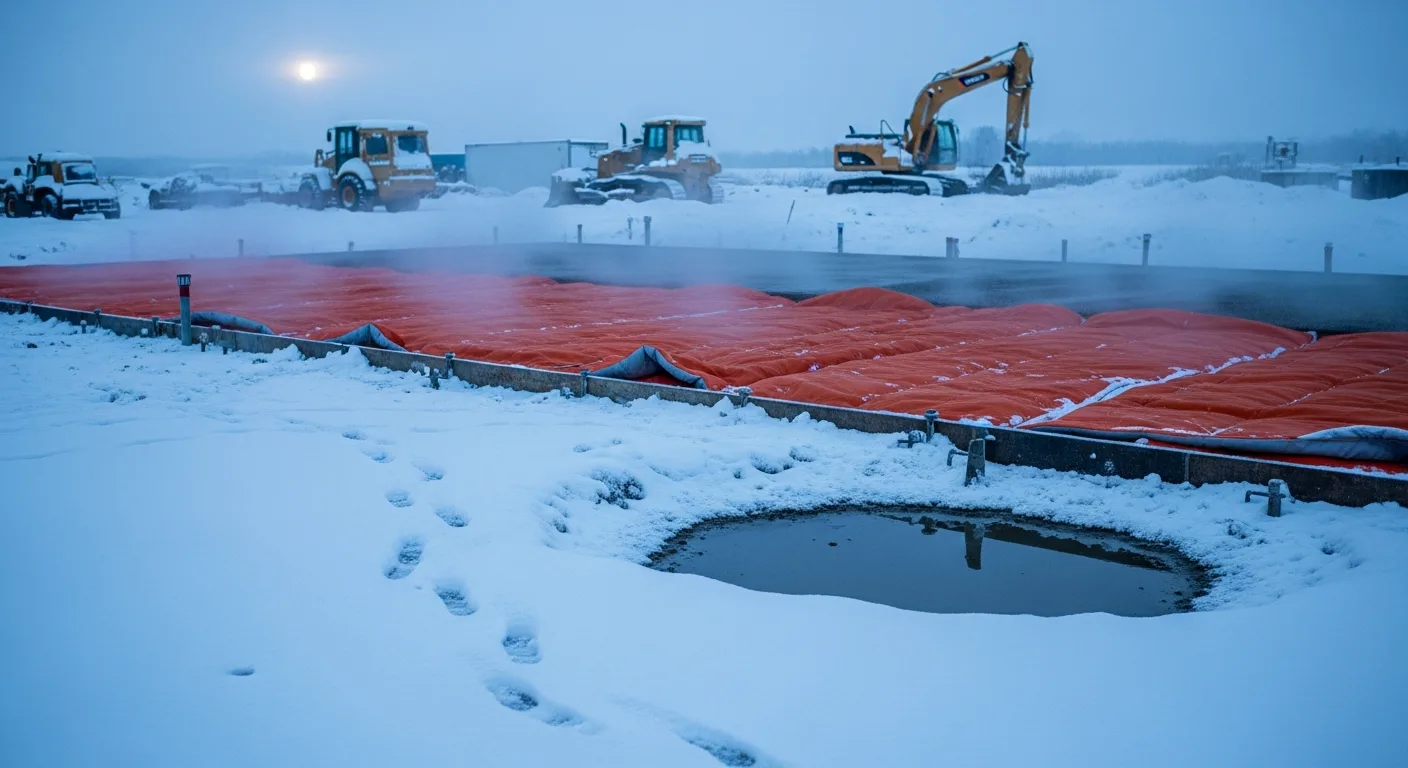
Every contractor who works in a climate with real winters has faced the question: do we pour in the cold or shut down and wait? Waiting costs money. Every day a project sits idle burns overhead, pushes schedules, and frustrates clients. But pouring concrete in freezing conditions without proper planning can produce slabs, walls, and foundations that look fine on the surface but are structurally compromised underneath.
Cold weather concreting is not about whether you can pour. You can pour concrete in surprisingly cold temperatures with the right preparation. It is about whether you take the steps necessary to protect the concrete until it gains enough strength to resist freeze damage. Skip those steps, and you are pouring money into a form that will crack, scale, and fail.
This guide covers everything a contractor needs to know about placing concrete in cold weather: the science behind it, the preparation required, the protection methods that work, and the mistakes that lead to expensive failures.
The Science of Cold Weather and Concrete
To understand why cold weather is a problem for concrete, you need to understand what happens during hydration.
When cement mixes with water, a chemical reaction called hydration begins. This reaction produces heat (called heat of hydration) and causes the concrete to harden and gain strength over time. The rate of hydration is directly affected by temperature.
Here is the relationship:
- At 73°F (the standard curing temperature), concrete gains strength on a predictable curve, reaching design strength in 28 days
- At 50°F, hydration slows significantly. Strength gain takes roughly twice as long
- At 40°F, hydration slows to a crawl
- At 32°F, hydration essentially stops
- Below 32°F, the water in the mix freezes, expanding by about 9% in volume
That 9% expansion is what causes the damage. In fresh concrete that has not yet developed sufficient strength, ice crystals disrupt the bond between cement paste and aggregate. The result is a weak, porous concrete with permanently reduced strength and durability.
The critical threshold: Concrete must reach a compressive strength of at least 500 psi before it can withstand one freeze cycle without significant damage. For concrete that will be exposed to repeated freeze-thaw cycles in service, many engineers require 3,500 psi or more before protection is removed.
ACI 306: The Industry Standard
ACI 306R, “Guide to Cold Weather Concreting,” is the industry reference for cold weather concrete work. While not a code itself, most project specifications reference ACI 306 requirements.
ACI 306 defines cold weather concreting conditions as:
- Average daily air temperature is below 40°F (4°C) for three or more consecutive days
- Air temperature is not greater than 50°F (10°C) for more than 12 hours in any 24-hour period
Key requirements from ACI 306:
- Fresh concrete temperature at placement must be between 50°F and 65°F, depending on section thickness
- Concrete temperature must not drop below 40°F during the curing period
- The concrete must not freeze until it reaches at least 500 psi
- Rapid temperature changes must be avoided during and after the protection period
- The maximum temperature differential between the concrete surface and interior should not exceed 35°F
These are not suggestions. They are the minimum standards that most specifications require, and falling short means the concrete may need to be removed and replaced.
Planning Your Cold Weather Pour
Successful cold weather concreting starts days before the trucks arrive. Here is your planning checklist.
Check the Forecast (Carefully)
You need more than just the daytime high. Look at:
- Overnight lows for the 72 hours following the pour
- Wind speed and direction (wind chill dramatically increases heat loss)
- Precipitation (snow or rain on fresh concrete is bad news)
- Temperature trends (is it getting colder or warming up?)
A 38°F day with calm winds is very different from a 38°F day with 20 mph winds. Wind chill can make effective temperatures 15 to 20 degrees lower at the concrete surface.
Adjust Your Mix Design
Work with your ready-mix supplier to modify the concrete mix for cold weather conditions.
Common cold weather mix adjustments:
- Higher cement content. More cement means more heat of hydration and faster strength gain. Type III (high-early) cement is common for cold weather work.
- Lower water-to-cement ratio. Reduces the amount of water available to freeze and produces higher early strength. Aim for 0.40 to 0.45 w/c ratio.
- Accelerating admixtures. Calcium chloride (1% to 2% by weight of cement) significantly speeds set time and early strength gain. Use non-chloride accelerators when reinforcing steel is present or when the specification prohibits chlorides.
- Air entrainment. Always include air entrainment (5% to 7% for exposed concrete) to provide freeze-thaw resistance in the hardened concrete.
- Heated mix water. Request that the batch plant heat the mix water. Target a concrete delivery temperature of 55°F to 65°F depending on section thickness.
A word on “anti-freeze” admixtures: Some products claim to allow concrete placement at temperatures well below freezing. Approach these with extreme caution. Most reduce the freezing point of the water slightly but do not eliminate the need for temperature protection. They are a supplement to cold weather practices, not a substitute.
Prepare the Subgrade and Forms
The ground and formwork must be above freezing before you place concrete against them.
- Remove all ice and snow from the subgrade, forms, reinforcing steel, and any embedded items
- Thaw frozen ground to a depth of at least 12 inches beneath the pour. Pouring concrete on frozen ground can cause the concrete to freeze from below even if you protect the top
- Warm metal forms if possible. Cold steel forms suck heat out of concrete quickly
- Insulate the subgrade with insulation blankets if you cannot fully thaw it in time
Never pour concrete on frozen ground and hope the heat of hydration will thaw it. It will not. The frozen ground will pull heat out of the bottom of the slab faster than hydration generates it, and you will get a frozen layer at the bottom of your pour.
Heating and Delivering Concrete
At the Batch Plant
Work with your ready-mix supplier on these items:
- Heat the mix water to 140°F or higher. This is the most efficient way to raise concrete temperature since water has the highest heat capacity of any mix component.
- Heat the aggregates if necessary. In extreme cold, heated water alone may not bring the concrete to the target temperature. Some plants can heat aggregates with steam or hot air.
- Sequence matters. If water is heated above 140°F, it must be combined with the aggregates before adding cement. Hot water in direct contact with cement can cause flash set.
- Target delivery temperature. The concrete should arrive at the job site at 55°F to 65°F depending on section thickness. Thicker sections need lower placement temperatures to avoid thermal cracking.
During Transit
Concrete loses heat during delivery, especially on cold and windy days.
- Minimize transit time. Keep delivery times under 60 minutes in cold weather. The longer the trip, the more heat is lost.
- Use drum rotation. Keep the drum turning during transit to maintain even temperature.
- Check temperature at delivery. Use a concrete thermometer to verify the temperature meets your specification before any concrete goes into the forms. Reject loads that are too cold.
During Placement
- Place concrete as quickly as possible after arrival. Every minute of exposure to cold air drops the temperature.
- Do not spread concrete too thin in the forms. Thin layers lose heat faster than thick ones.
- Avoid placing concrete directly against cold steel, ice, or frozen surfaces.
- Protect freshly placed surfaces immediately. Do not wait until the entire pour is complete to start covering early sections.
Protection Methods
Once concrete is placed, you need to maintain its temperature above 40°F (and ideally above 50°F) until it gains sufficient strength. The protection method depends on the conditions and the type of work.
Insulating Blankets
The simplest and most common protection method. Insulated concrete blankets (typically polyethylene-backed fiberglass or foam) are placed directly on the concrete surface after finishing.
When to use: Temperatures between 25°F and 40°F with moderate wind.
How it works: Concrete generates heat through hydration. Blankets trap that heat and slow its escape. The thicker the blanket and the thicker the concrete section, the more effective this method is.
Tips for blanket protection:
- Overlap blanket seams by at least 12 inches and tape or weight them to prevent wind from lifting edges
- Double or triple layer blankets in very cold conditions
- Cover edges and corners with extra insulation (these lose heat fastest)
- Extend blankets beyond the edge of the pour to protect the subgrade from freezing
- Do not remove blankets to “check on” the concrete. Every time you lift a blanket, you lose heat that takes hours to recover
Heated Enclosures
For temperatures below 25°F or for elevated slabs and walls where blankets alone are not sufficient, heated enclosures are necessary.
Enclosure construction:
- Build a frame around the pour area using scaffolding, lumber, or steel
- Cover with polyethylene sheeting (6-mil minimum), insulated tarps, or rigid insulation panels
- Seal seams and gaps to minimize heat loss
- The enclosure does not need to be airtight, but it should block wind
Heating options:
- Direct-fired propane heaters: Inexpensive and widely available, but produce CO2 and moisture. CO2 can cause carbonation of the concrete surface (a white, chalky, weak layer). Vent these heaters or use them only with adequate air exchange.
- Indirect-fired heaters: Exhaust is vented outside the enclosure. More expensive to rent but eliminates carbonation risk. This is the preferred method for enclosed spaces.
- Electric heaters: No combustion byproducts, safe for enclosed spaces. Higher operating cost but zero risk of carbonation or CO buildup.
- Hydronic heating systems: Circulate heated glycol through tubing placed on or under the concrete. Expensive to set up but provide very uniform heating. Common on large commercial pours.
Safety warning: Carbon monoxide from combustion heaters in enclosed spaces can be lethal. Always provide ventilation and monitor CO levels when workers are inside heated enclosures.
Ground Thawing and Heating
For slab-on-grade work, heating the ground before and during the pour is often necessary.
- Ground thaw blankets: Electric or hydronic blankets placed on the ground 24 to 72 hours before the pour to thaw frozen subgrade
- Hay or straw cover: An old-school but effective insulator for the subgrade. Place 6 to 12 inches of straw under polyethylene sheeting several days before the pour
Windbreaks
Even when temperatures are above 40°F, high winds can strip heat from concrete surfaces rapidly.
- Temporary plywood or tarp windbreaks can reduce wind speed at the concrete surface by 50% or more
- Position windbreaks on the upwind side of the pour
- Windbreaks are effective as supplemental protection alongside blankets
Temperature Monitoring
You cannot manage what you do not measure. Temperature monitoring during cold weather pours is not optional.
Methods
Concrete thermometers: The basic approach. Insert a probe thermometer into the fresh concrete at placement and check periodically. Inexpensive but labor-intensive and provides only snapshot data.
Embedded temperature sensors: Small sensors placed in the concrete at the time of pour that transmit temperature data wirelessly to a receiver or smartphone app. These provide continuous data and can alert you if temperatures drop below safe levels overnight.
Maturity meters: These use the relationship between temperature and time to calculate the strength of concrete in place. By monitoring the temperature history, maturity meters can tell you when the concrete has reached the target strength for protection removal, without having to break cylinders.
Monitoring Schedule
- Check temperature at placement (before any protection is applied)
- Monitor every 2 to 4 hours during the first 24 hours
- Continue monitoring every 6 to 12 hours until protection is removed
- Record all readings in your daily log
What to Watch For
- Concrete temperature dropping below 40°F: Add blankets, increase heater output, or add windbreaks immediately
- Temperature differential greater than 35°F between the surface and interior of the concrete. This causes thermal cracking. It is most common when heaters are too close to the surface or when blankets are removed too quickly.
- Concrete temperature above 90°F from excess heating. This can cause thermal cracking and weakens the long-term strength.
Curing in Cold Weather
Curing is always important, but cold weather adds complexity.
Standard curing requirements still apply. Concrete needs moisture and adequate temperature to cure properly. Cold weather does not change the need for curing; it makes it harder to achieve.
Curing methods in cold weather:
- Curing compounds can be applied to surfaces that will not be covered with blankets. Make sure the compound is rated for the expected temperature range.
- Ponding or wet curing is generally not practical in cold weather because the water will freeze.
- Blankets and enclosures provide both temperature protection and moisture retention. If the concrete is sealed under blankets, additional curing measures are usually not needed for the protected period.
- After protection removal, continue curing by applying curing compound or keeping surfaces moist if temperatures are above freezing.
When to Remove Protection
This is where many contractors make mistakes. Removing blankets or shutting off heaters too early can undo everything you did right during placement.
Do not remove protection based on time alone. “We always pull blankets after 48 hours” is a recipe for failure if those 48 hours were unusually cold.
Remove protection based on concrete strength. The concrete should have reached:
- 500 psi minimum for protection from a single freeze cycle
- Design strength requirement specified by the engineer (often 65% to 75% of 28-day strength) for structural elements
- Sufficient strength for the planned load application (if you are stripping forms or loading the slab)
Gradual temperature reduction. When removing protection, do it gradually. If the concrete has been maintained at 60°F under blankets for three days, stripping the blankets on a 20°F morning creates a 40°F temperature shock at the surface. This can cause thermal cracking.
Remove blankets in stages over 12 to 24 hours, or wait for a warmer period. Some contractors remove blankets at midday when air temperatures are at their peak.
Common Cold Weather Concrete Failures
Surface Scaling
What it looks like: The top 1/16 to 1/4 inch of the concrete surface peels away in flakes or patches, exposing aggregate beneath.
Cause: Freeze-thaw cycles acting on concrete that was not properly air-entrained, was not adequately cured, or had excess bleed water on the surface during finishing.
Prevention: Proper air entrainment, avoid finishing operations while bleed water is present, and maintain adequate curing temperature.
Low Strength
What it looks like: Cylinder breaks come back below design strength at 28 days.
Cause: Concrete froze during early curing, or curing temperatures were too low for adequate hydration.
Prevention: Monitor temperatures continuously and maintain protection until target strength is confirmed.
Thermal Cracking
What it looks like: Random cracks that appear within the first few days after placement.
Cause: Temperature differential between the interior and exterior of the concrete exceeds 35°F. Often caused by removing protection too quickly or heating the surface too aggressively.
Prevention: Monitor temperature differentials, remove protection gradually, and keep heaters at a reasonable distance from the concrete surface.
Cost Considerations
Cold weather concreting costs more than warm weather work. Knowing where the money goes helps you price it accurately.
Additional costs to budget:
| Item | Typical Cost Range |
|---|---|
| Insulating blankets (purchase) | $50 to $150 each (reusable) |
| Heated enclosure materials | $2 to $5/SF of enclosed area |
| Propane heater rental | $100 to $300/day per heater |
| Propane fuel | $200 to $500/day for a typical enclosure |
| Hydronic ground thaw system | $500 to $1,500/day rental |
| Temperature monitoring equipment | $200 to $2,000 depending on system |
| Hot water and accelerator upcharges | $8 to $20/CY from ready-mix supplier |
| Additional labor for protection | 2 to 4 extra labor hours per pour |
For a typical 100-CY foundation pour in cold weather, expect to add $3,000 to $8,000 in cold weather protection costs above what the same pour would cost in summer. On large commercial projects, cold weather costs can run $10,000 to $25,000+ per month during winter months.
Include these costs in your estimate from the start. If you are bidding a project with a winter schedule, cold weather concrete costs are not a surprise. They are a known requirement.
Documentation
Document everything about cold weather pours. You need this documentation for quality assurance, dispute resolution, and liability protection.
Record at minimum:
- Ambient air temperature at the time of pour and throughout the protection period
- Concrete temperature at delivery and at placement
- Mix design, including admixtures and water temperature
- Protection methods used and when they were applied
- Temperature monitoring readings (continuous data is best)
- When protection was removed and the basis for that decision (strength data, maturity calculations)
- Weather conditions throughout the process
- Any deviations from the cold weather plan and why
Keep this documentation with your project records permanently. If a slab develops scaling three years later and the owner claims it was a cold weather pour failure, you want the data to prove you followed proper procedures.
Scheduling and Crew Coordination for Winter Pours
Cold weather concrete is as much a logistics problem as a technical one. You can know every ACI guideline by heart, but if your crew shows up late, the blankets are on the wrong truck, or the ready-mix plant sends the standard summer mix, none of that knowledge helps.
Building the Winter Pour Schedule
Start scheduling backward from the pour date. Here is a realistic timeline for a cold weather pour:
72 hours before pour:
- Confirm the weather forecast for the pour day plus the following three days
- Contact your ready-mix supplier and confirm the cold weather mix design, delivery temperature, and truck spacing
- Verify that all protection materials are on site or scheduled for delivery: blankets, heaters, fuel, enclosure materials, temperature monitoring equipment
- If ground thawing is needed, place thaw blankets or begin heating the subgrade
48 hours before pour:
- Recheck the forecast. If a major cold snap is moving in that was not in the 72-hour forecast, this is your last good chance to postpone without burning money on mobilization
- Verify heater fuel supply. Running out of propane at 2 AM on the first night after a pour is a nightmare scenario
- Assign overnight monitoring shifts. Someone has to check temperatures and heaters through the night. Decide who and build it into the labor plan
24 hours before pour:
- Final subgrade and form inspection. Confirm no ice has formed overnight
- Pre-position all protection materials adjacent to the pour area. You want blankets stacked and ready to roll out, not buried in a storage container across the site
- Brief the crew on the cold weather plan. Everyone should know their role: who is placing, who is finishing, who is covering with blankets, who is firing up heaters
Pour day:
- Check concrete temperature at every truck. Reject any load below specification
- Begin protection on completed sections immediately. Do not wait for the entire pour to finish
- Start temperature logging as soon as concrete is placed
- Confirm overnight monitoring crew is ready
This level of planning takes time, and it is easy to skip steps when you are busy. But every skipped step is a potential failure point. Using a project management tool to build repeatable cold weather pour checklists means you do not have to rely on memory every time winter rolls around.
Crew Sizing for Cold Weather
Cold weather pours require more labor than the same work in summer. Plan for:
- Protection crew: 2 to 4 workers dedicated to placing blankets, building enclosures, and setting up heaters immediately behind the finishing crew. These workers cannot be pulled from other tasks.
- Overnight monitoring: At least one person on site checking temperatures, heater operation, and fuel levels every 2 to 4 hours through the first two nights. On large pours, this may require two-person shifts for safety.
- Heater maintenance: Propane heaters need refueling, pilot light checks, and occasional repositioning. Budget labor for this.
On a typical commercial foundation pour in cold weather, expect to add 30% to 50% more labor hours compared to the same pour in warm weather. That is not just the protection work itself but also the slower pace of placement and finishing when workers are dealing with cold temperatures, wind, and bulky winter gear.
If you are tracking labor hours with time tracking software, tag cold weather protection hours separately so you can build accurate historical cost data for future winter bids.
Communication With the Ready-Mix Plant
Your relationship with the batch plant dispatcher matters more in winter than any other time of year.
Confirm these details in writing (email or text, not just a phone call) at least 48 hours before the pour:
- Mix design number and any cold weather modifications
- Target concrete temperature at delivery
- Truck spacing (you may need tighter spacing in cold weather to avoid delays between loads)
- Contingency plan if a truck is delayed (can the plant hold the next load at temperature?)
- After-hours contact number for the plant if you are pouring early morning
A good batch plant will work with you on all of this. A bad one will send you 50°F concrete on a 15°F day and shrug. Know which kind you are working with before pour day.
Cold Weather Concrete for Different Project Types
Not all cold weather pours are the same. The approach varies depending on what you are building.
Slabs on Grade
Slabs are the most common cold weather pour for most contractors, and they are also one of the trickiest. The large surface area relative to thickness means slabs lose heat fast.
Key concerns for slabs:
- Ground contact is both a help and a risk. Unfrozen ground acts as a heat sink that keeps the bottom of the slab warm. Frozen ground does the opposite and will freeze the bottom of your slab while you are busy protecting the top.
- Finishing timing changes in cold weather. Bleed water evaporates slower, and set times are longer even with accelerators. Rushing the finish leads to surface defects. Waiting too long means working in the dark on a cold evening, which leads to sloppy work.
- Edge protection matters more than center protection. The edges and corners of a slab cool fastest. Double-layer blankets at edges and extend coverage at least 24 inches beyond the slab perimeter.
For residential slabs, blankets are usually sufficient down to about 20°F. Below that, or for large commercial slabs, you are looking at enclosures or hydronic heating.
Walls and Vertical Elements
Walls present different challenges than slabs. The good news is that the form material provides some insulation. The bad news is that thin wall sections cool quickly, and it is harder to apply blankets to vertical surfaces.
Strategies for walls:
- Use insulated form systems or attach rigid foam insulation to the outside of standard forms. Two inches of extruded polystyrene on the form exterior makes a significant difference.
- Leave forms in place longer in cold weather. The forms act as insulation, and stripping them too early exposes the concrete to cold air. If your schedule allows it, leave wall forms on for 5 to 7 days instead of the typical 1 to 2 days.
- For tall walls, heat loss is greatest at the top. The top of a wall pour is the last concrete placed, has the least mass above it, and is exposed to wind. Give it extra protection.
Footings and Foundations
Footings are often the first concrete placed on a winter project, and they set the tone for everything that follows. A failed footing means tearing it out, re-excavating, and starting over, which can push a project schedule by weeks.
Footing-specific considerations:
- Trench walls provide some wind protection, but the subgrade at the bottom of the trench may be frozen. Probe the soil before pouring. If it is frozen below the footing, you need to thaw it first.
- Footings with large cross-sections retain heat better than thin ones. A 24-inch by 12-inch continuous footing has enough mass to self-insulate in moderate cold with blanket protection. A 12-inch by 8-inch footing does not.
- Stepped footings and grade beams with varying cross-sections are tricky because thin sections cool faster than thick ones. Monitor temperature at the thinnest sections, not just the thick ones.
Elevated Decks and Suspended Slabs
These are the hardest cold weather pours. Elevated slabs are exposed to cold air on all sides (top, bottom, and edges), and wind hits them harder than ground-level work.
For elevated pours:
- Enclosures are almost always required. Blankets on top are not enough when cold air is circulating underneath the deck.
- Enclose the underside of the deck with tarps or polyethylene. Even without actively heating the space below, blocking wind reduces heat loss significantly.
- Consider delaying elevated pours until a warmer window if possible. The cost and complexity of protecting an elevated slab in extreme cold can exceed the cost of a short schedule delay.
Liability, Specifications, and Protecting Your Business
Cold weather concrete work carries more risk than warm weather work, and that risk does not just show up as cracked concrete. It shows up in rejected inspections, failed cylinder breaks, owner claims, and warranty callbacks years after the pour.
Understanding Your Contractual Obligations
Most commercial contracts reference ACI 306 either directly or through the project specifications. Read those specifications carefully before bidding. Look for:
- Minimum concrete placement temperatures. These vary by specification and are often more conservative than ACI 306 minimums.
- Protection period requirements. Some specs require protection until the concrete reaches a specific strength, while others specify a minimum number of days regardless of strength gain.
- Temperature monitoring and documentation requirements. Many specs require continuous temperature monitoring with data logging, not just periodic checks with a hand-held thermometer.
- Approval requirements. Some projects require the contractor to submit a cold weather protection plan to the engineer for approval before any cold weather concrete work begins.
If the spec says you need continuous temperature data and you only have spot checks in a daily log, you are not in compliance. And if a failure occurs, that gap in documentation is the first thing an attorney will point to.
Cylinder Testing Considerations
Standard concrete test cylinders (the ones your testing lab makes at the pour) are typically cured in the lab at 73°F. The 28-day break results from those cylinders tell you what the mix can do under ideal conditions. They do not tell you what the concrete actually achieved in the field under cold weather conditions.
For cold weather work, request field-cured cylinders in addition to standard lab-cured cylinders. Field-cured cylinders are kept with the pour and exposed to the same conditions. They give you a realistic picture of actual in-place strength.
Maturity testing is even better. It uses the actual temperature history of the concrete to calculate strength continuously, without waiting for cylinder breaks. If you are doing a lot of cold weather work, investing in a maturity system pays for itself quickly in reduced risk and faster protection removal decisions.
Documentation as Protection
We covered documentation earlier in this guide, but it is worth repeating in the context of liability: your cold weather pour records are your best defense if something goes wrong.
A general contractor or owner who sees scaling on a slab two years after the pour will blame the concrete contractor first. Your protection against that claim is a complete record showing:
- You had a cold weather plan that met ACI 306 and the project specification
- You monitored temperatures and kept the concrete above safe minimums throughout the protection period
- You removed protection based on verified strength data, not an arbitrary timeline
- You documented everything in real time, not reconstructed from memory weeks later
Contractors who keep detailed daily logs and jobsite documentation using construction daily log software are in a much stronger position when disputes arise. If it is not written down, it did not happen. That is how claims adjusters, attorneys, and arbitrators see it.
Winter Concrete Mistakes That Cost Contractors Thousands
Every experienced concrete contractor has at least one cold weather horror story. Here are the most common and expensive mistakes, beyond the technical failures already covered above.
Underbidding Winter Work
This is the number one financial mistake contractors make with cold weather concrete. They bid the project using summer production rates and add a token line item for “winter protection” without actually calculating the full cost.
A 200-CY elevated deck pour in January is not the same job as a 200-CY elevated deck pour in June. The concrete costs more. You need more labor. You need protection materials, heaters, fuel, overnight monitoring, and contingency time in the schedule for weather delays. If you price it like summer work, you will lose money on every winter pour.
Build a cold weather cost worksheet that includes every line item from the cost table earlier in this guide. Use it on every winter bid. After a few projects, you will have real historical data that makes future estimates more accurate. Tracking job costs with construction job costing software gives you the numbers to bid winter work profitably instead of guessing.
Pulling Protection Too Early
The blankets come off, the concrete looks fine, everyone moves on. Then a cold front hits that night and the temperature drops to 15°F. The concrete was at 400 psi, not the 500 psi minimum needed to survive a freeze cycle. Now you have a slab with compromised strength that may or may not show visible damage for months.
Always base protection removal on strength data, not on how the concrete looks or how many hours have passed. Looks are deceiving, and schedules are not a substitute for data.
Skipping Overnight Monitoring
This is tempting. Nobody wants to drive to the job site at 2 AM when it is 10°F outside. But heaters run out of fuel, pilot lights go out, wind shifts and lifts blanket edges, and generators fail. Any of these events can drop concrete temperatures below safe levels in just a few hours on a very cold night.
If you cannot staff overnight monitoring with your own crew, hire a temp worker or assign it to a superintendent. The cost of one person checking the site every few hours is trivial compared to removing and replacing a frozen pour.
Ignoring Wind
A 35°F day sounds manageable. Add 25 mph winds, and the effective temperature at the concrete surface can drop below 20°F. Wind strips heat from exposed surfaces faster than cold air alone.
Always check wind speed in your weather forecast, and always have windbreak materials on site during cold weather pours. Plywood panels, tarps on scaffolding, or even parked trucks positioned upwind can make a real difference.
Not Communicating the Plan
The foreman knows the cold weather plan, but the crew does not. Blankets get placed too late. Heaters are positioned wrong. Nobody knows who is supposed to check temperatures overnight.
Brief the entire crew before every cold weather pour. Write the plan down and post it in the job trailer. Make sure everyone knows their specific role during and after the pour. A few minutes of communication prevents hours of problems. For larger operations, keeping cold weather procedures documented in your construction estimating workflow helps ensure nothing gets missed from bid to field execution.
Final Thoughts
Cold weather does not have to stop concrete work. Contractors across the northern states, Canada, and other cold climates pour concrete through the winter every year. The key is preparation, protection, and monitoring.
Plan your mix design with your supplier. Prepare the subgrade and forms before the trucks arrive. Protect the concrete immediately after placement and keep it protected until it has gained enough strength to resist freezing. Monitor temperatures continuously, not just when it is convenient. And document everything.
The cost of cold weather protection is a line item in your budget. The cost of replacing a failed pour is a line item that can break a project. Spend the money on protection. It is always cheaper than the alternative.
Frequently Asked Questions
What temperature is too cold to pour concrete?
What happens if concrete freezes before it cures?
How long does concrete need to be protected in cold weather?
Can you add hot water to concrete mix in cold weather?
What admixtures help with cold weather concreting?
Do I need heated enclosures for cold weather concrete?
How do you monitor concrete temperature in cold weather?
Related Articles

Concrete Tilt-Up Construction: A Contractor's Complete Field Guide
Tilt-up construction accounts for roughly 15 percent of all industrial and commercial buildings in North America. This...
Read More →
How to Implement Construction Software Without Losing Your Mind
Most construction software rollouts fail. Not because the software is bad, but because the rollout was rushed. Here are...
Read More →
How Selections Can Pay for Themselves in Three Easy Steps
Most contractors lose thousands each year on wrong material orders, slow client decisions, and missed upsell chances....
Read More →