
Commercial Kitchen Buildout: Ventilation Hoods, Grease Traps, Fire Suppression, and Health Code Compliance | Projul
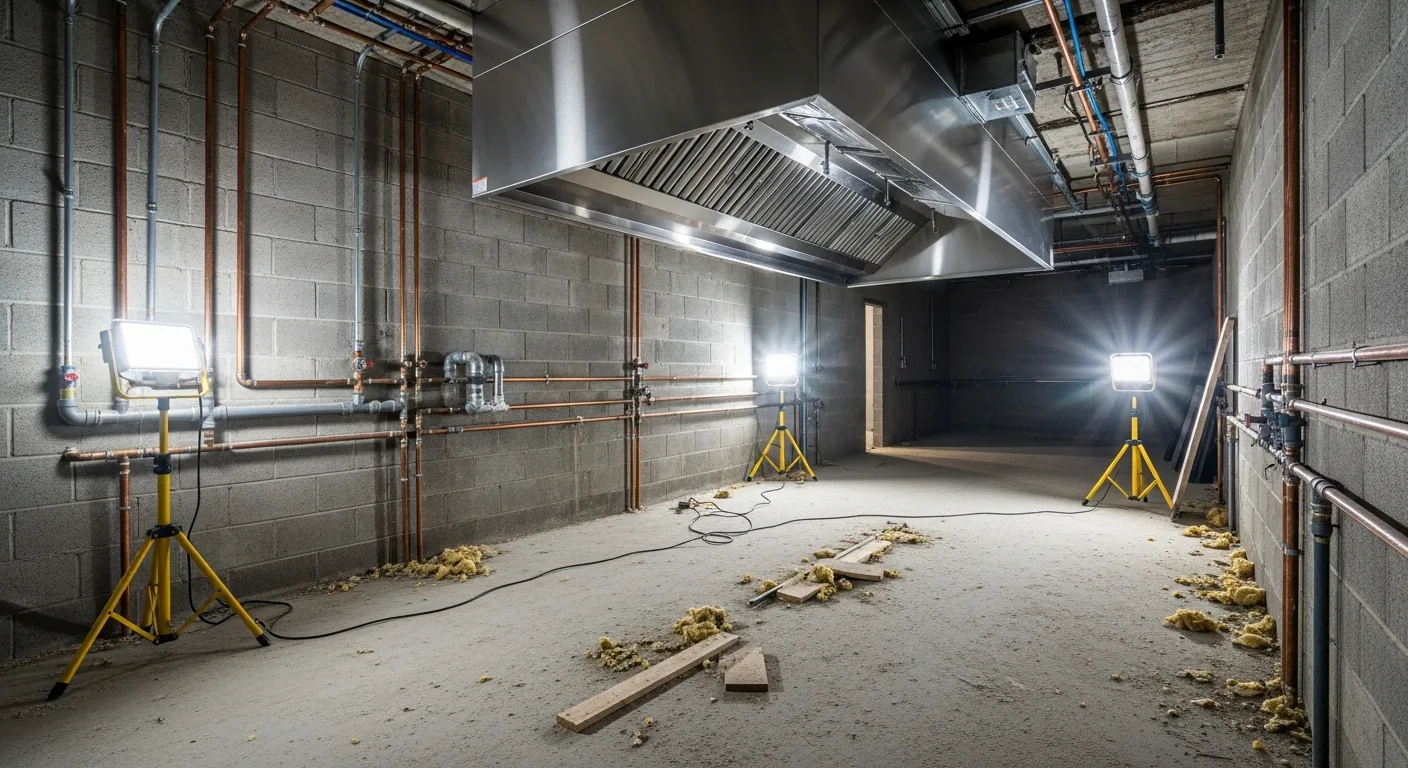
Commercial kitchen buildouts are some of the most complex tenant improvement projects in construction. You are dealing with heavy mechanical systems, strict health codes, fire suppression requirements, specialized plumbing, and a client who usually wants to be open yesterday.
Every trade has to work in a tight space with zero room for error. The hood has to be sized and positioned before the cooking line is finalized. The grease trap has to be sized before the plumbing is roughed in. The fire suppression system has to be designed around the final equipment layout. And the health department has to approve all of it before a single burger gets cooked.
This guide covers the major systems and requirements contractors face when building out a commercial kitchen.
Planning the Layout: Start With the Menu
Before you pick up a hammer, the kitchen layout needs to be nailed down. And the layout starts with the menu, not the floor plan.
A pizza shop, a full-service steakhouse, and a high-volume fast-casual chain all have completely different equipment needs, ventilation loads, and plumbing requirements. The menu determines the equipment, the equipment determines the layout, and the layout determines everything else.
Work with the owner and their kitchen consultant or food service designer to finalize the equipment list before you begin any design work. Changing the cooking line after the hood is designed and the grease trap is sized is an expensive change order.
Key Layout Considerations
- Workflow: The kitchen should flow logically from receiving and storage through prep, cooking, plating, and service. Health codes require separation of raw and cooked food areas.
- Equipment clearances: Check manufacturer specs for clearance requirements, especially around fryers and ovens that generate significant heat.
- Accessibility: Staff aisles need to be at least 36 inches wide (44 inches in high-traffic areas). ADA requirements apply if the kitchen will be open to the public or if employees require accommodation.
- Utility access: Every piece of equipment needs the right utility connection in the right spot. Gas lines, water supply, drains, and electrical circuits all need to land exactly where the equipment sits.
Exhaust Hoods and Ventilation
The exhaust hood system is the heart of the kitchen mechanical package. It controls smoke, grease, heat, and odors. Getting it wrong means a kitchen that is miserable to work in and a system that fails inspections.
Type 1 Hoods (Grease Hoods)
Type 1 hoods go over any cooking equipment that produces grease-laden vapors. That includes:
- Fryers
- Grills and charbroilers
- Ranges and cooktops
- Woks
- Broilers
- Tilting skillets
Type 1 hoods include grease-rated filters (baffle filters, not mesh), a fire suppression system, and ductwork that meets NFPA 96 for grease-laden exhaust. The duct must be welded steel (16-gauge minimum for rectangular, 18-gauge for round), with all joints welded and liquid-tight. The duct runs to the roof with a minimum of 18 inches of clearance from combustible materials.
Type 2 Hoods (Heat and Steam Hoods)
Type 2 hoods handle heat and moisture only. They go over equipment like:
- Dishwashers
- Convection ovens
- Steamers
- Pasta cookers
Type 2 hoods do not need grease filters or fire suppression. They can use standard HVAC ductwork.
Hood Sizing
The hood must overhang the cooking equipment on all exposed sides. The International Mechanical Code requires:
- Wall-mounted hoods: Extend 6 inches beyond the equipment on all open sides
- Island (center) hoods: Extend 12 inches beyond on all sides
- Minimum mounting height: 6 feet 6 inches above the floor (varies by jurisdiction)
Exhaust volume (CFM) depends on the hood type, size, and the equipment underneath. A typical calculation uses 150 to 400 CFM per linear foot of hood length, depending on the cooking equipment and hood style. The engineer of record will perform the actual calculation.
Makeup Air
When the hood exhausts 2,000 to 5,000 CFM (or more) of air from the kitchen, that air has to come from somewhere. Without a makeup air unit (MAU), the kitchen will be under extreme negative pressure. Doors will be hard to open, the hood will not capture properly, and the cooking equipment will not get enough combustion air.
The MAU is typically a rooftop unit that supplies tempered air directly into the kitchen. It should be sized to replace 80 to 100 percent of the exhaust volume. Many jurisdictions require a direct-fired makeup air unit that can heat or cool the incoming air.
Coordinate the MAU installation with the rooftop curb, structural support, gas line, and electrical connections. This is usually one of the longest lead-time items on the job.
Grease Traps and Interceptors
Commercial kitchens cannot dump grease down the sewer. Local sewer authorities require grease removal devices to prevent fats, oils, and grease (FOG) from clogging the municipal sewer system.
Indoor Grease Traps
Indoor units (also called point-of-use traps) are installed under or near the three-compartment sink and prep sinks. They are relatively small, rated at 7 to 50 GPM, and must be cleaned frequently (often daily or weekly).
Sizing rule: The trap must be sized for the total flow rate of all fixtures draining through it. Check the local plumbing code for the calculation method, which usually involves fixture unit counts and drainage flow rates.
Outdoor Grease Interceptors
For larger kitchens, the sewer authority may require an in-ground grease interceptor outside the building. These are concrete or fiberglass tanks ranging from 500 to 2,000 gallons or more. They provide much more retention time for grease to separate from the wastewater.
Key considerations:
- Interceptors need vehicular access for pump truck service (typically every 30 to 90 days)
- They require a permit from the sewer authority
- Installation involves significant excavation and concrete work
- The waste line from the kitchen to the interceptor must maintain proper slope (typically 1/4 inch per foot)
What Cannot Drain Through the Grease System
Garbage disposals, dishwashers, and handwash sinks typically have separate drainage requirements. Some jurisdictions prohibit garbage disposals in commercial kitchens entirely. Check with your local sewer authority and health department.
Fire Suppression Systems
Commercial kitchens with grease-producing cooking equipment require a dedicated fire suppression system over the cooking line. This is separate from the building’s sprinkler system.
UL 300 Wet Chemical Systems
The current standard is the UL 300 wet chemical system. It uses a potassium carbonate-based liquid agent stored in pressurized cylinders. When activated (manually or automatically), the system discharges the agent through nozzles aimed at the cooking surfaces and inside the exhaust hood.
The wet chemical agent does three things:
- Cools the burning grease below its auto-ignition temperature
- Creates a soapy foam blanket (saponification) that smothers the fire
- Prevents reignition
System Components
- Agent cylinders: Mounted on the wall near the cooking line, typically behind or beside the hood
- Nozzles: Positioned over each piece of cooking equipment and inside the hood plenum
- Detection line: A fusible link cable that runs through the hood, melting at a set temperature to trigger automatic activation
- Manual pull station: A clearly labeled pull station at the exit path from the kitchen
- Gas shutoff: The system must automatically shut off the gas supply to all cooking equipment when it activates
- Electrical shutoff: Shunt trip breakers for electric cooking equipment (varies by jurisdiction)
Installation Notes
- The system must be designed and installed by a licensed fire protection contractor
- Nozzle placement depends on the specific cooking equipment layout
- Each equipment change requires a system redesign and re-inspection
- The system ties into the building fire alarm
- Annual inspection and recharge after any activation
This is why the equipment layout must be finalized before the fire suppression system is designed. Moving a fryer six inches after the nozzles are set means a redesign.
Plumbing Requirements
Commercial kitchen plumbing is far more complex than residential work. Here is what you are dealing with.
Three-Compartment Sink
Health codes require a three-compartment sink for manual warewashing: wash, rinse, and sanitize. It needs hot and cold water supply, indirect waste drainage, and enough space for drain boards on both sides. Minimum basin size varies by jurisdiction but is typically 18 by 18 by 12 inches deep per compartment.
Handwash Sinks
You need a dedicated handwash sink in every food prep area, at the dishwashing station, and near the entrance to the kitchen. They must be accessible without passing through the cooking line. Hot water, soap dispenser, and paper towel dispenser are required at each one.
Floor Drains
Commercial kitchens need floor drains to handle cleaning water and spills. Spacing varies by code, but a common rule is one floor drain per 400 square feet. All floor drains need trap primers to prevent the trap seal from drying out, which would allow sewer gas into the kitchen.
Hot Water Requirements
A commercial kitchen needs a serious hot water system. Between the dishwasher (180-degree sanitizing rinse), the three-compartment sink, prep sinks, and handwash sinks, demand is high. Most kitchens need a dedicated commercial water heater sized at 50 to 100 gallons or more, depending on the dishwasher type and overall fixture count.
Backflow Prevention
Health codes require backflow prevention on the water supply to the kitchen. This typically means a reduced-pressure backflow preventer (RPZ) on the main supply line and air gaps on all indirect waste connections.
Electrical Requirements
Dedicated Circuits
Every major piece of equipment needs its own dedicated circuit. A typical commercial kitchen might require 20 to 40 dedicated circuits for:
- Walk-in cooler and freezer
- Reach-in refrigerators
- Dishwasher
- Convection ovens
- Microwave ovens
- Food processors
- Exhaust hood controls
- Makeup air unit
- Fire suppression system
- Point-of-sale equipment
Three-Phase Power
Many commercial cooking appliances and the exhaust hood motor require three-phase power. If the building does not have three-phase service, adding it is a significant cost. Verify the electrical service early in the project.
GFCI Protection
All receptacles within 6 feet of a water source need GFCI protection. In a commercial kitchen, that is nearly everything. Some jurisdictions require GFCI on the dishwasher circuit as well.
Emergency Lighting and Exit Signs
Kitchen areas need emergency lighting and illuminated exit signs per the building and fire codes. These are sometimes overlooked in kitchen buildouts.
Health Department Requirements
The health department plan review is often the longest and most unpredictable part of the permitting process. Requirements vary significantly by state, county, and city, but here are the universal themes.
Floor, Wall, and Ceiling Finishes
- Floors: Smooth, non-absorbent, easily cleanable. Quarry tile and sealed concrete are common. Must slope to floor drains.
- Walls: Smooth, washable, light-colored. FRP (fiberglass reinforced panels) and glazed tile are typical. All joints must be sealed.
- Ceilings: Smooth, washable, non-absorbent. Suspended acoustical tile is usually not allowed over food prep areas. Painted drywall, FRP, or washable ceiling panels are required.
- Cove base: Required at all wall-to-floor transitions, typically 4 to 6 inches, with a smooth radius for easy cleaning.
Temperature Controls
- Walk-in coolers: Must maintain 41 degrees Fahrenheit or below
- Walk-in freezers: Must maintain 0 degrees Fahrenheit or below
- All refrigeration units need thermometers visible from outside the unit
- Hot water at handwash sinks: Minimum 100 degrees Fahrenheit
- Dishwasher sanitizing rinse: 180 degrees (for high-temp machines) or chemical sanitizer concentration as rated
Pest Control
- All penetrations in walls and floors must be sealed
- Exterior doors need self-closing mechanisms and threshold seals
- Any opening to the outdoors needs screening
- Floor drains need covers
Plan Review Submission
The health department submittal typically includes:
- Floor plan with equipment layout
- Equipment specifications and data sheets
- Finish schedule for floors, walls, and ceilings
- Plumbing layout showing drainage and backflow prevention
- Ventilation layout
- Menu or description of food operations
Submit early. Health department reviews can take 2 to 8 weeks, and they often come back with revision requests.
Managing the Buildout Timeline
A commercial kitchen buildout has long lead times and tight coordination requirements. Here is a realistic timeline:
- Weeks 1 to 3: Design, equipment selection, plan preparation
- Weeks 3 to 9: Permit review (building, mechanical, plumbing, health department)
- Weeks 2 to 8: Equipment procurement (overlap with plan review)
- Weeks 9 to 11: Demolition, rough-in for mechanical, plumbing, electrical, gas
- Weeks 11 to 13: Hood installation, fire suppression rough-in, grease trap install
- Weeks 13 to 15: Finishes (floors, walls, ceilings), equipment set and connect
- Weeks 15 to 16: Testing, punch list, inspections
The biggest schedule risks are:
- Health department plan review delays
- Equipment lead times (especially custom stainless steel fabrication)
- Hood and makeup air unit manufacturing
- Grease interceptor excavation (weather-dependent)
Keeping It All on Track
Commercial kitchen buildouts involve more trades, more inspections, and more coordination than most tenant improvements. When you are juggling the hood installer, the fire suppression sub, the plumber, the electrician, equipment delivery dates, and multiple inspections, things fall through the cracks fast.
Projul’s project management tools give you a single place to schedule every trade, track equipment deliveries, store health department submittals, and manage inspection dates. Your whole team can see what is happening and what is next, from the office or the field.
If you are building out commercial kitchens and still managing schedules on paper or spreadsheets, take a look at Projul’s pricing or schedule a demo to see how it handles complex, multi-trade projects.
Final Thoughts
Commercial kitchen buildouts are demanding projects. The mechanical systems are complex, the code requirements are strict, and the coordination between trades has almost no margin for error. But when you understand the major systems and plan for the long lead times, these projects run smoothly and produce great results.
Start with the menu, finalize the equipment layout early, submit for permits immediately, and coordinate your trades through a shared schedule. Do those four things and you will avoid the most common pitfalls in commercial kitchen construction.
The restaurants will appreciate it, and so will your bottom line.
Frequently Asked Questions
How much does a commercial kitchen buildout cost?
What permits are needed for a commercial kitchen buildout?
What is a Type 1 vs Type 2 exhaust hood?
How big does a grease trap need to be for a restaurant?
What fire suppression system is required in a commercial kitchen?
How long does a commercial kitchen buildout take?
What floor type is required in a commercial kitchen?
Does a commercial kitchen need a separate HVAC system?
Related Articles

BIM Clash Detection: How to Catch Conflicts Before They Cost You on the Jobsite
BIM Clash Detection: How to Catch Conflicts Before They Cost You on the Jobsite Every contractor has a story about the...
Read More →
Asphalt Paving and Compaction Guide: Mix Types, Laydown Temperatures, and Quality Testing
Asphalt paving looks straightforward from a distance. A truck dumps material, the paver lays it down, and rollers...
Read More →
Construction Jobsite Wi-Fi & Connectivity Guide: Setting Up Reliable Internet in the Field
A practical guide to getting reliable internet on construction job sites. Learn about cellular hotspots, mesh networks,...
Read More →