
Construction Concrete Basics: Types, Mixes, and Placement for Contractors | Projul
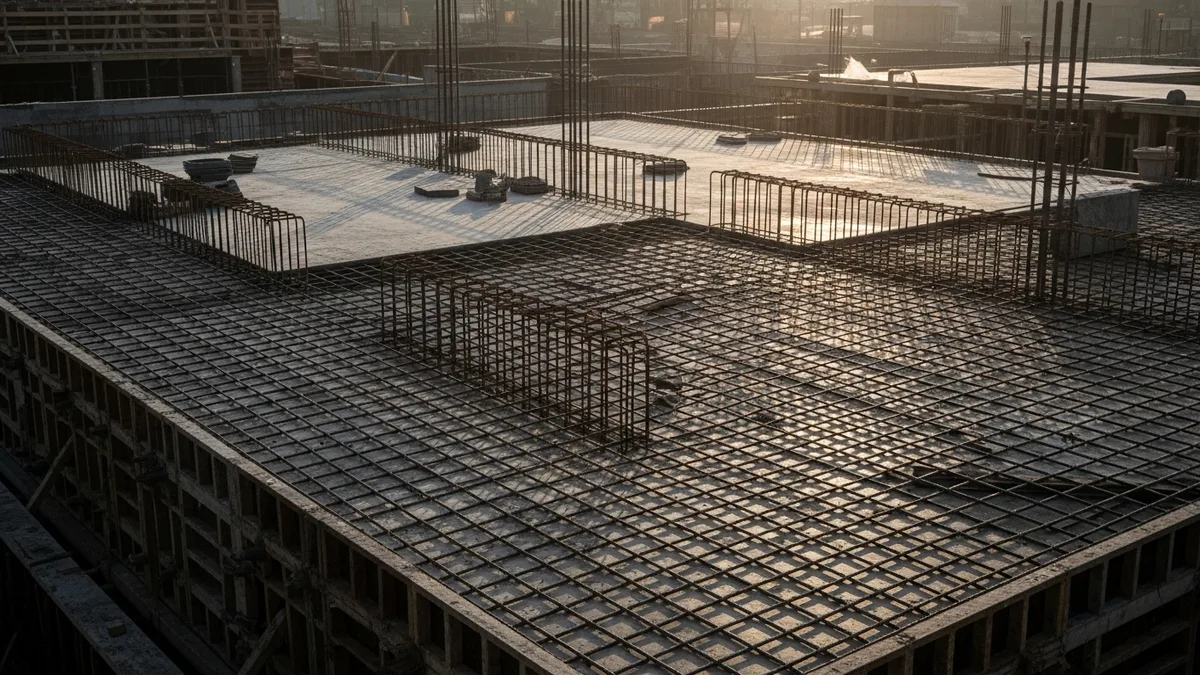
Concrete is one of those materials that every contractor deals with, but not every contractor truly understands. You can frame a wall wrong and tear it out in an afternoon. Pour a bad slab and you’re looking at jackhammers, disposal costs, and a schedule that just blew up.
The basics of concrete are not complicated. But skipping them, or getting sloppy with mix selection, placement, or curing, will cost you real money and real time. Whether you’re pouring footings, flatwork, or structural walls, understanding what’s actually happening with your concrete makes the difference between a job that holds up for decades and a callback that eats your profit.
This guide covers what contractors need to know about concrete types, mix designs, placement techniques, and the common mistakes that lead to failures on the job site.
Understanding Concrete as a Material
Concrete is a composite material made from four basic components: cement, water, fine aggregate (sand), and coarse aggregate (gravel or crushed stone). When cement and water combine, they create a paste that coats and bonds the aggregates together. That chemical reaction, called hydration, is what gives concrete its strength over time.
Here’s the part that trips people up: concrete does not “dry.” It cures. The hardening process is a chemical reaction between cement and water, not evaporation. That’s why keeping concrete moist during the early curing period makes it stronger, not weaker. Letting it dry out too fast actually weakens the final product.
The ratio of water to cement in any given mix is the single biggest factor affecting strength. More water makes the mix easier to pour and work, but it also makes the finished product weaker and more prone to cracking. This is why experienced concrete crews resist the temptation to add water at the chute to make placement easier. That extra water costs you compressive strength.
The basic components and what they do:
- Portland cement acts as the binder. It reacts with water to form the paste that holds everything together.
- Water triggers hydration and makes the mix workable. The amount directly affects strength and durability.
- Fine aggregate (sand) fills the gaps between coarse aggregate particles and contributes to workability.
- Coarse aggregate (gravel/stone) provides the bulk structural framework and compressive strength.
- Admixtures are chemical additives that modify specific properties like set time, workability, air content, or strength gain.
When you’re tracking material costs across multiple pours, understanding these components helps you evaluate whether mix changes are adding value or just adding cost.
Common Concrete Types and When to Use Them
Not all concrete is the same, and picking the wrong type for the application is a mistake that shows up months or years later. Here are the concrete types you’ll encounter most often in commercial and residential construction.
Ready-Mix Concrete
This is what shows up in the truck from your local batch plant. Ready-mix is batched at a central plant according to a specified mix design and delivered to your site. It’s the standard for any pour larger than a few yards. You order it by specifying strength (PSI), slump (workability), aggregate size, and any admixtures you need.
Ready-mix gives you consistency and quality control that site-mixed concrete can’t match. The batch plant weighs and measures every component, and they’ll provide tickets documenting exactly what’s in each load.
High-Strength Concrete
Anything above 6,000 PSI is generally considered high-strength. You’ll see this specified for structural columns, high-rise foundations, precast elements, and bridge components. High-strength mixes use lower water-to-cement ratios, often include supplementary cementitious materials like silica fume or fly ash, and require more careful placement and curing.
Lightweight Concrete
Made with lightweight aggregates like expanded shale or clay, this type weighs roughly 25% to 30% less than normal concrete. It’s used for improved decks, roof fills, and situations where reducing dead load on the structure matters. Lightweight concrete is more expensive per yard but can save money on structural steel and foundations because the building carries less weight.
Fiber-Reinforced Concrete
This mix includes synthetic or steel fibers distributed throughout. The fibers help control shrinkage cracking and can replace or supplement traditional welded wire mesh in slabs on grade. Fiber reinforcement doesn’t replace structural rebar in load-bearing applications, but it’s increasingly common in flatwork and industrial floors.
Self-Consolidating Concrete (SCC)
SCC flows and fills forms under its own weight without vibration. It’s useful for congested reinforcement areas, thin sections, and architectural concrete where bug holes and honeycombing need to be minimized. SCC costs more per yard and requires tighter quality control, but it saves labor on placement and vibration.
Knowing which type to specify starts with understanding the structural requirements, exposure conditions, and budget. Your estimating process should account for the significant price differences between standard ready-mix and specialty concrete types, because the gap can be $40 to $80 per yard or more.
Mix Design: Getting the Right Recipe
A concrete mix design specifies the proportions of each ingredient to achieve the required performance. On most commercial projects, the engineer specifies the performance requirements and the batch plant designs a mix to meet them. On residential work, you’re often selecting from standard mixes the plant already has on file.
Key specifications you need to understand:
Compressive Strength (PSI)
This is the primary performance measure, tested at 28 days by crushing cylinder samples in a lab. Common residential specs range from 2,500 to 4,000 PSI. Commercial and structural concrete typically runs 4,000 to 6,000 PSI. Anything above that enters high-strength territory.
Slump
Slump measures workability, or how fluid the mix is. It’s tested by filling a cone-shaped mold, lifting it off, and measuring how far the concrete drops. A 4-inch slump is stiff and holds its shape well, suitable for slabs and pavements. A 6-inch slump is more fluid and easier to place in walls and footings. Going above a 6-inch slump with standard mixes usually means too much water.
Air Entrainment
In climates with freeze-thaw cycles, air-entrained concrete is essential. Tiny air bubbles (4% to 7% of volume) give water room to expand when it freezes inside the concrete, preventing surface scaling and spalling. If you’re pouring exterior flatwork in any region that sees freezing temperatures, air entrainment is not optional.
Maximum Aggregate Size
The largest stone in the mix affects workability, pumpability, and strength. Standard mixes use 3/4-inch or 1-inch aggregate. Smaller aggregate (3/8-inch) is specified for thin sections or congested reinforcement. Larger aggregate is more economical but limits where the concrete can be placed.
Water-to-Cement Ratio
This ratio controls strength and durability. Most structural specs cap the w/c ratio at 0.45 to 0.50. Lower ratios mean stronger, more durable concrete but also stiffer mixes that are harder to place. The batch plant manages this, but you need to know it so your crews don’t add water on site and blow the ratio.
When you’re building estimates for concrete work, accounting for the right mix design from the start prevents surprise costs. A project that specs 5,000 PSI air-entrained concrete with a 0.45 w/c ratio costs meaningfully more than a standard 3,000 PSI mix. Tracking these details in your scheduling workflow helps ensure the right trucks show up on the right day with the right product.
Placement Techniques That Prevent Failures
Getting the concrete to the site is only half the job. How you place, consolidate, and finish it determines whether the final product performs as designed.
Subgrade Preparation
Everything starts with what’s underneath. A concrete slab is only as good as the ground it sits on. The subgrade needs to be uniformly compacted, properly graded for drainage, and free of organic material, soft spots, and standing water.
Read real contractor reviews and see why Projul carries a 9.8/10 on G2.
For slabs on grade, a layer of compacted granular base (usually 4 to 6 inches of crushed stone or gravel) provides a stable, drainable platform. Vapor barriers go under interior slabs where moisture migration could damage flooring. The time you spend getting the subgrade right pays back every single time.
Forming
Forms need to be straight, level, tight at the joints, and strong enough to hold the concrete without bulging. Blow-outs waste material, delay the pour, and create a mess that takes hours to clean up. Check forms twice before the trucks arrive. Oil or release agent on the form faces makes stripping easier and produces cleaner surfaces.
For walls and columns, verify that your forms can handle the lateral pressure of wet concrete. Pressure increases with pour rate and height. Filling a wall form fast generates significantly more pressure than pouring slowly.
Placing and Consolidating
Concrete should be deposited as close to its final position as possible. Dragging it long distances with rakes causes segregation, where the heavy coarse aggregate separates from the morite and paste. Drop concrete vertically when you can. For deep placements like walls, keep the free-fall distance under 4 to 5 feet to prevent segregation.
Vibration is critical for consolidating concrete in formed work. Insert the vibrator vertically, let it penetrate into the previous layer, and pull it out slowly. Over-vibrating is just as bad as under-vibrating because it brings excess paste to the surface and pushes coarse aggregate to the bottom.
For flatwork, a screed levels the surface, then bull floats or darbies smooth and embed the aggregate. Finishing operations like troweling should wait until bleed water has evaporated. Working bleed water back into the surface weakens the top layer and causes scaling.
Reinforcement Placement
Rebar and mesh need to be at the correct position within the slab or wall. A #4 bar specified at 3 inches of cover does nothing if it’s sitting on the ground. Use chairs, bolsters, and tie wire to hold reinforcement at the designed position, and check it before concrete arrives.
Recording placement details, reinforcement inspections, and any field changes in your daily logs protects you when questions come up months later about what was installed and where.
Curing and Protection: Where Most Contractors Cut Corners
If there’s one phase where contractors consistently leave performance on the table, it’s curing. Proper curing can be the difference between concrete that meets spec and concrete that fails, cracks, or dusts.
Why Curing Matters
Hydration requires water. If the surface dries out too quickly, the top layer of concrete never reaches its potential strength. The result is a weak surface prone to dusting, crazing, and scaling. Interior concrete has less exposure to wind and sun, but it still benefits from curing.
The first 7 days are the most critical. Concrete that’s kept moist and at a reasonable temperature during this window will develop significantly more strength than concrete left exposed.
Curing Methods
Water curing is the most effective method. This means keeping the surface continuously moist with wet burlap, soaker hoses, or ponding water on flat surfaces. It works great but requires attention and labor.
Curing compounds are liquid membranes sprayed on the surface immediately after finishing. They seal in moisture and are the most common method for flatwork because they’re fast and don’t require ongoing attention. Apply them at the manufacturer’s recommended rate. Too thin and they don’t work.
Plastic sheeting placed over the surface traps moisture. It works well but can cause discoloration if it contacts the surface unevenly, so it’s not ideal for decorative or architectural concrete.
Insulated blankets provide both moisture retention and temperature protection in cold weather. They’re essential when ambient temperatures drop below 50 degrees Fahrenheit during the curing period.
Cold and Hot Weather Considerations
Temperature extremes during placement and curing create problems. In hot weather (above 90 degrees Fahrenheit), concrete sets faster, loses workability quicker, and cracks more easily from rapid moisture loss. Strategies include scheduling pours for early morning, using ice or chilled water in the mix, and applying curing compound immediately after finishing.
In cold weather, the risks are even higher. Concrete that freezes before reaching approximately 500 PSI can permanently lose up to 50% of its design strength. Protect fresh concrete from freezing for at least the first 48 hours, and longer for thin sections. Heated enclosures, insulated blankets, and accelerating admixtures all help, but they add cost to the job.
Build these weather-dependent requirements into your project planning. Scheduling a big pour during a cold snap without budgeting for protection measures leads to either a bad pour or a surprise hit to your margins. Tools like Projul’s scheduling features help you coordinate pour dates with weather windows so your crew and materials line up when conditions are right.
Avoiding the Most Expensive Concrete Mistakes
Concrete mistakes are uniquely painful because the fix is almost always removal and replacement. You can’t patch a slab that’s 1,000 PSI below spec or straighten a wall that bowed during the pour. Here are the mistakes that cost contractors the most money and how to prevent them.
Adding Water on Site
This is the number one concrete sin. Every gallon of water added at the chute beyond the designed mix reduces compressive strength and increases shrinkage cracking. If the concrete arrives too stiff, the right move is to add a water-reducing admixture (which the truck driver may carry) or reject the load. Pouring low-strength concrete to save time on placement always costs more in the long run.
Skipping Control Joints
Concrete is going to crack. That’s physics. Control joints give it a predetermined weak point so it cracks where you want it to, in a straight line at the bottom of a saw cut or tooled groove, instead of randomly across the slab. The general rule is to space control joints at intervals no greater than 2 to 3 times the slab thickness in feet. For a 4-inch slab, that means joints every 8 to 12 feet. Panels should be roughly square; long, narrow panels crack diagonally.
Poor Subgrade Compaction
Settling under a slab creates voids. Voids mean unsupported concrete. Unsupported concrete cracks and sinks under load. If the subgrade wasn’t compacted properly or has soft spots, no amount of concrete strength or reinforcement will save the slab. Fix the ground before you pour.
Finishing Too Early
Starting troweling operations while bleed water is still on the surface traps that water under a dense, troweled skin. The result is delamination, where the top layer separates and flakes off. Wait until the bleed sheen disappears and a footprint leaves only a slight impression before troweling.
Not Testing
On commercial projects, concrete testing (slump tests, air content tests, and cylinder samples) is typically required. On residential work, many contractors skip it to save a few hundred dollars. Then when a slab fails or a footing doesn’t meet the spec, there’s no documentation to prove the concrete was good or to hold the batch plant accountable. Testing is cheap insurance.
Ignoring the Batch Ticket
Every ready-mix truck comes with a batch ticket showing the mix design, water content, time batched, and admixtures. Review it before the truck unloads. If the mix doesn’t match what you ordered, or if the concrete has been in the truck too long (generally 90 minutes or 300 revolutions is the limit), reject the load. Accepting bad concrete to keep the pour moving costs far more than the delay.
Catching these issues before they become problems is exactly why thorough documentation matters. Pairing field notes with a system that tracks daily activities keeps you protected and helps you refine your process over time.
Pulling It All Together
Concrete work is straightforward when you respect the fundamentals. Understand your materials, specify the right mix for the application, prepare the subgrade, place and consolidate properly, cure with discipline, and document everything.
The contractors who consistently deliver quality concrete work are not doing anything secret. They’re just doing the basics correctly every time. They check the subgrade before forming. They review the batch ticket before the chute opens. They cure for the full recommended period even when the schedule is tight. And they track their costs, quantities, and outcomes so they can estimate the next concrete job with confidence.
See how Projul makes this easy. Schedule a free demo to get started.
If you’re looking to tighten up how your crew handles concrete, or any material on the job site, start with better systems for estimating, scheduling, and tracking daily work. Projul is built specifically for contractors who want to run cleaner jobs without spending hours on paperwork. Check out the pricing page to see which plan fits your operation, and start turning your concrete work into a consistent, profitable part of your business.
Frequently Asked Questions
What is the most common concrete mix used in residential construction?
How long does concrete take to cure fully?
What causes concrete to crack after placement?
Can I pour concrete in cold weather?
What is the difference between concrete and cement?
Related Articles

Construction Apprenticeship vs Trade School: Which Path Is Better?
Apprenticeships and trade schools both lead to careers in the trades, but they take very different routes to get there....
Read More →
Owner-Builder Construction: What You Need to Know Before Acting as Your Own GC
Being your own general contractor sounds like a great way to save money, but the reality involves permits, insurance,...
Read More →
Construction Mechanical Piping and Process Piping Guide
Mechanical piping and process piping are two different animals, even though they both involve welding pipe and running...
Read More →