
Concrete Best Practices for Contractors (2026)
Concrete is the most widely used construction material on earth, and it is also one of the most misunderstood. Every contractor has poured concrete, but not every contractor pours it well. The difference between a slab that lasts 50 years and one that starts cracking in the first winter often comes down to decisions made before the trucks even arrive.
This guide covers the practices that separate good concrete work from bad: mix selection, placement, finishing, curing, and how to handle the challenges of extreme weather. Whether you are pouring a residential driveway or a commercial foundation, these fundamentals apply.
Understanding Concrete Mix Design
Concrete is not a single material. It is a recipe, and getting the recipe right for your specific application is the first step toward a successful pour.
The Basic Components
Cement. Portland cement is the binding agent that holds everything together. When mixed with water, it undergoes a chemical reaction called hydration that produces the hard paste that binds the aggregates. Type I/II is the standard for most construction. Type III is high-early-strength for cold weather or fast-track projects.
Water. Water activates the cement and makes the mix workable. But water is also the most abused ingredient in concrete. Too much water weakens the final product and increases shrinkage cracking. The water-to-cement ratio is the single most important factor in concrete strength and durability.
Coarse aggregate. Gravel or crushed stone makes up the bulk of the concrete volume. The size, shape, and gradation of the aggregate affect workability, strength, and finish quality. Round aggregates (gravel) are easier to place and finish. Angular aggregates (crushed stone) produce higher strength.
Fine aggregate. Sand fills the spaces between the coarse aggregate particles. Clean, well-graded sand produces a more workable and finishable mix.
Admixtures. Chemical additives that modify the concrete’s properties. Common admixtures include:
- Water reducers: allow lower water content without losing workability
- Air entraining agents: create microscopic air bubbles that improve freeze-thaw resistance
- Accelerators: speed up setting time for cold weather or fast-track work
- Retarders: slow down setting time for hot weather or long pours
- Superplasticizers: dramatically increase workability without adding water
Specifying the Right Mix
When ordering concrete, you need to specify several key properties:
Compressive strength (PSI). This is the most common specification. Typical values:
- 2,500 PSI: non-structural applications, fill
- 3,000 PSI: residential foundations, sidewalks
- 4,000 PSI: driveways, garage floors, commercial slabs
- 5,000+ PSI: structural elements, high-load applications
Slump. Slump measures workability, or how fluid the concrete is. It is tested by filling a cone-shaped mold, removing it, and measuring how much the concrete settles. Typical values:
- 2 to 3 inches: stiff mix for curbs and steps
- 4 to 5 inches: standard for slabs and foundations
- 6 to 8 inches: high-slump for pumped concrete or congested reinforcement
Air content. For any concrete exposed to freeze-thaw cycles, specify air entrainment of 5 to 7 percent. The tiny air bubbles give water room to expand when it freezes inside the concrete, preventing surface scaling and spalling.
Maximum aggregate size. Typically 3/4 inch or 1 inch for most applications. Smaller aggregate (3/8 inch) is used for thin sections or congested reinforcement where large stones would not fit.
Working with Your Ready-Mix Supplier
Develop a relationship with your ready-mix supplier. A good supplier will help you select the right mix for each application, adjust the recipe for seasonal conditions, and troubleshoot problems. Tell them what the concrete is for, what the exposure conditions are, and when you are pouring. They deal with hundreds of contractors and have seen every problem. Use their knowledge.
Subgrade Preparation
The concrete is only as good as what it sits on. Subgrade preparation is one of the most common areas where contractors cut corners, and it shows up in cracking and settlement problems later.
Soil Evaluation
Before you pour anything, understand what the soil is doing. Is it compacted? Is it uniform? Is it wet? Clay soils expand and contract with moisture changes. Sandy soils drain well but may not provide uniform support. Organic soils are never acceptable as a subgrade for concrete.
Compaction
The subgrade must be compacted to a uniform density. Use a plate compactor or roller to achieve at least 95 percent standard Proctor density. Test the compaction with a penetrometer or a nuclear density gauge on larger projects.
Soft spots and voids under the slab will cause differential settlement and cracking. Walk the subgrade before you pour and probe any areas that feel soft.
Sub-base Material
For slabs on grade, a 4 to 6 inch layer of compacted granular fill (crushed stone or gravel) over the prepared subgrade provides a stable, well-draining base. This layer helps distribute loads evenly and prevents moisture from wicking up through the slab.
Moisture Barriers
For interior slabs and any slab where moisture transmission is a concern, install a vapor barrier (typically 10-mil polyethylene) over the sub-base. Overlap seams by at least 6 inches and tape them. This prevents ground moisture from migrating through the slab, which causes problems with floor coverings, coatings, and stored materials.
Formwork
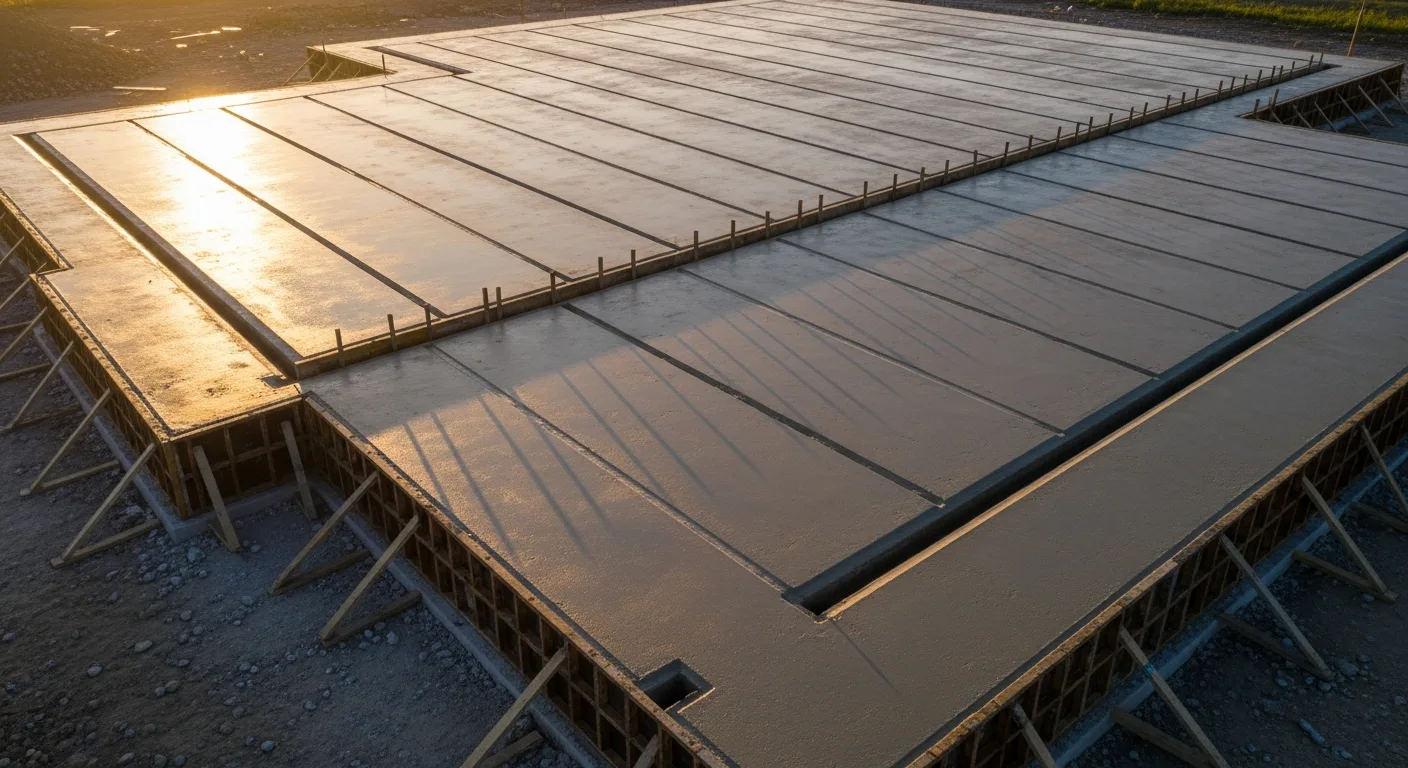
Good formwork produces clean edges, accurate dimensions, and the right slab thickness. Sloppy formwork produces slabs that are the wrong thickness, have irregular edges, and create problems for everything that comes after.
Form Materials
Lumber. 2x4, 2x6, or 2x8 lumber is standard for slab forms. Use straight, undamaged boards. Warped or twisted lumber produces wavy edges. For curved forms, use thin plywood or flexible form boards.
Metal forms. Reusable steel or aluminum forms are common for commercial and highway work. They produce cleaner edges and hold up to repeated use, but the upfront cost is higher.
Staking. Drive stakes at 3 to 4 foot intervals along the outside of the forms. The stakes resist the lateral pressure of wet concrete, which is considerable. Under-staked forms will bow outward and produce an oversize slab that wastes concrete.
Setting Forms to Grade
Check your forms for level and grade before the trucks arrive, not after. Use a string line, a laser level, or a transit to verify that the forms are at the correct elevation and slope. For exterior flatwork, a minimum slope of 1/8 inch per foot away from buildings provides adequate drainage.
Oiling Forms
Apply form release oil to wood forms before placing concrete. This prevents the concrete from bonding to the wood and makes stripping easier. Without release oil, removing forms can chip and damage the slab edges.
Reinforcement
Reinforcement gives concrete the ability to resist tension forces. Concrete is strong in compression but weak in tension, which is why unreinforced concrete cracks so readily.
Welded Wire Mesh
For residential slabs on grade, 6x6 W1.4/W1.4 welded wire mesh is the most common reinforcement. It controls shrinkage cracking and holds cracks tightly together if they do form.
The critical detail with mesh is positioning. Mesh that sinks to the bottom of the slab during the pour does almost nothing. It needs to be in the middle or upper third of the slab. Use chairs, bolsters, or rebar supports to hold the mesh at the correct height. Some contractors pull the mesh up during placement, but this is less reliable than supporting it properly before the pour.
Rebar
For structural applications, footings, stem walls, suspended slabs, and any element designed by an engineer, rebar placement must follow the structural drawings exactly. Bar size, spacing, cover, lap lengths, and bend details all matter.
Inspect reinforcement before the pour. Check bar sizes, spacing, and cover against the plans. A few minutes of inspection prevents expensive problems later.
Fiber Reinforcement
Synthetic fibers (polypropylene) or steel fibers mixed into the concrete reduce plastic shrinkage cracking and improve impact resistance. Fibers work well as a supplement to traditional reinforcement or as the primary crack control for non-structural slabs.
Fibers do not replace structural reinforcement. They control cracking, but they do not provide the tensile capacity that rebar provides.
Placement
How concrete is placed affects its strength, durability, and appearance. Rushed or careless placement creates problems that no amount of finishing can fix.
Delivery and Timing
Know your window. Concrete begins setting as soon as it is mixed. In moderate conditions, you have about 90 minutes from batching to placement. In hot weather, that window shrinks. In cold weather, it expands. Coordinate with your ready-mix supplier so trucks arrive at intervals you can handle.
Check the load. When the first truck arrives, check the ticket to verify the mix matches your order. Run a slump test before placing. If the slump is too low, the supplier can add water or superplasticizer (within limits). If the slump is too high, that truck was batched wrong and should be sent back.
Never add water in the field. Adding water at the jobsite to make the concrete easier to pour is one of the most common and most damaging practices in concrete construction. Every gallon of water added to a cubic yard of concrete reduces the compressive strength by 150 to 200 PSI and increases shrinkage cracking. If you need more workable concrete, order it that way from the plant or use admixtures.
Placing Techniques
Drop height. Keep the drop height under 5 feet to prevent segregation (the coarse aggregate separating from the paste). For deep pours, use a chute, tremie pipe, or pump.
Consolidation. Vibrate the concrete to remove trapped air and ensure it fills all corners and spaces in the forms. Use an internal vibrator (pencil vibrator) for walls, columns, and deep sections. For slabs, a screed vibrator or the screeding process itself typically provides adequate consolidation.
Over-vibrating is as bad as under-vibrating. Too much vibration brings excess paste to the surface, creates a weak surface layer, and causes segregation.
Continuous placement. Avoid cold joints by placing concrete continuously. A cold joint forms when fresh concrete is placed against concrete that has already started to set. The bond between the two layers is weak and creates a potential leak and crack point. If a cold joint is unavoidable, treat the surface with a bonding agent before placing the next lift.
Finishing
Finishing is where skill and timing separate experienced concrete workers from everyone else. The same mix, placed on the same subgrade, can look completely different depending on how it is finished.
The Sequence
Screeding. Immediately after placement, screed the concrete to the correct elevation using a straightedge, screed board, or power screed. This is the rough leveling step that establishes the slab surface.
Bull floating. After screeding, pass a bull float over the surface to smooth it and push down aggregate. This closes the surface and prepares it for finishing.
Waiting for bleed water. This is the step most people rush. After bull floating, water will rise to the surface as the heavier particles settle. This is called bleed water. You must wait for the bleed water to evaporate before proceeding with finishing operations. Finishing over bleed water traps the water in the surface layer, creating a weak, dusty, and scaling-prone surface.
How long you wait depends on conditions. In hot, dry weather, bleed water evaporates quickly and you need to move fast. In cool, humid conditions, it can take an hour or more. Watch the surface. When the sheen disappears and the concrete supports your weight with only a slight impression, it is time to finish.
Edging. Run an edging tool along the forms to create a rounded edge that resists chipping.
Jointing. Cut control joints with a grooving tool or saw to control where cracks form. Joint spacing should be no more than 2 to 3 times the slab thickness in feet. A 4-inch slab should have joints every 8 to 12 feet. Cut joints to a depth of at least one-quarter of the slab thickness.
Floating. For most exterior flatwork, a broom or float finish is appropriate. Hand float or power float the surface after the bleed water is gone to produce a smooth, even surface.
Troweling. For interior slabs that will receive a hard, smooth finish, follow floating with steel troweling. Multiple passes with a steel trowel compress and densify the surface. Each pass increases the hardness and smoothness. Do not start troweling too early. The concrete should be firm enough that the trowel does not dig into the surface.
Broom finishing. For exterior surfaces that need slip resistance, drag a broom across the surface after floating. The depth and direction of the broom texture affect traction and appearance. Pull the broom in straight, parallel lines for the best appearance.
Common Finishing Mistakes
Finishing too early. Working the surface before bleed water has evaporated traps water and weakens the surface. This is the number-one finishing mistake.
Sprinkling water on the surface. Adding water during finishing makes the concrete easier to trowel, but it weakens the surface layer, causes discoloration, and increases scaling. Never do this.
Over-troweling. Too many trowel passes or troweling too aggressively brings excess paste to the surface and can cause delamination: a thin, hard surface layer that separates from the concrete below.
Curing
Curing is the process of maintaining adequate moisture and temperature in the concrete as it gains strength. It is the most neglected step in concrete construction and the cause of countless problems.
Why Curing Matters
The chemical reaction that hardens concrete (hydration) requires water. If the surface dries out before it has fully hydrated, the concrete will be weak, dusty, and prone to cracking. Proper curing can increase surface strength by 50 percent or more compared to uncured concrete.
Curing Methods
Curing compounds. Spray-on liquid membranes that seal the surface and prevent moisture loss. This is the most common curing method for flatwork because it is fast and easy to apply. Apply curing compound immediately after final finishing at the coverage rate specified by the manufacturer.
Wet curing. Keeping the surface continuously wet with water, wet burlap, or saturated cotton mats. This is the gold standard for curing and produces the strongest, most durable surface. It is more labor-intensive than curing compounds but is required for some specifications.
Plastic sheeting. Covering the surface with polyethylene film traps moisture and prevents evaporation. Secure the edges so the plastic does not blow off. The downside is that wrinkles and creases in the plastic can cause discoloration.
Insulated blankets. For cold weather curing, insulated blankets retain both heat and moisture. They are essential when ambient temperatures drop below 50 degrees Fahrenheit.
Curing Duration
Maintain curing for a minimum of 7 days for standard concrete. High-early-strength mixes may allow shorter curing periods. For critical structural elements and high-performance concrete, 14 days or more may be specified.
Hot Weather Concrete
Pouring concrete when temperatures exceed 85 to 90 degrees Fahrenheit creates challenges that require specific countermeasures.
Problems Caused by Heat
- Faster setting time reduces your working window
- Increased water demand tempts workers to add water
- Higher evaporation rate causes plastic shrinkage cracking
- Reduced ultimate strength if the concrete gets too hot
- Thermal cracking from rapid temperature changes between day and night
Hot Weather Precautions
Schedule early. Pour early in the morning before temperatures peak. Starting at 5 or 6 AM gives you cooler placing temperatures and more working time.
Cool the ingredients. Your ready-mix supplier can use chilled water or ice to lower the concrete temperature. Keeping the concrete below 90 degrees Fahrenheit at placement is the target.
Use retarding admixtures. Retarders slow the setting time and give your crew more time to place and finish.
Windbreaks and sunshades. Erect temporary windbreaks and sunshades over the work area to reduce evaporation. Even simple tarps on poles make a meaningful difference.
Fog misting. In extremely hot and dry conditions, a fog mist above the concrete surface reduces evaporation without adding water to the surface. This is different from spraying water on the concrete, which is never acceptable.
Immediate curing. Apply curing compound or start wet curing the moment finishing is complete. In hot weather, every minute of delay increases the risk of surface cracking.
Cold Weather Concrete
Cold weather concrete is a different set of challenges but equally important to manage correctly.
The Critical Rule
Fresh concrete must not freeze within the first 24 hours. If it does, the ice crystals that form in the pore structure will permanently damage the concrete, reducing its strength by 50 percent or more. There is no way to fix frozen concrete. It must be removed and replaced.
Cold Weather Precautions
Heat the ingredients. The ready-mix plant can heat the water and aggregates to deliver concrete at 50 to 65 degrees Fahrenheit, depending on the ambient temperature.
Use accelerating admixtures. Accelerators speed up setting and early strength gain. Calcium chloride is the most common, but non-chloride accelerators are used when corrosion of reinforcement is a concern.
Protect the pour. Cover fresh concrete with insulated blankets, heated enclosures, or both. Maintain concrete temperature above 50 degrees Fahrenheit for at least the first 48 hours, and above 40 degrees Fahrenheit for the remainder of the curing period.
Never pour on frozen ground. Frozen subgrade will thaw unevenly, causing settlement and cracking. Thaw the subgrade with ground heaters or insulated blankets before placing concrete.
Extended curing. Cold weather slows hydration significantly. What takes 7 days to cure in summer may take 14 days or more in winter. Do not strip forms or load the concrete before it has reached adequate strength, regardless of the calendar.
Temperature monitoring. Place temperature probes in the concrete and monitor them throughout the curing period. This is the only reliable way to know if your protection measures are working.
Common Concrete Defects and Their Causes
Understanding what causes defects helps you prevent them.
Plastic shrinkage cracks. Fine, random cracks that appear within the first few hours. Caused by rapid surface drying. Prevented by wind protection, fog misting, and immediate curing.
Drying shrinkage cracks. Longer cracks that develop over days or weeks as the concrete dries. Controlled by proper joint spacing, low water-to-cement ratio, and adequate curing.
Scaling. Flaking of the surface layer, often in freeze-thaw environments. Caused by inadequate air entrainment, finishing over bleed water, or poor curing. Prevented by specifying air-entrained concrete, proper finishing timing, and thorough curing.
Spalling. Deeper surface failures, often at joints or edges. Can be caused by corrosion of reinforcement near the surface, impact damage, or freeze-thaw cycles with poor air entrainment.
Discoloration. Uneven color across the surface. Caused by inconsistent curing (plastic sheeting wrinkles), varying water-to-cement ratios, calcium chloride admixtures, or different cement sources between loads.
Dusting. A powdery surface that generates dust under traffic. Caused by finishing over bleed water, adding water during finishing, insufficient curing, or carbonation from unvented heaters in enclosed spaces.
Popouts. Small cone-shaped holes in the surface caused by aggregate particles that absorb water and expand near the surface. Prevented by using sound aggregates and proper mix design.
Testing Requirements
Testing is how you verify that the concrete you received and placed matches what you specified. Do not skip testing. It protects you legally and ensures quality.
Field Tests
Slump test. Performed at the truck before placement. Fill a standard slump cone, lift it, and measure the settlement. This verifies workability and consistency between loads.
Air content test. Performed with a pressure meter. Critical for any exterior concrete in freeze-thaw climates. Verify that air content is within the specified range (typically 5 to 7 percent).
Temperature. Check the concrete temperature, especially in hot and cold weather. Record it on the batch ticket.
Unit weight. Measures the density of the concrete. Useful for verifying mix proportions and calculating yield.
Strength Tests
Cylinder samples. Cast standard 4x8 or 6x12 inch cylinders at the point of placement. Make at least four cylinders per sample: one for 7-day testing, two for 28-day testing, and one spare. Store the cylinders in conditions that match the specification (usually standard cured in a lime-saturated water bath).
Break results. The testing lab will break the cylinders in compression and report the results. The 28-day break must meet or exceed the specified compressive strength. If it does not, the engineer will determine the appropriate action, which may include coring the in-place concrete for additional testing.
Documentation
Keep all testing records, batch tickets, and delivery receipts in your project file. These documents prove that you received the correct concrete, placed it properly, and achieved the required strength. In the event of a dispute or a failure, this documentation is your best defense.
Putting It All Together
Good concrete work is not complicated, but it requires attention to detail at every step. Select the right mix for the application. Prepare the subgrade properly. Set forms accurately. Place reinforcement at the correct position. Place the concrete without adding water. Finish it at the right time. Cure it thoroughly. And test it to verify the results.
The contractors who do these things consistently produce concrete that looks good, performs well, and lasts for decades. The contractors who cut corners produce concrete that cracks, scales, and generates callbacks.
If you are looking for a way to keep your projects organized from bid to completion, including tracking materials, scheduling pours, and documenting quality, check out Projul. It is built for contractors who care about doing the job right.
Frequently Asked Questions
What is the most common concrete mix for residential work?
How long does concrete need to cure before it can bear weight?
What causes concrete to crack?
Can you pour concrete in cold weather?
What is the right water-to-cement ratio?
How do I prevent surface defects in finished concrete?
What concrete tests should I require on my projects?
When should I use fiber reinforcement versus wire mesh or rebar?
Related Articles

Concrete Tilt-Up Construction: A Contractor's Complete Field Guide
Tilt-up construction accounts for roughly 15 percent of all industrial and commercial buildings in North America. This...
Read More →
How to Implement Construction Software Without Losing Your Mind
Most construction software rollouts fail. Not because the software is bad, but because the rollout was rushed. Here are...
Read More →
How Selections Can Pay for Themselves in Three Easy Steps
Most contractors lose thousands each year on wrong material orders, slow client decisions, and missed upsell chances....
Read More →