
Concrete Curing Methods & Best Practices for Contractors | Projul
If you have been pouring concrete for any length of time, you already know that the pour itself is only half the battle. What happens in the hours and days after finishing is what separates a rock-solid slab from one that maps out with cracks before the customer even moves in. Concrete curing is not glamorous work, but it is some of the most important work you will do on any project that involves a mix truck.
This guide breaks down the curing methods that actually work in the field, when to use each one, and the mistakes that cost contractors time and money every single week across this industry. Whether you are pouring a residential driveway or a commercial foundation, these best practices will help you deliver better results and avoid the callbacks that eat into your margins.
Why Concrete Curing Matters More Than Most Contractors Think
Here is the short version: concrete does not just “dry” into something hard. It goes through a chemical reaction called hydration, where water and cement particles bind together to form the crystalline structure that gives concrete its strength. If that water evaporates too quickly from the surface, the reaction stops before the concrete reaches its design strength. The result is a weak, dusty, crack-prone surface that looks terrible and performs worse.
The numbers back this up. Properly cured concrete can reach its full 28-day compressive strength as designed. Concrete that is left to dry on its own in hot, windy conditions might only hit 40 to 50 percent of that target. On a 4,000 PSI mix, that means you could end up with concrete performing at 2,000 PSI or less. That is a structural problem, not just a cosmetic one.
For contractors running multiple jobs, the curing phase is also where scheduling gets tricky. You need to plan around cure times, coordinate follow-up trades, and make sure your crew or the customer does not do something that compromises the slab during those first critical days. Good construction scheduling software can help you map out cure windows alongside the rest of your project timeline so nothing falls through the cracks.
The bottom line is this: every dollar you spend on proper curing saves you five or ten dollars in repair work and reputation damage down the road.
Water Curing Methods That Deliver Consistent Results
Water curing is the gold standard. Nothing hydrates cement better than keeping the surface in direct contact with water throughout the curing window. The challenge is execution, because keeping a slab wet for seven straight days takes more effort than most people expect.
Ponding and immersion work best on flat slabs. You build small berms or dams around the edges of the slab using soil or sand, then flood the surface with a few inches of water. This method delivers outstanding results because the concrete surface is never exposed to air. The downside is that it only works on flat, contained surfaces and it ties up that area for the duration of the cure.
Wet coverings are the most common water curing method on jobsites. You lay soaked burlap, cotton mats, or even old towels over the finished surface and keep them saturated with a garden hose or sprinkler system. The fabric holds moisture against the concrete while allowing some air circulation. The key to making this work is keeping those coverings wet around the clock. If they dry out in the afternoon sun, they actually wick moisture away from the concrete and make things worse.
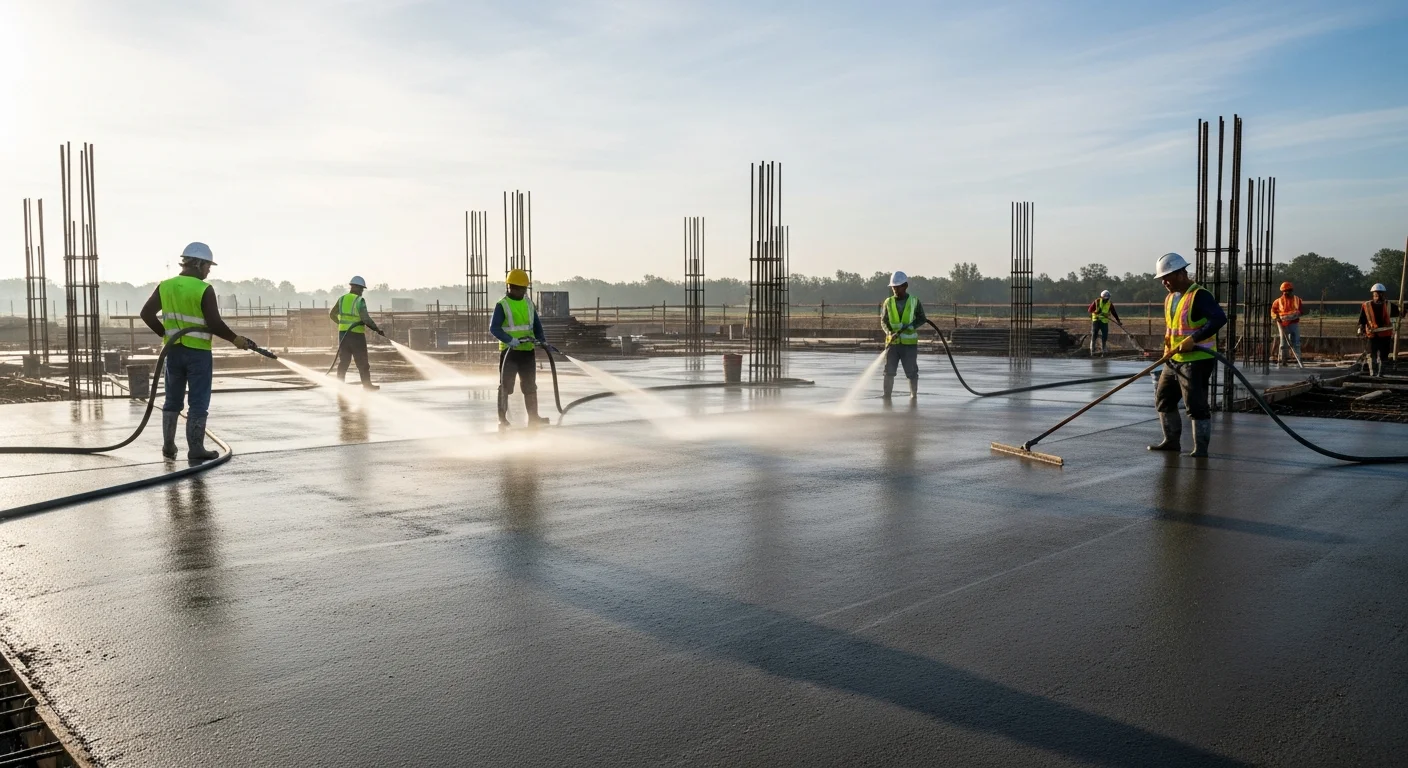
Fog misting and sprinklers are solid options when you cannot physically cover the surface. Setting up sprinkler heads or mist systems on timers keeps a continuous film of water on the surface. This works well for large pours like parking lots or warehouse floors where covering the entire area with burlap is not practical.
A few tips from the field:
- Start water curing as soon as the surface can handle it without being damaged, usually right after final finishing.
- Use a timer on your water source so the surface does not dry out during lunch breaks or overnight.
- In windy conditions, wet coverings outperform sprinklers because the wind can blow mist away from the surface.
- Track your curing schedule alongside your other project tasks. If you are using a crew management system, assign curing checks as daily tasks so somebody is accountable.
Membrane and Chemical Curing Compounds
Not every job allows for a week of wet burlap and garden hoses. That is where curing compounds come in. These are liquid products you spray directly onto the finished concrete surface, where they form a thin membrane that traps moisture inside the slab. The cement still gets the water it needs for hydration, but you do not have to babysit the process.
Liquid membrane-forming compounds are the most popular option for everyday work. They come in clear, white-pigmented, and dissipating versions. White-pigmented compounds are great for hot weather because they reflect sunlight and keep the surface cooler, which slows evaporation even further. Clear compounds work better when appearance matters or when the surface will be coated or painted later.
Application matters. Most curing compounds need to go on at a specific coverage rate, usually around 150 to 200 square feet per gallon depending on the product. Too thin and the membrane has gaps that let moisture escape. Too thick and you waste material and potentially create adhesion problems for future coatings. Use a pump sprayer with a consistent fan pattern and apply in two passes at right angles to each other for even coverage.
Timing is critical. Apply the compound as soon as the bleed water has disappeared from the surface and the concrete can handle foot traffic without leaving marks. Wait too long and you have already lost moisture you cannot get back. Move too fast and the compound mixes with bleed water and fails to form a proper seal.
Here is what to watch out for:
- Not all curing compounds are compatible with subsequent floor coatings, sealers, or adhesives. If the slab will get an epoxy coating or tile, check compatibility before you spray anything.
- Resin-based compounds generally perform better than wax-based ones, but they cost more.
- Wind and temperature affect coverage rates. On a hot, windy day, you may need to bump your application rate up by 10 to 15 percent.
- Document which product you used and when you applied it. This protects you if there is ever a dispute about concrete quality. Your project management software should have a place to log these details.
Steam Curing and Accelerated Methods
Sometimes the schedule does not allow for a seven-day natural cure. Precast operations, tilt-up construction, and fast-track projects often need concrete to reach handling strength in hours instead of days. That is where accelerated curing methods come in.
Steam curing pumps warm, moist air over or around the concrete at controlled temperatures, usually between 140 and 170 degrees Fahrenheit. The heat speeds up the hydration reaction dramatically. Precast plants use steam curing routinely to strip forms and move pieces within 12 to 24 hours instead of waiting a full week. On jobsites, steam curing typically involves building temporary enclosures around the concrete and piping in steam from a portable boiler.
Autoclave curing takes things further by combining steam with high pressure. This is strictly a plant operation used for specialty precast products like concrete masonry units and certain architectural panels. You will not see this in the field, but it is worth knowing about if you spec precast elements for your projects.
Insulated curing uses the heat generated by the hydration reaction itself. Concrete produces heat as it cures, and by wrapping the pour in insulated blankets or tarps, you trap that heat and maintain a higher internal temperature. This is particularly useful in cold weather when you need to prevent freezing without hauling in external heat sources.
Chemical accelerators added to the mix design can speed up early strength gain. Calcium chloride is the old standby, though non-chloride accelerators are preferred when rebar is present because chlorides promote corrosion. These are mix design decisions that should be coordinated with your concrete supplier and the project engineer.
A word of caution: accelerated curing methods require more control and monitoring than standard approaches. Push the temperature too high or too fast and you get thermal cracking. Skip the gradual cooldown period and you get surface damage. If you are not experienced with these methods, work with your concrete supplier or a testing lab to develop the right protocol for your specific situation.
Understanding your concrete mix design is essential before choosing any accelerated method. The mix proportions, cement type, and admixtures all affect how the concrete responds to heat and moisture manipulation.
Cold and Hot Weather Curing Challenges
Read real contractor reviews and see why Projul carries a 9.8/10 on G2.
Mother Nature does not care about your project schedule. Pouring concrete in extreme temperatures is sometimes unavoidable, and curing becomes even more critical when the weather is working against you.
Hot weather curing fights rapid moisture loss. When air temperature, wind speed, and low humidity combine to create high evaporation rates, the surface can dry out faster than the bleed water can replace it. This leads to plastic shrinkage cracking, which shows up as short, random cracks on the surface before the concrete even sets.
Prevention measures for hot weather include:
- Scheduling pours for early morning to avoid peak heat
- Using cold mixing water or ice to lower the concrete temperature at delivery
- Setting up windbreaks around the pour area
- Applying evaporation retarders (not the same as curing compounds) to the surface during finishing
- Starting curing immediately after finishing with no delay
- Using white-pigmented curing compounds to reflect sunlight
Cold weather curing fights frozen water. If the water inside fresh concrete freezes before the cement has a chance to hydrate, the expanding ice crystals destroy the internal structure permanently. Concrete that freezes in the first 24 hours can lose 50 percent or more of its potential strength, and no amount of later curing will fix that.
Cold weather protection measures include:
- Keeping concrete temperature above 50 degrees Fahrenheit for at least 48 hours after placement
- Using insulated blankets or heated enclosures
- Adding hot water to the mix at the plant
- Avoiding placement on frozen subgrade
- Extending the curing period beyond the standard seven days since hydration slows down in cold temperatures
Both scenarios require careful scheduling and coordination. Your construction scheduling approach needs to account for weather windows, material lead times, and the extended curing timelines that extreme conditions demand. Build weather contingency time into your estimates and communicate those potential delays to your customers upfront. Transparent communication about weather impacts is part of running a professional operation.
Monitoring, Testing, and Quality Control
Curing is not a “set it and forget it” process. You need to verify that your methods are actually working, both during the cure and after.
Temperature monitoring is your first line of defense. Maturity meters and simple thermocouples placed in the concrete during the pour give you real-time data on internal temperature. This tells you whether the hydration reaction is progressing normally, whether the concrete is getting too hot (mass pours), or whether it is dropping toward freezing temperatures.
Moisture monitoring on the surface tells you whether your curing method is keeping the slab wet enough. A simple hand test works in a pinch: if the surface looks dry or feels warm to the touch, your curing is not adequate. More precise measurements use surface moisture meters or the ASTM F2170 relative humidity test for slabs that will receive moisture-sensitive floor coverings.
Cylinder testing remains the standard for verifying that the concrete reached its design strength. Your testing lab breaks cylinders at 7 days and 28 days per standard protocol. If the 7-day breaks come in low, that is an early warning that something went wrong with the cure (or the mix), and you need to investigate before the slab goes into service.
Documentation protects you. Keep records of:
- Curing method used and when it was started
- Products applied, including batch numbers and coverage rates
- Temperature and weather conditions during the cure period
- Any interruptions to the curing process and corrective actions taken
- Cylinder break results at 7 and 28 days
This paper trail is invaluable if there is ever a dispute about concrete quality. Keeping organized records should be part of your standard workflow, and a good construction estimating and project tracking system makes it easier to tie curing documentation back to specific jobs and line items.
Investing in quality control during the curing phase is one of the highest-return activities on any concrete project. The cost of monitoring and testing is minimal compared to the cost of tearing out and replacing a failed slab.
Building Curing Into Your Project Workflow
The best curing plan in the world fails if it is not built into your overall project workflow. Curing is not something you think about after the pour. It needs to be planned during the estimating phase and scheduled alongside every other task on the project.
During estimating, include curing materials and labor in your bid. Curing compound, burlap, insulated blankets, and the labor hours to apply and monitor them all cost money. Contractors who skip these line items end up eating the cost or, worse, skipping the curing altogether. Your estimating process should have curing as a standard line item for every concrete scope.
During scheduling, block out the full cure window before follow-up trades are allowed on the slab. Framing crews walking on a two-day-old slab, plumbers cutting into concrete that has not reached design strength, or painters moving equipment across a surface that is still gaining hardness are all recipes for damage and disputes. Build buffer time into the schedule and communicate the concrete cure window to every trade on the project.
During execution, make curing accountability clear. Somebody on your crew needs to own the curing process for each pour. That means checking coverings, verifying sprinklers are running, confirming compound coverage, and documenting conditions. If nobody is specifically responsible, it does not get done consistently.
After the cure, inspect the surface before you move on. Walk the slab and look for cracking, scaling, discoloration, or soft spots. Catch problems now while you still have the concrete supplier and testing lab engaged, not six months later when the customer calls with complaints.
Building these steps into a repeatable process is what separates contractors who consistently deliver quality concrete work from those who are always fighting callbacks and warranty claims. Construction project management tools like Projul give you a framework to standardize these workflows across your entire team, so quality does not depend on which foreman is running the job that day.
Try a live demo and see how Projul simplifies this for your team.
The reality of concrete work is that the curing phase is where your reputation is built or broken. Every shortcut you take during curing shows up eventually, usually at the worst possible time. Invest the time, train your crew, plan for it in your bids, and make it a non-negotiable part of how you run concrete projects. Your future self and your bottom line will thank you.
Frequently Asked Questions
How long does concrete need to cure before it reaches full strength?
What happens if you do not cure concrete properly?
Can you cure concrete in cold weather?
What is the best concrete curing method for residential slabs?
Does spraying water on concrete help it cure?
Related Articles

BIM Clash Detection: How to Catch Conflicts Before They Cost You on the Jobsite
BIM Clash Detection: How to Catch Conflicts Before They Cost You on the Jobsite Every contractor has a story about the...
Read More →
Asphalt Paving and Compaction Guide: Mix Types, Laydown Temperatures, and Quality Testing
Asphalt paving looks straightforward from a distance. A truck dumps material, the paver lays it down, and rollers...
Read More →
Construction Jobsite Wi-Fi & Connectivity Guide: Setting Up Reliable Internet in the Field
A practical guide to getting reliable internet on construction job sites. Learn about cellular hotspots, mesh networks,...
Read More →