
Fireplace and Chimney Construction: Firebox Dimensions, Flue Sizing, Hearth Requirements, and Clearances | Projul
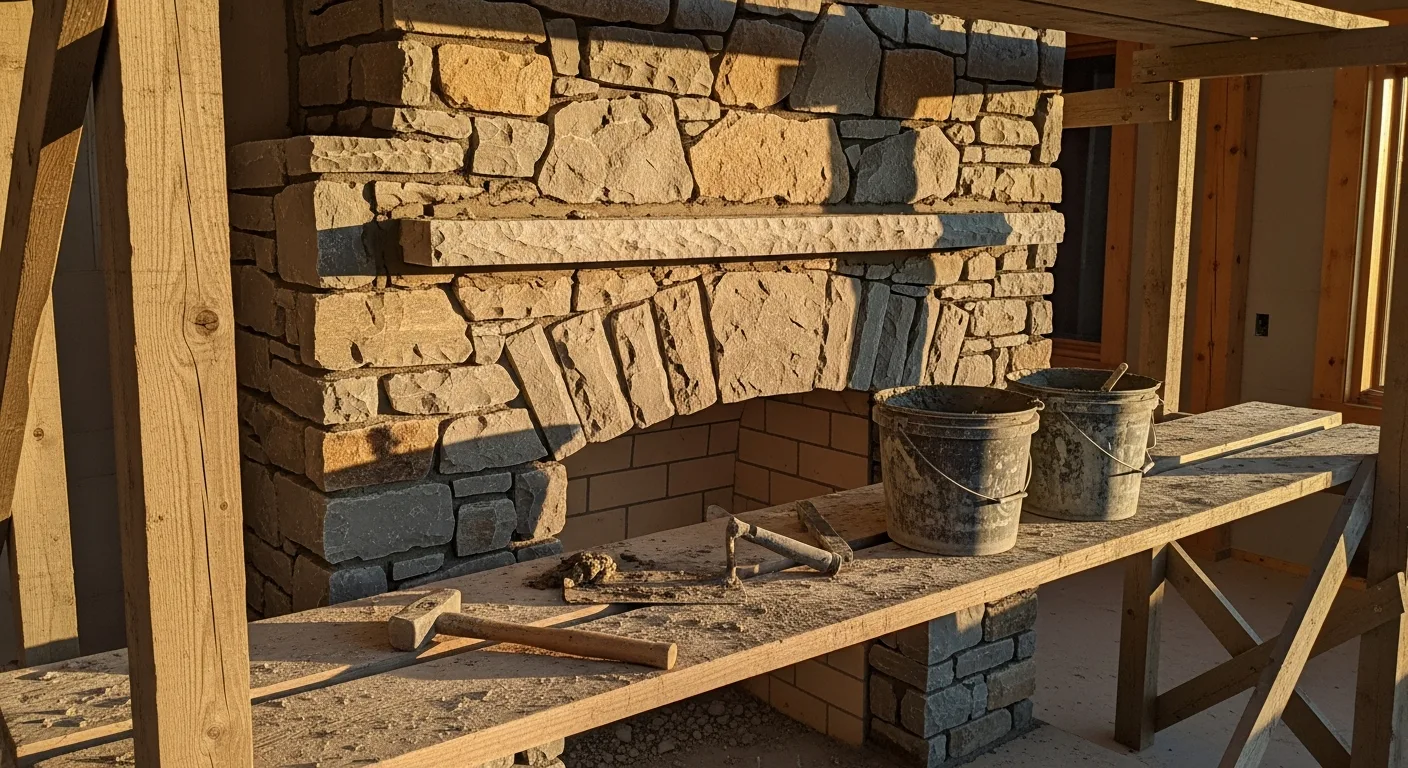
A masonry fireplace done right is a thing of beauty and a genuine asset to any home. Done wrong, it smokes, leaks, cracks, and becomes a fire hazard. The difference comes down to getting the proportions, materials, and clearances right during construction. There is no fixing a poorly proportioned firebox or an undersized flue after the brick is laid.
This guide covers the full scope of masonry fireplace and chimney construction, from foundation through cap. We will walk through firebox proportions, flue sizing, hearth requirements, clearances to combustibles, and the code requirements that govern the whole assembly.
Foundation Requirements
A masonry fireplace and chimney is one of the heaviest single elements in a residential building. A two-story exterior chimney with a standard fireplace can weigh 10,000 to 15,000 pounds. That weight needs a proper foundation.
Foundation Design
The fireplace foundation must:
- Extend below the local frost depth (or to bearing soil if frost depth is not a factor)
- Be at least 12 inches thick for solid concrete
- Extend at least 6 inches beyond the fireplace footprint on all sides
- Bear on undisturbed soil or engineered fill with adequate bearing capacity
Most residential fireplace foundations are poured as part of the overall foundation system, with the fireplace footing sized independently from the wall footings. The footing size depends on the soil bearing capacity and the total weight of the fireplace assembly.
For a rough estimate, figure 130 to 150 pounds per cubic foot for the weight of masonry construction. A standard single-story interior fireplace with a chimney extending 20 feet above the hearth might contain 60 to 80 cubic feet of masonry, putting the total weight in the 8,000 to 12,000 pound range.
Fireplace on Upper Floors
When a fireplace is located on an upper floor (second story or above), the entire assembly must still be supported down to a proper foundation. This usually means a masonry support column or structural steel framing running from the foundation up to the fireplace location. The structural engineer needs to design this support system as part of the building structure.
Firebox Construction
The firebox is where the fire burns. Its dimensions, proportions, and materials directly determine whether the fireplace draws properly, burns efficiently, and lasts for decades.
Firebox Proportions
Correct firebox proportions are critical for draft performance. The relationships between width, height, and depth have been refined over centuries of practice, and the building code codifies the minimum requirements.
Common firebox dimensions (width x height x depth):
- 28 x 24 x 16 inches (small)
- 32 x 26 x 18 inches (medium-small)
- 36 x 28 x 18 inches (standard)
- 42 x 28 x 18 inches (medium-large)
- 48 x 32 x 20 inches (large)
The depth-to-height ratio is important for smoke control. A firebox that is too shallow relative to its height will push smoke into the room. A firebox that is too deep will not radiate heat effectively. A depth of roughly 60 to 70 percent of the height works well in practice.
Back Wall and Throat
The firebox back wall should be vertical from the hearth floor for about 12 to 14 inches, then angle forward toward the throat. This angled section (called the back slope or back pitch) accelerates the rising hot gases and directs them toward the throat opening.
The throat is the narrow opening at the top of the firebox where the combustion gases transition from the firebox into the smoke chamber. The throat must be:
- Located at least 8 inches above the top of the firebox opening
- At least the full width of the firebox
- 4 inches deep (front to back) minimum
A damper is installed at the throat to control airflow and close the flue when the fireplace is not in use. Throat dampers are the traditional choice, though top-mount dampers that seal the flue at the chimney top are increasingly popular for their superior air seal.
Firebox Materials
Firebrick is required for the firebox lining. Standard firebrick (also called refractory brick) is made from fire clay and rated to withstand temperatures above 2,000 degrees Fahrenheit. Common firebrick dimensions are 9 x 4-1/2 x 2-1/2 inches (standard) and 9 x 4-1/2 x 1-1/4 inches (splits).
Refractory mortar must be used for all joints in the firebox. Standard masonry mortar will crack, spall, and fall out under the thermal cycling of a working fireplace. Refractory mortar is specifically formulated to handle high temperatures and thermal expansion.
Joint thickness in firebrick work should not exceed 1/4 inch. Thicker joints are more prone to cracking and mortar loss.
Firebox Wall Thickness
The firebox walls must be a minimum of 10 inches thick for solid masonry (including the firebrick liner), or 8 inches of solid masonry with a 2-inch firebrick liner. The back and side walls of the firebox need this full thickness to contain the fire and insulate the surrounding structure.
Smoke Chamber
The smoke chamber is the transition zone between the rectangular firebox throat and the round or square flue above. Its job is to compress and direct the rising combustion gases smoothly into the flue liner.
Smoke Chamber Construction
The smoke chamber walls are built by corbeling the masonry inward from the throat to the base of the flue liner. Each course of brick or block can project (corbel) no more than 1 inch beyond the course below it. This gradual narrowing creates a smooth, funnel-shaped space.
The interior surfaces of the smoke chamber must be parged (coated) with a smooth layer of refractory mortar at least 1/2 inch thick. This smooth surface reduces turbulence and helps maintain strong draft. Rough, unfinished smoke chamber interiors are a common cause of poor draft performance.
Smoke Shelf
The smoke shelf is a flat ledge at the base of the smoke chamber, directly behind the throat. Its purpose is to deflect downdrafts back up and prevent cold air from pushing smoke into the room.
The smoke shelf should extend the full width of the firebox and be as deep as practical (8 to 12 inches is common). Its surface should be concave (slightly cupped) to redirect downdrafts upward.
Flue Sizing
The flue is the vertical channel that carries combustion gases from the smoke chamber to the top of the chimney. Correct sizing is essential for proper draft.
The Sizing Rule
The cross-sectional area of the flue must be proportional to the area of the firebox opening. The standard ratios are:
- Round flue: Flue area must be at least 1/10 of the firebox opening area
- Square or rectangular flue: Flue area must be at least 1/12 of the firebox opening area (per IRC; some sources use 1/8 for rectangular)
For example, a 36 x 28-inch firebox opening has an area of 1,008 square inches. Using the 1/10 ratio for a round flue, you need at least 100.8 square inches of flue area. A 12-inch round flue liner has an area of about 113 square inches, which satisfies the requirement.
Common Flue Liner Sizes
Standard clay flue liner sizes (nominal outside dimensions and approximate inside area):
- 8 x 8 inch: approximately 36 square inches inside area
- 8 x 12 inch: approximately 57 square inches
- 12 x 12 inch: approximately 87 square inches
- 12 x 16 inch: approximately 120 square inches
- 16 x 16 inch: approximately 162 square inches
- 16 x 20 inch: approximately 208 square inches
Round clay liners:
- 8-inch diameter: approximately 50 square inches
- 10-inch diameter: approximately 79 square inches
- 12-inch diameter: approximately 113 square inches
- 15-inch diameter: approximately 177 square inches
Oversized vs. Undersized Flues
An undersized flue will not provide enough draft, causing the fireplace to smoke. An oversized flue can also cause problems because the combustion gases cool too quickly in the large flue, reducing draft velocity and potentially causing condensation and creosote buildup.
Stick to the code ratios. They have been proven through generations of practice.
Flue Liner Installation
Clay flue liners are set in refractory mortar with the joints staggered from the surrounding masonry joints. Each liner section must be fully bedded in mortar with no gaps or voids at the joints. The mortar joint between liner sections should be no more than 1/4 inch thick.
The flue liner must be continuous from the smoke chamber to the top of the chimney. It must not have any openings, cracks, or connections except for the cleanout at the base and the fireplace connection.
Chimney Construction
The chimney is the visible structure that surrounds and protects the flue liner. It must be structurally sound, properly sized, and correctly terminated above the roof.
Chimney Wall Thickness
Masonry chimney walls must be at least 4 inches of solid masonry (nominal) around a lined flue. For unlined flues (which are not permitted by modern codes for new construction but exist in older buildings), the minimum wall thickness is 8 inches.
The 3-2-10 Rule
Chimney height above the roof is governed by the 3-2-10 rule:
- The chimney must extend at least 3 feet above the highest point where it passes through the roof
- The chimney must be at least 2 feet higher than any portion of the building within 10 feet measured horizontally
This rule ensures adequate draft and prevents downdrafts caused by wind pressure zones near the roof. It also keeps the chimney top above the zone where sparks could ignite roof materials.
For a chimney on a steep roof or near a ridge, this rule can require significant chimney height. Calculate the required height during the design phase so the foundation and structural support are sized accordingly.
Chimney Flashing
The intersection of the chimney and roof is one of the most leak-prone details in residential construction. Proper flashing requires:
- Step flashing along the sides, woven with each course of shingles
- Counter flashing (also called cap flashing) set into the mortar joints of the chimney, overlapping the step flashing
- A cricket or saddle on the uphill side of chimneys wider than 30 inches, to divert water around the chimney
Use lead, copper, or painted aluminum for flashing materials. Galvanized steel works but has a shorter lifespan due to corrosion from mortar alkalinity.
Chimney Cap and Crown
The chimney crown is the concrete or mortar top that seals the space between the flue liner and the outer chimney wall. It should:
- Be at least 2 inches thick at the thinnest point
- Slope away from the flue liner on all sides
- Overhang the chimney walls by at least 2 inches with a drip edge
- Be formed with a bond break between the crown and the flue liner to allow independent thermal movement
A chimney cap (rain cap or spark screen) sits on top of the flue and keeps rain, animals, and debris out while containing sparks. Stainless steel caps with mesh screens are the most durable and effective option.
Hearth Requirements
The hearth protects the floor structure from the heat of the fire. Both the inner hearth (firebox floor) and the outer hearth (extension in front of and to the sides of the opening) have specific code requirements.
Inner Hearth
The inner hearth is the floor of the firebox. It must be constructed of firebrick or equivalent refractory material, supported by a reinforced concrete hearth slab.
Outer Hearth Extension
The hearth extension is the non-combustible surface in front of and beside the firebox opening. Code requirements (per IRC Section R1001.9):
- Thickness: Minimum 4 inches, including the hearth slab
- Front extension: At least 16 inches for firebox openings less than 6 square feet; at least 20 inches for openings 6 square feet or larger
- Side extension: At least 8 inches beyond each side of the firebox opening
The hearth extension must be supported by non-combustible materials or by a masonry arch or lintel. It cannot cantilever on combustible framing.
Common hearth finish materials include stone, brick, tile, and concrete. Whatever the finish material, the underlying slab must meet the minimum thickness requirement.
Clearance to Combustibles
Maintaining proper clearance between the fireplace/chimney assembly and all combustible materials is one of the most critical safety requirements.
Chimney Clearance
A minimum of 2 inches of airspace must be maintained between the exterior surface of a masonry chimney and any combustible material (framing, sheathing, insulation, drywall). This clearance must be maintained through all floors, ceilings, and the roof.
The airspace cannot be filled with insulation or any other material. It must remain as open air. Sheet metal fireblocking is used at each floor level to close the gap while maintaining the required clearance.
Fireplace Clearance
Combustible materials (mantels, trim, shelving) must maintain specific clearances from the firebox opening:
- Combustible materials placed within 12 inches of the firebox opening must not project more than 1/8 inch for each inch of clearance from the opening
- A wood mantel, for example, must be at least 12 inches from the top of the firebox opening if it projects 1-1/2 inches from the wall
This is one of the most frequently violated clearance requirements in residential construction. Mantels installed too close to the firebox opening are a fire hazard and a code violation.
Combustible Floor Protection
Combustible flooring cannot extend closer than the hearth extension boundaries defined by code. Where wood flooring or carpet meets the hearth extension, the transition must be clean and the combustible material must not extend under the hearth.
Multiple Flues in One Chimney
A single chimney structure can contain multiple flue liners for separate appliances (fireplace, furnace, water heater). When multiple flues share a chimney, each flue must:
- Have its own continuous liner from bottom to top
- Be separated from adjacent flues by at least 4 inches of solid masonry (called a wythe)
- Terminate at different heights (stagger the tops by at least 4 inches) to prevent cross-contamination of exhaust gases
Never connect two appliances to the same flue unless the flue is specifically sized and listed for that application.
Ash Dump and Cleanout
An ash dump is a small cast-iron or steel door in the firebox floor that allows ashes to be swept into a pit below. The ash pit is accessed through a cleanout door on the exterior or basement side of the chimney.
The ash pit must be constructed of non-combustible materials with a tight-fitting cleanout door. The cleanout opening must be at least 12 inches below the lowest flue inlet.
While an ash dump is not required by code, it is a practical convenience that most homeowners appreciate. Including one during construction costs very little.
Exterior vs. Interior Chimneys
Where the chimney is located relative to the building envelope affects performance significantly.
Interior Chimneys
Chimneys built inside the thermal envelope of the building stay warmer, which improves draft performance and reduces creosote buildup. The warm chimney creates stronger, more consistent draft from startup.
Exterior Chimneys
Chimneys built on an exterior wall are exposed to outdoor temperatures. In cold climates, an exterior chimney can be difficult to start because the cold flue creates a reverse draft (cold air sinking down the flue). Exterior chimneys also experience more freeze-thaw cycling, accelerating masonry deterioration.
If an exterior chimney is the design choice, consider using an insulated flue liner system or building the chimney with additional mass to moderate temperature swings.
Project Management for Fireplace Construction
Fireplace and chimney construction involves multiple trades and requires precise coordination. The foundation crew, mason, framer, roofer, and finish carpenter all have roles, and the sequencing has to be right.
Using a construction management platform like Projul helps track the details that matter: foundation pour schedules, firebrick delivery, flashing installation timing, and final inspections. When a project involves multiple fireplace locations or custom designs, having all the specifications and schedules in one place prevents costly mistakes.
If you are building homes or doing remodel work that includes fireplaces, take a look at Projul’s features and schedule a demo to see how it fits your workflow. Pricing information is available for crews of all sizes.
Common Mistakes in Fireplace Construction
-
Wrong firebox proportions. A firebox that is too shallow or too tall for its width will smoke. Follow the proven dimensional ratios.
-
Undersized flue. This is the most common cause of a smoky fireplace. Size the flue by the code ratios, not by guessing.
-
Rough smoke chamber interior. An unparged smoke chamber creates turbulence that kills draft performance. Always parge smooth with refractory mortar.
-
Inadequate clearance to combustibles. This is a fire safety issue. Measure twice and maintain the full 2-inch airspace at all chimney locations and the required clearances at the fireplace opening.
-
Missing or improperly installed flashing. Chimney leaks are among the most common water intrusion problems in residential construction. Get the step flashing, counter flashing, and cricket right.
-
Using standard mortar in the firebox. Standard mortar will crack and fall out within a few years of use. Refractory mortar is the only acceptable option for firebox joints.
-
Insufficient chimney height. Violating the 3-2-10 rule causes draft problems and code violations. Calculate the required height during design, not after the chimney is built.
-
Skipping the smoke shelf. Without a smoke shelf, downdrafts push directly into the firebox and fill the room with smoke.
Final Thoughts
Masonry fireplace and chimney construction is detailed, exacting work that rewards careful planning and precise execution. Every dimension matters, from the firebox proportions to the chimney height above the ridge. The code requirements exist because generations of builders figured out what works and what burns houses down.
Take the time to get the design right on paper before the first brick is laid. Follow the code requirements, use the correct materials, and maintain proper clearances throughout the assembly. The result will be a fireplace that draws cleanly, heats effectively, and lasts as long as the house itself.
Frequently Asked Questions
What are the standard firebox dimensions for a residential fireplace?
How do you size a flue for a masonry fireplace?
What is the minimum chimney height above the roofline?
How thick does a fireplace hearth need to be?
What are the clearance requirements between a masonry chimney and combustible materials?
Can you build a fireplace without a foundation?
What type of mortar is used for firebox construction?
How often should a masonry chimney be inspected?
Related Articles

BIM Clash Detection: How to Catch Conflicts Before They Cost You on the Jobsite
BIM Clash Detection: How to Catch Conflicts Before They Cost You on the Jobsite Every contractor has a story about the...
Read More →
Asphalt Paving and Compaction Guide: Mix Types, Laydown Temperatures, and Quality Testing
Asphalt paving looks straightforward from a distance. A truck dumps material, the paver lays it down, and rollers...
Read More →
Construction Jobsite Wi-Fi & Connectivity Guide: Setting Up Reliable Internet in the Field
A practical guide to getting reliable internet on construction job sites. Learn about cellular hotspots, mesh networks,...
Read More →