
French Drain and Yard Drainage Guide for Contractors: Grading, Pipe, Fabric, and Outlet Design | Projul
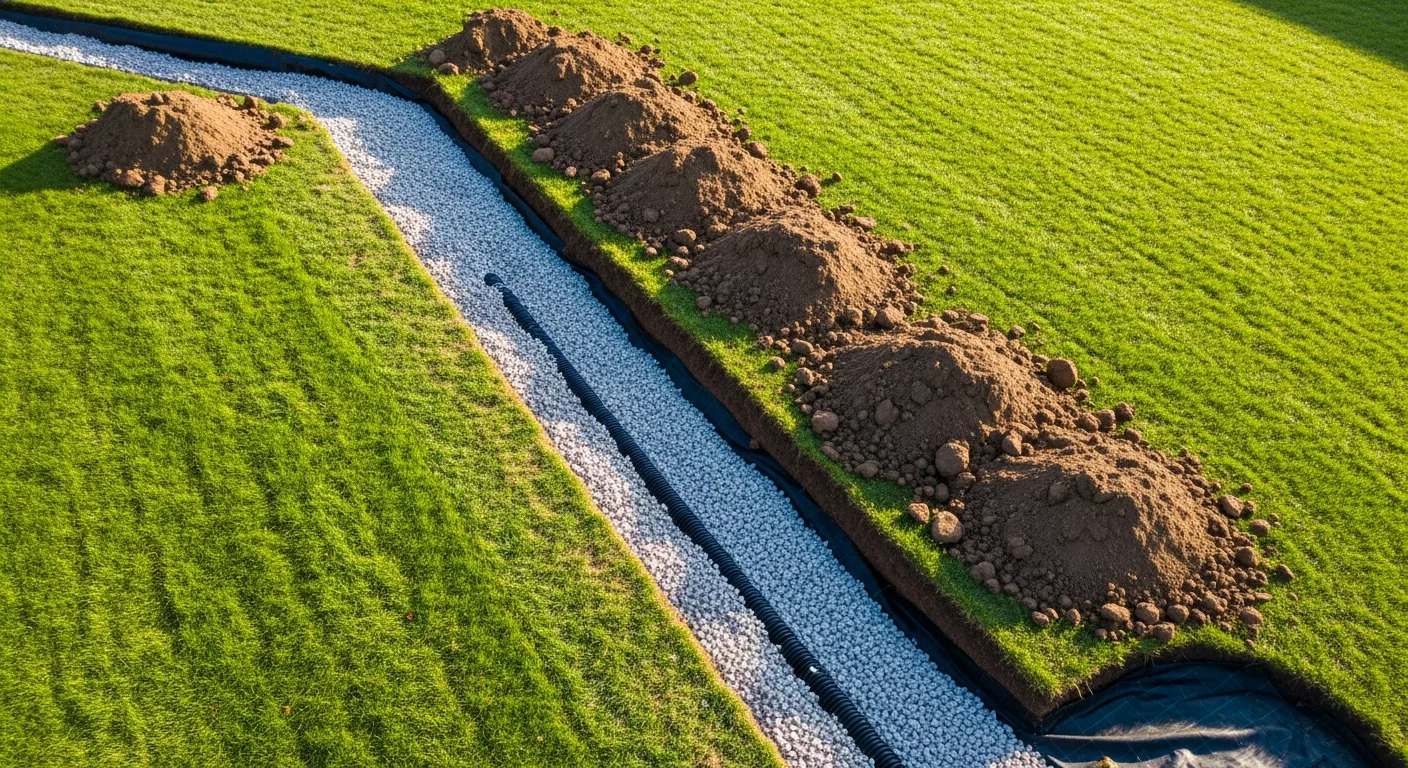
French Drains and Yard Drainage: A Contractor’s Complete Guide
Standing water in a yard is more than an eyesore. It kills grass, creates mosquito habitat, erodes soil, and when it pools near a foundation, it becomes a structural threat. Homeowners call contractors when they are tired of watching their yard turn into a swamp every time it rains, and the fix usually involves some combination of grading corrections and subsurface drainage.
French drains are one of the most reliable tools in the drainage contractor’s kit. They have been used for over 150 years because the concept is simple and, when installed properly, they work for decades. But “simple concept” does not mean “easy installation.” The details matter, and getting them wrong means the drain fails within a few years.
This guide covers everything a contractor needs to know about residential French drains and yard drainage: site assessment, grading, trench excavation, pipe selection, filter fabric, gravel, outlet design, and the mistakes that cause premature failure.
Understanding the Problem: Why Yards Hold Water
Before you start digging, you need to understand why the water is not draining on its own. The cause determines the solution.
Poor Surface Grading
The yard may slope toward the house or have low spots where water collects. This is the most common cause of residential drainage complaints. The fix is often regrading the surface to direct water away from structures and toward natural drainage paths.
The general rule is a minimum of 6 inches of fall in the first 10 feet away from the foundation. Beyond that, the yard should continue to slope (even gently) toward the property’s natural drainage outlet, whether that is a swale, storm drain, or low area at the property edge.
High Water Table
In some areas, the groundwater table sits close to the surface, especially in spring or after prolonged rain. Surface grading alone will not fix this because the water is coming from below. Subsurface drainage (French drains) is needed to intercept and redirect the groundwater.
Compacted or Clay Soil
Heavy clay soils and compacted subgrades drain very slowly. Water sits on the surface because it cannot percolate down. French drains help by providing a path of least resistance (gravel and pipe) that water can follow instead of sitting in the clay.
Impervious Surfaces
Driveways, patios, rooftops, and sidewalks shed water that concentrates in areas that might have handled natural rainfall just fine. Adding 2,000 square feet of patio to a yard changes the runoff pattern significantly. The drainage plan needs to account for all impervious surfaces on the property.
Downspout Discharge
Roof runoff from downspouts that dump at the foundation is a major contributor to basement moisture and yard drainage problems. Extending downspouts and tying them into a drainage system is often part of the solution.
Site Assessment and Planning
Walk the Property After Rain
The best time to assess a drainage problem is during or right after a heavy rain. You can see exactly where water collects, which direction it flows, and where the natural low points are. If you cannot visit during rain, look for clues: mud stains on the foundation, erosion channels, dead grass in low areas, and water marks on fences or walls.
Survey Elevations
Use a transit, laser level, or builder’s level to shoot elevations across the property. You need to know:
- The elevation of the foundation at multiple points
- The high and low points of the yard
- The elevation of any potential outlet (storm drain, swale, property edge)
- The available fall from the problem area to the outlet
Without adequate fall from the drain to the outlet, the system will not work. You need at least 1 percent slope across the entire run of pipe.
Identify the Outlet
Every drainage system needs somewhere to put the water. Common outlets include:
- Daylight outlet: The pipe exits the ground on a slope, discharging water at the surface. This is the simplest and most reliable option when the terrain allows it.
- Storm sewer connection: Tying into a municipal storm drain (where permitted and with proper permits).
- Dry well: A buried chamber filled with gravel that allows water to percolate into the surrounding soil. Works best in sandy or well-draining soils. Not effective in clay.
- Rain garden or bioswale: A planted depression designed to absorb and filter runoff. Increasingly required or incentivized by municipalities.
- Sump pit and pump: When gravity drainage is not possible, a sump pit with a pump moves water up and out. This adds complexity, maintenance, and a failure point (pump dies during the biggest storm of the year, every time).
Plan the outlet before you design the drain. If you cannot get the water somewhere useful, the prettiest French drain in the world will not solve the problem.
Check Utilities
Call 811 (or your local one-call service) before digging. Every time. Gas lines, water mains, electrical conduit, fiber optic cable, and sewer laterals are all buried in residential yards. Hitting a gas line with a trencher is a bad day for everyone.
French Drain Construction
Trench Layout
Mark the trench route with paint or stakes and string. The trench should follow the path of water from the collection area to the outlet, maintaining consistent downhill slope the entire way.
For intercepting water before it reaches a foundation, the trench typically runs parallel to the foundation, 3 to 6 feet away from the wall. Placing it right against the foundation risks undermining the footing and is usually a bad idea unless you are doing a full exterior waterproofing job.
For collecting water from a low area in the yard, route the trench through the lowest part of the problem area and run it downhill to the outlet.
Trench Dimensions
- Width: 12 inches is standard for most residential French drains. Wider trenches (18 to 24 inches) move more water but cost more in gravel and labor.
- Depth: 12 to 18 inches for surface water collection. 18 to 24 inches for groundwater interception near foundations.
- Shape: A flat-bottomed trench is easier to grade and provides a stable bed for the pipe.
Excavation
For short runs (under 50 feet), hand digging with a trenching shovel works but is labor intensive. For longer runs or deeper trenches, use a walk-behind trencher or a mini excavator. A trencher cuts a clean, consistent trench quickly but cannot handle rocky soil well. A mini excavator is more versatile but requires more skill to cut a straight, even-bottomed trench.
Whatever method you use, check the trench bottom grade with a laser or string line before placing any material. The bottom must slope consistently toward the outlet. Low spots in the trench create standing water in the pipe.
Filter Fabric Installation
Line the entire trench with non-woven geotextile filter fabric before adding any gravel. Leave enough fabric on each side to fold over the top of the gravel bed after it is filled.
The fabric serves one purpose: keeping fine soil particles out of the gravel. Without it, silt migrates into the gravel voids over months and years, eventually clogging the system. The fabric allows water through while blocking particles.
Use non-woven fabric, not woven. Woven fabric has a tighter weave that can clog faster in fine soils. Non-woven fabric has a random fiber structure that resists clogging better.
Gravel Base
Place 2 to 3 inches of washed 3/4-inch to 1.5-inch crushed stone on the fabric-lined trench bottom. Level this base so the pipe sits at the correct slope.
The gravel must be washed. Unwashed crusher run or quarry process contains fine particles (stone dust) that clog the filter fabric and defeat the entire purpose of the system. Specify washed stone when you order materials.
Pipe Selection and Placement
Two main options for French drain pipe:
Rigid PVC (Schedule 20 or 35 perforated):
- 4-inch diameter for most residential work
- Smooth interior means better flow
- Comes in 10-foot sections with coupling fittings
- More labor to install (cutting, fitting) but more durable
- Perforations should face down when installed (water rises into the pipe)
Corrugated HDPE (perforated):
- 4-inch diameter, available in rolls up to 250 feet
- Flexible, fast to install, fewer fittings needed
- Corrugated interior creates slightly more friction (reduced flow)
- Some contractors avoid it because the corrugations can trap sediment
- The corrugated “sock pipe” (with fabric sleeve) is popular but the sock clogs faster than a proper fabric-wrapped gravel bed
For best performance, use rigid PVC in a fabric-wrapped gravel bed. For budget-conscious jobs, corrugated HDPE with a full trench fabric wrap is acceptable and much faster to install.
Place the pipe on the gravel base centered in the trench. Check the slope one more time.
Gravel Fill and Fabric Closure
Fill gravel around and over the pipe until you have at least 2 inches of gravel above the top of the pipe. For better performance, fill gravel to within 4 to 6 inches of the surface.
Fold the filter fabric over the top of the gravel, overlapping the edges. This fully encapsulates the gravel bed in fabric, preventing soil intrusion from any direction.
Backfill
Top off the trench with the excavated soil, or with topsoil if you are restoring a lawn. If the drain runs under a lawn area, grade the backfill slightly above the surrounding surface to account for settling.
Some installations leave the gravel exposed at the surface or cover it with decorative stone. This works in landscape beds and along foundation walls but is not practical in lawn areas.
Additional Drainage Solutions
Channel Drains
Channel drains (also called trench drains) are surface-mounted drains that collect water from driveways, patios, and other paved areas. They consist of a narrow channel with a grate that sits flush with the surface. The channel connects to a solid pipe that carries water to the outlet.
Use channel drains at the base of sloped driveways, along garage door thresholds, and at the edge of patios that slope toward the house.
Catch Basins
Catch basins are surface-mounted collection points, typically 9x9, 12x12, or larger boxes with grates. They collect surface water and connect to underground solid pipe. Use them at low points in the yard, at the end of swales, and where multiple drainage lines converge.
Install a catch basin with a sump (the box extends below the pipe outlet) to trap sediment and debris before it enters the pipe system. Clean the basins annually.
Downspout Connections
Tie roof downspouts into the drainage system using underground solid pipe (not perforated). A common approach is to connect each downspout to a 4-inch solid PVC pipe that runs underground to the main drain line or directly to the outlet.
Use a pop-up emitter at the discharge end for a clean look. The emitter opens under water pressure and closes when flow stops, keeping debris and animals out of the pipe.
Dry Wells
A dry well is an underground chamber that receives collected water and allows it to percolate into the surrounding soil. They work well in sandy or loamy soils where the percolation rate is high. In clay soils, dry wells fill up and overflow before the water can absorb.
Size the dry well to handle the expected volume. A standard residential dry well (36 inches in diameter, 36 inches deep) holds about 50 gallons. For larger volumes, use multiple dry wells in series or a larger chamber system.
Wrap the dry well in filter fabric and surround it with gravel, just like a French drain.
Grading and Surface Drainage
Not every drainage problem needs a French drain. Sometimes the fix is moving dirt.
Regrading
If the yard slopes toward the house or has obvious low spots, regrading can solve the problem without any pipe work. Bring in fill dirt, compact it in lifts, and establish positive drainage away from the structure.
The International Residential Code calls for a minimum 6-inch fall in the first 10 feet from the foundation. Beyond that, maintain at least a 2 percent slope (about 1/4 inch per foot) toward the property’s natural drainage outlet.
Swales
A swale is a shallow, wide channel that directs surface water without pipe. Swales work well for moving water across a yard to a drainage outlet. They can be grassed (for a natural look) or lined with stone for higher flows.
Design swales with a minimum 1 percent slope along their length. The cross-section should be broad and shallow (parabolic shape) rather than deep and narrow to prevent erosion.
Common Drainage Installation Mistakes
Insufficient Slope
A French drain with inadequate slope collects water but does not move it. The pipe fills up, the gravel saturates, and the drain becomes nothing more than an underground puddle. Verify slope at every stage of installation.
Skipping Filter Fabric
Without fabric, soil migrates into the gravel within a few years, clogging the system. Replacing a clogged French drain means digging the whole thing up and starting over. The fabric costs a few dollars per linear foot and adds years to the system’s life.
Using Dirty Gravel
Crusher run, road base, and unwashed gravel contain fine particles that clog fabric and fill the voids between stones. Always specify washed stone for drainage applications.
Discharging Against Setback Rules
Many jurisdictions have rules about where you can discharge stormwater. Dumping water onto a neighbor’s property, across a sidewalk, or into a sanitary sewer can result in fines and required removal. Check local codes and HOA rules before setting the outlet location.
Forgetting About Freeze/Thaw
In cold climates, shallow drainage systems can freeze. Water trapped in pipes expands and can crack PVC fittings. Install drain outlets so they can drain completely (no standing water in the system) and consider using corrugated pipe in freeze-prone areas because it flexes without cracking.
Tracking Drainage Projects
Drainage jobs involve excavation, pipe work, gravel delivery, fabric installation, grading, and restoration. On larger properties, you may have multiple drain runs, catch basins, downspout connections, and a complex outlet system. Keeping all of that organized, estimated, and tracked takes more than a notepad.
Projul’s project management tools let you break a drainage job into phases, assign tasks to crew members, track material quantities and costs, and log daily progress with photos. When the homeowner asks why the job ran a day over estimate, your records show that you hit an unmarked water line at 14 inches and had to reroute.
For contractors looking to add drainage work to their services or tighten up their existing process, check out Projul’s pricing or request a demo to see how it works for field crews.
Final Thoughts
Yard drainage is problem-solving work. Every property is different, and the solution depends on soil type, topography, water sources, utility locations, and local codes. The fundamentals stay the same though: identify where the water comes from, figure out where it should go, and build a system that moves it there reliably for decades.
French drains are not complicated, but they require attention to detail. Clean gravel, proper fabric, consistent slope, and a well-planned outlet make the difference between a drain that works for 25 years and one that clogs in 5.
Do the site assessment, plan the system, install it right, and track your costs. That is how you build a drainage business worth running.
Frequently Asked Questions
How deep should a French drain be for residential yard drainage?
What is the correct slope for a French drain pipe?
Should I use perforated or solid pipe for a French drain?
What size gravel works best for French drains?
Do French drains need filter fabric?
How long do French drains typically last?
Can a French drain discharge into the storm sewer?
How do contractors price French drain installation?
Related Articles

BIM Clash Detection: How to Catch Conflicts Before They Cost You on the Jobsite
BIM Clash Detection: How to Catch Conflicts Before They Cost You on the Jobsite Every contractor has a story about the...
Read More →
Asphalt Paving and Compaction Guide: Mix Types, Laydown Temperatures, and Quality Testing
Asphalt paving looks straightforward from a distance. A truck dumps material, the paver lays it down, and rollers...
Read More →
Construction Jobsite Wi-Fi & Connectivity Guide: Setting Up Reliable Internet in the Field
A practical guide to getting reliable internet on construction job sites. Learn about cellular hotspots, mesh networks,...
Read More →