
Mass Timber Construction Guide (2026)
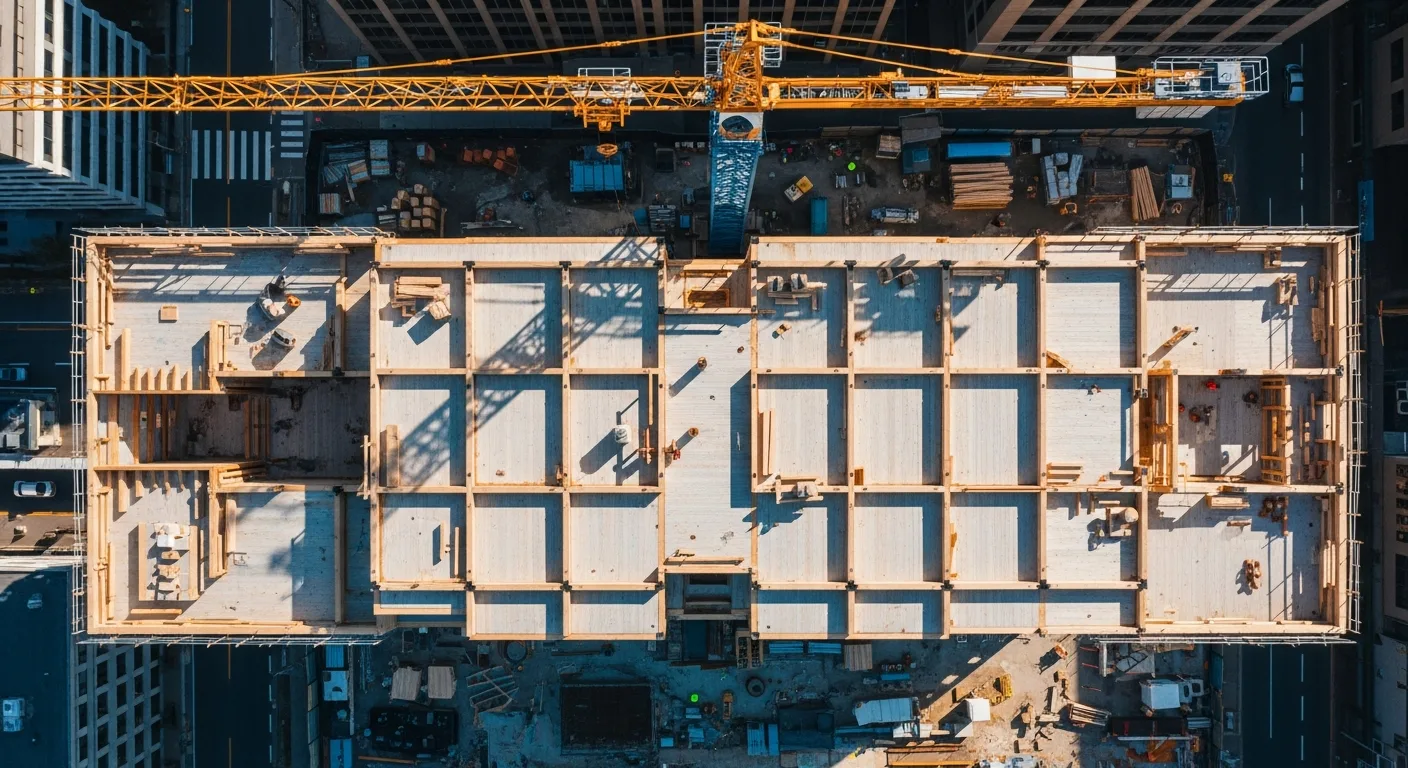
Mass Timber Construction: What Every Contractor Needs to Know About CLT, Glulam, and NLT
If you have been in commercial construction for more than a few years, you have probably noticed mass timber showing up on more and more bid invitations. What used to be a niche product for architects chasing sustainability awards has become a legitimate structural system that owners and developers are choosing for cost, speed, and aesthetics.
But here is the thing: most contractors who have spent their careers pouring concrete and erecting steel are not sure what to make of mass timber. The questions are reasonable. Is it really strong enough? What about fire? How do I bid something I have never built?
This guide breaks down everything you need to know about mass timber construction, from the different product types to fire performance, cost considerations, and practical tips for contractors taking on their first mass timber project.
What Is Mass Timber, Exactly?
Mass timber is a category of engineered wood products that are large enough and strong enough to serve as primary structural elements. We are not talking about stick framing or heavy timber post-and-beam. These are factory-manufactured panels and beams that can replace concrete slabs and steel beams in mid-rise and tall buildings.
The most common mass timber products include:
Cross-Laminated Timber (CLT)
CLT is the flagship product. It consists of layers of dimensional lumber stacked at right angles and bonded with structural adhesive. A typical CLT panel is 3, 5, or 7 layers thick, ranging from about 4 inches to over 12 inches in total thickness.
CLT panels can serve as floors, walls, and roofs. They arrive on site pre-cut to exact dimensions, often with window and door openings already machined. Think of it like a massive, structural version of plywood.
Glue-Laminated Timber (Glulam)
Glulam has actually been around for decades. It consists of dimensional lumber laminated together with the grain running in the same direction, creating beams and columns. If you have ever worked on a building with exposed wood arches or large timber beams, you have probably seen glulam.
In mass timber construction, glulam typically serves as the beam and column system that supports CLT floor and roof panels. It is the skeleton that holds everything up.
Nail-Laminated Timber (NLT)
NLT is the simplest mass timber product. It consists of dimensional lumber (usually 2x4, 2x6, or 2x8) stacked on edge and nailed together. The result is a solid wood panel that works well for floors, walls, and roof decks.
NLT is popular for renovations and adaptive reuse projects because it can be fabricated locally without specialized manufacturing equipment. Any competent framing crew can build NLT panels on site if needed.
Dowel-Laminated Timber (DLT)
DLT is similar to NLT but uses hardwood dowels instead of nails to hold the laminations together. This creates a product with no metal fasteners, which appeals to architects who want a clean, all-wood aesthetic on exposed ceilings. It also makes the panels easier to modify on site since there are no hidden nails to hit with a saw.
Why Owners and Developers Are Choosing Mass Timber
Before you invest time learning a new construction method, you need to understand why this market is growing. Here are the drivers:
Speed of Construction
Mass timber buildings go up fast. Really fast. Because panels arrive pre-cut and pre-drilled from the factory, erection is closer to structural steel than cast-in-place concrete. A typical mid-rise mass timber floor can be erected in days, not weeks.
One widely cited example: the 8-story Carbon12 building in Portland, Oregon erected its mass timber superstructure in just 9 weeks. Comparable concrete buildings take months. That speed translates directly to reduced general conditions, earlier occupancy, and faster return on investment for the owner.
Lighter Weight
Mass timber weighs roughly one-fifth as much as an equivalent concrete structure. That means smaller foundations, reduced seismic loads, and the ability to build on sites with challenging soil conditions where a heavy concrete building would require expensive deep foundations.
For contractors, lighter weight also means smaller cranes and less complex rigging. A CLT panel that a tower crane swings into place in minutes would require significantly more effort as a concrete pour.
Carbon and Sustainability
Mass timber stores carbon rather than emitting it. Trees absorb CO2 as they grow, and that carbon stays locked in the wood for the life of the building. By contrast, cement production alone accounts for roughly 8 percent of global CO2 emissions.
Owners pursuing LEED certification, carbon-neutral goals, or ESG commitments find mass timber attractive because it dramatically reduces the embodied carbon of a building. This is not just a feel-good story. Many institutional and corporate clients now require carbon accounting on their projects.
Aesthetics
Exposed mass timber ceilings and walls look stunning. There is no way around it. Architects and owners love the warmth and texture of exposed wood, and studies suggest that occupants in mass timber buildings report higher satisfaction and well-being. For commercial office, hospitality, and multifamily projects, this aesthetic premium can translate into higher rents and faster lease-up.
Fire Performance: Addressing the Elephant in the Room
Every contractor asks the same question: “What happens when it catches fire?”
The answer is more reassuring than you might expect. Mass timber does not behave like dimensional lumber in a fire. Here is why:
Charring Behavior
When mass timber is exposed to fire, the outer surface chars at a predictable rate, roughly 1.5 inches per hour for most species. That char layer acts as insulation, protecting the structural core from heat. A 7-layer CLT panel can burn on one side for over two hours and still maintain its structural capacity.
This predictable charring behavior is actually an advantage over unprotected steel. Steel does not burn, but it loses roughly half its strength at 1,100 degrees Fahrenheit. In a fully developed fire, unprotected steel beams can fail within 15 to 20 minutes. Mass timber, by contrast, degrades slowly and predictably.
Code Requirements
The 2021 IBC introduced three new construction types for mass timber:
- Type IV-A: Up to 18 stories, requires noncombustible protection (like gypsum board) on all mass timber surfaces
- Type IV-B: Up to 12 stories, allows some exposed mass timber with noncombustible protection on certain elements
- Type IV-C: Up to 9 stories, allows exposed mass timber throughout (this is the “all-wood” look that architects love)
Each type has specific requirements for fire-resistance ratings, allowable area, sprinkler systems, and shaft enclosures. The key takeaway: mass timber buildings are heavily regulated and thoroughly tested. This is not cowboy engineering.
Construction Phase Fire Risk
The real fire risk with mass timber is during construction, before the building is enclosed and fire protection systems are installed. Exposed wood on an active construction site is more vulnerable than in a finished building.
Best practices include:
- Hot work permits and fire watch protocols
- Temporary sprinkler coverage on completed floors
- On-site fire suppression equipment (extinguishers, standpipes)
- Limiting exposed wood area by installing gypsum protection as floors are completed
- Security to prevent arson and unauthorized access
Your builder’s risk insurer will likely have specific requirements. Address these during preconstruction, not after you have panels on site.
Cost Considerations: Does Mass Timber Make Financial Sense?
This is where the conversation gets practical. Contractors need to know if mass timber pencils out.
Material Costs
CLT panels typically cost more per square foot than a concrete slab or steel deck. Depending on the market and project, you might see a 5 to 15 percent premium on structural materials alone. Glulam beams and columns are generally competitive with structural steel on a per-member basis.
However, material cost is only one piece of the puzzle.
Installation Speed
Mass timber erection is fast, and speed saves money across the board. Fewer weeks of crane rental, general conditions, temporary facilities, and supervision add up quickly. On a 6-story building, shaving 8 to 12 weeks off the schedule can save hundreds of thousands of dollars.
Foundation Savings
Because mass timber weighs so much less than concrete, foundation requirements shrink. On projects with good soil conditions, you might go from deep foundations to spread footings. On projects with poor soils, you might reduce pile counts by 30 to 50 percent. These savings can be substantial.
Reduced On-Site Trades
A mass timber erection crew is small compared to the army of formwork carpenters, rebar installers, and concrete finishers needed for a cast-in-place structure. Fewer trades on site means less coordination, fewer conflicts, and simpler logistics.
The Bottom Line
For the right project, mass timber can be cost-competitive with concrete and steel, and sometimes cheaper when you factor in schedule savings and foundation reductions. The best candidates are mid-rise buildings (4 to 12 stories) with repetitive floor plates, like multifamily housing, office buildings, and hotels.
The worst candidates are one-off, complex geometries where the factory prefabrication advantage is limited, or very tall buildings where concrete and steel still dominate.
How to Bid Your First Mass Timber Project
If you are a GC or CM looking at your first mass timber opportunity, here is how to approach it:
1. Find an Experienced Mass Timber Erector
Unless you plan to self-perform the erection, you need a subcontractor who has done this before. Mass timber erection is not complicated, but it requires understanding panel sequencing, connection details, and crane planning specific to large wood panels. Ask manufacturers like Structurlam, Sterling, Kalesnikoff, or Nordic Structures for referrals to erection crews in your region.
2. Engage the Manufacturer Early
Mass timber manufacturers are not commodity suppliers. They are design-assist partners who engineer the panel layouts, connection details, and fabrication drawings. Engage them during preconstruction, ideally during design development or early construction documents. Their input on panel sizes, connection types, and erection sequences will shape your bid.
3. Understand Lead Times
CLT and glulam are manufactured to order. Lead times range from 12 to 20 weeks depending on the manufacturer and market conditions. If you are building a schedule, account for this and coordinate with the design team to finalize structural drawings early enough to feed the factory.
4. Plan Your Crane Strategy
Mass timber panels are large but relatively light. A typical CLT floor panel might be 8 feet wide, 40 feet long, and weigh 8,000 to 12,000 pounds. That is well within the capacity of most mobile and tower cranes, but panel size affects rigging, laydown area, and sequencing. Work with your erector and crane operator to develop a detailed lift plan.
5. Coordinate MEP Early
One of the trickiest aspects of mass timber is MEP coordination. Unlike concrete, you cannot easily core-drill CLT panels after installation. Penetrations for plumbing, electrical, and HVAC need to be planned during the shop drawing phase and machined at the factory. Any missed penetration means field cutting, which is slower, messier, and can compromise fire ratings.
This is where your project management software earns its keep. Tracking RFIs, shop drawing approvals, and MEP coordination across multiple trades and the manufacturer requires serious organizational discipline.
6. Develop a Construction Fire Protection Plan
As mentioned earlier, fire protection during construction is critical. Develop a written plan that addresses hot work, temporary suppression, security, and insurance requirements. Share it with your insurer, the fire marshal, and your entire project team.
Common Mistakes Contractors Make on Mass Timber Projects
Learning from other people’s mistakes is cheaper than making your own. Here are the most common pitfalls:
Treating It Like Concrete Construction
Mass timber has a different rhythm than concrete. You cannot adjust panel sizes on the fly. You cannot pour a little extra to fix a dimensional error. Everything is manufactured to precise tolerances, and the panels arrive ready to install. Embrace the prefabrication mindset: invest in preconstruction, and the field work becomes almost easy.
Ignoring Moisture Protection
Wood and water do not get along. CLT and glulam are kiln-dried to specific moisture content during manufacturing, and keeping them dry on site is critical. This means covered storage, tarps during erection, and a plan for drying out panels that get wet during rain events.
Most manufacturers provide moisture management guidelines. Follow them. Panels that absorb too much moisture can swell, cup, or develop mold, and remediation is expensive and time-consuming.
Skipping the Mockup
On your first mass timber project, build a mockup of a typical connection or panel assembly. This lets your crew practice the installation sequence, test connection hardware, and identify issues before you are 6 stories up with a crane running at $500 per hour. A few thousand dollars on a mockup can save tens of thousands in the field.
Underestimating Connection Complexity
Mass timber connections are engineered assemblies that use a combination of steel plates, screws, bolts, and bearing surfaces. They are not complicated individually, but there can be dozens of unique connection types on a single project. Make sure your erection crew has reviewed every connection detail in the shop drawings and has the correct hardware on site before erection begins.
The Mass Timber Market in 2026
The mass timber market has grown significantly over the past five years. Here is where things stand:
- Over 1,700 mass timber buildings have been completed or are under construction in the United States
- Manufacturing capacity has expanded with new plants in Arkansas, Alabama, Washington, and Montana
- Several buildings over 20 stories are in design or under construction worldwide
- Insurance companies are becoming more comfortable with mass timber, and premiums are normalizing
- Universities including Oregon State, Virginia Tech, and Georgia Tech have active research programs advancing the science
For contractors, this growth means more opportunities and more competition. The firms that invest in mass timber experience now will have a significant advantage as the market continues to expand.
How Project Management Software Supports Mass Timber Construction
Mass timber projects demand tight coordination between design teams, manufacturers, erection crews, and finishing trades. The prefabrication workflow means that decisions made (or missed) during preconstruction have amplified consequences in the field.
Construction project management software like Projul helps contractors:
- Track manufacturing lead times alongside the project schedule so panels arrive on time
- Manage RFIs and submittals between the design team and manufacturer with clear approval workflows
- Coordinate MEP penetrations through centralized document management so nothing gets missed
- Log daily progress with photos that document panel placement, connections, and moisture protection
- Communicate with the full team including subs, suppliers, and the owner through a single platform
When you are building with a material that arrives fully manufactured, staying organized is not optional. It is the difference between a smooth erection sequence and a project that stalls waiting for answers.
Scheduling a Mass Timber Project: What’s Different
If you have run schedules on concrete or steel jobs, mass timber will feel familiar in some ways and completely foreign in others. The biggest shift is that your critical path moves upstream into the factory, not downstream on the jobsite.
The Manufacturing Window Drives Everything
On a concrete project, your schedule flexibility lives in the field. You can adjust pour sequences, add crews, or shift work between floors as conditions change. Mass timber does not give you that same flexibility. Once panels are in production, changes are expensive and slow. The factory is cutting, pressing, and machining your panels based on finalized shop drawings. A late design change does not mean a revised pour. It means scrapped material and a new production slot, potentially weeks out.
This means your schedule needs to account for a design freeze that happens much earlier than on a conventional project. Structural and MEP drawings need to be locked down 16 to 24 weeks before you need panels on site. That is a different conversation to have with your architect and engineers, and it needs to happen at the very first preconstruction meeting.
Erection Sequencing Is More Linear
Concrete buildings often have multiple areas progressing simultaneously. You might be forming the third floor while pouring the second and stripping the first. Mass timber erection is more sequential. Panels go up in a specific order dictated by the structural connections and the crane’s reach. You cannot skip ahead to a different bay because you feel like it.
The upside is that erection moves quickly once it starts. A well-organized crew can set an entire floor of CLT panels in two to three days on a mid-rise building. But if a panel is damaged, missing, or arrives in the wrong sequence, the whole operation stalls. This is where a solid construction scheduling tool pays for itself many times over. You need real-time visibility into panel delivery status, crane availability, and crew assignments, and everyone on the project needs to see the same information.
Weather Contingency Planning
Rain stops mass timber erection in a way it does not stop concrete work. You can pour concrete in light rain with proper precautions. You should not be setting CLT panels in rain because moisture exposure before the building is dried in creates problems that show up months later: warping, mold, finish damage.
Build weather days into your schedule, especially in the Pacific Northwest and Northeast where multi-day rain events are common. Some contractors erect temporary canopy systems over the work area, but this adds cost and complexity. At minimum, have a clear protocol for tarping installed panels overnight and during rain events.
Coordinating the Handoff from Erection to Finishing
One detail that catches first-time mass timber contractors off guard is the speed of the handoff between structure and finishes. Because mass timber erection is so fast, your finishing trades need to be mobilized and ready much sooner than on a concrete project. If your drywall, mechanical, and electrical subs are planning their mobilization based on a typical concrete schedule, they will be late.
Get your subcontractors involved early. Share the erection schedule with them during preconstruction so they can plan labor and materials accordingly. This is another area where centralized project management for construction makes a measurable difference. When your framing crew finishes a floor in three days instead of three weeks, everyone downstream needs to know about it and be ready to roll.
Moisture Management and Site Logistics for Mass Timber
Moisture is the single biggest source of problems on mass timber jobsites. The material arrives from the factory at a controlled moisture content, typically 12 percent or below. Your job is to keep it there until the building is enclosed. Sounds simple. It is not.
Receiving and Storing Panels
CLT and glulam panels are heavy, awkward, and expensive. When a flatbed truck rolls up with a load of panels, you need a plan for where they go and how they stay dry.
Best practices for panel storage:
- Elevated storage: Panels should sit on dunnage at least 6 inches off the ground to allow air circulation and prevent wicking moisture from the slab or ground.
- Covered storage: Full tarps or temporary canopy structures over panel stacks. Shrink wrap from the manufacturer helps, but it is not enough for extended storage in wet climates.
- Sequenced delivery: Coordinate with the manufacturer to deliver panels in the order you need them. This reduces the time panels sit on site exposed to weather and minimizes double-handling with the crane.
- Laydown area planning: CLT panels can be 8 feet wide and 40 feet long. You need a laydown area that can handle those dimensions without blocking site access for other trades. On tight urban sites, just-in-time delivery directly from the truck to the crane might be necessary.
Wet Weather Protocols
Even with the best planning, panels will get wet on some projects. The question is how you respond. Most manufacturers provide guidelines for acceptable moisture levels and drying procedures. The key principles:
- Surface moisture from brief rain exposure is usually fine and will dry quickly once the weather clears.
- Prolonged exposure (panels sitting in standing water or uncovered for days) can cause structural issues and will void some warranties.
- Use moisture meters to check panels before and after rain events. Document readings in your daily construction logs so you have a record if questions come up later.
- If panels need to dry out, allow adequate time before applying finishes or encapsulating with gypsum board. Trapping moisture inside wall or floor assemblies leads to mold and rot.
Site Layout Considerations
Mass timber jobsites need more organized laydown and staging areas than typical concrete sites. Here is why: you are dealing with large, prefabricated elements that arrive in a specific sequence. If Panel 3B-7 is buried under Panel 5A-2, you are paying for crane time to shuffle material around instead of setting structure.
Think of your site logistics the way a steel erector thinks about iron delivery. Each piece has a designated location in the building, and the delivery and staging plan should reflect the erection sequence. If you have ever worked with a good steel erector who has their laydown area organized by piece mark and erection sequence, that is exactly the level of discipline you need for mass timber.
On urban sites with limited laydown, work with the manufacturer to schedule panel deliveries in tight windows that align with your daily erection plan. Some projects operate on a just-in-time basis where panels go directly from the delivery truck to the crane hook. This requires precise scheduling and good communication between the manufacturer’s logistics team and your site superintendent.
Connections and Hardware: The Details That Make or Break a Mass Timber Build
If mass timber panels are the bones of the building, connections are the joints. And just like in the human body, joint problems can take down the whole system. This is the area where most first-time mass timber contractors underestimate the complexity.
Types of Connections
Mass timber connections fall into a few broad categories:
Panel-to-panel connections join CLT floor or wall panels to each other. These typically use self-tapping screws, surface splines (strips of plywood or LSL inserted into routed grooves), or metal plates. The connection type depends on the structural loads and the fire-rating requirements. Panel-to-panel connections in fire-rated assemblies often need to be concealed behind noncombustible material.
Panel-to-beam connections attach CLT floor panels to glulam beams. Common methods include bearing directly on the beam with screws to prevent uplift, or using concealed metal brackets. The choice depends on whether the connection needs to be exposed or hidden, and whether the beam is below the panel (simple bearing) or flush with the panel (more complex hardware).
Beam-to-column connections in glulam frames use steel knife plates, concealed steel tubes, or proprietary connection systems. These are the most engineered connections on the project and typically require the manufacturer’s or structural engineer’s involvement in design. Do not improvise these in the field.
Base connections anchor glulam columns or CLT wall panels to the concrete foundation or podium. These use standard anchor bolt and base plate details similar to structural steel, but with modifications for the wood-to-concrete interface.
Hardware Procurement
Here is a practical detail that trips up many contractors: the hardware for mass timber connections is not something you pick up at the local supply house. Self-tapping structural screws, for example, are specialty fasteners manufactured by companies like Rothoblaas, SWG, and Assy. They are engineered for specific load capacities and installation torques, and they are not interchangeable with standard construction screws.
Order connection hardware early. Confirm quantities against the shop drawings, add 10 to 15 percent for waste and field damage, and have it on site before erection begins. Running out of a specific screw type mid-erection means your crane sits idle while you wait for a special order shipment.
Field Quality Control
Connection installation requires attention to detail that goes beyond what most framing crews are used to. Self-tapping screws need to be installed at specific angles and depths. Over-driven screws lose capacity. Under-driven screws leave gaps that compromise the connection. Knife plates need to be perfectly aligned because the slots in the glulam are machined to tight tolerances.
Put a quality control process in place before erection starts. This should include:
- Pre-erection review of all connection details with the crew
- Written procedures for each connection type, including screw patterns, torque values, and inspection criteria
- Regular inspection of completed connections by a qualified person (your project engineer or a third-party inspector)
- Photo documentation of all concealed connections before they are covered with gypsum or other finishes
Document everything. Your structural engineer and the building inspector will want to see that connections were installed correctly, and photos taken during installation are worth a thousand words during a dispute.
Estimating and Budgeting for Mass Timber: A Contractor’s Breakdown
Putting together a number for a mass timber project requires adjusting your estimating approach in a few key areas. If you try to estimate mass timber using the same cost categories and assumptions you use for concrete or steel, you will either leave money on the table or price yourself out of the job.
Breaking Down the Structural Package
On a conventional project, you might break your structural estimate into concrete (foundations, slabs, columns, shear walls), rebar, formwork, and structural steel. On a mass timber project, the structural package looks different:
- Mass timber supply: CLT panels, glulam beams and columns, connection hardware. This typically comes as a package price from the manufacturer, including engineering, fabrication, and delivery. Get this number directly from the manufacturer based on their design-assist work.
- Erection labor: The crew that sets the panels and installs connections. Price this as a subcontract or self-perform estimate based on panel count, crane plan, and project duration.
- Crane costs: Mass timber erection is crane-intensive. Every panel gets picked, placed, and fastened. Your crane costs will be higher than a comparable steel project on a per-day basis, but the shorter overall schedule usually keeps total crane cost in check.
- Concrete podium or foundation: Most mass timber buildings sit on a concrete podium (usually 1 to 3 stories of concrete with mass timber above). Estimate this portion using your standard concrete approach.
- Fire protection: Gypsum board encapsulation on mass timber surfaces as required by code. This is a significant cost on Type IV-A buildings where all wood must be covered, and a smaller cost on Type IV-C buildings with exposed wood.
Contingency and Allowances
On your first mass timber project, carry a higher contingency than you normally would. Ten to fifteen percent on the mass timber structural package is reasonable. The unknowns you are covering include:
- Field modifications to connections or panels that were not anticipated in shop drawings
- Weather delays during erection (you cannot work in rain like you can with concrete)
- Learning curve for your crew on a new construction type
- Potential panel damage during handling and erection
As you gain experience, you can reduce this contingency. Contractors who have completed several mass timber projects typically carry contingency levels comparable to their concrete or steel work.
Tracking Costs During Construction
Mass timber projects move fast, and your cost tracking needs to keep pace. If you are updating your budget spreadsheet once a month, you will not catch problems until it is too late. Use construction budgeting software that gives you real-time visibility into committed costs, actual costs, and projections. When your erection crew burns through their labor budget faster than expected, you need to know about it this week, not at the end of the month.
Pay particular attention to change orders related to MEP coordination. Missed penetrations that require field cutting are one of the most common sources of cost overruns on mass timber projects. Track every field modification and back-charge it appropriately through your change order management process.
Comparing Apples to Apples
When an owner or developer asks you to compare mass timber to concrete or steel, make sure you are comparing total project cost, not just structural material cost. Mass timber’s advantages in schedule, foundation, and trade coordination often offset the higher material cost. Present your estimate in a way that clearly shows these tradeoffs:
| Category | Concrete | Mass Timber |
|---|---|---|
| Structure material | Lower | Higher |
| Foundation | Higher | Lower |
| Schedule (GCs) | Longer | Shorter |
| Crane | Lower daily, longer duration | Higher daily, shorter duration |
| MEP coordination | Standard | More preconstruction effort |
| Fire protection | Minimal | Varies by type |
This kind of transparent comparison helps owners make informed decisions and positions you as a knowledgeable contractor, which makes you more likely to win the next mass timber bid too. Keeping organized estimates and clear cost breakdowns is much easier when you are running your projects through a purpose-built construction project management platform rather than cobbling together spreadsheets.
Subcontractor Coordination on Mass Timber Projects
If you have run large commercial jobs, you already know that subcontractor coordination is where projects succeed or fall apart. Mass timber adds a few wrinkles to the coordination game that are worth understanding before you are standing in a trailer trying to sort things out mid-build.
Fewer Trades on the Structure, More Pressure on Each One
A concrete superstructure might involve formwork carpenters, rebar installers, concrete finishers, post-tensioning crews, and a pump operator. Mass timber cuts that list down to an erection crew, a crane operator, and maybe a connection specialist. That sounds simpler, and in many ways it is. But it also means there is less slack in the system. If your erection crew has a problem, there is no other trade working on the structure to absorb schedule float. Everything stops.
This makes subcontractor selection critical. You want an erection crew that has done mass timber before, has their own equipment and rigging, and communicates well with your superintendent. Ask for references on completed mass timber projects specifically. A crew that is excellent at structural steel erection will not automatically be excellent at mass timber. The materials handle differently, the connections are different, and the moisture sensitivity adds a layer of care that steel does not require.
MEP Subcontractors Need Education
Your mechanical, electrical, and plumbing subs may have never worked on a mass timber building. They need to understand three things before they start:
- You cannot core-drill CLT casually. Every penetration should be pre-planned and factory-machined. Field-cut penetrations require engineering approval and may need fire-stopping details that are different from what your subs are used to.
- Surface-mounted routing is common. Because cutting into CLT panels is restricted, MEP runs often use surface-mounted channels, furring strips, or dropped ceiling cavities. Your subs need to plan their routes accordingly, and these routes need to be coordinated before erection, not after.
- The schedule is compressed. As mentioned earlier, mass timber goes up fast. Your MEP subs cannot wait until the structure is complete to start planning their work. They need to be at the table during preconstruction, reviewing panel layouts and identifying penetration requirements months before panels arrive on site.
Hold a pre-erection coordination meeting with all subcontractors. Walk through the erection sequence, panel-by-panel if necessary, and make sure everyone understands the timeline and their mobilization dates. Use your construction scheduling software to share a live schedule that subs can check from their phones. When your timber erector finishes the fourth floor on Tuesday instead of Thursday, your drywall sub needs to know about it immediately, not at the next weekly meeting.
The Architect’s Role in Coordination
On mass timber projects, the architect stays more involved during construction than on a typical concrete or steel building. Exposed wood surfaces mean that structural tolerances, connection details, and finish quality all matter architecturally. Your architect will probably want to review and approve panel surfaces, connection covers, and any field repairs to damaged panels.
Build this into your coordination plan. Schedule regular architect walkthroughs, especially during the first few floors of erection when the crew is establishing quality standards. It is much easier to adjust expectations and procedures early than to argue about aesthetics when the building is topped out.
Sustainability Documentation and Green Building Credits
Owners who choose mass timber often care about sustainability, and they frequently want documentation to prove it. If you are building for a client pursuing LEED, WELL, Living Building Challenge, or simply trying to meet corporate carbon reduction targets, you will need to support the documentation effort.
Embodied Carbon Calculations
Mass timber’s biggest sustainability story is embodied carbon. The wood itself stores carbon that the trees absorbed during growth, and the manufacturing process for CLT and glulam uses far less energy than producing steel or concrete.
Your client’s sustainability consultant will likely request Environmental Product Declarations (EPDs) from the mass timber manufacturer. EPDs are standardized documents that quantify the environmental impact of a building product across its lifecycle. Most major CLT and glulam manufacturers publish EPDs for their products. Make sure you request these during procurement and pass them along to the design team.
On some projects, you may also be asked to track the carbon impact of transportation, meaning how far the panels traveled from the factory to your site. This is straightforward to calculate but requires you to document the manufacturer’s location and the delivery distance. Keep the shipping records.
Chain of Custody and Forest Certification
Mass timber made from certified sustainable forests (FSC or PEFC certified) earns additional green building credits. If your project needs these credits, confirm with the manufacturer early that they can supply certified material. Not all manufacturers carry chain-of-custody certification, and switching suppliers late in the game to get certified wood can blow your schedule and budget.
Waste Reduction Documentation
Mass timber generates significantly less jobsite waste than conventional construction. Panels arrive pre-cut, so there is minimal on-site cutting waste. What waste does exist (offcuts, damaged sections) is clean wood that can be recycled or repurposed.
Document your waste diversion rates if your project requires it. This is another area where daily logs and photo documentation help. Track dumpster pulls, recycling volumes, and any material sent to landfill. Many construction daily reporting tools let you add custom fields for tracking this kind of project-specific data alongside your standard progress notes.
Telling the Story
Beyond the technical documentation, many owners want help telling the sustainability story of their building. This might include jobsite signage, progress photos showing timber erection, or data points for press releases and marketing materials. As the contractor, you are in the best position to provide this content because you are on site every day watching the building go up.
This is not traditional contractor work, but it builds goodwill with the owner and positions your firm as a mass timber expert. Firms that can build the project and help tell the story are the ones that get invited back for the next mass timber opportunity.
Insurance, Bonding, and Risk Management for Mass Timber
Insurance and bonding on mass timber projects deserve more attention than most contractors give them. The good news is that the insurance industry has come a long way in understanding mass timber. The bad news is that not all carriers are there yet, and surprises during the bidding phase can kill a deal.
Builder’s Risk Insurance
Builder’s risk is the policy most affected by mass timber construction. This policy covers damage to the building during construction, and exposed wood on an active jobsite is a different risk profile than steel and concrete.
Here is what to expect:
- Higher premiums on your first project. Some carriers add a surcharge for mass timber, especially if you have no track record with the material. This surcharge typically ranges from 10 to 25 percent over a comparable concrete project.
- Fire protection requirements. Your carrier will almost certainly require a written fire protection plan for the construction phase. This should cover hot work procedures, temporary sprinkler coverage, fire watch staffing, and security during non-work hours. Some carriers require third-party review of this plan.
- Moisture damage coverage. Confirm that your builder’s risk policy covers moisture damage to installed panels. Some policies exclude damage from rain during construction if the contractor did not follow manufacturer-recommended moisture protection procedures. This is another reason to document your moisture management practices carefully.
Shop your builder’s risk policy early. Get quotes from at least three carriers and share your fire protection plan with each one. Carriers who specialize in commercial construction will be more familiar with mass timber and typically offer better terms.
General Liability Considerations
Your standard CGL policy should cover mass timber construction without modifications, but notify your carrier anyway. The main liability concern during construction is fire damage to adjacent properties, which is a standard coverage area for CGL policies. After completion, the mass timber structure is no different from any other building type from a liability standpoint.
Performance and Payment Bonds
If your project requires bonding, your surety will want to understand mass timber as part of their underwriting. Prepare a summary of the project that explains the construction method, your team’s experience (or the experience of your key subcontractors), and your risk mitigation plans. Sureties care most about schedule risk and cost certainty, so emphasize the prefabrication aspect of mass timber (which reduces field uncertainty) and the track record of your erection subcontractor.
If this is your first mass timber project and your surety is hesitant, connect them with the mass timber manufacturer. Manufacturers like Structurlam and Nordic Structures have worked with dozens of sureties and can provide project case studies and technical information that help underwriters get comfortable.
Warranty and Defect Risk
Mass timber manufacturers typically provide warranties on their panels and connections, covering manufacturing defects, delamination, and dimensional accuracy. These warranties are separate from your standard contractor warranty on workmanship.
Make sure you understand the manufacturer’s warranty terms and pass them through to the owner. Key items to watch for:
- Moisture exposure limits. Most warranties require that panels be stored and installed according to the manufacturer’s moisture management guidelines. If you deviate from these guidelines, the warranty may not cover resulting damage.
- Connection installation requirements. Warranties on connection hardware typically require installation per the manufacturer’s specifications. Document your installation procedures and inspections to protect your warranty position.
- Panel modification restrictions. Field modifications to panels (cutting, drilling, notching) may void the manufacturer’s structural warranty unless approved by the engineer of record. Get written approval for any field modification before making the cut, and keep that approval on file.
Understanding these risk factors early helps you price the job accurately and avoid disputes during construction. It is also the kind of thorough preparation that construction project management software helps you track and organize from bid day through closeout.
Training Your Crew for Mass Timber Work
You can have the best plans, the best schedule, and the best equipment on site, but if your crew does not know how to handle mass timber, you are setting yourself up for problems. Training does not have to be elaborate, but it does have to happen before erection day.
What Your Crew Needs to Know
At minimum, every person on the erection crew should understand:
- Panel identification and sequencing. Every CLT panel has a unique mark that corresponds to its location in the building. Your crew needs to read panel marks, match them to the erection plan, and set them in the correct order. Setting a panel in the wrong location is not just an inconvenience. It can require crane time to remove and reset it, and it may damage connections that were already partially installed.
- Rigging and handling. CLT panels are large and flexible. A 40-foot panel will deflect under its own weight when picked at two points. Your rigging plan needs to account for this flexibility, and your crew needs to know how to sling panels without damaging edges or surfaces. Spreader bars are common on larger panels.
- Connection installation. Self-tapping structural screws require specific tools (usually high-torque impact drivers with depth-stop settings), specific angles (typically 30 to 45 degrees to the panel surface), and specific patterns (spacing, edge distance, row spacing). Walk through every connection type with the crew before erection starts.
- Moisture protection. Everyone on site should know the protocol for covering panels during rain, checking moisture readings, and reporting water intrusion. This is not just the superintendent’s job. The laborers and operators handling panels every day need to understand why keeping the wood dry matters.
Manufacturer Training Programs
Most mass timber manufacturers offer contractor training, either at their factory or on your jobsite. Take advantage of this. A half-day training session where your crew can see panels being manufactured, handle connection hardware, and practice installations is worth far more than handing them a stack of shop drawings and hoping for the best.
Some manufacturers also provide a technical representative on site during the first few days of erection to help your crew get started. This is usually included in the panel supply contract or available for a modest fee. Use this resource.
Building Institutional Knowledge
After your first mass timber project, capture what your crew learned. Write it down. What went well? What would you do differently? Which connections were tricky? What moisture issues came up?
This kind of project-specific knowledge is what separates contractors who are good at mass timber from contractors who just survived their first mass timber project. Store your lessons learned alongside your project closeout documents so the next project team can benefit. If you are using Projul’s daily logging features, your crew’s daily reports from the first project become a training resource for the next one.
Getting Started
Mass timber construction is not a fad. It is a structural system with real advantages in speed, sustainability, and aesthetics. The contractors who learn this building method now will be positioned to capture a growing share of the commercial construction market.
If you are considering your first mass timber project, start by visiting a completed building to see the product firsthand. Talk to manufacturers about design-assist partnerships. Find an experienced erection crew. And make sure your project management systems can handle the coordination demands that come with prefabricated construction.
The learning curve is real but manageable. And once your crew has one mass timber project under their belt, they will wonder why everything is not built this way.
Frequently Asked Questions
What is mass timber construction?
Is mass timber as strong as steel or concrete?
How does mass timber perform in a fire?
What building codes allow mass timber construction?
Is mass timber more expensive than traditional construction?
What trades are involved in a mass timber project?
Do contractors need special insurance for mass timber projects?
How does Projul help manage mass timber construction projects?
Related Articles

How Construction Teams Use AI to Cut Admin Time
Most contractors lose a full day every week to paperwork. AI now handles the repetitive admin work that used to eat...
Read More →
Concrete Tilt-Up Construction: A Contractor's Complete Field Guide
Tilt-up construction accounts for roughly 15 percent of all industrial and commercial buildings in North America. This...
Read More →
How to Implement Construction Software Without Losing Your Mind
Most construction software rollouts fail. Not because the software is bad, but because the rollout was rushed. Here are...
Read More →