
Metal Stud Framing: Sizes, Layout, and Tools
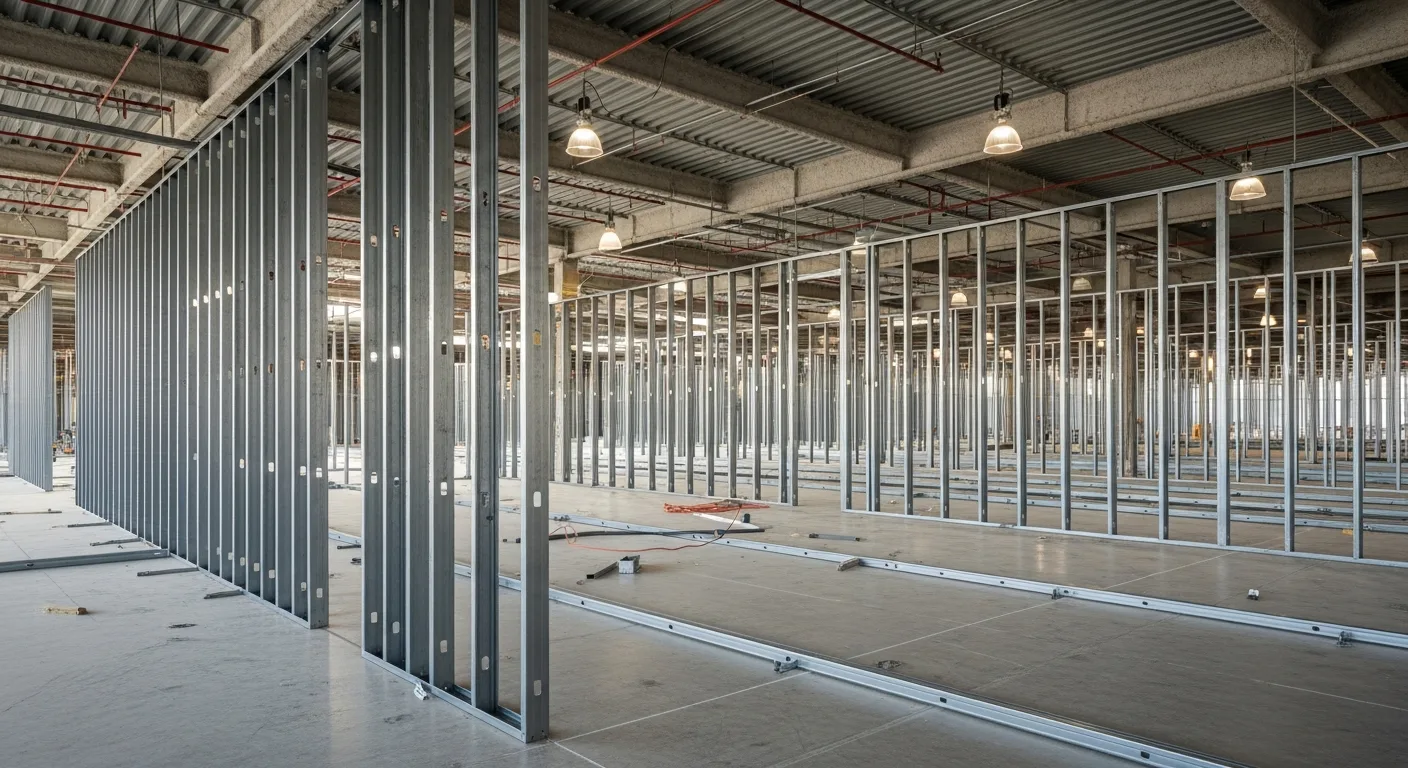
If you have only framed with wood, picking up a metal stud for the first time feels wrong. It is light, it flexes in your hands, and it is hard to imagine it holding up a wall. But metal stud framing is the standard for commercial interior construction, and it is showing up more and more in residential work too. Once you understand the materials, the fastening methods, and the layout process, metal framing is fast, efficient, and produces walls that are perfectly straight every time.
This guide covers everything you need to know to frame with metal studs, whether you are doing your first commercial tenant improvement or adding metal framing to your residential crew’s skill set.
Why Metal Studs?
Before we get into the how, let’s talk about why metal studs are used in the first place.
Advantages Over Wood
- Perfectly straight. Every stud is identical. No crowns, no twists, no sorting through a lumber pile looking for decent boards.
- Lightweight. A 10-foot 3-5/8” metal stud weighs about 5 pounds. A 10-foot 2x4 weighs about 12 pounds. On a commercial job with thousands of studs, your crew notices the difference.
- No shrinkage or warping. Wood moves with moisture changes. Steel does not. This means fewer drywall cracks and nail pops over time.
- Termite and rot proof. In humid climates or slab-on-grade construction, metal studs eliminate moisture and pest concerns.
- Non-combustible. Steel studs do not burn. This can simplify fire rating requirements in commercial construction.
- Consistent dimensions. Every stud is exactly the same width, depth, and thickness. Layout is predictable.
Disadvantages
- Thermal conductivity. Steel conducts heat much better than wood. Exterior walls need thermal breaks or continuous exterior insulation to meet energy codes.
- Requires different tools and techniques. Crews trained on wood need to learn new skills.
- Harder to attach heavy items. You cannot just drive a screw anywhere and expect it to hold weight. Wood blocking is needed for cabinets, grab bars, and similar items.
- Screw-based assembly. Everything is screwed, not nailed. This is slower for some connections but more precise for others.
- Noise transmission. Metal is more rigid than wood in some respects, and sound can travel along the studs. Acoustic insulation and resilient channel are often needed in metal stud walls.
Metal Stud Sizes and Gauges
Understanding the sizing system is the first step. Metal studs are specified by three dimensions: web depth, flange width, and material gauge (thickness).
Web Depth
The web is the wide face of the stud (equivalent to the wide face of a 2x4). Common web depths:
- 1-5/8”: Used for furring and very short partitions
- 2-1/2”: Light partitions, soffits, and bulkheads
- 3-5/8”: The standard for most interior partitions (equivalent to a 2x4 wall)
- 6”: Taller partitions, exterior walls, and walls requiring thicker insulation (equivalent to a 2x6 wall)
- 8” and larger: Tall walls, elevator shafts, and specialty applications
Flange Width
The flange is the narrow face where screws are driven. Standard flange width is 1-1/4 inches for most studs. Some heavy-gauge structural studs have wider flanges (1-5/8” or 2”) for more screw edge distance.
Material Gauge
Gauge determines the thickness of the steel and therefore the structural capacity.
- 25-gauge (0.0188”): Lightest. Used for non-load-bearing interior partitions up to about 10 feet tall. This is the most common gauge for commercial tenant improvement work.
- 22-gauge (0.0283”): Mid-range. Used for taller non-load-bearing partitions and where more rigidity is needed.
- 20-gauge (0.0346”): Heavy-duty non-load-bearing and light structural applications.
- 18-gauge (0.0451”): Structural. Used for load-bearing walls and exterior framing.
- 16-gauge (0.0566”): Heavy structural. Load-bearing walls with significant loads.
- 14-gauge (0.0713”): The heaviest commonly available. Heavy structural applications.
Track
Track is the top and bottom “plate” for metal stud walls. It is U-shaped and sized to match the stud web depth. The studs slide into the track and are screwed in place. Track comes in the same gauges as the studs, and you should match the track gauge to the stud gauge.
Deflection Track
At the top of the wall, many commercial specifications call for deflection track (also called slip track). This track allows the top of the wall to move independently of the structure above it, accommodating building deflection without cracking the drywall. The studs sit in the track but are not screwed to it at the top. Instead, they are held in place by the track flanges, with a gap left at the top for movement.
Tools for Metal Stud Framing
Cutting Tools
- Aviation snips: The basic tool. You need three types: left-cut (red handle), right-cut (green handle), and straight-cut (yellow handle). To cut a stud, snip both flanges, then bend and snip the web.
- Metal-cutting chop saw: For production work, a chop saw with an abrasive or carbide-tipped metal-cutting blade cuts studs in seconds. Much faster than snips for high-volume work.
- Angle grinder with cut-off wheel: Useful for cutting in tight spots and making notches.
- Electric shears: Power shears cut through metal studs quickly without the sparks of a chop saw. Good for on-the-fly cuts.
Fastening Tools
- Screw gun with adjustable clutch: This is the primary tool. Set the clutch so screws drive flush without stripping. A good screw gun with a depth-sensitive nose makes the job much faster and more consistent.
- Self-drilling screws: The standard fastener for metal-to-metal connections. These screws have a drill point that bores through the steel before the threads engage. Common sizes are #8 x 1/2” for stud-to-track connections and #6 x 1” or 1-1/4” for drywall-to-stud.
- Powder-actuated tool: For shooting track to concrete floors and steel decks. Ramset and Hilti are the most common brands.
- C-clamp locking pliers: Used to clamp studs to track before screwing. These hold the pieces firmly in alignment while you drive screws.
Layout Tools
- Laser level: Essential for snapping track lines on the floor and transferring them to the ceiling or deck above. A rotary laser or line laser saves hours compared to plumb bobs and chalk lines on a commercial job.
- Chalk line: Still useful for marking track locations on the floor.
- Magnetic torpedo level: Sticks to the stud for checking plumb. Much more convenient than a standard level that you have to hold in place.
- Tape measure and permanent marker: Layout marks on metal do not show with pencil. Use a fine-tip permanent marker or a scriber.
Layout and Installation Process
Step 1: Read the Drawings
Before you cut a single stud, study the floor plan. Identify:
- Wall locations and dimensions
- Door and window openings (header sizes, rough opening dimensions)
- Any walls that are load-bearing (these require heavier gauge studs)
- Deflection requirements at the top of the wall
- Backing and blocking requirements for fixtures, cabinets, and equipment
- Fire-rated assemblies and their specific UL-listed details
Step 2: Snap Floor Lines
Using a laser level and chalk line, snap the floor track locations. Measure from established reference points (column lines, exterior walls, or other fixed elements) per the drawings.
Double-check your layout before you start shooting track. On a commercial job, moving a wall after the track is down wastes time and leaves holes in the slab that need patching.
Step 3: Install Floor Track
Shoot the floor track to the slab using a powder-actuated tool. Standard spacing is 24 inches on center for fasteners, with a fastener within 2 inches of each end and each side of every joint or opening.
On wood subfloors, screw the track down with pan-head screws long enough to reach into the framing below.
For sound-rated assemblies, apply acoustic sealant under the track before fastening. This breaks the sound path from the floor into the wall assembly.
Step 4: Transfer Lines and Install Ceiling Track
Using the laser level, transfer the floor track locations up to the ceiling or deck above. Plumb up from the floor track at both ends of each wall run and snap a line.
Install ceiling track using the same fastener spacing as the floor. If deflection track is specified, install it per the manufacturer’s requirements, leaving the specified gap between the top of the studs and the underside of the structure.
Step 5: Lay Out Stud Spacing
Mark the stud layout on the floor track. Standard spacing is 16 inches on center. Mark with a permanent marker and be consistent about marking on the same side of the stud (most crews mark the side the stud will be on, like layout on a wood plate).
Step 6: Cut and Install Studs
Measure the height from inside the floor track to inside the ceiling track. Cut studs to length, accounting for the deflection gap if using slip track at the top.
To install each stud:
- Set the stud into the floor track at the layout mark.
- Twist the stud into the ceiling track (tip one end in, then swing the bottom into position).
- Check plumb with a magnetic level.
- Clamp the stud to the track with locking C-clamps.
- Drive two self-drilling screws through the track flange into the stud flange at the bottom.
- If not using deflection track, drive two screws at the top as well.
For deflection track, the studs are NOT screwed to the top track. They sit inside it and are held laterally by the track flanges, but free to move vertically as the building deflects.
Step 7: Frame Openings
Door and window openings in metal stud walls use the same concepts as wood framing but with different components.
Jamb studs: These are the equivalent of king and jack studs. In commercial work, jamb studs are often box-framed (two studs screwed together in a box shape) or fitted with jamb clips for extra rigidity.
Headers: Metal stud headers are typically built from track material. A common method is to cut a piece of track to span the opening plus the bearing on each side, cut and bend the flanges to create tabs, and screw the tabs to the jamb studs. For heavier loads, use doubled track or an angle iron header.
Sill members: For window openings, the sill is a piece of track cut and installed between the jamb studs, with cripple studs below.
Step 8: Install Blocking and Backing
This is a step that gets missed and causes problems later. Anywhere a heavy item will be mounted to the wall, you need solid backing:
- Plywood blocking: 3/4-inch plywood screwed between studs at the right height for cabinets, TV mounts, grab bars, etc.
- Wood blocking: 2x lumber screwed between studs.
- Heavy-gauge metal blocking: Hat channel or strapping screwed between studs for moderate loads.
Mark all blocking locations on the floor plan so the drywall crew (and the trim carpenters) know where the backing is. Take photos before the drywall goes up. Backing that nobody can find after the walls are closed is useless.
Step 9: Inspection and Close-In
Before drywall starts:
- Verify all stud spacing and wall locations match the drawings
- Check that all openings are correctly sized and square
- Confirm blocking is installed at all required locations
- Verify fire-rated assemblies have the correct stud gauge, spacing, and track connections
- Check that deflection gaps are present and correct where specified
- Confirm electrical and plumbing rough-ins are complete and inspected
Tips for Working With Metal Studs
Cutting Tips
- When cutting studs with snips, cut the flanges first, then bend the stud back and forth to fatigue the web, and snip the remaining web material. This is faster and produces a cleaner cut than trying to snip straight through the web.
- Wear gloves. Cut metal edges are razor sharp.
- On a chop saw, clamp the stud firmly. Lightweight studs can kick or spin if they are not secured.
Screw Tips
- Do not overdrive screws. The screw head should sit flush with the surface. Overdriven screws strip out the thin metal and lose holding power.
- Use the clutch on your screw gun. Adjust it so the driver disengages when the screw is flush.
- For drywall screws into metal studs, the screw needs to penetrate at least 3/8 inch beyond the back of the stud flange. Use screws long enough to achieve this.
- Keep screws at least 3/8 inch from the edge of any stud flange. Too close and the screw rips out.
Plumbing and Electrical
- Metal studs have pre-punched knockouts for running wires and pipes. Use grommets (snap-in bushings) in every knockout where a wire passes through to protect the wire insulation from the sharp metal edges.
- Secure pipes and conduit with proper hangers. Do not rely on the knockout holes to support the weight of piping.
- Ground the metal stud wall if required by electrical code. Metal studs are conductive, and a stray wire with damaged insulation can energize the entire wall.
Sound Isolation
Metal stud walls transmit sound more readily than wood framing in some configurations. To improve sound performance:
- Use acoustic sealant under all track (floor, ceiling, and abutting walls)
- Fill the stud cavity with fiberglass or mineral wool insulation
- Use resilient channel on one side of the wall to decouple the drywall from the studs
- Stagger studs on a wider track (wider than the stud) so each side of the wall attaches to different studs
- Add additional layers of drywall for mass
Managing Metal Stud Projects
Commercial metal stud framing projects involve a lot of moving parts: material deliveries, crew scheduling, coordination with MEP trades, inspections, and close-in deadlines. Keeping it all straight with phone calls and paper notes gets messy fast, especially on multi-floor or multi-phase projects.
Project management software built for construction makes a real difference here. With Projul, you can:
- Schedule framing crews by floor or zone and track progress in real time
- Manage material orders and track deliveries against the install schedule
- Coordinate with electrical and plumbing trades so rough-ins are done before close-in
- Document blocking locations with photos for future reference
- Track labor costs against the estimate to catch budget issues early
If you are running metal stud framing crews, take a look at Projul and see how it handles the scheduling and cost tracking that keep commercial projects profitable.
Metal Studs in Residential Construction
Metal studs are not just for commercial work anymore. More residential builders are using them for specific applications.
Where Metal Studs Make Sense in Residential
- Interior non-load-bearing partitions: Lightweight, straight, and fast to install. No worrying about shrinkage causing drywall cracks.
- Basement walls: On slab-on-grade and below-grade walls where moisture is a concern, metal studs eliminate the rot risk of wood bottom plates in contact with concrete.
- Soffits and bulkheads: Lightweight metal framing is ideal for framing soffits over kitchen cabinets, bathtub enclosures, and dropped ceilings.
- Fire-rated assemblies: Garage-to-house demising walls, multi-family separation walls, and similar fire-rated partitions.
Where Wood is Still Better for Residential
- Exterior load-bearing walls: While structural metal studs can handle the loads, the thermal bridging issue makes wood (or wood with exterior insulation) more practical for most residential builders.
- Roof framing connections: Most residential roof systems are designed to sit on wood top plates. Transitioning from metal studs to a wood roof system adds complexity.
- Areas with heavy attachment needs: If every wall in a room will have cabinets, shelving, or heavy fixtures, the blocking requirements for metal studs can negate the time savings.
Safety Considerations
Metal stud framing has specific safety hazards that differ from wood framing.
Sharp Edges
Cut metal studs have razor-sharp edges that will cut through gloves and skin easily. Always wear cut-resistant gloves when handling cut studs and track. File or crimp sharp edges on cuts in traffic areas.
Eye Protection
Drilling screws into metal throws small metal shavings. Cutting with snips or a chop saw produces sharp fragments. Safety glasses are mandatory for all metal stud work.
Hearing Protection
Metal-cutting chop saws and screw guns in enclosed spaces are loud. Wear hearing protection, especially on interior jobs where sound reflects off hard surfaces.
Powder-Actuated Tools
Powder-actuated tools fire hardened pins at high velocity. Only trained and certified operators should use them. Follow the manufacturer’s safety procedures, wear hearing and eye protection, and never point the tool at anyone or fire it into material that might allow the pin to pass through.
Final Thoughts
Metal stud framing is a skill set worth having, whether you are a commercial contractor or a residential builder looking to add capability. The materials are consistent, the walls are straight, and an experienced crew can frame interior partitions faster with metal than with wood.
The keys to success are understanding the material (gauges, sizes, and limitations), having the right tools (especially a good screw gun and sharp snips), and following the engineered details on fire-rated and structural assemblies. Do those things well, and metal stud framing becomes just another tool in your framing crew’s toolkit.
For help managing your framing projects, whether metal or wood, check out Projul’s features or see our pricing to find the right plan for your crew.
Frequently Asked Questions
What gauge metal studs should I use for load-bearing walls?
Can metal studs be used for exterior walls?
What tools do I need for metal stud framing?
How do you hang heavy items on metal stud walls?
What is the difference between a C-stud and a track?
Do metal studs need fireproofing?
How far apart should metal studs be spaced?
Is metal stud framing faster than wood framing?
Related Articles

How to Implement Construction Software Without Losing Your Mind
Most construction software rollouts fail. Not because the software is bad, but because the rollout was rushed. Here are...
Read More →
How Selections Can Pay for Themselves in Three Easy Steps
Most contractors lose thousands each year on wrong material orders, slow client decisions, and missed upsell chances....
Read More →
3 Free Concrete Estimate Templates for Every Pour Type (2026)
Three ready-to-use concrete estimate templates with realistic line items, material costs, labor rates, and markup...
Read More →