
Metal Stud Framing: Sizes, Layout, and Tools
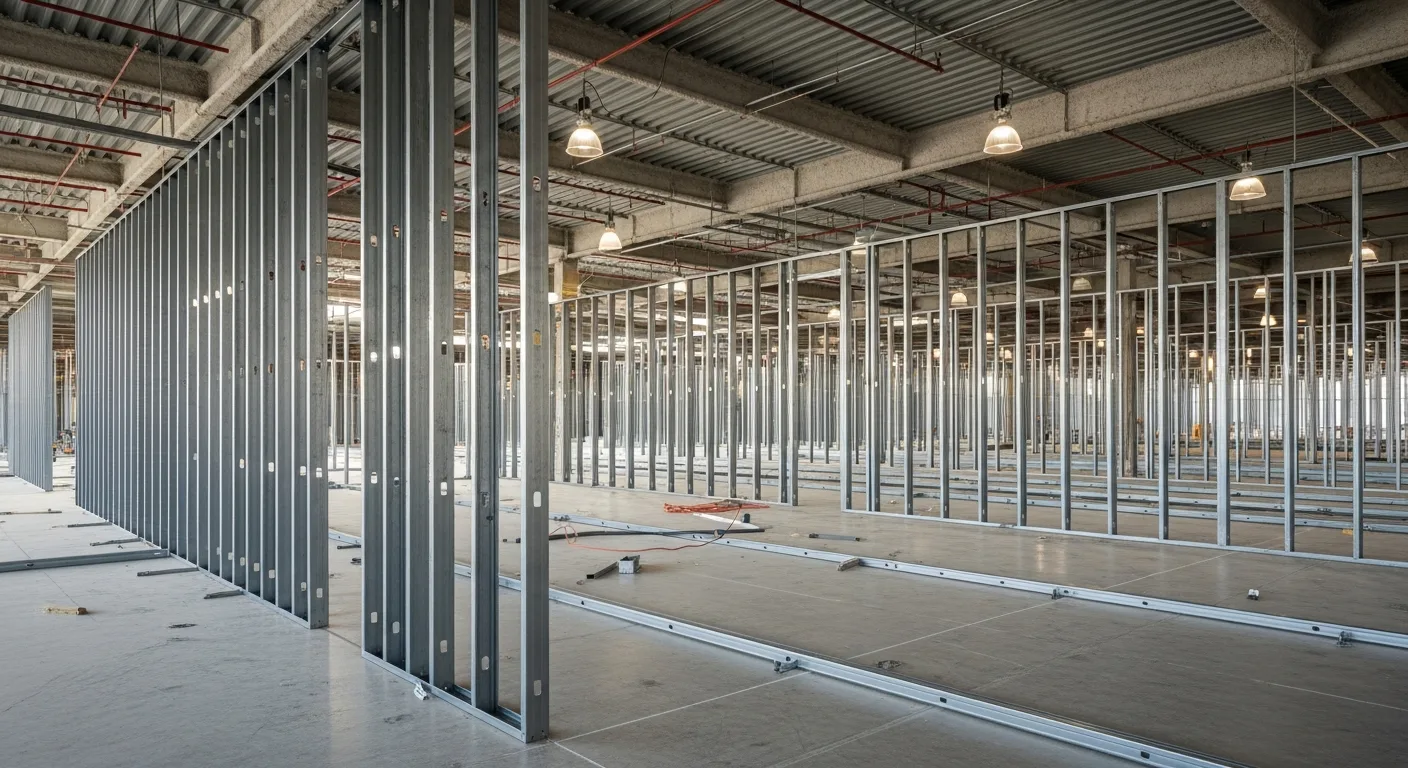
If you have only framed with wood, picking up a metal stud for the first time feels wrong. It is light, it flexes in your hands, and it is hard to imagine it holding up a wall. But metal stud framing is the standard for commercial interior construction, and it is showing up more and more in residential work too. Once you understand the materials, the fastening methods, and the layout process, metal framing is fast, efficient, and produces walls that are perfectly straight every time.
This guide covers everything you need to know to frame with metal studs, whether you are doing your first commercial tenant improvement or adding metal framing to your residential crew’s skill set.
Why Metal Studs?
Before we get into the how, let’s talk about why metal studs are used in the first place.
Advantages Over Wood
- Perfectly straight. Every stud is identical. No crowns, no twists, no sorting through a lumber pile looking for decent boards.
- Lightweight. A 10-foot 3-5/8” metal stud weighs about 5 pounds. A 10-foot 2x4 weighs about 12 pounds. On a commercial job with thousands of studs, your crew notices the difference.
- No shrinkage or warping. Wood moves with moisture changes. Steel does not. This means fewer drywall cracks and nail pops over time.
- Termite and rot proof. In humid climates or slab-on-grade construction, metal studs eliminate moisture and pest concerns.
- Non-combustible. Steel studs do not burn. This can simplify fire rating requirements in commercial construction.
- Consistent dimensions. Every stud is exactly the same width, depth, and thickness. Layout is predictable.
Disadvantages
- Thermal conductivity. Steel conducts heat much better than wood. Exterior walls need thermal breaks or continuous exterior insulation to meet energy codes.
- Requires different tools and techniques. Crews trained on wood need to learn new skills.
- Harder to attach heavy items. You cannot just drive a screw anywhere and expect it to hold weight. Wood blocking is needed for cabinets, grab bars, and similar items.
- Screw-based assembly. Everything is screwed, not nailed. This is slower for some connections but more precise for others.
- Noise transmission. Metal is more rigid than wood in some respects, and sound can travel along the studs. Acoustic insulation and resilient channel are often needed in metal stud walls.
Metal Stud Sizes and Gauges
Understanding the sizing system is the first step. Metal studs are specified by three dimensions: web depth, flange width, and material gauge (thickness).
Web Depth
The web is the wide face of the stud (equivalent to the wide face of a 2x4). Common web depths:
- 1-5/8”: Used for furring and very short partitions
- 2-1/2”: Light partitions, soffits, and bulkheads
- 3-5/8”: The standard for most interior partitions (equivalent to a 2x4 wall)
- 6”: Taller partitions, exterior walls, and walls requiring thicker insulation (equivalent to a 2x6 wall)
- 8” and larger: Tall walls, elevator shafts, and specialty applications
Flange Width
The flange is the narrow face where screws are driven. Standard flange width is 1-1/4 inches for most studs. Some heavy-gauge structural studs have wider flanges (1-5/8” or 2”) for more screw edge distance.
Material Gauge
Gauge determines the thickness of the steel and therefore the structural capacity.
- 25-gauge (0.0188”): Lightest. Used for non-load-bearing interior partitions up to about 10 feet tall. This is the most common gauge for commercial tenant improvement work.
- 22-gauge (0.0283”): Mid-range. Used for taller non-load-bearing partitions and where more rigidity is needed.
- 20-gauge (0.0346”): Heavy-duty non-load-bearing and light structural applications.
- 18-gauge (0.0451”): Structural. Used for load-bearing walls and exterior framing.
- 16-gauge (0.0566”): Heavy structural. Load-bearing walls with significant loads.
- 14-gauge (0.0713”): The heaviest commonly available. Heavy structural applications.
Track
Track is the top and bottom “plate” for metal stud walls. It is U-shaped and sized to match the stud web depth. The studs slide into the track and are screwed in place. Track comes in the same gauges as the studs, and you should match the track gauge to the stud gauge.
Deflection Track
At the top of the wall, many commercial specifications call for deflection track (also called slip track). This track allows the top of the wall to move independently of the structure above it, accommodating building deflection without cracking the drywall. The studs sit in the track but are not screwed to it at the top. Instead, they are held in place by the track flanges, with a gap left at the top for movement.
Tools for Metal Stud Framing
Cutting Tools
- Aviation snips: The basic tool. You need three types: left-cut (red handle), right-cut (green handle), and straight-cut (yellow handle). To cut a stud, snip both flanges, then bend and snip the web.
- Metal-cutting chop saw: For production work, a chop saw with an abrasive or carbide-tipped metal-cutting blade cuts studs in seconds. Much faster than snips for high-volume work.
- Angle grinder with cut-off wheel: Useful for cutting in tight spots and making notches.
- Electric shears: Power shears cut through metal studs quickly without the sparks of a chop saw. Good for on-the-fly cuts.
Fastening Tools
- Screw gun with adjustable clutch: This is the primary tool. Set the clutch so screws drive flush without stripping. A good screw gun with a depth-sensitive nose makes the job much faster and more consistent.
- Self-drilling screws: The standard fastener for metal-to-metal connections. These screws have a drill point that bores through the steel before the threads engage. Common sizes are #8 x 1/2” for stud-to-track connections and #6 x 1” or 1-1/4” for drywall-to-stud.
- Powder-actuated tool: For shooting track to concrete floors and steel decks. Ramset and Hilti are the most common brands.
- C-clamp locking pliers: Used to clamp studs to track before screwing. These hold the pieces firmly in alignment while you drive screws.
Layout Tools
- Laser level: Essential for snapping track lines on the floor and transferring them to the ceiling or deck above. A rotary laser or line laser saves hours compared to plumb bobs and chalk lines on a commercial job.
- Chalk line: Still useful for marking track locations on the floor.
- Magnetic torpedo level: Sticks to the stud for checking plumb. Much more convenient than a standard level that you have to hold in place.
- Tape measure and permanent marker: Layout marks on metal do not show with pencil. Use a fine-tip permanent marker or a scriber.
Layout and Installation Process
Step 1: Read the Drawings
Before you cut a single stud, study the floor plan. Identify:
- Wall locations and dimensions
- Door and window openings (header sizes, rough opening dimensions)
- Any walls that are load-bearing (these require heavier gauge studs)
- Deflection requirements at the top of the wall
- Backing and blocking requirements for fixtures, cabinets, and equipment
- Fire-rated assemblies and their specific UL-listed details
Step 2: Snap Floor Lines
Using a laser level and chalk line, snap the floor track locations. Measure from established reference points (column lines, exterior walls, or other fixed elements) per the drawings.
Double-check your layout before you start shooting track. On a commercial job, moving a wall after the track is down wastes time and leaves holes in the slab that need patching.
Step 3: Install Floor Track
Shoot the floor track to the slab using a powder-actuated tool. Standard spacing is 24 inches on center for fasteners, with a fastener within 2 inches of each end and each side of every joint or opening.
On wood subfloors, screw the track down with pan-head screws long enough to reach into the framing below.
For sound-rated assemblies, apply acoustic sealant under the track before fastening. This breaks the sound path from the floor into the wall assembly.
Step 4: Transfer Lines and Install Ceiling Track
Using the laser level, transfer the floor track locations up to the ceiling or deck above. Plumb up from the floor track at both ends of each wall run and snap a line.
Install ceiling track using the same fastener spacing as the floor. If deflection track is specified, install it per the manufacturer’s requirements, leaving the specified gap between the top of the studs and the underside of the structure.
Step 5: Lay Out Stud Spacing
Mark the stud layout on the floor track. Standard spacing is 16 inches on center. Mark with a permanent marker and be consistent about marking on the same side of the stud (most crews mark the side the stud will be on, like layout on a wood plate).
Step 6: Cut and Install Studs
Measure the height from inside the floor track to inside the ceiling track. Cut studs to length, accounting for the deflection gap if using slip track at the top.
To install each stud:
- Set the stud into the floor track at the layout mark.
- Twist the stud into the ceiling track (tip one end in, then swing the bottom into position).
- Check plumb with a magnetic level.
- Clamp the stud to the track with locking C-clamps.
- Drive two self-drilling screws through the track flange into the stud flange at the bottom.
- If not using deflection track, drive two screws at the top as well.
For deflection track, the studs are NOT screwed to the top track. They sit inside it and are held laterally by the track flanges, but free to move vertically as the building deflects.
Step 7: Frame Openings
Door and window openings in metal stud walls use the same concepts as wood framing but with different components.
Jamb studs: These are the equivalent of king and jack studs. In commercial work, jamb studs are often box-framed (two studs screwed together in a box shape) or fitted with jamb clips for extra rigidity.
Headers: Metal stud headers are typically built from track material. A common method is to cut a piece of track to span the opening plus the bearing on each side, cut and bend the flanges to create tabs, and screw the tabs to the jamb studs. For heavier loads, use doubled track or an angle iron header.
Sill members: For window openings, the sill is a piece of track cut and installed between the jamb studs, with cripple studs below.
Step 8: Install Blocking and Backing
This is a step that gets missed and causes problems later. Anywhere a heavy item will be mounted to the wall, you need solid backing:
- Plywood blocking: 3/4-inch plywood screwed between studs at the right height for cabinets, TV mounts, grab bars, etc.
- Wood blocking: 2x lumber screwed between studs.
- Heavy-gauge metal blocking: Hat channel or strapping screwed between studs for moderate loads.
Mark all blocking locations on the floor plan so the drywall crew (and the trim carpenters) know where the backing is. Take photos before the drywall goes up. Backing that nobody can find after the walls are closed is useless.
Step 9: Inspection and Close-In
Before drywall starts:
- Verify all stud spacing and wall locations match the drawings
- Check that all openings are correctly sized and square
- Confirm blocking is installed at all required locations
- Verify fire-rated assemblies have the correct stud gauge, spacing, and track connections
- Check that deflection gaps are present and correct where specified
- Confirm electrical and plumbing rough-ins are complete and inspected
Tips for Working With Metal Studs
Cutting Tips
- When cutting studs with snips, cut the flanges first, then bend the stud back and forth to fatigue the web, and snip the remaining web material. This is faster and produces a cleaner cut than trying to snip straight through the web.
- Wear gloves. Cut metal edges are razor sharp.
- On a chop saw, clamp the stud firmly. Lightweight studs can kick or spin if they are not secured.
Screw Tips
- Do not overdrive screws. The screw head should sit flush with the surface. Overdriven screws strip out the thin metal and lose holding power.
- Use the clutch on your screw gun. Adjust it so the driver disengages when the screw is flush.
- For drywall screws into metal studs, the screw needs to penetrate at least 3/8 inch beyond the back of the stud flange. Use screws long enough to achieve this.
- Keep screws at least 3/8 inch from the edge of any stud flange. Too close and the screw rips out.
Plumbing and Electrical
- Metal studs have pre-punched knockouts for running wires and pipes. Use grommets (snap-in bushings) in every knockout where a wire passes through to protect the wire insulation from the sharp metal edges.
- Secure pipes and conduit with proper hangers. Do not rely on the knockout holes to support the weight of piping.
- Ground the metal stud wall if required by electrical code. Metal studs are conductive, and a stray wire with damaged insulation can energize the entire wall.
Sound Isolation
Metal stud walls transmit sound more readily than wood framing in some configurations. To improve sound performance:
- Use acoustic sealant under all track (floor, ceiling, and abutting walls)
- Fill the stud cavity with fiberglass or mineral wool insulation
- Use resilient channel on one side of the wall to decouple the drywall from the studs
- Stagger studs on a wider track (wider than the stud) so each side of the wall attaches to different studs
- Add additional layers of drywall for mass
Managing Metal Stud Projects
Commercial metal stud framing projects involve a lot of moving parts: material deliveries, crew scheduling, coordination with MEP trades, inspections, and close-in deadlines. Keeping it all straight with phone calls and paper notes gets messy fast, especially on multi-floor or multi-phase projects.
Project management software built for construction makes a real difference here. With Projul, you can:
- Schedule framing crews by floor or zone and track progress in real time
- Manage material orders and track deliveries against the install schedule
- Coordinate with electrical and plumbing trades so rough-ins are done before close-in
- Document blocking locations with photos for future reference
- Track labor costs against the estimate to catch budget issues early
If you are running metal stud framing crews, take a look at Projul and see how it handles the scheduling and cost tracking that keep commercial projects profitable.
Metal Studs in Residential Construction
Metal studs are not just for commercial work anymore. More residential builders are using them for specific applications.
Where Metal Studs Make Sense in Residential
- Interior non-load-bearing partitions: Lightweight, straight, and fast to install. No worrying about shrinkage causing drywall cracks.
- Basement walls: On slab-on-grade and below-grade walls where moisture is a concern, metal studs eliminate the rot risk of wood bottom plates in contact with concrete.
- Soffits and bulkheads: Lightweight metal framing is ideal for framing soffits over kitchen cabinets, bathtub enclosures, and dropped ceilings.
- Fire-rated assemblies: Garage-to-house demising walls, multi-family separation walls, and similar fire-rated partitions.
Where Wood is Still Better for Residential
- Exterior load-bearing walls: While structural metal studs can handle the loads, the thermal bridging issue makes wood (or wood with exterior insulation) more practical for most residential builders.
- Roof framing connections: Most residential roof systems are designed to sit on wood top plates. Transitioning from metal studs to a wood roof system adds complexity.
- Areas with heavy attachment needs: If every wall in a room will have cabinets, shelving, or heavy fixtures, the blocking requirements for metal studs can negate the time savings.
Safety Considerations
Metal stud framing has specific safety hazards that differ from wood framing.
Sharp Edges
Cut metal studs have razor-sharp edges that will cut through gloves and skin easily. Always wear cut-resistant gloves when handling cut studs and track. File or crimp sharp edges on cuts in traffic areas.
Eye Protection
Drilling screws into metal throws small metal shavings. Cutting with snips or a chop saw produces sharp fragments. Safety glasses are mandatory for all metal stud work.
Hearing Protection
Metal-cutting chop saws and screw guns in enclosed spaces are loud. Wear hearing protection, especially on interior jobs where sound reflects off hard surfaces.
Powder-Actuated Tools
Powder-actuated tools fire hardened pins at high velocity. Only trained and certified operators should use them. Follow the manufacturer’s safety procedures, wear hearing and eye protection, and never point the tool at anyone or fire it into material that might allow the pin to pass through.
Metal Stud Sizes and Gauges: Choosing the Right Stud for the Job
Picking the right stud size and gauge is not guesswork. It depends on wall height, load requirements, and what the engineer specifies. But understanding the logic behind the choices helps you catch drawing errors and make smarter material orders.
Gauge Selection by Wall Height (Non-Load-Bearing)
For standard non-load-bearing interior partitions with drywall on both sides, here is what works in practice:
- 25-gauge, 3-5/8” stud at 16” OC: Good for walls up to about 10 feet tall. This is the bread and butter of commercial tenant improvement work. Light, cheap, and fast to install.
- 25-gauge, 3-5/8” stud at 24” OC: Works for walls up to about 8 feet. Some specs allow this for basic office partitions, but 16” OC is more common because it gives better drywall support.
- 22-gauge, 3-5/8” stud at 16” OC: Bump up to 22-gauge when walls run 10 to 13 feet tall. The added thickness gives more rigidity and less flex in the wall.
- 20-gauge, 3-5/8” stud at 16” OC: For walls from 13 to 16 feet. Common in lobbies, atriums, and retail spaces with high ceilings.
- 20-gauge, 6” stud at 16” OC: When you need both height capacity and room for thicker insulation. Works for walls up to about 18 to 20 feet depending on the specific product and manufacturer load tables.
Gauge Selection for Load-Bearing Walls
Load-bearing metal stud walls are a different animal. The gauge jumps up significantly:
- 18-gauge: The starting point for most load-bearing applications. Handles moderate loads on single-story or top-floor walls.
- 16-gauge: The workhorse for multi-story load-bearing metal framing. Handles significant gravity loads and some lateral loads.
- 14-gauge: Heavy structural applications. Multi-story buildings, high wind zones, and seismic regions where the engineer needs maximum capacity.
Load-bearing walls also typically use studs with wider flanges (1-5/8” or 2”) to provide more bearing area and better screw edge distance. The engineer will specify exactly what you need, but if you see 25-gauge studs called out on a load-bearing wall, that is a red flag worth questioning.
Web Depth Selection
The web depth (the wide face of the stud) is mostly about matching the wall thickness you need:
- 1-5/8”: Furring walls, strap walls against concrete, and very shallow soffits. Not a standalone partition wall.
- 2-1/2”: Slim partitions where space is tight. Common in hotel bathrooms and closet dividers. Fits standard electrical boxes but barely.
- 3-5/8”: The standard. Equivalent to a 2x4 wall. Works for most interior partitions, fits standard electrical boxes and single-gang device rings easily.
- 6”: Use this when you need room for bigger mechanical runs, thicker insulation, or when the wall height requires the extra rigidity of a deeper section. Equivalent to a 2x6 wall.
- 8” and 10”: Specialty applications. Elevator shafts, stairwell enclosures, and very tall walls where deflection control is critical.
Quick Reference: When to Go Heavier
If you are on a jobsite and something feels wrong about the stud spec, here are the situations where you should be using heavier material:
- Wall is over 12 feet tall: at minimum 22-gauge, likely 20-gauge
- Wall carries any load from above: 18-gauge minimum
- Wall is exterior: 18-gauge or 16-gauge with thermal breaks
- Wall supports heavy MEP equipment: heavier gauge or additional bracing
- High-traffic corridor with potential impact loads: consider 20-gauge even for short walls
- Fire-rated wall with multiple drywall layers: the added weight of extra drywall layers can require heavier studs
Always follow the engineered drawings. But if the drawings call for 25-gauge studs on a 16-foot-tall wall, ask the engineer to double-check before you order material.
Metal vs Wood Framing: A Real Cost Comparison
One of the biggest questions contractors ask is whether metal studs actually save money compared to wood. The answer depends on the project, the market, and what you are building. Here is an honest breakdown with real numbers.
Material Cost Per Linear Foot (2025/2026 Averages)
These numbers fluctuate with commodity prices, but here is the general range:
- 25-gauge 3-5/8” metal stud, 10-foot: $3.50 to $5.00 per stud, or roughly $0.35 to $0.50 per linear foot
- 20-gauge 3-5/8” metal stud, 10-foot: $6.00 to $9.00 per stud, or roughly $0.60 to $0.90 per linear foot
- 2x4 SPF stud, 8-foot precut: $3.00 to $6.00 per stud (lumber prices swing wildly), or roughly $0.38 to $0.75 per linear foot
- 2x4 SPF stud, 10-foot: $4.00 to $8.00 per stud, or roughly $0.40 to $0.80 per linear foot
Metal studs also require track (top and bottom), which adds about $0.15 to $0.30 per linear foot of wall. Wood framing uses plates cut from the same lumber, so that cost is already included.
Self-drilling screws for metal framing cost more per fastener than nails for wood, but you use fewer of them. Net fastener cost is roughly comparable.
Labor Cost Comparison
This is where the real difference shows up:
- Experienced metal stud crew: Interior partition framing runs about $1.50 to $2.50 per square foot of wall (both sides).
- Experienced wood framing crew: Interior partition framing runs about $2.00 to $3.50 per square foot of wall.
Metal is faster for experienced crews because the studs are lighter, perfectly straight, and require no sorting. There is no checking for crown, no culling warped boards, and no crown-up orientation. A good metal stud crew on a commercial job can frame more linear feet per day than a wood crew on the same type of partition.
But here is the catch: if your crew has never done metal framing, they will be slower for the first few jobs. The learning curve is real. Budget 20 to 30 percent more labor time for the first project and expect it to normalize by the third or fourth project.
Total Installed Cost Comparison
For a standard interior, non-load-bearing partition wall with drywall on both sides:
- Metal stud wall (25-gauge, 3-5/8”, 16” OC): $8 to $14 per square foot installed, including studs, track, drywall, tape, and finish.
- Wood stud wall (2x4, 16” OC): $10 to $16 per square foot installed, including studs, plates, drywall, tape, and finish.
Metal wins on most commercial interior work. Wood can be cheaper on small residential jobs where the crew already has wood framing skills and the lumber market is in a dip.
When Metal Saves the Most Money
- High-rise and multi-story commercial: Lighter material means less weight on the structure, faster transport to upper floors, and no fire-retardant treatment needed.
- Large tenant improvement projects: Bulk metal stud pricing drops significantly on large orders. A 50,000-square-foot TI project gets much better material pricing than a single-house framing package.
- Projects with long timelines: Metal stud prices are more stable than lumber prices. You can lock in material costs months in advance without worrying about lumber market swings doubling your framing budget.
- High-moisture environments: No rot, no mold growth on the studs themselves. Saves money on treated lumber and long-term maintenance.
When Wood Saves the Most Money
- Small residential projects: Lumber yards are everywhere, and every framing crew knows how to work with wood.
- Load-bearing walls in residential: Structural metal studs (16-gauge and 14-gauge) are significantly more expensive than dimensional lumber for the same load capacity.
- Areas with cheap lumber and expensive steel: Regional pricing varies. In timber-producing regions, wood can be 30 to 40 percent cheaper.
Common Metal Stud Framing Mistakes on Commercial Jobsites
After years of seeing the same problems on commercial jobs, these are the mistakes that cost the most time and money. If you are running a metal stud crew, print this list and tape it to the job trailer wall.
Mistake 1: Using the Wrong Gauge
This happens more than you would think. The spec calls for 20-gauge studs on a tall wall, but someone orders 25-gauge because they look the same at first glance. The wall goes up, the drywall goes on, and then the wall flexes when you push on it. The inspector notices, or worse, nobody notices until the tenant moves in and the walls feel flimsy.
Fix: Check the gauge stamp on every bundle when it arrives on site. The gauge is printed on the stud web. Verify it matches the drawings before a single stud gets cut.
Mistake 2: Screwing Studs to Deflection Track
This is the most common mistake new metal stud framers make. Deflection track exists to allow vertical movement at the top of the wall. If you screw the studs to the top track, you defeat the entire purpose. When the building deflects (and every building deflects), the wall cracks, the drywall buckles, and you are back on site doing repairs.
Fix: Train every crew member on deflection track. Mark the deflection track with spray paint or tape so nobody accidentally screws into it. On the inspection walkthrough, physically push on the top of several studs to confirm they slide freely in the track.
Mistake 3: Not Accounting for Floor Flatness
Concrete slabs are never perfectly flat. If you shoot your floor track down without shimming, the track follows every dip and hump in the slab. Your studs end up at different heights, and the wall is wavy.
Fix: Check the slab flatness along the track line before installation. Use a straightedge or laser. Shim the track with sheet metal shims or grout to bring it level. This takes time upfront but saves you from chasing waves in the drywall later.
Mistake 4: Missing Blocking for Fixtures
The drywall goes up and the wall looks great. Then the cabinet installer shows up and asks where the blocking is. There is none. Now someone has to cut open the finished wall, install blocking, patch the drywall, and repaint. On a commercial job with dozens of rooms, this mistake multiplies fast.
Fix: Walk the drawings before you start framing and mark every location that needs blocking: cabinets, TV mounts, grab bars, toilet accessories, fire extinguisher cabinets, marker boards, anything that mounts to the wall. Install the blocking during framing and photograph every location before drywall. Project management software like Projul lets you attach those photos to the project record so the finish trades can find every piece of blocking later.
Mistake 5: Overdriving Screws
When you overdrive a screw into a thin-gauge metal stud, the screw head punches through and the threads strip out. The connection has zero holding power. This is especially common with 25-gauge studs where the material is barely thicker than a heavy-duty aluminum can.
Fix: Use a screw gun with an adjustable clutch and set it correctly at the start of every shift. Test on a scrap piece before driving production screws. The screw head should sit flush with the surface, not countersunk into the metal.
Mistake 6: Ignoring Bracing Requirements
Tall metal stud walls need lateral bracing to prevent the studs from twisting or buckling. The drawings will call for horizontal bridging (flat strap or channel bridging screwed to the stud webs) at specific intervals. Skipping or forgetting the bridging leaves the wall wobbly and non-compliant.
Fix: Install bridging as you go, not as an afterthought. If the specs call for bridging at mid-height on a 12-foot wall, install it when the studs are at 6 feet, not after the wall is fully framed and you need a ladder to reach the middle.
Mistake 7: Poor Layout Transfer to Ceiling Track
If your floor track layout does not align perfectly with your ceiling track layout, the studs are not plumb. This seems obvious, but on a big commercial floor with dozens of walls, layout errors compound. A 1/4-inch error at the floor becomes a noticeably out-of-plumb wall by the time you frame it up.
Fix: Use a laser plumb or a rotary laser to transfer every layout point from floor to ceiling. Do not rely on tape measure offsets from different reference points at the floor and ceiling. Confirm plumb on the first and last stud of every wall run before filling in the rest.
Inspection Checklist for Metal Stud Framing
Knowing what the inspector is looking for helps you pass the first time. Here is what gets checked on a commercial metal stud framing inspection.
Stud Gauge and Spacing
The inspector will check the gauge stamp on the studs and verify it matches the approved drawings. They will also spot-check stud spacing with a tape measure. If the drawings call for 16” OC, every stud should be within 1/4 inch of layout. Random spacing gets flagged.
Track Fastener Spacing
Floor and ceiling track must be fastened at the specified intervals (typically 24” OC with fasteners within 2” of each end and joint). The inspector will walk the track line and look for consistent fastener spacing. Missing fasteners or wide gaps between shots get flagged.
Deflection Track Gaps
If the specs call for deflection track at the top of the wall, the inspector will look for the gap between the top of the studs and the structure above. They will also check that studs are NOT screwed to the deflection track. This is one of the most common inspection failures on commercial jobs.
Blocking and Backing
The inspector will check for blocking at locations called out on the drawings: grab bars (especially in ADA-compliant restrooms), heavy fixtures, fire extinguisher cabinets, and any other wall-mounted items that need solid backing.
Fire-Rated Assembly Compliance
For fire-rated walls, the inspector checks everything against the UL-listed assembly number on the drawings:
- Correct stud gauge and spacing
- Correct number of drywall layers (and correct drywall type)
- Correct screw spacing for each drywall layer
- Insulation type and thickness if specified
- Proper caulking or firestopping at the top and bottom of the wall and at all penetrations
- No gaps or holes that break the fire barrier
Fire-rated assemblies are pass/fail with no room for interpretation. If the UL listing says 5/8” Type X drywall with screws at 12” OC on the first layer and 8” OC on the second layer, that is exactly what the inspector expects to see.
Bridging and Bracing
The inspector will check for horizontal bridging at the intervals specified in the drawings. They may also check that the bridging is properly fastened to each stud with the correct number of screws.
Plumb and Alignment
While not always a formal code check, most inspectors will eyeball the walls for plumb and straight. A wall that is visibly out of plumb or wavy signals sloppy work and may trigger a closer inspection of everything else.
What to Have Ready for Inspection
- Approved drawings at the jobsite (not in the truck, not on someone’s phone somewhere)
- Submittals showing the stud manufacturer, gauge, and UL assembly details
- Access to all walls (do not stack materials against walls that need inspection)
- A copy of the fire-rated assembly details for every rated wall
Pass the inspection the first time by doing your own walkthrough before calling the inspector. Use the list above and check everything yourself. It takes 30 minutes and saves you the week it takes to get the inspector back for a reinspection.
Estimating and Takeoff for Metal Stud Framing Jobs
Getting the estimate right on a metal stud job is different from wood framing in a few important ways. Miss any of these and you are eating costs or losing the bid.
How to Do a Metal Stud Takeoff
Start with the floor plan and elevations. You need three numbers for every wall: linear footage, wall height, and the spec (stud size, gauge, and spacing). From there, the math is straightforward but tedious.
Studs per wall: Take the wall length in inches, divide by the on-center spacing, and add one. A 20-foot wall at 16” OC is 240 divided by 16, plus one, which is 16 studs. Then add studs for each side of every opening (king studs and jack studs), plus cripple studs above and below openings.
Track: You need two pieces of track for every linear foot of wall (floor and ceiling). Add track for headers and sills at openings. On a typical commercial job, track runs about 15 to 20 percent of total material cost, so do not eyeball it.
Screws: Figure two screws per stud-to-track connection at the bottom (and top, if not deflection track). That is four screws per stud on a fixed-top wall, two per stud on a deflection-top wall. Add screws for bridging, blocking, and misc connections. A rough rule of thumb is 10 to 15 screws per stud for the framing alone, not counting drywall screws.
Waste factor: Metal studs generate less waste than wood because they are consistent and you can order exact lengths. But you still need a waste factor for mis-cuts, damaged material, and short pieces that are not reusable. Use 5 to 8 percent for studs and 8 to 10 percent for track (track has more cuts and more waste at openings).
Pricing the Labor
Labor is where most estimating errors happen. If your crew is experienced with metal studs, you can use production rates based on your own history. If you are bidding your first metal stud job, here are some starting points:
- Standard interior partition (25-gauge, 8 to 10 feet tall, 16” OC): 80 to 120 linear feet of wall per carpenter per day. This includes layout, track installation, cutting and setting studs, and basic blocking.
- Tall walls (12 to 16 feet, 20-gauge): 50 to 80 linear feet per carpenter per day. Taller walls take more time for everything: longer studs are harder to handle, you need scaffolding or a lift, and bridging installation slows things down.
- Fire-rated assemblies: Add 10 to 15 percent to your labor for the extra attention to detail, documentation, and inspection coordination.
- Opening framing (doors and windows): Budget 30 to 45 minutes per opening for framing the jambs, header, and sill. Complex openings with sidelights or borrowed lights take longer.
Track your actual production rates on every job. After three or four metal stud projects, you will have numbers you can trust. Until then, pad your labor estimate and track hours carefully. Construction cost tracking tools help you break down where the hours actually go so your next bid is tighter.
Material Ordering Tips
- Order exact lengths when possible. Metal studs come in standard lengths from 8 to 20 feet. If your walls are 9 feet 6 inches, order 10-foot studs and cut them down. Do not order 8-foot studs and try to splice.
- Order all material from the same manufacturer. Stud dimensions vary slightly between manufacturers. Mixing brands means the studs may not fit the track perfectly.
- Get material on site early. Metal studs are light and stack flat. They do not take up much space and they will not warp or degrade sitting on the job. Having material ready when the crew shows up avoids lost production time.
- Check for damage on delivery. Bent or dented studs are useless. Inspect every bundle before the delivery truck leaves.
Coordinating Metal Stud Framing With Other Trades
On a commercial job, your framing crew is one of several trades working in the same space. Bad coordination kills your production rate and creates rework. Here is how to keep things running smooth.
Sequencing With MEP Trades
The basic sequence on most commercial interiors is: frame walls, rough-in MEP (mechanical, electrical, plumbing), inspect, then close in with drywall. But it is rarely that clean.
Electrical and plumbing often need to get into the walls before you finish framing. Overhead duct work might need to go in before you can run your ceiling track. Fire sprinkler rough-in needs to coordinate with both your framing heights and the ceiling grid layout.
The fix is a coordination meeting before framing starts. Get the framing foreman, electrical foreman, plumbing foreman, and HVAC foreman in the same room (or on the same call) and walk through the sequence floor by floor, zone by zone. Decide who goes where and when. Write it down. Publish the schedule so everyone has it.
Scheduling tools built for construction make this a lot easier than passing around paper schedules or relying on the GC’s weekly meeting to sort out conflicts. When the plumber can see the framing crew’s schedule and vice versa, fewer trades show up to the same area on the same day.
The Drywall Handoff
Your framing quality directly affects the drywall crew’s speed and the finished wall quality. A few things make the handoff smoother:
- Straight walls. Check your walls with a straightedge before calling for drywall. A stud that is pushed in or kicked out by 1/4 inch shows through the finished drywall. Fix it during framing, not during drywall.
- Consistent stud spacing. If your studs drift off layout, the drywall crew has to hunt for studs, which slows them down and increases the chance of missed screws.
- Clean openings. Door and window frames need to be square, plumb, and at the correct rough opening dimensions. The door installer should not have to shim more than 1/4 inch on any side.
- Blocking documented. As mentioned earlier, photograph all blocking locations. Share those photos through your project management platform so the drywall crew and finish trades can find every piece.
Handling Change Orders During Framing
Walls move. Doors get added or deleted. The architect decides a conference room needs to be 2 feet wider. On commercial jobs, changes during framing are constant.
Metal stud framing handles changes better than wood in some ways. Pulling a stud out of track is easier than pulling nails. Moving a wall means lifting out the studs, pulling the track, snapping new lines, and re-shooting track. It is not free, but it is faster than demolishing a nailed wood wall.
The key is documenting every change. When the GC tells you to move a wall, get it in writing (even an email or a text message) before you do the work. Log the extra labor hours separately so you can back up your change order. Job costing by phase or cost code makes it easy to separate base contract work from change order work when it is time to bill.
Building and Training a Metal Stud Framing Crew
If you are a contractor who has been doing wood framing and you want to take on commercial metal stud work, the crew transition is the biggest hurdle. Here is a practical plan based on what actually works.
Start With Your Best Carpenters
Pick two or three of your sharpest carpenters for the first metal stud project. These should be people who pick up new skills quickly and do not get frustrated when things are different from what they are used to. Do not try to convert your entire crew at once.
Invest in a Training Day
Before your first metal stud job, spend a day (or even half a day) practicing. Buy a bundle of 25-gauge studs and track, set up in your shop or on an empty slab, and have the crew:
- Practice cutting with snips (both flanges, then the web)
- Set up and cut with a metal chop saw
- Shoot floor track with a powder-actuated tool
- Set studs in track and screw them off
- Frame a mock door opening with jamb studs and a header
- Practice with deflection track (studs NOT screwed at top)
One training day saves you three days of fumbling on the actual job. The motions are different from wood framing and muscle memory takes a few hours to develop. Cutting with aviation snips is nothing like cutting with a circular saw. Driving screws is nothing like swinging a framing hammer or shooting nails.
Pair With an Experienced Crew
If you can find a commercial framing sub or a retired metal stud foreman willing to work with your crew for the first week of a job, it is worth every dollar. Having someone on site who can answer questions in real time and catch mistakes before they become problems accelerates the learning curve by weeks.
Production Expectations
Be realistic about production on the first job. Your crew will be 30 to 40 percent slower than an experienced metal stud crew. By the second job, that drops to 10 to 20 percent slower. By the third or fourth job, your crew should be at full production speed.
Factor this into your first few bids. Eating some labor cost on early projects is an investment in a new revenue stream. Commercial interior framing work is steady, year-round, and less affected by weather and housing market swings than residential wood framing.
Tools to Buy
For a crew of three to four framers transitioning to metal studs, here is the minimum tool investment:
- 3 to 4 screw guns with adjustable clutches ($150 to $300 each)
- 3 to 4 sets of aviation snips (left, right, straight — $30 to $50 per set)
- 1 metal-cutting chop saw ($200 to $400)
- 1 powder-actuated tool with appropriate loads and pins ($300 to $500)
- 6 to 8 locking C-clamp pliers ($15 to $25 each)
- 3 to 4 magnetic torpedo levels ($15 to $30 each)
- 1 rotary laser level if you do not already have one ($300 to $800)
- Fine-tip permanent markers (buy a box — they disappear constantly)
Total tool investment for a small crew: roughly $2,000 to $4,000. That is nothing compared to the revenue potential of commercial framing contracts.
Where to Find Commercial Framing Work
Once your crew is ready, finding work is the next step. Commercial metal stud framing jobs come from:
- General contractors (GCs): Reach out to commercial GCs in your area. Most maintain a list of framing subs and are always looking for reliable crews. Start with smaller tenant improvement projects (office buildouts, retail spaces) before bidding multi-floor commercial buildings.
- Drywall contractors: Many drywall companies also bid the framing portion. If they are overloaded, they sub out the framing. Building a relationship with two or three drywall contractors can keep your crew busy.
- Construction plan rooms and bid boards: Commercial projects are posted on plan rooms (local and online). Check them regularly and bid on projects that match your crew size and experience level.
- Your existing network: If you have been doing residential work, some of your GC relationships may also do commercial work. Ask around. The same GC who hires you for a custom home addition might have a small commercial project that needs framing.
Track every bid, won or lost. Over time, your win rate tells you whether your pricing is competitive, and your job history builds the resume you need to land bigger projects. A good construction project management system keeps all of this organized so you are not digging through email chains and paper folders when a GC asks for references.
Fire-Rated Metal Stud Assemblies: What You Actually Need to Know
Fire-rated walls are where metal stud framing gets serious. Mistakes here do not just fail inspection — they put people at risk. This section covers the practical side of fire-rated metal stud walls for crews who are building them.
How Fire Ratings Work
A fire rating is a time measurement. A 1-hour fire-rated wall means it has been tested in a lab and held up for one hour under standardized fire conditions (ASTM E119 or UL 263). The wall does not stop fire forever. It gives people on the other side of the wall time to get out and gives the fire department time to respond.
The fire rating belongs to the entire wall assembly, not to any single component. The stud gauge, stud spacing, drywall type, number of drywall layers, screw spacing, insulation, and sealant all work together. Change any one element and the rating may no longer apply.
Common Fire-Rated Metal Stud Assemblies
Here are the assemblies you will see most often on commercial jobs:
1-hour rated wall (UL U305 or similar):
- 3-5/8” metal studs, 25-gauge or 20-gauge, at 24” OC
- One layer of 5/8” Type X gypsum board on each side
- Screws at 12” OC on edges, 12” OC in the field
- Mineral wool or fiberglass insulation in the cavity (if specified)
2-hour rated wall (UL U411 or similar):
- 3-5/8” metal studs, 25-gauge or 20-gauge, at 24” OC
- Two layers of 5/8” Type X gypsum board on each side
- First layer screwed at 12” OC, second layer at 12” OC (offset joints from first layer)
- Insulation in the cavity
STC-rated walls (sound transmission class):
- These often combine fire rating with sound rating
- May include resilient channel on one side, staggered studs, or double stud walls
- Specific insulation type and thickness are part of the tested assembly
The Details That Matter
When building a fire-rated wall, the small details make the difference between passing and failing inspection:
Joint stagger: Drywall joints in multi-layer assemblies must be staggered. The second layer joints cannot land on the same stud as the first layer joints. This prevents a single seam from creating a weak point in the fire barrier.
Screw pattern: The UL listing specifies exact screw spacing for each layer. Do not guess. If the listing says 12” OC on edges and 12” OC in the field for the first layer, that is what you install. The inspector will check with a tape measure.
Penetrations: Every hole in a fire-rated wall (electrical boxes, pipes, conduit, duct) must be firestopped. The firestopping product and method must match the penetration type and the wall assembly. This is not your crew’s responsibility if the GC has a firestopping sub, but know the requirement so you do not cut unnecessary holes.
Top and bottom sealant: Many fire-rated assemblies require continuous bead of fire-rated sealant at the top and bottom of the wall where the drywall meets the floor and ceiling track. This seals the gap and prevents fire and smoke from bypassing the wall at the perimeter.
Head-of-wall joint: Where the top of the wall meets the deck or structure above, the fire rating must continue. If using deflection track, the head-of-wall detail typically includes specific firestopping material (mineral wool safing insulation and fire sealant) stuffed into the gap between the top track and the structure. This detail gets missed constantly and is one of the most common fire inspection failures.
Documentation on Site
Keep a copy of every UL assembly detail on site. Not in the truck. Not on someone’s phone. Printed and in the job trailer or taped to the wall in the framing area. Every crew member working on a fire-rated wall should know which assembly they are building and where to find the details.
When the inspector arrives, hand them the assembly details before they ask. It shows you know what you are doing and it makes the inspection go faster. Inspectors appreciate crews who are organized because it means they are less likely to find problems.
Final Thoughts
Metal stud framing is a skill set worth having, whether you are a commercial contractor or a residential builder looking to add capability. The materials are consistent, the walls are straight, and an experienced crew can frame interior partitions faster with metal than with wood.
The keys to success are understanding the material (gauges, sizes, and limitations), having the right tools (especially a good screw gun and sharp snips), and following the engineered details on fire-rated and structural assemblies. Do those things well, and metal stud framing becomes just another tool in your framing crew’s toolkit.
For help managing your framing projects, whether metal or wood, check out Projul’s features or see our pricing to find the right plan for your crew.
Frequently Asked Questions
What gauge metal studs should I use for load-bearing walls?
Can metal studs be used for exterior walls?
What tools do I need for metal stud framing?
How do you hang heavy items on metal stud walls?
What is the difference between a C-stud and a track?
Do metal studs need fireproofing?
How far apart should metal studs be spaced?
Is metal stud framing faster than wood framing?
Related Articles

How Construction Teams Use AI to Cut Admin Time
Most contractors lose a full day every week to paperwork. AI now handles the repetitive admin work that used to eat...
Read More →
Concrete Tilt-Up Construction: A Contractor's Complete Field Guide
Tilt-up construction accounts for roughly 15 percent of all industrial and commercial buildings in North America. This...
Read More →
How to Implement Construction Software Without Losing Your Mind
Most construction software rollouts fail. Not because the software is bad, but because the rollout was rushed. Here are...
Read More →