
Mudjacking and Slab Leveling: Methods, Costs, and When to Replace Instead | Projul
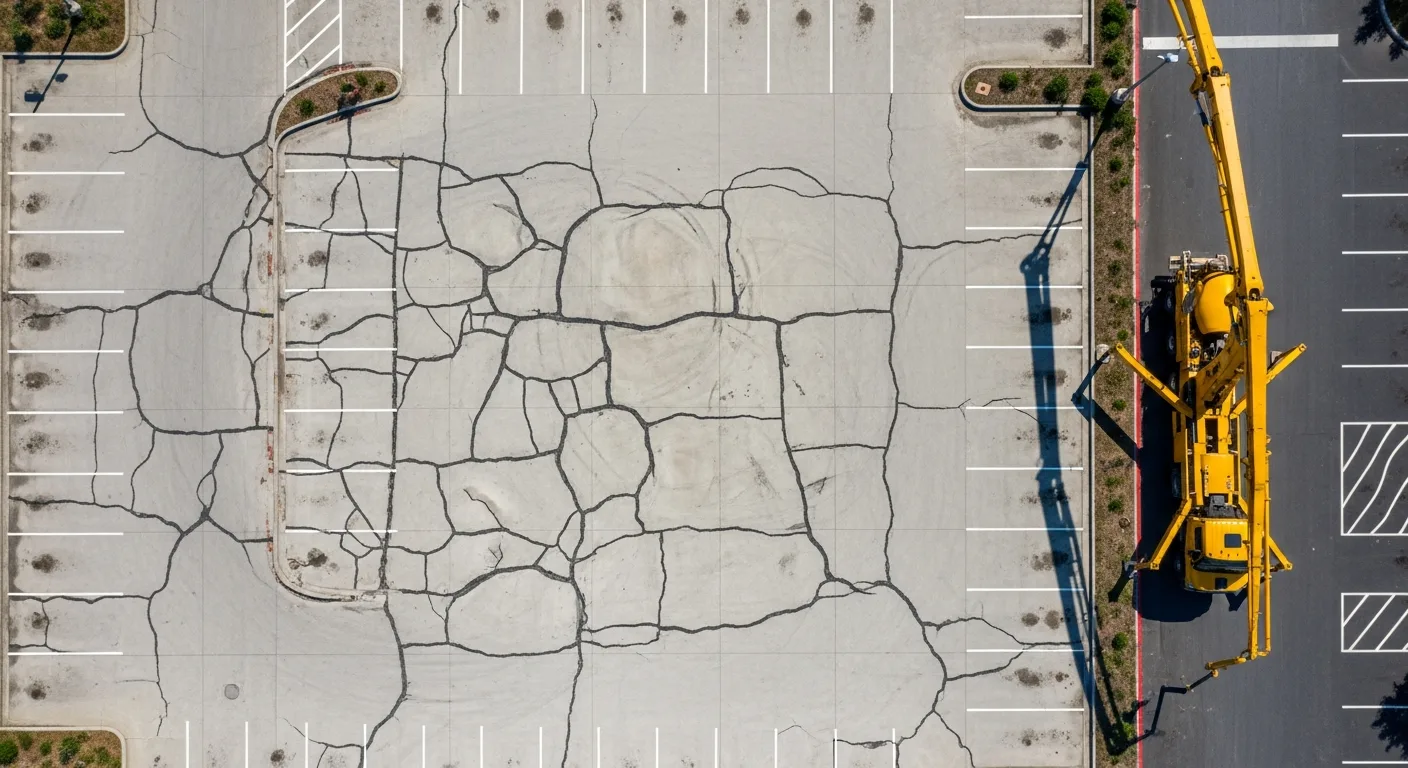
Sunken concrete slabs are one of the most common problems contractors encounter on both residential and commercial properties. Driveways that have dropped an inch at the garage, sidewalk panels that have tilted and become trip hazards, warehouse floors that have settled and created drainage issues, pool decks with uneven joints. The slabs are structurally fine, but they are no longer where they are supposed to be.
For decades, the only option was to tear out the old slab and pour new concrete. That is expensive, disruptive, and often unnecessary when the concrete itself is still in good shape. Mudjacking and its newer cousin, polyurethane foam injection, offer a way to lift the slab back into position at a fraction of the cost of replacement.
This guide covers both methods in detail, explains when each one makes sense, and helps you advise your customers on the best approach for their situation.
How Traditional Mudjacking Works
The Process
Traditional mudjacking, also called slabjacking or pressure grouting, follows a straightforward sequence.
Step 1: Drill access holes. The crew drills 1.5 to 2 inch diameter holes through the sunken slab. Hole spacing depends on slab thickness, the amount of lift required, and the area of the void underneath. Typical spacing is 3 to 6 feet apart in a grid pattern.
Step 2: Pump slurry. A hydraulic pump forces a cement-based slurry through the holes and into the void space beneath the slab. The slurry is a mixture of sand, Portland cement, and water, sometimes with additives like limestone dust, fly ash, or clay for workability.
Step 3: Lift the slab. As slurry fills the void and builds pressure, the slab begins to rise. The operator controls the lift by monitoring slab elevation with a level or laser and adjusting pump pressure and volume. The goal is to raise the slab to match the elevation of adjacent concrete or to achieve the specified grade.
Step 4: Plug the holes. Once the slab is at the correct elevation, the pump hose is removed and the drilled holes are patched with quick-setting cement or a concrete plug.
Step 5: Clean up. Excess slurry that may have squeezed out at slab edges or through cracks is cleaned off. The area is typically ready for foot traffic within a few hours.
Slurry Mix Design
The slurry used in traditional mudjacking is not a precision-engineered material. Most mudjacking contractors have developed their own preferred mixes based on experience with local conditions.
Typical components:
- Portland cement: provides strength and binding
- Sand: provides bulk and fill volume
- Water: for workability and pumpability
- Limestone dust or fly ash: sometimes added for flowability
- Clay or topsoil: some mixes use small amounts for pumpability
Typical proportions: A common mix is approximately 1 part cement to 3 parts sand with enough water to create a thick, pumpable consistency. The mix should be fluid enough to flow through the pump and fill irregular voids but thick enough to support the slab weight without excessive settlement.
Density: Cured mudjacking slurry is heavy, typically 100 to 140 pounds per cubic foot. This weight is a consideration for slabs on weak or compressible soils where adding weight could contribute to future settlement.
Equipment
Mudjacking equipment is relatively simple and affordable, which makes it accessible for contractors considering adding this service.
Hydraulic pump: A positive-displacement pump capable of handling the abrasive sand and cement slurry. Piston-style pumps are most common, with operating pressures of 50 to 150 psi and flow rates of 3 to 8 cubic feet per minute.
Mixer: A drum or paddle mixer for preparing the slurry. Larger operations use continuous mixing systems that feed the pump directly.
Drill: A rotary hammer drill or core drill for creating the access holes through the concrete slab.
Level and measuring tools: A long straightedge, builder’s level, or laser level for monitoring slab elevation during lifting.
Hose and fittings: High-pressure hose with quick-connect fittings sized for the pump output and the drilled hole diameter.
Polyurethane Foam Injection (Foam Jacking)
How It Works
Foam jacking uses expanding two-part polyurethane foam instead of cement slurry. The process is similar to mudjacking in concept but differs in materials, equipment, and several practical details.
Step 1: Drill access holes. Holes are smaller than mudjacking, typically 5/8 inch diameter. This is one of the main selling points of foam jacking: the repair holes are much less noticeable.
Step 2: Inject foam. A proportioning gun mixes two liquid components (an isocyanate and a polyol resin) at the point of injection. The mixed liquid is injected through the holes and into the void beneath the slab.
Step 3: Foam expands. Within seconds, the liquid begins to expand, typically growing to 15 to 25 times its original volume depending on the foam density selected. As it expands, it fills voids and generates lifting pressure.
Step 4: Control the lift. The operator injects foam in short pulses, checking elevation between pulses. Foam expansion is fast, so over-lifting is a real risk. Experienced operators develop a feel for how much material to inject based on the slab size, void volume, and foam expansion ratio.
Step 5: Plug and clean. The small injection holes are filled with a plug or patching compound. Cleanup is minimal since foam does not create the mess that slurry can.
Foam Types
Not all polyurethane foams are the same. The foam density selected affects lifting capacity, cost, and application suitability.
Low-density foam (2 to 4 lbs/ft3): Used for void filling under slabs where significant volume needs to be filled but lifting pressure requirements are moderate. Lower cost per volume but lower bearing capacity.
Medium-density foam (4 to 8 lbs/ft3): The most common choice for residential and commercial slab lifting. Provides good lifting capacity with reasonable material cost.
High-density foam (8 to 15+ lbs/ft3): Used under heavy-loaded slabs such as warehouse floors, highway pavements, and airport taxiways. Higher cost per volume but capable of supporting significant structural loads.
Advantages of Foam Over Traditional Mudjacking
Weight: Cured foam weighs 2 to 8 pounds per cubic foot compared to 100 to 140 pounds for cement slurry. This matters on weak soils where adding heavy material under the slab can cause additional settlement.
Cure time: Foam reaches full strength in about 15 minutes. Traditional slurry takes 24 to 48 hours to develop significant strength. This means foam-jacked slabs can accept traffic much sooner.
Hole size: 5/8 inch holes are less visible than 1.5 to 2 inch holes, which matters on decorative concrete, stamped surfaces, and high-visibility areas.
Water resistance: Closed-cell polyurethane foam does not absorb water and does not erode. Cement slurry can erode over time if water continues to flow beneath the slab.
Reach: The expanding nature of foam allows it to fill irregular voids, channels, and small gaps that thick cement slurry might not reach.
Disadvantages of Foam Compared to Mudjacking
Cost: Foam material is significantly more expensive than sand and cement. Foam jacking typically costs 1.5 to 2.5 times more than traditional mudjacking per square foot.
Control: Foam expansion is fast and difficult to precisely control. Over-lifting is more common with foam than with slurry because the material continues to expand after injection stops.
Environmental concerns: Polyurethane foam is a petroleum-based product. Some customers and jurisdictions have concerns about injecting plastic materials into the ground. Cement slurry is inert and has no environmental concerns.
Equipment cost: Foam injection equipment, especially heated proportioning systems for cold-weather work, costs significantly more than mudjacking pumps.
Cannot be removed: Once foam is injected and cured, removing it requires mechanical excavation. Cement slurry can be broken up more easily if re-work is needed.
Assessing the Job: What to Check Before Committing
Slab Condition
Walk the entire area and evaluate the concrete condition. Look for:
- Settlement amount: How much has the slab dropped? Mudjacking and foam jacking work well for lifts of 1/4 inch to 4 inches. Larger lifts are possible but increase risk and cost.
- Cracking: Minor cracks from settlement are normal and usually not a problem. Major structural cracking, corner breaks, or shattered sections may mean the slab cannot survive the lifting process.
- Thickness: Thinner slabs (3 inches or less) are more likely to crack during lifting. Standard 4-inch residential and 6-inch commercial slabs handle lifting well.
- Rebar or wire mesh: Reinforced slabs hold together better during lifting. Unreinforced slabs can crack if lifted unevenly.
Void Assessment
Try to understand what is under the slab. Is it a uniform void from soil consolidation, or has water eroded channels and created an irregular cavity? Probing through small test holes with a thin rod can help map the void. Large, irregular voids may require more material and more injection points.
Cause of Settlement
This is the most important assessment question. If you do not address the cause, the repair will not last.
Soil erosion from water: Downspout discharge, poor grading, broken pipes, or surface drainage directed under the slab washes soil away over time. Fix the water problem before lifting the slab.
Soil consolidation: All soils settle under load, especially poorly compacted fill. If settlement has largely stabilized (years after construction), mudjacking may provide a long-lasting repair. If consolidation is ongoing, the slab will settle again.
Organic decomposition: Fill containing wood, vegetation, or organic topsoil decomposes over time, creating voids. This process can take years and may continue after mudjacking.
Clay shrinkage: Expansive clay soils shrink during drought and swell when wet. Slabs on expansive clay may rise and fall with seasonal moisture changes. Mudjacking can level the slab, but movement may recur.
Utility trench settlement: Backfill in utility trenches that cross under slabs is a common settlement source. The trench backfill consolidates, creating a void along the trench alignment.
When to Mudjack vs. When to Replace
Mudjack or Foam Jack When:
- The concrete is in good structural condition (sound surface, minor cracking only)
- Settlement is less than 4 inches
- The underlying soil problem can be identified and corrected
- Cost savings over replacement are significant
- The slab has decorative features (stamped, colored, exposed aggregate) that are expensive to reproduce
- Minimal disruption is needed (occupied buildings, active driveways)
- Speed matters (no curing time for new concrete)
Replace the Slab When:
- The concrete is structurally deteriorated (spalling, delaminating, severe cracking)
- Settlement exceeds 4 to 6 inches
- The slab is too thin to survive lifting
- The underlying soil problem cannot be corrected
- The slab needs to be upsized (thicker, wider, reinforced)
- The area needs regrading that requires removal of the existing slab anyway
- Cost difference between mudjacking and replacement is small due to slab condition
Pricing Your Work
Traditional Mudjacking
Material costs are low, typically $10 to $20 per cubic foot of slurry. Labor and equipment are the primary cost drivers. Most contractors price mudjacking at $3 to $6 per square foot of slab area, with minimum charges of $500 to $1,000 per mobilization.
Factors that increase cost:
- Thick slabs requiring more material
- Large voids requiring high slurry volumes
- Difficult access (fenced yards, narrow gates, indoor slabs)
- Decorative concrete requiring extra care
- Multiple mobilizations for phased work
Polyurethane Foam Injection
Material costs are higher, often $15 to $25 per board foot of foam. Pricing typically runs $5 to $10 per square foot of slab area, with minimums of $1,000 to $2,000.
Factors that increase cost:
- Deep voids requiring large foam volumes
- High-density foam for heavy-load applications
- Cold weather requiring heated equipment
- Multiple small areas rather than one large area
Profitability
Both mudjacking and foam jacking are high-margin services when managed efficiently. A two-person crew with one pump can complete 3 to 6 residential jobs per day with mudjacking. Material cost per job is often $100 to $300, while typical residential job pricing is $800 to $2,500. The math is favorable.
Foam jacking has higher material costs but also commands higher prices. Equipment investment is larger, but the speed of foam work allows more jobs per day.
Marketing Slab Leveling Services
If you are considering adding mudjacking or foam jacking to your business, the market demand is strong. Homeowners searching for solutions to trip hazards, sunken driveways, and settling garage floors represent a steady stream of small to mid-size jobs.
Key selling points for customers:
- Saves 50% to 70% compared to slab replacement
- Completed in hours, not days
- No demolition mess or debris hauling
- Slab can be used the same day (foam) or next day (mudjacking)
- Preserves existing decorative concrete
- Environmentally friendly (mudjacking): no concrete waste going to landfill
How Projul Helps Manage Slab Leveling Operations
Running a mudjacking or foam jacking business means managing a high volume of small jobs, each requiring site assessment, quoting, scheduling, material calculation, and follow-up. Projul’s construction project management software helps contractors keep track of leads, schedule crews efficiently across multiple daily jobs, manage material inventory, send professional estimates, and follow up with customers, all from one platform designed for contractors.
Final Thoughts
Mudjacking and foam jacking are practical, profitable services that solve a problem almost every property owner will encounter eventually. The barrier to entry for traditional mudjacking is relatively low, making it an attractive add-on service for concrete, foundation, and general contractors. Foam jacking requires a larger equipment investment but commands premium pricing and offers faster production.
Whichever method you choose, success comes down to properly assessing the job, understanding what caused the settlement in the first place, setting honest expectations with the customer about longevity, and doing clean, precise work. Fix the cause of the problem, lift the slab carefully, and leave the site better than you found it.
Frequently Asked Questions
What is mudjacking?
What is the difference between mudjacking and foam jacking?
How long does mudjacking last?
How much does mudjacking cost compared to slab replacement?
Can you mudjack a slab that has cracks?
How soon can you use a slab after mudjacking?
What causes concrete slabs to sink?
Is mudjacking a permanent fix?
Related Articles

BIM Clash Detection: How to Catch Conflicts Before They Cost You on the Jobsite
BIM Clash Detection: How to Catch Conflicts Before They Cost You on the Jobsite Every contractor has a story about the...
Read More →
Asphalt Paving and Compaction Guide: Mix Types, Laydown Temperatures, and Quality Testing
Asphalt paving looks straightforward from a distance. A truck dumps material, the paver lays it down, and rollers...
Read More →
Construction Jobsite Wi-Fi & Connectivity Guide: Setting Up Reliable Internet in the Field
A practical guide to getting reliable internet on construction job sites. Learn about cellular hotspots, mesh networks,...
Read More →