
Night Work in Construction: Planning, Safety, and Productivity After Dark | Projul
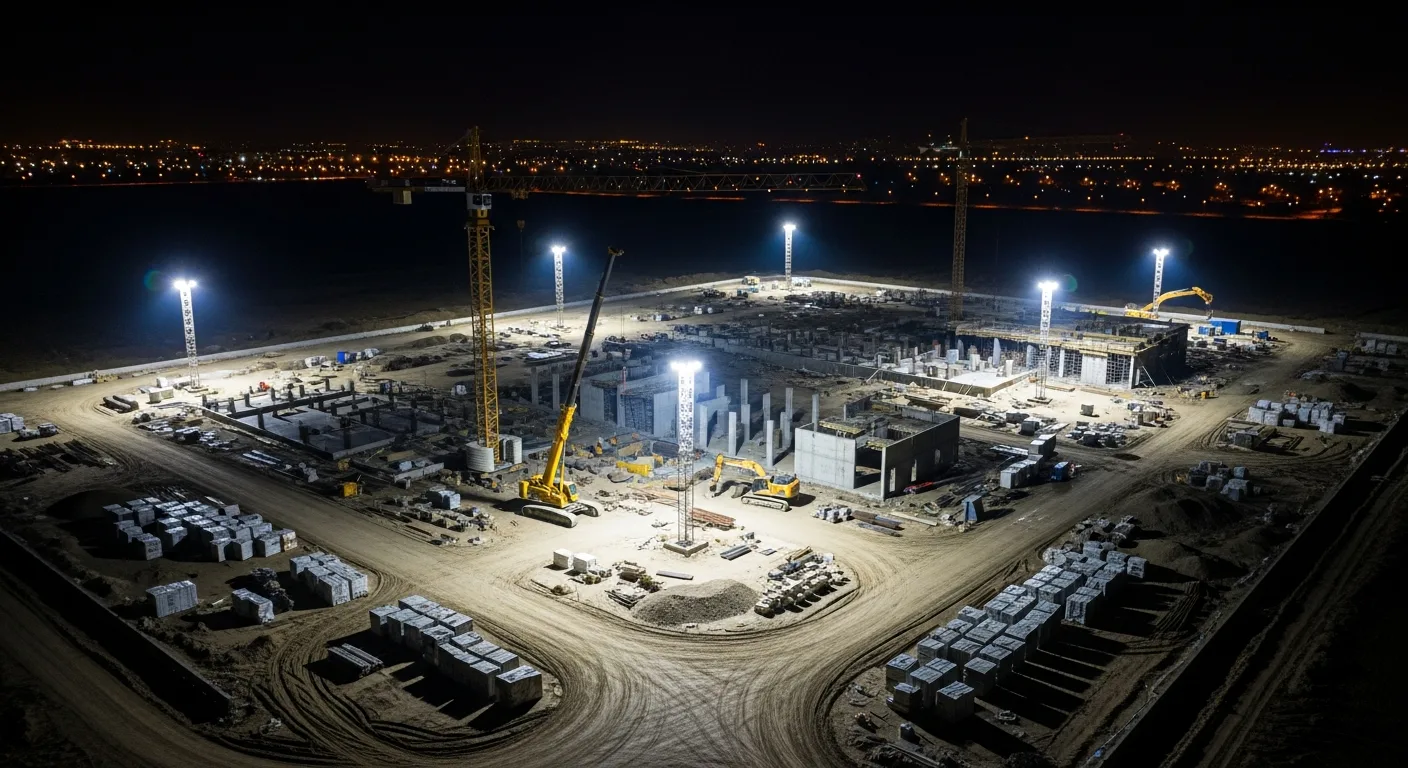
Night work is a reality for many contractors. Whether it is a highway project that cannot shut down lanes during rush hour, a hospital renovation where daytime noise is not acceptable, or a project running double shifts to meet a tight deadline, working after dark comes with its own set of challenges.
This guide covers the practical side of planning and executing night construction: how to set up lighting, navigate noise rules, schedule your crews, keep everyone safe, and maintain productivity when the sun goes down.
When Night Work Makes Sense
Not every project needs night shifts. Before committing to after-dark operations, make sure the reasons justify the added cost and complexity.
Common Reasons for Night Work
Traffic management. Highway, road, and bridge projects often require night work because daytime lane closures would create unacceptable traffic congestion. Many DOT contracts specify that certain operations can only happen between specific nighttime hours.
Occupied buildings. Renovations in hospitals, schools, offices, and retail spaces often need to happen when the building is empty or lightly occupied. Night and weekend work is the typical solution.
Extreme heat. In the Southwest and other hot-climate regions, concrete work and other heat-sensitive operations are sometimes shifted to night when temperatures drop. Pouring concrete at 105 degrees Fahrenheit creates serious quality and safety concerns.
Schedule recovery. When a project falls behind schedule, adding a night shift can help recover lost time. This is often the most expensive reason for night work, but sometimes the liquidated damages for missing a deadline make it the cheaper option.
Owner requirements. Some owners, particularly in retail and hospitality, do not want construction activity visible to their customers during business hours.
When Night Work Is Not Worth It
If the only reason for night work is poor planning or an overly aggressive bid, think carefully before adding shifts. The cost premium of night work (15 to 25 percent) can eat your margin fast. And the fatigue, safety, and coordination challenges compound over time.
Lighting: The Foundation of Night Work
Good lighting is not optional for night construction. It is the single most important factor in safety, quality, and productivity after dark.
OSHA Requirements
OSHA’s minimum lighting standards for construction are:
- General construction areas: 5 foot-candles
- General shops and indoor areas: 10 foot-candles
- First aid stations, offices, and shops: 30 foot-candles
These are minimums. For most night construction work, you should exceed them significantly. Workers coming from a bright equipment cab or break trailer into a dimly lit work area experience momentary blindness that creates fall and trip hazards.
Types of Lighting Equipment
Light towers. Portable light towers are the workhorse of night construction. A standard unit puts out 100,000 to 400,000 lumens and illuminates a large area. They run on diesel, gas, or battery power and can be positioned wherever needed. Most projects need multiple units to eliminate dark spots.
Balloon lights. These are large inflatable globes with internal lighting that produce diffuse, glare-free illumination. They are excellent for work areas where direct light from towers would create harsh shadows or blind workers. Many contractors prefer them for concrete finishing, paving, and other detail work.
String lights. For interior work, corridors, and confined spaces, string lights provide continuous illumination along a path or work area. LED string lights are lightweight, durable, and produce good light quality.
Task lighting. Individual work lights, headlamps, and equipment-mounted lights supplement the general illumination for specific tasks. Every worker on a night shift should have a personal headlamp in addition to the area lighting.
Lighting Layout Tips
Eliminate shadows. Position lights from multiple angles to reduce shadows in work areas. A single light source creates deep shadows behind objects that can hide hazards.
Control glare. Direct light that hits workers’ eyes is worse than no light at all. Position lights above the work area and angle them downward. Balloon lights are better than tower lights for reducing glare in active work zones.
Light the perimeter. The edges of your work area, where the lit zone meets darkness, are high-hazard areas. Make sure perimeter fencing, barricades, and drop-offs are well illuminated.
Plan for movement. As work progresses through the night, you may need to reposition lights. Assign someone to manage lighting throughout the shift, not just at the start.
Backup power. Always have backup power for your lighting. If a generator fails and the site goes dark, you have an immediate safety emergency. A second generator or battery-powered backup lights should be part of your plan.
Navigating Noise Ordinances
Noise is the most common source of complaints and regulatory problems for night construction. Understanding and complying with local noise rules is essential.
Know Your Local Rules
Noise ordinances vary significantly by jurisdiction. Some key questions to answer before scheduling night work:
- What are the permitted hours for construction activity?
- What decibel limits apply during nighttime hours?
- Is there a permit or variance process for after-hours work?
- Are there notification requirements for nearby residents?
- What are the penalties for violations?
Get answers to these questions from the local building department, code enforcement office, or city attorney before you start. Do not assume that the rules in one city apply to the next one.
Getting a Noise Variance
Most jurisdictions that restrict nighttime construction also have a process for granting variances. The variance application typically requires:
- A description of the work to be performed at night
- An explanation of why daytime work is not feasible
- A noise mitigation plan
- A plan for notifying affected residents and businesses
- The dates and hours of proposed night work
Submit your variance application early. The approval process can take two to six weeks depending on the jurisdiction, and some require a public hearing.
Noise Mitigation Strategies
Even with a variance, you should minimize noise as much as possible. Complaints from neighbors can lead to additional restrictions, political pressure, and even stop-work orders.
Equipment selection. Use the quietest equipment available for night operations. Electric and battery-powered equipment is significantly quieter than diesel. If you must use diesel equipment, make sure mufflers are in good condition.
Scheduling. Put the noisiest operations at the beginning of the shift when people are still awake, and save quieter work for the early morning hours. Avoid impact operations (pile driving, jackhammering) during the most noise-sensitive periods.
Barriers. Temporary noise barriers, such as sound blankets on fencing or purpose-built acoustic panels, can reduce noise by 10 to 15 decibels at the property line.
Communication. Proactive communication with neighbors goes a long way. Let them know what you are doing, when you are doing it, how long it will last, and who to call with concerns. A personal visit or a door hanger before work begins shows respect and prevents many complaints.
Crew Scheduling for Night Work
How you schedule your crews directly affects safety, productivity, morale, and retention. Night work is hard on people, and getting the scheduling right matters.
Shift Structures
Straight night shift. A dedicated night crew that works the same hours every night. This is the least disruptive to circadian rhythms because workers can adjust their sleep schedules. Common hours are 6 PM to 4 AM (a 10-hour shift with breaks) or 7 PM to 5 AM.
Swing shift. A shift that overlaps the end of the day crew and the beginning of the night. Typically 2 PM to midnight or 4 PM to 2 AM. Swing shifts help with handoffs between day and night crews.
Rotating shifts. Crews alternate between day and night shifts on a weekly or biweekly basis. This is the hardest schedule on workers because their bodies never fully adjust. Use rotating shifts only when you cannot staff dedicated night crews.
Shift Length
Longer shifts (10 or 12 hours) mean fewer shift changes and more continuous production, but fatigue increases significantly after 8 hours, especially at night. Most experienced night-work contractors settle on 10-hour shifts as the best balance between productivity and safety.
Avoid scheduling more than five consecutive night shifts without a day off. Fatigue accumulates over multiple nights, and the accident risk increases with each consecutive shift.
Staffing Considerations
Shift differential. Night workers expect higher pay. The standard differential is 10 to 20 percent above base rate, depending on your market and the difficulty of the work. If you do not offer a competitive differential, you will struggle to attract and keep good people on the night shift.
Supervision. Night shifts need strong supervision. Some contractors make the mistake of putting their least experienced supervisors on nights. This is backwards. Night work has more hazards and less margin for error. Put your best leaders on the night shift.
Support staff. Do not forget about the support functions. Night crews need access to material handling, equipment maintenance, first aid, and project management support. Running a night shift with no forklift operator or no one who can authorize a change creates frustrating delays.
Fatigue Management
Fatigue is the hidden danger of night work. The human body is designed to sleep at night, and working against that natural rhythm has real consequences.
Watch for signs. Slowed reaction times, poor judgment, irritability, difficulty concentrating, and microsleeps (brief involuntary episodes of sleep) are all signs of fatigue. Train your supervisors to recognize these signs and act on them.
Break schedules. Provide more frequent breaks during night shifts. A 15-minute break every 2 hours is a common standard for night work, compared to every 3 to 4 hours during daytime.
Food and hydration. Make sure workers have access to food, coffee, and water during the night shift. A midnight meal break helps workers recharge. Some contractors provide a food truck or catered meal for night crews, which also helps with morale.
Commute safety. Workers driving home after a night shift are at increased risk of drowsy driving accidents. Consider providing transportation for workers who live far from the site, or encourage carpooling so a more alert driver is at the wheel.
Safety Protocols for Night Work
Night construction amplifies many of the hazards that exist during the day and creates some new ones. Your safety plan needs specific provisions for after-dark operations.
Visibility
High-visibility clothing. Every person on a night construction site should wear ANSI Class 3 high-visibility vests or jackets with reflective striping. Class 2 vests are the daytime standard, but the higher visibility of Class 3 is necessary at night.
Equipment visibility. All equipment should have working lights, reflective markings, and backup alarms. Consider adding additional lighting to equipment that will be moving through the work area.
Signage. All warning signs, barricades, and traffic control devices need to be reflective or illuminated. Standard daytime signage is not adequate for night work.
Communication
Communication is harder at night. Radios, hand signals, and verbal commands that work fine during the day can be missed in the dark, especially with hearing protection in noisy environments.
Radio protocol. Establish clear radio procedures for night work. Use standardized calls for equipment movement, crane operations, and emergencies. Test radios at the start of every shift.
Signal persons. Any operation that requires a signal person (crane lifts, vehicle backing, equipment swing) needs a designated spotter with illuminated wands or a lighted vest. The operator must be able to see the signal person clearly at all times.
Emergency procedures. Update your emergency action plan for night conditions. Make sure everyone knows the location of the first aid station, the emergency assembly point, and how to contact emergency services. Conduct a night-specific safety orientation before the first night shift.
Specific Hazards
Falls. Fall hazards are harder to see at night. Guardrails, covers, and warning lines need to be illuminated or have reflective markings. Leading edges, floor openings, and excavation edges are especially dangerous after dark.
Struck-by incidents. Equipment and vehicles are harder to see at night, even with lights. Establish clear pedestrian walkways separated from equipment traffic. Use flaggers and spotters more liberally than you would during the day.
Electrical hazards. Temporary power and lighting cables create trip hazards and potential electrical hazards, especially when they run through wet areas. Route cables along the edges of walkways, cover crossings with ramps, and inspect all connections at the start of each shift.
Wildlife. Depending on your location, nocturnal animals can be a real concern. Snakes, coyotes, and other wildlife are more active at night and may be drawn to the warmth and light of a construction site.
Productivity After Dark
Night work is inherently less productive than day work. But the gap does not have to be as large as many contractors assume. Good planning closes much of the difference.
Why Productivity Drops
Reduced visibility. Even with good lighting, workers cannot see as well at night. This slows down every task, from reading plans to placing materials to operating equipment.
Fatigue. The body wants to sleep at night. Fighting that instinct takes energy that would otherwise go into productive work.
Coordination challenges. Communication with the office, suppliers, and other crews is harder at night. Questions that would get an instant answer during the day might have to wait until morning.
Temperature. Night work often means colder temperatures, which slows both workers and some materials (concrete curing, paint drying, adhesive setting).
How to Minimize the Loss
Plan the work in detail. Night crews should never show up without a clear plan for the shift. Lay out the tasks, the sequence, the materials needed, and the expected production. Do this during the day so the plan is ready when the night crew arrives.
Pre-stage materials. Have everything the night crew needs in place before they start. Searching a dark yard for materials is a massive time killer.
Pick the right work. Not all construction activities are equally suited to night conditions. Concrete placement, paving, mechanical installations, and large-scale earthwork translate well to night shifts. Detailed finish work, painting, and complex layout work do not.
Invest in lighting. This cannot be overstated. Better lighting directly improves productivity. Spend the money on high-quality, well-positioned lights and the productivity gains will more than cover the cost.
Overlap shifts. A 30-minute overlap between the day and night crews allows for a proper handoff. The day foreman walks the night foreman through the current status, upcoming issues, and the night’s plan. Without this overlap, the night crew wastes the first 30 to 60 minutes figuring out where things stand.
Equipment Considerations
Operating heavy equipment at night requires additional precautions and planning.
Equipment Lighting
Make sure all equipment has fully functional headlights, work lights, and tail lights. Many newer machines have LED light packages that provide excellent illumination, but older equipment may need aftermarket lighting upgrades.
Consider adding ground-level lighting around equipment operating areas so workers on foot can see the ground surface and avoid hazards.
Fuel and Maintenance
Schedule fueling during shift changes rather than during active work. Running out of fuel in the middle of a night operation causes delays that are harder to recover from than during the day when suppliers are open.
Have basic maintenance supplies and a mechanic available during night shifts. A broken hose or a flat tire that would take 30 minutes to fix during the day can shut down a night operation for hours if no one is available to handle it.
Warm-Up and Cool-Down
In cold weather, equipment needs longer warm-up periods at night. Factor this into your schedule. Hydraulic systems, in particular, perform poorly when cold and can be damaged by heavy use without adequate warm-up.
Managing the Day-Night Interface
When you run both day and night shifts, the handoff between them is critical. Poor handoffs waste time, create confusion, and lead to mistakes.
Daily Logs
Both the day and night foremen should maintain detailed daily logs that the other shift reads at the start of their work. The log should cover work completed, problems encountered, decisions made, safety concerns, and pending items.
Clean Handoffs
At every shift change, the outgoing foreman should walk the incoming foreman through the site. Point out completed work, in-progress tasks, hazards, equipment status, and any issues that need attention. This walk-through typically takes 15 to 30 minutes and is worth every minute.
Shared Tools
Project management tools like Projul make day-night coordination easier by keeping schedules, daily logs, photos, and task updates in one place. When the night foreman can pull up the day crew’s progress photos and notes on a tablet, the handoff is faster and more accurate.
Final Thoughts
Night construction is demanding work. It costs more, carries higher risks, and takes a toll on the people who do it. But when it is necessary, doing it well separates the professionals from the amateurs.
Invest in lighting. Respect the noise rules. Take care of your crews. Plan every shift in detail. And track your costs carefully so you know exactly what night work is costing you and whether the results justify the investment.
The contractors who handle night work safely and efficiently build a reputation that wins them more of the complex, higher-value projects where night shifts are simply part of the job. That reputation is worth building.
Frequently Asked Questions
Why do some construction projects require night work?
What lighting levels are required for night construction?
How do noise ordinances affect night construction?
How does night work affect worker productivity?
What safety precautions are specific to night construction?
How should I schedule crews for night work?
Do I need special permits for night construction?
How do I estimate costs for night work?
Related Articles

BIM Clash Detection: How to Catch Conflicts Before They Cost You on the Jobsite
BIM Clash Detection: How to Catch Conflicts Before They Cost You on the Jobsite Every contractor has a story about the...
Read More →
Asphalt Paving and Compaction Guide: Mix Types, Laydown Temperatures, and Quality Testing
Asphalt paving looks straightforward from a distance. A truck dumps material, the paver lays it down, and rollers...
Read More →
Construction Jobsite Wi-Fi & Connectivity Guide: Setting Up Reliable Internet in the Field
A practical guide to getting reliable internet on construction job sites. Learn about cellular hotspots, mesh networks,...
Read More →