
Parking Garage Construction: Structural Systems, Ramp Grades, Drainage, and Coatings | Projul
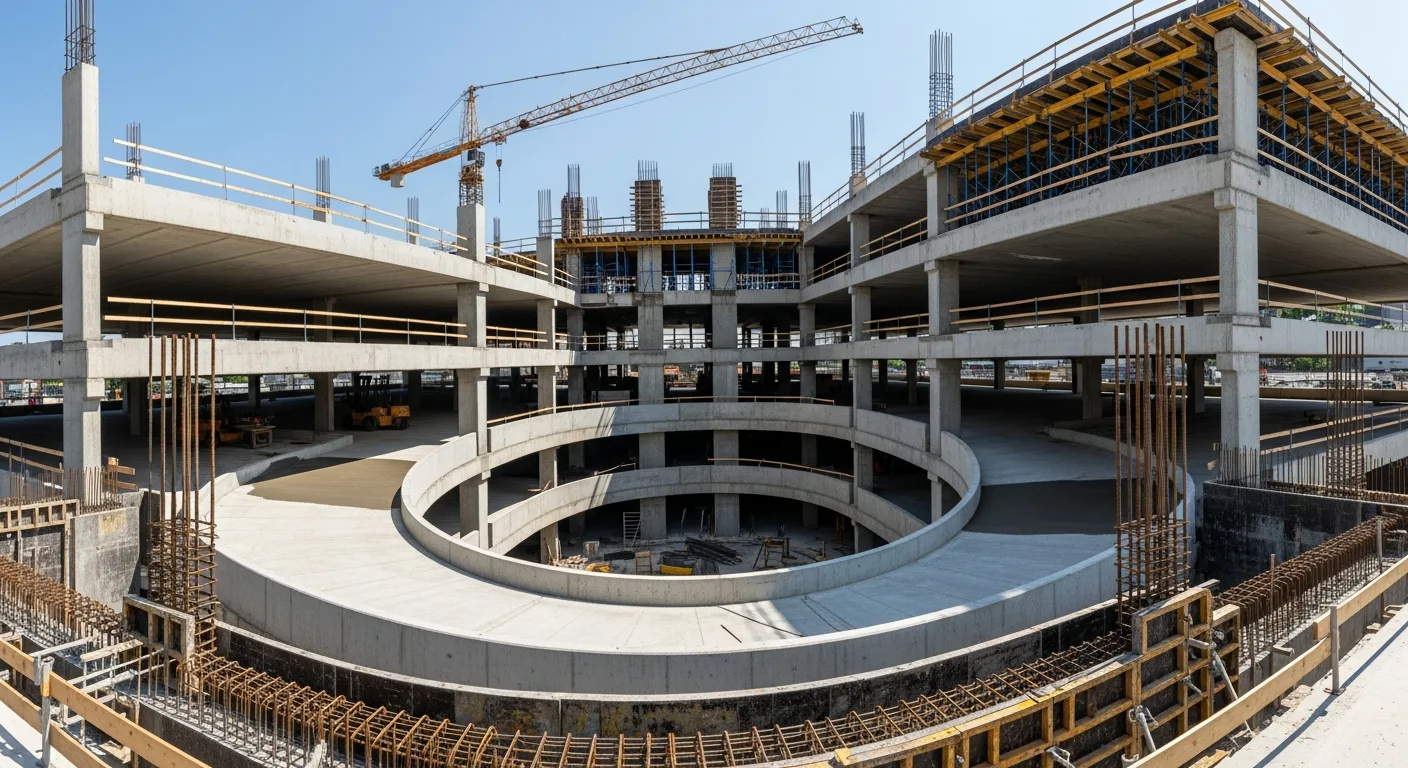
Parking garages look simple from the outside. Concrete floors, ramps, some lighting, and parking stripes. But anyone who has actually built one knows better. Between the structural engineering, drainage design, waterproofing details, and the sheer volume of concrete, a parking structure is one of the most technically demanding building types in commercial construction.
This guide covers the practical side of parking garage construction, from picking a structural system to getting the coatings right so the deck holds up for decades.
Structural System Options
The structural system you choose affects everything: cost, construction speed, span capabilities, floor-to-floor height, and long-term maintenance. Here are the most common systems used in parking garages today.
Precast, Prestressed Concrete
Precast is the most popular structural system for parking garages in North America, and for good reason. Double-tee beams span long distances (55 to 65 feet is standard), allowing column-free parking bays that maximize the number of spaces per floor.
Advantages:
- Fast erection. A skilled precast crew can set an entire floor in days.
- Factory quality control produces consistent, high-strength concrete.
- Long spans mean fewer columns and more efficient parking layouts.
- The structure can be open to traffic quickly after erection and topping slab placement.
Considerations:
- Transportation logistics matter. Double-tees are large and heavy, so the precast plant distance affects cost.
- Connections between precast elements require careful detailing, especially for seismic regions.
- The topping slab over double-tees is a common source of cracking if not placed and cured properly.
Cast-in-Place Concrete
Cast-in-place (CIP) garages offer design flexibility and can be more economical in areas without nearby precast plants. Two common CIP approaches exist:
Post-Tensioned Slabs: Post-tensioned (PT) flat slabs are popular for parking garages because they allow thinner sections (6 to 7 inches vs. 8 to 10 inches for conventional reinforced slabs), reducing material and the overall building height. PT slabs also have fewer cracks, which means better long-term durability.
Conventional Reinforced Concrete: Standard rebar-reinforced slabs and beams work fine for smaller garages. Spans are shorter (25 to 35 feet typical), requiring more columns, but the formwork and construction process are straightforward.
Steel Frame with Concrete Deck
Steel-framed garages use structural steel columns and beams with a composite concrete deck. This system is common in areas where steel is competitively priced or where soil conditions favor a lighter structure.
Advantages:
- Lighter foundation loads compared to all-concrete structures.
- Faster erection in some markets.
- Easier to modify or expand in the future.
Disadvantages:
- Steel requires fireproofing if enclosed.
- Corrosion protection is critical, especially in climates where road salt is used.
- The concrete deck still needs all the same waterproofing and drainage attention as any other system.
Ramp Design
Ramps are the circulatory system of a parking garage. Get them wrong and you have traffic backups, confused drivers, and scraped bumpers.
Ramp Types
Straight Ramps: The simplest design. Vehicles travel straight up between levels. Works well for smaller garages but uses floor area that could otherwise be parking spaces.
Helical (Circular) Ramps: Space-efficient for express up and down traffic. Commonly placed at the ends of the garage. Drivers travel in a continuous circle to move between levels. The turning radius must accommodate the largest expected vehicles.
Split-Level (Staggered Floor) Design: Parking floors are offset by half a level, connected by short ramps. This design is efficient because the ramps also serve as parking area. It is the most common layout for mid-size garages.
Speed Ramps: Dedicated ramps for fast vertical travel, not used for parking. Common in larger garages to move traffic quickly between distant levels.
Ramp Slopes and Transitions
The IBC allows a maximum ramp slope of 15%, but most designers target 5% to 6.67% for the main parking ramps. Steeper ramps cause discomfort and can bottom out low-clearance vehicles.
Transition zones at the top and bottom of ramps are critical. Where a ramp meets a flat floor, the slope must transition gradually to prevent undercarriage scraping. A common detail is a transition zone at half the ramp slope (so a 6% ramp gets a 3% transition) extending 8 to 16 feet.
Ramp Width
Two-way ramps typically need 22 to 24 feet of clear width. One-way ramps can work at 12 to 16 feet, though 14 feet minimum is preferred for larger vehicles. Add barriers, curbs, and any structural elements to get the overall ramp bay width.
Turning Radii
For helical ramps, the inside turning radius should be at least 20 feet for passenger vehicles and 28 feet for larger vehicles. The driving surface must be banked (superelevated) at 2% to 4% to help vehicles maintain traction and control.
Floor Drainage and Slope
Water management in a parking garage is not optional. Vehicles track in rain, snow, and road salt. Sprinkler systems discharge water. Even condensation on cold concrete creates moisture. If the water does not move off the deck quickly, it sits on the surface, penetrates cracks, and corrodes the reinforcing steel.
Minimum Slope
Design all parking deck surfaces with a minimum slope of 1.5% (about 3/16 inch per foot) toward drains or the building perimeter. Many engineers specify 2% to account for construction tolerances and long-term deflection that can flatten the effective slope.
Ramp surfaces already have slope built in, but the cross-slope (perpendicular to the direction of travel) still needs attention to direct water to side drains or the low side of the ramp.
Drain Location and Sizing
Floor drains should be spaced so that no point on the deck is more than about 50 feet from a drain. Common locations include:
- Column lines (where slight deflection between columns creates natural low points)
- Ramp gutters (trench drains along the low side of ramps)
- Stair and elevator tower perimeters (to prevent water from running into these areas)
- Expansion joint lines (these joints often double as drainage paths)
Size storm drain piping per your local plumbing code, using the tributary area and local rainfall intensity data. Do not undersize. A plugged or undersized drain means standing water, and standing water on a parking deck is the number one cause of premature deterioration.
Trench Drains
Trench drains at the base of ramps and at the building perimeter are critical for capturing water before it flows off the structure or into stair towers. Use heavy-duty, traffic-rated grates that can handle vehicle wheel loads without deflecting or breaking. ADA requirements also apply to grate openings on pedestrian paths.
Concrete Mix Design and Placement
The concrete in a parking garage takes more abuse than almost any other building type. Vehicles, road salt, freeze-thaw cycles, and de-icing chemicals all attack the concrete surface. Getting the mix design and placement right is the single best thing you can do for long-term durability.
Mix Design Recommendations
- Compressive strength: 4,000 psi minimum, 5,000 psi preferred for exposed top decks
- Water-to-cement ratio: 0.40 maximum (lower is better for durability)
- Air entrainment: 5% to 7% for freeze-thaw resistance in cold climates
- Slump: 4 to 6 inches for conventional placement; higher for PT slabs if approved by the engineer
- Supplementary cementitious materials: Fly ash (15% to 25%), silica fume (5% to 8%), or slag cement (25% to 50%) reduce permeability and improve long-term durability
- Corrosion inhibitor: Calcium nitrite admixtures are commonly specified for garage decks exposed to chlorides
Placement and Finishing
- Consolidation: Vibrate thoroughly, especially around post-tensioning ducts and congested reinforcement areas.
- Finishing: Broom finish for parking surfaces provides traction. Do not hard-trowel exposed parking decks because the dense surface can trap bleed water and lead to delamination.
- Curing: Wet cure for a minimum of 7 days. This is not negotiable for parking garage durability. Use wet burlap and plastic sheeting, or a curing compound approved for use under the specified coating system.
- Crack control: Proper curing, contraction joints at reasonable spacing, and adequate reinforcement minimize cracking. Some cracking is inevitable in concrete, but keeping crack widths below 0.012 inches helps prevent chloride penetration.
Waterproofing and Coatings
Waterproofing is what separates a parking garage that lasts 50 years from one that needs major repairs at 15. The exposed top deck is especially vulnerable.
Traffic-Bearing Membrane Systems
These are applied directly to the driving surface and must withstand vehicle traffic, UV exposure, and chemical attack. Common types include:
Polyurethane Systems: Flexible, good crack-bridging ability, and available in multiple colors for lane marking and wayfinding. Typical systems are 40 to 60 mils dry film thickness applied in multiple coats.
Methyl Methacrylate (MMA): Fast-curing (can be open to traffic in 1 to 2 hours), which is a huge advantage for occupied garages. MMA systems are also durable and chemical-resistant but more expensive than polyurethane.
Epoxy Systems: Excellent adhesion and chemical resistance, but less flexible than polyurethane. Epoxies are better suited for interior, protected decks rather than exposed rooftop levels.
Penetrating Sealers
Silane and siloxane penetrating sealers are used on concrete surfaces that will not receive a membrane system. They reduce water and chloride absorption without forming a surface film. Reapplication every 3 to 5 years is typical. Penetrating sealers are often used on:
- Underside of elevated decks
- Walls and columns
- Interior decks in mild climates where a full membrane is not cost-justified
Below-Slab Waterproofing
For garages built below grade (underground parking), a full waterproofing system below the slab and on the exterior of the walls is essential. Sheet membranes (modified bitumen or HDPE), bentonite panels, or spray-applied systems keep groundwater out of the structure.
Expansion and Construction Joints
Expansion Joints
Thermal expansion and contraction are significant in exposed parking structures. A concrete deck can move 1/4 inch per 100 feet for a 50-degree temperature swing. Without proper expansion joints, this movement causes cracking and spalling.
Expansion joint spacing depends on the structural system and local climate. General guidelines:
- Post-tensioned slabs: 300 to 450 feet between expansion joints (PT tendons handle some movement)
- Precast: 250 to 350 feet
- Conventional reinforced: 150 to 200 feet
Joint sealants and covers must be designed for the expected movement range and vehicle traffic. Armored joints with steel plates protect the concrete edges and provide a smooth driving surface.
Construction Joints
Construction joints (cold joints where one concrete pour meets the next) need careful treatment in parking garages. Clean the joint surface, apply bonding agent if specified, and detail the reinforcement to cross the joint properly. Waterstops at construction joints in below-grade walls prevent water migration.
Lighting and Electrical
Good lighting improves safety, security, and the user experience. Minimum illumination levels per IES RP-20:
- General parking areas: 5 to 10 footcandles (maintained average)
- Ramps and turns: 10 to 15 footcandles
- Entrances and exits: 50 footcandles (to help drivers’ eyes adjust)
- Stairwells and elevators: 10 to 20 footcandles
LED fixtures are now standard for parking garages due to their energy efficiency, long life, and excellent light distribution. Many installations include occupancy sensors that dim lights in unoccupied areas and brighten them when vehicles or pedestrians approach.
Electrical systems also include:
- Emergency lighting and exit signs
- Fire alarm and detection systems
- EV charging stations (increasingly required by code)
- Security cameras and access control
- Revenue control equipment (gates, ticket dispensers, payment stations)
Plan your electrical room locations and conduit routes early. Parking garages have limited ceiling space, and coordinating conduit, piping, and lighting fixtures requires attention during the shop drawing phase.
Ventilation
Enclosed parking garages produce carbon monoxide (CO) from vehicle exhaust. Mechanical ventilation is required by code to maintain safe CO levels.
Code Requirements
IBC and IMC require mechanical ventilation providing 0.75 CFM per square foot of floor area for enclosed garages. Alternatively, a CO monitoring system with variable-speed fans can reduce energy consumption by running fans only when CO levels exceed thresholds.
Open vs. Enclosed
Many garages qualify as “open” under the IBC if they have sufficient natural ventilation openings (at least 20% of the wall area on two or more sides). Open garages do not need mechanical ventilation, which saves significant cost in fan equipment, ductwork, and energy.
Design the facade openings to meet the open garage criteria if possible. This is one of those code provisions that can save the project real money if addressed early in design.
Project Management for Parking Garage Construction
A parking garage involves a lot of moving parts: structural, electrical, plumbing, waterproofing, striping, signage, elevators, and more. Keeping all these trades coordinated on a fast-moving schedule requires solid project management.
Projul’s construction management platform is built for exactly this kind of multi-trade coordination. From scheduling pours and tracking submittals to managing RFIs and punch lists, having everything in one system keeps the project on track. If you are bidding a garage project and want to see how Projul handles complex commercial work, schedule a demo.
Maintenance Planning
A parking garage is a long-term asset, and the construction team’s decisions directly affect maintenance costs for decades. Here are items to address during construction that will pay off later:
- Document the coating system including manufacturer, product names, batch numbers, and application conditions. The maintenance team needs this for warranty claims and recoating.
- Install monitoring points for post-tensioning tendon corrosion if specified.
- Provide maintenance access to expansion joints, drains, and waterproofing terminations.
- Leave extra coating material with the owner for touch-up repairs.
- Create a maintenance manual that includes recommended inspection frequencies, drain cleaning schedules, and recoating timelines.
Cost Considerations
Parking garage costs vary widely by region, structural system, and finish level. Rough ranges for 2026:
- Precast structure: $55 to $85 per square foot
- Cast-in-place PT: $65 to $95 per square foot
- Steel frame with concrete deck: $60 to $90 per square foot
- Below-grade (underground): $90 to $150+ per square foot
These are structural costs only. Add site work, MEP, coatings, signage, elevators, and soft costs for the total project budget. Per-space costs typically range from $25,000 to $45,000 for above-grade structures and $40,000 to $75,000 for below-grade.
Good estimating and cost tracking are essential on a project this size. Check out Projul’s pricing if you need a construction management tool that helps you track costs as they happen, not after the project is done.
Final Thoughts
Building a parking garage right means getting the details right: proper slopes for drainage, the right concrete mix for durability, appropriate coatings for the exposure conditions, and expansion joints that accommodate real thermal movement. None of it is complicated in concept, but every item requires careful execution.
Start with a clear understanding of the structural system and work outward from there. Coordinate early with your waterproofing and coating contractors because their surface preparation requirements may influence your concrete placement and curing approach. And keep every trade aligned with a project management system that handles the complexity without slowing you down.
Frequently Asked Questions
What is the maximum ramp slope for a parking garage?
How thick is a typical parking garage slab?
What live load is required for parking garage design?
How do you waterproof a parking garage?
What is the minimum floor-to-floor height in a parking garage?
How long does it take to build a parking garage?
What type of concrete is best for parking garages?
Do parking garages need expansion joints?
Related Articles

BIM Clash Detection: How to Catch Conflicts Before They Cost You on the Jobsite
BIM Clash Detection: How to Catch Conflicts Before They Cost You on the Jobsite Every contractor has a story about the...
Read More →
Asphalt Paving and Compaction Guide: Mix Types, Laydown Temperatures, and Quality Testing
Asphalt paving looks straightforward from a distance. A truck dumps material, the paver lays it down, and rollers...
Read More →
Construction Jobsite Wi-Fi & Connectivity Guide: Setting Up Reliable Internet in the Field
A practical guide to getting reliable internet on construction job sites. Learn about cellular hotspots, mesh networks,...
Read More →