
Construction Podcast Marketing Guide: Start a Contractor Podcast | Projul
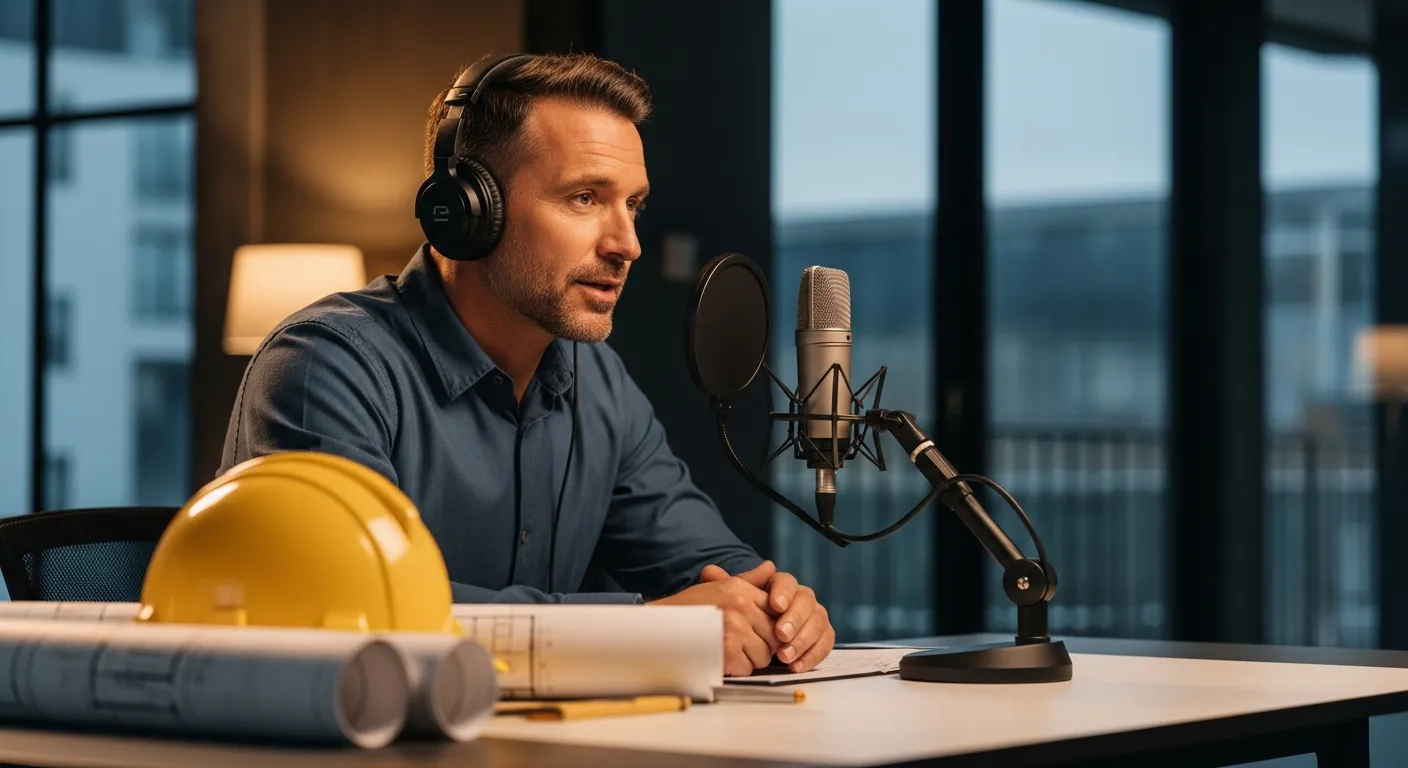
Most contractors have never considered starting a podcast. That makes sense. You got into construction to build things, not to sit behind a microphone. But here is the reality: podcasting has become one of the most effective ways to build trust with potential clients, connect with other pros in the industry, and position your company as the go-to authority in your market.
You do not need a fancy studio. You do not need a media degree. You need a microphone, a topic you know well, and the willingness to hit record. This guide walks you through every step, from buying your first mic to tracking whether your podcast is actually bringing in business.
Why Construction Companies Should Start a Podcast
Let’s get the obvious question out of the way: why would a contractor spend time podcasting when there are jobs to bid, crews to manage, and materials to order?
The answer comes down to trust. When someone listens to you talk for 20 or 30 minutes about foundation repair, project scheduling, or how to handle a difficult subcontractor, they start to feel like they know you. That familiarity is worth more than any billboard or pay-per-click ad.
Here are a few specific reasons podcasting works for construction companies:
Your competition is not doing it. In most markets, you can count the number of local contractor podcasts on zero fingers. Starting one right now puts you ahead of every competitor who is still relying on the same tired marketing playbook. If you are looking for more ways to stand out, check out our list of construction marketing ideas for 2026.
Podcasts have a long shelf life. A social media post disappears in hours. A podcast episode stays on Apple Podcasts, Spotify, and Google for years. Someone searching for “how to choose a general contractor” in 2028 might find the episode you recorded next month.
It builds relationships before the first handshake. Homeowners and commercial clients who listen to your show already trust you before they ever pick up the phone. Your close rate on those leads will be significantly higher than cold inquiries.
You can repurpose content everywhere. One 30-minute episode can become a blog post, several social media clips, a newsletter, and a YouTube video. If you are already working on your social media content strategy, a podcast gives you a mountain of raw material.
Equipment and Setup: What You Actually Need
One of the biggest reasons contractors never start a podcast is the assumption that you need thousands of dollars in equipment and a soundproof room. You don’t. Here is a realistic breakdown of what to buy and what to skip.
The Essentials (Under $200)
USB Microphone ($60 to $130): The Audio-Technica ATR2100x or the Samson Q2U are both excellent starter mics. They plug directly into your laptop with USB, so there is no extra gear to buy. Avoid using your laptop’s built-in mic. The audio quality will make your show sound like a phone call from 2004.
Headphones ($20 to $50): Any closed-back headphones will work. You need them to monitor your audio while recording and to catch background noise you might not notice otherwise. Sony MDR-7506 headphones are an industry standard, but even a $20 pair from Amazon will do the job.
Recording Software (Free): Audacity is free, open-source, and does everything you need for recording and basic editing. GarageBand works great if you are on a Mac. If you want something more polished, Descript ($24/month) lets you edit audio by editing a text transcript, which is a huge time saver.
Pop Filter ($10): That little mesh screen that goes in front of the mic. It kills plosive sounds (the harsh “p” and “b” sounds that blow out the audio). Ten bucks well spent.
Nice to Have (But Not Required)
USB Audio Interface ($100 to $170): The Focusrite Scarlett Solo lets you use professional XLR microphones and gives you more control over audio levels. Worth it once you are a few months in and committed to the show.
Acoustic Treatment ($50 to $150): Foam panels or moving blankets hung on the walls of your recording space can dramatically reduce echo. A closet full of clothes actually works surprisingly well as a budget recording booth.
Remote Recording Tool ($0 to $20/month): If you plan to interview guests over the internet, Riverside.fm or SquadCast record each person’s audio locally, so you get studio-quality sound even on a bad internet connection. Zoom works in a pinch, but the audio quality is noticeably worse.
Recording Space
You do not need a studio. A quiet room with carpet, a closed door, and some soft furniture is enough. Your office works. A spare bedroom works. Even your truck works in a pinch if you park somewhere quiet. The key is to minimize echo and background noise.
Episode Topics That Construction Audiences Actually Care About
Running out of things to talk about is one of the top fears for new podcasters. The good news is that construction is packed with stories, lessons, and debates that make great episodes. Here are topic categories with specific episode ideas to get you started.
Project Stories and Lessons Learned
- The hardest project you ever completed and what it taught you
- A time you had to fire a subcontractor mid-project
- Your biggest estimating mistake and how you fixed it
- Behind the scenes of a project from bid to final walkthrough
How-To and Educational Content
- How to read a set of construction plans (for homeowners)
- What homeowners should know before hiring a general contractor
- How to handle change orders without destroying the client relationship
- The real cost of skipping permits
Industry Trends and Business Topics
- How material prices have changed and what to expect next year
- Should you specialize or stay a general contractor?
- Hiring in a labor shortage: what is actually working
- How to price jobs when your costs keep changing (this pairs well with our guide on construction business growth strategies)
Interviews and Guest Episodes
- Interview a supplier about what contractors get wrong when ordering materials
- Bring on a fellow contractor from a different trade for a cross-industry conversation
- Talk with a real estate agent about what buyers look for in new construction
- Sit down with your best crew lead and let them share what the job looks like from the field
Client-Facing Topics
- What to expect during a kitchen remodel (timeline, budget, surprises)
- How to tell if your contractor is doing good work
- Why the lowest bid is almost never the best choice
The key is to talk about what you already know. You have years of field experience, war stories, and opinions. That is your content. You do not need to research topics for hours. Just press record and talk about your day.
Getting Your Podcast Out There: Distribution and Promotion
Recording a great episode is only half the battle. You also need people to hear it. Here is how to distribute and promote your construction podcast.
Hosting Platforms
You need a podcast hosting service that stores your audio files and distributes them to all the major listening apps. Here are the best options for contractors:
- Buzzsprout ($12/month): Simple, beginner-friendly, includes a website for your podcast and basic analytics. This is where most new podcasters should start.
- Podbean ($9/month): Solid features at a lower price point. Good if you want to monetize with ads later.
- Anchor (now Spotify for Podcasters) (Free): Completely free hosting with unlimited storage. The trade-off is fewer analytics and less control over your feed.
Once your hosting is set up, submit your podcast to these directories:
- Apple Podcasts
- Spotify
- Google Podcasts
- Amazon Music
- iHeartRadio
- Stitcher
Contractors across the country trust Projul to run their businesses. Read their reviews.
Most hosting platforms will handle the submission process for you. You upload the episode once, and it automatically appears everywhere.
Promoting Each Episode
Publishing alone will not build an audience. You need to actively push each episode through your existing channels.
Your website: Embed each episode on your blog or create a dedicated podcast page. This also helps your SEO strategy because search engines can index your show notes and transcripts.
Social media: Pull two or three short clips (60 to 90 seconds) from each episode and post them as video or audio clips on Instagram, Facebook, and LinkedIn. If you need help with your social strategy, our social media marketing guide covers the basics.
Email list: Send a short note to your email list when a new episode drops. Include a one-sentence summary and a direct link to listen.
YouTube: Upload each episode as a video (even if it is just a static image with audio). YouTube is the second-largest search engine, and many people discover podcasts there. If you are already doing video marketing, adding podcast episodes to your channel is a natural fit.
Show notes: Write detailed show notes for every episode. Include timestamps, key takeaways, and links to anything you mentioned. This helps with search traffic and gives listeners a reason to visit your website.
Cross-Promotion
Reach out to other podcasters in the construction, real estate, or home improvement space and offer to swap guest appearances. You go on their show, they come on yours. Both audiences get exposed to a new voice, and it costs nothing.
Using Your Podcast for Thought Leadership
A podcast is not just a marketing channel. It is a credibility machine. Here is how to use it to position yourself as a leader in your market.
Consistency Builds Authority
Publishing on a regular schedule (even once a month) signals to your audience that you are serious and committed. Over time, you become the voice people associate with your trade in your area. When a homeowner in your city searches for a contractor and sees that you have 50 episodes covering every aspect of the work, that says something no ad can say.
Share Real Opinions
The construction industry has plenty of debates: stick-built vs. modular, licensing requirements, union vs. non-union, software vs. spreadsheets. Do not be afraid to pick a side and explain your reasoning. Listeners respect honesty and conviction far more than wishy-washy answers. The contractors who play it safe on every topic are the ones nobody remembers.
Feature Your Team
Bring your project managers, estimators, and crew leads on the show. This does two things: it shows that your company has depth beyond just the owner, and it helps with recruiting. Skilled tradespeople want to work for companies that invest in their team and give them a voice.
Document Your Journey
Some of the best construction podcasts are just owners talking honestly about what is happening in their business. Cash flow problems, hiring wins, a project that went sideways. That transparency is incredibly rare in this industry, and people gravitate toward it.
Lean Into Your Local Focus
National construction podcasts are great, but you have an advantage they do not: local expertise. Talk about building codes in your county, weather challenges in your region, local material suppliers, and projects you have completed in neighborhoods your listeners recognize. That local angle makes you the obvious choice when someone in your area needs a contractor.
Connect With Industry Partners
Invite architects, engineers, inspectors, suppliers, and real estate agents onto your show. Those conversations build professional relationships, and those guests will share the episode with their own networks. Over time, you build a web of referral partners who all know your name and trust your work.
Measuring Podcast ROI: Is It Actually Working?
This is where most podcasting advice falls short. Everyone tells you to start a show, but nobody explains how to know if it is paying off. Here is a practical framework for measuring your podcast’s return on investment.
Track Downloads, But Do Not Obsess Over Them
Most hosting platforms show you how many times each episode was downloaded. For a local construction company podcast, here are some realistic benchmarks:
- First 3 months: 25 to 100 downloads per episode
- 6 to 12 months: 100 to 500 downloads per episode
- 12+ months (consistent publishing): 500 to 2,000 downloads per episode
These numbers might seem small compared to national shows, but remember: if 200 people in your metro area are listening to you talk about construction every two weeks, that is a marketing channel most competitors cannot touch.
Ask New Leads How They Found You
This is the simplest and most effective way to measure podcast ROI. Add “How did you hear about us?” to your intake form or have your office staff ask during the first phone call. When someone says “I listen to your podcast,” you can directly attribute that lead. If you are already using a CRM to track leads, tie it into your lead follow-up process.
Monitor Website Traffic From Show Notes
Use Google Analytics or a similar tool to track how much traffic comes from your podcast show notes links. Create UTM parameters for each episode link so you can see exactly which episodes drive the most website visits.
Calculate Cost Per Episode
Add up your monthly expenses: hosting ($12), your time recording and editing (2 to 4 hours per episode at your hourly rate), and any other costs. Divide by the number of episodes. Most contractors find their cost per episode lands between $100 and $400, depending on how they value their time.
Compare to Other Marketing Channels
Now compare that cost per episode to what you spend on other marketing:
- A single Google Ads click in the construction space costs $8 to $50
- A direct mail campaign might cost $1 to $3 per piece
- A trade show booth can run $2,000 to $10,000
If your podcast generates even two or three quality leads per month, the math works out in your favor. And unlike paid ads, your podcast episodes keep working for you long after you publish them.
Track Long-Term Brand Metrics
Some podcast benefits are harder to quantify but still very real:
- Are you getting invited to speak at industry events?
- Are subcontractors and employees seeking you out because they heard the show?
- Are clients coming in more educated and easier to work with?
- Are referral partners mentioning your podcast when they send you business?
These signals tell you that your show is building the kind of reputation that pays dividends for years.
Set a 6-Month Commitment
Podcasting is a slow burn. You will not see dramatic results in the first month or two. Commit to publishing consistently for six months before you evaluate whether to continue. Most contractors who make it past that initial hump find that the show becomes one of their most valuable marketing assets.
Getting Started This Week
You do not need to overthink this. Here is a simple action plan to get your construction company podcast off the ground in the next seven days:
Day 1: Order a USB microphone and headphones. Download Audacity or GarageBand.
Day 2: Pick a name for your show and write a one-sentence description. Keep it simple. “[Your Company Name] Construction Podcast” works fine.
Day 3: Sign up for Buzzsprout or your hosting platform of choice.
Day 4: Write a loose outline for your first three episodes. Pick topics you could talk about for 20 minutes without any research.
Day 5: Record your first episode. It will not be perfect. That is fine. Done is better than perfect.
Day 6: Do basic editing (trim the beginning and end, remove long pauses, add a simple intro).
Day 7: Upload to your hosting platform and submit to Apple Podcasts and Spotify.
That is it. You are a podcaster. Now keep going.
The contractors who win in the next five years will be the ones who build audiences, not just buildings. A podcast is one of the most direct ways to do that. Pair it with a solid website, a consistent social presence, and project management software that keeps your operations tight, and you have got a business that grows on reputation, not just referrals.
See how Projul makes this easy. Schedule a free demo to get started.
Hit record. Your future clients are waiting to hear from you.
Frequently Asked Questions
How much does it cost to start a construction company podcast?
How long should a construction podcast episode be?
Do I need to publish new episodes every week?
Can a podcast actually generate leads for a construction company?
What if I am not a good speaker or interviewer?
Related Articles
Construction Company Email Marketing Strategies: Drip Campaigns, Newsletters, and More
Most contractors know they should be sending emails but have no clue what to send or when. This guide breaks down six...
Read More →
Construction Company Direct Mail Marketing: Postcards, Mailers & Neighborhood Targeting That Actually Works
Direct mail is far from dead for construction companies. Learn how to use postcards, neighborhood targeting, and smart...
Read More →
Construction Brand Storytelling: How to Tell Your Company's Story and Win More Bids
Your construction company has a story worth telling. Learn how to craft your origin story, spotlight your crew, build...
Read More →