
Prefab and Modular Construction: A Contractor's Guide to the Growing Trend | Projul
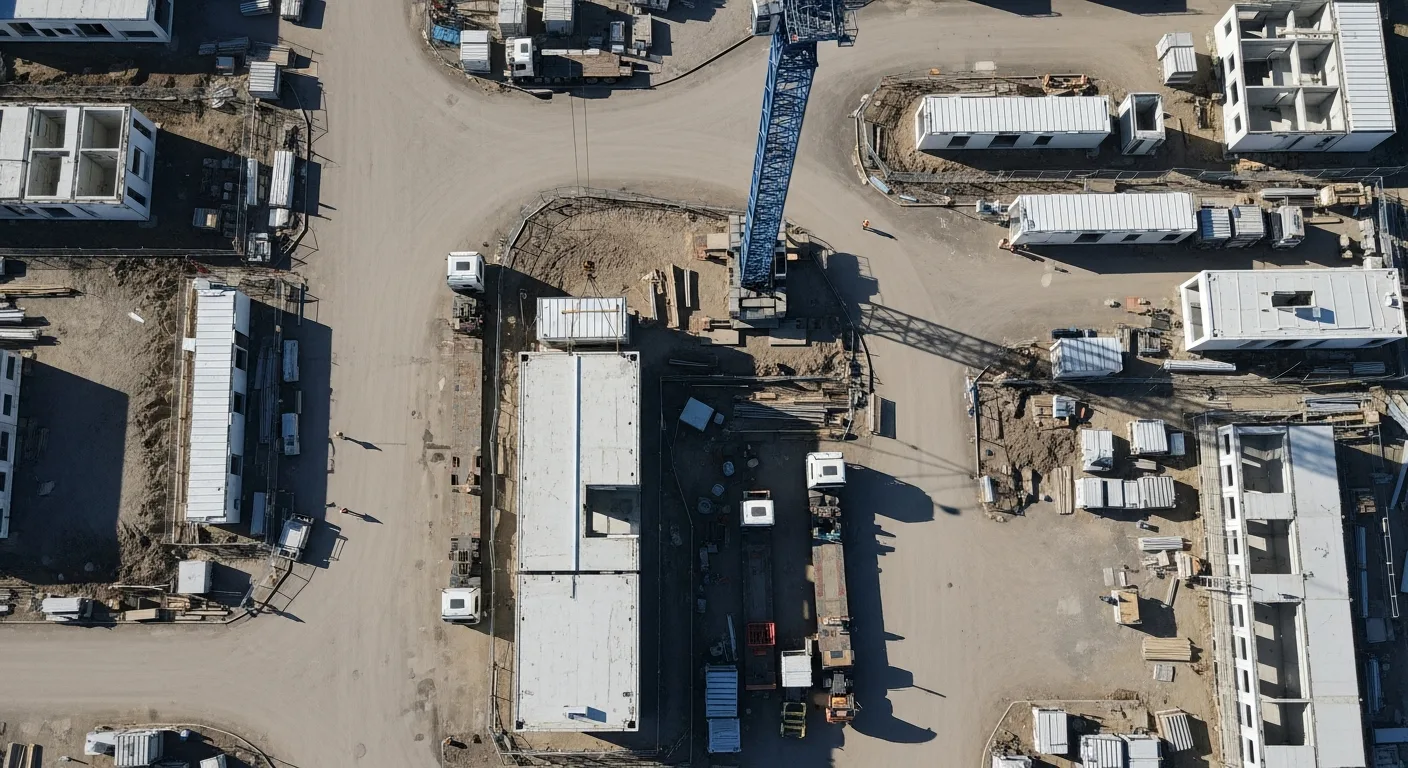
Prefab construction is not new. Contractors have been using prefabricated trusses, wall panels, and other components for decades. What is new is the scale and sophistication of what is being built off-site, and the growing number of contractors who are making it a core part of their business.
This guide is written for contractors who want to understand the prefab and modular space: what it is, how it works, when it makes financial sense, and how to get started without making expensive mistakes.
Understanding the Types of Prefab
The term “prefab” covers a wide range of approaches. Before you can evaluate whether prefab fits your business, you need to understand the different categories.
Component Prefabrication
This is the most common and least disruptive form of prefab. Individual building components are manufactured in a factory and shipped to the jobsite for installation. You are probably already using some of these:
- Roof trusses
- Floor trusses and joists
- Pre-hung doors and windows
- Prefabricated stairs
- MEP (mechanical, electrical, plumbing) assemblies
- Precast concrete elements
Component prefab is easy to adopt because it slots into your existing workflow. You order the components from a supplier, they arrive on a truck, and your crew installs them just like they would any other material.
Panelized Construction
Panelized systems take component prefab a step further. Entire wall sections, floor sections, and roof sections are built in a factory as flat panels. These panels arrive on-site ready to be tilted up and connected.
A panelized wall might include the framing, sheathing, insulation, windows, and even exterior cladding. When it arrives, your crew tilts it into position, connects it to the foundation and adjacent panels, and moves on. What would take a framing crew several days to build stick-by-stick gets done in hours.
Volumetric Modular
This is the most complete form of prefab. Entire three-dimensional room-sized modules are built in a factory, complete with finishes, fixtures, plumbing, electrical, and sometimes even furniture. The modules are transported to the site on flatbed trucks, lifted into position by crane, and connected together.
A hotel room, for example, can arrive as a finished module: walls, ceiling, floor, bathroom, HVAC, lighting, and outlets all done. The on-site work is limited to connecting the modules, finishing the joints between them, and hooking up the building-wide systems.
Hybrid Approaches
Many projects combine multiple prefab methods. A building might use prefabricated bathroom pods (volumetric), panelized exterior walls, and traditional construction for the lobby and common areas. The best approach depends on the specific project.
The Real Cost Savings
Every article about prefab construction talks about cost savings. But where do those savings actually come from? Let us break it down.
Reduced Labor Hours
This is the biggest source of savings. Factory workers building in a controlled environment with specialized jigs, tools, and workstations are significantly more productive than field crews building the same elements on a jobsite. There is no climbing ladders, no working in awkward positions, and no time lost to weather.
Studies consistently show that factory production requires 30 to 50 percent fewer labor hours than equivalent site-built work. In a market where skilled labor is expensive and hard to find, this matters enormously.
Less Material Waste
Factories buy materials in bulk at lower prices and cut them with precision equipment. Material waste in a well-run prefab factory is typically 2 to 5 percent, compared to 10 to 15 percent on a typical construction site. That adds up, especially on large projects.
Shorter Timelines
Time is money in construction. Every day a project runs is a day of carrying costs, equipment rental, insurance, and overhead. Prefab projects typically finish 30 to 50 percent faster because site preparation and factory fabrication happen at the same time.
A traditional apartment building might take 18 months to build. A comparable modular building might take 10 to 12 months. Those extra six months of avoided interest payments, general conditions, and overhead can represent significant savings.
Fewer Weather Delays
Factory production is not affected by rain, snow, extreme heat, or extreme cold. For contractors in regions with short building seasons or unpredictable weather, this reliability has real dollar value.
Fewer Change Orders
When the design is finalized before manufacturing begins (which prefab requires), there are fewer changes during construction. Change orders are expensive, not just for the direct cost of the change but for the disruption to the schedule and the downstream effects on other trades.
Timeline Benefits in Detail
The timeline advantage of prefab deserves a closer look because it affects almost everything else about a project.
Parallel Workflows
In traditional construction, tasks happen in sequence. You pour the foundation, then frame the walls, then install the roof, then rough in MEP, and so on. Each step waits for the previous one.
With prefab, the site work and the building fabrication happen simultaneously. While your site crew is excavating and pouring foundations, the factory is building the wall panels, floor sections, or modules. By the time the foundation is ready, the building components are ready too.
Faster Enclosure
Getting a building enclosed (weather-tight) quickly protects subsequent work from weather damage and allows interior trades to start sooner. Panelized wall systems and modular construction can enclose a building in days rather than weeks.
Predictable Schedules
Factory production operates on a fixed schedule that is not subject to weather delays, no-show subcontractors, or material delivery problems. This predictability helps you plan your site work more confidently and give your clients more reliable completion dates.
Quality Control: The Factory Advantage
One of the most compelling arguments for prefab is quality, and it is also the most misunderstood.
Controlled Environment
A factory provides consistent temperature, humidity, and lighting. Materials are stored properly and protected from weather. Workers have ergonomic workstations, proper tools, and good lighting. These conditions produce better work than a muddy jobsite in February.
Standardized Processes
Factory production uses jigs, templates, and standardized procedures that ensure consistency. Every wall panel built to the same specification comes out identical. This level of consistency is nearly impossible to achieve in field construction, where every crew member has their own approach.
Inspection at Every Stage
In a factory, quality checks happen at multiple points during production. A defect caught on the factory floor costs a fraction of what it would cost to fix after installation on site. Some manufacturers use laser measurement systems and automated inspection to verify dimensions and placement before a component leaves the factory.
Documentation
Factories typically maintain detailed production records: who built each component, when it was inspected, what materials were used, and what the test results were. This documentation is valuable for warranty claims, building certifications, and owner confidence.
When Prefab Makes Sense
Prefab is not the right answer for every project. Here is how to evaluate whether it fits:
Good Candidates
Repetitive designs. Hotels, apartments, dormitories, healthcare facilities, and multi-unit housing all have repetitive elements that benefit from factory production. Building 200 identical hotel room modules is exactly the kind of work a factory does well.
Tight timelines. When the project schedule is aggressive, prefab’s parallel workflow can make the difference between meeting the deadline and missing it.
Remote locations. Sites that are far from skilled labor markets or material suppliers can benefit from having components manufactured elsewhere and shipped in. Alaska, northern Canada, and island locations are common examples.
Projects with high quality requirements. Hospitals, laboratories, data centers, and cleanrooms benefit from the precision and consistency of factory production.
Harsh climates. Regions with short building seasons or extreme weather get more value from factory-based production that is not affected by conditions outside.
Poor Candidates
Highly custom designs. If every room is different, every elevation is unique, and the architect insists on complex curves and unconventional geometries, prefab loses most of its efficiency advantages.
Small, simple projects. A single-story residential addition or a small commercial tenant improvement is usually too small to justify the coordination overhead of prefab. The logistics of transporting components to the site cost more than the labor you save.
Sites with difficult access. If the site cannot accommodate the trucks and cranes needed to deliver and install prefab components, traditional construction may be more practical. Tight urban lots, sites with overhead obstructions, and locations on narrow roads can all be problematic.
Projects with uncertain scope. Prefab requires the design to be locked down before manufacturing begins. If the owner is still changing the program or the design is evolving, prefab is not a good fit.
Common Objections (And Honest Answers)
“Prefab buildings look cheap.”
This was true 30 years ago. It is not true today. Modern prefab and modular buildings are indistinguishable from traditionally constructed buildings. They use the same materials, the same finishes, and the same architectural details. Nobody walking into a modular hotel room knows or cares how it was built.
”I will lose control of my project.”
This is a valid concern, but it is manageable. The key is choosing a manufacturer you trust and establishing clear communication protocols. You should visit the factory, review the quality control processes, and define exactly how decisions will be made during production. The best manufacturers treat contractors as partners, not just customers.
”My subs will not go for it.”
Some subcontractors see prefab as a threat to their work. This is understandable. But prefab does not eliminate subcontractor work. It changes it. Electricians, plumbers, and HVAC technicians still need to make connections on site, install building-wide systems, and commission equipment. The work shifts from full installation to connection and commissioning, which requires skilled tradespeople.
”The transportation costs eat up the savings.”
Transportation is a real cost, and it increases with distance. Most prefab projects source components from manufacturers within 200 to 500 miles. Beyond that distance, shipping costs start to erode the labor and material savings. But within that range, the math usually works out favorably.
”It does not meet code.”
Prefab and modular buildings must meet the same codes as any other building. Reputable manufacturers design for compliance with IBC, IRC, and local amendments. The components are inspected at the factory by third-party inspectors, and they are inspected again on site by the local building department.
Getting Started with Prefab
If you are interested in exploring prefab for your business, here is a practical approach.
Step 1: Start with Components
If you are not already using prefabricated trusses, pre-hung doors, and other basic components, start there. The learning curve is minimal and the benefits are immediate.
Step 2: Try Panelized on a Suitable Project
Find a project with repetitive wall or floor layouts and work with a panelized manufacturer. A multi-unit residential project or a commercial building with repetitive bays is a good test case.
Step 3: Visit Factories
Before committing to a manufacturer, visit their factory. See how they build, how they inspect, and how they handle problems. Talk to their workers and their quality team. A factory visit tells you more than any brochure.
Step 4: Start Small
Do not bet your company on your first prefab project. Pick a project where you can compare the results against traditional construction and learn from the experience. Track your costs, schedule, and quality metrics carefully.
Step 5: Build Relationships
The manufacturer relationship is critical in prefab construction. It is similar to a subcontractor relationship but with higher stakes because the factory is producing major building components. Invest time in finding the right partners and building strong working relationships.
Coordinating Prefab Projects
Managing a prefab project requires different skills than managing traditional construction. The planning happens earlier, the decisions are more front-loaded, and the coordination between factory and field is critical.
Design Freeze
In traditional construction, design changes can happen deep into the project (at a cost). In prefab, the design needs to be locked down before manufacturing begins. Changes after production starts are expensive and disruptive. This requires more disciplined design management and earlier owner sign-off.
Logistics Planning
Getting prefab components from the factory to the site involves careful logistics planning. You need to coordinate truck sizes, delivery routes, crane placement, and staging areas. For modular construction, this planning can be as complex as the construction itself.
Site Preparation Timing
The foundation and site work must be ready when the components arrive. If the site is not prepared, the components either sit on trucks (expensive) or get staged on site (risky). Timing the site work to match the factory production schedule requires tight coordination.
Connection Details
The joints between prefab components are critical. This is where air sealing, waterproofing, structural connections, and MEP tie-ins all come together. Your field crew needs clear instructions and training on the specific connection details for each system.
The Role of Technology
Construction management software plays a big role in making prefab projects run smoothly. You need tools that can handle the coordination between factory production and site construction, track materials from factory to site, and manage the accelerated schedule.
Platforms like Projul help contractors manage the scheduling, communication, and documentation that prefab projects demand. When your factory is producing components on a fixed schedule and your site crew needs to be ready for each delivery, having everyone on the same page is not optional.
The Future of Prefab
Prefab and modular construction are growing, and the growth is accelerating. Labor shortages are pushing contractors to find ways to do more with fewer workers. Clients are demanding faster delivery and more predictable costs. And factory technology, including robotics and automation, is making prefab production more efficient every year.
Contractors who develop prefab expertise now will be well-positioned as the market continues to shift. You do not need to become a modular builder overnight. But understanding the options, building manufacturer relationships, and running a few prefab projects will give you capabilities that many of your competitors lack.
The construction industry has always evolved. Prefab is simply the next chapter. And for contractors who approach it with the same discipline they bring to any other part of their business, it is a chapter worth reading.
Frequently Asked Questions
What is the difference between prefab and modular construction?
How much money can prefab construction save?
How much faster is prefab compared to traditional construction?
Is prefab construction lower quality than traditional building?
Can prefab buildings meet local building codes?
What types of projects work best for prefab?
What are the biggest challenges with prefab construction?
Do I need special equipment to install prefab components?
Related Articles

BIM Clash Detection: How to Catch Conflicts Before They Cost You on the Jobsite
BIM Clash Detection: How to Catch Conflicts Before They Cost You on the Jobsite Every contractor has a story about the...
Read More →
Asphalt Paving and Compaction Guide: Mix Types, Laydown Temperatures, and Quality Testing
Asphalt paving looks straightforward from a distance. A truck dumps material, the paver lays it down, and rollers...
Read More →
Construction Jobsite Wi-Fi & Connectivity Guide: Setting Up Reliable Internet in the Field
A practical guide to getting reliable internet on construction job sites. Learn about cellular hotspots, mesh networks,...
Read More →