
Construction Safety Management Guide for Contractors
Safety isn’t just about staying out of trouble with OSHA. It’s about keeping your people alive, your insurance premiums down, and your reputation intact.
But here’s the reality most contractors face: you know safety matters, yet the day-to-day pressure to hit deadlines and stay on budget pushes safety meetings to the back burner. Your toolbox talks become a rushed five-minute checkbox. Your documentation lives in a binder that nobody opens.
That approach works right up until it doesn’t. One fall, one trench collapse, one electrical contact, and everything changes. For the worker, for their family, and for your business.
This guide covers how to build a construction safety program that your crew will actually follow, how to document everything properly, and what to do when something goes wrong.
Why Safety Is a Business Decision, Not Just a Regulation
Let’s talk money first, because that’s what gets most contractors to pay attention.
OSHA fines are not small. A single serious violation can cost you up to $16,131 as of 2024. Willful or repeated violations? Up to $161,323 per violation. If OSHA finds the same fall protection issue on three different jobsites, you’re looking at nearly half a million dollars in fines before you even get to the legal fees.
Insurance costs are directly tied to your safety record. Your Experience Modification Rate (EMR) is basically a scorecard that insurance companies use to set your workers’ comp premiums. An EMR above 1.0 means you’re paying more than average. Every recordable injury pushes that number up. Some contractors pay two or three times what their competitors pay for the same coverage, purely because of their safety history.
And it goes beyond direct costs. A bad EMR can disqualify you from bidding on projects. Many GCs and owners won’t even look at a sub with an EMR above 1.2. That’s work you’ll never see, and you won’t even know you lost it.
Worker retention is a safety issue too. Good workers have options. If your jobsites feel dangerous, your best people will go work for someone who takes safety seriously. Training a new worker costs thousands of dollars and months of lost productivity. Keeping your experienced crew is cheaper than replacing them.
Reputation takes years to build and one incident to lose. Word gets around in this industry. A serious accident on your jobsite becomes the story that follows you to every bid meeting and every networking event. Homeowners Google your company name. If the first result is a news story about a worker death, you’re done in that market.
Safety is the foundation your business sits on. Treat it that way.
The Most Common Construction Safety Violations
OSHA publishes their most-cited violations every year, and the list barely changes. That tells you something: the industry keeps making the same mistakes.
Here are the violations that show up on jobsites over and over again.
Fall Protection (29 CFR 1926.501)
Fall protection has been the number one OSHA violation for over a decade straight. It’s not even close.
Any time a worker is six feet or more above a lower level, they need fall protection. Guardrails, safety nets, or personal fall arrest systems. No exceptions.
The most common issues: workers on roofs without any tie-off, missing guardrails around floor openings, and unprotected leading edges. The excuse is almost always the same: “It’ll only take a minute” or “We’re almost done.” Falls don’t care about your timeline.
Scaffolding (29 CFR 1926.451)
Scaffolding violations typically involve missing guardrails, improper planking, or scaffolds that weren’t built by a competent person. Yes, OSHA has a specific definition for “competent person,” and it’s not just whoever showed up first that morning.
Every scaffold needs a full deck, guardrails on all open sides, and proper access. Climbing the cross braces is not proper access, even though you see it on every other jobsite.
Ladders (29 CFR 1926.1053)
Ladder violations are so common they’re almost background noise. Using the wrong type of ladder, not extending it three feet above the landing, setting it at the wrong angle, or loading it beyond its capacity.
The biggest killer: using a metal ladder near electrical work. It happens more than you’d think.
Trenching and Excavation (29 CFR 1926.652)
Trench collapses are some of the deadliest incidents in construction. A cubic yard of soil weighs about 3,000 pounds. When a trench wall lets go, there’s no outrunning it.
Any trench five feet or deeper needs a protective system: sloping, shoring, or a trench box. The soil needs to be classified by a competent person. Spoil piles need to be at least two feet back from the edge.
Every year, workers die in unprotected trenches. Every single one of those deaths was preventable.
Electrical (29 CFR 1926.405)
Electrical violations cover everything from exposed wiring to improper grounding to working too close to overhead power lines. Extension cords without ground prongs, damaged insulation, and missing covers on junction boxes all fall into this category.
The danger with electrical hazards is that they’re invisible until contact happens. You can’t see voltage, and by the time you feel it, it’s too late.
PPE and Eye/Face Protection (29 CFR 1926.102)
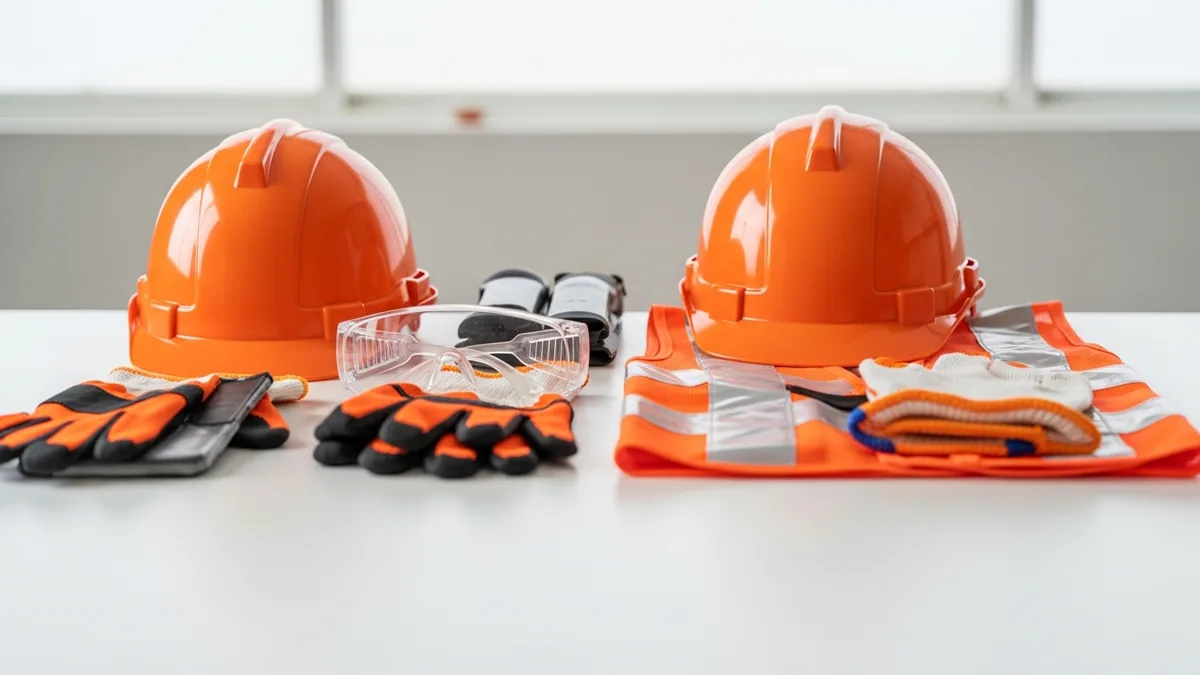
This one should be simple: if there’s a hazard, wear the right protection. Safety glasses, hard hats, gloves, hearing protection, high-vis vests.
The violations usually aren’t about not having PPE available. It’s about not wearing it. And that’s a culture problem, not an equipment problem.
Building a Safety Program That Your Crew Will Actually Follow
Here’s where most contractors get it wrong. They buy a generic safety manual, put it on the shelf, and call it a program. That’s not a safety program. That’s a prop.
A safety program that actually works has three things: leadership buy-in, crew involvement, and consistent follow-through.
Start at the Top
If the owner or superintendent walks through a jobsite without a hard hat, every worker on that site gets the message: safety is optional. It doesn’t matter what your policy says if your leadership doesn’t live it.
Safety starts with you. Wear your PPE every single time. Stop work when you see a hazard, even if it costs you an hour. When your crew sees that you’d rather lose time than risk someone getting hurt, they’ll start believing you mean it.
Get Your Crew Involved
Nobody likes being lectured. But everyone likes being asked for their opinion.
Instead of reading a safety topic at your crew, ask them what hazards they’re seeing. Let your foremen pick the toolbox talk topics based on what’s actually happening on the project. When a worker identifies a hazard and you fix it immediately, you’ve just shown everyone that speaking up matters.
Create a system where workers can report hazards without fear of getting hassled. Some companies use anonymous reporting. Others just make it clear that bringing up a safety concern is always the right call, even if it slows things down.
Make It Specific to Your Work
A generic safety manual written for all of construction is mostly useless for a roofing crew. Your safety program needs to address the specific hazards your people face on your specific types of projects.
If you do residential remodeling, your program should cover lead paint, asbestos awareness, and working in occupied homes. If you’re a concrete contractor, it should cover silica exposure, formwork, and post-tensioning hazards.
Build your program around the work you actually do. Use real examples from your own jobsites. Your crew will pay attention when the safety topic is something they dealt with last Tuesday.
Train Consistently, Not Just on Day One
Orientation training is important, but it’s the ongoing training that keeps safety alive. Weekly toolbox talks, monthly safety meetings, and annual refresher courses on topics like fall protection and hazard communication.
Keep the training short and focused. A 15-minute toolbox talk that covers one topic well beats an hour-long lecture that puts everyone to sleep. Use photos from your own jobsites to make it real.
And document every training session. Who attended, what was covered, and the date. You’ll need those records if OSHA shows up.
Enforce Consistently
The hardest part of any safety program is enforcement. Nobody wants to be the bad guy. But if your best carpenter doesn’t wear his safety glasses and nothing happens, you’ve just told everyone that the rules are flexible.
Progressive discipline works: verbal warning, written warning, suspension, termination. Apply it the same way to your best producer and your newest hire. Consistency is everything.
Safety Documentation and Record-Keeping
If it’s not documented, it didn’t happen. That’s not just an OSHA thing. It’s a legal reality.
When an incident occurs, the first thing every lawyer and insurance adjuster asks for is your safety documentation. If you can’t prove your workers were trained, that you conducted site inspections, and that you addressed known hazards, you’re exposed.
Toolbox Talks
Keep a log of every toolbox talk: the date, the topic, who presented it, and the names of everyone who attended. Get signatures. A clipboard works, but a digital system with daily logs is faster and harder to lose.
Topics should rotate through the hazards relevant to your current work. If you’re starting a roofing phase, talk about fall protection that week. If a new sub is bringing in equipment, cover struck-by hazards.
Incident Reports
Every incident, near-miss, and first-aid case needs a written report. Not just the serious ones. Near-misses are free warnings. They tell you exactly where your next real injury is coming from.
A good incident report includes: what happened, when and where it happened, who was involved, what caused it, and what corrective actions you’re taking. Photos help. Take them at the time of the incident, before anything gets moved or cleaned up.
Use your photo documentation tools to capture the scene, tag it to the project, and store it where it won’t get lost.
Training Records
Maintain a training matrix for every employee. It should show what training they’ve completed, when they completed it, and when it expires. OSHA 10 and OSHA 30 certifications, equipment-specific training, first aid and CPR, fall protection competent person training.
Contractors across the country trust Projul to run their businesses. Read their reviews.
When OSHA asks to see training records for the worker who was injured, you need to produce them quickly. Not “I think he went through orientation” but actual documented proof with dates and signatures.
Site Inspections
Regular jobsite inspections catch hazards before they become incidents. Weekly is good. Daily walk-throughs by your foreman are better.
Use a standardized checklist for each inspection. Cover housekeeping, fall protection, electrical, trenching, PPE compliance, fire protection, and equipment condition. Document what you found and what you corrected.
The inspection records serve double duty: they prove you were actively looking for hazards, and they create a trail showing you fixed problems when you found them. Both matter in court.
How Technology Helps with Construction Safety
Paper-based safety programs work, but they’re slow, easy to lose, and hard to search when you need something in a hurry. The right technology doesn’t replace good safety practices. It makes them easier to do consistently. And as wearable technology like smart hard hats and biometric monitors becomes more affordable, field crews are getting real-time safety data that was impossible just a few years ago.
Digital Checklists and Inspections
Instead of filling out a paper form on a clipboard, your foremen can run through a digital safety checklist on their phone. The data goes straight to the office. Nothing gets lost in a truck cab. Nothing sits in a pile on someone’s desk for three weeks.
With a tool like Projul’s project management features, you can attach safety checklists to specific project phases and make sure they get completed before work moves forward.
Photo Documentation
A photo is worth a thousand words on an OSHA citation defense. Document hazards, corrective actions, PPE compliance, and jobsite conditions with timestamped, geotagged photos that tie directly to the project record.
Projul’s photo and document management makes this simple. Snap a photo, tag it, and it’s stored with the project forever. No more digging through someone’s camera roll from six months ago.
Real-Time Reporting
When something happens on a jobsite, you need to know about it immediately. Not at the end of the day when your foreman remembers to call. Digital daily logs let field crews report incidents, near-misses, and safety observations in real time.
With daily logs, your superintendent can see what happened on every jobsite before they finish their morning coffee. That speed matters when you need to respond to an incident or address a hazard before someone gets hurt.
Training Tracking
Keeping up with training certifications for 20 or 50 or 200 workers is a headache with spreadsheets. Digital systems can alert you when certifications are expiring, track who attended which training sessions, and generate reports for audits.
Cost Tracking
Safety incidents cost money. Medical expenses, lost work days, damaged equipment, increased insurance premiums, OSHA fines, and legal fees all add up. When you track these costs against specific projects and incidents, you can make a clear business case for safety investments.
What to Do When an Accident Happens
No matter how good your safety program is, incidents can still happen. How you respond in the first minutes and hours makes a huge difference in the outcome for the injured worker, for your company’s legal exposure, and for your OSHA compliance.
Immediate Response
First priority: get the injured worker medical attention. Call 911 if there’s any question about the severity. Don’t try to diagnose injuries on a jobsite.
Secure the scene. If there’s a fall hazard, electrical hazard, or trench that’s unstable, keep everyone clear. Don’t let other workers into the area until it’s safe.
Identify witnesses. Get their names and contact information before people leave the site or the shift ends.
Document Everything
As soon as the immediate emergency is handled, start documenting.
Take photos and video of the scene from multiple angles. Capture the conditions, equipment, and any contributing factors. If PPE was involved, photograph it. If a guardrail was missing, photograph where it should have been.
Write down a timeline of events while memories are fresh. Interview witnesses separately and record their statements. Note the weather, lighting, and any other environmental factors.
This documentation protects the injured worker, protects your company, and gives you the information you need for your OSHA report and insurance claim.
OSHA Reporting Requirements
You need to know the reporting deadlines. They’re non-negotiable.
Within 8 hours: Report any workplace fatality or in-patient hospitalization to OSHA by phone (1-800-321-OSHA) or online.
Within 24 hours: Report any amputation or loss of an eye.
Within 7 days: File OSHA Form 301 (Injury and Illness Incident Report) for any recordable injury.
Ongoing: Maintain your OSHA 300 Log (Log of Work-Related Injuries and Illnesses) and post the OSHA 300A Summary from February 1 through April 30 each year.
Missing a reporting deadline is itself a violation. Set reminders and assign a specific person as responsible for OSHA reporting.
Insurance Claims
Contact your insurance carrier as soon as possible after an incident. Most workers’ comp policies require prompt notification, and delays can complicate claims.
Provide your insurer with the incident report, photos, witness statements, and any medical documentation you have. The more complete your initial report, the smoother the claims process goes.
Keep copies of everything. Your insurance company will have their copies, but you need your own set for your records and for any potential legal proceedings.
Post-Incident Review
After the dust settles, conduct a thorough review of what happened and why. This isn’t about assigning blame. It’s about figuring out what failed and fixing it so it doesn’t happen again.
Was there a breakdown in procedures? Was training inadequate? Was the hazard known but not corrected? Did time pressure lead to shortcuts?
Whatever you find, update your safety program accordingly. Share the lessons learned (without identifying the injured worker) at your next safety meeting. Turn a bad situation into a prevention opportunity.
Investing in Safety Pays Off
The math on construction safety is simple. Prevention costs less than the consequences of ignoring it.
A fall protection use costs about $150. An OSHA fine for missing fall protection starts at $16,131. A workers’ comp claim for a fall averages over $47,000. A wrongful death lawsuit? That’s a number that can end your company.
Good safety management also wins you work. More and more project owners are requiring detailed safety programs in their prequalification packages. Having a solid program with documented training, low incident rates, and a good EMR sets you apart from the contractors still running things off the back of a napkin.
If you’re ready to get your safety documentation organized and your jobsite communication tightened up, check out Projul’s pricing and see how the right tools can make safety management part of your daily workflow instead of an afterthought.
Book a quick demo to see how Projul handles this for real contractors.
OSHA’s Most Cited Violations in Construction and How to Avoid Them
We covered the major violation categories earlier, but it helps to look at the actual numbers. Every October, OSHA releases its annual “Top 10” list of the most frequently cited workplace safety standards. Construction dominates the list year after year. Understanding the patterns behind these citations gives you a real advantage when building your safety program.
Fall protection (1926.501) leads every year. In fiscal year 2024, OSHA issued over 7,000 fall protection citations in construction alone. The fix is straightforward but requires discipline. Every worker at six feet or above needs a guardrail, safety net, or personal fall arrest system. Period. The most common excuse inspectors hear is that the task was quick or nearly finished. OSHA does not care how long the task takes. If you are six feet up, you need protection.
To stay ahead of fall protection citations, make it part of your daily routine. Before any worker steps onto a roof, scaffold, or elevated platform, someone needs to verify that fall protection is in place. Use your daily logs to record these checks so you have proof when an inspector shows up.
Hazard communication (1910.1200) catches more contractors than you’d expect. This standard requires you to maintain Safety Data Sheets for every chemical on your jobsite and train workers on chemical hazards. Paint thinners, adhesives, concrete sealers, and cleaning solvents all count. Many contractors assume this only applies to chemical plants, but OSHA applies it everywhere. Keep a binder or digital folder of SDS sheets accessible on every jobsite, and cover chemical hazards during your toolbox talks at least once a quarter.
Respiratory protection (1910.134) violations spike on renovation and demolition projects. Cutting concrete, grinding metal, sanding drywall, and disturbing old materials can all generate harmful dust and particles. If your crew works around silica dust, lead paint, or any airborne contaminant, you need a written respiratory protection program, medical evaluations, fit testing, and proper training. Half-measures get cited fast.
Scaffolding (1926.451) and ladder (1926.1053) violations remain in the top five every single year. The fixes are basic. Train a competent person to inspect scaffolds before each shift. Make sure ladders extend three feet above the landing surface. Never use damaged equipment. These are simple rules, but the pressure to keep moving on a busy jobsite leads crews to skip steps.
Here is a practical approach to avoiding citations across the board. Pick one OSHA standard per month and do a deep review with your crew. Walk the jobsite together and look specifically for violations of that standard. When you find issues, fix them on the spot and document the correction. Over the course of a year, you will have covered every major standard, and your crew will start spotting violations on their own.
The best contractors do not wait for OSHA to show up. They run their own inspections using the same checklist an inspector would use. If you want to compare your current safety documentation against the best construction software options available, you will find that digital tools make self-inspections faster and more consistent than paper ever could.
Building a Safety Culture That Goes Beyond Compliance
Compliance gets you past an OSHA inspection. Culture keeps people alive. There is a real difference between a crew that follows safety rules because they have to and a crew that follows them because they want to. The first group cuts corners when nobody is watching. The second group holds each other accountable whether the boss is on site or not.
Culture starts with how you talk about safety. If every safety conversation begins with “OSHA requires” or “We’ll get fined if,” you are building a compliance program, not a culture. Instead, tie safety back to the people. “We do this so everyone goes home tonight.” “Your kids need you to clip in.” That lands differently than quoting a regulation number.
Recognize safe behavior, not just unsafe behavior. Most safety programs focus entirely on catching people doing something wrong. That trains your crew to hide mistakes instead of reporting them. Flip the script. When you see a worker stop and set up fall protection before stepping onto a roof, call it out. When someone flags a hazard during a pre-task meeting, thank them in front of the crew. Positive reinforcement changes behavior faster than punishment.
Give your crew ownership. Let workers lead toolbox talks on a rotating basis. Ask them to pick the topics. When a near-miss happens, involve the crew in the investigation instead of just handing down a verdict from the office. People support what they help create. A safety program built by your crew will always outperform one handed down from management.
Make reporting easy and consequence-free. The biggest barrier to a strong safety culture is fear. Workers worry that reporting a hazard will slow down the job and get them in trouble. They worry that admitting a near-miss will lead to write-ups or lost hours. You have to actively fight that fear every single day.
Set up a simple reporting system. It could be a text to the foreman, a quick entry in your daily log software, or even an anonymous drop box on the jobsite trailer. The method matters less than the message: reporting a problem is always the right call, and nobody gets punished for speaking up.
Track leading indicators, not just lagging ones. Most contractors only measure safety by injury rates. That is a lagging indicator. By the time you have data, someone already got hurt. Leading indicators tell you what is about to happen. Track the number of safety observations submitted, the percentage of toolbox talks completed on time, the number of hazards identified and corrected during inspections, and how quickly corrections happen after a hazard is reported.
When you track leading indicators, you can see your safety culture improving in real time. You can also spot problems before they turn into injuries. A drop in safety observations does not mean your jobsite got safer. It means people stopped reporting, and that should concern you more than a single incident.
Subcontractor alignment matters. Your safety culture is only as strong as your weakest sub. Set clear expectations during preconstruction. Include safety requirements in your subcontract language. Hold subs to the same standards you hold your own crew. If a sub repeatedly violates your site safety rules, remove them from the project. One sub cutting corners can undo years of culture building.
Building a real safety culture takes time. You will not see results in a week or a month. But over a year or two, you will notice fewer incidents, lower turnover, better morale, and crews that genuinely watch out for each other. That is worth more than any compliance checklist.
Calculating the Real Cost of Jobsite Injuries
Most contractors dramatically underestimate what a workplace injury actually costs. They think about the medical bill and maybe a few days of lost work. The reality is far worse. For every dollar you spend on direct costs like medical treatment and workers’ comp, you spend three to five dollars on indirect costs that never show up on an insurance claim.
Direct costs are the easy part to calculate. Medical expenses, workers’ compensation payments, and any OSHA fines associated with the incident. The average workers’ comp claim for a construction injury runs between $30,000 and $50,000. A serious fall can easily exceed $100,000. A fatality claim can reach seven figures before legal fees even start.
Indirect costs are where the real damage happens. These include lost productivity from the injured worker and the crew members who stopped working during and after the incident. Overtime paid to other workers picking up the slack. The cost of hiring and training a replacement. Administrative time spent on paperwork, investigations, and legal consultations. Equipment that was damaged or taken out of service. Project delays and the associated penalties or lost bonuses.
Here is a real-world example. Say a framer falls eight feet from an unguarded floor opening and breaks his wrist and two ribs. The direct costs might look like this: $15,000 in medical bills, $8,000 in workers’ comp wage replacement over six weeks, and a $16,131 OSHA fine for the fall protection violation. That is about $39,000 in direct costs.
Now add the indirect costs. The crew stopped working for two hours while EMS responded and the scene was secured. That is $800 in lost labor. You paid overtime to cover the injured worker’s tasks for six weeks, adding $6,000. Your superintendent spent 20 hours dealing with the OSHA investigation, insurance paperwork, and legal calls, costing $2,000 in his time alone. You brought in a temp worker who produced at 60% efficiency for the first month, losing another $4,000 in productivity. Your project fell three days behind schedule, triggering a $1,500 per day delay penalty, for $4,500 total.
The indirect costs in this example add up to roughly $17,300. Combined with the $39,000 in direct costs, this single broken wrist incident cost your company over $56,000. And we have not even touched the long-term insurance premium increase, which could add tens of thousands more over the next three to five years through your EMR adjustment.
The EMR impact is the cost that keeps costing. A single serious claim can raise your Experience Modification Rate for three full years. If your annual workers’ comp premium is $50,000 and your EMR jumps from 0.95 to 1.25, you are now paying $65,789 per year instead of $47,368. That is an extra $18,421 per year for three years, or $55,263 in additional premiums from one incident.
Lost bidding opportunities are impossible to calculate but very real. If your EMR climbs above 1.2, many general contractors and project owners will not consider you for work. You will never know how many projects you lost because your name got crossed off a prequalification list before you even heard about the bid.
Use these numbers to justify safety investments. When you need to convince yourself or a partner that spending $5,000 on better fall protection equipment is worth it, run the math. Compare that $5,000 against the $56,000 cost of a single fall incident, plus $55,000 in EMR-driven premium increases. The return on investment is not even close.
Track your safety-related costs in your project management software so you can pull real numbers from your own projects. When you can show your crew, your insurance carrier, and your clients that you know exactly what safety costs and what it saves, you move from being a contractor who talks about safety to one who runs a business on it.
If your crews work at height regularly, make sure everyone on your team has reviewed the specific requirements in our aerial lift safety guide. Lifts and boom equipment carry their own unique set of risks that deserve focused attention beyond general fall protection training.
Start tracking today, not after the next incident. Set up a simple spreadsheet or use your project management software to log every incident cost, both direct and indirect. After six months, you will have enough data to calculate your true cost per incident. That number becomes the most powerful argument for every safety investment you want to make. It also gives you leverage in insurance negotiations, because carriers reward contractors who understand and manage their risk with real data.
Frequently Asked Questions
What is an Experience Modification Rate (EMR) and why does it matter?
Your EMR is a number calculated by the National Council on Compensation Insurance (NCCI) that compares your company’s workers’ comp claims history to other companies of similar size in your industry. An EMR of 1.0 is average. Below 1.0 means fewer claims than average, and your premiums go down. Above 1.0 means more claims, and your premiums go up. Many GCs won’t hire subs with an EMR above 1.2, so a bad safety record can cost you work on top of higher insurance costs.
How often should I hold toolbox talks?
At minimum, hold a toolbox talk once a week. Daily pre-task safety briefings are even better, especially when you’re starting a new phase of work or a new crew is on site. Keep them short, around 10 to 15 minutes, and focused on one specific topic that’s relevant to the work happening that day or week.
Do I need a written safety program if I have fewer than 10 employees?
Yes. While OSHA exempts companies with 10 or fewer employees from certain record-keeping requirements (like the OSHA 300 Log), you’re still required to comply with all safety standards. Having a written safety program protects you legally, helps train new workers, and shows insurance companies and potential clients that you take safety seriously. Size doesn’t exempt you from keeping your people safe.
What’s the difference between an OSHA 10 and OSHA 30 certification?
OSHA 10 is a 10-hour training course designed for entry-level workers that covers basic safety hazard recognition and prevention. OSHA 30 is a 30-hour course intended for supervisors and workers with safety responsibilities, covering a broader range of topics in more depth. Many states and project owners require OSHA 10 as a minimum for all workers and OSHA 30 for foremen and superintendents.
How long do I need to keep safety records?
OSHA requires you to keep injury and illness records (300 Log, 301 forms) for five years following the end of the calendar year they cover. Training records should be kept for the duration of employment plus 30 years for certain health-related training like hazard communication and respiratory protection. In practice, keep everything for as long as possible. Digital storage is cheap, and having old records available can protect you years after an incident.
Frequently Asked Questions
What are the most common OSHA violations in construction?
How do I create a construction safety program?
How much do OSHA fines cost contractors?
Are toolbox talks required on construction sites?
How does a safety program lower my insurance costs?
Related Articles
Free Construction Business Plan Template (2026)
Most contractors skip the business plan and learn as they go. That works until you need a bank loan, a bonding line, or...
Read More →
5 Free Construction Change Order Templates for 2026 (Ready to Use)
Verbal change orders cost contractors thousands every year. Use these free construction change order templates to...
Read More →
7 Free Construction Scope of Work Templates (2026) + Writing Guide
Vague scopes of work cost contractors thousands in disputes and change orders every year. Grab these free construction...
Read More →