
Septic System Installation Guide: Tank Sizing, Drain Field Layout, Perc Tests, and Maintenance | Projul
About one in five homes in the United States relies on a septic system for wastewater treatment. In rural areas and many suburban communities, septic systems are the only option. Getting the design and installation right is critical because a failed septic system is expensive to fix, disgusting to deal with, and can contaminate groundwater and surface water.
This guide walks through the complete septic system process, from initial site evaluation and perc testing through tank sizing, drain field design, installation, and ongoing maintenance. If you are a contractor installing septic systems or a builder who needs to understand the process for new home construction, this covers the practical details you need.
How Septic Systems Work
A conventional septic system has two main components: the septic tank and the drain field (also called a leach field or soil absorption system).
The septic tank is a watertight buried container, usually concrete, fiberglass, or polyethylene. All household wastewater flows into the tank, where solids settle to the bottom (sludge), grease and light solids float to the top (scum), and partially clarified liquid (effluent) flows out to the drain field.
Bacteria in the tank break down some of the organic solids through anaerobic digestion. This is a slow process, and the tank never fully processes all solids, which is why regular pumping is necessary.
The drain field distributes the effluent into the soil through perforated pipes laid in gravel-filled trenches. The soil filters and treats the effluent as it percolates down through the ground. By the time it reaches the water table (in a properly functioning system), the wastewater has been treated by soil bacteria and physical filtration.
The entire system relies on gravity in a conventional installation. Wastewater flows downhill from the house to the tank, and from the tank to the drain field. When the site does not allow gravity flow, a pump chamber and effluent pump are added to move the effluent uphill to the drain field.
Site Evaluation and Percolation Testing
Before anything gets designed or installed, the site has to be evaluated. This is not a step you can skip or shortcut. A bad site evaluation leads to a system that fails, and the contractor who installed it gets the blame and often the liability.
Soil Evaluation
A qualified soil evaluator or licensed septic designer digs test pits or borings at the proposed drain field location. They are looking at:
- Soil texture: Sand, silt, clay, and gravel in various combinations. Sandy and loamy soils drain well. Heavy clay does not.
- Soil structure: How the soil particles are arranged. Granular and blocky structures drain better than platy or massive structures.
- Depth to restrictive layer: Bedrock, hardpan, or an impermeable clay layer beneath the proposed drain field limits the available treatment depth. Most codes require a minimum of 2 to 4 feet of suitable soil below the drain field pipes.
- Depth to seasonal high water table: If groundwater rises into the drain field during wet seasons, the system cannot treat effluent properly. Mottling (gray and orange spots) in the soil indicates seasonal high water levels.
The Percolation Test
The perc test is the traditional method for evaluating soil drainage capacity. The basic procedure:
- Dig test holes at the proposed drain field depth (typically 18 to 36 inches)
- Pre-soak the holes for a specified period (often 24 hours) to saturate the surrounding soil
- Fill the holes with water to a measured level
- Measure the rate of water level drop over 30 to 60 minutes, recording readings at regular intervals
- Calculate the percolation rate in minutes per inch
Interpreting perc rates:
- 1 to 5 minutes per inch: Very fast. Sandy soil. May need special design to prevent inadequate treatment.
- 5 to 30 minutes per inch: Good range for conventional drain fields. Most codes accept rates in this range.
- 30 to 60 minutes per inch: Slow. Larger drain field required. Some jurisdictions allow conventional systems; others require alternatives.
- Over 60 minutes per inch: Too slow for conventional systems. Alternative systems required, or the site may not be suitable.
Many states have moved away from perc tests in favor of soil profile evaluations, where a trained soil scientist assesses the soil directly rather than relying on a timed water test. The soil profile method provides more reliable information about long-term performance because perc test results can vary with soil moisture conditions at the time of testing.
Setback Requirements
Every jurisdiction has specific setback distances that the septic system must maintain from various features:
| Feature | Typical Minimum Setback |
|---|---|
| House foundation | 5 to 10 feet (tank), 10 to 20 feet (drain field) |
| Well (property owner) | 50 to 100 feet |
| Well (neighbor) | 100 to 200 feet |
| Property line | 5 to 10 feet |
| Streams and water bodies | 50 to 100 feet |
| Steep slopes | Varies by grade |
| Large trees | 10 to 25 feet |
These distances vary significantly by jurisdiction. Always check with the local health department or environmental agency before starting the design. Getting a system permitted in the wrong location means digging it up and starting over.
Septic Tank Sizing and Selection
Sizing by Bedrooms
Septic tank size is based on the number of bedrooms, which serves as a proxy for the number of people who will use the system. This method is used because bedrooms are a permanent feature of the house, while actual occupancy changes over time.
Minimum tank sizes (typical code requirements):
| Bedrooms | Minimum Tank Size |
|---|---|
| 1 to 3 | 1,000 gallons |
| 4 | 1,250 gallons |
| 5 | 1,500 gallons |
| 6 | 1,750 gallons |
Going bigger than the minimum is usually worth the modest extra cost. A larger tank provides more settling time, requires less frequent pumping, and handles peak flows better. Many experienced installers recommend oversizing by one step.
Tank Materials
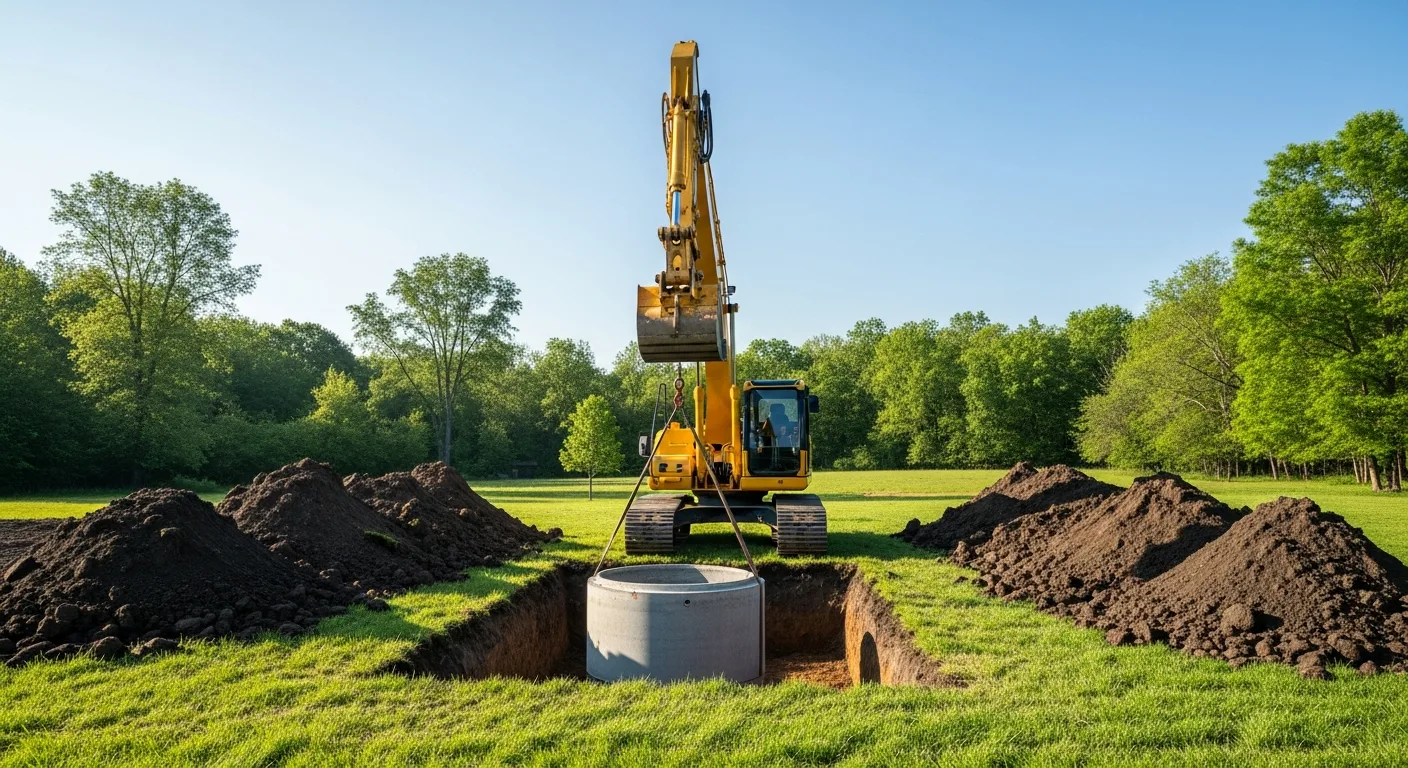
Precast concrete is the most common tank material. Concrete tanks are durable, heavy (which prevents flotation in high water table conditions), and available in most areas. They typically come in two sections (base and lid, or two halves) that are set by crane and sealed at the joint with butyl rubber or mastic sealant. A properly made concrete tank lasts 40 years or more.
Fiberglass tanks are lightweight, corrosion-resistant, and watertight. They are easier to transport and install in difficult-access areas. However, they can float out of the ground in high water table conditions if not properly anchored. Cost is typically higher than concrete.
Polyethylene (plastic) tanks are the lightest and least expensive option. Like fiberglass, they must be anchored or ballasted against flotation. They are susceptible to crushing from soil loads if not backfilled properly. Some jurisdictions do not approve plastic tanks.
Tank Features
Modern septic tanks include:
- Two compartments (or two tanks in series) to improve settling. The first compartment handles most of the settling; the second provides additional treatment.
- Inlet and outlet baffles (or tees) to direct flow downward into the tank and prevent scum from leaving with the effluent.
- Effluent filter at the outlet to catch solids that would otherwise reach the drain field. This inexpensive filter is one of the best things you can install to extend drain field life. It needs cleaning every 1 to 3 years.
- Risers and lids extending to grade level for easy access during pumping and inspection. Buried tanks with no risers are a hassle and cost more to service.
Drain Field Design and Installation
The drain field is where the real treatment happens, and it is the most critical part of the system to get right. A tank can be replaced. A failed drain field usually means a new drain field in a different location, which may not be available.
Conventional Trench Systems
The standard drain field consists of parallel trenches, typically 18 to 36 inches wide and 18 to 36 inches deep, filled with washed gravel and perforated distribution pipe. The trenches are spaced 6 to 10 feet apart (center to center) depending on code requirements.
Trench construction:
- Excavate trenches to the specified depth, keeping the bottom level (or with a very slight slope for gravity distribution)
- Place 6 to 12 inches of clean, washed gravel (3/4 to 2-1/2 inch) in the bottom
- Lay 4-inch perforated pipe on the gravel bed, holes facing down
- Cover pipe with 2 to 6 inches of gravel
- Cover gravel with geotextile fabric to prevent soil migration into the gravel
- Backfill with native soil, mounded slightly to account for settling
Sizing the Drain Field
Drain field size is based on the daily wastewater flow (determined by bedrooms and fixtures) and the soil’s long-term acceptance rate (from the perc test or soil evaluation).
Basic formula:
Required drain field area = Daily flow (gallons per day) / Soil application rate (gallons per square foot per day)
For example: A 3-bedroom home producing 450 gallons per day in soil with an application rate of 0.6 gallons per square foot per day needs 750 square feet of drain field bottom area.
The application rate comes from the perc test results or soil evaluation, applied through a table in the local code. Faster-draining soils get higher application rates (smaller drain fields), and slower soils get lower rates (larger drain fields).
Alternative Distribution Methods
Chamber systems use arched plastic chambers instead of gravel-filled trenches. The chambers provide storage volume and allow soil contact without gravel. They are lighter, faster to install, and eliminate the need for gravel delivery and placement. Many jurisdictions have approved chamber systems as equivalent to conventional gravel trenches.
Pressure distribution uses a pump to deliver effluent through small-diameter pipes with calibrated orifices, distributing flow evenly across the entire drain field. This produces better treatment than gravity distribution because the entire field is used equally. Required by many codes for alternative systems.
Drip distribution uses flexible drip tubing with emitters, buried 6 to 12 inches deep. Very even distribution and shallow installation make this system work in difficult soils and tight sites. Requires a pump, filter, and control system.
Mound Systems
When the water table is high or bedrock is shallow, a mound system raises the drain field above the natural ground surface. Clean sand fill is placed on the existing ground, and the drain field is constructed within the sand mound. A pump delivers effluent to the mound through pressure distribution piping.
Mound systems are more expensive than conventional systems because of the sand fill, pump, and larger footprint. They also require careful construction to maintain the sand fill specifications and prevent short-circuiting.
Installation Best Practices
Excavation
- Never excavate in wet conditions. Heavy equipment on saturated soil smears and compacts the drain field area, destroying the soil structure that the system depends on for treatment. If the site is wet, wait.
- Protect the drain field area. Do not drive equipment across the proposed drain field during other construction activities. Tire ruts and compaction reduce soil permeability.
- Keep the trench bottom undisturbed. Excavate carefully and do not over-dig. If you dig too deep, do not recompact the bottom with fill. The undisturbed soil structure is what provides treatment.
Tank Installation
- Excavate the tank hole with adequate clearance for backfill on all sides
- Place 6 inches of compacted gravel or sand bedding in the bottom
- Set the tank level using a crane or excavator
- Connect the inlet pipe from the house sewer line (typically 4-inch Schedule 40 PVC, sloped 1/4 inch per foot)
- Connect the outlet pipe to the distribution box or directly to the drain field
- Install risers and secure lids
- Fill the tank with water before backfilling to prevent flotation and to test for leaks
- Backfill carefully with suitable material, compacting in lifts to avoid shifting the tank
Distribution Box
The distribution box (D-box) splits effluent flow equally among multiple drain field trenches. It must be set precisely level so that flow divides evenly. An unlevel D-box sends most of the effluent to one trench, overloading it while the others sit idle.
Some installers use flow equalizers or orifice plates in the D-box outlets to ensure even distribution regardless of minor settling. This is good practice, especially on sites where some settlement is expected.
Inspection and Testing
Most jurisdictions require at least one inspection during installation, typically after the tank is set and the drain field is constructed but before backfilling. The inspector checks:
- Tank placement and connections
- Drain field trench dimensions and spacing
- Gravel depth and pipe placement
- D-box installation and leveling
- Setback distances
- Overall compliance with the approved design
Do not backfill before the inspection. This is a common mistake that results in having to re-excavate for the inspector, which is expensive and can damage the installed system.
Maintenance for Long System Life
A septic system is not install-and-forget. Regular maintenance keeps the system working properly and avoids the $20,000-plus cost of a drain field replacement.
Pumping Schedule
Pump the tank every 3 to 5 years based on household size and tank capacity. The pumper should measure the sludge and scum layers to determine if the schedule needs adjustment. When the sludge layer reaches one-third of the tank liquid depth, it is time to pump regardless of the calendar.
Effluent Filter Maintenance
If the tank has an effluent filter (and it should), clean it every 1 to 3 years. This is a simple job: pull the filter cartridge, hose it off into the tank, and replace it. A clogged filter causes slow drains and can force sewage backup into the house.
Water Conservation
The drain field can only handle so much water. Excessive water use overloads the system, flushing solids into the drain field and preventing proper treatment. Fix running toilets, spread laundry loads across the week, and use water-efficient fixtures.
Protect the Drain Field
- Do not drive or park on the drain field
- Do not plant trees or deep-rooted shrubs over the drain field
- Do not build structures, patios, or pools over the drain field
- Direct surface water drainage away from the drain field area
- Do not add additional wastewater sources (like a hot tub drain) without verifying the system can handle the additional load
Tracking Septic Installations
Septic system projects involve permitting, site evaluations, engineer reviews, material ordering, inspections, and often coordination with the home builder and other site contractors. Keeping track of which sites have passed perc tests, which permits are approved, and which inspections are scheduled is a lot of detail to manage across multiple projects.
Projul’s project management features help contractors keep all of this organized. Track permits and inspections on the schedule, store site evaluation reports and designs in the project file, and coordinate with builders and inspectors through the platform. When you are running five or six septic installs alongside other site work, having one system to manage it all makes a real difference.
Check out a demo to see how Projul works for site contractors and excavation companies.
Final Thoughts
Septic system installation is one of those trades where doing it right the first time is everything. A properly designed and installed system works quietly for decades. A poorly installed one creates problems that are expensive, messy, and sometimes impossible to fix without starting over in a new location.
Know your soils. Follow the engineering. Build it to code. And maintain it regularly. That is the formula for a septic system that lasts.
If you are looking for a better way to manage your site work projects, including septic installations, take a look at what Projul offers. Good project management and good field work go hand in hand, and both start with paying attention to the details.
Frequently Asked Questions
How much does a septic system cost to install?
How big of a septic tank do I need?
What is a percolation test and why is it required?
How far should a septic tank be from a house?
How often should a septic tank be pumped?
Can you install a septic system in clay soil?
What causes septic system failure?
How long does a septic system last?
Related Articles

BIM Clash Detection: How to Catch Conflicts Before They Cost You on the Jobsite
BIM Clash Detection: How to Catch Conflicts Before They Cost You on the Jobsite Every contractor has a story about the...
Read More →
Asphalt Paving and Compaction Guide: Mix Types, Laydown Temperatures, and Quality Testing
Asphalt paving looks straightforward from a distance. A truck dumps material, the paver lays it down, and rollers...
Read More →
Construction Jobsite Wi-Fi & Connectivity Guide: Setting Up Reliable Internet in the Field
A practical guide to getting reliable internet on construction job sites. Learn about cellular hotspots, mesh networks,...
Read More →