
Slipform Concrete Construction: How It Works, Equipment, and Best Practices | Projul
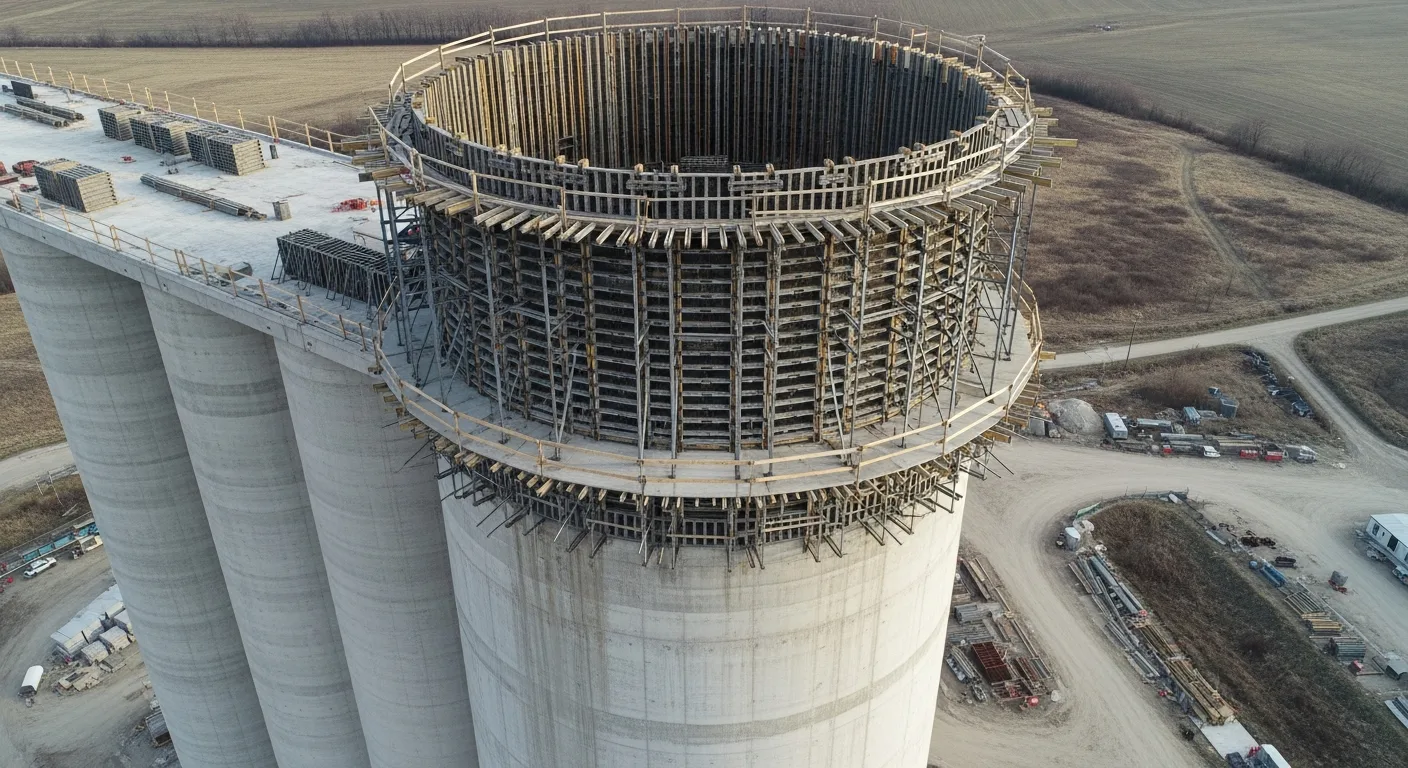
Slipform construction is one of those methods that looks almost magical the first time you see it. A set of forms climbing up a silo at a steady pace, concrete going in at the top while a finished wall emerges from the bottom, with no stopping, no form stripping, and no construction joints. Or a curb machine rolling down the street, leaving behind a perfectly shaped concrete curb as fast as the crew can keep it fed with material.
Both vertical and horizontal slipforming have been around for decades, but they remain specialized operations that many contractors have never been directly involved with. This guide covers both types, explaining how the equipment works, when slipforming makes economic sense, and the practical details that determine whether a slipform operation succeeds or turns into an expensive headache.
Vertical Slipform Construction
How It Works
A vertical slipform system consists of inner and outer form panels, typically 4 to 5 feet tall, supported by a structural yoke frame. Hydraulic jacks mounted on the yokes grip smooth steel jack rods that are embedded in the concrete below. When the jacks are activated, they climb up the jack rods, lifting the entire form assembly.
The process is continuous. Concrete is placed into the form at the top, vibrated to consolidate it, and the form is raised at a rate that allows the concrete to set enough to be self-supporting by the time it emerges from the bottom of the form. Rebar is placed just ahead of the rising form. Embeds, blockouts, and openings are installed at their designated elevations as the form passes those points.
The climbing rate is the critical variable. Move too fast and the concrete slumps or collapses when it exits the form. Move too slow and the concrete bonds to the form panels, which can tear the wall surface or even lock up the entire system. Typical climbing rates fall between 8 and 12 inches per hour, but the actual rate depends on temperature, mix design, wall thickness, and concrete set time.
Equipment Components
Form panels: Steel or plywood-faced panels that shape the concrete. The panels taper slightly outward from bottom to top, typically 1/8 to 1/4 inch per side. This draft angle prevents the form from bonding to the concrete and reduces friction as the form climbs.
Yoke frames: Steel frames that span across the wall and support the form panels on both sides. Yokes are spaced 4 to 6 feet apart around the perimeter. They carry the weight of the form, the work deck, and all equipment and personnel.
Hydraulic jacks: Hollow-center jacks that grip the jack rods and climb when hydraulic pressure is applied. Each jack has a capacity of 3 to 6 tons. They are connected to a central hydraulic power unit and operated simultaneously to keep the form level.
Jack rods: Smooth steel rods, typically 1 inch or 1-1/4 inch diameter, that serve as the climbing track for the jacks. Jack rods are spliced with threaded couplings as the form rises. They remain embedded in the completed wall and are typically cut off flush with the wall surface after the slip is complete.
Work deck: A platform at the top of the form where concrete placement, rebar installation, and embed setting take place. The work deck is supported by the yoke frames and provides working space for the entire crew.
Finishing platform: A suspended platform hanging below the form that allows workers to patch, finish, and cure the newly exposed concrete surface.
Planning a Vertical Slipform Operation
Successful slipforming requires extensive planning before the form is ever assembled.
Wall geometry review: Examine the structure for changes in wall thickness, openings, pilasters, and other features that complicate the slip. Constant cross-sections are ideal. Variable geometry is possible but adds complexity and cost.
Rebar detailing: All reinforcement must be detailed for installation in the rising form. Lap splices need to be staggered so the form is never passing through a section where all bars are being spliced simultaneously. Horizontal steel is placed from the work deck as the form rises. Vertical bars are set in advance, extending several feet above the work deck.
Embed and opening planning: Every embed plate, anchor bolt, sleeve, and blockout must be cataloged with its exact elevation and position. The crew needs a clear schedule showing what gets installed at each elevation. Missing an embed in a slipform wall is extremely expensive to fix after the fact.
Concrete supply: A vertical slipform operation requires continuous concrete delivery, typically 24 hours a day for the duration of the slip. Any interruption in concrete supply forces the form to slow or stop, which creates problems. Arrange backup batch plants or ready-mix suppliers if possible.
Crew scheduling: Slipform crews work in shifts, usually 8 or 12 hours, around the clock. A typical crew includes a slip superintendent, jack operator, concrete placers, rod setters, finishers on the trailing platform, and concrete delivery coordination. For a mid-size silo, you might have 15 to 25 people on each shift.
Weather planning: Temperature affects concrete set time, which directly affects climbing rate. Hot weather speeds up set and may require retarders in the mix. Cold weather slows set and may need accelerators, heated water, or insulated forms. Rain during a slip is manageable if drainage is provided, but heavy storms can cause problems.
Quality Control During Vertical Slipforming
Level monitoring: The form must stay level as it climbs. Uneven jacking or differential concrete set can cause the form to tilt, which makes the wall go out of plumb. Survey measurements are taken regularly, and individual jacks are adjusted to correct any deviation.
Concrete set time: The slipform superintendent continuously monitors the condition of concrete at the bottom of the form. Poking the concrete with a rod or using a penetration resistance test helps determine if the climbing rate is appropriate. The concrete should be firm enough to hold its shape but not so hard that it is dragging on the form.
Surface quality: The finishing crew on the trailing platform patches bug holes, fills voids, and applies curing compound or wet curing to the freshly exposed surface. Surface defects are easiest to repair immediately after the form passes.
Rebar placement: Verify bar sizes, spacing, lap lengths, and cover as the steel is placed. In a continuously moving operation, there is no opportunity to go back and fix rebar placement errors without breaking out concrete.
Horizontal Slipform Construction
How It Works
Horizontal slipforming, often called curb and gutter machine work or extrusion paving, uses a self-propelled machine that moves along a guideline (typically a taut string line or electronic sensor guidance). Concrete is deposited in front of or into the machine, which shapes it through a mold, vibrates it, and extrudes the finished profile as it moves forward.
The concrete must be stiff enough to hold the extruded shape immediately after the machine passes. Typical slump is 0 to 1 inch for simple profiles and up to 2 inches for more complex shapes.
Common Applications
Curb and gutter: The highest-volume application for horizontal slipforming. Modern curb machines can place 300 to 800 linear feet of curb per hour.
Concrete barrier (Jersey barrier profile): Highway median barriers and bridge parapets are commonly slipformed in place rather than precast and set.
Sidewalks and bike paths: Flat-section slipforming is used for sidewalks, especially on long runs where hand-forming would be slow and expensive.
Canal and ditch lining: Specialized slipform machines shape concrete linings for irrigation canals and drainage ditches.
Bridge parapet walls: Small slipform machines with custom mold shapes cast parapet walls on bridge decks.
Equipment
Slipform paver: The machine itself, which includes a hopper for receiving concrete, auger or conveyor distribution, internal vibration, and the extrusion mold. Machines range from small walk-behind units for residential curb work to large self-propelled pavers for highway barriers.
Stringline or guidance system: The machine follows a guideline that defines the horizontal and vertical alignment. Stringline setup requires careful survey work. Modern machines increasingly use GPS or laser guidance for automated steering.
Concrete delivery: Concrete must be delivered at a rate that keeps the machine fed without overloading the hopper. Ready-mix trucks typically dump directly into the machine hopper or into a spreader box ahead of the machine.
Finishing tools: Hand finishers follow behind the machine to touch up edges, fill any surface voids, apply texturing, and install joints.
Mix Design for Horizontal Slipforming
Horizontal slipform concrete must be very stiff. Zero-slump to 1-inch slump is typical. The concrete needs to hold its extruded shape without slumping, sagging, or edge rollover.
Key mix design factors:
- Low water content with high cement factor (typically 600 to 700 lbs/yd3)
- Well-graded aggregate with strong particle shape
- Often includes supplementary cementite materials for workability
- Fiber reinforcement is common for crack control
- Air entrainment for freeze-thaw durability
Quality Control for Horizontal Slipforming
Grade and alignment: Check the finished profile against the design grade and alignment. GPS-guided machines hold tighter tolerances than stringline systems in most conditions.
Profile shape: Use a template to verify that the cross-section matches the specified shape. Edge slump, crown distortion, and flat spots indicate mix or vibration problems.
Surface finish: The extruded surface should be uniform and free of tears, honeycombing, and excessive vibrator trails.
Joint placement: Tooled contraction joints are cut at regular intervals (typically 10 to 15 feet for curb) using a jointing tool immediately after the machine passes or by early-entry saw cutting.
Strength verification: Standard cylinder testing applies. Cores may also be taken from the finished work if there are questions about in-place quality.
When Slipforming Makes Economic Sense
Vertical Slipforming Is Cost-Effective When:
- The structure is tall with a constant or near-constant cross-section
- Speed is a priority (slipforming can complete structures 30% to 50% faster than conventional forming)
- Elimination of horizontal construction joints is important (liquid storage, containment)
- Crane time is at a premium and reducing forming cycles saves on crane costs
- Multiple similar structures are being built (learning curve pays off on repetitions)
Vertical Slipforming May Not Make Sense When:
- The structure has complex geometry with many changes in wall thickness
- There are numerous large openings that interrupt the wall continuity
- The total wall area is small and does not justify mobilizing slipform equipment
- Concrete supply continuity cannot be guaranteed
- Weather conditions are unpredictable during the planned slip period
Horizontal Slipforming Is Almost Always the Right Choice When:
- Placing more than a few hundred linear feet of curb, gutter, or barrier
- The alignment is reasonably straight or has gradual curves
- Consistent cross-section profile is required
- Speed of placement matters (horizontal slipforming is many times faster than hand-forming)
Common Problems and Solutions
Vertical Slipform Problems
Form sticking: The form bonds to the concrete, usually because climbing speed is too slow. Solution: increase climbing rate, verify form panel draft, and apply form release agent to panels.
Wall bulging: Concrete below the form is not stiff enough to resist hydrostatic pressure from fresh concrete above. Solution: reduce climbing rate, adjust mix to accelerate set, or reduce lift height of concrete in the form.
Out-of-plumb walls: Caused by uneven jacking, differential concrete set on one side, or wind loading on tall forms. Solution: monitor plumb continuously and adjust individual jack rates.
Cold joints: If the operation stops and restarts, a cold joint is created. These joints must be prepared and treated per the engineer’s specifications, including surface roughening, cleaning, and potentially applying bonding agents.
Horizontal Slipform Problems
Edge slump: The concrete slumps at the edges of the extruded profile because it is too wet. Solution: reduce slump, increase mix stiffness, or slow the machine speed.
Tearing: The surface tears as concrete passes through the mold, usually because the mix is too dry or the machine is moving too fast. Solution: adjust mix workability slightly or reduce machine speed.
Poor consolidation: Visible honeycombing or voids caused by insufficient vibration. Solution: verify vibrator function, adjust vibrator frequency, and ensure proper concrete feed rate into the mold.
Safety Considerations
Vertical Slipforming
Working 24 hours a day on an elevated, continuously moving platform introduces significant safety hazards.
- Fall protection is required for all workers on the work deck and finishing platform
- Fatigue management is critical for crews working extended shifts
- Overhead lifting of concrete, rebar, and supplies creates struck-by hazards
- Hydraulic system failures can cause the form to drop or tilt
- Electrical safety for pumps, lights, and vibrators in wet conditions
Horizontal Slipforming
- Traffic control on roadway projects
- Struck-by hazards from ready-mix trucks and delivery equipment
- Hot weather heat stress for crews working exposed on pavement
- Equipment pinch points and rotating components on the paving machine
How Projul Helps Manage Slipform Projects
Slipform operations, especially vertical slips, are schedule-intensive projects where concrete delivery, crew shifts, material supply, and weather all need to be coordinated with precision. Projul’s construction project management software helps contractors plan shift schedules, track concrete delivery timing, manage material quantities, and keep real-time communication flowing between the field crew and the office during 24-hour operations.
Final Thoughts
Slipform construction is a specialized skill set, but it is one that pays off significantly when applied to the right projects. Vertical slipforming turns weeks of conventional forming into days of continuous production, and horizontal slipforming multiplies curb and barrier production rates by a factor of 5 to 10 compared to hand-forming.
If you are a concrete contractor working on tall structures, storage facilities, or high-volume site work, understanding slipform methods gives you options that your competitors may not have. The key is matching the method to the project, planning the operation thoroughly, and executing with crews who understand the demands of continuous concrete placement.
Frequently Asked Questions
What is slipform concrete construction?
How fast does a vertical slipform move?
What types of structures use vertical slipforming?
What are the advantages of slipform over conventional formwork?
Can you put openings and embeds in slipformed walls?
What happens if a vertical slipform operation has to stop?
How is horizontal slipform paving different from vertical slipforming?
What concrete mix is used for slipforming?
Related Articles

BIM Clash Detection: How to Catch Conflicts Before They Cost You on the Jobsite
BIM Clash Detection: How to Catch Conflicts Before They Cost You on the Jobsite Every contractor has a story about the...
Read More →
Asphalt Paving and Compaction Guide: Mix Types, Laydown Temperatures, and Quality Testing
Asphalt paving looks straightforward from a distance. A truck dumps material, the paver lays it down, and rollers...
Read More →
Construction Jobsite Wi-Fi & Connectivity Guide: Setting Up Reliable Internet in the Field
A practical guide to getting reliable internet on construction job sites. Learn about cellular hotspots, mesh networks,...
Read More →