
Temporary Shoring in Construction: Types, Safety, and Best Practices
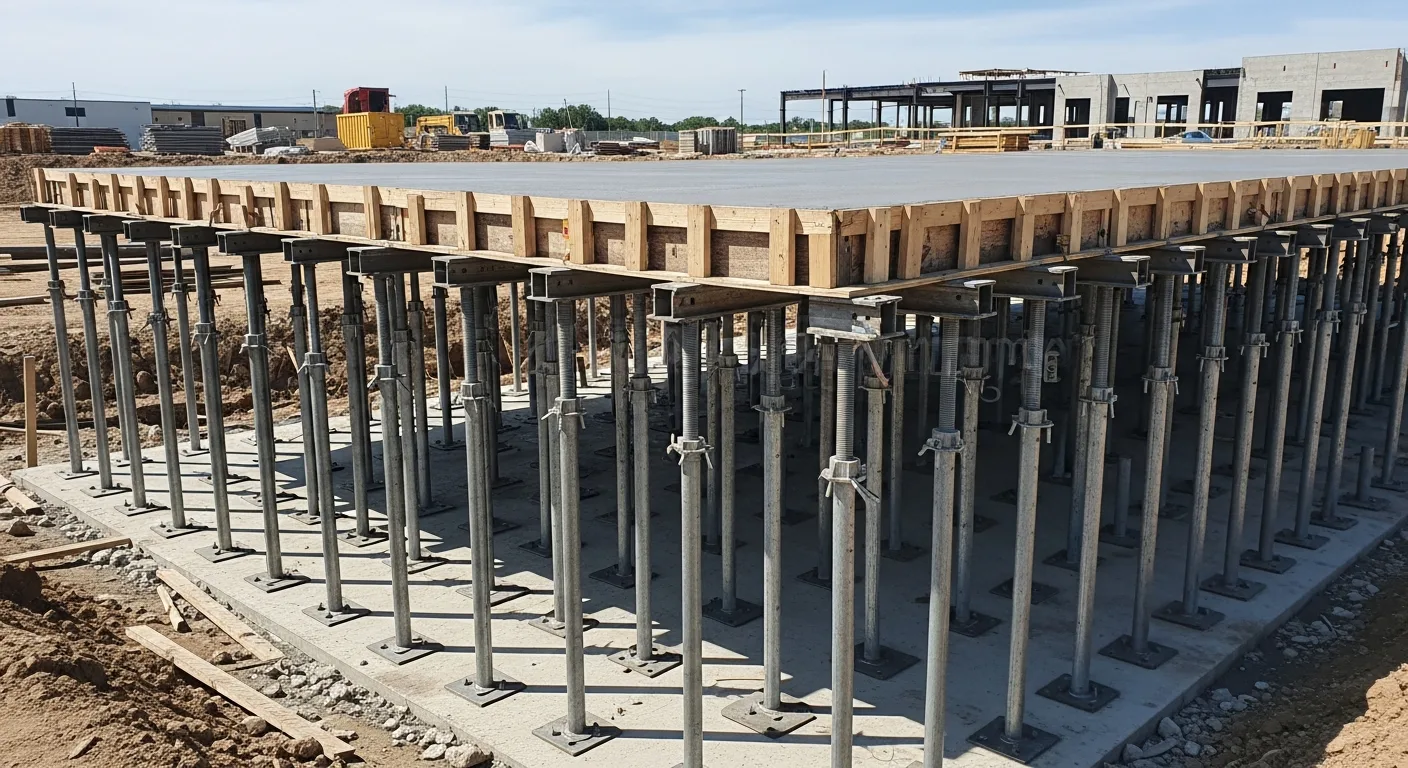
Temporary Shoring and Bracing Guide for Construction Projects
Temporary shoring and bracing are the unsung heroes of construction. Nobody notices them when they are doing their job. But when they fail, people get hurt and structures collapse. Whether you are pouring a multi-story concrete frame, removing a load-bearing wall in a renovation, or stabilizing an excavation, understanding shoring and bracing principles is fundamental to safe construction.
This guide covers the types of temporary support systems you will encounter, how loads are calculated, the safety requirements you must follow, and the practical field knowledge that keeps your projects running safely.
Why Temporary Shoring Matters
Every structure goes through a vulnerable phase during construction. Concrete has not cured to design strength. Steel connections are not all bolted up. Masonry walls are not fully grouted. During these phases, temporary support systems carry the loads that the permanent structure cannot yet handle.
Getting shoring wrong has real consequences. Formwork collapses are among the most deadly construction accidents. When a multi-story concrete shoring system fails, the progressive collapse can bring down multiple floors in seconds, with almost no warning.
The good news is that shoring failures are almost always preventable. They typically result from inadequate design, overloading, improper installation, premature removal, or a combination of these factors. Understanding the principles in this guide helps you avoid all four.
Types of Temporary Shoring Systems
Adjustable Steel Shores (Post Shores)
The most common shoring element on concrete construction projects. These are telescoping steel tubes with a threaded adjustment mechanism that allows precise height setting. They come in light-duty, medium-duty, and heavy-duty ratings, typically ranging from 5,000 to 15,000 pounds of capacity per shore.
Best for: Slab-on-metal-deck shoring, residential concrete work, light commercial projects, and renovation work where you need to support a floor while modifying the structure below.
Key considerations: Always use the manufacturer’s load tables, which account for the shore length (capacity decreases as the shore gets taller). Never extend a shore beyond its rated maximum height. Make sure the base plate sits on a solid, level surface that can handle the concentrated load.
Shoring Frames (Heavy-Duty Frames)
These are modular steel frames, similar in appearance to scaffolding frames but engineered for vertical load support. They stack in tiers with cross-bracing and can support substantial loads when properly configured.
Best for: Multi-story concrete construction, heavy slab pours, post-tensioned slabs, and any application requiring high load capacity over a large area.
Key considerations: Frame shoring requires engineered layout drawings that specify the frame spacing, cross-bracing configuration, screw jack extensions, and base plate requirements. The capacity depends on the frame spacing, tier height, and bracing configuration. Do not assume that closer spacing always means more capacity; the bracing must be adequate to prevent buckling.
Timber Shoring
Before steel adjustable shores became common, timber posts and beams were the standard shoring method. Timber shoring is still used on smaller projects, renovation work, and in situations where steel shores are not available.
Best for: Small residential projects, temporary support during wall removal, emergency shoring of damaged structures.
Key considerations: Timber capacity depends on species, grade, cross section, and unbraced length. A standard 4x4 Douglas Fir post can support about 6,000 to 9,000 pounds depending on height, but check the NDS (National Design Specification for Wood Construction) tables for the specific conditions. Timber shores need solid bearing at top and bottom, wedges for height adjustment, and lateral bracing to prevent buckling.
Hydraulic Jacks and Needle Beams
For renovation work where you need to remove or modify a load-bearing wall, needle beams with hydraulic jacks are the standard approach. Steel beams (needle beams) are installed through the wall above the opening, supported on temporary posts or jacks on each side. The jacks allow precise load transfer and height adjustment.
Best for: Load-bearing wall removal, structural modification work, underpinning operations, and situations requiring controlled load transfer.
Key considerations: This work must be engineered. The needle beam size, jack capacity, post locations, and sequence of operations all need to be specified by a structural engineer. The temporary support must be in place and loaded before you start demolishing the existing structure.
Raking Shores (Inclined Shores)
Raking shores are inclined braces that support a wall laterally, preventing it from leaning or collapsing. They are common in historic preservation, emergency stabilization of damaged buildings, and masonry construction.
Best for: Stabilizing freestanding walls, supporting party walls during adjacent demolition, emergency shoring of damaged structures after storms or earthquakes.
Key considerations: The angle of the raking shore affects its capacity. The ideal angle is between 60 and 75 degrees from horizontal. The shore must have a solid footing that can resist both vertical and horizontal forces. A raking shore that kicks out at the base is useless and dangerous.
Flying Forms and Table Forms
On large commercial concrete projects, flying forms (or table forms) combine the formwork and shoring into a single unit that is moved as a complete assembly from one bay to the next using a crane. These systems are efficient for repetitive floor construction on projects with consistent floor-to-floor heights and column spacing.
Best for: Multi-story commercial buildings with repetitive floor plans, parking garages, and high-rise construction.
Key considerations: Flying form systems require significant upfront investment in engineering and fabrication. The cycle time savings on large projects justify the cost, but they are not practical for small projects or buildings with irregular layouts.
Load Calculations for Temporary Shoring
If you are responsible for shoring design (or reviewing an engineer’s design), you need to understand where the numbers come from.
Dead Loads
Concrete weight: Normal weight concrete is about 150 pounds per cubic foot (pcf). For a slab pour, convert this to pounds per square foot by multiplying by the slab thickness in feet. An 8-inch slab: 150 pcf x 0.667 feet = 100 psf.
Formwork weight: Plywood decking, joists, stringers, and hardware typically add 5 to 15 psf depending on the system.
Reinforcing steel: Usually included in the concrete weight at the standard 150 pcf unit weight, but for heavily reinforced members, add a few psf.
Live Loads (Construction Loads)
ACI 347 (Guide to Formwork for Concrete) specifies minimum construction live loads:
- Minimum 50 psf for normal construction operations (workers, hand tools, small equipment)
- 75 psf minimum if motorized concrete buggies or similar equipment will be used on the formwork
- Point loads from concrete buckets, pump hose reactions, and other concentrated equipment must be accounted for separately
Impact and Dynamic Loads
Concrete placement creates impact forces, especially when using buckets or pump lines. ACI 347 does not specify a single impact factor but requires that the designer account for dynamic effects. A common approach is to apply a 25 percent increase to the static design loads during concrete placement.
Load Path Through Multi-Story Shoring
On multi-story construction, the shoring from the floor being poured transfers loads through the slab below, through its shoring, and down to the floors below that. The loads accumulate, and the lowest floor in the shoring system carries the highest total load.
This is why the shoring engineer needs to know the strength of each floor at each stage of construction. A slab that has only cured for three days cannot carry the same construction loads as a slab that has cured for 28 days.
Reshoring is the process of removing shores from a cured slab and immediately reinstalling new shores to redistribute the construction loads. This allows form stripping for reuse on the next floor while still providing multi-floor load distribution. The reshoring must be installed before any significant additional load is applied to the stripped floor.
Example Calculation
For a typical 8-inch normal weight concrete slab with conventional formwork:
| Load Component | Load (psf) |
|---|---|
| Concrete (150 pcf x 0.667 ft) | 100 |
| Formwork | 10 |
| Construction live load | 50 |
| Total | 160 |
With a safety factor, the design load for the shoring system would be approximately 160 to 200 psf. The shoring engineer divides this by the capacity of each shore to determine the required spacing.
Bracing Systems
While shoring handles vertical loads, bracing handles lateral loads and stability. Many construction failures involve inadequate bracing rather than shoring overload.
Formwork Bracing
Concrete formwork for walls and columns must resist the lateral pressure of wet concrete, which increases with pour height and pour rate. At the bottom of a wall form, the lateral pressure can exceed 1,000 psf for a fast pour. The bracing system (typically a combination of ties through the wall, walers, and external strongbacks or kickers) must resist this pressure without allowing the forms to bulge or blow out.
Tilt-Up Bracing
Tilt-up concrete panels need temporary bracing from the time they are tilted into position until the roof structure is installed and connected, providing permanent lateral support. Tilt-up braces are engineered steel tubes with adjustable end connections that bolt to inserts cast into the panel and to anchors in the floor slab.
Critical requirements:
- Braces must resist both inward and outward forces (wind can blow from either direction)
- Minimum of two braces per panel, positioned in the upper third of the panel height
- Brace anchors must be designed for the full uplift and shear forces
- Braces stay in place until the roof diaphragm is complete and all connections are made
Steel Erection Bracing
Structural steel frames need temporary bracing during erection until enough of the permanent bracing system is installed to provide stability. OSHA requires that the erector follow a steel erection plan that specifies the bracing sequence.
Column plumbing cables, temporary diagonal braces, and bolted connection tightening sequences are all part of the stability plan during steel erection.
Masonry Wall Bracing
Unreinforced masonry walls are extremely vulnerable to wind loads during construction before they are fully grouted and connected to the floor and roof structure. Temporary bracing must resist the wind pressure on the exposed wall area, which can be substantial on a tall wall with no roof to share the load.
The Mason Contractors Association of America (MCAA) publishes guidelines for temporary bracing of masonry walls during construction. The bracing must remain in place until the wall is fully grouted, the reinforcement is in place, and the floor or roof diaphragm is connected.
Safety Requirements and OSHA Standards
OSHA takes shoring and bracing seriously. The relevant standards include:
29 CFR 1926.703 (Concrete and Masonry Construction - Shoring) requires:
- Shoring designed by a qualified designer
- Shoring inspected by a competent person before concrete placement
- No workers permitted under freshly poured concrete until shoring is confirmed adequate
- Shoring not removed until the concrete has sufficient strength
29 CFR 1926.703(b) specifically addresses reshoring:
- Reshoring design must account for all loading conditions
- Reshoring must be placed as soon as original shores are removed
29 CFR 1926.756 (Steel Erection - Beams and Columns) addresses temporary bracing during steel erection, including requirements for column stability and connection security.
Competent Person Requirement
OSHA requires a “competent person” to inspect shoring and bracing before, during, and after concrete placement. A competent person, by OSHA’s definition, is someone who can identify existing and predictable hazards and has the authority to take corrective action. This is not just the project manager checking a box. It needs to be someone who understands the shoring system and can spot problems.
Common OSHA Violations Related to Shoring
- No engineered shoring plan
- Exceeding the rated capacity of shoring components
- Missing or inadequate cross-bracing on shoring frames
- Shores bearing on unstable surfaces (mud, unfrozen fill, unsupported slabs)
- Premature shore removal before concrete reaches required strength
- Workers under suspended loads during shoring operations
Practical Field Tips
Base Conditions
The best shoring system in the world is useless if the bases are sitting on mud. Every shore, every post, every frame leg needs to bear on a surface that can handle the concentrated load without settling. On grade, this usually means compacted fill with timber mud sills to spread the load. On elevated slabs, check that the slab below can handle the point loads from the shores above.
Eccentric Loading
Shores work best when loaded concentrically (straight down through the center). When loads are applied off-center, the shore sees bending in addition to compression, which significantly reduces its capacity. Keep shores plumb and directly under the supported load. Use U-heads and base plates that allow the supported beam to sit centered on the shore.
Temperature and Weather
Cold weather affects both the shoring schedule (concrete takes longer to gain strength, so shores stay in place longer) and the shoring components (steel shores can be slippery when icy, timber shores absorb moisture and may swell or shrink). Hot weather accelerates concrete strength gain but can also cause thermal expansion of steel shores.
Wind loads on bracing systems increase dramatically with height. Bracing designed for a two-story building may not be adequate for the same building at the six-story stage when more wall area is exposed to wind.
Documentation and Inspection
Maintain a shoring log that records:
- Date and time of shore installation
- Shore type, capacity, and configuration
- Inspection results before, during, and after concrete placement
- Concrete cylinder break results (to verify strength before shore removal)
- Date and time of shore removal or reshoring
This documentation is required by OSHA and protects you in the event of an incident. Using construction project management software like Projul makes it straightforward to attach inspection reports, photos, and test results to the project record where everyone on the team can access them.
Managing Shoring Costs on Your Projects
Shoring is typically a rental expense, and the rental clock runs for the entire duration the shores are in place. On a multi-story concrete project, you might have three or four floors of shoring and reshoring in place simultaneously. At $5 to $15 per shore per month (depending on the type), the costs add up quickly.
Tracking shoring rental costs, delivery and pickup dates, and shore inventory is a job management headache that the right software can simplify. Projul’s job costing features let you allocate shoring costs to specific floors and phases, so you know exactly where your money is going.
Planning the shoring and reshoring sequence to minimize the total number of shores on site (while maintaining safety) is one of the best ways to reduce costs on multi-story concrete work. This requires close coordination between the shoring engineer, the concrete foreman, and the project schedule.
When to Call an Engineer
Not every shoring situation requires a licensed engineer, but many do. Here are the situations where you definitely need engineering:
- Multi-story concrete construction
- Shoring loads exceeding 10,000 pounds per shore
- Shoring on elevated slabs (need to verify the slab can carry the shore loads)
- Shores taller than 12 feet (buckling becomes critical)
- Any shoring that supports occupied space below
- Load-bearing wall removal in existing structures
- Emergency shoring of damaged structures
- Any situation where a failure could cause serious injury or death
When in doubt, get the engineer involved. The cost of a shoring design is trivial compared to the cost of a shoring failure. If you need help organizing the engineering requirements and tracking design approvals, schedule a demo with Projul to see how contractors manage these workflows.
Bottom Line
Temporary shoring and bracing keep your projects standing during the most vulnerable phases of construction. Respect the loads, follow the engineering, inspect the installations, and do not rush the schedule. Your crew’s safety and your company’s reputation depend on getting this right every single time.
Frequently Asked Questions
What is the difference between shoring and bracing in construction?
Who is responsible for designing temporary shoring on a construction project?
How do you calculate the load on temporary shoring for a concrete slab?
How long does shoring need to stay in place after pouring a concrete slab?
What are the OSHA requirements for temporary shoring?
What is reshoring and when is it required?
Can you use scaffolding as temporary shoring?
How do you shore an existing floor for a heavy equipment installation?
Related Articles

How to Implement Construction Software Without Losing Your Mind
Most construction software rollouts fail. Not because the software is bad, but because the rollout was rushed. Here are...
Read More →
How Selections Can Pay for Themselves in Three Easy Steps
Most contractors lose thousands each year on wrong material orders, slow client decisions, and missed upsell chances....
Read More →
3 Free Concrete Estimate Templates for Every Pour Type (2026)
Three ready-to-use concrete estimate templates with realistic line items, material costs, labor rates, and markup...
Read More →