
Timber Frame and Post-and-Beam Construction Guide: Joinery, Structural Design, and Modern Hybrid Approaches | Projul
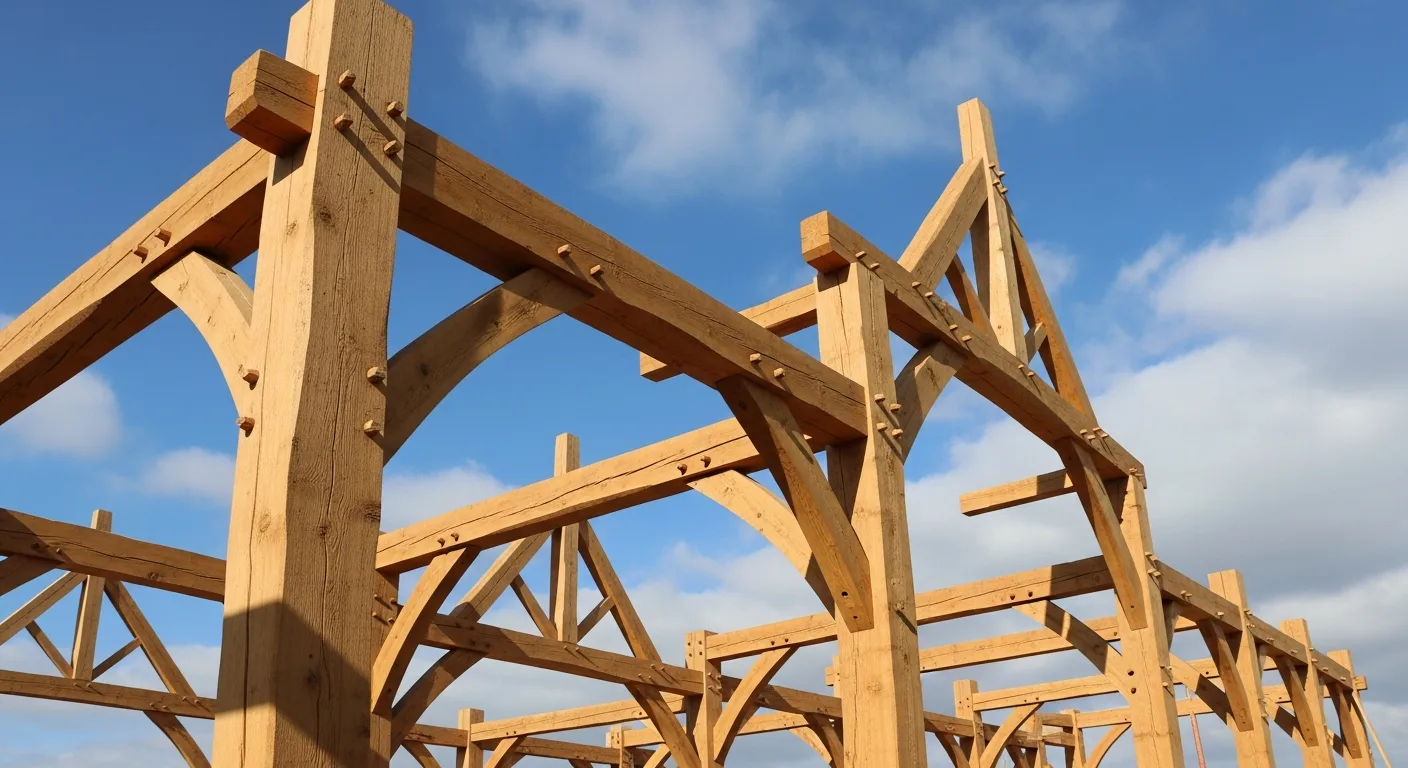
The Appeal of Heavy Timber
There is something about walking into a building framed with massive wood timbers that hits differently than any other construction method. The exposed beams, the visible joinery, the warmth of the wood grain overhead. It connects people to the building in a way that drywall and steel never will.
Timber framing is one of the oldest construction methods in the world, with examples standing for 800 years or more in Europe and Asia. In North America, the tradition arrived with European settlers and was the dominant building method until balloon framing took over in the mid-1800s. The shift happened because small-dimension lumber from sawmills was cheaper and faster to work with than hand-hewn timbers.
But timber framing never died. It went niche, kept alive by craftspeople and a growing market of clients willing to pay for the aesthetics and quality of heavy timber construction. Today, the industry is experiencing a genuine resurgence, driven by better engineering tools, CNC fabrication technology, and a market that values craftsmanship and natural materials.
For builders, timber framing and post-and-beam work is a specialty that commands premium pricing. The skills are specialized, the materials are expensive, and the results are dramatic. This guide covers the fundamentals: wood selection, joinery types, structural principles, enclosure systems, and the growing trend of hybrid timber construction.
Timber Frame vs. Post-and-Beam: Clarifying the Terms
People use these terms interchangeably, but they describe different approaches to heavy timber construction.
Timber Frame
Traditional timber framing connects members using wood-to-wood joinery: mortise and tenon, dovetail, scarf joints, and similar connections. These joints are secured with hardwood pegs (trunnels, short for “tree nails”), not metal fasteners. The frame is a self-supporting structure that relies entirely on the precision of the joinery for its strength.
This is the craft-intensive approach. Every joint is laid out, cut, test-fitted, and numbered in the shop before the frame is disassembled and shipped to the site for raising.
Post-and-Beam
Post-and-beam construction uses heavy timbers as the structural system but connects them with metal hardware: steel brackets, through-bolts, knife plates, and engineered connectors. The joinery is simpler (square cuts rather than complex mortise-and-tenon), and the metal connectors handle the structural loads.
Post-and-beam is faster to fabricate and erect, generally costs less than traditional timber framing, and allows for longer spans and heavier loads through engineered connections. The trade-off is that the metal hardware is visible (though some architects incorporate it as a design feature).
Hybrid Approaches
Most modern timber buildings blend these approaches. You might see traditional mortise-and-tenon joinery on the main bents (cross-frames) with steel connections on secondary members. Or a post-and-beam structure with decorative traditional joinery at key visual locations. The market drives these decisions: clients want the timber look, but budgets and engineering realities favor pragmatic solutions.
Wood Species for Timber Framing
The species you choose affects everything: strength, workability, appearance, durability, cost, and availability. Here are the most common species used in North American timber framing.
Douglas Fir
The go-to species for structural timber framing. Douglas fir has an excellent strength-to-weight ratio, accepts finish well, and is widely available from Western suppliers. The grain is straight, the color ranges from pinkish to reddish-brown, and it looks stunning when finished with a clear coat.
Douglas fir is graded under WCLIB or WWPA rules. For timber framing, you want Select Structural or No. 1 grade. Specify “free of heart center” (FOHC) to avoid the checking and splitting that occurs when timbers dry around the heart (pith).
White Oak
White oak is the premium choice for visible timber framing. It is extremely strong, naturally rot-resistant (the tyloses in white oak make it nearly waterproof), and has a beautiful grain pattern. White oak is traditionally associated with barn frames and high-end residential timber work.
The downsides: white oak is significantly heavier than Douglas fir, harder to work (tougher on tools), and more expensive. Availability can be limited for large timbers.
Eastern White Pine
White pine is the softest and lightest of the common timber framing species. It is easy to work with hand tools (a plus for traditional crafters), readily available in the Northeast, and relatively affordable. The light color and fine grain give it a clean, Scandinavian look.
The trade-off is lower structural strength compared to Douglas fir or oak. White pine frames need to be engineered with this in mind, often requiring larger member sizes.
Western Red Cedar
Cedar is naturally rot-resistant and dimensionally stable, making it a good choice for exposed exterior timbers, pergolas, and covered porches. It is softer and weaker than Douglas fir, so it is typically used for non-structural or lightly loaded applications.
Reclaimed Timber
Reclaimed timbers salvaged from old barns, factories, warehouses, and bridges have become extremely popular. The aged patina, nail holes, and character marks give reclaimed timber an aesthetic that new wood cannot replicate.
Working with reclaimed timber requires careful inspection for hidden metal (old nails, bolts, and spikes that destroy saw blades), insect damage, rot, and structural defects. Have reclaimed timbers graded by a qualified inspector before using them in structural applications.
Traditional Joinery
The joinery is what makes timber framing a craft. Each joint is designed to transfer specific loads (compression, tension, shear) through the geometry of the wood-to-wood connection. Here are the fundamental joints.
Mortise and Tenon
The most basic and most common timber frame joint. A rectangular hole (mortise) is cut into one member, and a matching projection (tenon) is cut on the connecting member. The tenon slides into the mortise and is secured with a hardwood peg.
Variations include:
- Through tenon: The tenon passes completely through the receiving member and is visible on both sides.
- Housed tenon: A shoulder is cut around the tenon so the connecting member seats flush against the receiving member. This provides bearing area for the load.
- Tusk tenon: A through tenon secured with a wedge or tusk on the exit side. Common in floor beam connections.
Dovetail
A flared tenon that resists withdrawal. The dovetail shape locks the joint mechanically. Common uses include connecting tie beams to posts (where the joint is in tension) and braces to beams.
Scarf Joint
When a single timber is not long enough, a scarf joint splices two timbers end-to-end. There are dozens of scarf joint variations, from simple half-laps to complex bladed scarfs with keys. The joint must handle both compression and tension since a spliced beam sees both forces.
Lap Joints
Half-lap and cross-lap joints are used where two members cross at the same elevation. Each member is notched to half its depth so they interlock. Simple but effective for secondary framing and plate connections.
Braces
Braces are the diagonal members that triangulate the frame and provide lateral stability. Typical brace joinery uses a housed mortise-and-tenon at each end, with the brace running at 45 to 60 degrees between a post and beam.
Without braces (or an equivalent lateral system like SIPs or shear panels), a timber frame is a mechanism, not a structure. It will rack and collapse under lateral loads like wind.
Structural Design Principles
Timber frame engineering follows the same principles as any structural design: loads flow through the frame to the foundation, and every member and connection must handle the forces applied to it.
Load Path
The load path in a timber frame is simple and direct:
- Roof loads (dead load, snow, wind) transfer through rafters to purlins to principal rafters or trusses
- Trusses or principal rafters transfer loads to posts through the plate (top beam)
- Floor loads transfer through joists to beams (girts or summer beams) to posts
- Posts carry accumulated loads straight down to the foundation
This direct load path is one of the structural advantages of timber framing. Every member has a clear purpose, and the loads are predictable.
Engineering Heavy Timbers
Heavy timbers are engineered using the National Design Specification (NDS) for Wood Construction, published by the American Wood Council. Design values for each species and grade are tabulated, and members are sized for bending, shear, compression, and deflection.
Key considerations:
- Checking: As green timbers dry, they develop checks (cracks along the grain). Surface checks are cosmetic and do not affect structural capacity. Deep through-checks at connection points can reduce the capacity of pegged joints.
- Shrinkage: Green timbers shrink as they dry, primarily across the grain (tangential and radial). This can affect joint fit, floor levelness, and door/window alignment. Design for it.
- Fire resistance: Heavy timber construction has excellent fire resistance. Large timbers char on the surface, forming an insulating layer that protects the inner wood. This is why the building code recognizes Type IV (Heavy Timber) as a distinct construction type with favorable fire ratings.
Engineered Timber Products
Modern timber construction frequently uses engineered products alongside solid timbers:
- Glulam (glue-laminated timber): Layers of dimension lumber glued together to create beams and columns of virtually any size. Stronger and more dimensionally stable than solid sawn timbers. Available in architectural grades with beautiful exposed finishes.
- SIPs (structural insulated panels): Rigid foam insulation sandwiched between OSB faces. Used as the enclosure system over a timber frame, providing structure, insulation, and air barrier in one step.
- CLT (cross-laminated timber): Layers of lumber glued in alternating directions to create large structural panels. Used for floors, walls, and roofs in mass timber buildings.
The Fabrication Process
A timber frame is built twice: once in the shop and once on site.
Shop Work
The shop is where the craft happens. Each timber is selected, inspected, and laid out on a work surface. The joiner marks every joint location using traditional layout tools (squares, dividers, marking gauges) or, increasingly, CNC-generated templates.
Joints are cut using a combination of tools:
- Chain mortiser: Cuts mortises quickly and accurately
- Circular saw and reciprocating saw: For tenon cheeks, shoulders, and housings
- Chisels and slicks: For fine-tuning joints and cleaning up saw cuts
- CNC machines: Large timber CNC routers can cut entire frames with extraordinary precision. CNC has dramatically increased production speed without sacrificing quality.
After cutting, the frame (or sections of it) is test-assembled in the shop to verify fit. Joints are numbered using a traditional system of Roman numerals and assembly marks so the frame can be disassembled, shipped, and reassembled on site without confusion.
Site Preparation
While the frame is being cut in the shop, site work proceeds: foundation, slab or piers, and any site-specific preparations. The foundation must be level and ready to receive the timber sill before the frame arrives.
Coordinate the crane delivery with the frame delivery. On rural sites, verify that the crane can access the building footprint and has enough reach and capacity for the heaviest timber lifts.
The Raising
Raising day is when everything comes together. The frame arrives on flatbed trucks, and a crane lifts each bent (cross-frame section) into position. The crew guides the timbers, aligns the joints, drives the pegs, and moves to the next bent.
A well-organized raising for a residential timber frame takes 2 to 5 days with a 4 to 8 person crew and a crane. The sequence matters: sills first, then bents, then connecting girts and plates, then roof structure.
Safety during a raising is critical. Workers are operating at height, handling heavy suspended loads, and driving pegs with mallets while standing on beams. Fall protection, hard hats, and a clear communication system between the crane operator and crew are mandatory.
Enclosure Systems
A timber frame is the skeleton. You still need skin, insulation, and weatherproofing. The enclosure system wraps the outside of the frame, leaving the timbers exposed on the interior.
Structural Insulated Panels (SIPs)
SIPs are the most popular enclosure system for timber frame buildings. A SIP panel consists of rigid foam insulation (EPS or polyurethane) bonded between two faces of OSB. The panels span between timbers, providing structure, insulation, and an air barrier in a single installation step.
Advantages: fast installation, high R-value per inch, minimal thermal bridging, and a tight building envelope.
Considerations: SIPs are sensitive to moisture (the OSB skins can rot if exposed to persistent wetness), require careful detailing at joints and penetrations, and can be difficult to modify after installation.
Exterior Rigid Foam and Conventional Framing
Some builders wrap the timber frame exterior with rigid foam board, then install conventional 2x framing outside of that for siding attachment. This hybrid approach gives you insulation and flexibility for running mechanicals in the exterior wall cavity.
Straw Bale and Natural Infill
In the natural building world, timber frames are sometimes infilled with straw bales, cob, or other natural materials. These approaches are niche but growing in the sustainable building market.
Managing Timber Frame Projects
Timber frame construction involves long lead times, specialized subcontractors, and precise coordination between shop fabrication and site work. The frame fabrication alone can take months, and changes after cutting begins are extremely expensive.
Tracking the project timeline from engineering through shop fabrication, delivery logistics, raising, enclosure, and finish work requires a system that handles long-duration, multi-phase projects. Projul gives builders a central platform to manage these timelines, communicate with the timber framing shop, schedule the crane and raising crew, and coordinate follow-on trades.
For custom home builders and timber frame specialists, having your project schedule, client communication, and cost tracking in one place saves hours of phone calls and email threads. Check pricing for your operation size, or request a demo to see how it fits your workflow.
Cost Considerations
Timber frame construction costs more than conventional stick framing, but the premium is not as large as many people assume.
Frame only: The timber frame package (engineering, fabrication, delivery, and raising) typically runs $25 to $50 per square foot of building footprint for a residential structure. Simple frames with fewer connections land at the low end; complex designs with curved members and intricate joinery push toward the high end.
Full project cost: The total cost of a timber frame home (including enclosure, mechanical, and finishes) generally runs 15% to 25% more than a comparable high-end stick-built home. The premium shrinks if you compare against a stick-built home with similar finish quality, since timber frame clients tend to choose high-end finishes regardless.
Where the money goes:
- Engineering: $5,000 to $20,000
- Timber material: Varies hugely by species, grade, and sourcing
- Shop labor (cutting and test assembly): The largest cost component
- Shipping: Heavy loads on flatbed trucks; distance matters
- Crane rental: $1,500 to $5,000+ per day depending on size
- Raising crew labor: 3 to 7 days for a residential frame
- Enclosure (SIPs or other): $8 to $15 per square foot installed
Hybrid Timber Construction
The fastest-growing segment of the timber frame market is hybrid construction. Rather than building the entire structure as a timber frame (which maximizes cost), hybrid projects use timber framing selectively for high-impact spaces and conventional framing for everything else.
Common hybrid approaches:
- Timber frame great room + stick-built bedrooms and utility areas. The dramatic timber ceiling goes where the family spends the most time, and standard framing handles the rest.
- Timber frame entry and porch + conventional interior. A timber frame portico or covered porch makes a strong first impression without the cost of a full timber structure.
- Exposed timber trusses in a conventionally framed building. Individual decorative trusses installed during framing give the timber look without a full timber frame system.
- Glulam beams and posts in an otherwise conventional structure. Exposed glulam ridge beams, headers, and posts provide the heavy timber aesthetic at a fraction of the cost.
Hybrid construction is a good entry point for builders who want to offer timber frame elements without committing to a full timber frame specialty. It also makes timber aesthetics accessible to clients with moderate budgets.
Wrapping Up
Timber framing is a craft that connects modern construction to centuries of building tradition. Whether you are building full timber frames, offering hybrid timber elements, or simply appreciate the structural logic of heavy timber construction, understanding the materials, joinery, and processes behind this work makes you a better builder.
The market for timber frame and post-and-beam construction continues to grow as clients seek homes and buildings that feel substantial, natural, and built to last. For builders willing to invest in the skills and relationships this work requires, it is some of the most rewarding construction you will ever do.
Frequently Asked Questions
What is the difference between timber frame and post-and-beam construction?
What wood species are best for timber framing?
How much does a timber frame home cost compared to conventional framing?
Can you insulate a timber frame building?
How long does it take to build a timber frame?
Do timber frame buildings meet building codes?
What is a raising and how does it work?
Can you add timber frame elements to a conventional house?
Related Articles

BIM Clash Detection: How to Catch Conflicts Before They Cost You on the Jobsite
BIM Clash Detection: How to Catch Conflicts Before They Cost You on the Jobsite Every contractor has a story about the...
Read More →
Asphalt Paving and Compaction Guide: Mix Types, Laydown Temperatures, and Quality Testing
Asphalt paving looks straightforward from a distance. A truck dumps material, the paver lays it down, and rollers...
Read More →
Construction Jobsite Wi-Fi & Connectivity Guide: Setting Up Reliable Internet in the Field
A practical guide to getting reliable internet on construction job sites. Learn about cellular hotspots, mesh networks,...
Read More →