
3 Free Painting Estimate Templates (2026) | Download
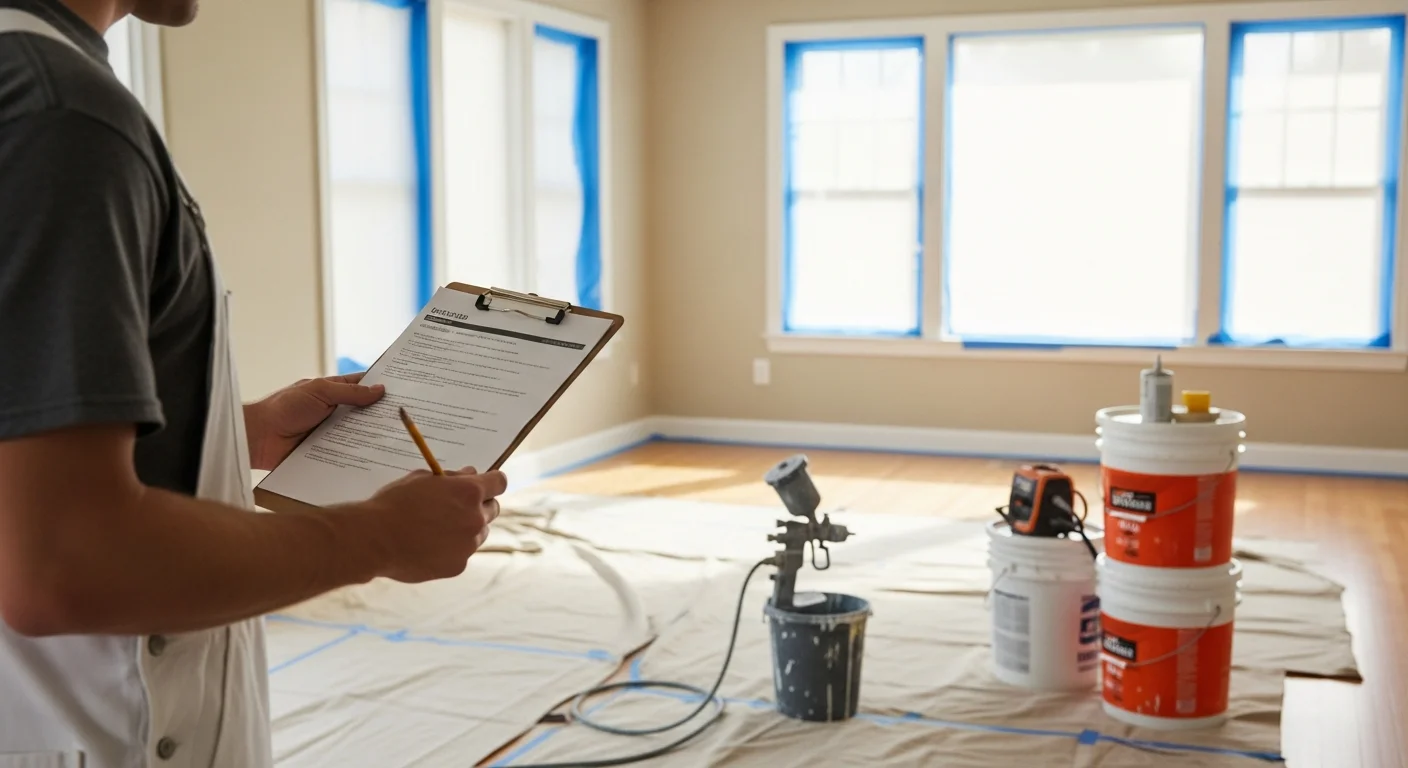
Painting contractors lose more money on bad estimates than they do on bad paint. A missed prep step, an undercount on trim footage, or a low-ball labor rate can turn a $5,000 job into a $3,500 payday before you even open the first bucket.
The tricky part about painting estimates is that the work looks simple to the customer. They see paint going on walls and think it should be cheap. Your estimate needs to show them the real scope: the prep work, the coats, the trim detail, the protection of their floors and furniture, and the cleanup. A detailed estimate educates the customer and justifies your price.
These three templates cover the most common painting jobs: an interior whole-house repaint, an exterior repaint, and a commercial painting project. Each includes realistic line items, production rates, and markup formulas you can customize for your market.
📥 Get Your Free Estimate Templates
Download Projul’s free construction estimate templates - built by contractors, ready to customize. Create professional estimates in minutes and win more jobs.
How to Use These Templates
Each template is organized into prep, materials, labor, and other costs. Here is how to make them work for you:
- Measure every surface that will be painted. Walls, ceilings, trim, doors, and any special areas.
- Assess the prep work needed: patching, sanding, caulking, priming, and masking.
- Calculate material quantities based on surface area and number of coats.
- Estimate labor hours using your crew’s production rates.
- Add overhead and profit to the total direct costs.
The costs shown are mid-range U.S. estimates for 2026. Paint prices, labor rates, and production rates vary by region. Always verify your numbers before sending a live estimate.
Template 1: Interior Whole-House Repaint Estimate
This template covers a full interior repaint of a 2,200 sq ft, 4-bedroom, 2.5-bathroom home with 9-foot ceilings. Includes walls, ceilings, trim, doors, and closets. Two coats of paint on walls, one coat on ceilings, two coats on trim.
Prep Work
| Line Item | Quantity | Unit | Unit Cost | Total |
|---|---|---|---|---|
| Move and cover furniture | 12 | rooms | $25.00 | $300.00 |
| Floor protection (rosin paper/drop cloths) | 2,200 | sq ft | $0.15 | $330.00 |
| Mask windows, hardware, and fixtures | 1 | lot | $250.00 | $250.00 |
| Patch nail holes and minor drywall repair | 1 | lot | $200.00 | $200.00 |
| Caulk trim and gaps (interior) | 400 | lin ft | $0.50 | $200.00 |
| Sand and spot-prime repairs | 1 | lot | $150.00 | $150.00 |
| Prep Subtotal | $1,430.00 |
Materials
| Line Item | Quantity | Unit | Unit Cost | Total |
|---|---|---|---|---|
| Wall paint (premium latex, eggshell) | 20 | gallons | $55.00 | $1,100.00 |
| Ceiling paint (flat white) | 7 | gallons | $45.00 | $315.00 |
| Trim paint (semi-gloss) | 5 | gallons | $60.00 | $300.00 |
| Primer (stain-blocking, spot use) | 2 | gallons | $40.00 | $80.00 |
| Caulk (painter’s, white) | 12 | tubes | $5.00 | $60.00 |
| Patching compound | 1 | quart | $12.00 | $12.00 |
| Sandpaper (assorted grits) | 1 | lot | $25.00 | $25.00 |
| Masking tape and plastic | 1 | lot | $65.00 | $65.00 |
| Roller covers, brushes, trays (consumable) | 1 | lot | $85.00 | $85.00 |
| Materials Subtotal | $2,042.00 |
Labor
| Task | Hours | Rate | Total |
|---|---|---|---|
| Prep work (patch, sand, caulk, prime) | 24 | $55.00 | $1,320.00 |
| Mask and protect | 8 | $55.00 | $440.00 |
| Paint ceilings (1 coat) | 10 | $55.00 | $550.00 |
| Paint walls (2 coats) | 36 | $55.00 | $1,980.00 |
| Paint trim and doors (2 coats) | 20 | $55.00 | $1,100.00 |
| Paint closet interiors | 6 | $55.00 | $330.00 |
| Touch-up and detail work | 4 | $55.00 | $220.00 |
| Final cleanup and walkthrough | 4 | $55.00 | $220.00 |
| Labor Subtotal |
Summary
| Amount | |
|---|---|
| Prep Work | $1,430.00 |
| Materials | $2,042.00 |
| Labor | $6,160.00 |
| Direct Cost Subtotal | $9,632.00 |
| Overhead (15%) | $1,444.80 |
| Profit (15%) | $1,661.52 |
| Total Estimate | $12,738.32 |
Tips for This Template
- Labor is 65-70% of an interior repaint. If your labor numbers are wrong, your whole estimate is wrong. Track your crew’s actual hours on the next 5 jobs and compare to your estimates.
- Price closet interiors separately. Many contractors include them by default and then get frustrated when they eat up half a day. Some customers do not want closets painted. Ask before you price them in.
- Use the homeowner’s paint selection to set material costs. Premium paint at $55-65/gallon covers better and lasts longer than $35 contractor-grade. You look better recommending quality, and you save time on the second coat.
- Always walk the final job with the customer. Touch up any spots they notice while you still have the paint and tools on site. It takes 20 minutes and prevents a callback.
Template 2: Exterior Repaint Estimate
This template covers a full exterior repaint of a 2,400 sq ft two-story home with wood siding, wood trim, and a covered front porch. Includes pressure washing, prep, prime, and two coats on siding and trim.
Prep Work
| Line Item | Quantity | Unit | Unit Cost | Total |
|---|---|---|---|---|
| Pressure wash (house and eaves) | 3,200 | sq ft | $0.25 | $800.00 |
| Scrape loose and peeling paint | 3,200 | sq ft | $0.40 | $1,280.00 |
| Sand rough areas | 1 | lot | $350.00 | $350.00 |
| Caulk windows, doors, and seams | 300 | lin ft | $0.75 | $225.00 |
| Repair/replace rotted wood (allowance) | 1 | lot | $400.00 | $400.00 |
| Prime bare wood and repairs | 400 | sq ft | $0.50 | $200.00 |
| Mask windows, doors, lights, and ground cover | 1 | lot | $350.00 | $350.00 |
| Prep Subtotal | $3,605.00 |
Materials
| Line Item | Quantity | Unit | Unit Cost | Total |
|---|---|---|---|---|
| Exterior paint (100% acrylic, satin) | 18 | gallons | $58.00 | $1,044.00 |
| Trim paint (exterior semi-gloss) | 6 | gallons | $62.00 | $372.00 |
| Primer (exterior, bonding) | 4 | gallons | $42.00 | $168.00 |
| Caulk (exterior, paintable) | 15 | tubes | $6.50 | $97.50 |
| Wood filler (exterior grade) | 2 | quarts | $15.00 | $30.00 |
| Masking materials (tape, plastic, paper) | 1 | lot | $120.00 | $120.00 |
| Roller covers, brushes, pads (consumable) | 1 | lot | $95.00 | $95.00 |
| Materials Subtotal | $1,926.50 |
Labor
| Task | Hours | Rate | Total |
|---|---|---|---|
| Pressure washing | 6 | $55.00 | $330.00 |
| Scraping and sanding | 24 | $55.00 | $1,320.00 |
| Caulking and wood repair | 8 | $55.00 | $440.00 |
| Priming bare spots | 4 | $55.00 | $220.00 |
| Masking and protection | 6 | $55.00 | $330.00 |
| Paint siding (2 coats, brush/roll/spray) | 28 | $55.00 | $1,540.00 |
| Paint trim (2 coats, brush) | 16 | $55.00 | $880.00 |
| Paint porch ceiling and posts | 6 | $55.00 | $330.00 |
| Touch-up and detail | 4 | $55.00 | $220.00 |
| Cleanup and final walkthrough | 4 | $55.00 | $220.00 |
| Labor Subtotal |
Equipment
| Item | Quantity | Unit | Unit Cost | Total |
|---|---|---|---|---|
| Ladder rental (40-ft extension) | 1 | week | $120.00 | $120.00 |
| Pressure washer (own/rental) | 1 | day | $85.00 | $85.00 |
| Airless sprayer (own/consumables) | 1 | job | $75.00 | $75.00 |
| Equipment Subtotal | $280.00 |
Summary
| Amount | |
|---|---|
| Prep Work | $3,605.00 |
| Materials | $1,926.50 |
| Labor | $5,830.00 |
| Equipment | $280.00 |
| Direct Cost Subtotal | $11,641.50 |
| Overhead (15%) | $1,746.23 |
| Profit (15%) | $2,008.16 |
| Total Estimate | $15,395.89 |
Tips for This Template
- Exterior prep is where jobs go sideways. A house that looks like a simple repaint from the street might have 20 hours of scraping hiding under the eaves. Always inspect up close before you price.
- Include a wood repair allowance in every exterior estimate. Rotted trim, window sills, and fascia boards are almost guaranteed on homes older than 15 years. $400-800 covers minor repairs. Major rot is a separate scope.
- Weather is your enemy. Build 2-3 weather buffer days into your schedule. Painting on wet wood or in high humidity leads to adhesion failures, bubbling, and callbacks.
- Spray vs. brush/roll affects your labor hours dramatically. Spraying siding cuts application time by 40%, but masking takes longer. Price accordingly based on your crew’s method.
Template 3: Commercial Interior Painting Estimate
This template covers a 5,000 sq ft commercial office repaint. Includes walls and ceilings in 12 offices, 2 conference rooms, hallways, and a lobby. Work performed after business hours (evenings and weekends).
Prep Work
| Line Item | Quantity | Unit | Unit Cost | Total |
|---|---|---|---|---|
| Cover/protect carpet and furniture | 5,000 | sq ft | $0.10 | $500.00 |
| Mask door frames, windows, and fixtures | 1 | lot | $350.00 | $350.00 |
| Patch and repair drywall (commercial wear) | 1 | lot | $400.00 | $400.00 |
| Sand and prime patches | 1 | lot | $150.00 | $150.00 |
| Prep Subtotal | $1,400.00 |
Materials
| Line Item | Quantity | Unit | Unit Cost | Total |
|---|---|---|---|---|
| Wall paint (commercial-grade latex, eggshell) | 30 | gallons | $48.00 | $1,440.00 |
| Ceiling paint (flat, commercial grade) | 12 | gallons | $42.00 | $504.00 |
| Primer (stain-blocking) | 3 | gallons | $40.00 | $120.00 |
| Patching compound and caulk | 1 | lot | $60.00 | $60.00 |
| Masking materials | 1 | lot | $150.00 | $150.00 |
| Roller covers, brushes, spray tips | 1 | lot | $120.00 | $120.00 |
| Materials Subtotal | $2,394.00 |
Labor
| Task | Hours | Rate | Total |
|---|---|---|---|
| Prep (patch, sand, mask) | 20 | $55.00 | $1,100.00 |
| Prime stained/repaired areas | 4 | $55.00 | $220.00 |
| Paint ceilings (1 coat, spray) | 8 | $55.00 | $440.00 |
| Paint walls (2 coats, spray and back-roll) | 32 | $55.00 | $1,760.00 |
| Cut-in detail work (corners, trim) | 16 | $55.00 | $880.00 |
| Touch-up and punch list | 6 | $55.00 | $330.00 |
| Daily setup and cleanup (after-hours) | 10 | $55.00 | $550.00 |
| Labor Subtotal |
Other Costs
| Item | Quantity | Unit | Unit Cost | Total |
|---|---|---|---|---|
| After-hours premium (10%) | 1 | lot | $528.00 | $528.00 |
| Airless sprayer consumables | 1 | lot | $85.00 | $85.00 |
| Other Subtotal | $613.00 |
Summary
| Amount | |
|---|---|
| Prep Work | $1,400.00 |
| Materials | $2,394.00 |
| Labor | $5,280.00 |
| Other Costs | $613.00 |
| Direct Cost Subtotal | $9,687.00 |
| Overhead (12%) | $1,162.44 |
| Profit (12%) | $1,301.93 |
| Total Estimate | $12,151.37 |
Tips for This Template
- After-hours work costs more. Period. Add a 10-15% premium for evening and weekend shifts. Your crew does not want to work nights for the same pay, and you should not absorb that cost.
- Commercial work is often spray-heavy. Budget for spray tips, filters, and cleanup time. Overspray in an occupied office is a serious problem, so your masking needs to be thorough.
- Get the color schedule in writing before you start. Commercial clients change their minds on colors more often than residential ones, and reprinting an entire conference room costs real money.
- Commercial clients expect a per-square-foot price for comparison. Even if you estimate by the hour internally, present your total divided by the area as a reference point. For commercial repaints, $2.00-3.00 per sq ft installed is typical in 2026.
Adjusting These Templates for Your Business
Know Your Production Rates
Production rates are the foundation of every painting estimate. Track how many square feet your crew paints per hour by surface type and condition:
- Walls (latex, smooth, 2 coats): 150-200 sq ft per painter per hour
- Ceilings (flat, roller): 200-250 sq ft per painter per hour
- Trim (brush, semi-gloss): 50-80 lin ft per painter per hour
- Exterior siding (brush/roll): 100-150 sq ft per painter per hour
- Exterior siding (spray): 300-500 sq ft per painter per hour
These are averages. New construction is faster. Old homes with heavy prep are slower. Track your real numbers and adjust your templates accordingly.
Calculate Your Labor Burden
If your painter makes $22/hour in wages, your actual cost per hour is higher once you add payroll taxes (7.65%), workers comp (5-10%), insurance, PTO, and vehicle costs. Most painting companies find their burdened rate is 30-40% higher than the base wage. A $22/hour painter actually costs $29-31/hour. Your billing rate of $55/hour needs to cover that cost plus overhead and profit.
Price Materials at Retail Plus Markup
Buy paint at contractor pricing (typically 25-40% off retail) and charge the customer retail or retail plus 10%. This gives you a material margin that helps cover the small items (tape, caulk, sandpaper) you might not itemize. Most painting contractors earn 20-35% margin on materials.
Go Digital
Painting estimates get complicated when you are tracking 12 rooms, 3 paint colors, different sheen levels, and separate prep requirements for each area. Projul’s estimating tools let you build and send painting estimates from your phone, track customer approvals, and convert to work orders. No more lost sticky notes. Schedule a demo to see how it works for painters.
Common Mistakes That Cost Painters Money on Estimates
Underestimating prep time. Prep is 60-80% of your labor on most repaints. If you estimate 20 hours of prep and it takes 30, that is 10 hours of free labor your business just donated. Walk every room and assess the prep condition before you estimate.
Not counting trim and doors separately. Trim work takes 3-4 times longer per square foot than wall painting. A house with crown molding, chair rail, window casings, 15 interior doors, and baseboards throughout could have 30+ hours of trim labor. Price it as a separate line item.
Forgetting multiple paint colors. Every color change adds time for cleaning equipment, masking color transitions, and the risk of bleed-through. If the homeowner wants 5 different wall colors, your labor is 15-20% higher than a single-color job. Price each color zone separately.
Using contractor-grade paint to save money. Cheap paint covers poorly, requires more coats, and does not hold up. You save $15 per gallon on materials and lose $200 in extra labor for the third coat. Always recommend and price premium paint.
Not including a touch-up visit. Plan for a 1-2 hour return visit after the paint has fully cured (2-4 weeks). The customer will find spots you missed under different lighting. A scheduled touch-up visit is far better than an angry phone call.
What Every Painting Estimate Needs Beyond the Numbers
- Scope of work. “Repaint all interior walls (2 coats, eggshell), ceilings (1 coat, flat white), and trim (2 coats, semi-gloss) in all rooms including closets. 4 bedrooms, 2.5 bathrooms, kitchen, living room, dining room, hallways.”
- Paint specifications. Brand, product line, sheen, and color names/numbers for each area.
- Number of coats. Specify coats for each surface. Two coats on walls is standard. Dark-to-light color changes may need three.
- Prep details. List specific prep work: “Patch 12 nail holes, caulk all trim joints, sand and prime ceiling water stain in master bath.”
- What you will protect. “All floors covered with rosin paper and drop cloths. Furniture moved to center of each room and covered.”
- Timeline. “Interior repaint: 5-7 working days for a 2-man crew. Touch-up visit within 2 weeks of completion.”
- Payment terms. “33% deposit at signing, 33% at midpoint, 34% at final walkthrough.” Use construction contract templates to formalize these terms.
- Warranty. “2-year warranty on workmanship including peeling, bubbling, or flaking caused by prep or application defects.”
- Exclusions. “Does not include wallpaper removal, lead paint abatement, exterior painting, or cabinet refinishing.”
How to Estimate a Painting Job Step by Step
Whether you are new to running a painting business or just want a tighter process, here is how to build a painting estimate from scratch.
Step 1: Walk the job site. Never estimate from photos alone. Walk every room, check every surface, and look for damage. Bring a notepad, tape measure, and a flashlight for checking trim and corners.
Step 2: Measure all paintable surfaces. For walls, multiply the perimeter of each room by the ceiling height. Subtract windows (about 20 sq ft each) and doors (about 21 sq ft each). For ceilings, multiply length by width. For trim, measure linear feet of baseboards, crown molding, window casings, and door frames. Write it all down by room so you can price each area.
Step 3: Assess the prep work. This is where most painters lose money. Look for peeling paint, nail holes, drywall cracks, water stains, and caulk gaps. Exterior jobs need a close look at wood rot, chalking, and mildew. List every prep task and estimate the hours for each one. Do not group prep into one lump number.
Step 4: Choose your materials. Pick the paint brand, product line, sheen, and number of coats for each surface. Calculate gallons based on your measured square footage and the paint’s coverage rate (check the data sheet). Add primer, caulk, tape, and consumables to the list.
Step 5: Calculate labor hours. Use your production rates to convert square footage into hours. For example, if your crew paints 175 sq ft of wall per hour (2 coats), a room with 500 sq ft of wall area takes about 2.9 hours of painting time. Add prep, masking, and cleanup hours separately.
Step 6: Add overhead and profit. Your overhead covers insurance, vehicle costs, office expenses, marketing, and everything else that keeps your business running. Most painting contractors add 10-15% for overhead and 10-20% for profit on top of direct costs. If your total feels too high, do not cut your profit. Find ways to work more efficiently instead.
Step 7: Present a clean estimate. Send a professional, itemized estimate that shows the customer exactly what they are getting. Include the scope, materials, timeline, and payment terms. Projul’s estimate tools let you build and send this from your phone in minutes.
Interior vs Exterior Painting Estimates: Key Differences
Interior and exterior painting estimates look similar on paper, but the costs, risks, and line items are very different. Here is what changes between the two.
Prep work is heavier on exteriors. Interior prep is mostly patching nail holes, caulking trim, and light sanding. Exterior prep includes pressure washing, scraping old paint, replacing rotted wood, and priming bare surfaces. Exterior prep can take twice as long as the actual painting. Budget 60-80% of your labor hours for prep on any exterior repaint.
Materials cost more outside. Exterior paint is formulated to resist UV, moisture, and temperature swings. A gallon of quality exterior acrylic runs $55-65 compared to $45-55 for interior latex. You also need exterior-grade caulk, bonding primer, and wood filler that costs more than their interior counterparts.
Equipment adds up on exteriors. Interior work needs ladders, drop cloths, and basic tools. Exterior work may require a 40-foot extension ladder, scaffolding, a pressure washer, and an airless sprayer. Include equipment rental or depreciation as a separate line item on every exterior estimate.
Weather is a factor outside. You cannot paint exteriors in the rain, in high humidity, or when temperatures drop below 50 degrees. Build 2-3 buffer days into your exterior schedule. Interior work is not weather-dependent, so your timeline is more predictable.
Liability is higher on exteriors. Working at heights means higher workers comp rates and more risk. If your crew is painting a two-story home from a 32-foot ladder, your insurance costs are higher than a crew rolling walls in a living room. Factor this into your overhead percentage.
Pricing per square foot differs. Interior repaints typically run $2.00-4.00 per sq ft. Exterior repaints run $1.50-3.50 per sq ft but can spike to $5.00+ on homes with heavy prep, difficult access, or multiple stories. Always calculate your actual costs rather than relying on per-square-foot rules of thumb.
For both types, tracking your actual job costs against your estimates is the fastest way to improve your pricing accuracy over time.
Related Estimate Templates
Looking for templates beyond painting? Projul offers free estimate templates for every trade. Here are some that painting contractors find useful:
- Free Drywall Estimate Templates - Drywall repair and installation are common add-ons for painting contractors.
- Free General Contractor Estimate Templates - Useful if you handle full remodel projects alongside paint work.
- Free Flooring Estimate Templates - Flooring and painting often happen on the same remodel job.
- Free Deck Building Estimate Templates - Deck staining and painting is a natural extension for exterior painters.
- Free Siding Estimate Templates - Siding replacement and painting go hand in hand on exterior projects.
- Free Cabinet and Countertop Estimate Templates - Cabinet painting and refinishing is a high-margin service many painters add.
- Free Bathroom Remodel Estimate Templates - Bathroom repaints are part of almost every bathroom renovation.
- Free Construction Change Order Templates - Protect your profits when the customer changes the scope mid-job.
Want all of these in one place? Visit our free estimate templates resource page to download templates for 30+ trades.
Frequently Asked Questions
Check the FAQ section above for answers to common questions about measuring for paint estimates, material quantities, profit margins, pricing methods, and budgeting for prep work.
Start Sending Better Estimates Today
These templates give you a strong starting point for interior repaints, exterior repaints, and commercial painting projects. Plug in your production rates and material costs, add your company branding, and start winning more jobs with detailed, professional estimates.
If you want to send estimates faster and stop losing bids to painters who respond first, Projul’s estimating features let you build, send, and track painting estimates from your phone. No per-user fees. Built for painting companies and every other trade. Schedule a live demo and see the difference.
📥 Get Your Free Estimate Templates
Download Projul’s free construction estimate templates - built by contractors, for contractors. Create professional estimates in minutes and win more jobs.
DISCLAIMER: We make no warranty of accuracy, timeliness, and completeness of the information presented on this website. Posts are subject to change without notice and cannot be considered financial advice.
Frequently Asked Questions
How do painters calculate square footage for an estimate?
How much paint does a painter need per job?
What profit margin should painting contractors target?
Should painters charge by the square foot or by the hour?
How much should a painting estimate include for prep work?
What is a good price per square foot for painting?
How long does it take to paint a house interior?
Do painters need a contract or just an estimate?
Related Articles

Concrete Tilt-Up Construction: A Contractor's Complete Field Guide
Tilt-up construction accounts for roughly 15 percent of all industrial and commercial buildings in North America. This...
Read More →
How to Implement Construction Software Without Losing Your Mind
Most construction software rollouts fail. Not because the software is bad, but because the rollout was rushed. Here are...
Read More →
How Selections Can Pay for Themselves in Three Easy Steps
Most contractors lose thousands each year on wrong material orders, slow client decisions, and missed upsell chances....
Read More →