Clone Projects, Estimates & Tasks
Schedule a Demo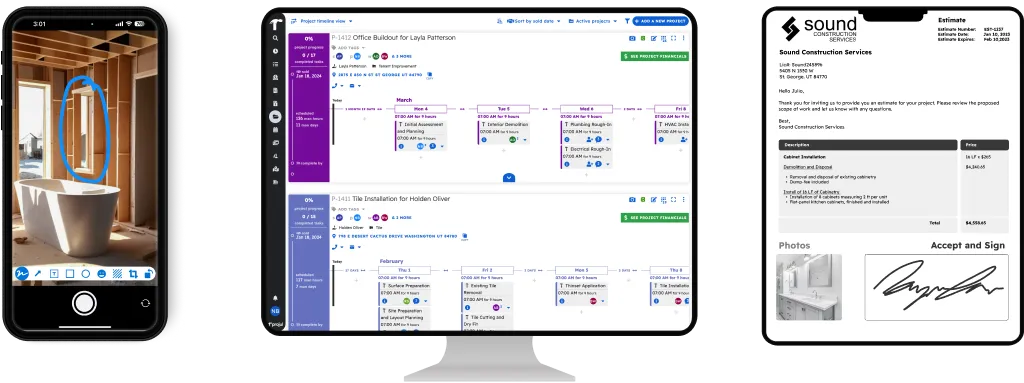
Clone Construction Projects in Seconds
If you’re a contractor who builds similar jobs over and over, you already know the pain. Every new kitchen remodel, every bathroom renovation, every roof replacement starts with the same tasks, the same materials, the same schedule. And every time, you’re typing it all out again from scratch.
That’s where cloning comes in. Projul lets you clone construction projects, duplicate estimates, and reuse schedules so you never rebuild the same job twice. Over 5,000 contractors use Projul’s cloning tools to skip the repetitive setup and get straight to the work that actually matters.
Projul’s Project Cloning lets contractors duplicate entire projects, estimates, and schedules in seconds so repeat jobs never start from scratch. Save templates once and reuse them on every similar job. Projul offers flat-rate pricing with no per-user fees for construction companies of all sizes.
Build a project once. Save it. Reuse it forever. A few clicks and your new job has the same structure, tasks, materials, and schedule as the last one. Make a couple tweaks for the specifics and you’re already running.
Why Cloning Saves Hours on Repeat Work
Think about how much time your office spends setting up new projects. You pull up the last similar job, open a spreadsheet or your old software, and start copying line items one at a time. Maybe you forget a task. Maybe you miss a material. Maybe your estimator spends 45 minutes rebuilding something that already existed.
Multiply that by every new job, every week, every month. For contractors running 10, 20, or 50 active projects, that’s hundreds of hours a year spent on setup that adds zero value.
Cloning fixes this. When you clone a project in Projul, every task, every estimate line item, every schedule entry comes with it. Your team isn’t retyping. They’re reviewing and adjusting, which takes minutes instead of hours.
Contractors using Projul report saving 2+ hours daily on administrative work. A big chunk of that comes from cloning. When your estimator can duplicate a proven estimate in 30 seconds instead of rebuilding it in 30 minutes, that time goes back into winning more bids and managing more jobs.
And it’s not just about speed. Cloning reduces mistakes. When you start from a proven template instead of a blank page, you don’t forget the dumpster rental or leave out the final inspection task. Your projects start clean and complete every time.
What You Can Clone in Projul
Projul doesn’t limit cloning to just projects. You can clone individual pieces and mix them together however you need.
Full projects. Save any completed or active project as a template. The next time a similar job comes in, clone the whole thing. Tasks, schedule, estimate, steps, and assignments all carry over. Assign it to the new client, pick your start date, and you’re running.
Estimates. This is where contractors save the most time. Save your best estimates as templates, labor, materials, hard costs, margins, and all. When a new bid comes in, clone the closest estimate, adjust the quantities, and send it out. No more rebuilding a 50-line estimate from memory.
Estimate sections. Projul goes a step further and lets you save individual sections of an estimate as templates. Got a standard electrical rough-in section? A standard finish carpentry section? Save each one separately and mix and match them to build a detailed estimate in under a minute. This is huge for contractors who do varied work but have repeatable components.
Schedules. Save a schedule as a template and apply it to any new job. Pick the start date and Projul automatically slides every task to the right dates. You choose whether to keep the same crew assignments or swap in different workers for the new job.
Tasks. Individual tasks and task groups can be saved and reused across projects. If you have a standard punch list or a standard closeout process, save it once and drop it into every job.
How Cloning Works, Step by Step
Setting up cloning in Projul is simple. Here’s the process:
-
Build your first project the right way. Put in the time on your first kitchen remodel, your first reroof, your first bathroom gut. Get the estimate right, the schedule dialed, and the tasks organized.
-
Save it as a template. One click saves the whole project, or just the estimate, or just the schedule. Name it something obvious like “Standard Kitchen Remodel” or “3-Day Reroof.”
-
Clone it when the next similar job comes in. Select your template, assign the new client, pick the start date, and Projul builds the project for you. All the tasks, materials, and schedule entries are there.
-
Tweak the details. Every job is a little different. Swap out the countertop material, adjust the square footage, change a couple task dates. But you’re editing, not creating from scratch. That’s the difference.
-
Start working. Your crew sees the tasks on their phones. Your client gets a polished estimate. Your schedule is set. And you spent five minutes on setup instead of an hour.
Clone Estimates and Convert Them to Tasks
Here’s a workflow that saves contractors serious time. Build an estimate using your cloned template, get it approved by the client, then convert that estimate directly into project tasks with a couple of clicks.
That means the line items in your estimate become the tasks your crew works from. No re-entering the scope of work. No miscommunication between what was estimated and what gets built. The estimate and the project stay connected from bid to completion.
This is especially useful for GCs who need to keep their estimates and project plans aligned. When a change order comes through, you update the estimate and the tasks reflect the change. Everything stays in sync.
Cloning for Different Trades
Different trades get different benefits from cloning. Here’s how contractors across the industry use it:
Remodelers build templates for kitchen remodels, bathroom renovations, and additions. Each template includes trade-specific tasks, standard material lists, and typical timelines. A new kitchen job goes from “just sold” to “fully scheduled” in under five minutes.
Roofers clone estimates by roof type and size. A standard shingle tear-off and replace has the same materials and labor every time. Clone the estimate, adjust the square footage, and the bid is ready.
HVAC contractors template their install schedules and equipment lists. When a new system install comes in, they clone the closest template and swap in the specific equipment model. The schedule and tasks are already set.
GCs running multiple subdivisions clone entire projects for each lot. Same floorplan, same schedule, same subs. Clone it, assign the lot number, and the project is ready to manage.
Why Cloning Beats Starting From Scratch
Every contractor has a system for setting up new jobs. Maybe it’s a spreadsheet you copy and paste from. Maybe it’s opening the last similar project in your old software and manually re-entering every line item. Maybe it’s working from memory and hoping you don’t forget anything.
All of those methods have the same problem: they eat time and introduce mistakes.
Here’s what happens when you start every project from a blank page:
You waste time on work that’s already been done. If you’ve built 30 kitchen remodels, you already know the tasks, the materials, and the schedule. But without cloning, your office is rebuilding that same project structure every single time. That’s not productive work. That’s busywork.
You miss line items. This is the expensive one. When you’re typing out a 40-line estimate from memory, you’re going to forget something. Maybe it’s the permit fee. Maybe it’s the final clean. Maybe it’s the haul-off cost for demolition debris. Whatever it is, that forgotten line item comes straight out of your margin. On a $50,000 kitchen remodel, a missing $1,200 dumpster rental doesn’t seem like much. But miss it on 20 jobs a year and that’s $24,000 in lost profit.
Your pricing drifts. When different estimators build the same type of estimate from scratch, they price things differently. One person remembers to include overhead on materials. Another one doesn’t. One person marks up electrical subs at 15%. Another uses 10%. Without a standard starting point, your pricing is inconsistent across jobs - and inconsistent pricing means inconsistent margins.
Your team can’t scale. If every new project requires 45 minutes to an hour of setup, you’re limited by how fast your office can process new work. Hiring another project manager to handle setup doesn’t add value. It just adds payroll. Cloning lets you handle more projects without adding headcount because the setup work drops from an hour to five minutes.
Cloning fixes all of this in one move. You build the perfect version of a project once. You save it. And then every time a similar job comes in, you start from that proven foundation. The line items are all there. The pricing is standardized. The schedule is set. Your team isn’t creating - they’re reviewing and adjusting. That’s faster, more accurate, and way easier to scale.
Think about it this way: a general contractor running 15 active projects who saves 45 minutes per project setup is saving over 11 hours a month. That’s nearly a full day and a half of office time, every month, just from cloning. Over a year, that’s more than 130 hours. What would you do with 130 extra hours?
Most contractors we talk to say the same thing: “I didn’t realize how much time we were wasting on setup until we stopped doing it.” Cloning doesn’t just save time. It gives you back the capacity to take on more work without burning out your team.
And the consistency piece matters more than most people think. When every project starts from the same proven template, your crews know what to expect. Your subs see the same task structure every time. Your clients get estimates that look professional and thorough. That consistency builds trust - with your team, your subs, and your customers.
The bottom line: starting from scratch is a choice, and it’s an expensive one. Cloning is faster, more accurate, and more profitable. Once you try it, you won’t go back.
What You Can Clone in Projul
Projul gives you cloning tools at every level of your project - from the full job all the way down to a single task. Here’s a detailed breakdown of what you can duplicate and how each piece works.
Full Projects
When you clone a full project in Projul, you’re copying the entire structure of a job. That includes:
- Every task and subtask in the project, organized the same way as the original
- The full schedule with task durations and dependencies intact
- Budget line items so your cost tracking starts from a proven baseline
- Steps and checklists attached to each task, so your crew sees the same detailed instructions
- File and photo organization structure (folders carry over, even if the actual files don’t)
You pick the new client, choose a start date, and Projul builds the project for you. The scheduling engine automatically shifts all task dates based on your new start date, keeping the same durations and sequences. If your original kitchen remodel had a 3-day demo phase followed by a 5-day rough-in, the cloned version keeps that exact sequence - just anchored to whenever the new job kicks off.
This is especially powerful for contractors who run the same type of job repeatedly. If you do 80% bathroom remodels, you probably only need two or three project templates to cover most of your work. Clone the right one, adjust for the specifics of the new bathroom, and you’re managing instead of setting up.
Estimates
Estimate cloning is where most contractors see the biggest time savings. A detailed construction estimate can have 30, 50, or even 100+ line items. Rebuilding that from scratch for every bid is painful. With Projul, you save your best estimates as templates and clone them in seconds.
When you clone an estimate, everything comes with it:
- All line items with quantities, unit costs, and descriptions
- Assemblies - groups of related line items that belong together (like all the materials and labor for a standard shower install)
- Markup percentages and profit margins, applied exactly the way you set them
- Cost categories (labor, materials, subcontractor, equipment) already organized
- Notes and descriptions that your client sees on the final estimate
The power of estimate cloning really shows up when you combine it with assemblies. An assembly is a pre-built group of line items - say, everything needed for a standard electrical rough-in in a 200-square-foot bathroom. You build the assembly once with all the materials, labor hours, and costs. Then you drop that assembly into any estimate with one click.
So your workflow becomes: clone the overall estimate template, swap out a couple of assemblies for the specifics of this job, adjust quantities, and send. What used to take 45 minutes now takes five.
Estimate Sections
This is a feature that separates Projul from most construction software. You don’t have to clone an entire estimate. You can save individual sections as templates and mix and match them to build a custom estimate fast.
Here’s how contractors use this in practice. Say you’re a remodeler who does kitchens, bathrooms, and full-home renovations. Your full-home reno estimate might include:
- A kitchen section (cabinets, countertops, appliances, plumbing, electrical)
- A bathroom section (tile, fixtures, vanity, plumbing, electrical)
- A flooring section (demo, subfloor prep, material, installation)
- A painting section (prep, prime, two coats, trim, ceilings)
- A general conditions section (permits, dumpsters, porta-potty, final clean)
Each of those sections is saved as its own template. When a new job comes in that needs a kitchen and two bathrooms but no flooring work, you pull in the kitchen section template, drop in the bathroom section template twice, add general conditions, and you’ve got a detailed estimate built from proven components - in under two minutes.
This modular approach means you can handle varied work without starting from zero every time. Even if no two jobs are exactly alike, the individual pieces are often very similar.
Schedules
Schedule templates save you from manually building out timelines for every new job. When you save a schedule as a template, Projul captures:
- All tasks and their durations
- Task dependencies (what has to finish before the next thing starts)
- Crew size assumptions
- Milestone markers
When you apply a schedule template to a new project, you pick the start date and Projul does the math. Every task slides to the correct date automatically. A 6-week kitchen remodel template that starts on March 1st looks exactly like one that starts on April 15th - just shifted forward. No manual date entry required.
You also choose whether to keep crew assignments from the template or start fresh with different workers. This is useful for contractors who have multiple crews and want to assign the right team for each job while keeping the same schedule structure.
Individual Tasks
Sometimes you don’t need to clone a whole project or estimate. You just need to reuse a specific task or task group across jobs. Projul lets you save individual tasks as templates and drop them into any project.
Common examples include:
- A standard punch list task group with 15-20 common items
- A closeout process with final inspection, client walkthrough, warranty handoff, and final payment collection
- A pre-construction checklist covering permits, utility locates, material orders, and sub confirmations
- A safety orientation task with attached documentation and sign-off requirements
These task templates keep your processes consistent across every job. Your closeout process doesn’t depend on which project manager remembers what - it’s the same every time because it comes from the same template.
Real Scenarios Where Cloning Saves Hours
Cloning sounds good in theory. But the real value shows up in how actual contractors use it every day. Here are three common scenarios where cloning turns hours of work into minutes.
Tract Home Builders Running 50+ Identical Houses
If you’re a production builder putting up a subdivision, you might have three or four floor plans that repeat across 50, 80, or 100+ lots. Every house with the same floor plan has the same tasks, the same materials, the same schedule, and the same budget.
Without cloning, your project coordinator is setting up each lot manually. Even if they’re fast, that’s 30-45 minutes per lot. Multiply that by 50 lots and you’ve spent over 37 hours just on project setup. That’s almost a full work week doing nothing but data entry.
With Projul’s cloning, here’s what the process looks like:
- Build the project for the first lot with the floor plan. Get everything perfect - tasks, schedule, estimate, budget, steps.
- Save it as a template called “Maple 3BR/2BA Floor Plan” (or whatever you name it).
- For every subsequent lot with that floor plan, clone the template. Assign the lot number, pick the start date, and done.
- Total setup time per lot: about 3-5 minutes, mostly spent assigning the lot and confirming the start date.
Over 50 lots, you’ve gone from 37+ hours of setup to about 4 hours. That’s 33 hours saved on a single subdivision. And the quality is better because every lot starts with the same proven structure. No missed tasks, no forgotten inspections, no inconsistent budgets.
Production builders using Projul often create a template for each floor plan and each elevation. Some also create separate templates for lots with upgrades (finished basements, expanded garages, premium appliance packages) so they can clone the right version immediately without making manual adjustments.
Remodelers With Standard Kitchen and Bath Packages
Most remodeling companies have a handful of standard packages they offer. Maybe it’s a “Standard Kitchen Remodel,” a “Premium Kitchen Remodel,” and a “Luxury Kitchen Remodel.” Or maybe it’s broken down by scope: “Kitchen - Cabinets and Counters Only,” “Kitchen - Full Gut,” and “Kitchen - Layout Change.”
Each of those packages has a predictable estimate with known line items, known labor hours, and known material costs. The specifics change from job to job (granite vs. quartz, 10-foot run vs. 12-foot run), but the structure stays the same.
Here’s how a remodeler uses cloning to handle this:
Step 1: Build your package estimates. Create a detailed estimate for each standard package. Include every line item you’d typically need - demo, rough plumbing, rough electrical, cabinets, countertops, backsplash, flooring, painting, fixtures, appliances, permits, and cleanup. Price everything at your standard rates.
Step 2: Save each as a template. Now you have three or four estimate templates ready to go.
Step 3: When a new lead comes in, clone the closest template. Customer wants a full kitchen gut with mid-range finishes? Clone “Kitchen - Full Gut.” Adjust the linear footage, swap the countertop material from granite to quartz, update the appliance allowance, and the estimate is done in 10 minutes.
Step 4: Send it with eSignatures. The client reviews and signs right from their phone or computer. No printing, no scanning, no chasing paper.
The time savings add up fast. If your estimator handles five kitchen bids a week and cloning saves 30 minutes per bid, that’s 2.5 hours a week - or 130 hours a year. That’s over three full work weeks of estimating time saved, every year.
But the bigger win is consistency. Every estimate your company sends follows the same format, includes the same line items, and applies the same markups. Your pricing is predictable, your margins are protected, and your clients see a professional, thorough estimate every time.
Commercial Contractors Bidding Similar Tenant Improvements
Commercial contractors who do tenant improvement (TI) work often bid on similar spaces. A 2,000-square-foot office buildout in one suite looks a lot like the 2,000-square-foot buildout three floors up. The framing, drywall, ceiling grid, flooring, electrical, and HVAC distribution follow similar patterns.
Without cloning, your estimator is rebuilding a 60-80 line item estimate for every TI bid. They’re pulling up the last similar job, cross-referencing line items, and manually entering everything into the new estimate. It works, but it’s slow and error-prone.
With Projul, the approach changes completely:
- Save your best TI estimates as templates organized by size range and scope (small office 1,000-2,000 SF, medium office 2,000-5,000 SF, large office 5,000+ SF).
- Clone the closest template when a new bid request comes in.
- Adjust for the specific space - update square footage quantities, swap in the specified flooring material, adjust the ceiling height, update the HVAC distribution based on the mechanical engineer’s design.
- Send the bid knowing that every line item is accounted for because you started from a proven template that’s already been used on successful jobs.
Commercial contractors tell us the biggest benefit isn’t just speed - it’s accuracy. TI bids are competitive, and the contractor who includes every line item (and prices them correctly) wins more often than the one who forgets the fire caulking or underestimates the ceiling grid. Cloning from a proven template means you’re starting with a complete scope every time.
Some commercial contractors take this even further by saving section templates for specific building systems. They have a template section for standard drywall partitions, one for glass office fronts, one for break room buildouts, and one for server room requirements. When a new TI bid comes in, they assemble the estimate from these sections like building blocks - pulling in exactly the sections they need for that particular space.
Clone, Customize, Send: The Fastest Way to Bid
Speed wins bids. When a potential client asks for an estimate, the contractor who responds first and most professionally has a serious advantage. Cloning makes that possible without cutting corners on accuracy.
Here’s the complete workflow from incoming lead to signed estimate, using Projul’s cloning tools:
Step 1: The Lead Comes In
A homeowner calls about a bathroom remodel. Your office takes the basic info: name, address, scope of work (full gut, not just cosmetic), approximate bathroom size (about 80 square feet), and any special requests (walk-in shower instead of tub, heated floors).
You create the client in Projul and start a new project.
Step 2: Clone Your Closest Estimate Template
You’ve got a saved template called “Bathroom - Full Gut - Standard.” It was built from your best recent bathroom job and includes every line item your team typically needs:
- Demo (tile, fixtures, vanity, drywall as needed)
- Rough plumbing (shower valve, drain relocation, supply lines)
- Rough electrical (fan, lighting, GFCI outlets, heated floor circuit)
- Waterproofing (membrane, backer board, curb construction)
- Tile (floor, shower walls, shower floor, niche)
- Fixtures (shower head, valve trim, toilet, vanity faucet)
- Vanity and countertop
- Mirror and accessories
- Paint
- Finish electrical (switches, outlets, light fixtures, fan)
- Finish plumbing (trim, toilet set, faucet install)
- Final clean and punch list
- Permits and inspections
You clone this template into the new project. All 40+ line items appear instantly with your standard quantities, unit costs, and markups already applied.
Step 3: Customize for This Specific Job
Now you adjust. This bathroom is 80 square feet instead of the 60 in your template, so you update the tile quantities. The client wants heated floors, and your template already includes a heated floor line item - you just confirm the square footage. They want a frameless glass shower door instead of the standard, so you swap that line item.
Total time adjusting: about 8-10 minutes. You’re reviewing and tweaking, not building from nothing.
Step 4: Review Your Numbers
With the adjustments made, you review the estimate total. Your markups are already applied from the template, so your margin is consistent with your other bathroom jobs. You double-check the labor hours against the scope and make sure the material quantities make sense for the space.
Because you started from a proven template, you’re not second-guessing whether you included everything. You know you did, because this template has been used on 15 previous bathroom remodels and it’s been refined each time.
Step 5: Send With eSignatures
Here’s where the speed advantage really kicks in. You hit send, and the client receives a professional, itemized estimate on their phone or computer. They review it, ask any questions through Projul’s client portal, and sign electronically with eSignatures.
No printing. No scanning. No meeting just to hand over paperwork. No waiting for the mail. The client can approve the estimate from their couch at 9 PM on a Tuesday night, and you wake up to a signed contract.
The Complete Timeline
Let’s add it up:
- Create client and project: 2 minutes
- Clone estimate template: 30 seconds
- Customize for this job: 8-10 minutes
- Review numbers: 3-5 minutes
- Send for eSignature: 1 minute
Total: about 15-18 minutes from lead to sent estimate.
Compare that to the old way: pull up the last similar job in your spreadsheet, manually copy 40+ line items, re-enter quantities, recalculate markups, format it to look professional, print or PDF it, email it, wait for the client to print it, sign it, scan it, and send it back. That process takes an hour or more on the estimating side alone, plus days or weeks of back-and-forth on the signing side.
With cloning and eSignatures, you can respond to a lead within hours instead of days. And in a competitive market where homeowners are getting three to five bids, the contractor who responds quickly and professionally stands out.
Why This Workflow Wins More Jobs
This isn’t just about saving time for your office. It’s about the impression you make on the client. When a homeowner reaches out for a bathroom remodel estimate and gets a detailed, professional, itemized bid back within a few hours, that sends a clear message: this contractor is organized, responsive, and ready to work.
Compare that to the contractor who takes a week to send a one-page estimate with vague line items. Who would you hire?
The cloning workflow lets you compete on speed and professionalism simultaneously. You’re not rushing and cutting corners. You’re starting from a proven, detailed template and making targeted adjustments. The result is a faster response with a better estimate.
And once the client signs, the estimate converts directly into your project tasks. The scope you estimated is the scope your crew works from. No re-entering data, no miscommunication, no gaps between what was bid and what gets built. It’s the same information flowing from estimate to project to completion.
Stop Rebuilding. Start Cloning.
Every hour your team spends rebuilding projects from scratch is an hour they could spend on billable work, client communication, or winning new bids. Projul’s cloning tools turn repetitive setup into a few clicks.
Save your best estimates as templates. Clone your proven schedules. Reuse your most efficient project structures. That’s how contractors scale without adding office staff.
Cloned projects land ready to manage inside Projul’s project management tools with tasks, schedules, and crew assignments intact. Your team picks up where the template left off and starts working immediately.
Over 5,000 contractors already use Projul to clone their way to faster project setup. Plans start at $399/month with no per-user fees, so your whole team benefits from every template you build.