Construction Selections Software
Improve your estimates, add flexibility, and sell bigger ticket jobs with client selections.
Schedule a Demo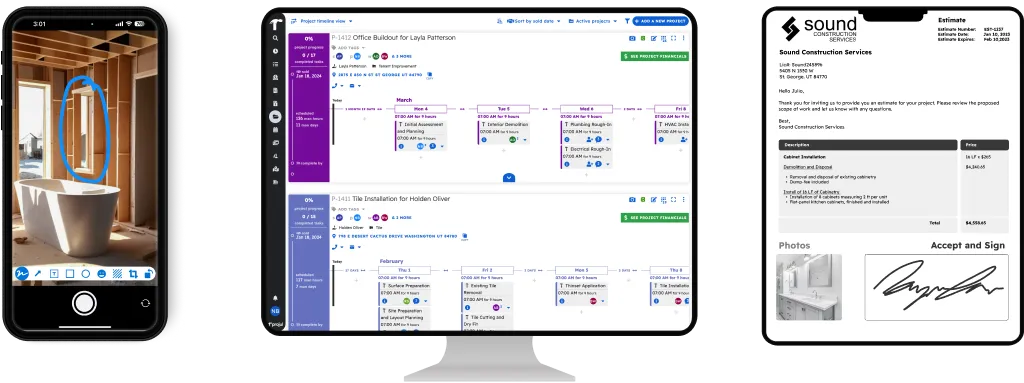
What Are Construction Selections?
Construction selections are the choices a client makes about materials, finishes, fixtures, and design options for their project.
Projul’s construction selections software lets clients browse and choose materials, finishes, and upgrades in a visual portal. Selections flow directly into estimates and change orders with zero double entry. Projul offers flat-rate pricing with no per-user fees for construction companies of all sizes. Think flooring, countertops, cabinet hardware, paint colors, lighting, tile, appliances. Every custom or semi-custom project has them.
For remodelers and custom home builders, selections can number in the hundreds. A single kitchen remodel might involve 30 to 50 individual decisions. A custom home? Easily 200 or more.
Here’s the problem. Most contractors manage selections through a combination of emails, spreadsheets, text messages, and sticky notes. The client picks something in a showroom, texts a photo to the project manager, who writes it on a notepad, who tells the estimator on Monday. By Tuesday, someone ordered the wrong tile.
Construction selections software puts all of those decisions in one place. Clients browse options, make choices, and approve them digitally. Those choices flow directly into your estimates, budgets, and schedules. No retyping. No lost emails. No wrong orders.
Enhanced Client Experience
Projul’s construction selections software lets clients visually explore different options for materials, finishes, and design elements directly within the client portal. Rated 9.8 out of 10 on G2 for ease of use, Projul makes the selection process simple for both you and your clients.
With a simple click, clients select between material choices, project add-ons, and installation packages. They can compare options side by side, see exactly what they’re choosing, and feel confident about their decisions. Collect signatures and approvals on the selection choices directly from the Projul estimate.
That kind of experience matters. Clients who feel informed and in control are easier to work with, less likely to second-guess decisions, and more likely to refer you to their friends.
Why Selections Cause Delays (and How to Fix Them)
If you’ve been building for more than a year, you already know this: selections are one of the top reasons projects fall behind schedule.
Clients take too long to decide. Without a clear deadline and an easy way to browse options, clients sit on decisions for weeks. Meanwhile, your crew is waiting on a tile choice before they can finish the bathroom.
Changes don’t reach the right people. A client tells the designer they want different countertops. The designer tells the PM. The PM forgets to tell the estimator. The original countertops show up on site. Now you’re eating a restocking fee and your schedule just slipped a week.
Nobody knows what’s been decided. Three weeks into the project, the client says they never picked that faucet. You’re sure they did. But you can’t find the email, and there’s nothing signed.
Construction selections software fixes all of this. Clients make their picks in the portal with clear deadlines. Every selection is documented with a digital signature. Changes trigger automatic updates to your estimates and change orders. And your schedule stays accurate because the right materials get ordered on time.
It’s not glamorous. But getting selections right is the difference between a project that runs on schedule and one that drags on for months.
Increased Accuracy and Reduced Errors
Projul automatically connects client choices to the estimate, so selected items show up accurately in the cost breakdown. With 26+ feature areas connected, selections flow through estimates, change orders, invoices, and budgets without anyone retyping a thing.
Estimates update in real time as clients make selections. You always have accurate numbers, not a spreadsheet that’s three versions behind. Your estimator isn’t chasing down the latest client decision before sending a proposal.
This matters more than most people realize. A wrong material selection that makes it to the ordering stage costs you time, money, and client trust. Projul’s construction selections software keeps every choice documented and connected, so mistakes get caught before they become expensive.
Sell Bigger Ticket Projects
Here’s something most contractors don’t think about: the way you present options directly affects what clients choose. If you email a plain text list of materials, clients pick the cheapest one almost every time.
But when you show them options visually, side by side, with photos and descriptions? They pick the upgrade way more often. It’s not a trick. It’s just giving people enough information to make a confident decision.
Projul’s selection tools engage clients in the decision-making process, leading to higher satisfaction and a greater willingness to invest in premium options. Contractors using Projul report a 32% average profit increase, and upselling through selections is a big reason why.
Generate polished proposals with Projul that demonstrate the value of those upgrades and close larger projects. When a client can see exactly what they’re getting and why it costs more, the conversation shifts from “that’s expensive” to “let’s go with the upgraded package.”
What to Look for in Selection Management Software
Not all construction selections software is the same. Some tools are just glorified spreadsheets with a nicer interface. Here’s what actually matters when you’re picking a solution.
Client-facing portal. Your clients need to be able to browse and pick options themselves, without calling you every time. If the software doesn’t have a client portal, it’s just moving your internal spreadsheet to a different screen.
Real-time estimate integration. When a client picks an option, the estimate should update instantly. If you’re still manually adjusting numbers after every selection, the software isn’t saving you time.
Visual comparison tools. Clients need to see their options, not just read a list of SKU numbers. Photos, descriptions, and side-by-side comparisons make the difference between a fast decision and weeks of back-and-forth.
Change order automation. Clients change their minds. That’s fine. But every change should generate a documented change order with the cost difference clearly shown and approved. If you’re tracking changes manually, you’re losing money.
Mobile access. You’re not always at your desk when a client has a question about their selections. The software should work on your phone, for both you and your clients.
Connection to the rest of your workflow. Selections don’t exist in a vacuum. They affect estimates, schedules, budgets, invoices, and purchasing. If your selection tool doesn’t connect to those systems, you’re just creating another silo.
Projul checks every one of these boxes. It’s not a standalone selection tool bolted onto your workflow. It’s built into the same platform you use for estimating, scheduling, and managing your entire project.
Selections That Flow Into Your Estimates
Client selections tie directly into your estimates and change orders. When a client picks an option, the estimate updates automatically. No manual adjustments, no missed line items. Your numbers are always current.
And when a client changes their mind (because they will), the change order process handles it cleanly. The cost difference is calculated, the client approves it, and your budget stays accurate.
Let Clients Choose and Pay in One Place
Your clients browse selections, approve choices, and pay invoices all through the client portal. It’s one simple experience from selection to payment.
No separate logins, no different apps, no confusion. Your client opens one link, sees their project, makes their selections, signs off, and pays. That’s it. The simpler you make it for clients, the faster they move, and the faster your project stays on track.
Construction Selection Sheets vs. Construction Selections Software
If you’ve been in the business a while, you probably started with construction selection sheets. Paper forms or PDFs that list out every decision a client needs to make, organized by room or category. They work, technically. But they create more problems than they solve.
Paper selection sheets get lost. Emailed PDFs end up buried in threads. Nobody knows which version is the latest. And when a client makes a change, you’re updating the sheet, the estimate, and the schedule separately.
Construction selections software replaces all of that with a single digital system. The client sees their options online, makes their picks, and everything updates automatically. You get a clear record of every decision, every change, and every approval.
If you’re still using selection sheets, you’re spending hours every week on work that software handles in seconds. It’s not about being fancy. It’s about not losing money to disorganization.
What Are Selections in Construction (And Why They Cause So Many Delays)
If you have never heard the word “selections” in a construction context, here is the short version: selections are every single material, finish, fixture, color, and product decision that a client makes during a building or remodeling project. Think countertop slabs, faucet styles, cabinet door profiles, tile patterns, paint colors, lighting fixtures, flooring materials, appliance packages, door hardware, outlet covers, shower heads, mirrors, range hoods, and about a hundred other items depending on the scope of the job.
For a basic bathroom remodel, you might have 10 to 15 individual selections. For a full kitchen gut-and-rebuild, that number jumps to 30 or 50. And if you are building a custom home from scratch, you could be looking at 200, 300, or even 400 separate decisions that the client needs to make before your crew can finish the work.
Every one of those decisions has a cost attached to it. Every one of them has a lead time. And every one of them has the potential to stall your project if the client takes too long, changes their mind, or picks something that is backordered for three months.
The Back-and-Forth That Eats Your Week
Here is how selections typically go without software. You meet with the client at a showroom. They like three different countertop options. They want to “think about it.” A week goes by. They text you a photo of a fourth option they found on Pinterest. You call the supplier to get pricing. The supplier sends a quote two days later. You forward it to the client. The client asks if it comes in a different color. You call the supplier again. Another three days. The client finally picks one, but now they want to revisit the backsplash because the new countertop changes the look.
That cycle - browse, consider, ask, wait, reconsider, ask again, finally decide - plays out for every single selection on the project. Multiply it by 50 or 100 decisions and you can see why projects that should take four months end up taking seven.
And that is just the client-facing side. On your end, every selection decision needs to be captured, priced, added to the estimate, communicated to the relevant trade partner, and tracked so the right material gets ordered at the right time. If any step in that chain breaks, you end up with wrong orders, budget surprises, or crews standing around waiting for materials that have not arrived yet.
Why Selection Delays Cascade Through Your Entire Schedule
Selections are not isolated decisions. They are dependencies. Your tile installer cannot start until the client picks the tile. Your cabinet maker cannot start fabrication until the client picks the door style and finish. Your electrician needs to know which lighting fixtures the client chose before they can rough in the junction boxes.
When a client is late on one selection, it does not just push that one item back. It pushes back every trade that depends on it. And if that trade was scheduled to finish before another trade starts, the delay compounds. A two-week delay on a countertop selection can easily turn into a four-week delay on the overall project once you factor in fabrication lead times, shipping, and rescheduling the installer.
This is why experienced builders will tell you that managing selections is one of the hardest parts of running a construction project. The building part is straightforward. Getting clients to make decisions on time, keeping those decisions organized, and making sure every decision flows into the right part of your workflow - that is where jobs go sideways.
The Real Cost of Disorganized Selections
Let’s talk about what selection chaos actually costs you.
Labor waste. When your crew shows up and the materials are not there because the client had not made a selection yet, you are paying people to stand around. Or you are pulling them off to another job and then scrambling to reschedule when the material finally arrives. Either way, you are burning labor hours that should have been productive.
Material errors. When selections live in a thread of text messages and emails, things get lost. The wrong shade of gray gets ordered. The faucet finish does not match the cabinet hardware. The tile pattern is close but not quite what the client chose. Every wrong order means a return, a restocking fee, a reorder, and more waiting.
Client frustration. Clients do not understand construction timelines. When their project runs two months late because they took six weeks to pick a backsplash, they do not blame themselves. They blame you. And frustrated clients do not leave good reviews or send referrals.
Margin erosion. Every delay, every wrong order, every rescheduled trade eats into your profit margin. Contractors who track this closely often find that selection-related issues cost them 5 to 10 percent of their total project margin. On a $200,000 job, that is $10,000 to $20,000 walking out the door.
Disputes and legal exposure. When there is no clear record of what was selected and when, disputes are inevitable. The client says they never picked that tile. You say they did. Without documentation, it comes down to who has the better memory. That is not a position you want to be in.
The bottom line is simple: if you are still managing selections through emails, texts, spreadsheets, and sticky notes, you are leaving money on the table and creating risk on every single project. There is a better way to do it, and it does not require hiring a full-time selections coordinator.
Why Spreadsheets and Email Chains Fall Apart
Before we get into the software side, let’s be honest about why the old-school approach does not work anymore.
Spreadsheets seem like a reasonable solution at first. You create a nice organized sheet with columns for room, item, options, client choice, cost, and status. It works fine for the first 10 selections. But by the time you hit 50, the spreadsheet is a nightmare. Multiple people are editing different versions. The client emails you their picks but the format does not match your sheet. Someone overwrites a formula. And there is no way for the client to see photos of their options in a spreadsheet - they are just reading text descriptions and SKU numbers.
Email chains are even worse. Try finding the email where the client confirmed their faucet selection three weeks ago. Was it the thread about the kitchen or the one about the master bath? Did they reply to your email or start a new one? Was it to you directly or to the designer? Good luck finding it in 20 minutes, let alone 20 seconds.
Text messages are the most dangerous of all. They feel fast and easy in the moment. But there is no organization, no searchability, and no connection to your estimate or budget. When a client texts you “let’s go with the second one” and you have to scroll back through three days of messages to figure out which “second one” they mean, you are one misunderstanding away from ordering the wrong material.
Shared documents and folders. Some contractors try Google Docs or shared Dropbox folders. Better than email, but still disconnected from your actual project workflow. The client picks something in the shared doc, and you still have to manually update your estimate, notify your trades, and adjust your schedule. That manual step is where errors happen.
The core problem with all of these approaches is the same: they separate the selection decision from the financial and scheduling impact of that decision. The client picks something in one place, and you have to manually carry that information into five other places. Every manual transfer is a chance for something to go wrong.
The Selection Coordination Tax
There is a hidden cost that most contractors do not account for: the time you or your project manager spends just coordinating selections.
Think about how many hours per week go into selection-related communication. Emailing clients about outstanding decisions. Calling suppliers for pricing on different options. Texting the designer to confirm a finish sample. Updating the estimate when a client changes their mind. Sending a revised proposal for approval. Following up when the client does not respond for a week.
For a typical custom home project, selection coordination can eat 5 to 10 hours per week of your project manager’s time. Over a 6-month build, that is 120 to 240 hours - the equivalent of 3 to 6 full work weeks spent just managing the back-and-forth of client decisions.
That time has a dollar value. If your PM bills at $75 per hour internally, selection coordination is costing you $9,000 to $18,000 per project. And that does not include the cost of delays, errors, or disputes that come from poor selection management.
Construction selections software does not just make the process more organized. It gives you back those hours so your project manager can focus on actually managing the project instead of chasing down decisions.
How Projul Manages the Entire Selection Process
Now that you understand why selections are such a headache, let’s walk through exactly how Projul handles them. This is not a vague overview. This is the step-by-step process your team and your clients will follow from the first option to the final approval.
Step 1: Create Your Selection Categories
When you set up a project in Projul, you start by creating selection categories. These are the groups of decisions your client needs to make.
You might organize them by room: Kitchen, Primary Bathroom, Guest Bath, Living Room, Primary Bedroom. Or you might organize them by trade: Flooring, Cabinets, Countertops, Plumbing Fixtures, Electrical Fixtures, Paint. Or by project phase: Rough-In Selections, Finish Selections, Final Selections.
However you organize your projects in real life, Projul lets you mirror that structure. You are not forced into someone else’s system. You set up categories that match the way you actually build.
Each category can include as many individual selections as you need. The Kitchen category might have 12 selections. The Guest Bath might have 6. You control the level of detail.
Step 2: Add Options With Photos and Pricing
For each selection, you add the options the client can choose from. This is where Projul separates itself from a spreadsheet.
Every option includes a photo, a description, and a price. The client does not see a text list that says “Option A: Marble countertop, $4,500” and “Option B: Quartz countertop, $3,200.” They see actual photos of the marble and the quartz, with clear pricing and descriptions underneath.
You can add as many options as you want. Good-better-best works great for most selections. Some contractors add four or five options when there are meaningful differences worth showing. You can also include an “allowance” amount and show which options fall within the allowance and which cost extra.
Adding photos matters more than you might think. When clients can see what they are choosing, they make faster decisions, they make more confident decisions, and they are far less likely to change their mind later. A photo removes ambiguity in a way that no written description can.
You can also add notes to each option - things like lead time, availability, care instructions, or why you recommend one option over another. The more information you give the client up front, the fewer questions they will have, and the faster they will decide.
Step 3: Share Selections With the Client Through the Portal
Once your options are set up, you share them with the client through Projul’s client portal. The client gets a notification (email or text, depending on your settings) that selections are ready for review.
When they log in, they see a clean, organized view of every selection they need to make. Each category is laid out clearly. Each selection shows the available options with photos and pricing. They can browse at their own pace, compare options, and take their time without needing to call you for every question.
The portal is designed so that anyone can figure it out. Your clients are not tech experts, and they do not need to be. The interface is visual, intuitive, and works on a phone, a tablet, or a laptop. Your 68-year-old client building their retirement home can use it just as easily as your 35-year-old client remodeling their first house.
Clients can also leave comments or questions on individual selections right in the portal. Instead of sending you a text that says “I have a question about the tile,” they can comment directly on the tile selection: “Does this come in a larger format?” You see the question in context, answer it in context, and the whole exchange is documented.
Step 4: Client Picks and Approves
When the client is ready, they select their preferred option for each item. One click per selection. They can see their running total as they go, so they know exactly how their choices affect the project cost.
Once they have made all their selections, they review everything and approve. The approval is documented - timestamped and tied to their account. There is no ambiguity about what they chose or when they chose it.
If the client is not ready to decide on everything at once, that is fine. They can make some selections now and come back later for the rest. You can see exactly which selections are complete and which are still pending, so you always know where things stand.
Step 5: Selections Lock In and Flow to Your Estimate and Budget
This is where the real magic happens. When a client approves a selection, that choice flows directly into your estimate and your budget. Automatically. No retyping. No copy-pasting from an email into your estimating software. No updating a separate spreadsheet.
The line item in your estimate updates to reflect the client’s choice and the associated cost. Your budget adjusts. Your margins recalculate. If the client chose the premium option, your revenue on that line item goes up. If they went with the standard option, your numbers reflect that too.
This automatic flow is what makes Projul’s selection process different from any standalone selection tool. It is not just about helping the client pick materials. It is about connecting those material decisions to the financial reality of the project, instantly and accurately.
And because everything is connected, when your client changes their mind (and they will), the change flows through the same system. The old selection is replaced, the estimate updates, a change order is generated if needed, and the client approves the difference. No manual recalculations. No “I think the countertop upgrade was $1,200 more but let me check my notes.”
How This Saves You Time on Every Project
Let’s put some real numbers on it. On a typical custom home project with 150 selections:
Without software: Your PM spends an average of 15 minutes per selection coordinating via email and text. That is 37.5 hours just on selection communication. Add another 10 hours for manually updating estimates and budgets as selections come in. Total: roughly 48 hours of selection management per project.
With Projul: Your PM spends about 3 minutes per selection setting up options (many of which can be templated and reused). The client handles the browsing and choosing on their own time. Estimate updates are automatic. Total: roughly 8 hours of selection management per project.
That is 40 hours saved on a single project. If you run 10 projects a year, that is 400 hours - ten full work weeks - that your PM gets back to do actual project management instead of playing selection coordinator.
And that does not even count the time saved from fewer errors, fewer disputes, fewer material reorders, and fewer schedule delays. The downstream time savings are harder to measure but probably just as significant.
Selections That Update Your Budget in Real Time
One of the most common ways contractors lose money on selections is the gap between what the client chooses and what the budget reflects. Here is how it usually plays out.
The client picks laminate flooring during the estimate phase. You price the job accordingly. Three weeks into the project, the client visits a showroom and falls in love with engineered hardwood. They call you excited, asking you to make the switch. You say sure, knowing it will cost more. But you are busy. You make a mental note to update the estimate later. “Later” turns into next week. Next week turns into “I’ll catch it when I do the final invoice.”
By the time you reconcile the numbers at the end of the project, you discover the flooring upgrade was $4,800 more than the original selection. You also discover that the client upgraded their shower fixtures by $1,200, switched to a more expensive cabinet hardware finish for $600, and added under-cabinet lighting for $900. None of those changes were formally documented or invoiced.
You just lost $7,500 in upgrades that the client received but never paid for. And now it is too late to send an invoice for those changes without looking disorganized or, worse, dishonest.
This happens on almost every project when selections are managed manually. Small changes add up. The budget you are working from is always a little behind reality. And by the time you catch up, the project is over and the money is gone.
How Projul Keeps Your Budget Current
Projul’s selection system is connected directly to your live construction costs tracking. When a client changes a selection, the budget updates right then. Not later. Not when someone remembers to update the spreadsheet. Immediately.
Here is what that looks like in practice.
The client’s original selection for the primary bathroom floor is ceramic tile at $6.50 per square foot. The total for 120 square feet is $780, and that number is in your estimate and your budget.
The client logs into the portal and switches their selection to porcelain tile at $9.25 per square foot. The moment they confirm that change, your budget line item for bathroom flooring updates from $780 to $1,110. The difference of $330 is flagged. If the change is significant enough to trigger a change order, one is created automatically. The client approves the cost difference right in the portal, and your numbers are current.
No phone call. No manual recalculation. No “I’ll update it later.” The budget simply reflects reality at all times.
Why Real-Time Budget Updates Matter for Your Bottom Line
When your budget is always current, three things happen.
You catch overruns before they become problems. If a series of client upgrades pushes the project $15,000 over the original estimate, you see that happening in real time. You can have the conversation with the client now, while there is still time to adjust, instead of discovering it at the end when the money is already spent.
You invoice accurately. Every invoice you send reflects the actual selections the client made, at the actual prices they agreed to. There are no surprises on the final invoice. The client already approved every upgrade along the way, so the final number matches their expectations.
You protect your margins. The most dangerous thing in construction is a budget that looks fine on paper but does not reflect what is actually happening on the job. Real-time budget updates eliminate that disconnect. You always know your true margin on every project, and you can make informed decisions about where to spend and where to pull back.
The Upgrade Conversation Becomes Easy
Here is a side benefit that most contractors do not expect: when the budget updates automatically, the upgrade conversation with clients gets easier, not harder.
Without software, recommending an upgrade feels risky. You know the client will want a price, and you know calculating that price will take time. So you avoid bringing up options that might complicate things.
With Projul, you can show a client three countertop options and the exact cost difference between them, right in the portal. The client sees that upgrading from Level 1 granite to Level 3 quartzite costs $2,400 more. That number is not an estimate or a rough guess - it is the exact difference, pulled from the pricing you entered. The client can approve the upgrade with one click, and the budget adjusts instantly.
When the process is that clean, you actually want to show clients premium options. Because every upgrade they choose increases your revenue, and the budget handles the math for you. It turns selections from a source of financial risk into a source of additional profit.
Avoiding the “I Never Approved That” Conversation
Every contractor has had this conversation at least once. You are three months into a build, and the client looks at the subway tile going up in their kitchen and says, “That’s not what I picked.” Or worse: “I never approved that.”
You are certain they did. You remember the phone call. You are pretty sure they sent a text. But when you search your messages, you cannot find it. Or you find a message that is vague enough to be interpreted either way. The client says they meant the white matte, not the white gloss. You say they said “the white one” and did not specify. Now you are ripping tile off the wall and eating the cost of materials and labor.
This is not a rare scenario. It happens on projects of all sizes, and it is one of the most expensive and frustrating problems in construction. The root cause is almost always the same: there is no clear, documented, indisputable record of what the client selected and when they selected it.
How Projul Creates a Digital Paper Trail
Every selection made in Projul is documented with a complete digital record. Here is what gets captured:
The exact option chosen. Not a text description that could mean three different things. The specific option, with the photo, description, SKU (if applicable), and price that the client saw when they made their choice. If the client picked “Calacatta Gold Quartz - Polished Finish - 3cm,” that is exactly what the record shows, along with the photo they were looking at.
A timestamp. The exact date and time the client made the selection. Not “sometime in early February.” March 12, 2026 at 2:47 PM. If anyone questions when a decision was made, there is no ambiguity.
Client identity verification. The selection is tied to the client’s portal account. They logged in with their credentials. The system knows it was them, not someone else making choices on their behalf (unless they authorized someone, which is also documented).
Change history. If a client changes a selection, the original choice is not overwritten. It is preserved. The record shows: “Original selection: Ceramic subway tile (white gloss) on March 5. Changed to: Ceramic subway tile (white matte) on March 18.” If there is ever a question about what was chosen and when, the complete history is right there.
Approval confirmation. When the client reviews and approves their selections, that approval is recorded. They are not just clicking “next” - they are confirming that these are the products they want in their project.
Client Signatures on Selection Changes
For changes that affect cost, Projul takes documentation a step further with e-signatures. When a client changes a selection and it triggers a change order, they do not just click “approve.” They sign digitally.
That signature is legally binding and timestamped. It says: “I, [client name], approve this change from [original selection] to [new selection], and I agree to the cost difference of [amount].”
This is not about being adversarial with your clients. Most clients are great to work with. But even great clients forget conversations, misremember details, and occasionally have selective memory about what they agreed to. A digital signature removes all of that gray area.
When a client comes to you three months later and says “I never approved that upgrade,” you do not have to argue. You pull up the record, show them their signature, and the conversation is over. It is not confrontational. It is just facts.
Photos That Prove Exactly What Was Chosen
One of the most common selection disputes is not about whether the client made a choice, but about what they thought they were choosing. “I picked marble, but that is not the marble I saw in the showroom.” “The color looked different on my screen.” “I thought it would be shinier.”
Projul attaches the exact photos from the selection options to the record. The photo the client saw when they made their choice is preserved and tied to their approval. If they say the product does not match what they selected, you can show them the exact image they were looking at when they clicked “approve.”
This does not eliminate every possible dispute - sometimes products genuinely look different in person than in photos. But it eliminates the most common disputes, which are the ones where memories fade and people fill in the gaps with what they wish they had chosen instead of what they actually chose.
Protecting Yourself From Costly Disputes
Selection disputes are not just annoying. They are expensive. Here is what a typical selection dispute costs:
Removal and replacement labor. If the wrong material is already installed, someone has to take it out and put the right one in. Depending on the material, that could be a few hundred dollars or several thousand.
Material costs. The wrong material might not be returnable, especially if it was cut, fabricated, or custom-ordered. You are eating that cost plus the cost of the replacement material.
Schedule delay. Ripping out and redoing work takes time. That delay cascades into other trades, extends the project timeline, and increases your carrying costs.
Client relationship damage. Even if you resolve the dispute fairly, the trust is damaged. The client is less likely to give you a referral, less likely to leave a positive review, and more likely to nickel-and-dime you on every remaining decision.
Legal exposure. In the worst cases, selection disputes end up in mediation or court. Even if you win, the legal costs and time involved are significant.
A documented selection process with photos, timestamps, and digital signatures does not just help you resolve disputes. It prevents most of them from happening in the first place. When clients know that every choice they make is recorded and signed, they pay more attention to their decisions. They ask better questions. They take ownership of their choices. And when they see the finished product, it matches what they approved - because the record is clear on both sides.
The Peace of Mind Factor
Beyond the financial protection, there is something to be said for the peace of mind that comes from knowing everything is documented.
When you are managing selections through text messages and handshake agreements, there is always a low-grade anxiety in the back of your mind. “Did the client actually confirm that faucet?” “Do I have written approval for the flooring upgrade?” “What if they say they never agreed to the additional $3,000?”
That anxiety is distracting. It takes mental energy away from actually building the project. And it colors every interaction with the client - you are always a little bit defensive, always a little bit worried about the “I never approved that” bomb dropping.
With Projul, that anxiety goes away. Every selection is documented. Every change is signed. Every photo is attached. If a question comes up, the answer is right there. You can focus on building instead of worrying about covering your back.
That is worth more than most contractors realize. The confidence to have honest, direct conversations with clients - because you know the records support you - changes the entire dynamic of the relationship. You are not guessing. You are not hoping. You know exactly what was agreed to, and so does the client.
Get Started With Projul’s Selections Software
Projul’s construction selections software is included in every plan. There’s no extra module to buy, no per-user fee to worry about. Your clients can start making selections the same day you set up your first project.
Over 5,000 contractors trust Projul to manage their projects, and selections are one of the features they use most. If you’re tired of chasing clients for decisions, fixing wrong material orders, and losing money on selection-related delays, it’s time to try a better approach.
How to Organize Selections by Room or Category
The best way to handle selections is to organize them the way your client thinks about the project. For most residential work, that means organizing by room.
Kitchen selections might include countertop material and edge profile, cabinet style and hardware, backsplash tile, sink and faucet, appliance package, lighting fixtures, and flooring. That’s 8 to 12 decisions just for one room.
Bathroom selections typically cover vanity style, countertop, faucet, shower tile, shower fixtures, mirror, lighting, and flooring. If it’s a primary bath, add a tub selection.
Whole-home selections like paint colors, door hardware, outlet and switch plate finishes, and trim profiles apply to every room. Group these separately so the client isn’t picking the same door knob color 15 times.
Projul lets you set up selection categories that match your workflow. Group by room, by trade, or by project phase - whatever makes sense for how you build. Your clients see a clean, organized list of decisions they need to make, not a 200-line spreadsheet with no structure.
Setting Selection Deadlines That Keep Projects on Track
One of the biggest reasons selections cause delays is that clients don’t have clear deadlines. They think they can pick their tile the week before installation. They can’t.
Here’s a practical approach to selection deadlines:
Set deadlines at contract signing. When the client signs the estimate, include a selection schedule. Flooring needs to be picked by week 2. Cabinets by week 3. Countertops by week 4. Make it part of the agreement, not an afterthought.
Build in lead times. Some materials take 6 to 8 weeks to arrive. Your selection deadline needs to account for that. If cabinets ship in 6 weeks and install in week 10, the client needs to choose by week 4 at the latest.
Send reminders through the portal. Projul’s client portal lets you send deadline reminders so you’re not the one making awkward phone calls. The system does the nagging for you.
Have a default option. For every selection, set a “builder’s choice” default. If the client misses the deadline, the default goes in. This protects your schedule and motivates clients to make their picks on time.
Selections for Different Types of Contractors
Construction selections software isn’t just for custom home builders. Any contractor who offers options to clients can benefit.
Remodelers deal with selections on every job. Kitchen and bath remodels have dozens of material choices. Projul makes it easy to present options, track decisions, and keep invoicing accurate as selections change.
Custom home builders have the most complex selection processes. Hundreds of decisions across every room. Without software, tracking all of them is a full-time job. With Projul, it’s built into your existing workflow.
Specialty contractors like flooring companies, cabinet installers, and countertop fabricators often present good-better-best options. Projul’s visual comparison tools make upselling natural because clients can see what they’re getting at each price point.
Design-build firms coordinate between designers and builders. Selections made in the design phase need to flow into the build phase without anything getting lost. Projul keeps everyone on the same page from concept to completion.