Construction Estimating Software - Send Winning Estimates in Minutes, Not Hours
- Send professional estimates quickly and easily with templates
- Keep everyone up to date with live tracking and clear estimate editing
- Close the sale promptly with digital signatures
Projul Estimates Are the Foundation of Your Projects
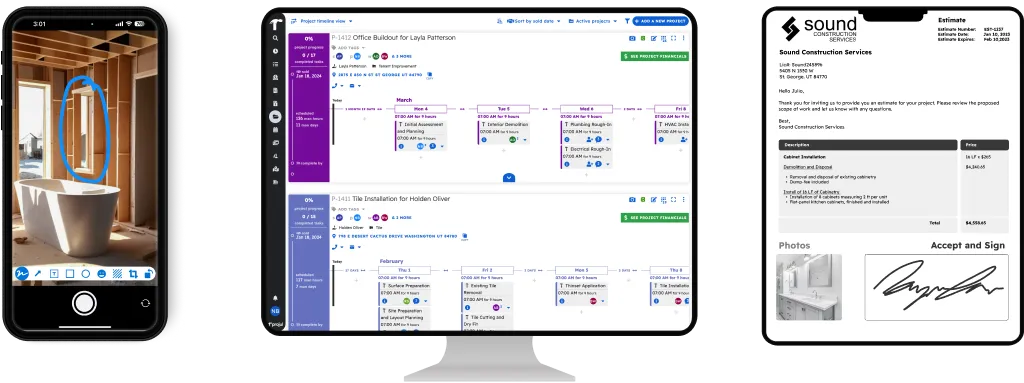
Projul turns a single estimate into your contract, order list, task list, budget, and reports, all connected across 26+ feature areas. Once the estimate is accepted, the data flows into these documents automatically so you hit the ground running.
Save any estimate as a full template. Labor, materials, costs with markup, and hard costs are all preserved so you never enter the same data twice.
Projul’s construction estimating software helps contractors create, send, and track estimates with built-in templates, digital signatures, and QuickBooks sync. One accepted estimate populates your budget, schedule, and tasks automatically. Projul offers flat-rate pricing with no per-user fees for construction companies of all sizes.
- Automatically fill in contracts, budgets, and more
- Hit the ground running on new projects
- Sync estimates to QuickBooks Online and QuickBooks Desktop
Why Estimating Is Where You Win or Lose Jobs
Most contractors think they lose jobs on price. But more often, they lose jobs on speed and presentation.
The contractor who sends a professional estimate within 24 hours wins. The one who takes a week to put together a Word doc with inconsistent formatting? They don’t even get a callback.
Here’s what’s actually happening: your potential client requested estimates from three contractors. The first one (using construction estimating software like Projul) sends a polished estimate with clear line items, a professional layout, and a “sign here” button, all within a few hours. The second sends a PDF the next day. You’re still typing yours up in Excel three days later.
By the time your estimate arrives, the client has already signed with contractor number one. Speed matters. Presentation matters. And the right estimating tool gives you both.
Projul users save 2+ hours daily on estimate creation. That’s 2+ hours you can spend on jobsites, closing deals, or actually living your life. And if you’re not sure whether to send an estimate, quote, or proposal, our guide on estimates vs quotes vs proposals breaks down when to use each.
Rapidly Get Estimates in Front of Customers Using Templates
Projul’s estimate templates let you send professional estimates before your competition has time to open Word. Pre-build your most common job types with materials, labor, markup, and hard costs. When a new lead comes in, pull the template, adjust the numbers, and send.
Built-in change orders keep you profitable and customers informed. Creating change orders, tracking expenses, and getting customer approvals is fast and painless with Projul.
- Stay one step ahead of competitors by delivering estimates fast
- Impress prospects with attractive, professional estimates
- Always include the key information customers need
The Change Order Problem (and How to Fix It)
Change orders are where contractors lose money. Not because the work isn’t profitable, but because the change never gets documented properly.
Here’s the pattern: the client asks for something extra on site. Your crew does the work. Nobody writes it down. At the end of the project, you eat the cost because there’s no signed approval. Or you try to bill for it and the client pushes back because “we never agreed to that.”
Projul’s construction change order software fixes this. When scope changes, you create a change order right from the original estimate. The client gets it on their phone, reviews the cost, and signs with a tap using built-in e-signatures. The approved change order updates your project budget automatically.
No more verbal agreements that cost you thousands. No more “he said, she said” at the end of a job. Every change is documented, signed, and tracked.
And because change orders connect to the original estimate, you always see the full picture. Original scope plus changes, with accurate totals your whole team can access.
Live Editing, Tracking, and Digital Signatures
Projul gives you live editing, real-time status tracking, and built-in digital signatures on every estimate. Over 5,000 contractors use Projul to keep estimates moving from draft to signed without switching tools.
Edit the live estimate whenever you want and track its status in real time. When the customer is ready, they sign digitally straight from the estimate itself.
Clients can view, approve, and sign estimates right from their smartphone, tablet, or desktop. If changes are needed, clients request revisions with a click, and your estimators get notified automatically.
- Make changes to your estimates anytime
- Track status with live updates
- Make it easy for customers to say yes and sign on
From Estimate to Invoice in One Platform
This is where most contractor estimating tools fall short. You build a great estimate, the client signs it, and then you have to retype everything into a separate invoicing tool. Line items get missed. Numbers get transposed. You underbill and don’t realize it until the job’s done.
Projul connects the entire chain. The estimate becomes the budget. The budget tracks actual costs. And when it’s time to bill, Projul’s invoicing tools let you convert that estimate into an invoice with one click.
Need to bill for tracked labor? Service invoicing pulls approved time logs directly into your invoices. Need to invoice for a change order? It’s already tied to the project with the approved amounts.
From estimate to signed contract to completed invoice, everything lives in one platform. Your books are accurate, your billing is complete, and you’re not spending hours reconciling between different systems.
Build Estimates Faster with Templates and Assemblies
Stop typing the same line items over and over. Estimate templates let you save your best estimates and reuse them on new jobs in seconds. Assemblies group common materials and labor into reusable calculation blocks you can drop into any estimate.
The combination is powerful. A kitchen remodel template with pre-built assemblies for plumbing, electrical, and finish work means you can produce a detailed estimate in minutes instead of hours. And because assemblies recalculate when you change measurements, the estimate stays accurate no matter how many revisions you make.
Keep Estimates Accurate with Live Costs
Material prices change constantly. An estimate built with last month’s lumber prices could cost you thousands when you actually buy the materials. Projul’s live construction costs keep your pricing current so your margins stay protected.
When costs change, your assemblies and templates reflect the updated numbers. You always know your estimate is based on real, current pricing, not guesswork from three months ago.
Estimates That Connect to Your Whole Business
Most contractor estimating tools treat the estimate like a standalone document. You create it, send it, and that’s where the software’s job ends. Then you’re copying numbers into a separate project management tool, a separate invoicing tool, and a separate schedule.
Projul connects everything. When a client signs your estimate, the line items automatically populate your project budget. Your materials list is ready for ordering. Your task list is ready for scheduling. Your invoice template is pre-filled with the approved amounts.
This isn’t just convenient. It’s where contractors stop losing money. Every time you manually transfer numbers between systems, there’s a chance for errors. A missed line item here, a transposed number there. Over the course of a year, those small mistakes add up to real money.
With Projul, the number you put in the estimate is the number that shows up on the invoice. Period.
Why Over 5,000 Contractors Choose Projul for Estimating
Contractors don’t switch estimating tools on a whim. It’s a big deal to move your templates, retrain your team, and change your workflow. So when 5,000+ contractors make the switch to Projul, it says something.
The most common reasons contractors tell us they switched: they were tired of paying per user, tired of jumping between multiple tools, and tired of estimates that didn’t connect to anything else. Projul solves all three.
Flat-rate pricing means your whole team gets access. The all-in-one platform means estimates, scheduling, invoicing, and project management live in one place. And the data flows between features, so you enter information once and it follows the project from start to finish.
Construction Estimating Software Built by a Contractor
Projul wasn’t built by a software company that Googled “what do contractors need.” It was built by someone who spent years in the field, writing estimates on the hood of a truck and losing money on bad change order processes.
That experience shows in every part of the estimating workflow. The templates make sense for how contractors actually work. The change order process matches how scope changes really happen on jobsites. And the pricing is flat-rate with no per-user fees, because charging contractors per seat when they have 30 people who need access is ridiculous.
Over 5,000 contractors trust Projul to handle their estimates, change orders, and project management. If you’re still building estimates in spreadsheets, it’s time to try something that was actually built for how you work.
Estimating for Every Type of Contractor
Whether you’re a solo remodeling contractor or a GC running 20 crews, Projul’s construction estimating software scales with you.
Residential contractors use templates for common jobs like kitchen remodels, bathroom renovations, and additions. Drop in a template, adjust the measurements, and send. Your client gets a professional estimate before your competitor even opens their laptop.
Commercial contractors build detailed estimates with multiple sections, assemblies for each trade, and clear markup structures. The estimate handles the complexity without turning into a mess of spreadsheet tabs.
Specialty contractors like electricians, plumbers, and HVAC techs set up trade-specific assemblies that match their exact materials and labor rates. A plumber’s rough-in assembly looks different from a framer’s wall assembly, and Projul handles both.
General contractors pull it all together. Build estimates that include sub bids, your own labor, materials, and markup. Track which subs have submitted pricing and which ones you’re still waiting on. When the estimate is approved, the whole project is ready to go.
No matter your trade or company size, the fundamentals are the same: send accurate estimates fast, handle change orders properly, and connect everything to your invoicing and project management. That’s what Projul does.
Turn Estimates Into a Sales Advantage
Your estimate is your best sales tool. It’s often the first professional document a prospect sees from your company, and it sets the tone for the entire relationship.
Contractors who pair fast estimating with strong lead management close more jobs. When a new lead comes in, you pull a template, adjust the numbers, and send a polished estimate before your competition even responds. That speed matters because prospects who get a professional estimate within a few hours are far more likely to sign.
Projul ties your estimates directly to your sales pipeline. You can see which estimates are pending, which ones were opened, and which prospects need a follow-up call. Your CRM tracks every interaction so your sales team knows exactly where each deal stands.
And once the estimate is signed, the data flows into your project budget and schedule automatically. There’s no gap between “sold” and “started” because Projul connects every step. Want to boost your close rate even further? Learn how to sell more jobs with photos in your estimates.
Common Estimating Mistakes That Cost Contractors Money
Even experienced contractors make estimating errors that eat into profits. Here are the most common ones and how to avoid them.
Forgetting to include overhead. Direct costs are easy to calculate. But if you’re not factoring in insurance, truck payments, office rent, and other overhead, you’re working for less than you think. Projul lets you build overhead percentages into your templates so it’s always included.
Using outdated material prices. Lumber, copper, and concrete prices shift constantly. An estimate based on last quarter’s pricing can be thousands of dollars off by the time you buy materials. Live construction costs in Projul keep your numbers current.
Not tracking change orders. Every undocumented scope change is money out of your pocket. Projul’s change order workflow makes sure every addition gets priced, approved, and signed before work starts. A clear construction scope of work prevents most scope disputes before they happen.
Sending estimates too slowly. The contractor who responds first wins more often than the one with the lowest price. Templates and assemblies let you build accurate estimates in minutes, not days. If you’re bidding competitive work, our construction bid day management guide covers how to stay organized and submit winning bids under pressure.
Inconsistent formatting. A messy estimate makes your company look unprofessional, even if your pricing is competitive. Projul’s templates keep every estimate clean, consistent, and branded to your company.
How to Build a Construction Estimate in Projul (Step by Step)
Building an estimate in Projul takes minutes once you know the workflow. Here is exactly how to go from a blank screen to a signed proposal.
Step 1: Start from a template or blank estimate. When a new lead comes in, open Projul and create a new estimate. If you have a saved template for that job type, select it and all your line items, labor rates, materials, and markup fill in automatically. If it is a unique job, start with a blank estimate and build it from scratch.
Step 2: Add your line items. Each line item includes a description, quantity, unit cost, and markup percentage. For a bathroom remodel, you might add line items for demo, plumbing rough-in, tile, fixtures, paint, and cleanup. Be specific so your client knows exactly what they are paying for and your crew knows exactly what the job includes.
Step 3: Drop in assemblies for common work bundles. Instead of adding 15 individual line items for a plumbing rough-in, drop in a pre-built assembly that includes all the fixtures, pipe, fittings, and labor in one click. Assemblies recalculate based on quantity, so if the job calls for two bathrooms instead of one, just change the number and the totals update instantly.
Step 4: Set your markup and margins. Projul lets you apply markup at the line item level, the section level, or across the entire estimate. You control what the client sees. Show a detailed breakdown or a single price per section. Your internal view always shows your true costs and margins so you know exactly where you stand.
Step 5: Add photos and notes. Photos help sell the job. Add images of similar completed work, product selections, or site conditions. Notes let you clarify scope, exclusions, or payment terms without cluttering the line items.
Step 6: Preview and send. Before sending, preview the estimate exactly as your client will see it. Check the layout, verify the numbers, and make sure your company branding looks right. When everything is ready, send the estimate by email or text with a built-in link for digital signature.
Step 7: Client reviews and signs. Your client opens the estimate on their phone, tablet, or computer. They see a clean, professional document with clear pricing. If they have questions, they can request a revision with one click and your team gets notified. When they are ready, they sign digitally right on the estimate.
That is the full cycle. From lead to signed estimate, all in one place, with no printing, scanning, or chasing down signatures.
Templates and Assemblies: Build Estimates in Minutes
Speed wins jobs. The faster you can get an accurate estimate in front of a prospect, the more likely you are to close the deal. Templates and assemblies are how Projul makes that happen.
Templates save your best work. Every time you build a great estimate, save it as a template. The next time a similar job comes in, pull the template and adjust instead of starting from zero. A residential painting contractor might have templates for interior repaint, exterior repaint, and new construction. A general contractor might have templates for kitchen remodels, bathroom remodels, additions, and decks. Each template keeps your line items, quantities, unit costs, markup percentages, and section structure.
Assemblies group related items together. An assembly is a pre-built bundle of materials and labor that you drop into any estimate. Think of it as a recipe. A “bathroom rough-in” assembly might include:
- PVC drain pipe (40 linear feet)
- Copper supply lines (60 linear feet)
- Shut-off valves (4)
- Toilet flange and wax ring (1)
- Shower valve and trim kit (1)
- Labor for rough-in (8 hours at your crew rate)
Instead of typing each of those items every time you estimate a bathroom, you add the assembly with one click. Change the quantity to three bathrooms and every item in the assembly multiplies automatically.
Templates and assemblies work together. Your “bathroom remodel” template might contain five assemblies: demo, plumbing rough-in, electrical rough-in, tile and finish, and fixtures. When you pull that template for a new job, you get a detailed, accurate estimate in under five minutes. Compare that to the 45 minutes it takes to build the same estimate from scratch in a spreadsheet.
The time savings add up fast. If you send 10 estimates a week and each one takes 40 minutes less, that is nearly seven hours back every week. That is time you can spend on jobsites, meeting clients, or training your team.
From Estimate to Invoice in One Click
Here is where Projul saves you from the most frustrating part of running a construction business: entering the same data over and over.
In most workflows, you build an estimate in one tool, track the project in another, and invoice from a third. Every time you move data between systems, you risk missing a line item or entering the wrong number. Over the course of a year, those small errors cost you thousands in underbilling.
Projul eliminates that problem. When your client signs the estimate, here is what happens automatically:
- Your project budget populates. Every line item from the estimate flows into your project budget so you can track actual costs against estimated costs in real time.
- Your task list is ready. The estimate sections and line items can be converted into scheduled tasks in your project schedule, so your crew knows what to do and when.
- Your invoice is pre-filled. When it is time to bill, Projul’s invoicing pulls the approved amounts directly from the estimate. One click and your invoice is ready to send.
No retyping. No copy-paste errors. No missed line items. The number on your estimate is the number on your invoice.
This also makes progress billing simple. If you bill at milestones, select which line items or sections to include on each invoice. Projul tracks what has been billed and what is still outstanding, so you never accidentally double-bill or forget to bill for completed work.
For contractors who track time in the field, service invoicing pulls approved labor hours directly into your invoices too. Your crew logs time, you approve it, and it shows up on the next invoice automatically.
The result is fewer billing mistakes, faster payments, and less time spent on paperwork. That is the real value of having your estimates and invoicing in one connected platform.
Change Orders Without the Chaos
Every contractor has a change order horror story. The client asks for “just one small change” on site. Your foreman does the work. Nobody writes it down. At the end of the project, you are out $3,000 because there is no signed approval.
Change orders are not the problem. Undocumented change orders are the problem. Projul makes documenting them so fast that there is no excuse to skip it.
Create a change order in seconds. When scope changes, open the original estimate and create a change order directly from it. The change order inherits the project details, client info, and formatting. You just add the new line items, adjust quantities, or modify existing items.
Send for approval instantly. The change order goes to your client by email or text with a digital signature link, just like the original estimate. No printing, no scanning, no waiting for a fax. Your client reviews the cost, asks questions if needed, and signs from their phone.
Budget and schedule update automatically. Once the client signs the change order, the new amounts add to your project budget. Your team sees the updated scope. Your schedule reflects the additional work. Everyone is on the same page.
Track every change order in one place. Projul keeps a complete history of every change order on every project. You can see the original estimate, each change order, approval dates, and the running total at a glance. If a client disputes a charge six months later, you have the signed documentation to back it up.
Protect your margins on every project. Scope creep is the number one profit killer for contractors. It happens slowly, one small change at a time, until you realize you have done 20% more work than the original estimate covered. Projul’s change order tracking makes the true cost of changes visible throughout the project, so you and your client both know exactly where the budget stands.
The bottom line: if a change is worth doing, it is worth documenting. Projul makes documentation take 60 seconds instead of 20 minutes, so your team actually does it every time.
Estimating Software vs Spreadsheets: Why Contractors Switch
If you are still building estimates in Excel, Google Sheets, or Word, you are not alone. Most contractors start there. But at some point, the spreadsheet stops working, and here is why.
Time. A detailed estimate in a spreadsheet takes 45 minutes to an hour. The same estimate in Projul, using templates and assemblies, takes 10 to 15 minutes. Multiply that difference across every estimate you send in a month, and you are looking at days of recovered time.
Errors. Spreadsheets do not catch mistakes. A broken formula, a missed row, or a wrong cell reference can cost you thousands on a single job. Projul’s built-in calculations handle the math automatically, so what you quote is what you meant to quote.
Professional appearance. A spreadsheet estimate looks like a spreadsheet. It does not inspire confidence. Projul produces clean, branded estimates that look like they came from a company that has its act together. First impressions matter when you are asking someone to trust you with a $50,000 project.
E-signatures. With a spreadsheet, you send a PDF, the client prints it, signs it, scans it, and emails it back. Or they don’t, because it is too much hassle. Projul includes digital signatures built into every estimate. Your client taps “sign” on their phone and the deal is done.
Tracking. A spreadsheet sits in a folder. You have no idea if the client opened it, reviewed it, or forgot about it. Projul tracks estimate status in real time, so you know when to follow up and when to move on.
Change orders. Good luck managing change orders in a spreadsheet. You end up with “Estimate v2 FINAL revised FINAL2.xlsx” and nobody knows which version is current. Projul keeps everything connected and versioned automatically.
Connection to invoicing. When the job is done, your spreadsheet estimate does not talk to your invoicing tool. You retype everything, and that is where billing errors happen. Projul converts estimates to invoices in one click.
Here is a quick comparison:
| Spreadsheets | Projul | |
|---|---|---|
| Time per estimate | 45 to 60 minutes | 10 to 15 minutes |
| Error protection | None (manual formulas) | Built-in calculations |
| E-signatures | No | Yes, built in |
| Change order tracking | Manual, error-prone | Automatic, connected |
| Estimate-to-invoice | Retype everything | One click |
| Client tracking | None | Real-time status |
| Professional branding | Basic | Fully branded |
The switch from spreadsheets to Projul is not about having fancier software. It is about sending better estimates faster, making fewer mistakes, and keeping more of the money you earn. That is why over 5,000 contractors have made the move.