Construction Lead Management - Stop Losing Leads, Close More Deals
Schedule a Demo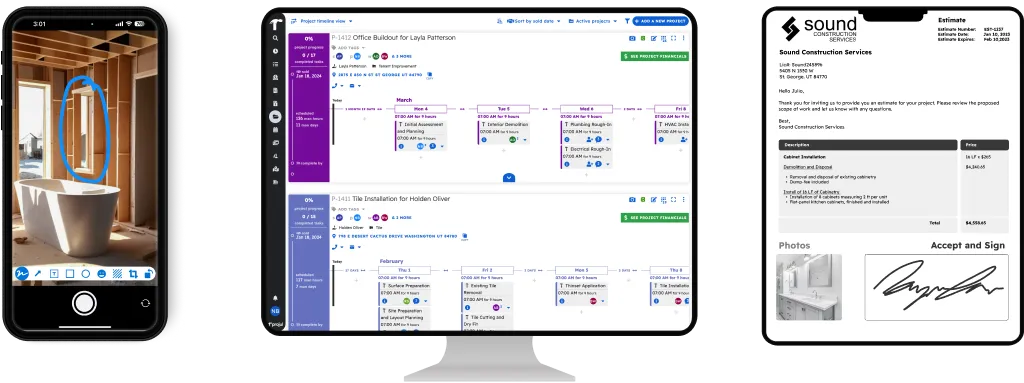
Why Contractors Lose Leads
Most contractors don’t have a lead problem. They have a follow-up problem.
Projul’s lead management software gives contractors a construction-specific sales pipeline with automatic follow-up reminders, web lead capture, and estimator performance tracking. Over 5,000 contractors close more deals without leads slipping through the cracks. Projul offers flat-rate pricing with no per-user fees for construction companies of all sizes.
You get a call from a homeowner who wants a kitchen remodel. You’re on a job site, so you jot down the number on a scrap of paper. You mean to call back at lunch. But then a sub doesn’t show up, a material delivery is wrong, and by 5 PM you’ve completely forgotten about that lead.
Sound familiar? You’re not alone. Studies show that 48% of salespeople never make a single follow-up attempt. In construction, it’s probably worse because you’re not sitting at a desk all day with a CRM open.
Here’s what’s actually happening when you lose leads:
No system for tracking who called. If leads come in through your website, phone, email, referrals, and job site signs, and there’s no single place to capture them, leads will slip through. It’s not a question of if. It’s when.
No follow-up process. Even when you do write the lead down somewhere, who’s responsible for following up? When? How many times? Without a defined process, follow-ups depend on someone remembering, and memory is unreliable when you’re running three active projects.
No visibility into what’s working. Are your Google Ads leads converting better than your referrals? Which estimator closes the most jobs? Without data, you’re guessing. And guessing means you keep spending money on lead sources that don’t work while ignoring the ones that do.
Construction lead management software solves all three problems. It captures every lead in one place, automates follow-up tasks, and gives you real numbers on what’s converting.
What Good Lead Management Looks Like
Good construction lead management isn’t complicated. It just has to be consistent. Here’s what it looks like in practice.
Every lead goes into one system. Website form, phone call, referral from your best client, message on Facebook. It doesn’t matter where the lead comes from. It goes into one pipeline where your team can see it.
Leads are organized by stage. Not just “new” and “old.” A good system breaks your pipeline into stages that match how you actually sell: TO CONTACT, TO ESTIMATE, ESTIMATE SENT, FOLLOWING UP, WON, LOST. At a glance, you know where every opportunity stands.
Follow-ups happen automatically. Your system creates tasks and reminders so nothing depends on someone remembering. Lead came in three days ago and nobody called? The system flags it. Estimate sent last week with no response? Time for a follow-up. This is where contractor lead management tools earn their money.
You have real numbers. How many leads came in this month? What’s your close rate? What’s your average job size by lead source? How long does it take from first contact to signed contract? These numbers tell you exactly where to focus your time and marketing dollars.
Your whole team is on the same page. Your office manager, estimators, and sales team all see the same pipeline. No more “I thought you were handling that lead” conversations.
Automatic Follow-up Reminders
Projul’s follow-up reminders keep revenue from slipping away. Apply a template to your leads and Projul automatically creates tasks that enforce best practices on the number of follow-ups to complete. Over 5,000 contractors rely on this to stay on top of every prospect.
Here’s how it works in the real world. A lead comes in on Tuesday. Projul creates a task to call them within 24 hours. You make the call and log it. Projul schedules the next follow-up for three days later. If the lead doesn’t respond, another follow-up gets scheduled. Your sales process runs on autopilot, not on someone’s memory.
Projul’s construction lead management pipeline is easy to use but surprisingly powerful. It automates prospect follow-ups and makes sure no leads get forgotten. From the minute you receive a lead until the project is sold and completed, every step is tracked.
Sales Pipeline Visibility
Projul’s sales pipeline gives you real-time visibility into incoming revenue, likelihood of sale, project types, lead status, estimator performance, and sales conversion rates. Contractors using Projul see a 32% average profit increase partly because they always know exactly where their sales process stands.
Project leads are automatically grouped in phases like TO CONTACT, TO ESTIMATE, and TO SEND. This makes it easy for you and your team to always know what needs to be done and where problems are in your sales process.
Want to know why you lost 12 leads last month? Projul tracks that. Want to see which estimator has the best close rate? It’s right there in the reports. This isn’t vanity data. It’s the information you need to make better decisions about where to spend your time and money.
Notes, prospect communications, photos, and documents are automatically organized with the project lead where they belong. No digging through emails or text threads to find that conversation from two weeks ago.
From Lead to Signed Contract
The real power of Projul’s CRM is that it doesn’t stop at lead tracking. It connects your entire sales process, from first contact to signed contract to project kickoff.
Here’s the typical flow:
1. Lead capture. A prospect fills out your lead capture form on your website, or your office manager enters the lead manually. Either way, it lands in your pipeline immediately.
2. Qualification. Your team reviews the lead details, project type, budget, timeline, and location. You decide if it’s worth pursuing. If it is, you move it to the next stage.
3. Estimate. Create an estimate directly from the lead record. All the prospect’s info carries over so nobody is retyping contact details or project notes. Send the estimate through Projul and track when the client opens it.
4. Follow-up. Projul schedules follow-up tasks automatically. Your team knows exactly when to call, email, or text. No leads go cold because someone forgot.
5. Close. The client signs the estimate right in Projul. The lead converts to an active project. Your schedule, budget, and invoicing are ready to go, all in the same system.
That connected workflow is what separates construction-specific lead management from generic CRM tools. In HubSpot or Salesforce, you’d need integrations, plugins, and custom fields to make this work. In Projul, it’s how the system works out of the box.
Capture Leads Automatically From Your Website
Projul’s lead capture form sends website inquiries straight into your pipeline. No copy-pasting from email, no leads falling through the cracks.
Embed the form on your website in minutes. When a prospect fills it out, their name, phone number, email, project type, and description drop right into your sales pipeline. Your team gets notified and the follow-up process starts immediately.
If you’re spending money on Google Ads, SEO, or social media to drive traffic to your website, this is the piece that turns those clicks into actual conversations. Without it, leads hit your inbox, get buried under 50 other emails, and never get a callback.
From Lead to Estimate in Minutes
Once a lead is qualified, create an estimate right from the lead record. Your prospect data carries over so you don’t retype contact info or project details. Track the whole journey in your CRM.
The faster you get an estimate in front of a prospect, the more likely you are to win the job. Contractors who respond within an hour are seven times more likely to close compared to those who wait a day. Projul helps you move fast without cutting corners.
Stop Guessing, Start Measuring
Most contractors have no idea what their close rate is. Ask them how many leads they got last month, and you’ll get a shrug. Ask which lead source produces the best jobs, and you’ll get “word of mouth, I think.”
That’s not a strategy. That’s a guess.
Projul’s construction lead management gives you actual numbers. Leads by source, close rates by estimator, average deal size by project type, time from first contact to signed contract. When you have that data, you stop spending money on lead sources that don’t convert and double down on the ones that do.
You also spot problems in your sales process before they cost you money. If leads are piling up in the TO ESTIMATE phase, you know your estimating team is the bottleneck. If your close rate drops in Q4, you can adjust your approach instead of wondering why revenue fell off a cliff.
Construction CRM leads tracked in Projul give you the visibility to run your sales process like a business, not a guessing game.
Why Construction-Specific Lead Management Matters
You could use any CRM to track leads. But general-purpose tools like HubSpot or Salesforce weren’t built for how contractors sell. They don’t know what an estimate is. They don’t connect to your schedule. They can’t generate a change order.
With Projul, your lead management, estimating, scheduling, and invoicing all live in one system. That means less data entry, fewer mistakes, and a faster path from “interested prospect” to “signed contract.” Your team uses one tool instead of four, and nothing falls through the gaps between them.
That’s contractor lead management done right.
How to Set Up Your Construction Sales Pipeline
Setting up a sales pipeline doesn’t have to be complicated. Here’s a simple process that works for most contractors.
Step 1: Define your stages. Most contractors need five to seven stages. Something like: New Lead, Contacted, Site Visit Scheduled, Estimate Sent, Following Up, Won, Lost. Keep it simple. You can always add stages later.
Step 2: Set follow-up rules. Decide how many times you’ll follow up and when. A good starting point: call within 24 hours, follow up at day 3, day 7, and day 14. After that, move the lead to a nurture list or mark it lost. Projul automates these follow-up tasks so nobody has to remember.
Step 3: Assign leads to the right people. If you have multiple estimators, route leads based on project type, location, or workload. Your CRM should make it clear who owns each lead.
Step 4: Track your numbers weekly. Review your pipeline every week. How many new leads came in? How many estimates went out? What’s your close rate? These numbers tell you if your sales process is healthy or needs attention.
Step 5: Connect to your estimating tools. Leads should flow directly into estimates without manual data entry. Projul handles this automatically, so your estimator gets the lead details, project notes, and client contact info in one click.
Lead Source Tracking: Know Where Your Best Leads Come From
Not all leads are equal. A referral from a happy client closes at a much higher rate than a cold Google Ads click. But if you’re not tracking where leads come from, you have no way to know which marketing channels are actually working.
Projul’s lead management tracks the source of every lead. You can see at a glance how many leads came from your website, referrals, Google Ads, social media, yard signs, or any other source you define.
This data changes how you spend money. If your lead capture form on your website is generating 40% of your leads and they close at 25%, that’s your best channel. Double down on it. If you’re spending $2,000 a month on a lead service that produces leads with a 5% close rate, you know where to cut.
Over time, lead source tracking gives you a clear picture of your true customer acquisition cost. That number should guide every marketing dollar you spend.
How Contractors Lose Leads Without Realizing It
Here’s the thing about lost leads - you almost never know you lost them. A missed call doesn’t send you a notification that says “hey, you just lost a $40,000 bathroom remodel.” It just quietly disappears while you’re busy hanging drywall or arguing with a building inspector.
Let’s talk about where your leads actually come from and what happens to each one.
Website Inquiries
You spent good money on your website. Maybe you’re running Google Ads on top of that. Someone finds you, likes what they see, and fills out your contact form. That inquiry hits your email inbox. But your inbox already has 87 unread messages - material invoices, sub schedules, warranty questions, spam. That lead sits there for six hours. Maybe overnight. By the time you see it, the homeowner already called two other contractors and one of them picked up on the first ring.
This is the most common way contractors lose website leads. Not because the leads are bad. Because the leads arrive in the same place as everything else, and there’s no system to flag them as urgent.
Phone Calls
Your phone rings while you’re on a ladder. You can’t answer. The caller leaves a voicemail. Maybe. A lot of people won’t leave a voicemail in 2026 - they’ll just call the next contractor on the list. If they do leave a message, you listen to it three hours later when you’re finally off the job site. You mean to call back after dinner. You forget. That lead is gone.
Research from multiple sales studies shows that responding to a lead within five minutes makes you 21 times more likely to qualify that prospect compared to waiting 30 minutes. In construction, nobody expects a five-minute callback. But a two-hour delay cuts your close rate roughly in half compared to responding within the first hour. That’s not a small difference. That’s half your potential revenue walking out the door because you were busy doing your actual job.
Referrals
Referral leads are gold. A happy customer tells their neighbor about you. The neighbor calls or texts. You save the number in your phone and think “I’ll get back to them this weekend.” But the weekend gets busy with family stuff, and Monday morning you’re back on a job site. By Wednesday, you’ve completely forgotten. The neighbor hired someone else.
The frustrating part? Referral leads close at two to three times the rate of cold leads. When you lose a referral because of slow follow-up, you’re losing your highest-value prospect. And your happy customer who referred them? They feel a little embarrassed that their guy never called back.
Lead Services - Angi, HomeAdvisor, Thumbtack
You’re paying for leads from one or more of these services. The leads hit your email or their app. Some of them are great. Some of them are tire-kickers who submitted the same request to eight contractors. The problem is sorting the good from the bad, and the only way to do that is to call them fast.
On these platforms, speed is everything. The contractor who calls first almost always gets the job. If you’re checking your Angi leads once a day in the evening, you’re paying for leads that someone else is closing. That’s not the platform’s fault. It’s a follow-up problem.
The Sticky Note System
Be honest. How are you tracking leads right now? If the answer involves any combination of sticky notes, text message threads, a whiteboard in the office, a spreadsheet that hasn’t been updated in two weeks, and “I just remember” - you’re losing leads. Period.
Here’s a quick test. Can you answer these questions right now, without looking anything up?
- How many leads came in last month?
- How many of those turned into estimates?
- How many of those estimates turned into signed contracts?
- What’s your close rate?
- Which lead source produced the most revenue (not the most calls - the most revenue)?
If you can’t answer those questions, you don’t actually know how your sales process is performing. You have a feeling. And feelings are wrong more often than you’d think.
The Real Cost of Lost Leads
Let’s do some math. Say your average job is worth $15,000. You get 30 leads a month. Your current close rate is 20%, which means you’re signing six jobs a month for $90,000 in revenue.
Now imagine you’re losing just five leads a month because of slow follow-up, forgotten callbacks, and leads buried in your inbox. If even two of those five would have closed, that’s $30,000 a month you’re leaving on the table. That’s $360,000 a year.
You didn’t lose that money because your work is bad. You didn’t lose it because your prices are too high. You lost it because nobody called back fast enough.
That’s the lead problem most contractors don’t realize they have. It’s invisible. The leads you lose don’t complain - they just hire someone else. And you never know what could have been.
Why It Gets Worse as You Grow
When you’re a one-person operation, maybe you can keep track of everything in your head. Maybe. But the moment you add a second estimator, an office manager, or a dedicated sales person, the sticky note system falls apart completely.
“Did you call that lead back?” “Which lead?” “The one from Tuesday.” “I thought you were handling that.” “No, I was on the Johnson job site.”
Sound familiar? Without a central system, leads get claimed by nobody, followed up by nobody, and closed by your competitor who has their act together.
This is exactly where construction lead management software earns its keep. Not by adding complexity to your day, but by making sure every lead that comes in gets seen, gets assigned, gets followed up on, and gets tracked. Every single one.
Tracking Every Lead From First Contact to Signed Contract
Knowing you need a system is one thing. Knowing what that system should look like is another. Let’s walk through exactly how Projul’s pipeline stages work and how they map to the way you actually sell construction projects.
The Pipeline View
When you log into Projul, your lead pipeline shows every active prospect organized by stage. Think of it like a board with columns. Each column represents a step in your sales process, and each lead is a card that moves from left to right as it progresses.
At a glance, you can see:
- How many leads are waiting for first contact
- How many need estimates
- How many estimates have been sent and are waiting for a response
- How many are in active follow-up
- How many you’ve won or lost this month
This isn’t just a pretty dashboard. It’s a working tool that tells your entire team exactly what needs to happen today. No morning meetings required to figure out who’s doing what. The board tells you.
Stage 1 - New Lead (To Contact)
Every lead starts here, whether it came from your lead capture form, a phone call your office manager logged, a referral, or a lead service. The lead lands in the “To Contact” column with the prospect’s name, phone number, email, project type, and whatever details you have.
The clock starts ticking the moment a lead hits this column. Your goal is to move it to the next stage as fast as possible. Projul can create an automatic task the instant a new lead appears, so your team knows immediately that someone needs a callback.
Stage 2 - Contacted (Qualification)
You made first contact. Now you’re figuring out if this is a real opportunity or a dead end. Is the project in your service area? Is the scope something you handle? Does the timeline work with your current workload? Is the budget realistic?
This is where you ask the right questions and take notes directly in the lead record. Everything you learn about the prospect - their budget range, their timeline, who the decision-maker is, what other contractors they’re talking to - lives right there in Projul’s CRM. Not in your head. Not in a text thread. In the system where your whole team can see it.
If the lead isn’t a fit, mark it lost with a reason. That data matters later when you’re analyzing why leads don’t convert. If it is a fit, move it forward.
Stage 3 - Estimate
The lead is qualified. Time to put numbers in front of them. In Projul, you create an estimate directly from the lead record. All the prospect’s contact info, project details, and notes carry over automatically. No retyping. No copy-pasting from a sticky note to an estimate template.
Build your estimate using your saved templates, line items, and markups. When it’s ready, send it through Projul. The system tracks when the client opens the estimate, so you know if they’ve even looked at it before you call to follow up.
This stage is where a lot of contractors stall. They meet with the homeowner, promise an estimate “by the end of the week,” and then get buried in job site work. Two weeks later, the homeowner has three other bids and yours still hasn’t arrived. Projul’s pipeline makes this visible. If a lead sits in the Estimate stage for too long, you’ll see it. Your team will see it. And the automatic follow-up tasks won’t let anyone forget.
Stage 4 - Follow-Up
The estimate is out. Now you wait. But you don’t just wait - you follow up on a schedule. Projul automatically creates follow-up tasks based on templates you set up. Maybe it’s a call three days after sending the estimate, an email at day seven, and another call at day ten.
Your team doesn’t have to remember any of this. The tasks appear in their task list at the right time. They make the call, log the result, and the system schedules the next step. If the prospect needs more time, you adjust. If they’re ready to sign, you move them to Won.
This stage is where deals are actually won or lost. The estimate itself matters, sure. But the follow-up is what separates the contractor who gets the job from the three others who also sent good estimates. Persistence - polite, professional persistence - wins.
Stage 5 - Won or Lost
Every lead ends up in one of two places. Won means they signed the estimate and you’ve got a new project. In Projul, the lead converts directly into an active project. Your schedule, budget tracking, client communications, and invoicing all pick up right where the sale left off. No data re-entry. No “let me set up this project in our other system.”
Lost means they went with someone else, decided not to do the project, or simply went dark. But in Projul, “lost” isn’t the end of the story. You tag the reason (price, timing, went with competitor, no response) and that data feeds your pipeline reports. Over time, you’ll spot patterns. Maybe you’re losing too many to price, which means your estimates need adjusting. Maybe you’re losing to competitors who respond faster, which means your follow-up timing needs work.
Why the Pipeline Matters More Than You Think
Without pipeline stages, your leads exist in a blob. Some are new, some are old, some are somewhere in between, and nobody really knows what’s happening with any of them. The pipeline forces clarity. Every lead is in a defined stage with a clear next action. Your whole team can see it.
When a homeowner calls your office and asks about their estimate, anyone on your team can pull up the lead in two seconds and give an informed answer. No more “let me check with the estimator and call you back.” That kind of responsiveness is rare in construction, and it’s exactly what wins jobs.
The pipeline also gives you the data you need to make real business decisions. If you have 40 leads in the Estimate stage and only two in Follow-Up, you know your team is cranking out estimates but not following up. Fix that one bottleneck and you’ll close more deals without spending another dollar on marketing.
Connect your pipeline to Projul’s CRM and estimates for the complete picture - every lead, every estimate, every signed contract, all in one place.
Lead Sources: Know Where Your Best Customers Come From
You’re probably spending money in at least three or four places to generate leads. Google Ads, maybe Facebook. A listing on Angi or Thumbtack. Your website with some SEO. Yard signs on active job sites. Referral bonuses for past clients. Maybe a wrapped truck or two.
The question isn’t whether those channels generate leads. The question is which ones generate profitable jobs.
Inquiries vs. Signed Contracts
This is the distinction that changes everything. A lead source might produce 20 inquiries a month, but if only one of those turns into a signed contract, that’s a 5% close rate. Meanwhile, your yard signs might only produce five leads a month, but three of them sign. That’s a 60% close rate.
If you’re only counting how many leads come in from each source, you’re getting a misleading picture. Volume doesn’t matter. Revenue per source matters. Close rate per source matters. Average job size per source matters.
Projul tracks the source of every lead, and because the lead connects to the estimate and the signed contract, you can trace the full journey. Not just “we got 20 leads from Google this month” but “we got 20 leads from Google, 8 became estimates, and 3 became $45,000 in signed contracts.”
That’s the data that tells you where to spend your next marketing dollar.
Tracking Sources in Projul
When a lead enters your pipeline - whether through the lead capture form on your website, manual entry, or another channel - you tag it with a source. Website, referral, Google Ads, yard sign, Angi, repeat client, whatever categories make sense for your business.
Over time, this creates a clear picture. You can pull reports that show:
- Leads by source: How many inquiries each channel produces
- Close rate by source: What percentage of those inquiries become signed contracts
- Revenue by source: Total dollar value of signed contracts from each channel
- Average job size by source: Are your Google Ads leads $5,000 jobs while your referrals are $50,000 jobs?
- Cost per acquisition by source: If you’re spending $1,500 a month on Google Ads and it produces three signed contracts, your cost per acquisition is $500. Is that good? Depends on your average job size and margins.
Making Smarter Marketing Decisions
Let’s say you run this report at the end of Q1 and here’s what you find:
- Referrals: 15 leads, 8 signed, $320,000 in revenue, $0 marketing cost
- Google Ads: 45 leads, 5 signed, $75,000 in revenue, $4,500 marketing cost
- Angi: 30 leads, 3 signed, $36,000 in revenue, $3,000 in lead fees
- Website (organic): 25 leads, 6 signed, $180,000 in revenue, minimal ongoing cost
- Yard signs: 8 leads, 4 signed, $92,000 in revenue, $200 in sign costs
Now look at that. Your referrals produce the most revenue with zero marketing cost. Your organic website traffic is second, with a strong close rate and large job sizes. Google Ads produces a lot of leads, but the revenue per dollar spent is low. Angi is even worse.
Without source tracking, you might look at total lead count and think Google Ads and Angi are your best channels because they produce the most volume. In reality, your referral program and website SEO are driving the business. That’s a completely different marketing strategy.
The Referral Gap
Most contractors know that referrals are their best leads. But almost nobody tracks them properly. A referral comes in as a phone call, gets handled informally, and never gets tagged as a referral in any system. Six months later, when you’re trying to decide whether to invest in a formal referral program, you have no data to support the decision.
Tag every referral lead in Projul with the source and, ideally, who referred them. Over time, you’ll discover which past clients send you the most business. Those are your VIP clients - the ones you should be sending holiday gifts to, checking in on, and asking for Google reviews. They’re your unpaid sales team, and they deserve to be treated that way.
Cutting What Doesn’t Work
Lead source tracking isn’t just about finding winners. It’s about finding losers. Every dollar you spend on a lead source that doesn’t convert is a dollar you could be spending on one that does.
If you’ve been paying $500 a month for a directory listing that produced zero signed contracts in six months, cut it. If your Facebook Ads generate lots of likes and comments but no actual leads, rethink the strategy or reallocate that budget.
This sounds obvious, but without data, you’ll keep paying for things “because we’ve always done it.” Projul gives you the numbers to make those decisions with confidence instead of gut feelings.
Automated Follow-Up That Wins More Jobs
Speed to lead is the single biggest factor in whether you win or lose a new prospect. It beats price. It beats reputation. It beats having the nicest truck or the best website. The contractor who responds first wins the job an overwhelming percentage of the time.
But here’s the catch - you’re a contractor, not a call center. You can’t sit by the phone all day waiting for leads to come in. You’re on job sites. You’re meeting with subs. You’re reviewing plans. You’re doing the actual work that keeps your business running.
That’s exactly why automated follow-up exists. It bridges the gap between “I’m too busy to respond right now” and “I just lost a $30,000 lead because nobody called back.”
What Happens in the First Hour
When a new lead comes in, the clock starts immediately. Here’s what the data says:
- Responding within 5 minutes makes you 21 times more likely to qualify the lead
- Responding within the first hour gives you the best chance of winning the job
- After two hours, your odds of closing drop by roughly 50%
- After 24 hours, most prospects have already talked to another contractor
- After 48 hours, your chances are close to zero unless you’re the only game in town
Those numbers aren’t specific to construction. They come from sales research across industries. But they apply to contractors just as much - maybe more, because homeowners shopping for a contractor are usually talking to three to five companies at once. The first one who calls back and sounds professional gets a massive advantage.
Automated First Response
Projul can send an automatic email or text message the moment a new lead enters your pipeline. The prospect fills out your website form at 2 PM while you’re on a roof. Within seconds, they get a message that says something like:
“Thanks for reaching out to [Your Company]. We received your project details and one of our team members will be in touch within the next hour. In the meantime, here’s a little more about how we work: [link to your process page].”
Is that as good as a live phone call? No. But it’s infinitely better than silence. That automated message does three critical things:
- Confirms you received their inquiry. The prospect knows they didn’t submit a form into a void.
- Sets expectations. They know someone will call within an hour, so they’re less likely to immediately call the next contractor.
- Starts building trust. A fast, professional response signals that you run a real business, not a one-man operation that might disappear mid-project.
That message buys you time to finish what you’re doing and make a proper follow-up call.
Scheduled Follow-Up Reminders
The first response is just the beginning. Most leads don’t say yes on the first call. They need time to think. They want to compare estimates. They need to talk to their spouse. They want to check your reviews. That’s normal.
What’s not normal - but incredibly common - is the contractor who sends an estimate and then never follows up. The homeowner is waiting for a nudge, and it never comes. They assume you’re not interested or too busy, and they sign with someone who showed more initiative.
Projul’s automated client reminders make sure this never happens to you. Here’s how it works in practice:
Day 0 - Lead comes in. Automatic email/text goes out. Follow-up task created for your team to call within one hour.
Day 1 - First call made. You talk to the prospect, gather details, and schedule a site visit or start working on the estimate. Projul logs the call and schedules the next follow-up.
Day 3 - Estimate sent. You send the estimate through Projul. The system tracks when the client opens it. A follow-up task is created for day 5.
Day 5 - Follow-up call. Your estimator calls to answer questions and ask if they’re ready to move forward. If not, a new follow-up is scheduled for day 8.
Day 8 - Second follow-up. Email this time. “Just checking in - do you have any questions about the estimate? We’d love to work on your project.”
Day 12 - Final follow-up. One more call. If no response, move the lead to Lost with a reason. Maybe try again in 30 days with a “still interested?” email.
That entire sequence runs automatically through task creation and reminders. Your team just has to show up and do the work. The system handles the “when” and “what’s next.”
Never Let a Hot Lead Go Cold
The worst feeling in construction sales is finding out a lead you forgot about signed with your competitor last week. You had the inside track - maybe they were referred by a past client, or they specifically asked for you - and you blew it because nobody followed up.
With Projul’s automated follow-up system and construction communications tools, that scenario becomes almost impossible. Every lead has a clear owner. Every owner has clear tasks. Every task has a deadline. If a task is overdue, it’s visible to the whole team.
Your office manager can check the pipeline every morning and immediately see if any leads are going cold. “Hey Mike, you have three follow-ups that are two days overdue. One of them is the Johnson referral - that’s a $60,000 kitchen remodel. Call them before lunch.”
That’s the difference between a system and a sticky note. The system doesn’t forget. The system doesn’t get busy. The system doesn’t assume someone else is handling it.
Follow-Up Is Where the Money Is
Think about your sales process right now. How much money did you spend to get that lead in the first place? Between your website, your Google Ads, your Angi listing, and your time at networking events, the cost of acquiring a lead isn’t zero. It might be $50, $100, or $200 per lead depending on the channel.
When you fail to follow up, you don’t just lose the deal. You waste the money you spent to generate the lead. Every missed follow-up is a marketing dollar down the drain.
Automated follow-up costs you nothing extra. The tasks are created by the system. The reminders go out on schedule. All your team has to do is make the calls and send the emails. The ROI is obvious - you close more of the leads you’re already paying for, which means more revenue without more marketing spend.
That’s how you grow a construction business. Not by generating more leads, but by closing a higher percentage of the ones you already have. Projul’s lead management and automated follow-up tools make that happen without adding more hours to your day.
Training Your Team on Lead Follow-up
The best lead management software in the world won’t help if your team doesn’t use it. Here are some practical tips for getting your team to follow the process.
Make it part of the morning routine. Start every day by checking the pipeline. Who needs a call today? Which estimates are pending? Five minutes of pipeline review can save you from losing a $50,000 job.
Set clear expectations. Every lead should get a response within 24 hours. Period. If your team knows that’s the rule, and they can see the follow-up tasks in Projul, there are no excuses.
Celebrate wins. When someone closes a big deal, make it visible. Share the win in your team meeting. Track your monthly close rate and try to beat it. Healthy competition keeps your team engaged.
Review lost leads. Every month, look at the leads you lost. Why did they go somewhere else? Price? Speed? Communication? Lost leads are free market research if you pay attention to them.