Progress Billing Software for Contractors
Bill at every milestone. Protect your cash flow, reduce risk, and keep clients in the loop from start to finish.
Schedule a Demo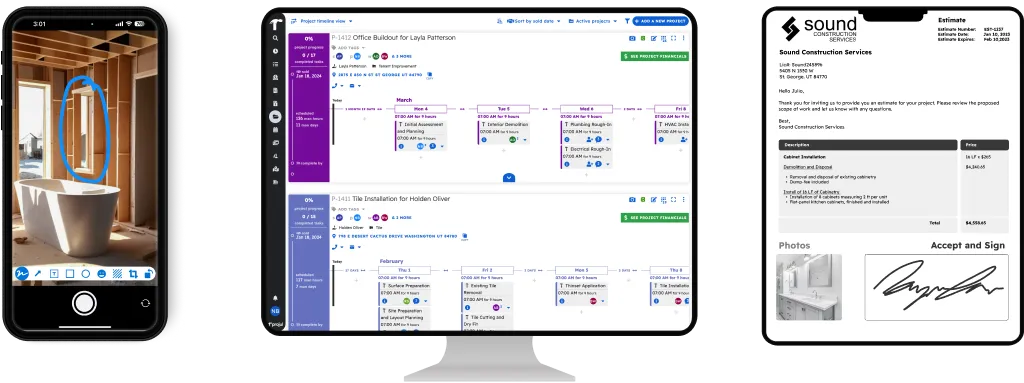
What Is Progress Billing in Construction?
Progress billing is how contractors get paid in stages as work gets done, rather than sending one big invoice at the end of a project. You break the job into phases or milestones, bill the client after each one is complete, and collect payment before moving on. It is the standard billing method for residential remodels, new construction, and commercial projects across the trades.
For contractors, progress billing solves the biggest problem in the business: cash flow. Without it, you are paying for labor, materials, and equipment out of pocket for weeks or months before you ever see a dollar from the client. Progress billing software like Projul makes this process easy to set up, track, and manage on every job.
Stop Floating Your Projects Out of Pocket
Progress billing in construction is the difference between a healthy business and one that’s always scrambling for cash. If you’re waiting until the end of a job to bill your client, you’re basically giving them a free loan. And last time we checked, you’re a contractor, not a bank.
Projul’s progress billing lets contractors invoice at every project milestone instead of waiting until the job is done. Build invoices from estimates, set custom payment schedules, and track every payment in one place. Projul offers flat-rate pricing with no per-user fees for construction companies of all sizes.
Projul makes it easy to collect deposit invoices that cover material purchases and early labor costs on your jobs. Over 5,000 contractors use Projul to keep cash flowing from day one. With construction progress payments built into your workflow, you’ll stop wondering when you’re getting paid and start focusing on the work.
How Progress Billing Actually Works
If you’ve never set up progress billing before, or you’ve been doing it with spreadsheets and handshake agreements, here’s how it works when you do it right.
Step 1: Break the Project into Phases
Before the job starts, you and your client agree on the project phases and what each one costs. This usually maps to your estimate. For a kitchen remodel, that might look like demo, rough-in, cabinets, countertops, and final finishes.
Step 2: Set Your Billing Schedule
Decide when you’ll bill for each phase. Some contractors bill when a phase is complete. Others bill on a set schedule, like the 1st and 15th. In Projul, you can set this up however you want and even front-load a deposit invoice to cover materials.
Step 3: Complete the Work
Do what you do best. Finish the phase, document the work, take photos if your contract requires it.
Step 4: Send the Invoice
In Projul, you build the invoice directly from your estimate or change order. The line items, amounts, and details are already there. You’re not retyping anything. Just select what’s done, generate the invoice, and send it.
Step 5: Client Reviews and Pays
Your client gets a clear invoice showing exactly what was completed and what they owe. With Projul’s payment processing, they can pay right from the invoice. No checks in the mail. No “I’ll get to it next week.”
Step 6: Repeat Until the Job’s Done
Move to the next phase and do it again. By the time you’re wrapping up the project, most of the money is already in your account. The final invoice is just the last piece.
When to Use Progress Billing vs. Lump Sum
Not every job needs progress billing. Here’s how to think about it.
Use progress billing when:
- The project runs longer than 4-6 weeks
- Total contract value is over $10,000-$15,000
- You need to purchase significant materials upfront
- The project has clear, distinct phases
- You’re working with a new client you haven’t built trust with yet
Use lump sum billing when:
- It’s a small, short job (a day or two)
- Material costs are minimal
- The scope is simple and well-defined
- You have a long history with the client
Most contractors doing remodels, new builds, or commercial work should be progress billing on almost every job. The risk of not getting paid, or waiting too long to get paid, is just too high on bigger projects.
If you’re doing service work or T&M jobs, service invoicing might be a better fit. It pulls in tracked time and materials automatically.
Common Progress Billing Mistakes
We’ve seen contractors make these mistakes over and over. Don’t be that guy.
Not Billing Enough Upfront
If you’re buying $30,000 in materials for a job and your first progress payment doesn’t hit until week three, you’re floating that cost yourself. Always get a deposit invoice out before materials are ordered. Projul lets you create deposit invoices in seconds, and it ties right into your budget tracking so you can see the cash flow impact.
Vague Milestone Descriptions
“Phase 1 complete” doesn’t mean anything to a client. Be specific. “Framing complete, passed rough inspection, ready for MEP rough-in.” The more detail in your invoice, the faster it gets approved. Projul lets you pull line items directly from your estimate so the descriptions stay consistent.
Not Tracking Change Orders
Here’s where progress billing gets messy fast. The client adds scope mid-project, you do the work, and then there’s an argument about what was included. Every change needs a documented change order before the work happens. Projul ties change orders directly to your billing so nothing falls through the cracks.
Billing Behind Schedule
Some contractors get so busy running the job that they forget to bill. Then they’re two phases behind on invoicing and cash flow is suffering even though the work is done. Set a rhythm. In Projul, you can see exactly what’s been billed and what hasn’t, so you never fall behind.
Not Reconciling with Your Books
Your progress billing needs to match what’s in your accounting software. If it doesn’t, you’ll have a mess at tax time and you won’t know your real job costs. Projul’s QuickBooks integration syncs your invoices automatically, so your books stay clean without double entry.
Progress Billing for Different Project Types
Progress billing isn’t one-size-fits-all. How you structure it depends on the type of work you’re doing.
Residential Remodels
Kitchen and bath remodels are perfect for progress billing. You’ll typically break it into demo, rough-in, installation, and finishes. Most homeowners expect a deposit upfront, and progress payments feel natural because they can see the work happening in their own house.
New Construction
New builds usually follow a draw schedule tied to construction milestones: foundation, framing, dry-in, rough mechanicals, drywall, finishes, and final. Lenders often require this structure for construction loans. Projul’s progress billing maps perfectly to draw schedules.
Commercial Projects
Commercial work often uses AIA-style billing with schedule of values. Progress billing in Projul lets you track completion percentages by line item, which is exactly what commercial clients and their accountants want to see. You can bill based on percentage complete or milestone complete.
Service and Repair Work
For smaller service calls, progress billing usually isn’t necessary. That’s where service invoicing shines instead. But for bigger repair jobs that stretch over multiple weeks, progress billing keeps the cash flowing.
AIA Billing and Retainage in Progress Billing
If you do commercial work, you will likely deal with AIA-style billing. AIA billing uses a schedule of values that lists every line item on the project with its cost. Each billing period, you update the percentage complete for each line item and submit the application for payment. General contractors, project owners, and architects all expect this format on commercial jobs.
Retainage is the percentage of each progress payment that the client holds back until the project is finished, usually 5-10%. It is meant to protect the owner in case of defects or incomplete work. Retainage adds up fast on big jobs, so you need to track it carefully. Projul lets you see exactly how much retainage is outstanding on every project so there are no surprises at closeout.
Whether you are billing AIA-style on a commercial build or sending simple milestone invoices on a residential remodel, Projul’s progress billing handles both. You can track completion percentages by line item, hold retainage amounts, and generate professional invoices that match what your clients and their accountants expect.
Eliminate Risk While Building Client Trust
Projul’s progress billing protects you from absorbing the cost of material orders and canceled projects. Bill for work completed and materials ordered. Contractors using Projul report a 32% average profit increase, partly because they stop leaving money on the table.
Provide clients with a detailed breakdown of work completed and billed to reduce disputes and provide clear documentation. When clients can see exactly what they’re paying for at every stage, arguments go way down.
Avoid delays and disruptions to projects by securing project funds in advance and on time. Nothing kills a project timeline faster than waiting on a check.
Customize Invoices to Meet Your Business Needs
Projul lets you tailor each invoice to your unique business needs and client arrangements. With no per-user fees, your whole team can create and manage invoices without worrying about extra costs. Progress billing is available on Core+ and Pro plans.
Add flexibility to your invoicing process to account for all project types and payment schedules. Whether you bill by phase, by percentage, or by date, Projul handles it.
Build invoices directly from an estimate or change order, and create custom payment schedules based on your terms and conditions. You’re not starting from scratch on every invoice.
Works Hand in Hand with Projul’s Invoicing Tools
Progress billing is just one part of the picture. Standard invoicing handles your final bills and one-time charges, while service invoicing pulls tracked time and materials into invoices automatically. When your client is ready to pay, integrated payment processing lets them pay digitally from the invoice itself.
And when you need to see the big picture on job profitability, your budget pulls everything together so you know exactly where each project stands financially.
Setting Up Progress Billing That Protects Your Cash Flow
Cash flow kills more construction businesses than bad work ever will. A cash flow management guide can help you understand the bigger picture, but progress billing is the single most important tool for keeping money moving on active jobs.
Here’s how smart contractors set up progress billing to protect themselves. First, front-load your deposit to cover materials. If you’re buying $20,000 in lumber and fixtures for a kitchen remodel, that deposit invoice should go out before you place the order. Projul ties deposit invoices directly to your estimate so the client sees a clear breakdown of what their deposit covers.
Second, keep your milestones tight. Don’t set up three billing milestones on a job that takes four months. Break it into five or six phases so you’re collecting every two to three weeks. Shorter billing cycles mean less exposure if something goes sideways. If a client stops paying at phase three, you’ve only done two to three weeks of unbilled work instead of two months.
Third, document everything before you invoice. Take photos of completed work, log your daily notes, and make sure your time tracking is up to date. When a client questions a progress payment, you have the receipts. This also helps if you ever end up in a dispute or need to file a lien.
Fourth, reconcile every invoice with your budget. Progress billing only works if you’re tracking what you’ve billed against what you’ve spent. If you billed 60% of the contract but you’ve burned through 75% of the budget, you’ve got a problem and you need to catch it early. Projul’s budget tracking shows you exactly where each job stands financially.
Finally, send invoices the same day you hit a milestone. The longer you wait, the longer you wait to get paid. Contractors who bill consistently and on time report fewer payment disputes and faster collections. If you want to dig deeper into AIA billing for commercial work, we’ve got a full breakdown on that too.
Why Progress Billing Beats Billing at the End
If you are still billing your clients at the end of a project, you need to stop and think about what you are actually doing. You are financing their project. You are paying your crew every week. You are buying materials out of your own pocket or putting them on a credit line. You are covering fuel, equipment rentals, dump fees, and permit costs. And the whole time, your client has not paid you a single dollar.
That might work on a two-day service call. But on a three-month kitchen remodel or a six-month custom home build? You are gambling with your business every single day that job runs without a payment.
Cash Flow During Long Projects Is Everything
The number one reason construction companies fail is not bad workmanship. It is cash flow. You can be the best builder in your market, and if you run out of cash between jobs or during a long project, you are done. Progress billing is the fix because it matches your income to your expenses in real time.
Think about it this way. On a $200,000 new build that runs five months, your costs are hitting every single week. Lumber deliveries, concrete pours, sub invoices, payroll. If you are billing at completion, you are carrying all of that cost for five months before you see a dollar. That is not a business plan. That is a prayer.
When you bill at milestones, the money comes in as the costs go out. You finish the foundation, you bill for the foundation. You finish framing, you bill for framing. Your bank account stays healthy because you are collecting throughout the project instead of hoping everything works out at the end.
Stop Financing the Job Out of Your Own Pocket
Here is the math that keeps contractors up at night. You have three jobs running at the same time. Each one has $40,000 in costs before the first progress payment would normally hit. That is $120,000 you need to float if you are not billing along the way. Do you have $120,000 sitting in your operating account right now? Most contractors do not.
So what happens? You start juggling. You use money from Job A to cover materials on Job B. You put supplies on a credit card and hope the payment comes in before the statement closes. You delay paying a sub because the client has not paid you yet. This is how the cash flow death spiral starts, and progress billing is how you avoid it entirely.
When you bill at every milestone, you are collecting money before you need to spend money on the next phase. The deposit covers early materials. The framing payment covers the drywall order. Each phase funds the next one. Your business runs on client payments, not on your savings account or your credit limit.
Keeping Subs and Suppliers Paid on Time
Your subs and suppliers have businesses to run too. When you pay them late because your client has not paid you yet, you are pushing your cash flow problem onto them. Do that enough times and you will lose your best subs. They will start working for contractors who pay on time, and you will be stuck with whoever is left.
Progress billing fixes this because you are collecting from the client at the same pace you owe your subs. When the framing payment hits your account, you pay your framing crew that same week. When the mechanical rough-in is billed and collected, your plumber and electrician get paid right away. You build a reputation as a contractor who pays on time, and that means better subs want to work with you.
The Contractor Who Bills Monthly Survives
This is not an opinion. It is a pattern we have seen across thousands of contractors using Projul. The ones who bill regularly, whether monthly or at milestones, have healthier businesses. They carry less debt. They have fewer disputes with clients. They close out projects faster because there is no giant final invoice sitting unpaid for weeks.
The contractor who waits until completion to bill is rolling the dice. What if the client is unhappy with something and holds up the entire payment? What if they suddenly have their own cash flow problem? What if the project drags on longer than expected and your costs keep climbing? With progress billing, your worst-case scenario is losing one milestone payment. Without it, your worst case is losing the entire project payment. The math is simple.
How to Set Up a Progress Billing Schedule
Before you send your first progress invoice, you need to decide how you are going to structure your billing schedule. There are three common approaches, and the right one depends on the type of project and what your client is comfortable with.
Milestone-Based Billing
This is the most common approach for residential work. You tie each payment to a specific project milestone: deposit, demo complete, framing complete, mechanicals complete, drywall complete, finishes, and final walkthrough. The client pays when they can see the work is done.
Milestone-based billing works great because it is tied to real, visible progress. The client is not paying for something abstract. They can walk the jobsite and confirm that yes, the framing is up, the inspection passed, and the next payment is earned. It builds trust and keeps arguments to a minimum.
Percentage-Based Billing
With percentage-based billing, you bill based on the percentage of the total project that is complete. This is common on commercial work and larger projects where the schedule of values breaks down into dozens of line items. Each billing period, you update the completion percentage for each line item and bill accordingly.
This approach works well when the project has a lot of moving parts and milestones do not line up neatly. It is also what most GCs and commercial clients expect if you are a sub on a bigger project.
Time-Based Billing
Some contractors bill on a set schedule regardless of milestone completion. The 1st and 15th of every month, for example, or every two weeks. You bill for whatever work was completed during that period. This works for long-running projects where progress is steady but milestones are hard to define.
Time-based billing keeps your invoicing rhythm consistent, which is great for cash flow forecasting. The downside is that some clients push back because they want to see specific deliverables tied to each payment.
Common Schedules by Project Type
Remodels (kitchen, bath, basement): Deposit (15-25%), demo complete, rough-in complete, installation complete, final walkthrough. Usually 4-6 milestones over 4-12 weeks.
New construction: Deposit, foundation, framing/dry-in, mechanicals rough, drywall, finishes, final. Usually 6-8 milestones over 4-8 months. Often tied to a lender draw schedule.
Commercial projects: Monthly billing based on schedule of values and percentage complete. AIA G702/G703 format is standard. Retainage of 5-10% held until substantial completion.
Get the Billing Schedule into the Contract
This is the part that too many contractors skip. You agree on a billing schedule verbally and then there is a fight about it later. Your billing schedule needs to be written into the contract before work starts. Every milestone, every amount, every payment term.
Build your billing schedule into your estimate so the client sees it from the very first proposal. When they sign the contract using eSignatures, the payment schedule is part of what they are agreeing to. No ambiguity. No arguments later. You both signed off on when payments are due, and now it is just a matter of doing the work and collecting what you are owed.
Progress Billing in Projul: Step by Step
Setting up progress billing in Projul takes a few minutes at the start of a project and saves you hours of billing headaches for the life of the job. Here is how it works from start to finish.
Create Billing Milestones Tied to the Project
When you set up a new project in Projul, you create your billing milestones based on your estimate. Each milestone has a name, a description, and a dollar amount. You can pull these directly from your estimate line items or set them up manually. Either way, your milestones map to the actual phases of work on the job.
For a $150,000 remodel, your milestones might look like this: $22,500 deposit, $30,000 at demo and rough-in complete, $37,500 at cabinets and countertops installed, $37,500 at finishes complete, and $22,500 at final walkthrough. Each milestone is sitting in Projul waiting for you to mark it done.
Mark Milestones Complete as Work Progresses
As your crew finishes each phase, you mark the milestone complete in Projul. This is a quick update that takes seconds. Your project manager or foreman can do it right from the field using the mobile app. Once a milestone is marked complete, it is ready to be invoiced.
You can also track partial completion on milestones for commercial work where you are billing by percentage. Update the completion percentage as work progresses and bill for the completed portion each period.
Generate an Invoice for Completed Milestones
With the milestone marked complete, you generate an invoice directly from it. Projul pulls in the line items, descriptions, and amounts from your estimate so you are not retyping anything. The invoice shows the client exactly what work was completed and what they owe for that phase.
You can generate invoices for a single milestone or batch multiple completed milestones into one invoice. Either way, the invoice ties back to the original estimate and any change orders that were added along the way. Everything stays connected so there is a clear paper trail from estimate to invoice to payment. For more on how invoicing works in Projul, check out the full invoicing feature page.
Send to the Client with a Pay Link
Once the invoice looks good, send it to your client right from Projul. They get an email with a professional invoice and a link to pay online. No printing, no mailing, no chasing down checks. With Projul’s payment processing, clients can pay by credit card or ACH transfer directly from the invoice.
Clients who can pay with one click pay faster. That is not a theory. Contractors on Projul consistently report faster collection times because the friction of writing a check, finding a stamp, and mailing it is completely gone. The easier you make it to pay you, the faster the money hits your account.
Tracking Billed vs Unbilled Work
One of the most dangerous blind spots in construction is not knowing the gap between work you have completed and money you have collected. If you have done $80,000 worth of work but only billed $50,000, you are sitting on $30,000 of unbilled revenue. That is money you have earned but do not have. And if something goes wrong with the project or the client, you might never see it.
The Overbilling and Underbilling Problem
Overbilling happens when you have billed more than the work you have actually completed. On paper, your cash position looks great. But if the client or their lender figures out that you billed for work that is not done yet, you lose trust fast. On commercial jobs, overbilling can get you removed from a project. It is not worth the risk.
Underbilling is the opposite problem and it is far more common among busy contractors. You are heads-down on the job, focused on the work, and your invoicing falls behind. You have completed three milestones but only billed for one. That gap is money you are owed that is sitting in limbo, and the longer it sits there, the harder it is to collect.
Both problems come from the same root cause: you do not have real-time visibility into your billing position. You are guessing instead of knowing.
Know Exactly Where You Stand on Every Job
In Projul, you can see the billing status of every project at a glance. How much of the contract has been completed. How much has been invoiced. How much has been collected. And how much is still outstanding. This is not a report you run once a month. It is live data that updates as your team marks milestones complete and payments come in.
When you combine progress billing with Projul’s budgeting tools, you get a complete picture of each job’s financial health. You can see not just what you have billed, but what you have spent. If your costs are running ahead of your billing, you catch it immediately instead of discovering it at the end of the job when it is too late to fix.
Real-Time Visibility Into Your Billing Position
The contractors who make the most money are not always the ones with the biggest jobs. They are the ones who know their numbers. They know what they are owed at any given moment. They know which jobs are profitable and which ones are bleeding money. They know when to push for a payment and when to slow down spending.
Projul’s reporting gives you this visibility across your entire business. You can pull reports on billed vs unbilled work by project, by client, by date range, or across your whole portfolio. When tax season rolls around, your accountant will thank you because every dollar is tracked from estimate to invoice to payment.
The goal is simple. Never do more work than you have been paid for without knowing exactly how big that gap is and having a plan to close it. Progress billing gives you the structure. Projul gives you the visibility. Together, they keep your cash flow healthy and your business on solid ground.
Get Paid as You Build
Progress billing isn’t complicated. It’s just smart business. You do the work, you send the invoice, you get paid. No more financing your client’s project for months and hoping the check shows up at the end.
Projul makes the whole process simple enough that you’ll actually do it consistently. And consistency is what turns progress billing from a good idea into real money in your account. Over 5,000 contractors already use Projul to keep their cash flow healthy and their projects on track. Your crew can be up and running by lunch on day one.