Construction Purchase Order Software. Built by construction pros with honest pricing.
- Create and send professional purchase orders in seconds. No more tedious paperwork. Generate polished POs with just a few clicks.
- Keep everyone up to date with live order tracking. Know the status of every order at a glance and keep your team in the loop in real time.
- Keep projects on schedule by ordering materials on time. Ensure nothing gets forgotten or delayed. Every item is accounted for so your jobs stay on track.
Projul Purchase Orders Are the Backbone of Your Projects
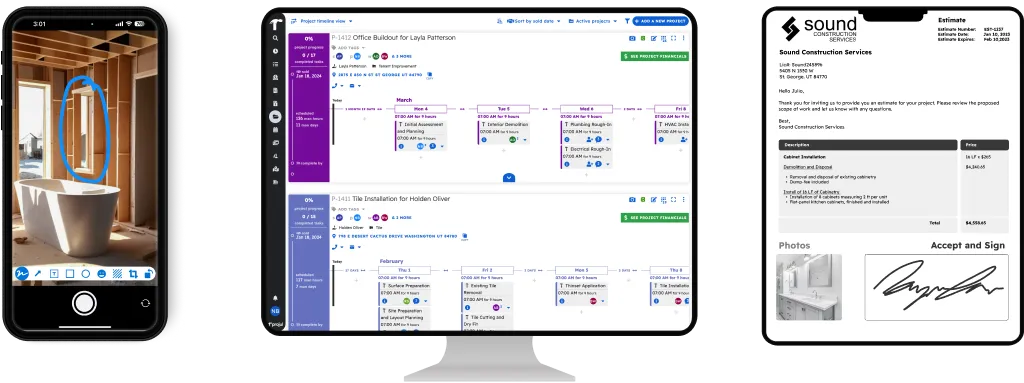
Projul ties every purchase order directly to your project’s budget, job cost records, and documentation, all updated automatically. Contractors using Projul report a 32% average profit increase, and tighter purchasing control is a big reason why.
Projul’s purchase order software lets contractors create, send, and track POs that tie directly to project budgets and job costs. Pull line items from estimates and sync everything to QuickBooks automatically. Projul offers flat-rate pricing with no per-user fees for construction companies of all sizes.
Once the purchase order is sent out, its details are automatically reflected across your project. Your budget and cost reports update instantly, and your team stays in the loop. Nothing falls through the cracks.
- Automatically update budgets, job costs, and records. Every PO you create instantly logs material costs into your budget and reports, no double-entry needed.
- Hit the ground running with materials ordered from day one. Start new projects knowing the needed supplies are already ordered and tracked.
- Sync purchase orders to QuickBooks Online and Desktop. Your purchasing data syncs automatically to QuickBooks to keep accounting simple.
Why Paper and Email POs Cost You Money
If your purchase order process involves a phone call, a handwritten note, or an email with “Hey, can you get me 200 2x4s?”, you’re losing money. Here’s how:
No paper trail. When a vendor delivers the wrong material or the wrong quantity, you need documentation to dispute it. A phone call or a text message isn’t proof of what you ordered. A formal PO with item descriptions, quantities, and agreed prices is.
Double orders. Without a central system tracking what’s been ordered for each job, duplicate orders happen. Your PM orders lumber from one supplier. Your super orders the same lumber from another. You end up with twice the material and a budget that’s already blown.
Budget surprises. When purchase orders aren’t connected to your project budget, you don’t know how much you’ve spent on materials until the invoices come in. By then, it’s too late to adjust. You find out you’re over budget after the money is already spent.
Slow ordering. Writing POs by hand or building them in a spreadsheet takes time. You’re formatting documents, looking up vendor contact info, and manually calculating totals. That’s time you could spend on the job site.
Lost orders. An email PO sitting in someone’s inbox gets buried. A paper PO left on a desk gets covered up. When no one follows up, the material doesn’t arrive, and your crew sits idle.
Projul eliminates every one of these problems by giving you a fast, connected, trackable purchase order system built specifically for construction.
How Projul’s PO Workflow Works
Creating a purchase order in Projul takes seconds, not minutes. Here’s what the process looks like:
Start from an estimate or from scratch. If you’ve already built an estimate for the project, Projul can pull material line items directly into a new PO. No retyping item descriptions, quantities, or unit costs. If you need to order something that wasn’t in the estimate, create a PO from scratch just as quickly.
Add your vendor. Select from your saved vendor list or add a new one. Projul stores vendor contact info, so you’re not hunting through emails or business cards every time you place an order.
Review and send. Check the items, quantities, and costs. Send the PO directly to your vendor as a professional document. The vendor gets a clean, organized PO that’s easy to read and process.
Track the status. Once the PO is sent, track its status from ordered to shipped to delivered. Your team can see the status of every open PO in one view, so nobody has to ask “did we order that yet?”
The whole process, from opening a new PO to sending it to your vendor, takes less time than finding the right spreadsheet template on your laptop.
Vendor Management in One Place
Projul keeps all your vendor information organized so you can reorder quickly and keep your supplier relationships clean.
Saved vendor profiles. Store contact info, notes, and order history for every vendor you work with. When you need to reorder from your lumber supplier, their info is already there.
Order history by vendor. See every PO you’ve sent to a specific vendor across all projects. This is useful when negotiating pricing, checking past order quantities, or resolving a dispute about what was ordered and when.
Professional documentation. Your vendors get clean, standardized POs that are easy to read and process. No more deciphering handwritten notes or trying to figure out what “the usual” means on a text message. Clear documentation means fewer errors, fewer returns, and faster processing.
Material Tracking That Keeps Your Crew Moving
The worst thing that can happen on a job site is a crew with nothing to do because materials didn’t show up. It costs you labor hours, pushes your schedule back, and frustrates everyone involved.
Projul’s purchase order tracking gives you visibility into every material order so you can catch problems before they become delays.
Real-time status updates. Every PO shows its current status: ordered, shipped, or delivered. When you open Projul in the morning, you can see at a glance which deliveries are expected today and which orders are still pending.
No more “did we order that?” conversations. Your PM, super, and office manager can all check PO status without calling each other. The information is right there in the project record.
Catch late shipments early. If a delivery is overdue, you see it immediately and can follow up with the vendor before it becomes a job site problem. That’s the difference between a one-day delay and a one-week delay.
Budget Integration and Cost Control
This is where Projul’s purchase order system separates itself from standalone PO tools and spreadsheets. Every purchase order you create automatically updates your project budget.
See material costs in real time. As you create POs, the costs flow into your project budget automatically. You always know exactly how much you’ve committed to materials and how much budget remains. No waiting for invoices to find out you’re over budget.
Compare estimated vs. actual. Projul shows you what you estimated for materials and what you’ve actually ordered. If there’s a gap, you see it early and can adjust before it eats your profit margin.
Job costing stays accurate. Material costs from POs feed directly into your job cost reports. When you’re reviewing project profitability, the numbers are current and complete because they updated automatically as POs were created.
No spreadsheet reconciliation. If you’re tracking POs in a spreadsheet and budgets in another tool, someone has to reconcile them manually. That takes time and introduces errors. Projul connects them automatically, so the numbers always match.
At $4,788/year with no per-user fees, your entire team can create and track purchase orders without adding cost. Your PM creates the PO. Your super checks delivery status from the field. Your accountant sees the budget impact in the financial reports. Everyone works from the same data.
Rapidly Get Your Purchase Orders to Vendors
Projul lets you create clear, organized POs in seconds, often before you could even open a spreadsheet. Over 5,000 contractors rely on Projul to get materials ordered fast and keep their crews moving.
Your crew doesn’t want to sit idle waiting on materials, and you don’t want to waste time writing out purchase orders by hand. Projul solves both problems.
- Stay one step ahead of project delays by sending POs out fast. Materials arrive before your team is left waiting.
- Make things easy for your vendors with professional documents that are clear, detailed, and easy to understand.
- Always include every important detail. Item descriptions, quantities, costs, supplier info, and delivery instructions are all captured.
With Live Editing, Tracking, and Team Visibility, It’s More Than a Document
Projul gives you real-time editing and tracking on every purchase order, so you always know exactly where your materials stand. With no per-user fees, your whole team can check PO status without adding cost. Purchase orders are available on the Pro plan.
Edit a purchase order on the fly whenever something changes, and track its status from ordered to delivered in real time. Need to adjust a quantity or add a new item? No problem.
- Make on-the-fly changes to POs whenever needed. Edit orders to add items, change quantities, or update details without starting over.
- See the status of every order with live tracking. Know at a glance which POs are pending, en route, or delivered.
Approval Workflows for Larger Teams
As your company grows, you need controls on purchasing. You don’t want every crew lead placing material orders without oversight. Projul lets you set up approval workflows so the right people review POs before they go out.
Your field super creates a PO for the materials needed at the job site. Your PM reviews it and approves it. The PO goes to the vendor. The budget updates. Everyone has visibility, and nothing gets ordered without the right sign-off.
This keeps spending in check without slowing down your crew. The approval process happens inside Projul, so it’s fast and trackable. No email chains. No waiting for a signature on a piece of paper that’s sitting on someone’s desk.
See the Impact on Your Budget Instantly
Every purchase order updates your project budget automatically. You’ll know exactly how material costs affect your margins without touching a spreadsheet. When it’s time to bill, those costs flow into invoicing and service invoicing too.
Projul connects purchasing, budgeting, and invoicing so the numbers flow from one stage to the next. Material costs from your POs show up in your budget. Budget data informs your invoices. And everything syncs to QuickBooks so your accountant has the numbers they need.
Start With Accurate Estimates
Great purchase orders start with great estimates. Estimates and change orders define your materials up front, so creating POs for a new project is fast and accurate from day one.
When the scope changes mid-project (and it will), update your estimate and generate new POs for the additional materials. The budget adjusts, the costs track, and you stay in control.
Why Construction Companies Need Purchase Orders (Even Small Ones)
You might think purchase orders are just for the big guys - the GCs running $5 million commercial jobs with dedicated procurement departments. But here’s the truth: if you’re ordering materials for any job, you need purchase orders. Period. It doesn’t matter if you’re a two-person crew doing kitchen remodels or a 50-person outfit building custom homes. The moment you pick up the phone and order materials, you’ve created a financial commitment. The only question is whether you’re tracking it or hoping for the best.
The Difference Between Knowing Your Costs and Guessing
Every contractor has been there. You finish a job, look at the final numbers, and wonder where the money went. The materials cost more than you expected. The profit margin you planned for? Gone. But you can’t point to exactly where things went sideways because you never had a clear record of what was ordered, from whom, and at what price.
That’s the fundamental problem with skipping purchase orders. Without them, you’re guessing. You’re estimating your material costs from memory, trusting that suppliers charged what they quoted, and hoping your crew didn’t over-order. Hope is not a business strategy.
With purchase orders, you know. You know exactly what was ordered for each job. You know the agreed price for every item. You know who the supplier is, when the order was placed, and what the expected delivery date was. That’s not paperwork for the sake of paperwork - that’s the information you need to run a profitable business.
Tracking What Was Ordered, From Whom, at What Price
Think about how many material orders go out across your jobs in a given week. Lumber from one supplier. Concrete from another. Electrical supplies, plumbing fittings, drywall, paint, fasteners - the list goes on. Now multiply that by the number of active projects you’re running.
Without purchase orders, all of that lives in a scattered mess of phone calls, text messages, emails, and handwritten notes. When a question comes up - “How much did we pay for that delivery of 2x10s on the Johnson project?” - you’re digging through your phone trying to find a text from three weeks ago.
With purchase orders, every order is documented. You can pull up any PO and see exactly what was ordered, the quantity, the unit price, the total, and which project it was for. That kind of visibility changes how you run your business. You stop guessing and start managing.
Catching Overbilling From Suppliers
Here’s something that doesn’t get talked about enough: supplier invoices don’t always match what you ordered. Sometimes it’s an honest mistake. Sometimes it’s not. Either way, if you don’t have a purchase order to compare against the invoice, how would you even know?
Let’s say you order 500 board feet of cedar decking at $4.50 per board foot. The supplier delivers the material. A week later, the invoice shows up and it says $4.85 per board foot. That’s a $175 difference on a single line item. Across an entire project with dozens of material orders, those small discrepancies add up fast.
When you have a purchase order on file, you can compare the invoice against the PO line by line. You catch the price difference immediately. You call the supplier, reference the PO number, and get it corrected. Without the PO, you probably just pay the invoice and never realize you overpaid.
This isn’t about being adversarial with your suppliers. Good supplier relationships matter. But good relationships are built on clear communication and accurate documentation, not on blind trust. A purchase order protects both sides. The supplier knows exactly what you expect, and you know exactly what you agreed to pay.
Knowing What Materials Are Allocated to Which Job
When you’re running multiple projects at the same time - and most contractors are - material allocation becomes a real issue. You order a load of framing lumber, but which job is it for? If it’s not documented, it’s a coin flip. Materials end up on the wrong job. Costs get assigned to the wrong project. Your job costing reports are fiction.
Purchase orders solve this by tying every material order to a specific project. When you create a PO in Projul, it’s linked to the job from the start. The cost of that material hits the right project budget automatically. There’s no confusion about which job the order belongs to, and your financial reports actually reflect reality.
This matters even more when you’re dealing with materials that look the same across jobs. A pallet of concrete bags could go to any of three active projects. If the PO says it’s for the Miller renovation, that’s where the cost lands. No guessing, no misallocation, no end-of-project surprises.
Small Companies Benefit the Most
Big companies have procurement departments, dedicated estimators, and accounting teams that catch mistakes. Small and mid-size contractors usually don’t. The owner is the estimator, the PM, the purchasing agent, and the bookkeeper all rolled into one. There’s no safety net.
That’s exactly why purchase orders matter more for small companies, not less. You don’t have a team of people cross-checking invoices and reconciling budgets. You need a system that does it for you. Every PO you create is a record that protects your bottom line. Every PO you skip is a gap in your financial picture.
And let’s be real - when you’re a smaller operation, every dollar matters more. A $500 billing error on a $50,000 job is 1% of revenue. On a $15,000 job, it’s over 3%. Small companies feel those hits harder, which is exactly why tracking every order with a purchase order isn’t optional. It’s survival.
The Cost of “Winging It”
Contractors who skip purchase orders aren’t saving time. They’re creating future problems. The time you “save” by not writing a PO gets spent later trying to figure out what was ordered, disputing invoices you can’t verify, and explaining to customers why the project went over budget.
The math is simple. Spending two minutes to create a PO in Projul saves you hours of confusion, disputes, and financial guessing down the road. It’s the difference between running a business and just doing work.
How Purchase Orders Work in Projul
Now that you understand why purchase orders matter, let’s walk through exactly how they work in Projul. The process is designed to be fast, connected, and practical - because we know you’d rather be on the job site than sitting at a computer filling out forms.
Step 1: Create a PO Tied to a Project
Everything starts with the project. When you create a purchase order in Projul, it’s linked to a specific job from the very beginning. This isn’t a generic PO floating in space - it’s connected to the project budget, the estimate, the schedule, and the rest of your project data.
Open the project, navigate to the purchase orders section, and start a new PO. Projul automatically fills in the project details so you’re not retyping the job name, address, or project number. The PO inherits the project context, which means every cost hits the right budget line from the start.
Step 2: Add Line Items From Your Estimate
This is where Projul saves you serious time. If you’ve already built an estimate for the project, you can pull material line items directly into your purchase order. The item descriptions, quantities, and unit prices transfer over automatically.
Think about what that means in practice. You estimated 2,400 square feet of hardwood flooring at $6.50 per square foot. When it’s time to order, you pull that line item into a PO with one click. The description, quantity, and price are already there. No retyping, no math errors, no discrepancies between what you estimated and what you ordered.
Of course, not everything on a PO comes from the estimate. Sometimes you need materials that weren’t in the original scope - maybe the customer added a feature, or you discovered something during demolition that requires additional supplies. In those cases, you can add line items manually. Type in the description, quantity, and price, and the PO updates immediately.
You can also split an estimate across multiple POs. Maybe you need framing lumber now but won’t need finish materials for another three weeks. Create separate POs for each phase and send them when the timing is right. Your budget tracks each one independently.
Step 3: Select Your Vendor and Send
Pick a vendor from your saved list or add a new one on the spot. Projul stores your vendor information - company name, contact person, email, phone number, and any notes you’ve added - so you’re not hunting through your contacts every time you place an order.
Once the PO is ready, send it directly to the supplier from inside Projul. The vendor receives a professional, clearly formatted purchase order document with every detail they need: line items, quantities, unit prices, totals, delivery address, and any special instructions. No ambiguity, no back-and-forth clarification calls.
Step 4: Track Delivery Status
After the PO goes out, track its progress through every stage. Projul gives you clear status indicators:
- Ordered - The PO has been sent to the vendor and is awaiting fulfillment.
- Shipped - The vendor has confirmed the materials are on the way.
- Delivered - Materials have arrived at the job site or your warehouse.
Your entire team can see these status updates. Your PM knows what’s been ordered. Your super knows what’s arriving today. Your office manager knows what’s still outstanding. Nobody has to make a phone call or send a text to get an answer. The information is right there in the project record.
Step 5: Match Against Invoices When Materials Arrive
When the supplier invoice comes in, pull up the original PO and compare them side by side. Are the quantities the same? Do the prices match? Were there any substitutions or back-ordered items?
This is where you catch mistakes before they become costly. If the invoice shows a higher price than the PO, you have documentation to dispute it. If items were back-ordered and not delivered, you know not to pay for them. The PO is your proof of what was agreed upon, and the invoice is what the supplier is claiming. When they match, pay it. When they don’t, question it.
This simple step - matching invoices against POs - is one of the most effective ways to protect your profit margin. Contractors who do this consistently report catching billing errors on a regular basis. Those errors might be $50 here or $200 there, but over the course of a year across multiple projects, they add up to thousands of dollars.
The Whole Process Takes Minutes
From opening a new PO to sending it to your vendor, the entire workflow takes a few minutes at most. Compare that to handwriting a PO on a carbon copy pad, or building one in a spreadsheet, or typing up an email with a list of materials. Projul’s process is faster, more accurate, and creates a permanent record that connects to everything else in your project.
Purchase Orders and Job Costing: Knowing Your Real Numbers
Here’s where purchase orders go from useful to essential. When your POs are tied to your project budget and job costing system, you get a financial picture that’s actually accurate - not a rough estimate based on outdated numbers and gut feelings.
Every PO Ties Back to the Project Budget
In Projul, every purchase order is connected to the project it belongs to. When you create a PO, the cost of those materials is immediately reflected in your project budget. You don’t have to wait for the invoice. You don’t have to manually enter the cost into a separate system. The budget updates the moment the PO is created.
This gives you something incredibly valuable: committed costs. These are costs you’ve agreed to spend but haven’t necessarily paid for yet. The materials might still be on a truck somewhere, but the financial commitment is real. Your budget reflects that reality.
Why does this matter? Because committed costs tell you where your budget actually stands. If you’ve budgeted $30,000 for materials on a project and you’ve already created POs totaling $27,000, you know you only have $3,000 left to work with - even if none of those invoices have been paid yet. That’s the kind of visibility that prevents budget overruns.
See Committed Costs Before Materials Even Arrive
Most contractors don’t find out they’re over budget on materials until the invoices pile up. By then, the money is spent. The materials are on the job site. There’s nothing you can do about it except absorb the loss.
With Projul, you see the financial impact of every material order the moment the PO is created. Your live construction costs dashboard shows committed costs alongside actual costs, giving you a complete picture of where your money is going.
Let’s say you’re running a $200,000 remodel. You’ve budgeted $65,000 for materials. After two weeks, you’ve created POs totaling $45,000. Projul shows you that immediately. You know you’ve committed 69% of your materials budget with the project only 30% complete. That’s an early warning sign. Maybe some of those POs covered bulk materials for the entire project, and you’re actually fine. Or maybe you’re trending over budget and need to find savings somewhere. Either way, you know now - not three months from now when the project is done and the money is gone.
Catch Budget Overruns Before They Happen, Not After
This is the whole point. Purchase orders connected to job costing give you the ability to catch problems while you can still do something about them.
Without this connection, budget reviews happen after the fact. You finish a project, pull your cost reports, and discover that materials came in 15% over budget. The project is done. The client has been invoiced. The loss is baked in. All you can do is learn from it (and hope you remember the lesson on the next job).
With Projul, you see budget variances in real time. Every PO you create either keeps you on track or pushes you closer to the edge. If you’re approaching your materials budget and there are still major orders to place, you know immediately. You can talk to the client about a change order. You can negotiate better pricing with a supplier. You can find a different material that costs less. You have options because you caught the problem early.
Your reporting tools in Projul make this even clearer. Run a job cost report at any point during the project and see estimated costs vs. committed costs vs. actual costs. The three-way comparison shows you exactly where every project stands financially - not approximately, not roughly, but exactly.
Job Costing That Reflects Reality
Job costing is only as good as the data feeding into it. If your material costs are based on estimates and you never update them with actual purchase data, your job cost reports are fiction. They might look professional, but the numbers are wrong.
When purchase orders feed directly into your job costing system, the numbers are real. Every PO adds actual committed costs to the project. When invoices come in and payments are made, those committed costs convert to actual costs. The progression from estimate to commitment to actual payment is tracked every step of the way.
This means your job cost reports are trustworthy. When you look at a project’s material costs, you’re seeing what was actually ordered and what was actually paid - not what someone estimated six months ago. That accuracy matters when you’re making decisions about pricing, staffing, and which types of projects are actually profitable for your company.
The Connection Between POs, Budgets, and Profitability
Here’s the bigger picture. Purchase orders aren’t just administrative documents. They’re financial data points that feed into your overall business intelligence.
When every PO ties to a project budget, and every budget ties to job cost reports, and every job cost report ties to your profitability analysis, you get a clear picture of how your business actually performs. You can see which types of projects are most profitable. You can see which suppliers give you the best pricing. You can see where material costs consistently exceed estimates - and adjust your estimating process accordingly.
That feedback loop - from estimate to PO to invoice to job cost report - is what separates contractors who grow from contractors who stay stuck. And it all starts with something as simple as creating a purchase order for every material order.
Going Paperless With Digital Purchase Orders
If you’re still using carbon copy PO books, this section is for you. Those triple-copy forms served their purpose for decades, but they come with real limitations that cost you time and money. Digital purchase orders aren’t just a modern convenience - they’re a practical upgrade that pays for itself almost immediately.
No More Carbon Copy PO Books
Carbon copy POs have problems that everyone tolerates but nobody likes:
- They’re hard to read. The second and third copies are faded and smudged. Good luck reading a quantity or price on that pink copy three months later.
- They get lost. Left on a job site, stuck in a truck, buried under a pile of plans on someone’s desk. When you need to reference a PO from last month, finding it is a scavenger hunt.
- They can’t be searched. Need to find every PO you sent to a specific supplier last year? That means flipping through stacks of paper one page at a time.
- They don’t connect to anything. A paper PO is an island. It doesn’t update your budget. It doesn’t feed your job costing. It doesn’t sync to your accounting software. Every number on that piece of paper has to be manually entered somewhere else.
Digital POs in Projul eliminate all of these problems. They’re legible, organized, searchable, and connected to the rest of your project data. It’s not about being “high tech” - it’s about not wasting time on problems that have already been solved.
Searchable History at Your Fingertips
One of the biggest practical advantages of digital purchase orders is search. Need to find a specific PO? Search by PO number, vendor name, project name, date range, or material description. The result comes up in seconds.
Compare that to paper. You think you ordered rebar from ABC Supply sometime in October for the Hillcrest project. With paper POs, you’re opening a file cabinet, pulling out a folder, and scanning through dozens of documents hoping to find the right one. With Projul, you type “ABC Supply Hillcrest” and it’s on your screen.
This searchability matters beyond just convenience. When a supplier disputes a delivery, when a customer questions a cost, when your accountant needs documentation for an audit - you need to be able to find specific purchase orders quickly. Digital records make that effortless.
Email POs Directly to Suppliers
With Projul, you send purchase orders to vendors directly from the platform. No printing, no faxing (yes, some suppliers still deal with faxes), no scanning and emailing. Click send, and the vendor gets a clean, professional PO document in their inbox.
This speeds up the ordering process significantly. You create the PO, review it, and send it - all without leaving your chair. The vendor receives it immediately and can start processing the order. There’s no lag time between creating the document and getting it to the supplier.
It also creates an automatic digital trail. Every PO you send is logged with a timestamp, the recipient’s email address, and the complete document. If there’s ever a question about whether a PO was sent or when it was sent, the record is right there.
Attach to Project for a Complete Audit Trail
Every digital PO in Projul lives inside the project it belongs to. When you open a project, you can see every purchase order that’s been created for that job - along with all your photos, documents, and other project files.
This creates a complete audit trail that’s invaluable for several situations:
- Client disputes. A customer says you charged too much for materials. Pull up the POs and show them exactly what was ordered, at what price, and from which supplier.
- Insurance claims. If materials are damaged or stolen, you have documentation showing what was ordered and what it cost.
- Tax documentation. Your accountant needs records of material purchases for a specific project or time period. Pull the POs from Projul and hand them over.
- Internal reviews. Looking back at a completed project to see what went right and what went wrong? Your PO history shows every material decision you made.
The Practical Reality of Going Paperless
Going paperless with purchase orders doesn’t mean changing everything about how you do business. It means replacing one slow, error-prone process with a faster, more reliable one. You still order the same materials from the same suppliers. You still review quantities and prices before placing orders. You still track deliveries and match invoices.
The difference is that every step happens faster, creates better records, and connects to the rest of your project data automatically. Your POs update your budget. Your budget informs your job costing. Your job costing feeds your profitability analysis. It’s one continuous flow of information instead of a collection of disconnected paper documents.
And here’s the part that contractors appreciate most: it works from your phone. You’re on the job site and realize you need additional materials. Open Projul on your phone, create a PO, send it to the supplier, and get back to work. No driving back to the office. No calling someone to write it up for you. No waiting until tomorrow.
The crew that’s been using carbon copy PO books for 20 years might be skeptical at first. But after the first week of creating POs in Projul - and seeing how much faster and cleaner the process is - they don’t want to go back. Every contractor we’ve talked to who has made the switch says the same thing: “I should have done this years ago.”
Stop Losing Money on Materials
Material costs are one of the biggest expenses on any construction project, whether you’re a general contractor, a home builder, or a commercial contractor. Without a proper purchase order system, you’re guessing at costs, losing track of orders, and finding out you’re over budget after the money is already gone.
Projul gives you control over your purchasing process so every dollar is tracked and every order is documented. Over 5,000 contractors trust Projul to keep their projects on budget. At $4,788/year with no per-user fees, your entire team gets access to purchase orders, budgeting, and everything else in the platform.