Carpenter Business Software. Saw your way to success, from proposal to payment. Built by construction pros with honest pricing.
You've spent years mastering your craft, so you shouldn't be spending all your time organizing your projects. Projul makes this easy by simplifying your processes and giving you everything you need in one place. Rated 4.9 out of 5 on G2 for ease of use.
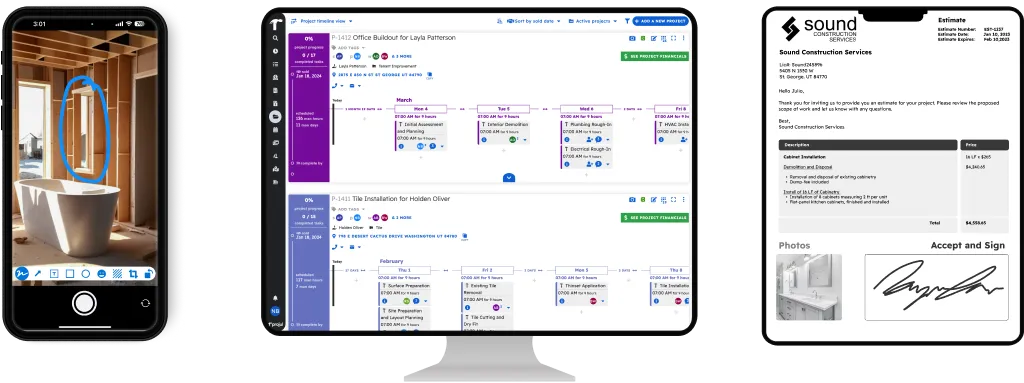
- Keep your customers up-to-date with a customer portal
- Quickly create accurate estimates with our assemblies calculator
- Get paid faster with professional invoicing
What Is Carpentry Software?
Carpentry software is a digital platform that helps carpentry contractors manage every job from the first material takeoff through final payment. It connects estimating, crew scheduling, shop and field time tracking, and invoicing so nothing gets lost between the shop and the job site.
Projul’s carpentry software helps carpenter contractors track material costs, schedule shop and field crews, and send accurate estimates from a platform built by a real contractor. Projul offers flat-rate pricing with no per-user fees for construction companies of all sizes. If you run a carpentry business, the building is the easy part. The hard part is pricing jobs accurately, keeping crews productive across multiple sites, tracking material costs that change every week, and getting paid without chasing invoices. Carpenter contractor software handles the business side so you can focus on the craft.
Organize Your Carpentry Business in One Platform
Carpentry jobs range from custom cabinetry to full structural framing, and every one has different material needs, timelines, and crews. Projul helps carpentry contractors track material costs, schedule crews across multiple job sites, and keep clients updated without a stack of phone calls at the end of each day. Over 5,000 contractors rely on Projul to manage the details that make or break a job’s profitability.
Most carpenter contractor software on the market was built for general contractors and then loosely adapted for specialty trades. You can feel it when you try to do a material takeoff for a custom built-in or track shop hours separately from field hours. The workflows do not fit how carpentry businesses actually operate. Projul works for carpenters because it was built by a contractor who understood the difference between a framing crew and a finish crew.
Custom Cabinetry and Millwork Estimating
Custom cabinetry is where carpentry businesses build their highest margins and take their biggest risks. Price a kitchen cabinet job too low and you eat the difference in shop time and materials. Miss a detail on the specs and you rebuild a box that took your crew two days to build the first time.
Projul’s assemblies calculator lets you build detailed cabinet estimates with line items for sheet goods, hardwood face frames, drawer slides, hinges, pulls, and finishing materials. Create a base cabinet template, a wall cabinet template, and a pantry template. When a new kitchen bid comes in, assemble the estimate from your templates, adjust for the specific layout, and send a professional proposal.
For millwork like crown molding packages, wainscoting, and custom mantels, build templates that capture every component. Your crown molding template might include the crown profile, backing blocks, inside and outside corner pieces, adhesive, and finish nails. Carpentry software that stores these templates means you are not rebuilding the same estimate from scratch every time a similar job comes in.
The speed advantage matters. A carpenter who sends a detailed, professional estimate the day after the site visit wins more work than one who takes a week to build a quote in a spreadsheet. Carpenter contractor software that accelerates your estimating puts more bids in front of clients while the project is still fresh in their mind.
Pricing Materials When Lumber Costs Fluctuate
Lumber prices are volatile. A sheet of cabinet-grade plywood that cost $45 last month might cost $55 today. Dimensional lumber swings with supply and demand, and hardwood species like walnut and white oak can jump 20% in a single quarter.
Projul lets you update material costs in your templates as prices change. When your supplier sends a new price sheet, update the template and every future estimate reflects the current cost. You stop quoting jobs based on lumber prices from three months ago and then losing money when you actually buy the material.
For carpentry businesses that buy in volume, this cost tracking also helps you decide when to stock up. If you see plywood trending up, buy ahead for your next few cabinet jobs and lock in the lower price. Carpentry software that keeps your pricing current protects your margin on every bid.
Material Takeoffs: Board Footage, Sheet Goods, and Hardware
Accurate material takeoffs separate profitable carpentry businesses from ones that are always short on material or sitting on expensive surplus. Every type of carpentry work has its own takeoff method.
Board footage calculations for hardwood lumber depend on the species, grade, and dimensions. A 1x6 red oak board that is 8 feet long is 4 board feet. Your trim package for a 2,000 square foot house might need 300 linear feet of baseboard, 200 linear feet of casing, and 50 linear feet of crown. Each profile comes in different lengths, and you need to account for waste from cuts at corners and splices.
Sheet goods for cabinetry require a different approach. A standard 4x8 sheet of plywood yields a specific number of cabinet sides, tops, and bottoms depending on your cut layout. An efficient cut layout wastes 10 to 15% of the sheet. A sloppy one wastes 25% or more.
Projul’s assemblies calculator handles these takeoff calculations so you are not doing them by hand or in a spreadsheet that breaks when someone changes a formula. Enter the dimensions, the material, and the waste factor. The calculator does the math. Carpentry software that speeds up takeoffs means you spend less time at your desk and more time in the shop or on the job site.
Finish Carpentry vs. Rough Carpentry
Finish carpentry and rough carpentry are different businesses that happen to share a trade name. Rough carpenters frame walls, set trusses, and sheath roofs. Finish carpenters install trim, hang doors, build closet systems, and set cabinetry. The estimating, scheduling, and crew management for each are different.
Rough carpentry estimates focus on dimensional lumber, sheathing, fasteners, and hardware like joist hangers and hurricane ties. The work moves fast and the tolerances are measured in fractions of an inch. A framing crew might rough in a house in a week.
Finish carpentry estimates focus on trim profiles, hardwood, sheet goods for built-ins, and specialty hardware. The work moves slowly and the tolerances are measured in sixty-fourths. A finish crew might spend two weeks trimming the same house the framing crew roughed in five days.
Projul lets you build separate template libraries for rough and finish work. Your framing templates use dimensional lumber quantities and production labor rates. Your finish templates use linear footage for trim, sheet goods for built-ins, and detail labor rates that reflect the slower pace of precision work. Carpenter contractor software that separates these two categories keeps your estimating accurate for both.
Trim and Molding Work
Trim work is the bread and butter of most finish carpentry businesses. Baseboard, casing, crown molding, chair rail, wainscoting, and shoe molding go into nearly every residential project. Pricing trim work requires counting linear footage room by room, accounting for inside and outside corners, and adding waste for cuts and splices.
Projul’s estimating templates let you build a trim package with every profile itemized. When you walk a house for a trim bid, note the linear footage by room and by profile. Back at the office, plug the numbers into your template. The estimate includes the material, the labor, and the waste factor for each profile.
For custom trim profiles that need to be milled, add the milling time as a line item in your estimate. This shop time is often underpriced because carpenters focus on the install labor and forget about the hours spent at the molder. Carpentry software that captures shop time as a separate cost category prevents this common margin leak.
Built-Ins, Bookcases, and Custom Storage
Built-in cabinetry, bookcases, entertainment centers, and closet systems are high-value projects that clients are willing to pay a premium for. They also require detailed estimating because every built-in is unique to the space.
Projul lets you estimate built-ins with line items for sheet goods, hardwood, hardware, finishing materials, and labor. Break the labor into shop time for building the components and field time for installation. This separation is important because shop time happens in your controlled environment and field time happens in the client’s house where progress is slower.
For built-in projects, document the client’s specifications in the project record with photos, sketches, and measurements. When your shop crew starts building, they pull up the specs on their phone instead of working from a hand-drawn sketch that someone left on the workbench. When the install crew arrives at the house, they see the same specs and know exactly what they are working with.
Carpenter contractor software that keeps your shop and field teams working from the same project record eliminates the communication gaps that cause rework. A bookcase built to the wrong dimensions because the shop crew had outdated measurements is a mistake that costs you days and materials.
Commercial Tenant Improvements
Commercial TI work is a major revenue source for carpentry businesses. Office buildouts, retail fit-ups, and restaurant renovations all need framing, blocking, backing, trim, and custom millwork. The work moves fast, the deadlines are tight, and the GC expects you to show up when scheduled and finish on time.
Projul helps you manage commercial TI projects alongside your residential work. Schedule your commercial framing crew for the office buildout while your finish crew handles a residential trim package across town. Both jobs show up on the same dashboard so you see your full workload.
For commercial work, estimating is typically based on plans provided by the architect or designer. Projul’s line-item estimating lets you price each scope item from the plans: metal stud framing by the linear foot, blocking and backing by quantity, trim and millwork by the piece. When the GC issues a change order adding a conference room partition, document it in Projul and your budget updates automatically.
Carpentry software that handles commercial and residential work in one platform means you are not switching between systems when you go from a tenant improvement to a custom home. One login. One schedule. One set of reports.
Shop vs. Field Time Tracking
Carpentry businesses split their time between the shop and the job site. Your cabinet crew might spend three days in the shop building boxes and two days on site installing them. Your trim crew might do all their work on site. Your millwork team might spend a week at the molder and a day on delivery and install.
Projul’s time tracking with geofencing automatically distinguishes between hours logged at your shop address and hours logged at job sites. When your cabinet builder clocks in at the shop, those hours are coded to shop time. When your finish carpenter clocks in at a client’s house, those hours are coded to field time.
This separation matters for job costing. If you estimated 20 hours of shop time and 8 hours of field time for a cabinet job, but your crew spent 30 hours in the shop because of a design revision, you need to know that. Carpenter contractor software that tracks shop and field hours separately gives you the data to price future jobs accurately.
For carpentry businesses with multiple shop locations or a main shop plus a finishing room, set up geofencing for each location. You see exactly where your labor hours go and which projects are consuming more shop time than budgeted.
Schedule Carpentry Crews Across Multiple Sites
Your carpenters are spread across job sites, your shop, and sometimes a supplier picking up materials. A framing crew finishes a house on Wednesday and needs to start the next one Thursday. Your finish crew is halfway through a trim package that will take three more days. Your cabinet installer is waiting for countertop templates before they can finish.
Projul’s scheduler shows all your crews and all your active jobs on one board. Drag tasks to assign crews. See gaps in the schedule and fill them. When a GC pushes your start date by a week, slide the tasks and your crew gets notified on their phone.
For carpentry contractors managing both shop production and field installation, the scheduler needs to show both. Projul lets you schedule shop tasks like “build kitchen cabinets” and field tasks like “install kitchen cabinets” as linked items. The install does not get scheduled until the build is complete.
Contractors using Projul save 2+ hours daily on scheduling and crew coordination. For a carpentry business running four or five active projects, that time savings translates directly to more productive hours for your crew.
Give Clients a Professional Experience
Projul’s customer portal lets your carpentry clients check project progress, view approved estimates, and access invoices without calling the shop. For custom cabinet clients who want to see progress photos from the shop, post updates to the project record and they see them in the portal.
This level of professionalism sets you apart from every carpenter who communicates through text messages and handwritten invoices. When a homeowner can log in and see that their built-in is 70% complete in the shop with photos of the progress, they stop calling you every other day for an update.
Rated 4.9/5 on G2 for ease of use, Projul’s client portal builds the kind of trust that generates referrals and repeat work. Carpentry software with a client-facing portal is no longer a luxury. It is what your clients expect.
Job Costing That Shows Where Your Money Goes
Not every carpentry job is equally profitable. That straightforward baseboard and casing package is a predictable moneymaker. The custom walnut entertainment center with integrated lighting is a margin gamble if you did not price it right.
Projul tracks estimated costs versus actual costs on every project. You see material costs, shop labor, field labor, and any change orders in real time. When a cabinet job is running over on shop hours, you catch it while the crew is still building instead of discovering it after delivery.
Over time, this data shows you which types of carpentry work make the most money. Maybe your trim packages are cash machines but your custom millwork barely breaks even because of all the shop time. That information shapes which jobs you chase, how you price them, and where you focus your marketing. Carpenter contractor software that gives you this visibility is the difference between growing profitably and just staying busy.
Manage Your Carpentry Jobs From the Field
Your carpenters are on site all day. They are not sitting at a desk. Projul’s native mobile app lets them pull up cut lists, check material specs, upload photos of finished work, and log hours with geofencing so time tracking is automatic.
When the client asks for a change at the job site, your carpenter checks the estimate on their phone and creates a change order before they pick up a saw. When a material delivery shows up short, they document it in the app and the office knows immediately. No phone tag. No waiting until the end of the day.
For shop work, your crew clocks in at the shop and logs time against specific projects. Progress photos of cabinet builds, millwork profiles, and test fits go straight into the project record where the office and the client can both see them.
Honest Pricing for Carpentry Contractors
Most carpentry software charges per user. If your shop manager, three cabinet builders, two finish carpenters, an estimator, and your office staff all need access, you are paying for eight or nine seats. That gets expensive fast for a trade where margins are already tight.
Projul starts at $4,788 per year for your entire carpentry company. No per-user fees. Your estimators, shop crew, field crew, and office staff all get full access without inflating the bill.
Over 5,000 contractors use Projul to manage their operations, and carpentry contractors consistently report saving 2+ hours daily on admin work. G2 users rate Projul 4.9/5 for ease of use and 4.9/5 for quality of support.
Carpenter Invoicing That Gets You Paid Faster
Getting paid is the whole point. But too many carpenter contractors finish a job, go home tired, and put off the invoice until the weekend. By then the details are fuzzy, the client has moved on, and your cash flow takes the hit.
Projul’s invoicing tools let you turn any approved estimate into a professional invoice with one tap. Finished the trim install? Pull up the estimate on your phone, convert it to an invoice, attach a photo of the completed work, and send it before you leave the driveway. Change orders are already included because they were documented during the project.
For carpenter contractors running multiple jobs, Projul shows you which invoices are outstanding, which are overdue, and which clients have a habit of paying late. QuickBooks integration keeps your accounting current without double entry. Your bookkeeper sees every invoice the moment it goes out.
Carpenter invoicing software should not be a separate tool from your estimating and scheduling. When everything lives in one platform, your numbers stay consistent from the first bid through the final payment. No copy-paste errors. No lost change orders. No invoices that sit in a drawer for two weeks.
How to Price Carpentry Work Without Leaving Money Behind
Pricing carpentry jobs is part math, part experience, and part knowing your own numbers. Here are the areas where most carpentry contractors lose money and what to do about it.
Account for Every Hour in the Shop
Shop time is the silent margin killer for carpentry businesses. You bid a custom built-in at 40 hours of labor, but your crew spends 12 hours just on sanding and finishing because the client picked a stain-grade hardwood that shows every imperfection. That extra shop time was not in your bid.
Break your labor estimates into categories: cutting and milling, assembly, sanding, finishing, and install. Track each category separately in your job costing reports so you know where the hours actually go. After a few projects, you will have real data on how long each phase takes for different material types. A paint-grade MDF built-in takes half the finishing time of a stain-grade walnut piece, and your pricing should reflect that difference.
Build a Waste Factor Into Every Material Takeoff
Lumber waste on carpentry jobs runs anywhere from 8% on straightforward framing to 20% or more on complex trim work with lots of miters and coped joints. If you are not building a waste factor into your material estimates, you are eating those costs on every single project.
Set your waste factors by work type in your estimate templates. Framing gets 10%. Straight-run baseboard gets 12%. Crown molding with inside and outside corners gets 18%. Custom millwork with odd angles gets 20% or more. These numbers should come from your actual job data, not from a guess. Review your material costs against your estimates on completed projects using Projul’s budgeting tools and adjust your waste factors based on what really happened.
Photograph Everything Before Drywall
For rough carpentry and framing work, take photos of every wall before it gets covered up. Blocking locations, header sizes, beam connections, and any structural modifications need to be documented. When the homeowner calls six months later wanting to mount a TV or add a shelf, you can pull up the project photos and tell them exactly where the blocking is.
This documentation also protects you on warranty claims and insurance issues. If a crack appears in the drywall and the homeowner blames your framing, you have photos showing the work was done correctly before the drywall crew showed up. Carpenters who work on home building projects or remodeling jobs learn quickly that photo documentation pays for itself the first time a dispute comes up.
Do Not Underestimate Install Time on Custom Work
Every custom carpentry project has surprises at install. The walls are not square. The floor is not level. The ceiling has a crown molding return that nobody measured. These site conditions add 15 to 30% more install time compared to working in your shop where everything is flat and plumb.
Build that extra time into your field labor estimates. If a cabinet install takes 8 hours in a perfect world, bid it at 10 to 11 hours. Your clients will not notice the difference in the total price, but your margin will notice the difference when install day goes long because the kitchen walls are an inch out of square.
Custom Millwork Estimation and Tracking
Custom millwork is where carpentry businesses earn premium rates and face the highest risk of underpricing. A set of custom interior doors, a library of floor-to-ceiling built-in shelving, or a hand-milled staircase railing involves dozens of material components, hours of machine time, and finishing work that can double or triple the labor depending on the species and the client’s expectations. If your estimate misses any of those layers, the job eats into your profit before your crew even starts the install.
The challenge with millwork estimation is that every project is truly one of a kind. A standard trim package has predictable quantities and repeatable labor rates. Custom millwork does not. That walnut library with integrated ladder rail and adjustable shelving requires a different material list, a different machine setup, and a different finishing process than the white oak entertainment center you built last month. You cannot just copy an old estimate and swap out the numbers.
Projul’s assemblies calculator lets you build millwork estimates in layers. Start with the raw material: board footage of rough lumber by species, sheet goods for backing and internal components, and any veneer or edge banding. Add your milling time as a separate labor line item. Account for sanding, staining or lacquering, and curing time between coats. Then add your install labor, hardware, and any site-specific preparation like scribing to out-of-plumb walls.
When you break a millwork estimate into these layers, you see exactly where the money goes and where you have been undercharging. Most carpentry businesses discover that their finishing labor is the biggest gap between estimate and reality. A clear coat on paint-grade MDF takes two hours. A hand-rubbed oil finish on quartersawn white oak takes two days. Your estimate needs to reflect that difference, and your job costing reports will confirm whether your rates are accurate after a few completed projects.
For tracking millwork projects through production, Projul keeps every detail in one project record. Your designer uploads the drawings. Your shop foreman checks dimensions on his phone before cutting. Your finisher logs hours against the finishing phase specifically. When the install crew heads to the job site, they pull up the project on the Projul mobile app and see the specs, the photos from the shop, and any notes about site conditions that the estimator captured during the walkthrough. Our millwork and cabinets installation guide covers the production workflow from shop to site in more detail.
The tracking side matters just as much as the estimating side. Without visibility into where each millwork project stands, your shop becomes a black hole where jobs go in and you hope they come out on time. Projul’s project timeline shows you which phase each job is in, whether it is on schedule, and which jobs need attention before they miss their install date. That visibility lets you manage shop capacity and commit to realistic delivery dates instead of guessing and hoping.
Trim Carpentry vs. Rough Carpentry Crew Management
If your carpentry business handles both rough and finish work, you already know that managing these two types of crews is like running two separate companies under one roof. Your framing crew works fast, moves heavy material, and measures in fractions of an inch. Your trim crew works slowly, handles delicate profiles, and measures in sixty-fourths. Scheduling them the same way, paying them the same rates, and estimating their work with the same templates leads to inaccurate bids and frustrated crews.
The scheduling challenge is the most immediate pain point. Your framing crew can rough in a house in five to seven days and needs to move to the next job immediately or they are sitting idle. Your trim crew might spend two to three weeks in that same house doing baseboard, casing, crown, and closet shelving. If your scheduler does not understand these different timelines, you end up with framing crews without a next job and trim crews double-booked because someone assumed trim takes the same time as framing.
Projul’s scheduling tools let you manage rough and finish crews on the same board with different task durations and labor rates. Color-code your crews by type so you can see at a glance where your framers are this week and where your finish carpenters are for the next two weeks. When a framing job wraps early, drag the crew to their next assignment. When a trim job runs long because the client added wainscoting to the dining room, extend the task and push the next job back before your trim crew gets double-booked.
Labor rate tracking is where most carpentry businesses lose money on mixed crews. Your framing labor rate might be $45 per hour. Your finish labor rate might be $65 per hour because the work is slower, requires more skill, and uses more expensive tools. If you estimate a project with a blended rate instead of separating rough and finish labor, you either overbid the framing portion or underbid the trim portion. Either way, your numbers are wrong.
Projul’s time tracking with geofencing captures hours by crew member and by project phase. When your framing crew clocks in at a job site, their hours go against the framing phase at the framing labor rate. When your trim crew arrives at the same house two weeks later, their hours go against the trim phase at the finish labor rate. Your job costing reflects the true cost of each phase, and your future estimates get more accurate with every completed project.
For carpentry contractors who subcontract one side or the other, the crew management challenge gets even more complex. Maybe you self-perform all trim work but sub out framing to a crew you trust. Projul lets you assign tasks to subcontractors and track their progress alongside your own crews. When the framing sub finishes and marks their tasks complete, your office sees it immediately and schedules your trim crew to start. No phone tag, no wondering whether the house is ready for finish work.
Wood Species and Material Sourcing Documentation
Every carpenter knows that material selection can make or break a project. The species of wood, the grade of lumber, the source of the material, and the current availability all affect your price, your timeline, and the final quality of the work. But most carpentry businesses track this information in their head or on scraps of paper that get lost between the shop and the job site.
The problem gets worse when lumber prices are volatile. A quote from your hardwood supplier is only good for 30 days. If the client takes six weeks to approve the estimate and white oak has jumped 15% in the meantime, you are either eating that cost increase or having an uncomfortable conversation about repricing. Carpenter contractor software should help you track supplier quotes, expiration dates, and price changes so you never get caught bidding with stale numbers.
Projul lets you attach supplier quotes, spec sheets, and material documentation directly to the project record. When your client picks quartersawn white oak for their built-in, attach the supplier quote showing the price per board foot, the grade, and the delivery timeline. If the client takes a month to decide and you need to reprice, the original quote is right there in the project for reference. Update the estimate with current pricing and the client sees exactly what changed and why.
For specialty species that require longer lead times, this documentation is critical for scheduling. Rift-sawn walnut might take four to six weeks from order to delivery. Reclaimed heart pine could take eight weeks if the supplier needs to source and mill it. If your scheduler does not know about these lead times, they will schedule the shop work before the material arrives and your crew sits idle waiting for lumber.
Track material lead times in your project notes and build them into your schedule. Projul’s project management tools let you create procurement tasks with due dates that trigger before your shop work is scheduled to begin. When the material arrives, mark the procurement task complete and your shop crew sees that the project is ready to start. That connection between material sourcing and production scheduling prevents the most common bottleneck in custom carpentry work.
Documentation also protects you on quality disputes. When a client complains that the stain looks different on their white oak than it did on your sample, you pull up the project record showing the species, the grade, and the supplier. Wood is a natural material and color variation is normal, but having documentation of exactly what was specified, ordered, and delivered gives you a solid foundation for that conversation. For more on tracking materials across projects, our construction material tracking guide covers best practices that apply directly to carpentry businesses.
Finish Carpentry Punch List and Quality Standards
The punch list is where finish carpentry reputations are made or broken. Every trim job, every cabinet install, and every piece of custom millwork faces a final inspection where the client walks through and points out every gap, every scratch, and every joint that is not perfect. How you handle that punch list determines whether the client pays the final invoice happily and refers you to their neighbors, or whether they hold payment and tell everyone about the carpenter who did sloppy work.
The problem with most punch list processes is that they are informal and unorganized. The client walks through with your lead carpenter and points out issues verbally. Your carpenter tries to remember 15 items across 8 rooms while nodding and saying “I’ll take care of it.” A week later, they come back to address the list and miss three items because they forgot, or they fix the wrong thing because they misremember which room the client was talking about.
Projul’s to-do and daily log tools let you create a formal punch list tied to the project record. Walk through with the client and log each item with a description, a photo, and a room location. Assign items to specific crew members. Set a target completion date. When your carpenter addresses an item, they mark it complete in the app and attach a photo of the fix. The client can see progress through the customer portal without calling your office every day.
For finish carpentry, quality standards need to be defined before the punch list walk happens. What is acceptable and what is not? A 1/32 inch gap at a miter joint might be within tolerance for painted trim but unacceptable for stain-grade walnut crown. A slight variation in sheen across a lacquered surface might be normal for hand-applied finish but a defect if the client was promised a sprayed cabinet-quality coat. Define these standards in your project scope and reference them during the punch list walk.
Our construction punch list best practices guide covers how to structure the walkthrough, set client expectations, and close out projects cleanly. For a more detailed walkthrough process, the punch list walkthrough tips guide gives you a step-by-step approach that works for finish carpentry projects of any size.
The quality control side goes beyond just punch lists. For carpentry businesses that want to reduce punch list items in the first place, build quality checkpoints into your production process. Check cabinet doors for alignment before you deliver. Test drawer slides before you install. Inspect trim joints before you caulk. Projul lets you create task checklists within each project phase so your crew verifies quality at every step, not just at the final walk. Our quality control inspection checklists guide has templates you can adapt for carpentry-specific checkpoints.
Tracking punch list data across projects also reveals patterns. If you consistently get called back for the same issue, like crown molding separation at outside corners or cabinet doors that go out of alignment after three months, that pattern points to a process or material problem you can fix permanently. Projul’s project records give you the history to spot these patterns and address the root cause instead of just fixing the same symptom on every job.
Stop Running Your Carpentry Business From a Spreadsheet
If you are still doing material takeoffs in Excel, tracking jobs on a whiteboard, and invoicing from Word documents, you already know it is not working. You are losing time on every estimate, losing money on material orders, and losing track of which projects need shop time versus field time.
Carpentry software like Projul is not about adding complexity. It is about running a tighter operation so you can take on more projects, protect your margins, and stop working weekends catching up on paperwork.
Over 5,000 contractors have already made the switch. They are spending less time on admin, estimating materials more accurately, and getting paid faster. Your competition is probably one of them.