Concrete Contractor Software. Built by construction pros with honest pricing.
Once the trucks start rolling, you can't hit pause. Projul helps concrete contractors schedule pours, time batch orders, and make sure your crew and finishers are locked in before the first yard hits the forms. 5,000+ contractors trust Projul because it was built by people who've actually been on a slab.
- Schedule pours with weather windows and crew availability on one screen
- Track rebar, form, and finish costs per job to protect your margins
- Coordinate batch plant orders so concrete arrives when your crew is ready
- Build estimates using yardage calculators for flatwork, footings, and foundations
What Is Concrete Contractor Software?
Concrete contractor software is a project management platform built for the unique demands of concrete work, including pour scheduling around weather windows, yardage-based estimating, batch plant coordination, and real-time job costing that tracks every yard placed against your bid. If you are comparing options, our guide to the best concrete contractor software breaks down what to look for.
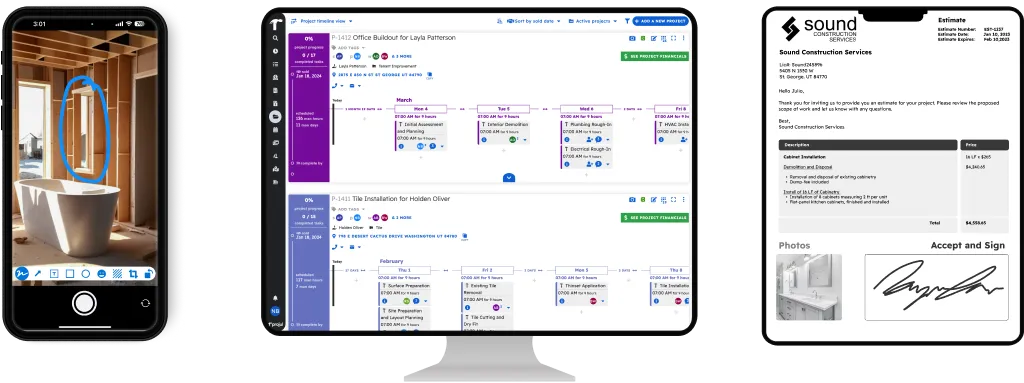
Projul’s concrete contractor software helps concrete companies schedule pours around weather windows, track yardage costs, and coordinate batch plant logistics from one platform built by contractors. Projul offers flat-rate pricing with no per-user fees for construction companies of all sizes. If you run a concrete company, your business moves on a clock that most other trades never deal with. Once that truck backs up to your forms, you have roughly 90 minutes before the mud starts setting up. There is zero room for confusion about who is doing what, when the next truck arrives, or whether the pump is on its way. Concrete contractor software like Projul puts all of those moving pieces on one screen so you stop losing money to bad timing and poor coordination.
Schedule Pours Around Weather, Temperature, and Crew Availability
Concrete is one of the most weather-sensitive trades in construction. A sudden rainstorm can ruin a fresh pour. Temperatures below 40 degrees require hot water and insulated blankets. Temperatures above 90 degrees shorten your working time and demand retarder or ice in the mix. You cannot just look at the forecast and hope for the best.
Projul’s scheduling tools let you plan pours against weather windows, crew availability, and batch plant lead times on one board. You see which days have the right conditions, which crews are committed elsewhere, and whether your finishers can make it. When a cold front moves in and kills your Thursday pour, you reschedule the entire chain in minutes. Your batch plant order, pump truck reservation, and crew assignments all shift together.
This kind of coordination used to take a morning of phone calls. Concrete contractor software like Projul turns it into a few taps on a screen. Your crew leads see the change on their phones before they leave the house. Over 5,000 contractors use Projul to manage exactly this kind of daily schedule chaos, and concrete companies consistently save 2+ hours daily on coordination alone.
Curing Time and Follow-Up Scheduling
A pour is not done when the finishers walk off the slab. You still need to schedule curing time, saw-cut joints, form stripping, and sometimes post-tension stressing. Miss your saw-cut window and you get random cracking. Strip forms too early and you compromise the concrete’s strength.
Projul lets you build task sequences that account for curing times. Set a 7-day form strip reminder after a wall pour. Schedule saw-cutting for 8 to 12 hours after a slab pour. These follow-up tasks appear automatically on your schedule so nothing slips through the cracks. Your foreman sees the full timeline, not just the pour date.
Estimating Concrete Jobs: Yards, PSI, Rebar, and More
Concrete estimating is all about volume, specifications, and reinforcement. You need to calculate cubic yards for flatwork, footings, walls, and grade beams. You need to spec the right PSI mix for the application. You need to price rebar or welded wire mesh based on the structural requirements. And you need to account for waste, because you always order more than the theoretical calculation says.
Projul’s estimating tools let you build detailed concrete bids with line items for every component. Create templates for your most common job types: 4-inch residential flatwork, 6-inch commercial slabs, stem wall foundations, decorative patios. Each template includes your standard yardage calculations, rebar specs, form materials, and finish labor so you are not starting from scratch on every bid.
When the client approves your estimate, it converts directly into a scheduled project. The line items become your job cost budget. Your yardage estimate becomes the baseline you track against actual delivery tickets. This is how concrete contractor software saves you from the disconnect between what you bid and what you spend.
Flatwork vs. Structural Estimating
Flatwork and structural concrete are different animals. A residential driveway is 4 inches of 3,000 PSI with wire mesh and a broom finish. A commercial foundation is 12-inch footings with #5 rebar on 12-inch centers, 4,000 PSI minimum, and inspection hold points before every pour.
Projul handles both. Set up separate estimate templates for each type of work. Your flatwork template might include yardage, mesh, finish labor, and saw-cutting. Your structural template adds rebar tonnage, form rental days, engineering submittals, and inspection scheduling. Bid faster because you are pulling from templates that already have your standard pricing, then adjust for the specific job.
Decorative Concrete: Stamped, Stained, and Polished
Decorative concrete work carries higher margins but also more complexity. Stamped concrete requires color hardener, release agent, specific stamp patterns, and a sealer coat. Stained concrete needs surface prep, acid or water-based stain application, and multiple sealer coats. Polished concrete involves progressive diamond grinding steps and densifier application.
Projul lets you build estimate templates for each decorative finish type. Track color selections, pattern choices, and material quantities as line items. Schedule the extra labor steps as individual tasks so your crew knows the full scope before they start. When a homeowner changes their stamp pattern two days before the pour, you update the estimate and the project record in one place. Concrete contractor software keeps decorative jobs profitable by making sure nothing gets missed in the complexity.
Batch Plant Ordering and Delivery Coordination
Getting concrete to your job site at the right time is the single most time-sensitive coordination task in your business. You call the batch plant a day or two ahead. You confirm yardage, mix design, and delivery time. And then you hope that the plant is not behind schedule, because once the trucks start, you need continuous delivery. A 30-minute gap between trucks on a large pour means cold joints and quality problems.
Projul’s scheduling tools help you plan batch plant orders alongside your crew schedule and pump truck reservations. When you know you need 40 yards of 4,000 PSI on Thursday morning, you can attach that order detail to the project schedule. Your estimator, your foreman, and your office all see the same information. When the batch plant calls to confirm, you are not scrambling to remember what you ordered.
Pump Truck Coordination
If your pour requires a pump truck, that is another vendor to schedule and another cost to track. Line pumps for residential flatwork. Boom pumps for commercial work or hard-to-reach locations. Each has different rates, setup times, and minimum-hour charges.
Projul tracks pump truck reservations as part of your project schedule. When a pour date shifts, you see the pump reservation right there and know to call for a reschedule. The cost hits your job record so you can compare estimated pump costs against actual charges. Software for concrete companies should handle this kind of vendor coordination without making you maintain a separate tracking sheet.
Formwork Planning and Tracking
Forms are a major cost on structural concrete jobs. Whether you own your forms or rent them, you need to know where they are, when they are available, and how long you can keep them on a job before rental costs eat your margin.
Projul’s job costing tracks form rental as a line item on every project. You see daily rental costs accumulating against your bid allowance. If a project runs two days longer than planned, you know exactly what those extra form rental days cost you. Your foreman can log form counts and condition from the field app, so you always know your inventory status.
For contractors who own their own form systems, Projul helps you schedule form availability across jobs. If your gang forms are tied up on a wall pour until Friday, you see that on the schedule before you commit to another pour on Thursday. Concrete contractor software that tracks your equipment alongside your labor and materials gives you a complete picture of job profitability.
Job Costing That Shows Profit on Every Pour
Here is the question every concrete contractor should be able to answer at any moment: Am I making money on this pour?
If you have to wait until the job is done to figure that out, you are already too late. Projul tracks estimated costs versus actual costs on every project in real time. You see labor hours logged against your bid. You see yardage delivered versus yardage estimated. You see form rental days ticking against your allowance.
Contractors using Projul report a 32% average profit increase. That number comes from catching overruns early. When you know at week two that labor is running 15% over estimate, you can adjust crew size, talk to your foreman, or renegotiate scope. When you find out at the end of the job, all you can do is learn an expensive lesson.
Tracking Yardage: Estimated vs. Delivered
Every concrete contractor has dealt with the yardage gap. You calculate 22 yards for a slab. The batch plant sends 25 because of waste, grade variations, or a subgrade that was not as flat as the survey said. Those extra 3 yards cost you $500 or more, and if you did not account for waste in your bid, that comes straight off your profit.
Projul lets you log delivery tickets against your estimated yardage on every pour. You see the running total as trucks arrive. Over time, you build data on your typical waste percentages by job type. That data makes your next estimate more accurate. Concrete software that helps you learn from every job is worth more than software that just tracks what already happened.
Rebar Inspection Hold Points and Compliance
Structural concrete work comes with inspection requirements. Your rebar has to be in place, properly tied, and approved by the building inspector before you can pour. Miss that inspection and you either wait (losing your batch plant slot) or pour without approval (risking a failed inspection and a tear-out).
Projul helps you schedule inspection hold points as tasks in your project timeline. Set a rebar inspection task before every structural pour. Attach photos of the rebar placement for documentation. When the inspector signs off, your foreman marks the task complete and the pour can proceed. All of that documentation stays in the project record for ACI compliance and your own records.
ACI Compliance Documentation
ACI (American Concrete Institute) standards govern concrete placement, testing, and curing. Your projects may require slump tests on every truck, cylinder samples for 7-day and 28-day break tests, temperature logs during cold weather pours, and batch tickets showing mix design compliance.
Projul stores all of this documentation in the project record. Attach slump test results, cylinder break reports, batch tickets, and weather logs directly to the job. When a general contractor or building official asks for your concrete documentation six months after a pour, you pull it up on your phone in seconds. Concrete contractor software that keeps your compliance records organized protects you from disputes and liability.
Time Tracking With GPS for Concrete Crews
Concrete work runs on crew labor, and labor is your biggest variable cost. Your forming crew, your rebar crew, your finishers, and your laborers all need to be tracked by project so you know where the hours went.
Projul’s time tracking includes geofencing. Your crew clocks in from the mobile app, and the system verifies they are at the right job site. No more paper timesheets filled out from memory on Friday. No more guessing whether those 8 hours were on the Smith foundation or the Johnson driveway.
The hours tie directly to job costing. You see labor costs building on each project in real time. When your finishers spend an extra 4 hours on a decorative pour because the stamps were not releasing cleanly, that cost shows up on the job record. Next time you bid a stamped job, you have real data on how long the finish work actually takes.
Your Foreman Runs the Pour From His Phone
Your foreman is on the slab, not at a desk. Projul’s native iOS and Android app lets him check the day’s pour schedule, track yardage delivered, and clock the crew in with geofencing. When a batch plant pushes delivery back an hour, he sees it in real time and keeps the finishers on pace.
From the app, your foreman can view and update the schedule, take photos and attach them to the project, log material deliveries, send messages to the office, and mark tasks complete as work progresses. Everything syncs instantly. Your office sees what the field sees, and nobody has to make a phone call to get a status update.
Rated 9.8 on G2 for ease of use, Projul’s mobile app was built for guys wearing gloves and squinting at a screen in the sun. Big buttons. Simple navigation. Your crew is using it by lunch on day one.
Invoicing That Gets You Paid on Time
Cash flow in concrete work is brutal. You front the batch plant order, the pump truck rental, and a week of crew labor before you send an invoice. If the client takes 30 days to pay, you are financing their project with your money.
Projul lets you invoice throughout the project. Send a deposit invoice before you mobilize. Bill after the pour is complete and the forms are stripped. Add change orders for extra yardage or scope changes that came up during the project. Your clients can pay online directly from the invoice, which cuts weeks off your payment cycle.
Projul integrates with QuickBooks so your invoices, payments, and job costs sync automatically. No double entry. No reconciliation headaches at the end of the month.
Client Communication That Builds Trust
Homeowners and general contractors both want to know the status of their concrete project without calling you every day. Projul’s client portal gives your customers visibility into project timelines, approved estimates, and invoice status. They can log in, see that the pour is scheduled for Thursday, and stop calling you on Tuesday to ask.
This kind of transparency wins repeat work. When a general contractor knows you are organized and communicative, you get the next project. Concrete contractor software that makes you look professional is a competitive advantage that pays for itself.
Why Concrete Contractors Switch to Projul
Most concrete companies come to Projul after trying spreadsheets, whiteboards, or generic project management tools that do not understand concrete work. The story is usually the same: the last system could not handle pour scheduling, did not track yardage, and had no way to coordinate batch plant orders with crew availability.
Here is what makes Projul different for concrete contractors:
- Built by a contractor. Kurt Clayson started Projul after years of running his own construction company. Every feature exists because a real contractor needed it.
- Flat-rate pricing. $4,788 per year for your entire company. No per-user fees. Your estimators, foremen, finishers, and office staff all get full access.
- All-in-one platform. CRM, estimating, scheduling, job costing, time tracking, invoicing, and client portal. One login. One place.
- Rated 9.8 on G2. For both ease of use and quality of support. That is not marketing spin. That is contractors voting with their reviews.
- Over 5,000 contractors. From two-truck flatwork crews to large structural concrete companies. The platform scales with you.
Weather Window Scheduling for Concrete Pours
Every concrete contractor has lost money to weather. You plan a Thursday pour, the forecast looks clean on Monday, and by Wednesday night a cold front drops temps below 35 degrees. Now you are scrambling to cancel the batch plant order, reschedule the pump truck, and find something productive for your crew to do on Thursday. That wasted day costs you $2,000 to $4,000 in lost labor alone, depending on crew size.
The problem is not the weather itself. Weather is unpredictable and always will be. The problem is how long it takes to react when conditions change. If your pour schedule lives on a whiteboard and your batch plant orders are confirmed by phone, every weather cancellation triggers a chain of calls that eats half your morning. Your foreman calls you. You call the batch plant. You call the pump company. You call the finishers. Meanwhile, your forming crew is standing around at the yard waiting for direction.
Projul’s scheduling tools let you see your pour schedule alongside weather forecasts, crew assignments, and vendor commitments on one screen. When the forecast shifts, you reschedule the pour and every connected task moves with it. Your batch plant order, pump reservation, and crew assignments all update at once. Your foreman sees the change on his phone before he starts his truck. The finishers get notified automatically. You make one decision and the system handles the communication.
For cold weather pours, this kind of planning is even more critical. ACI 306 requires concrete to be maintained above 50 degrees for the first 48 hours. That means you need to schedule not just the pour but also the blanket placement, the heated enclosure setup if you are using one, and the temperature monitoring for the curing period. Projul lets you build these follow-up tasks into your pour schedule as a template. Every cold weather pour automatically includes the protection steps so nothing gets skipped.
Hot weather pours carry their own risks. When ambient temps push above 90 degrees, your working time shrinks and you may need retarder, ice, or early morning start times. Scheduling those adjustments in your project management software means your crew knows the plan before they show up. They arrive at 5 AM because the schedule told them to, not because someone remembered to send a group text at 9 PM the night before. For more on managing temperature extremes, check out our hot weather concrete guide and cold weather concrete guide.
Seasonal planning also matters. In northern climates, your concrete season might run from April through November. In the south, you pour year-round but deal with afternoon thunderstorms from June through September. Either way, your annual revenue depends on maximizing pour days within your weather window. Projul helps you see the full season at a glance so you can front-load work during good weather months and plan indoor or covered work for the weeks when conditions are unpredictable.
The contractors who lose the least money to weather are the ones who can react the fastest. Concrete contractor software that ties your pour schedule to your vendor commitments and crew availability cuts your reaction time from hours to minutes.
Mix Design Tracking Per Project
Not every pour uses the same concrete. A residential driveway might call for 3,000 PSI with a 4-inch slump. A commercial slab could require 4,500 PSI with fly ash and a specific air entrainment percentage. A post-tension deck slab might need 5,000 PSI with a plasticizer for pump placement. Each mix design has its own batch ticket, and each batch ticket needs to match what the engineer specified.
The problem most concrete contractors run into is tracking which mix design goes with which project. When you are running five or six active jobs, each with different specs, it is easy to order the wrong mix or send the wrong batch ticket to the inspector. A mis-order delays the pour. A mismatched batch ticket fails the inspection. Both cost you time and money.
Projul’s document management tools let you attach mix design specifications directly to each project record. When your estimator specs a 4,000 PSI mix with 6% air entrainment for a parking garage, that spec lives on the job file. Your office references it when placing the batch plant order. Your foreman checks it against the batch ticket when the first truck arrives. Your inspector finds it in the project record when they ask for documentation.
This matters even more on jobs with multiple pours using different mixes. A commercial building might use 3,000 PSI for the slab on grade, 4,000 PSI for the elevated decks, and 5,000 PSI for the columns. Keeping those specs organized by pour location prevents the kind of mix-up that results in a tear-out. You can reference our concrete best practices guide for more on matching specs to applications.
Over time, tracking mix designs per project also builds a library of real data. You start to see which mixes perform best for different applications in your region. You learn which batch plants deliver consistently and which ones have quality control issues. That knowledge makes your next bid more accurate and your next pour more predictable. Concrete contractor software that tracks this level of detail turns each project into a data point that improves the next one.
For decorative concrete work, mix design tracking is especially important. Color-integral mixes, fiber-reinforced mixes, and high-early-strength mixes for stamped concrete all need precise documentation. If the color does not match between two pours on the same patio, the client is going to notice. Having the exact mix design on file for both pours gives you the documentation to work with the batch plant on consistency issues instead of guessing what went wrong.
Flatwork vs. Structural Crew Management
Running a concrete company that does both flatwork and structural work means managing two very different types of crews with different skills, different equipment needs, and different scheduling patterns. Your flatwork crew pours driveways, patios, sidewalks, and garage floors. They move fast, finish in a day, and need screeds, bull floats, and finishing trowels. Your structural crew handles foundations, walls, columns, and elevated decks. They work in multi-day cycles of form, pour, strip, and they need crane time, form hardware, and rebar crews.
The scheduling challenge is real. Your flatwork crew might complete two residential pours in a single day. Your structural crew might spend three days on forming before they are ready to pour. If both crews need your pump truck on the same day, or if both need the same set of finishers, you have a conflict that someone needs to catch before it turns into a wasted day.
Projul’s scheduling features show all your crews on one calendar. You see where your flatwork guys are today, where your structural crew is in their forming cycle, and which shared resources are committed where. When your finisher foreman is supposed to be on a residential driveway at 7 AM and a foundation wall pour at 1 PM, that shows up on the schedule as a potential conflict before it becomes a problem.
Crew skill sets matter too. Not every concrete worker can finish a stamped patio, and not every finisher wants to work on a wall pour. Tracking which crew members have which skills helps you assign the right people to the right jobs. Your best decorative finisher goes on the stamped patio, not the warehouse slab. Your most experienced form carpenter runs the wall pours, not the sidewalk crew. Projul’s crew tracking through time tracking with geofencing lets you see who worked on what, so you build a performance history that informs future assignments.
Equipment allocation is another piece of the puzzle. Your flatwork crew might share a laser screed that your structural crew also needs for elevated deck pours. Your structural crew has a vibrator set that the flatwork guys borrow for thicker pours. Knowing where your equipment is and who needs it next prevents the 7 AM phone call where two foremen are both expecting the same piece of gear.
For contractors growing from flatwork into structural work, or the other direction, Projul scales with you. Start by managing your residential flatwork jobs with simple one-day schedules. As you add structural projects, build out your task templates with multi-day forming, pouring, and stripping sequences. Your concrete contractor software should grow with your business, not force you to switch platforms when your project mix changes.
The companies that run both types of work profitably are the ones that manage the overlap carefully. Shared crews, shared equipment, and shared subcontractors all need coordination that spreadsheets and whiteboards simply cannot handle once you pass four or five active jobs.
ACI Compliance and Quality Documentation Workflows
ACI (American Concrete Institute) standards are not optional on structural concrete work. Engineers spec ACI 318 for structural concrete design. Inspectors check ACI 301 for construction practices. Testing labs follow ACI 211 for mix proportioning and ACI 318 for acceptance criteria. If your documentation does not match these standards, you risk failed inspections, project delays, and in the worst case, a tear-out and repour.
The documentation burden on a structural concrete project is significant. For every pour, you may need slump test results from every truck, air content readings, concrete temperature at time of placement, cylinder samples for 7-day and 28-day compressive strength testing, batch tickets from the plant, and photos of rebar placement before the pour. On a large commercial project, that is hundreds of documents across dozens of pours.
Most concrete contractors handle this with a combination of paper forms, email attachments, and filing cabinets. The problem surfaces six months later when the general contractor asks for your 28-day break results on the third-floor deck pour. You dig through files, check email, call the testing lab, and spend two hours reconstructing a record that should have been accessible in seconds.
Projul keeps all of your compliance documentation attached to the specific pour within the project record. Your testing lab sends cylinder break results and you attach them to the pour task. Your foreman uploads rebar photos before the inspector arrives. Batch tickets go on the job record as they come in throughout the pour day. When anyone needs to see the documentation, from the inspector on site to the GC’s project manager reviewing records months later, it is all in one place accessible from any device. For a deeper look at inspection workflows, our construction inspection checklist guide covers what to document and when.
This also protects you legally. If a structural issue surfaces years after a pour, your documentation proves that the concrete met spec at time of placement. You have the slump tests. You have the break results. You have the batch tickets showing the correct mix design was delivered. You have timestamped photos of rebar placement that match the engineering drawings. That level of documentation is your defense against liability claims.
Setting up these documentation workflows in Projul takes time upfront, but it saves far more time over the life of every project. Build a task template for structural pours that includes documentation steps: pre-pour rebar photos, batch ticket logging, slump test recording, cylinder sample tracking with 7-day and 28-day reminder dates, and post-pour curing documentation. Every structural pour on every project follows the same documentation process. Your foremen know what is expected. Your office knows where to find the records. And your concrete company builds a reputation for quality documentation that wins repeat work from general contractors who value organized subcontractors.
The reality is that many concrete contractors do good work but bad documentation. They place the concrete correctly, follow the specs, and deliver a quality product. But when the paperwork does not back that up, they look unprofessional at best and negligent at worst. Concrete contractor software that builds documentation into your daily workflow closes that gap without adding hours to your foreman’s day.
Honest Pricing for Concrete Contractors
Most concrete software charges per user. That pricing model punishes you for growing your team. Hire another foreman? More money. Give your finishers access? More money. Let your estimator use the scheduling tools? Even more money.
Projul starts at $4,788 per year for your entire concrete company. No per-user fees. Your estimators, crew leads, foremen, finishers, and office staff all get full access without inflating the bill. Over 5,000 contractors use Projul to manage their operations, and concrete contractors consistently report saving 2+ hours daily on admin work. G2 users rate Projul 9.8 for ease of use and 9.8 for quality of support.
Stop Losing Money to Bad Timing
Concrete work is unforgiving. A late truck means cold joints. A missed inspection means a wasted day. A bad estimate means you are paying out of pocket to finish someone else’s project. Software for concrete companies like Projul exists to tighten up every part of your operation so the pour goes right the first time.
Over 5,000 contractors have made the switch. They are spending less time on phone calls, catching cost overruns earlier, and getting paid faster. If you are still running your concrete business off a whiteboard and a stack of delivery tickets, your competition has already moved on. Concrete contractor software is not a luxury anymore. It is how profitable concrete companies operate.