Construction Management Software. Built by construction pros with honest pricing.
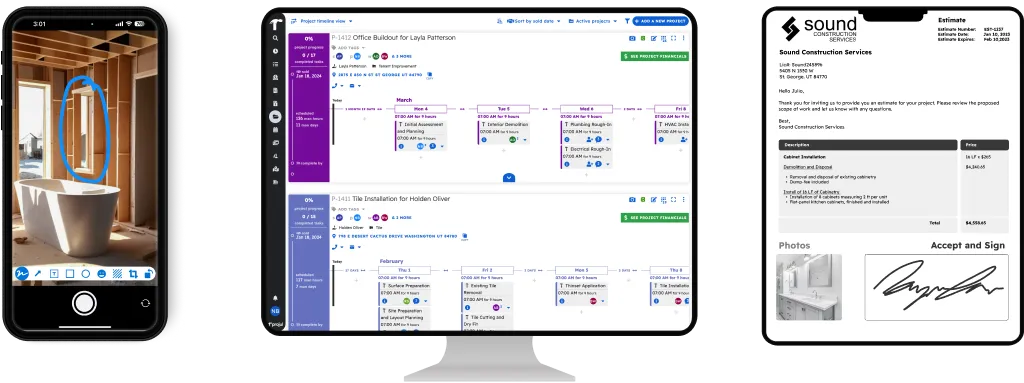
Track every project from first lead through final invoice with 26+ features built for how contractors actually work. Projul connects your office and field crews in real time so you catch budget problems early, keep schedules tight, and get paid faster. Flat-rate pricing means your whole team gets full access without per-user fees.
- Manage your lead pipeline, and send branded estimates
- Schedule your work with ease using our drag and drop scheduler
- Invoice your clients throughout the project, including deposits and change orders
What Is Construction Software?
Construction software is a digital platform that helps contractors manage projects from first lead through final payment. It connects estimating, scheduling, job costing, invoicing, and team communication in one place so nothing falls through the cracks between the office and the field.
Projul’s construction management software helps contractors manage estimating, scheduling, and job costing from one platform built by a contractor who understood the daily chaos of running a construction business. Projul offers flat-rate pricing with no per-user fees for construction companies of all sizes. If you’re running a construction company, you already know the real work isn’t just building. It’s juggling bids, tracking costs, keeping crews on schedule, and making sure you actually get paid. Construction software exists to handle the business side so you can focus on the building side.
Manage Construction Projects From Bid to Final Invoice
Managing construction projects means keeping a hundred details straight across multiple job sites, crews, and clients. A missed change order costs you money. A scheduling conflict costs you a day. A late invoice means you’re financing someone else’s project with your cash flow.
Projul brings your entire operation into one construction management software platform, from the first lead through final invoice. Over 5,000 construction companies use Projul to cut admin time and protect their margins. And because it was built by a contractor who lived these problems, it actually fits how construction businesses work.
Most construction software on the market was designed by tech companies and then marketed to contractors. You can feel the difference when you use it. Buttons in the wrong place. Workflows that don’t match how a real project moves. Features nobody asked for and missing ones everybody needs.
Projul is different because it started on a job site, not in a Silicon Valley office.
See Every Project at a Glance
Your project dashboard should answer your biggest questions in under ten seconds. Which jobs are on schedule? Which ones are bleeding money? What needs your attention today?
Projul’s dashboard shows all your active projects with their schedules, budget status, and next action items. Spot a project that’s trending over budget before it’s too late to course correct. Assign tasks to crews and subs, track completion in real time, and pull job costing reports that show exactly where your money went.
Contractors using Projul save 2+ hours daily on project admin. That’s time you get back for actual revenue-producing work, or for leaving the office before dark.
Real-Time Updates From the Field
When your foreman marks a task complete on his phone, your office sees it immediately. When a material delivery shows up short, your PM logs it in the app and the project record updates instantly. No more waiting until Friday to find out what happened Monday.
This kind of visibility changes how you run your business. You stop being reactive and start catching problems while they’re small.
Estimating That Wins More Work
Your estimate is your first impression. Send a sloppy bid on a napkin-style PDF and the homeowner goes with the company that looked more professional. Send a clean, itemized estimate from Projul and you look like the contractor who has their act together.
Projul’s estimating tools let you build detailed bids with line items, quantities, and markup. Save templates for the types of work you do most so you’re not rebuilding estimates from scratch every time. A fence replacement estimate that took you 45 minutes in a spreadsheet takes 15 minutes in Projul.
When the client says yes, that estimate converts directly into a scheduled project. The line items become your job cost budget. No re-entering data. No copy-paste errors. The work just flows forward.
Estimate Templates Save Hours Every Week
If you’re building the same types of estimates over and over, templates are the single biggest time saver in any construction management software. Build a template once for your most common project types. Adjust quantities and pricing for each new job. Send it out.
Contractors who use templates in Projul report cutting their estimating time in half. That means more bids out the door, which means more work coming in.
Scheduling That Adapts When Plans Change
Every contractor knows the plan changes. Weather kills a day. A material shipment runs late. The plumber doesn’t show. Your schedule has to flex without creating chaos.
Projul’s drag-and-drop scheduler lets construction managers move tasks, reassign crews, and shift timelines with a few taps. Seven schedule views, including Gantt charts and calendar, give you the visibility to keep every project moving.
Your crew sees schedule changes instantly on the mobile app. No more morning group texts sorting out who goes where. No more driving to a job site only to find out the work got pushed.
Rated 4.9/5 on G2 for ease of use, Projul’s scheduling tools work the way construction managers actually think. You see your week. You see your crew. You move things around until the puzzle fits.
Scheduling Multiple Crews Across Multiple Jobs
This is where most spreadsheets and whiteboards fall apart. When you’re running five active jobs with three crews, the scheduling math gets complicated fast. Who’s available Thursday? Can the tile crew start early if framing finishes ahead of schedule?
Projul shows all your crew assignments across every active project on one board. Drag a crew from one job to another. See the gaps. Fill them. Your field team gets notified automatically. That’s what good construction project management software looks like in practice.
Job Costing That Tells You the Truth
Here’s a question every contractor should be able to answer at any moment: Am I making money on this project right now?
If you can’t answer that without spending an hour in a spreadsheet, your job costing system is broken. And “I’ll figure it out when the job’s done” is how contractors lose their shirts on projects they thought were profitable.
Projul tracks estimated costs versus actual costs on every project in real time. You see where your labor dollars are going. You see which material line items are running over. You see whether the project is on pace to hit your target margin or heading for a loss.
Catch Overruns Before They Eat Your Profit
The real value of job costing isn’t the final report. It’s the warning at week three that labor is running 20% over estimate. That’s when you can still do something about it. Reassign tasks. Talk to the crew. Adjust the plan.
Contractors using Projul report a 32% average increase in profitability. That number comes directly from catching cost overruns early and keeping projects on track. By the time most contractors discover a budget problem, it’s already too late.
Time Tracking With GPS Verification
Time tracking in construction is a mess at most companies. Paper timesheets filled out from memory at the end of the week. Guys rounding up. No way to verify anyone was actually on the job site they claimed.
Projul’s time tracking includes geofencing. Your crew clocks in from the mobile app, and the system verifies they’re at the right job site. No more guessing. No more inflated hours. When payroll comes around, the data is already there.
This also feeds directly into your job costing. The labor hours your crew logs tie back to specific projects and tasks, so you know exactly where the time went. That connection between time tracking and job costing is what separates real construction management software from a glorified clock-in app.
Invoicing That Gets You Paid Faster
Slow invoicing is slow money. And in construction, cash flow is everything. If you’re waiting until the end of a project to send an invoice, you’re basically giving your client a free loan.
Projul lets you invoice throughout the project. Send deposit invoices before work starts. Bill for completed phases as you go. Add change orders to the invoice with one click. Your clients can pay online directly from the invoice, which means faster payments with less chasing.
Change Orders That Don’t Fall Through the Cracks
Every contractor has a story about a change order that never got documented. The client asked for an upgrade on site. Your crew did the work. Nobody wrote it down. Now you’re eating the cost because you can’t prove it was extra. Good construction document management software prevents this by keeping every change order, photo, and approval in one searchable record.
Projul tracks change orders inside the project record. Document the scope, get approval, and the change order automatically updates your budget and your invoice. No more lost money from verbal agreements.
Team Coordination Without the Phone Tag
Construction runs on communication. But the way most companies communicate is broken. Group texts for schedules. Phone calls to check on progress. Emails that nobody reads. Important details buried in a text thread from three weeks ago.
Projul’s built-in messaging keeps project communication tied to the project. When someone has a question about the Johnson remodel, they post it in the Johnson remodel project. The context stays with the job. Six months later, you can still find that conversation.
Your field crews get push notifications for schedule changes, new task assignments, and messages. They don’t need to check email or remember to look at a whiteboard. The information comes to them.
Client Communication That Builds Trust
Your clients want to know what’s happening with their project. They don’t want to call you every other day asking for updates. And you don’t want to take those calls.
Projul’s client portal gives your customers visibility into their project status without giving them access to your internal notes. They can see the schedule, approve estimates, sign change orders, and pay invoices. All in one place.
This level of transparency sets you apart from every other contractor who communicates through sporadic phone calls and texts. When a homeowner can log in and see that framing starts Monday, they stop calling you on Friday to ask.
Mobile App Your Crew Will Actually Use
Construction management tools are useless if your crew won’t use them. Most field workers don’t want to learn complicated software. They want to clock in, see what they’re doing today, and get to work.
Projul’s native iOS and Android app was designed for the field first. Big buttons. Simple navigation. It works on a dusty phone with one bar of signal. Your crew is using it by lunch on day one.
From the app, your team can clock in with GPS verification, view their schedule, update task status, take and attach photos, send messages, and log materials. Everything syncs to the office in real time.
QuickBooks Integration
Double-entering data into your accounting software is a waste of time and a source of errors. Projul integrates with QuickBooks Online so your invoices, payments, and customer records sync automatically.
When you send an invoice in Projul, it shows up in QuickBooks. When the client pays, both systems update. Your bookkeeper doesn’t need to re-enter anything, and your financial data stays accurate without extra work.
Why Contractors Switch to Projul
Most contractors come to Projul after trying one or two other construction management software platforms. The story is usually the same. The last tool was too expensive, too complicated, or too disconnected from how construction actually works.
Here’s what makes Projul different:
- Built by a contractor. Kurt Clayson started Projul after years of running his own construction company. Every feature exists because a real contractor needed it.
- Flat-rate pricing. $4,788 per year for your entire company. No per-user fees. Your estimators, PMs, crew leads, office staff, and subs all get full access.
- All-in-one platform. CRM, estimating, scheduling, job costing, time tracking, invoicing, and client portal. One login. One place.
- Rated 4.9/5 on G2. For both ease of use and quality of support. That’s not marketing spin. That’s contractors voting with their reviews.
- Over 5,000 contractors. From one-truck operations to companies with 200+ employees. The platform scales with you.
Honest Pricing for Construction Management Contractors
Most construction software charges per user. That pricing model punishes growth. Hire a new PM? More money. Add an estimator? More money. Give your crew leads access? Way more money.
Projul starts at $4,788 per year for your entire construction management company. No per-user fees. Your estimators, crew leads, office staff, and field workers all get full access without inflating the bill.
Over 5,000 contractors use Projul to manage their operations, and construction management contractors consistently report saving 2+ hours daily on admin work. G2 users rate Projul 4.9/5 for ease of use and 4.9/5 for quality of support.
Construction Software vs. Doing It the Old Way
Still on the fence about whether construction management software is worth it? Here’s what the manual approach actually costs you.
Estimating by spreadsheet: You spend 45 minutes to an hour per estimate. Templates break. Formulas get overwritten. You send a bid with a pricing error and either eat the cost or lose the client. With construction software, you build an estimate in 15 minutes using saved templates, and the math is always right.
Scheduling on a whiteboard: It works until you have more than three active jobs. Then someone erases the wrong line, a crew shows up at the wrong site, and you spend your morning on the phone sorting it out. Construction project management software puts the schedule on everyone’s phone and updates it in real time.
Job costing after the fact: You finish a project, add up the receipts, and discover you lost money. That knowledge doesn’t help you on a job that’s already done. Real-time job costing in your construction software warns you at week two, not month four.
Invoicing from Word documents: You format an invoice, email it, and hope the client pays. No online payment option. No automatic reminders. No connection to your accounting software. Projul invoices include online payment, automatic QuickBooks sync, and a payment status you can check in three seconds.
The math is simple. The time you waste on manual processes costs more than the software. Most contractors make back their Projul subscription in the first month from time savings alone.
How to Pick the Right Construction Software
Not every construction management software fits every company. Here’s what to look for based on your size and setup.
If you’re a small contractor (1 to 10 employees): You need something simple that doesn’t take a week to learn. Look for flat-rate pricing so you’re not paying per seat as you grow. Projul’s mobile-first design means your crew picks it up fast without formal training.
If you’re a mid-size company (10 to 50 employees): You need real job costing, not just invoicing. You need scheduling that handles multiple crews across multiple jobs. And you need your estimating and accounting systems to talk to each other. Projul handles all of this.
If you’re running a larger operation (50+ employees): You need a platform that won’t slow down with hundreds of active projects. You need permission controls so your crew leads see their schedule but not your profit margins. You need reporting that shows you the health of your business across every division. Projul scales from one-truck startups to companies with 200+ employees.
No matter your size, avoid construction management tools that charge per user. That pricing model punishes you for growing. Projul’s flat rate means adding your 50th employee costs the same as your 5th.
Common Mistakes That Cost Construction Managers Money
After working with thousands of construction companies, certain patterns show up again and again. These are the mistakes that quietly drain profit from construction management operations.
Not tracking change orders in real time. Verbal change orders are the single biggest profit leak in construction management. A client asks for something extra on site, your crew does the work, and nobody documents it until the end of the project, if at all. By then it is too late to bill for it without a fight. Every change order needs to be logged, priced, and approved before the work starts. Projul’s project management tools keep change orders tied to the project record with timestamps and client approvals.
Using one schedule view for everything. A Gantt chart is great for seeing the full project timeline, but it is terrible for a crew lead who just wants to know where to go tomorrow morning. Your office needs the big picture. Your field needs today’s tasks. Make sure your construction management software gives you both. Projul offers seven schedule views so each role sees what matters to them.
Waiting too long to invoice. Construction management companies that invoice monthly instead of at milestones are essentially giving clients interest-free loans. Bill at defined milestones: foundation complete, framing complete, rough-ins complete. Your cash flow depends on it. Use progress billing to break large projects into billable phases that keep money flowing throughout the job.
Ignoring labor cost data from past projects. Your completed projects contain the most valuable data in your business: actual labor hours by task type. If your last five framing jobs averaged 20% more labor than estimated, your estimates are wrong. Pull that data, adjust your templates, and bid the next job accurately. Projul’s live construction cost tracking gives you this data automatically.
Not giving clients visibility. Clients who do not know what is happening call constantly. Clients who can log into a client portal and see the schedule, approve change orders, and pay invoices online call almost never. That saved phone time adds up to hours every week, especially when you are managing multiple projects for general contractors or commercial contractors who want regular updates.
Multi-Project Portfolio Dashboards
When you are managing one or two jobs, you can keep the details in your head. When you are managing ten or twenty, that approach falls apart fast. The construction manager running a dozen active projects needs to know, at a glance, which jobs are on schedule, which ones are over budget, which ones need a decision today, and which ones are coasting along fine.
Most construction management companies piece together this picture from multiple sources. A scheduling app shows timelines. A spreadsheet tracks budgets. A whiteboard lists crew assignments. An email inbox holds client requests. By the time you pull all of that together, the information is already stale. The budget number you are looking at is from last Friday. The schedule you are reviewing does not reflect the change order that came in yesterday.
Projul’s project dashboard puts your entire portfolio on one screen. Every active project shows its schedule status, budget health, and pending action items. Color coding tells you which projects need attention and which are running clean. You do not need to open five different tools to answer the question your boss or your client just asked.
For construction managers running a mix of project types, this portfolio view is critical. You might have three commercial tenant improvements, two ground-up builds, and five residential renovations all running at once. Each has different timelines, different billing structures, and different client communication expectations. Projul’s project management tools let you see all of them in one place without losing the detail on any individual job.
The real value of a portfolio dashboard is pattern recognition. When you can see all your projects together, you start noticing things. Your framing crews are consistently running over on labor. Your electrical subs are always the bottleneck on tenant improvements. Material costs on your last five jobs have trended 12% higher than your estimates. These patterns are invisible when you look at projects one at a time. They jump out when you see the portfolio view. Our construction KPI dashboards and real-time reporting guide walks through the specific metrics that matter most for multi-project operations.
The construction managers who stay ahead of problems are the ones who see the full picture every morning before the first phone call comes in. Your software should give you that picture without making you build it yourself.
Owner and Developer Reporting Requirements
If you manage construction projects for owners, developers, or general contractors, you know that your internal tracking is only half the job. The other half is reporting. Your clients want regular updates on schedule, budget, and progress. And they do not want your raw data. They want clean, professional reports that answer their questions without requiring a follow-up meeting.
The problem is that building these reports manually takes hours. You pull schedule data from one system, budget numbers from another, and photos from a shared drive. You paste it all into a Word document or PowerPoint, format it to look decent, and email it out. By the time the report lands in the owner’s inbox, the data is two days old and you have spent half your afternoon on admin work instead of managing the actual project.
Projul’s reporting tools pull directly from your live project data. Schedule status, budget vs. actual costs, completed milestones, and pending items all come from the same source your team updates every day. When your field crew marks a task complete or logs a material receipt, that information flows into your reports automatically.
For developers managing multiple properties, this reporting consistency matters. They want to compare progress across projects without decoding a different report format from each construction manager. Build a standard report template in Projul that covers the metrics your clients care about: percent complete, schedule variance, cost variance, pending change orders, and upcoming milestones. Run it weekly or biweekly and send it out before anyone has to ask.
Professional reporting also protects you in disputes. When an owner claims you were behind schedule or over budget, your weekly reports tell the real story with timestamps. Every schedule change, every approved change order, and every budget adjustment is documented. That paper trail matters when the conversation gets uncomfortable.
The construction managers who get repeat work from developers and owners are the ones who communicate proactively. They do not wait for the phone call asking “where do we stand?” They send the report before the question gets asked. Projul’s automated client reminders can even notify stakeholders when reports are available in the client portal, keeping everyone informed without your office staff chasing people down.
RFI and Submittal Tracking
Requests for information and submittals are the paperwork backbone of construction management, especially on commercial and multi-trade projects. An RFI goes out when your team needs clarification on drawings, specs, or scope. A submittal goes out when you need approval on a material, product, or shop drawing before you can proceed with the work. Both create a paper trail that protects you legally and keeps the project moving.
The problem with RFIs and submittals is that they pile up fast and each one can stall progress if it sits unanswered. A single unanswered RFI about a floor finish specification can hold up your flooring sub for two weeks. A submittal that bounces back for revision adds a week of back-and-forth before the material can even be ordered. Multiply that across a project with 50 or 100 RFIs and the schedule impact is enormous.
Most construction managers track RFIs and submittals in spreadsheets or email folders. That works for the first ten. By number 30, you are scrolling through a spreadsheet trying to figure out which RFIs are still open, which were answered but not distributed to the field, and which answers created new questions. Important responses get buried in email threads. Critical submittals sit in someone’s inbox for a week because nobody followed up.
Projul’s photos and document management tools give you a centralized place to store and track project documents including RFIs and submittals. Every document is tied to the project record with dates, status, and the responsible party. When an architect takes two weeks to respond to an RFI, that delay is documented. When a submittal gets rejected and needs revision, the revision history is captured.
Our construction RFI guide covers best practices for writing clear RFIs that get faster responses, and our RFI management article goes deeper on tracking systems that prevent the backlog from spiraling. The key principle is simple: every RFI and submittal should have an owner, a due date, and a status that everyone on the project team can see.
For construction managers, disciplined RFI and submittal tracking is not just about organization. It is about schedule protection. Every unanswered RFI is a potential delay. Every late submittal is a potential material procurement problem. Track them aggressively, follow up consistently, and document everything. When the project close-out meeting happens, your records should tell the complete story of every question asked and every answer received.
Construction Schedule Recovery Planning
Every construction manager has lived through a project that went sideways. A foundation delay cascaded into a framing delay. A material shortage pushed the exterior work into winter. A failed inspection added two weeks that nobody planned for. By the time you add up all the individual slips, the project is six weeks behind and the owner is asking hard questions.
Schedule recovery is the process of getting a delayed project back on track without throwing money at the problem. It starts with an honest assessment of where you actually stand versus where you should be. Not where you hope you stand. Not where your last report said you stood. Where you actually are today, based on what is done and what is left.
Projul’s scheduling tools give you that honest picture. Your interactive Gantt view shows the critical path through your project, the sequence of tasks where any delay directly extends the completion date. When you know which tasks are on the critical path and which have float, you can focus your recovery efforts where they actually matter.
Common recovery strategies include resequencing work to run tasks in parallel that were originally planned as sequential, adding crew members to critical path tasks to compress their duration, and working extended hours on the tasks that control the end date. Each of these has cost implications. Running two crews instead of one costs more. Overtime hours cost more. But those costs need to be weighed against the cost of late completion: liquidated damages, lost follow-on work, and damaged relationships with owners and developers.
Our construction schedule recovery techniques guide covers specific strategies for compressing timelines, and our construction project recovery guide addresses the broader topic of getting troubled projects back on track, including budget recovery and team morale.
The construction managers who recover schedules successfully are the ones who catch the slip early. A project that is one week behind is recoverable with minor adjustments. A project that is six weeks behind requires expensive, disruptive changes that affect every trade on the job. Projul’s real-time schedule tracking and live construction cost data help you spot the drift at week one, not week six.
Schedule recovery planning should be part of your standard management approach on every project, not something you scramble to create after a crisis. Build contingency time into your original schedules. Monitor the critical path weekly. Track schedule variance as a key metric in your project dashboard. When the slip starts, you already have a recovery plan in mind because you have been watching the indicators all along. The construction look-ahead schedule guide explains how to build rolling short-term schedules that catch problems before they compound.
Stop Running Your Business From a Spreadsheet
If you’re still managing your construction company with spreadsheets, whiteboards, and group texts, you already know it’s not working. You’re losing time, losing money, and losing details every single day.
Construction software like Projul isn’t about adding technology for its own sake. It’s about running a tighter operation so you can take on more work, protect your margins, and actually go home at a reasonable hour.
Over 5,000 contractors have already made the switch. They’re spending less time on admin, catching budget problems earlier, and getting paid faster. Your competition is probably one of them.