Electrical contractor software. Spark joy in your clients with professional estimates and invoicing. Built by construction pros with honest pricing.
As electrical contractors, you have enough on your plate without having to do everything manually. With Projul you'll send competitive bids, easily assign jobs, and keep your profit margins high. All from one tool trusted by 5,000+ contractors!
- Win more work with effective estimates and an intuitive lead pipeline
- Get paid quickly with powerful invoicing
- Stay on track with industry-leading scheduling
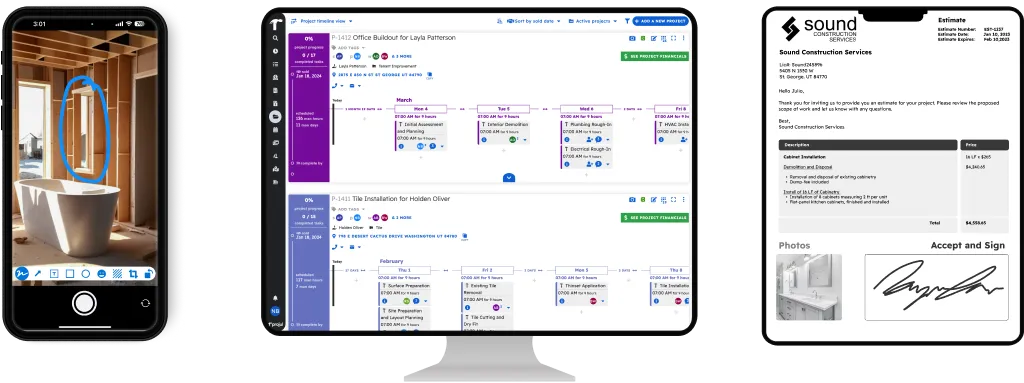
What Is Electrical Contractor Software?
Electrical contractor software is a project management platform built for electrical businesses that connects estimating, scheduling, job costing, crew dispatching, and invoicing so you can run every job from bid to final trim without juggling spreadsheets, texts, and paper permits.
Projul’s electrical contractor software helps electricians manage rough-in and trim-out scheduling, material cost tracking, and permit workflows from one platform built by a contractor. Projul offers flat-rate pricing with no per-user fees for construction companies of all sizes. If you run an electrical contracting business, you already know the work goes way beyond pulling wire. You are managing permit applications, coordinating rough-in timing with builders, tracking material costs that change every month, and trying to keep your crew productive across multiple job sites. That is a lot of moving parts for any business, and most of it has nothing to do with actual electrical work.
Electrical contractor software exists to handle the business side of your operation so you can focus on the technical side. Instead of spending your evenings catching up on bids and sorting through invoices, you get a single platform that keeps everything organized and connected.
Manage Electrical Projects From Rough-In to Final Trim
Electrical work follows a pattern that other trades do not share. You show up for rough-in before drywall, disappear for weeks while other trades work, then come back for trim-out and final connections. That gap creates scheduling challenges that general project management tools do not understand.
Projul helps electrical contractors manage this start-stop workflow by tying every phase of a project together. Your rough-in tasks, inspection milestones, and trim-out schedule all live in one project record. When the builder pushes drywall back a week, you drag your trim-out tasks to new dates and your crew gets notified instantly.
Over 5,000 contractors trust Projul because it was built by someone who has actually pulled permits and waited on inspections. The platform fits how electrical contractors really work, not how a software company imagines they work.
The Unique Rhythm of Electrical Work
Most trades show up, do their work, and leave. Electrical contractors bounce between projects in different phases. Monday morning you might have a crew doing rough-in on a new build, another crew handling a panel upgrade across town, and a service tech responding to emergency calls.
Managing that kind of schedule with a whiteboard or group text breaks down fast. You need software that shows you where every crew member is, what phase each project is in, and what is coming up next week across all your active jobs. That is what electrical contractor software does.
Win More Electrical Work With Fast, Professional Estimates
Your estimate is your first impression with a client. In electrical work, that estimate also signals whether you know what you are doing. A homeowner comparing bids for a 200-amp panel upgrade will notice the difference between a vague lump-sum number and an itemized proposal that breaks out the panel, breakers, wire, permits, and labor.
Projul’s estimating tools let electrical contractors build detailed proposals for service upgrades, panel swaps, new construction rough-ins, and commercial wiring jobs. Save assemblies for your most common configurations. A 200-amp residential panel install with 20 circuits, a whole-house rewire template, a standard outlet and switch package for new construction. Pull up the assembly, adjust quantities and pricing for the specific job, and send the bid.
Electrical contractors using Projul report a 32% average profit increase from faster bids and tighter job tracking. When you can send a professional estimate within hours instead of days, you win more work.
Electrical Estimating Is Different
Estimating electrical work involves variables that other trades do not deal with. You are counting fixtures, measuring wire runs, pricing panels and breakers by brand and amperage, and calculating labor based on whether it is rough-in or trim-out. You need to account for conduit type, box count, and circuit layout. A commercial job adds fire alarm wiring, data runs, and generator hookups to the mix.
Generic estimating tools force you to build all of that from scratch every time. Electrical business software with saved assemblies lets you price a job accurately in a fraction of the time. And when copper prices jump 15% in a month, you update your assembly pricing once and every future estimate reflects the new cost.
Handling Material Price Swings
Every electrical contractor has felt the pain of material price volatility. You bid a job in January with copper at one price, and by the time you start work in March, your wire cost is up 20%. That margin you planned on just evaporated.
Good electrician software helps you track material costs and adjust estimates quickly. When you keep your pricing templates current in Projul, every new bid reflects real costs instead of last quarter’s numbers. You can also flag older estimates that may need repricing before the client signs off.
Schedule Crews and Stay on the Builder’s Timeline
Electrical contractors live and die by coordination with other trades. Your rough-in can not start until framing passes inspection. Your trim-out can not happen until drywall and paint are done. If the plumber is behind schedule, it pushes your work back too.
Projul’s scheduling board shows where every electrician is assigned across your active projects. Coordinate rough-in timing with the framing schedule, and make sure your trim-out crew shows up after drywall and paint are done. When one job shifts, drag the tasks to new dates and your crew gets notified instantly. No more showing up to a site that is not ready.
Electrical contractors using Projul save 2+ hours daily on crew scheduling and coordination.
Dispatching Service Calls Alongside Project Work
One of the biggest challenges for electrical contractors is balancing scheduled project work with incoming service calls. A homeowner calls with a dead circuit. A property manager needs an outlet added by Friday. A commercial client has a breaker that keeps tripping.
These calls generate revenue, but they also pull technicians away from scheduled projects. Software for electricians needs to handle both workflows. Projul lets you schedule service calls alongside project tasks on the same board. Your dispatcher sees which technicians are available, assigns the call, and the tech gets the details on their phone. The service call gets its own project record with notes, photos, and an invoice.
No more sticky notes on the office desk. No more texting a tech who is already on a ladder.
Track Permits and Schedule Inspections
Permit tracking is one of the most frustrating parts of running an electrical business. Every jurisdiction has different requirements, different timelines, and different inspectors with different interpretations of the code. A permit that takes three days in one county takes three weeks in the next.
Projul lets you track permit applications inside the project record. Attach the application documents, log submission dates, and set reminders for follow-up. When the permit comes through, schedule the inspection as a milestone on your project timeline.
Avoiding Inspection Failures
Failed inspections cost you a return trip, a reschedule wait, and sometimes a crew sitting idle. The most common causes are documentation gaps, missed details in the rough-in, or code changes the crew was not aware of.
Electrical contractor software helps you avoid these failures by keeping inspection checklists and NEC code notes attached to the project. When your crew can pull up the inspection requirements on their phone before the inspector arrives, they catch problems first. When a code update changes box fill calculations or AFCI requirements, you can update your standard task lists so every future project reflects the new rules.
NEC Code Compliance
The National Electrical Code updates on a three-year cycle, and local amendments can change requirements between cycles. Keeping your crews current on code changes is critical. A wire gauge that was acceptable three years ago might not pass inspection today.
While no project management software replaces proper training and code knowledge, electrical contractor software gives you a place to document code requirements by project type. Add notes to your task templates about AFCI and GFCI requirements, wire sizing for specific circuits, and panel labeling standards. When every project starts from a template that reflects current code, your crews work to the right standard from day one.
Material Tracking for Electrical Work
Electrical contractors deal with a long list of materials that vary by project type. Wire in multiple gauges and types (Romex, THHN, MC cable), breakers by brand and amperage, panels, boxes, conduit, connectors, switches, outlets, fixtures, and specialty items like transfer switches or surge protectors.
Tracking these materials across multiple active projects is a headache without the right system. You need to know what was quoted, what was ordered, what showed up on site, and what actually got installed. The gap between those numbers is where your profit leaks.
Projul ties material costs to specific projects through your estimates and job costing. When you build an estimate with line items for wire, panels, and fixtures, those costs become your budget baseline. As your crew logs materials used on the job, you see how actual costs compare to your estimate in real time.
When Materials Do Not Show Up
Every electrical contractor has a story about a panel that was backordered, a shipment of wire that showed up short, or a box of breakers that was the wrong brand. These problems cascade through your schedule. If the panel does not arrive, your rough-in crew is standing around or getting redirected to another job.
Keeping material status visible inside your project management platform helps you catch supply problems before they blow up your schedule. When the office can see that a critical item is still on order, they can follow up with the supplier before the crew shows up expecting to install it.
Residential vs. Commercial Electrical Work
Many electrical contractors handle both residential and commercial work, and the two require different approaches to scheduling, estimating, and project management.
Residential electrical work typically involves shorter projects with faster turnaround. Service calls, panel upgrades, whole-house rewires, and new construction wiring for single-family homes. The client is usually the homeowner, communication is direct, and the scope is relatively straightforward. You might complete two or three residential jobs in a week.
Commercial electrical work involves longer timelines, multiple phases, and coordination with general contractors and other trades. You are working from blueprints, following a construction schedule set by someone else, and dealing with more complex systems like three-phase power, fire alarm, and data infrastructure. The permitting process is typically more involved, and inspections happen at multiple stages.
Electrical business software needs to handle both. Projul scales from a single-day service call to a multi-month commercial buildout without forcing you into different workflows. The same scheduling, estimating, and job costing tools work for a $500 outlet install and a $500,000 commercial tenant improvement.
Job Costing That Tells You the Truth
Here is a question every electrical contractor should be able to answer at any moment: Am I making money on this project right now?
If you can not answer that without digging through receipts and timesheets, your job costing system is broken. Electrical projects have tight margins, and the difference between a profitable job and a money-loser is often a few hundred dollars in unexpected labor or materials.
Projul tracks estimated costs versus actual costs on every project in real time. You see where your labor dollars are going. You see which material line items are running over. You catch the problem at week two, not after the final invoice.
Contractors using Projul report a 32% average increase in profitability. That number comes from catching cost overruns early and keeping projects on track.
Your Electricians Stay Connected Between Sites
Your electricians move between job sites all day. They need access to task lists, wiring diagrams, panel schedules, and project notes without driving back to the office.
Projul’s native iOS and Android app lets your crew clock in with geofencing, check their assignments, upload panel photos, and log material usage from the field. When the schedule changes mid-day, your crew sees the update on their phone instantly.
The app was designed for field workers, not office staff. Big buttons, simple navigation, and it works on a phone with a cracked screen and one bar of signal. Your apprentices and journeymen use it by lunch on the first day.
Photos That Stay With the Project
Electrical work involves a lot of behind-the-wall detail that disappears after drywall goes up. Photos of rough-in wiring, panel connections, and junction box locations are valuable for inspections, warranty claims, and future service work.
When your crew takes photos through the Projul app, those images attach directly to the project record. Six months later, when the homeowner calls about a circuit issue, you can pull up the rough-in photos and see exactly how the wiring was routed. No more scrolling through someone’s camera roll hoping they did not delete the pictures.
Coordinating With Other Trades
Electrical contractors rarely work alone on a job site. On new construction, you are coordinating with framers, plumbers, HVAC techs, drywall crews, and painters. Your schedule depends on their schedule, and theirs depends on yours.
The classic problem: you show up for rough-in and the framing is not done. Or worse, drywall went up before you finished your rough-in because nobody communicated the timeline. These coordination failures cost you money in wasted trips and delayed projects.
Projul’s scheduling tools give you visibility into your project timeline so you can spot conflicts before they happen. When you see that drywall is scheduled for Tuesday but your rough-in is not done until Wednesday, you flag it before your crew drives to a site they can not work on.
Invoicing That Gets You Paid Faster
Slow invoicing is slow money. In electrical contracting, cash flow determines whether you can take on the next job or turn it down because you can not float the material costs.
Projul lets you invoice throughout the project. Send deposit invoices before ordering materials. Bill for completed phases as you go. Add change orders to the invoice with one click. Your clients can pay online directly from the invoice, which means faster payments with less chasing.
Change Orders in Electrical Work
Change orders are a fact of life in electrical contracting. The homeowner wants to add four recessed lights in the kitchen. The GC needs an extra 20-amp circuit for a piece of equipment nobody mentioned during bidding. The inspector requires an additional GFCI that was not in the original scope.
If you do not document these changes and bill for them, you are working for free. Projul tracks change orders inside the project record. Document the scope, get approval through eSignature, and the change order automatically updates your budget and your invoice.
QuickBooks Integration
Double-entering financial data into your accounting software wastes time and creates errors. Projul integrates with QuickBooks Online and QuickBooks Desktop so your invoices, payments, and customer records sync automatically.
When you send an invoice in Projul, it shows up in QuickBooks. When the client pays, both systems update. Your bookkeeper stays current without re-entering anything.
Why Electrical Contractors Switch to Projul
Most electrical contractors come to Projul after trying one or two other platforms. The story is usually the same: the last tool was too expensive, too complicated, or built for general contractors and did not fit electrical work.
Here is what makes Projul different:
- Built by a contractor. Kurt Clayson started Projul after years of running his own construction company. Every feature exists because a real contractor needed it.
- Flat-rate pricing. The Core plan is $4,788 per year for up to 10 users. No per-user fees. Your estimators, journeymen, apprentices, office staff, and service techs all get full access.
- All-in-one platform. CRM, estimating, scheduling, job costing, time tracking, invoicing, and client portal. One login. One place.
- Rated 4.9/5 on G2. For both ease of use and quality of support. That is not marketing spin. That is contractors voting with their reviews.
- Over 5,000 contractors. From one-truck operations to companies with 200+ employees. The platform scales with you.
Electrical Contractor Bidding: Winning Work Without Leaving Money on the Table
Electrical contractors lose work for two reasons: bidding too high or bidding too slow. The contractor who sends a professional, itemized estimate within 24 hours wins the job over the one who takes a week to send a vague lump-sum number. Speed and detail both matter.
Projul’s estimating tools help you build electrical bids fast without cutting corners on accuracy. Save assemblies for your bread-and-butter jobs. A 200-amp panel upgrade with 30 circuits. A standard new-construction rough-in package for a 2,000-square-foot home. A commercial tenant improvement with dedicated circuits, data drops, and emergency lighting. Pull up the assembly, adjust for the specific job, and send the proposal.
When your estimates go out same-day, you close more work. When those estimates are detailed and professional, you close at higher margins because clients trust contractors who show exactly what they are paying for.
Tracking Your Win Rate by Job Type
Most electrical contractors have a gut feeling about which types of work they win and which they lose. Gut feelings are not data. Projul’s lead pipeline tracks every estimate from send to close, so you see your actual win rate by job type over time.
Maybe you close 60% of residential panel upgrades but only 25% of commercial bids. That tells you something. Maybe your commercial pricing is off, or maybe you need better relationships with GCs. Either way, the data shows you where to focus instead of guessing.
Protecting Your Margins on Long-Duration Projects
Commercial electrical jobs can stretch over months. Between the day you bid the work and the day your crew finishes trim-out, material prices shift, labor rates change, and scope creep sneaks in through “quick add” requests from the GC.
Projul’s job costing tracks your estimated budget against actual spend as the project moves forward. When wire costs jump mid-project, you see the impact on your margin right away. When the GC asks for extra circuits that were not in the original scope, you create a change order in Projul, get it approved digitally, and the cost updates your budget and invoice automatically. That discipline is the difference between a profitable project and one that looked good on paper but lost money in the field.
Honest Pricing for Electrical Contractors
Most electrician software charges per user. That pricing model punishes growth. Hire another journeyman? More money. Bring on an apprentice? More money. Give your dispatcher access? Way more money.
Projul starts at $2,388 per year, and the Core plan is a flat $4,788 per year for up to 10 users, with no per-user fees. Your estimators, crew leads, and office staff all get full access without inflating the bill. Over 5,000 contractors use Projul to manage their operations, and electrical contractors consistently report saving 2+ hours daily on admin work. G2 users rate Projul 4.9/5 for ease of use and 4.9/5 for quality of support.
Common Mistakes That Cost Electrical Contractors Money
After working with thousands of electrical contractors, the same problems show up again and again. Here are the ones that hurt your bottom line the most and how to avoid them.
Underbidding Service Work
Many electricians treat service calls as filler work between bigger projects and price them accordingly. The problem is that service calls carry hidden costs: drive time, diagnostic time, parts runs, and the disruption to your scheduled project work. A $150 service call that takes your tech two hours including travel is not profitable when you factor in the truck, insurance, and the project work that tech is not doing.
Price your service calls to cover the full cost of pulling a technician off scheduled work. Include a trip charge, a minimum diagnostic fee, and realistic labor time that accounts for troubleshooting. Projul’s time tracking shows you exactly how long service calls actually take so you can price them based on real data instead of gut feel.
Not Tracking Change Orders on Commercial Jobs
On commercial electrical work, scope changes happen constantly. The architect adds outlets. The tenant wants more data drops. The mechanical engineer moves ductwork and now your conduit route needs to change. Every one of those changes costs you labor and materials.
If you are not documenting and billing for every change order, you are doing free work. Keep a change order log in your project management system and get written approval before starting any out-of-scope work. The GCs who push back on change order paperwork are the same ones who will dispute your final invoice if you do not have documentation.
Skipping the Post-Job Cost Review
Most electrical contractors finish a job, send the invoice, and move on. They never go back and compare what they bid against what they actually spent. This means they repeat the same estimating mistakes on the next job.
Set aside 15 minutes after every completed project to review your job cost report. Where did you go over on labor? Which materials cost more than you quoted? Did the permit process take longer than expected? This review is where you calibrate your estimating for future work. Electrical contractors who do this consistently see their margins improve within two to three months because they stop repeating the same pricing errors.
Ignoring Lead Follow-Up
An electrical contractor who follows up with every lead within 24 hours wins more work than one who waits three days. Homeowners and property managers are calling multiple electricians. The first one to respond with a professional estimate gets the job more often than not. Use a lead management system to track every inquiry and set follow-up reminders so no lead falls through the cracks. This is especially important for residential contractors who depend on a steady flow of smaller jobs to fill the schedule between larger projects.
Grow Your Electrical Contracting Business
Ready to take your electrical company to the next level? Our guide to growing an electrical contracting business covers hiring strategies, marketing approaches, and operational systems that help you scale from a small shop to a multi-crew operation without losing quality or profitability.
Panel Upgrade Documentation and Load Calculations
Panel upgrades are one of the most common and most profitable jobs for electrical contractors, but they also carry serious liability if the documentation is not airtight. When you swap a 100-amp panel for a 200-amp service, the inspector wants to see your load calculation, your wire sizing justification, your grounding electrode conductor sizing, and proof that the existing service entrance equipment supports the upgrade. If any of that paperwork is missing or incomplete, you fail the inspection and eat a return trip.
Most electrical contractors do their load calculations on scratch paper or in a spreadsheet that lives on one person’s laptop. That works until the inspector asks a question six months later and nobody can find the calculation sheet. Or until a homeowner calls about a tripping breaker and your tech has no record of how the panel was loaded when it was installed.
Projul’s photos and document management gives you a place to attach load calculation worksheets, panel schedules, and service entrance specifications directly to the project record. When your electrician finishes a panel upgrade, they photograph the completed panel with the cover off, upload the image through the Projul app, and it stays with that project permanently. Six months or six years later, you pull up the project and see exactly what was installed, how circuits were distributed, and what the calculated load was at the time of installation.
For contractors who handle a high volume of residential panel upgrades, keeping this documentation organized pays off in ways beyond passing inspections. When a past customer calls about adding a hot tub or EV charger, your office pulls up the original panel schedule and load calculation in seconds. You know immediately whether the existing panel has capacity or whether the homeowner needs another upgrade. That kind of quick, informed response wins repeat business and referrals.
Load calculations also protect you legally. If a panel you installed is involved in a fire investigation or insurance claim, having your NEC Article 220 load calculation attached to the project record shows you sized the service correctly. That documentation is the difference between a clear record and a lawsuit. Store your construction project documentation inside Projul so every panel job has a complete paper trail from bid through final inspection.
Build a standard panel upgrade template that includes task items for the load calculation worksheet, before and after panel photos, permit application, and inspection scheduling. When every panel job follows the same documentation checklist, nothing gets skipped regardless of which electrician handles the work.
Arc Fault and GFCI Compliance Tracking
NEC code requirements for arc fault circuit interrupter (AFCI) and ground fault circuit interrupter (GFCI) protection have expanded significantly over the past several code cycles. Bedrooms required AFCI protection first, then kitchens, laundry rooms, and living areas were added. GFCI requirements now cover bathrooms, kitchens, garages, outdoor receptacles, crawl spaces, unfinished basements, and more locations with every update. Keeping track of which rooms and circuits need which type of protection is a real challenge, especially when your crews work across jurisdictions that adopt different NEC editions.
The cost of getting it wrong is not just a failed inspection. Installing standard breakers where AFCI or GFCI protection is required creates a code violation that exposes your company to liability. If a fire starts on a circuit that should have had arc fault protection but did not, your company is in a very difficult position. The same applies to GFCI protection in wet locations where a shock injury occurs.
Projul helps electrical contractors stay on top of compliance requirements by letting you build task templates that include AFCI and GFCI checklists by room type. Create a residential new construction template that lists every room requiring arc fault protection and every location requiring ground fault protection based on your local code adoption. When your crew works through the task list on site using the mobile app, they check off each requirement as they install the correct protection. Nothing gets missed because the checklist is built into the workflow, not written on a sticky note.
For contractors working in multiple jurisdictions, you can create separate templates for areas that have adopted different NEC editions. A county still on the 2017 NEC has different AFCI requirements than one on the 2023 edition. Having jurisdiction-specific templates means your crew always works to the right standard without memorizing which code applies where.
Tracking compliance also matters for your construction code compliance records over time. When a jurisdiction adopts a new NEC edition, you update your templates once and every future project reflects the new requirements. Your daily logs capture what was installed on each circuit, giving you an audit trail that proves compliance if questions come up months or years after the job is complete. Pair this with your permit tracking workflow and you have a complete compliance record from permit application through final inspection sign-off.
Electrical contractors who build compliance tracking into their standard workflow spend less time on inspection callbacks and more time on billable work. It is not about adding paperwork. It is about building the right checks into the process so your crews get it right the first time.
Stop Running Your Electrical Business From a Spreadsheet
If you are still managing your electrical contracting company with spreadsheets, whiteboards, and group texts, you already know it is not working. Permits slip through the cracks. Estimates take too long. You find out a job lost money after it is already done.
Electrical contractor software like Projul is not about adding technology for its own sake. It is about running a tighter operation so you can bid more work, protect your margins, and stop spending your evenings on paperwork.
Over 5,000 contractors have already made the switch. They are spending less time on admin, catching budget problems earlier, and getting paid faster. Your competition is probably one of them.