Gutter Contractor Software. Built by construction pros with honest pricing.
Gutter work moves fast. Three installs before lunch, material on the truck, invoice before you leave the driveway. Projul helps gutter contractors run more jobs per week without the paperwork pile-up. 5,000+ contractors trust Projul to keep production moving.
- Group jobs by area so crews follow tight routes instead of crisscrossing town all day
- Estimate seamless gutter runs, downspouts, gutter guards, and miters with saved templates
- Invoice on-site the moment the last hanger goes in and collect payment the same day
- Track K-style and half-round coil usage per job to cut waste and tighten your ordering
What Is Gutter Contractor Software?
Gutter contractor software is a business management platform that helps gutter installation and repair companies estimate jobs by the linear foot, schedule crews across multiple stops per day, track material usage, and invoice on-site. It replaces the clipboard estimates and phone-call scheduling that slow down high-volume gutter operations.
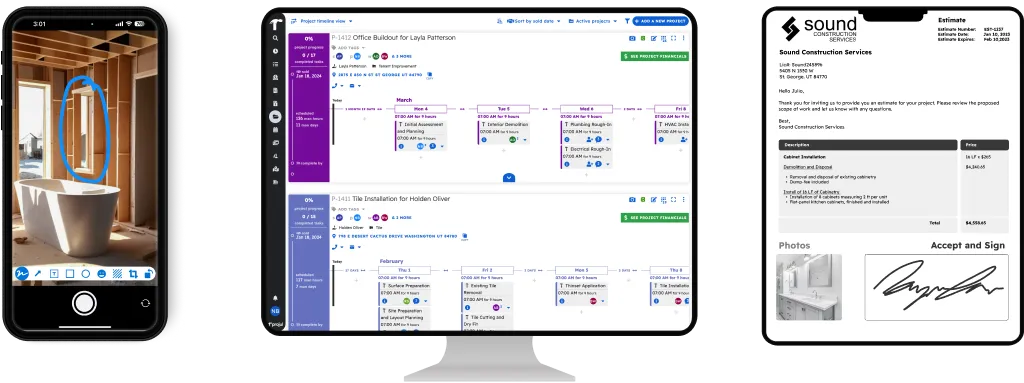
Projul’s gutter contractor software helps gutter companies estimate by the linear foot, schedule high-volume daily routes, and invoice on-site from a platform built by a real contractor. Projul offers flat-rate pricing with no per-user fees for construction companies of all sizes. If you run a gutter company, your day looks different from most contractors. You might hit four or five houses before lunch. Your materials roll out of a machine on the back of your truck. And your estimates need to be accurate to the foot because seamless gutters are fabricated on-site with no room for do-overs. Gutter software keeps all of that organized so you run more jobs per week without the paperwork bottleneck.
Why Gutter Companies Need Dedicated Software
Gutter work is a volume business. You make money by running efficient routes, keeping material waste low, and invoicing the moment the job is done. Anything that slows down that cycle costs you money.
Most gutter contractors start with a simple system. A notebook for estimates, a calendar on the wall, and a stack of invoices you type up at the end of the week. That works when you are running one truck. Once you add a second crew, a helper, or start booking 15 to 20 jobs a week, the cracks show fast.
Leads get lost in voicemail. Material counts are off because you estimated from memory instead of measured notes. Invoices go out late because you were too busy installing to sit down and bill. And when fall hits and the phone rings 30 times a day, you are buried under demand you cannot organize.
Gutter contractor software like Projul solves all of this from one platform. Over 5,000 contractors use Projul to run their operations, and gutter companies using the platform report saving 2+ hours daily on admin work. That is time you put back into billable installs or into finally leaving the office before dark.
Estimating Linear Footage, Downspouts, and Accessories
Every gutter estimate starts with linear footage, but a lot of contractors leave money on the table by not accounting for all the components that go into an install. Miters, end caps, outlets, downspout elbows, splash blocks, and hangers all cost money and all need to be in the bid.
Projul’s gutter software lets you build estimate templates that cover the full scope of a gutter install. Create one template for standard K-style aluminum with line items for gutters by the linear foot, inside and outside miters, end caps, outlets, downspouts, elbows, hangers, and screws. Save it and reuse it on every residential job.
For half-round installs, copper work, or commercial box gutters, build separate templates with different material pricing and component lists. A copper half-round estimate looks very different from an aluminum K-style bid, and your templates should reflect that.
When the homeowner says yes, the estimate converts into a scheduled job. Line items become your job cost budget. No re-entering numbers, no lost details between the sales call and the install. Gutter contractor software that connects your estimate to your schedule to your invoice is how you stop losing time and money on admin.
Material Options and Pricing Templates
Gutter contractors work with several material types, and each one has different cost structures, waste factors, and installation considerations.
Aluminum is the standard for residential work. Light, affordable, and available in dozens of colors. Your templates should price aluminum by the linear foot with separate line items for coil stock and formed components.
Copper carries a premium price and a premium labor rate. Soldered joints take more time than crimped aluminum. Build copper templates with higher labor hours and material costs to protect your margins on these specialty installs.
Steel gutters, including galvanized and galvalume, are common in commercial and agricultural applications. Heavier material means different handling and sometimes different hanger spacing. Price steel templates separately from aluminum.
Vinyl sectional gutters are the entry-level option. They install differently from seamless systems since you are joining pre-formed sections rather than running continuous lengths. If you install vinyl alongside seamless, keep a separate template so you do not confuse pricing between the two systems.
Projul lets you maintain as many estimate templates as you need. Update material costs when your supplier changes pricing, and every future estimate reflects the current numbers. You can also grab our free gutter estimate templates to see how top gutter contractors structure their bids.
Seamless vs. Sectional Gutter Estimating
If you run a gutter machine, seamless installs are your bread and butter. You fabricate gutters on-site to the exact length of each run, which means your measurements need to be precise and your material calculations need to account for waste on startup, color changes, and cut-offs.
Projul’s estimating tools let you price seamless work by the linear foot with waste factors built into your templates. If you know you lose 3 to 5 feet per color change and 2 feet on machine startup, add that into your template so every estimate accounts for real waste instead of theoretical perfection.
For sectional gutter work, your estimates need to include the connectors, sealant, and extra hangers that sectional systems require at each joint. Build those components into a separate template so your pricing stays accurate for each system type.
Gutter software that handles both seamless and sectional estimating from the same platform means you do not need separate tools for different job types. Everything lives in one system with one set of templates and one job costing view.
Gutter Guard Add-Ons and Upselling
Gutter guards are one of the best upsell opportunities in the gutter business. A homeowner who is already paying for new gutters is a natural candidate for leaf protection. The labor to install guards during the initial gutter install is minimal compared to a standalone guard retrofit.
Build gutter guard options into your Projul estimate templates. Create line items for micro-mesh guards, screen guards, foam inserts, or reverse-curve systems. Present gutter guards as an optional add-on in your estimate so the homeowner can see the price difference and make a decision before install day.
When gutter guards are part of the original estimate, the material goes on the truck with everything else and your crew installs them in a single trip. No second visit, no additional scheduling, and no chance the customer calls back in three months to add them when leaves start falling.
Gutter contractor software that makes upselling easy is gutter contractor software that grows your average ticket size without growing your admin time.
Fascia Board Assessment and Repair
You cannot hang gutters on rotten fascia. Every experienced gutter contractor has arrived at a job to find soft, water-damaged fascia boards that need replacement before the new gutters go up. If you did not include fascia repair in your estimate, you are either eating the cost or having an awkward conversation with the homeowner.
Use Projul’s project notes to document fascia condition during the estimate visit. Snap photos of problem areas and attach them to the project record. If fascia repair is needed, add it as a line item in the estimate. If the fascia looks questionable but you are not sure until the old gutters come down, add a contingency note in your terms.
When your crew arrives on install day, they pull up the project on the mobile app and see the fascia photos and notes before they touch a ladder. No surprises, no delays, and no unplanned trips to the lumber yard for fascia boards.
Scheduling High-Volume Gutter Work
Gutter contractors often run three to five jobs per day per crew. That is a fundamentally different scheduling challenge than a remodeler who books one project per week. You need route-based scheduling that groups jobs geographically and accounts for drive time between stops.
Projul’s scheduling tools let you group jobs by area so your crews follow tight routes instead of crisscrossing town. Drag and drop appointments to tighten the route order. When a cancellation opens a gap, slot in a nearby job from your backlog. Your crew sees the updated route on the mobile app and adjusts without calling the office.
For multi-day commercial gutter projects, Projul handles extended scheduling just as easily. Block out three days for a warehouse install, assign the right crew, and track progress by phase. The same scheduling platform works whether your crew is hitting five houses or spending the week on one building.
Weather-Dependent Scheduling
Gutter installation is weather-sensitive work. You cannot safely work on ladders in rain, high winds, or ice. And your sealant and caulk need dry conditions to cure properly.
Build weather awareness into your Projul scheduling routine. Check the forecast at the start of each week and reschedule exposed jobs before your crews waste a trip. When weather cancels a morning job, move a covered or sheltered job into the slot from your backlog.
Track weather delays in your project records so customers understand why their install moved. A simple note reading “rescheduled due to rain forecast” keeps the homeowner informed and prevents the “where are you?” phone call at 8 AM.
Ice Dam Solutions and Cold-Weather Services
In northern climates, ice dams are a significant source of gutter damage and a revenue opportunity for gutter contractors. Heat cable installation, ice dam removal, and gutter system upgrades designed to reduce ice buildup are all services you can offer.
Build ice dam service templates in Projul. Include heat cable by the linear foot, controllers, clips, and labor for roofline installation. Create a separate template for ice dam removal that includes steaming time, labor rates, and any roof access equipment.
Gutter software that lets you manage seasonal services alongside your core install work means you keep revenue flowing through winter months when new gutter installs slow down. Track these services as separate project types in Projul so your reporting shows you exactly how much revenue each service line generates.
Commercial Gutter Systems
Commercial gutter work involves larger profiles, heavier materials, and longer runs than residential installs. Box gutters, industrial downspouts, and scupper drains are common on commercial buildings and require different estimating approaches.
Create commercial gutter templates in Projul with line items for box gutter fabrication, heavy-gauge aluminum or steel, commercial hangers, and oversized downspouts. Commercial jobs often require progress billing, so use Projul’s invoicing tools to bill for completed phases instead of waiting until the entire install is done.
Job costing on commercial gutter projects is critical because the margin of error is smaller on larger jobs. A 5% material overrun on a $50,000 commercial install costs you $2,500. Projul tracks estimated versus actual costs in real time so you catch overruns early and adjust before they destroy your profit.
Maintenance and Cleaning Contracts
Gutter cleaning is steady, recurring revenue that fills gaps between install jobs and keeps your brand in front of past customers. A homeowner who hires you for annual cleaning is the first person you call when it is time for a gutter replacement.
Set up recurring maintenance jobs in Projul. Schedule annual or semi-annual cleaning for each customer on contract. The system reminds you when service is due, your crew gets the assignment on the mobile app, and you invoice immediately after completion.
Track cleaning contracts as a separate revenue stream in your reporting. Over time, you build a maintenance book that generates predictable income regardless of weather or new construction activity. Gutter contractor software that manages recurring work alongside one-time installs gives you stability that pure install businesses do not have.
Ladder Safety and Equipment Tracking
Gutter work means ladders on every single job. Single-story homes need a 28-foot extension ladder at minimum. Two-story homes require 32 to 40-foot ladders or boom lifts for safe access. Roof pitch, ground conditions, and overhead obstructions all affect your equipment needs.
Note story count, roof pitch, and access conditions in each Projul project record during the estimate visit. When your crew pulls up the job on the mobile app, they see exactly what equipment to bring before they leave the shop. No more arriving at a two-story colonial with a 24-foot ladder and losing an hour going back for the right one.
Build equipment setup time into your estimate templates for multi-story work. A two-story gutter install takes longer than single-story not just because of height but because of the additional ladder repositioning, safety setup, and slower production pace at elevation. If you do not price for this reality, you lose money on every tall house.
Lead Pipeline for Seasonal Demand Spikes
Gutter companies face two major demand spikes each year. Fall brings a rush of cleaning calls and replacement requests as homeowners deal with leaf buildup and discover damaged gutters. Spring brings storm damage repairs, ice dam aftermath in northern states, and new construction installs as builders ramp up.
Projul’s lead pipeline captures every phone call, web inquiry, and referral in one place. During peak season, when you might receive 20 to 30 calls per day, the pipeline keeps every lead organized with status, follow-up dates, and notes. No more sticky notes on the dashboard. No more voicemails you meant to return but forgot.
Set automatic follow-up reminders so leads that go quiet get a check-in call before they hire someone else. Gutter software that manages your sales process during peak demand is the difference between growing your business and drowning in missed opportunities.
Measuring Accuracy for Seamless Gutters
Seamless gutters are fabricated on-site to exact measurements. If your measurements are wrong, you waste material on a run that does not fit. If you underestimate the total footage, you come up short and need to make an extra run. Both mistakes cost time and money.
Projul helps you get measurements right the first time by keeping your estimate notes, photos, and dimensions tied to the project record. Measure during the estimate visit, enter run lengths and miter locations into your template, and the numbers are right there on your crew’s phone when they arrive to install.
For complex rooflines with multiple runs, valleys, and dormers, attach a sketch or annotated photo to the project. Your installer sees the layout before they start forming gutter sections. Better measurement accuracy means less waste, fewer mistakes, and more profit per job.
Invoicing On-Site and Getting Paid Same Day
Gutter contractors who invoice on-site collect payment faster than those who mail bills. When you hand a homeowner a professional invoice with an online payment link before you pull out of the driveway, you get paid the same day. When you wait a week to type up invoices at the office, you wait another two weeks for checks to arrive.
Projul lets you send invoices from the truck the moment the last hanger goes in. Clients pay by card or ACH directly from the invoice link on their phone. No stamps, no envelopes, no “the check is in the mail.”
For larger jobs that require deposits or progress billing, send a deposit invoice before materials ship and the balance invoice on completion day. Projul tracks payment status on every invoice so you always know who has paid and who needs a follow-up.
Mobile App for Gutter Install Crews
Your crews hit multiple houses every day and they do not have time to call the office between stops. Projul’s native iOS and Android app was built for this pace. Your installers check the next job address, view the estimate and material list, clock in with GPS verification, and upload completion photos from the driveway.
Geofencing logs arrival and departure times automatically so you get accurate labor hours without chasing timesheets. Everything syncs to the office in real time. Rated 9.8 on G2 for ease of use, Projul’s mobile app is built for crews who work with their hands, not behind a desk.
QuickBooks Integration for Gutter Companies
Double-entering invoices and payments into your accounting software wastes time you do not have. Projul integrates with QuickBooks Online and QuickBooks Desktop so your financial data syncs automatically. Invoices you send in Projul appear in QuickBooks. Payments post in both systems. Your bookkeeper stays happy and your numbers stay accurate.
Honest Pricing for Gutter Contractors
Most gutter software charges per user. That model punishes you for growing. Add an installer? More money. Give your office manager a login? More money. Let your lead estimator access the system? Even more money.
Projul starts at $4,788 per year for your entire gutter company. No per-user fees. Your estimators, installers, office staff, and crew leads all get full access without inflating the bill. Over 5,000 contractors use Projul to manage their operations, and gutter contractors consistently report saving 2+ hours daily on admin work. G2 users rate Projul 9.8 for ease of use and 9.8 for quality of support.
Gutter Installation Guides for Your Team
Proper drainage design prevents callbacks and protects your reputation. Our gutter, downspout, and drainage guide covers sizing calculations, slope requirements, and outlet placement for both residential and commercial systems.
For a deeper look at material options and installation best practices, our gutters and downspouts guide walks through seamless vs. sectional systems, hanger spacing, and end cap sealing techniques.
Seasonal Demand and Storm Damage Response
Gutter contractors deal with demand patterns that no other trade experiences quite the same way. You might have a slow Tuesday in July and then 40 missed calls after a Thursday night hailstorm. The companies that grow are the ones that capture every single lead during those surges and work through the backlog without dropping anyone.
Projul’s lead management pipeline is built for exactly this kind of volume swing. Every call, every web form, every referral goes into one queue with a timestamp, contact info, and status. When a summer storm tears gutters off 200 homes in a subdivision, you are not writing names on a legal pad and hoping you call everyone back. You are moving leads through a pipeline with clear stages: new inquiry, estimate scheduled, estimate sent, approved, and scheduled for install.
Storm damage response also changes your estimating workflow. After a major weather event, homeowners want someone out fast. They are not shopping three bids. They want the first contractor who shows up with a professional estimate and can get on the schedule. Build a storm damage estimate template in Projul with standard line items for gutter removal, fascia inspection, new gutter installation, and downspout replacement. When you pull up to a storm-damaged house, you fill in the measurements, send the estimate from your truck, and get the signature before you leave the driveway.
Seasonal planning matters just as much as storm response. Fall is your busiest season for cleaning and replacement calls. Spring brings ice dam aftermath in northern states and new construction installs as builders pick up activity. Use Projul’s reporting to look at your revenue by month over the past year and plan your crew size, material inventory, and marketing spend around those patterns. If you know September through November accounts for 40% of your annual revenue, you hire temporary help in August and stock extra coil before prices spike.
The contractors who treat seasonal demand as predictable instead of surprising are the ones who grow year over year. Projul gives you the data to plan ahead and the tools to execute when the phone starts ringing off the hook. Track your lead-to-close ratio during peak months versus slow months. If you close 60% of leads in October but only 30% in March, that tells you something about your pricing, your follow-up speed, or the type of work available in each season. Adjust accordingly and watch your numbers climb.
Seamless vs. Sectional Project Differences
Running both seamless and sectional gutter jobs out of the same company means managing two very different workflows. Your seamless crews carry a gutter machine on the truck and fabricate on-site. Your sectional crews work with pre-formed pieces and connectors. The estimating, material ordering, crew assignments, and even the callbacks look different between the two.
For seamless work, your estimate needs to account for machine setup time, coil stock by color, waste from color changes and startup, and the specific profile (K-style, half-round, or box). A 150-foot seamless run in one color is a different job than five 30-foot runs in three colors. The second scenario generates more waste and takes more time even though the total footage is the same. Build these variables into your Projul estimate templates so your pricing reflects reality.
Sectional gutter estimates need to include connectors at every joint, sealant, and the extra hangers that sectional systems require for proper support between joints. Sectional work also generates a different type of callback. Leaking joints are the number one complaint on sectional installs, and tracking which crew handled which job helps you identify whether the issue is technique, materials, or just bad luck.
Projul lets you create separate estimate templates for seamless and sectional work. Tag each project by system type so your job costing reports show you margins by category. If your seamless installs run 35% gross margin but your sectional jobs only hit 22%, that is information you need to see clearly. Maybe your sectional pricing is too low. Maybe your sectional crews are slower than they should be. Either way, the data points you toward the fix.
Scheduling also differs between the two systems. Seamless crews need the gutter machine on-site, which means you cannot split one truck across two jobs at the same time. Sectional crews can work with hand tools and a ladder, making them more flexible for smaller jobs or tight-access properties. Use Projul’s scheduling view to assign the right crew type to each job and avoid the mistake of sending a seamless truck to a job that only needs a 20-foot section replaced.
Material ordering is another area where the two systems diverge. Seamless coil stock comes in master rolls that you track by weight or footage remaining. Sectional pieces come in standard lengths that you count by the piece. Track both inventory types in your Projul project records so you know when to reorder before you run out mid-job. Nothing kills your daily production like a crew standing around waiting for material that should have been on the truck.
Gutter Guard Upsell Tracking
Gutter guards represent the highest-margin upsell in the gutter business, and most contractors leave money on the table by not tracking how often they offer them and how often customers say yes. If you do not know your gutter guard attachment rate, you cannot improve it.
Start by building gutter guard options into every residential estimate template in Projul. Create line items for the guard systems you carry, whether that is micro-mesh, screen, foam insert, or reverse-curve. Present them as an optional add-on with a clear price so the homeowner sees the cost difference between gutters alone and gutters with protection. When guards are visible on the estimate, the customer makes a decision. When guards are not on the estimate, nobody thinks about them until leaves start falling.
Track your gutter guard attachment rate by running reports in Projul. How many estimates included a guard option? How many of those were approved with guards? If you are offering guards on 100% of jobs but only closing 15%, your pricing might be too high or your crew is not explaining the value during the estimate visit. If you are only offering guards on 40% of jobs, you have a process problem, not a sales problem.
The math on gutter guard upsells is straightforward. If your average gutter install is $2,800 and adding guards brings it to $4,200, that is a 50% increase in ticket size with maybe 30 minutes of additional labor during the install. Your material cost on guards is typically 20% to 30% of the upsell price, which means the margin on guards is higher than the margin on the gutters themselves.
Use Projul’s estimating tools to create a “good, better, best” estimate format. Good is gutters only. Better is gutters plus standard guards. Best is gutters plus premium micro-mesh guards. Presenting three options gives the homeowner a sense of control and almost always moves them up from the base price. Contractors who adopt this approach consistently report average ticket increases of $800 to $1,500 per job.
Track guard callbacks separately from gutter callbacks in your project records. If a specific guard product generates frequent warranty claims or customer complaints, you need that data to decide whether to keep carrying it or switch to a different system. Your project documentation in Projul gives you a searchable history of every guard install, complete with photos, product type, and customer feedback. That history is worth real money when you are evaluating which products to stock and which to drop.
Multi-Story Safety and Equipment Planning
Multi-story gutter work is where the money is and where the risk is. A two-story colonial pays more per linear foot than a ranch house, but it also requires taller ladders, more setup time, and stricter safety protocols. If you do not plan for those requirements in your estimate, you either lose money on the job or cut corners on safety. Neither option is acceptable.
Start by documenting story count, roof pitch, and ground conditions during every estimate visit. Enter this information into the Projul project record so your crew knows exactly what equipment to load before they leave the shop. A two-story home on a hill with landscaping beds along the foundation requires different ladder placement than a two-story home on flat ground with a concrete walkway. Your crew needs to know the difference before they arrive, not after they have already set up wrong.
Build equipment setup time into your estimate templates for any job above single-story. A realistic estimate for two-story gutter work should include 30 to 60 minutes of additional setup time for ladder repositioning, safety tie-offs, and slower production pace at height. Three-story work or jobs requiring a boom lift need even more buffer. If your estimate only prices for the gutter footage and ignores the access challenge, you are giving away labor hours on every tall house.
Ladder safety is not just about protecting your crew. It is about protecting your business. One fall from a two-story roof can result in a workers’ comp claim that raises your rates for years. OSHA citations carry fines that start at $16,131 per violation. Document your safety setup with photos in Projul’s project record on every multi-story job. Take a photo of your ladder placement, tie-off points, and any fall protection equipment in use. If an inspector shows up or an incident occurs, your timestamped documentation shows you followed proper procedures.
For jobs that require aerial lifts or boom equipment, schedule the rental in advance and add the cost to your estimate. A 40-foot boom lift rental runs $250 to $400 per day depending on your market. If you are doing gutter work on a three-story apartment building, that lift pays for itself in crew productivity compared to repositioning extension ladders every 10 feet. Track equipment rental costs in your Projul job costing so your reports show the true cost of multi-story work versus single-story. That data helps you price future jobs more accurately and decide which jobs are worth pursuing based on their real profit potential.
Your crew training on multi-story work should also be documented in your business records. Who is certified for aerial lift operation? Who has completed fall protection training? Keep these records current so you can assign the right people to the right jobs. Sending an untrained helper to a three-story job is not just dangerous. It is a liability that could end your business with one bad day.
Stop Running Your Gutter Business From a Clipboard
If you are still estimating gutter jobs on a notepad, scheduling crews by memory, and typing invoices at the kitchen table on Sunday night, you know the system is breaking. Leads slip away, invoices go out late, and you lose money on jobs where your material count was off.
Gutter contractor software like Projul replaces all of that with one platform that handles your entire operation from first lead to final payment. Over 5,000 contractors have already made the switch. They are running tighter routes, estimating faster, and getting paid the same day. Your competition is probably one of them.