Home Builder Software. Built by construction pros with honest pricing.
A custom home has 30+ subs, five draw requests, and a punchlist that never seems to end. Projul gives home builders phase-by-phase project management from foundation to certificate of occupancy. Over 5,000 contractors run their builds through Projul because it was made by people who've actually pulled permits.
- Map out every build phase from rough frame through trim out and final walk
- Track draw schedules and tie payment milestones to completed phases
- Schedule and sequence dozens of subs so no trade shows up before their turn
- Log code inspections with dates, results, and follow-up items in one place
- Monitor budgets against actuals across 6-12 month build timelines
What Is Home Builder Software?
Home builder software is a project management platform designed for contractors who build new residential construction, from single custom homes to multi-lot subdivisions. It manages the full build lifecycle including phase scheduling, sub coordination, draw schedules, inspections, selections, and budget tracking across builds that span 6 to 12 months or longer.
Projul’s home builder software gives builders phase-by-phase project tracking, draw schedule management, and sub coordination tools designed by contractors who have managed new construction from permits to punch lists. Projul offers flat-rate pricing with no per-user fees for construction companies of all sizes.
Building homes is different from other types of contracting. The timelines are longer. The number of trades involved is higher. The financial structure with construction loans and draw schedules adds complexity that most project management tools were never designed to handle.
Home builder software like Projul was built to manage these specific challenges. Over 5,000 contractors use Projul to run their operations, including home builders managing everything from one custom home at a time to subdivisions with dozens of active lots.
Phase-by-Phase Project Management for Every Build
A new home build moves through distinct phases: lot preparation, foundation, rough framing, mechanicals (plumbing, electrical, HVAC), insulation, drywall, trim and finish, and final punch. Each phase has its own subs, its own inspection requirements, and its own budget.
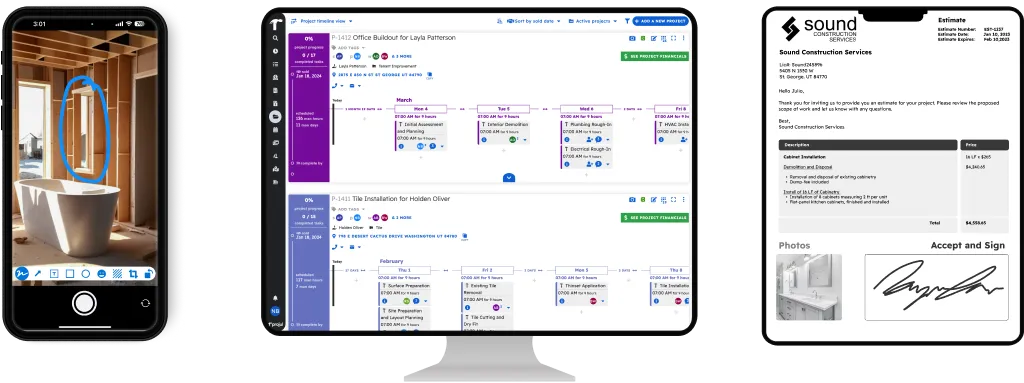
Projul breaks each build into these phases with their own schedules, budgets, and sub assignments using the interactive Gantt view. When your framing crew finishes two days early, the mechanical trades can start sooner. When rough frame runs two weeks late, every downstream phase shifts automatically and you see the impact on your completion date immediately.
This phase-based structure is what makes Projul work as home builder software. Generic project management tools treat a build like a flat list of tasks. Projul understands that a home build is a sequence of dependent phases where one delay ripples through the entire project.
With 26+ feature areas, Projul covers every phase of a home build in one platform. No more juggling separate tools for scheduling, budgeting, and sub coordination.
Spec Homes vs. Custom Homes: Different Workflows, One Platform
Spec homes and custom homes require fundamentally different management approaches. Home builder software needs to handle both.
Spec homes are built on fixed budgets with pre-selected finishes. Your profit lives or dies on cost control. You need tight job costing, efficient scheduling, and the ability to replicate successful builds across multiple lots. Projul’s template system lets you duplicate a proven project plan, complete with phases, material assemblies, and sub assignments, and apply it to the next lot. Adjust the specifics and start building.
Custom homes add client-driven selections, allowances, change orders, and a buyer who wants weekly updates. You need a client portal, selection tracking, and change order management on top of your project management. Projul handles all of this. Your buyer sees progress through the client portal, approves changes with digital signatures, and pays invoices online.
The difference between a profitable builder and one who is just busy often comes down to using the right home building software to manage these workflows efficiently. Projul gives you both in one platform.
Lot and Land Management
Before you pour a foundation, you need to manage the land. For builders working in subdivisions, that means tracking lot inventory, lot premiums, site conditions, and development status across multiple parcels.
Projul lets you set up each lot as a project from the earliest stage. Track which lots have been cleared, which have utilities stubbed, which are ready to build, and which are sold. When a lot moves from “available” to “under contract,” your team knows it is time to pull permits and start scheduling subs.
For custom builders working on individual lots, Projul tracks the site-specific details that affect your build: soil conditions, slope, setback requirements, utility locations, and access considerations. This information stays with the project record so anyone on your team can reference it without calling you.
Home builder software should manage the entire process from dirt to done. Projul starts at the lot level.
Selections and Allowances Without the Spreadsheet
Selections are where custom home builds get complicated. Your buyer needs to choose flooring, countertops, cabinetry, fixtures, appliances, lighting, tile, paint colors, and dozens of other items. Each selection has a budget allowance, an actual cost, and a lead time that affects your schedule.
Projul lets you set up allowance line items in your estimate for every selection category. When the buyer picks their countertop, update the actual cost in the project. If they choose granite at $4,500 on a $3,500 allowance, the $1,000 overage shows up immediately in your budget. If they go under on lighting fixtures, that savings offsets the overage.
Your buyer sees the running allowance total through the client portal. No surprise at closing when $15,000 in overages stack up and nobody tracked them. This transparency builds trust and prevents the arguments that damage your reputation and your profit.
Tracking selections in a spreadsheet works for your first custom home. By your third, you need home builder software that handles it properly. Projul does.
Draw Schedules and Construction Loan Management
Home building runs on construction loan draws. The bank releases funds at specific milestones: foundation complete, framing complete, dried in, mechanical rough complete, drywall complete, and final. Each draw requires proof of progress, typically inspection reports, photos, and a summary of completed work.
Projul lets you tie draw milestones to build phases. When your framing phase is marked complete with inspection records and photos attached, you have a draw package ready for the lender. Builders say this cuts draw processing time in half because the bank gets everything they need in one organized submission instead of a pile of loose documents.
For builders, faster draws mean faster cash flow. A draw that processes in three days instead of ten keeps your subs paid on time and your project moving. Home building software that connects your project progress to your draw schedule is not a luxury. It is a necessity for any builder managing construction loan timelines.
Warranty Management After the Keys Are Handed Over
The build does not end at closing. Most home builders carry a one-year warranty on workmanship and varying warranties on systems and structural components. Managing warranty requests through email and phone calls is a recipe for missed items and unhappy buyers.
Projul lets you keep the project active after closing for warranty tracking. When a buyer reports a drywall crack or a plumbing leak, log the warranty item in the project record, assign it to the responsible sub, and track it to completion. Your buyer sees the status through the portal. Your sub gets a notification with the details.
Over time, warranty data tells you which subs produce the most callbacks and which building practices cause the most issues. That data makes you a better builder on every future project.
Model Home and Sales Center Tracking
For builders with model homes and sales centers, Projul tracks the unique aspects of these projects. Model homes have their own budgets, their own maintenance schedules, and their own lifecycle from construction through eventual sale.
Track model home construction as a standard project, then keep it active for ongoing maintenance items: landscaping, cleaning, repairs from foot traffic, and seasonal updates. When the model sells, the project record has a complete history of every dollar spent.
This is a detail most home builder software overlooks because it was designed for one-off projects. Builders who sell from models need ongoing tracking, and Projul provides it.
Subdivision Management Across Multiple Active Lots
Running a subdivision means managing 5, 10, or 20 homes in various stages simultaneously. Your foundation crew is on lot 12 while your framing crew is on lot 8 and your trim carpenter is finishing lot 3. Keeping all of that straight without a system is nearly impossible.
Projul’s dashboard shows every active project with its current phase, schedule status, and budget health. Filter by subdivision to see just the lots in Pine Creek Estates. Filter by phase to see which homes are in framing this week. Filter by sub to see everywhere your plumber is scheduled.
Your supers walk multiple sites per day. The mobile app puts every lot’s details in their pocket. Check the schedule for lot 7, log an inspection result on lot 14, and reassign a task on lot 3, all from their phone.
Home building software that can manage a single custom home is useful. Software for home builders that can manage a 30-lot subdivision is what separates growing builders from those who hit a ceiling.
Buyer Communication Portals
Home buyers are emotionally and financially invested in their build. They want to know what is happening. They want to see progress. And if they do not hear from you, they assume the worst.
Projul’s client portal gives buyers controlled visibility into their home build. They see the phase schedule, approved selections, change order status, draw milestones, and progress photos. They can approve changes with digital signatures and pay invoices online.
This level of communication does three things for your business. First, it reduces the volume of “what’s happening with my house?” phone calls that eat your day. Second, it builds trust because informed buyers are happy buyers. Third, it generates referrals because your buyers tell their friends about the professional experience.
New construction software should include buyer communication as a core feature, not an afterthought. Projul was built with this in mind.
Coordinating 30+ Subcontractors on Every Build
A typical home build involves 25 to 35 different subcontractors: excavation, foundation, framing, roofing, plumbing, electrical, HVAC, insulation, drywall, painting, flooring, tile, cabinetry, countertops, trim, landscaping, and more. Each trade depends on the one before it. Get the sequence wrong and you have an electrician standing around because framing is not finished.
Projul’s scheduling board sequences every sub so trades show up in the right order. Each sub sees only their assigned tasks and dates. When one trade falls behind, adjust the schedule and every downstream sub gets notified automatically. No more phone trees. No more morning text chains sorting out who goes where today.
Home builders using Projul report a 32% increase in profitability from tighter sub scheduling alone. When your plumber shows up on the right day and your electrician is not waiting on the framer, you save real money on every build.
Code Inspections Within Your Project Timeline
Home building requires inspections at every major phase: foundation, framing, mechanical rough-in, insulation, and final. A failed inspection stops your project dead until the issue is corrected and the inspector comes back.
Projul lets you schedule inspections within your project timeline, log pass or fail results, attach inspector notes, and create follow-up tasks for failed items. When your rough-in inspection fails on a plumbing issue, the correction task goes straight to your plumber with the details. The re-inspection gets scheduled. Nothing gets lost in an email or a voicemail.
Over time, your inspection history shows you patterns. If rough plumbing fails 30% of the time with a particular sub, that is data you need to see. Home builder software that tracks inspections gives you that visibility.
Mobile App for Supers Who Live on the Job Site
Your site supervisors walk three or four houses a day checking on framing, mechanicals, and finishes. They do not sit at desks. They need their project information in their pocket.
Projul’s native iOS and Android app puts every build’s schedule, inspection logs, sub assignments, and budget status in their hands. Log inspection results, snap photos for draw documentation, update task status, and clock crews in with geofencing, all from the site. Everything works offline so a dead zone on a rural lot does not slow your super down.
Rated 9.8 on G2 for ease of use, Projul’s mobile app is built for people who wear hard hats, not people who sit in cubicles.
Job Costing Across 6 to 12 Month Timelines
Home builds stretch across months. A lot can go wrong with your budget between breaking ground and handing over keys. Lumber prices change. A sub comes in over their bid. The buyer upgrades their countertops.
Projul tracks estimated costs versus actual costs across the entire build timeline. Your labor hours feed in from time tracking. Your material costs and sub invoices post as they happen. At any point during the build, you see whether you are on budget or trending toward a loss.
For spec builders, this is how you protect your margin. For custom builders, this is how you catch allowance overages before they become a problem at closing. Home building software with real-time job costing turns a 9-month guessing game into a controlled process.
Contractors using Projul report a 32% average profit increase because they see the numbers while they can still act on them.
QuickBooks Integration for Builder Financials
Home building involves significant financial volume: sub payments, material invoices, draw proceeds, and buyer payments. Entering all of that into your accounting software by hand is time-consuming and error-prone.
Projul integrates with QuickBooks Online so your invoices, payments, and customer records sync automatically. Your bookkeeper works with clean data. Your accountant sees accurate financials. And you do not spend your evenings re-entering numbers.
Honest Pricing for Home Building Contractors
Most home builder software charges per user. When you have project managers, supers, estimators, office coordinators, and sub access needs, that per-user model gets expensive fast.
Projul starts at $4,788 per year for your entire home building company. No per-user fees. Every PM, super, estimator, and office coordinator gets full access without inflating the bill. For a builder running three to ten homes at a time, that is a fraction of what you lose on a single mismanaged sub delay.
Over 5,000 contractors use Projul to manage their operations. G2 users rate Projul 9.8 for ease of use and 9.8 for quality of support.
Spec Home vs. Custom Home Workflow Differences
Most home builders handle both spec homes and custom builds, but the workflows are fundamentally different. Running both with the same process is like using a framing hammer to set finish nails. It works, but it is not the right tool and you lose quality and speed.
Spec homes run on speed and cost control. You pick the lot, pull the permit, and build to a fixed plan with pre-selected finishes. Your margin depends entirely on how tight you manage costs and how fast you complete the build. Every day a spec home sits unfinished is a day you are paying interest on the construction loan with no buyer making payments. A spec home that takes seven months instead of six costs you an extra month of loan interest, typically $2,000 to $4,000 depending on the loan amount.
Custom homes run on communication and change management. Your buyer wants to pick every finish, change their mind twice on the kitchen layout, and add a covered patio that was not in the original contract. Your margin depends on tracking every change order, managing allowance overages, and keeping the buyer informed so they do not blame you when their upgrade choices push the budget up by $30,000.
Projul handles both workflows from one platform. For spec homes, use the template system to clone your proven project plan, apply it to the next lot, and track costs tightly against your target margin. For custom homes, set up the client portal so buyers see progress, approve changes with e-signatures, and track their allowance spending in real time. The project management is the same underneath, but the workflow layers on top are different.
The mistake many builders make is treating spec homes like custom homes, adding unnecessary communication overhead, or treating custom homes like spec homes, skipping the change order documentation that protects your margin. Projul’s flexibility lets you set up each project type with the right level of structure. Spec homes get lean templates focused on cost and speed. Custom homes get detailed allowance tracking and buyer-facing communication tools. Same software, different configurations.
For builders transitioning from all-spec to a mix of spec and custom, or the other direction, Projul makes the switch simple. You do not need separate systems or separate training. Your team learns one platform and adjusts the workflow per project type.
Lot and Land Acquisition Tracking
For builders who buy lots, land acquisition is where the project starts, months or even years before you pour a foundation. Tracking lot opportunities, purchase contracts, due diligence items, and development status in a spreadsheet works for your first two or three lots. By the time you are evaluating ten lots across three subdivisions, you need a system.
Projul lets you create a project for each lot starting at the acquisition stage. Track the purchase price, closing date, lot premium (corner lot, view lot, cul-de-sac), and any site conditions that affect buildability: slope, soil type, setbacks, easements, and utility availability. Attach the survey, the plat, and any geotechnical reports to the project record. When you are ready to build, all the site information is already in the system.
For subdivision builders negotiating bulk lot purchases, the financial tracking matters even more. You might buy 15 lots at $85,000 each with a takedown schedule that releases five lots every six months. Projul tracks which lots are in your inventory, which are under construction, and which are sold. Your total lot investment, carrying costs, and average lot cost per home are visible without pulling numbers from three different spreadsheets.
Due diligence is the phase where details get lost. A lot that looks great on paper might have a wetland setback that cuts your buildable area by 30%. Or the soil test reveals expansive clay that adds $15,000 to your foundation cost. Log every due diligence finding in the Projul project record so your team has the full picture when deciding whether to close on the lot or walk away.
For custom builders working on client-owned lots, the tracking is simpler but still important. Document the lot conditions, any restrictions from the HOA or municipality, and the site-specific details that affect your build plan. When the homeowner asks why the house cannot be moved 10 feet closer to the street, you reference the setback requirements documented in the project record instead of digging through emails.
Projul’s lead management tools also help builders track lot leads and prospect conversations. When a landowner calls about selling a parcel, or a developer offers you first right of refusal on new lots, log the conversation and follow up. The best lot deals come from relationships, and tracking those relationships in your home builder software keeps opportunities from falling through the cracks.
Model Home Showroom Scheduling and Maintenance
Model homes sell houses. A well-maintained model with a busy showing schedule can generate 30% to 50% of a subdivision builder’s sales. But model homes also eat money if you do not manage them. Between the construction cost, ongoing maintenance, cleaning, landscaping, utility bills, and eventual sale, a model home can be a $20,000 to $50,000 investment beyond the standard build cost. Tracking that investment matters.
Projul lets you manage your model home as an ongoing project after construction is complete. Schedule regular maintenance items: weekly cleaning, monthly landscaping, seasonal HVAC filter changes, and touch-up painting after high-traffic weekends. Assign each maintenance task to the responsible vendor and track completion. When the carpet shows wear after six months of showings, the replacement gets logged as a project cost so you know your true model home investment.
Showing schedules are another piece that most builders track informally. Your sales agent books appointments, weekend open houses, and realtor tours. Logging these in Projul’s scheduling system gives you data on showing volume by day and week. If your model gets 15 showings per week in spring but only 3 in winter, that data informs your marketing spend and staffing decisions.
When the model home eventually sells, the project record in Projul contains every dollar you spent from construction through sale. Subtract that total from the sale price and you know your true return on the model home investment. Most builders guess at this number. With Projul, you know it. That data helps you decide whether to build a model in your next subdivision or rely on virtual tours and spec home showings instead.
For builders with multiple model homes across different communities, Projul’s dashboard shows maintenance status, upcoming tasks, and costs for each model in one view. Your construction superintendent should not be managing model home maintenance in their head. It should be in the system where anyone on your team can see it and act on it.
The model home is often the first impression a buyer has of your company. A dead lightbulb in the kitchen, a scuffed baseboard in the entry, or a dirty HVAC filter blowing dusty air through the vents all send the wrong message. Projul’s task reminders make sure the small maintenance items get handled before the next showing, not after a buyer notices them.
HOA and Subdivision Compliance Tracking
Building in a community with an HOA or architectural review board adds a layer of requirements that can slow your project or cost you money if you miss them. Color approvals, material specifications, setback requirements, fence styles, landscaping minimums, and mailbox standards are just the start. Some HOAs require plan approval before you pull a permit. Others do final inspections before you get a certificate of occupancy.
Projul lets you build an HOA compliance checklist for each community you work in. List every requirement from the architectural guidelines: approved exterior colors, roof material specifications, minimum landscaping requirements, fence height and style, garage door specifications, and any other community-specific rules. Your project manager checks off each item as it is completed or approved, with documentation attached.
The cost of HOA non-compliance ranges from annoying to expensive. A paint color that does not match the approved palette means repainting the entire exterior at your cost, which could be $5,000 to $10,000. A fence that does not meet the architectural standard gets torn out and rebuilt. A landscaping plan that falls short of the minimum requirement delays your certificate of occupancy and your buyer’s closing. None of these are mistakes you can afford to make, and all of them are preventable with a checklist.
For subdivision builders working across multiple communities, each HOA has different requirements. The color palette in Oak Ridge Estates is not the same as Pine Creek Village. The fence requirements in one community might allow vinyl while another requires wood. Projul lets you create community-specific templates so your team knows exactly what each HOA requires without memorizing 15 different sets of architectural guidelines.
Track your HOA submission and approval dates in the project timeline. If the architectural review board takes three weeks to approve your plans, build that lead time into your pre-construction schedule. A builder who submits for HOA approval the same week they want to pull a permit loses three weeks waiting. A builder who submits during lot development gains that time back. Projul’s project timeline makes these lead times visible so your team plans ahead instead of reacting.
For builders working in master-planned communities with strict architectural oversight, the review process can include preliminary review, formal submission, revision requests, and final approval. Each step has a timeline that affects your overall schedule. Projul tracks each step as a task in the pre-construction phase so your team knows exactly where each submission stands. When the architectural review board requests a revision to your elevation rendering, the task updates with the new requirement and deadline. Your design team sees it immediately and responds before the deadline passes.
Some communities also require mid-construction inspections by the HOA, separate from municipal code inspections. These might check that your siding color matches the approved sample, that your landscaping plan is being followed, or that your construction site is maintained to community standards. Build these HOA inspections into your project timeline alongside your code inspections so nothing gets missed.
Document every HOA interaction in the project record: submission dates, approval dates, revision requests, and final sign-offs. When a homeowner calls two years after closing claiming you violated the architectural guidelines, your project record shows the approval documentation. That paper trail protects you from disputes that would otherwise come down to your word against theirs.
Pre-Construction Planning and Permit Tracking
The months between signing a contract and breaking ground are where experienced builders separate themselves from the rest. Pre-construction planning covers permit applications, plan reviews, utility coordination, HOA submissions, material pre-orders, and sub scheduling. Miss any of these and your start date pushes back, which pushes your completion date, which pushes your buyer’s closing, which costs you money and credibility.
Projul lets you set up a pre-construction phase in every project with tasks for each item that needs to happen before you dig. Permit application submitted. Plan review comments received and addressed. Utility locates called in. Tap fees paid. HOA architectural review approved. Truss order placed (six-week lead time). Each task has a due date, an owner, and a status. Your team sees the full pre-construction checklist and knows what is holding up the start.
Permit timelines vary wildly by jurisdiction. Some municipalities turn around a residential permit in two weeks. Others take eight to twelve weeks with multiple rounds of plan review comments. If you do not account for that timeline in your project schedule, you end up with a crew ready to dig and no permit in hand. Projul’s project timeline shows the permit application date, expected review period, and anticipated approval date so your construction start is realistic, not wishful.
For builders pulling permits in multiple jurisdictions, each municipality has different requirements, different fees, and different review timelines. Track the specifics for each jurisdiction in Projul so your team knows what to expect. The city of Springfield wants engineered truss drawings submitted with the permit application. The county wants a separate grading permit for any lot with more than a 10% slope. Log these requirements in your project templates so they are built into every project in that jurisdiction automatically.
Material pre-orders with long lead times need to start during pre-construction, not after you break ground. Trusses, engineered beams, specialty windows, and custom cabinetry can all have lead times of four to eight weeks or longer. Place these orders during pre-construction and tie the delivery dates to the project phase that needs them. Projul tracks the order date, expected delivery, and actual delivery so your schedule stays realistic.
Sub scheduling during pre-construction is another area where planning pays off. Your best subs book out weeks or months in advance. If you wait until you break ground to schedule your framing crew, they might not be available for three weeks. Contact your key trades during pre-construction, give them your anticipated start dates for their phase, and get verbal commitments. Log those commitments in Projul so your schedule reflects real availability, not assumptions.
The builders who consistently deliver on time are the ones who take pre-construction planning seriously. A well-planned project starts on time, materials arrive when needed, and subs are scheduled before you need them. Projul gives you the structure to manage all of this in one place instead of tracking permits in email, material orders in a spreadsheet, and sub scheduling on a whiteboard.
Home Building Guides for Your Team
Home additions are one of the most complex residential projects, combining structural modifications with tight timelines and homeowner expectations. Our home addition construction guide covers foundation tie-ins, roof line matching, and phasing strategies that keep the existing home livable during construction.
For a detailed breakdown of budgeting and pricing addition work, our home addition costs guide for contractors walks through square footage pricing, permit costs, and how to set realistic allowances that protect your margin.
Build Better Homes and a Better Business
Home building is complex work. The timelines are long, the trades are many, the financial stakes are high, and your buyers are watching every step. You cannot manage all of that with spreadsheets and phone calls.
Home builder software like Projul gives you the structure to manage every build from lot to closing without losing track of the details that protect your profit and your reputation. Over 5,000 contractors have already made the switch. Your competition is probably one of them.