Insulation Contractor Software. Built by construction pros with honest pricing.
Your window is razor thin. Framing passes inspection, you install, drywall shows up right behind you. Miss that slot and the whole build stalls. Projul helps insulation contractors nail their scheduling, track R-value compliance, and invoice before the next trade walks in the door. Rated 9.8 on G2 for a reason.
- Schedule batt, blown-in, and spray foam crews into the tight gap between framing and drywall
- Track R-value requirements, energy code specs, and vapor barrier details per project
- Estimate flash and batt, blown-in cellulose, and full spray foam jobs with reusable templates
- Log air sealing work, thermal bridging corrections, and inspector sign-offs on every job
- Manage blower truck logistics and spray foam rig assignments so equipment is never double-booked
What Is Insulation Contractor Software?
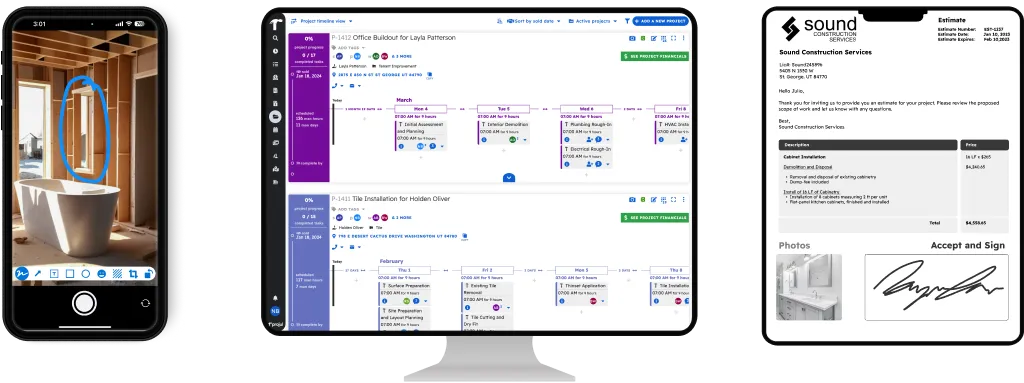
Insulation contractor software is a project management platform that helps insulation companies schedule crews into tight build windows, track R-value requirements, estimate jobs by material type, and document code compliance. Projul connects your office and field crews so every insulation job stays on schedule and on budget.
Projul’s insulation contractor software helps insulation companies schedule crews into tight build windows, track material requirements, and manage job costing with tools built specifically for trade contractors. Projul offers flat-rate pricing with no per-user fees for construction companies of all sizes.
If you run an insulation company, your business lives and dies by timing. Framing passes inspection, you install, and drywall shows up right behind you. Miss that slot and the whole build stalls. The builder calls someone else next time. Your crew sits idle burning payroll.
Insulation contractor software like Projul exists to keep your scheduling tight, your estimates accurate, and your code compliance documentation organized. It is not generic project management dressed up for insulation. It handles the specific problems that insulation contractors face every day.
Hit Your Install Window Every Time
Your install window is the gap between framing inspection and drywall. On a production build, that gap might be two or three days. On a custom home, you might get a week. Either way, if you miss it, you hold up every trade behind you and damage your relationship with the builder.
Projul shows your full schedule across every active job so you see exactly when framing inspections pass and your install window opens. Assign your crew before drywall gets booked. Insulation contractors using Projul save 2+ hours daily on scheduling and stop losing work because they responded too slowly to ready-to-insulate calls from builders.
The builders who keep you busy are the ones who trust you to show up on time, every time. Insulation contractor software that keeps your scheduling sharp is how you stay on their call list instead of getting replaced by the company that answers faster.
R-Value Calculations and Energy Code Compliance
Energy codes dictate the minimum R-values for walls, ceilings, floors, and crawl spaces in every climate zone. Get it wrong and you fail inspection. The 2021 IECC requires R-49 in the attic for most climate zones, R-20 or R-13 plus continuous insulation in walls, and specific air barrier requirements that did not exist a decade ago.
Projul lets you record R-value specs, energy code requirements, and insulation type for every project. Attach the energy report and inspector sign-off directly to the job record. When a code official asks for your R-38 ceiling documentation six months after you finished, you pull it up in seconds instead of digging through a filing cabinet.
For insulation contractors who work across multiple jurisdictions, tracking code requirements per project is critical. What passes in one county might fail in the next. Projul keeps those specs tied to each job so your crews install to the right standard every time.
Documenting Thermal Bridging Corrections
Thermal bridging at studs, headers, and rim joists is where heat loss concentrates. Code officials and energy raters are paying closer attention to how contractors address these areas. Projul lets your crews document thermal bridging corrections with photos and notes on the job record. When the energy rater checks your work, the documentation shows exactly what you did and where.
Material Types and Estimating by the Job
Insulation is not one product. It is several, and each carries different material costs, labor requirements, equipment needs, and performance characteristics. Your insulation contractor software needs to handle all of them.
Spray Foam Insulation
Open-cell and closed-cell spray foam are your premium products. Closed-cell delivers R-6.5 to R-7 per inch, acts as a vapor barrier, and adds structural rigidity. Open-cell gives you R-3.5 to R-3.7 per inch and is better for sound dampening and filling irregular cavities. Both require a spray foam rig, trained operators, and proper ventilation during application.
Projul lets you build estimate templates for open-cell and closed-cell spray foam with line items for material (board feet), labor, rig mobilization, PPE, and masking/protection of surfaces. Track your material usage against the estimate so you know whether your yield rates are hitting target or whether your crew is over-spraying and killing your margin.
Batt Insulation
Fiberglass and mineral wool batts are your bread and butter for wall cavities and floor systems. The work is labor-intensive but does not require specialized equipment. Projul helps you estimate batt jobs by square footage with waste factors built in. Track labor hours per square foot across jobs so you can tighten your bids over time.
Blown-In Insulation
Blown-in cellulose and fiberglass fill attics, dense-pack walls, and hard-to-reach cavities. You need a blower truck on site, and the material cost varies with density requirements. Projul schedules your blower equipment alongside your crews so neither one shows up without the other. Build estimate templates that account for settled density versus initial fill depth.
Rigid Board Insulation
Rigid foam board (XPS, EPS, polyiso) goes on exterior walls, foundation walls, and under slabs. It is measured in sheets and cut to fit, with different R-values per inch depending on the product. Projul tracks rigid board as a separate line item in your estimates with waste factors for cuts and waste.
Square Footage Estimating That Protects Your Margin
Insulation work is priced by the square foot or board foot, and your profit depends on accurate takeoffs. Underestimate the square footage and you eat the difference. Overestimate and you lose the bid to the contractor who measured right.
Projul’s estimating tools let insulation contractors build detailed bids with square footage, material quantities, and labor rates for each area of the project. Break the estimate into sections: attic, exterior walls, interior walls, floor system, crawl space, rim joists. Each section carries its own R-value requirement, material type, and labor rate.
Save templates for your most common project types. A standard 2,000 square foot new construction home. A retrofit attic blow-in. A commercial spray foam job. Adjust the measurements for each new project and send the estimate out the same day you measure. Insulation contractor software with solid estimating tools means more bids out the door and fewer surprises on job day.
Energy Audit Integration
Many insulation projects start with an energy audit. The auditor identifies air leaks, inadequate insulation, and areas of heat loss. The audit report becomes your scope of work for the retrofit.
Projul lets you attach energy audit reports directly to the project record. Reference the auditor’s findings when you build your estimate. Document which recommendations you addressed and which the homeowner declined. When the post-retrofit audit happens, the before-and-after data lives on the same job file.
For insulation contractors who partner with energy auditors, this workflow keeps everyone on the same page. The auditor’s report goes into Projul, you build the scope from it, and the follow-up verification ties back to the original findings. Your insulation contractor software becomes the single source of truth for the entire upgrade.
Blower Door Testing Documentation
Blower door tests measure the airtightness of a building and are required by code in many jurisdictions. The test result, measured in air changes per hour at 50 pascals (ACH50), tells you whether the building envelope meets the energy code threshold.
Projul lets you log blower door test results directly on the project record with the test date, ACH50 reading, and pass or fail status. Attach the test report as a document so it stays with the job permanently. When the energy rater or code official needs to verify your work passed, the documentation is right there.
For insulation contractors who perform their own blower door tests, this is a selling point. You can show builders and homeowners documented proof that your insulation and air sealing work meets or exceeds code requirements. That proof differentiates you from competitors who just staple batts and move on.
Scheduling Crews and Equipment Together
Insulation work requires matching the right crew with the right equipment at the right job site. A spray foam crew without a rig is useless. A blower truck without a crew is a parked asset. Your insulation contractor software needs to schedule people and equipment as a unit.
Projul shows which rig is committed to which job and when it frees up. Your dispatcher stops double-booking the proportioner or routing a rig across town when there is a closer site ready. Schedule spray foam rigs and blower trucks as equipment resources on your project timeline alongside crew assignments.
Over 5,000 contractors trust Projul for this kind of resource coordination. When your $80,000 spray foam rig is always at the right job at the right time, your utilization rate goes up and your cost per job goes down.
Commercial vs. Residential Insulation Projects
Commercial insulation work and residential projects are different animals. Commercial jobs involve larger square footage, tighter schedules coordinated with GCs, and material specs dictated by the architect or engineer. Residential work involves homeowner communication, energy audit recommendations, and schedules that flex around client availability.
Projul handles both from one platform. For commercial projects, coordinate with the GC’s master schedule, track your scope across multiple floors or sections, and manage the inspection process for each phase. For residential jobs, communicate directly with the homeowner, schedule around their availability, and document energy improvements for rebate programs.
Insulation contractor software that forces you into one workflow or the other limits your business. Projul adapts to whatever project you are working today.
Retrofit vs. New Construction Workflows
New construction insulation follows a predictable sequence. You install after framing inspection and before drywall. The scope comes from the energy code and the plans. Your schedule is set by the builder.
Retrofit work is different. You are adding insulation to an existing structure, often while the homeowner lives there. Access can be limited. Existing conditions vary. You might find old insulation that needs removal before you can install new material. The scope often comes from an energy audit rather than a set of blueprints.
Projul manages both workflows. For new construction, your insulation contractor software tracks your position in the build sequence and sends alerts when your install window opens. For retrofits, manage the homeowner relationship, document existing conditions, and track the upgrade scope from audit through completion.
Code Compliance That Stays on the Job Record
Insulation code compliance involves more than just R-values. You need to document vapor barrier placement, air barrier continuity, thermal bridging corrections, and proper installation techniques. A batt that is compressed, gapped, or missing vapor barrier facing does not deliver the labeled R-value, and the inspector knows it.
Projul captures all of this documentation on the project record. Your crews upload photos showing proper installation, vapor barrier placement, and air sealing details from the field. The inspector sees a clean, well-documented job. Your insulation contractor software creates the paper trail that proves you did the work right.
This documentation also protects you long term. When a homeowner complains about comfort issues two years later, you can show exactly what was installed, where, and to what specification. That is your defense against call-backs and warranty claims.
Track R-Values, Energy Code Specs, and Inspector Sign-Offs
Record R-value specs, energy code requirements, and insulation type for every project in Projul. Attach the energy report and inspector sign-off directly to the job record. When a code official asks for your R-38 ceiling documentation six months after you finished, you pull it up in seconds instead of digging through a filing cabinet.
Insulation contractors using Projul report a 32% average profit increase from tighter scheduling and accurate documentation. That number comes from hitting install windows consistently, billing for all the work you perform, and eliminating the back-and-forth that happens when your paperwork is incomplete.
Your Install Crews Stay Connected From the Attic
Your insulation crews work in crawl spaces, attics, and wall cavities where they cannot run back to the office for specs. Projul’s native mobile app lets them check R-value requirements, snap photos of vapor barrier placement, and log hours with geofencing, all from their phone.
If a crew finishes early, they can see the next available job and head straight there without calling dispatch. If they find unexpected conditions, like vermiculite insulation that might contain asbestos, they document it immediately and notify the office before anyone disturbs the material.
The app works on phones covered in cellulose dust with weak signal in a basement. Insulation contractor software that your crews actually use is the only kind worth paying for. G2 users rate Projul 9.8 for ease of use because it was built for the field first.
Job Costing That Shows Where Your Money Goes
Every insulation job has a target margin. Spray foam work should run higher margins because of the equipment and skill involved. Batt work runs tighter margins on higher volume. Without job costing, you do not know which jobs made money and which ones lost it.
Projul tracks estimated costs versus actual costs on every project. See whether your material usage matched your estimate. Check whether labor hours came in where you expected. Identify which job types are your most profitable and which ones need tighter bidding.
Insulation contractor software with real-time job costing turns your business from a guessing game into a data-driven operation. Contractors using Projul report catching cost overruns early enough to fix them instead of discovering the damage at tax time.
Managing Multi-Builder Relationships and Volume Pricing
Most insulation contractors do not work for just one builder. You might have standing relationships with three to eight builders in your market, each with different expectations, pay terms, and project cadences. Builder A wants you on site within 48 hours of framing inspection. Builder B gives you a week but expects a lower per-square-foot rate because they send you twenty houses a year. Builder C pays quickly but changes specs mid-project without a formal change order.
Keeping these relationships straight without a system means relying on memory and handshake agreements. That works until you accidentally quote Builder B at Builder A’s rate, or you miss Builder A’s 48-hour window because your schedule did not flag the framing completion.
Projul’s CRM and lead management tools let you set up each builder as a client with their own pricing templates, communication preferences, and scheduling rules. When Builder B sends you a batch of five houses, pull their specific template with the volume rate already built in. When Builder A marks framing complete, your scheduling notification fires and your dispatcher assigns a crew immediately.
Volume pricing is where the negotiation gets tricky. A builder who sends you 30 houses a year at $1.50 per square foot represents $90,000 or more in annual revenue. Losing that relationship because you missed two install windows is expensive. But pricing too low on volume work can erode your margins to the point where you are busy but not profitable.
Projul’s job costing reports show your actual profit per builder across all their projects. If Builder C’s constant spec changes are eating into your margin, you have the data to either renegotiate the rate or add a change order process. If Builder B’s volume rate is generating healthy margins because the work is predictable and efficient, you know to protect that relationship. Without project-level cost tracking, you are guessing which builders are worth your time and which ones are costing you money.
Tracking Spray Foam Chemical Inventory and Drum Counts
Spray foam insulation is a chemical process, and your material costs are tied directly to how well you manage your drum inventory. A set of A-side and B-side drums for closed-cell foam costs $1,500 to $2,500 depending on the manufacturer and your volume discount. On a busy week, a single rig might go through three to five sets. If you are not tracking drum usage per job, you have no idea whether your yield rates are where they should be.
Theoretical yield for closed-cell spray foam at one inch of thickness is roughly 200 board feet per set of drums at a 1:1 ratio. In practice, most crews get 160 to 180 board feet because of overspray, uneven substrates, and temperature variations. The gap between theoretical and actual yield is your waste, and it directly affects your profit on every job.
Projul lets you track material quantities at the project level. Log how many drum sets your crew used on each job and compare it to the board feet they installed. If a crew is consistently getting 140 board feet per set while another crew gets 175, you have identified a training issue or an equipment calibration problem. Fixing that gap on a crew that sprays 50 jobs a year could save you $15,000 or more annually.
Chemical inventory also has a shelf life and storage component. Spray foam chemicals need to be stored at specific temperatures, typically between 60 and 80 degrees Fahrenheit. Drums that freeze or overheat may not process correctly, leading to poor adhesion, off-ratio foam, and costly rework. Projul’s document management lets you attach safety data sheets, storage guidelines, and batch numbers to your inventory records so your warehouse team knows exactly how to handle incoming shipments.
Reordering at the right time matters too. Running out of chemical mid-job means your rig sits idle while you wait for a delivery. Ordering too far ahead ties up cash in inventory that takes up warehouse space. By tracking drum usage rates in Projul across your active projects, you can predict when you need to reorder and keep just enough stock on hand to cover the next week of work without over-buying.
Crew Certification Tracking and Safety Compliance
Insulation work, especially spray foam application, carries real safety requirements that other trades do not face. Spray foam installers work with isocyanates, which are respiratory hazards that require proper PPE, ventilation, and training. OSHA requires that workers exposed to isocyanates receive medical surveillance and hazard communication training. A crew member without current certification should not be on a spray foam job, period.
Beyond spray foam, general insulation work involves fiberglass and mineral wool fibers that irritate skin, eyes, and lungs. Blown-in cellulose creates dust clouds in enclosed spaces. Retrofit work in older homes can expose crews to asbestos-containing vermiculite insulation, which requires a completely different protocol.
Projul helps you track crew certifications and training records at the employee level. Log each worker’s spray foam manufacturer certification, OSHA 10 or 30 completion, respirator fit test dates, and medical surveillance records. Set expiration reminders so you know when certifications need renewal before your crew shows up on a job site out of compliance.
For contractors working on commercial projects or with larger builders, proof of crew training is often a requirement before you start work. The GC asks for your safety documentation, and you need to produce it quickly. Projul stores these records in one place so you pull them up in seconds instead of digging through a filing cabinet in your office. Our OSHA compliance guide covers the specific requirements that insulation contractors need to track.
Safety documentation also protects you from liability. If a crew member reports a respiratory issue and claims inadequate training, your records in Projul show the training dates, the topics covered, and the PPE that was provided. That paper trail is your first line of defense in any workers’ comp or OSHA investigation. Insulation contractors who treat safety documentation as a daily habit instead of an annual checkbox run tighter operations and face fewer surprises.
Rebate Program Paperwork and Utility Incentive Tracking
Energy efficiency rebates and utility incentive programs put money back in your customer’s pocket, and they can be a powerful sales tool for your insulation business. Federal tax credits under the Inflation Reduction Act cover up to 30% of insulation and air sealing costs, with a maximum of $1,600 for insulation and $150 for energy audits. Many states and utilities stack additional incentives on top of that.
The problem is that rebate paperwork is tedious, and most insulation contractors either skip it entirely or do it inconsistently. Each program has different requirements: some need pre-approval before work begins, some need photos of existing conditions, some need blower door test results before and after, and nearly all need receipts and a completed application form. Miss a step and the rebate gets denied, which frustrates the homeowner and reflects poorly on your company.
Projul turns rebate tracking into a project workflow instead of an afterthought. Create a task template for rebate-eligible projects that includes pre-work photos, existing insulation documentation, the rebate application submission, post-work photos, blower door test results, and final paperwork filing. Each step gets checked off as your crew and office staff complete it. Nothing gets skipped because the checklist is built into the project.
For homeowners, the rebate often makes the difference between a “yes” and a “let me think about it.” When you can show a customer that their $8,000 attic insulation and air sealing project qualifies for a $1,600 federal tax credit plus a $500 utility rebate, the effective cost drops to $5,900. That reframing closes deals. Include the rebate estimate in your Projul proposal so the client sees the net cost right next to your price.
Track which rebate programs you have used across all your projects with Projul’s reporting tools. See how many rebate-eligible jobs you completed this year, the total rebate value your customers received, and your close rate on rebate-eligible versus non-eligible proposals. That data helps you decide which programs are worth pursuing and which ones create more paperwork than value. For background on the energy audit process that supports many rebate applications, see our energy audit guide.
Estimating Flash-and-Batt Combination Projects
Flash-and-batt is one of the fastest-growing insulation methods in residential construction, and it creates unique estimating challenges. The approach combines a thin layer of closed-cell spray foam (typically 1 to 2 inches) with fiberglass or mineral wool batts to fill the remaining cavity depth. You get the air sealing and vapor barrier properties of spray foam with the cost savings of batt insulation for the bulk of the R-value.
The estimating complexity comes from pricing two separate installation processes on the same project. Your spray foam crew comes in first to flash the wall cavities, rim joists, and any areas that need air sealing. Then your batt crew follows behind to fill the remaining cavity depth. That means two crew mobilizations, two sets of material costs, and two labor line items for every area of the project.
Projul lets you build estimate templates specifically for flash-and-batt work. Break the estimate into two phases: the spray foam flash (priced per board foot at 1 to 2 inches of closed-cell) and the batt fill (priced per square foot based on cavity depth). Each phase carries its own material cost, labor rate, and equipment allocation. When a builder asks for a flash-and-batt bid on a 2,400-square-foot home, you pull the template, adjust the square footage, and have a detailed proposal ready the same day.
The margin on flash-and-batt work typically falls between straight batt and full spray foam. You are charging a premium over batt-only because the spray foam component adds air sealing value and better overall performance. But you are priced below a full closed-cell spray foam application because the batt fills most of the cavity at a lower cost per R-value. Tracking your actual costs on these hybrid jobs in Projul’s job costing tools tells you whether your pricing is dialed in or whether you need to adjust.
For insulation contractors who offer all three approaches, batt only, flash-and-batt, and full spray foam, having separate estimate templates in Projul for each method lets you present options to the builder or homeowner quickly. Some clients want the best performance regardless of cost. Others want to meet code at the lowest price. Flash-and-batt often wins as the middle option. Our insulation estimate templates give you a starting point for building these proposals.
Scheduling Around Builder Timelines and Inspection Holds
Your schedule is not really your schedule. It belongs to the builder. When a framing crew runs two days late, your install window shifts. When the building inspector does not show up on the scheduled day, everything downstream moves. Your crews, your equipment, and your material deliveries all depend on events you do not control.
The insulation contractors who stay profitable in this environment are the ones who can react quickly without wasting resources. That means knowing, in real time, where every job stands in the build sequence and having the flexibility to reassign crews when windows shift.
Projul’s scheduling tools connect your project timeline to the milestones that matter: framing inspection passed, site ready for insulation, drywall scheduled. When a builder updates the framing completion date, your schedule adjusts and your dispatcher sees the change immediately. Instead of finding out Monday morning that a site is not ready, you know Friday afternoon and can redirect your crew to a different job.
For insulation contractors running ten to twenty active jobs with three to five crews, this kind of schedule visibility prevents the most expensive problem in the trade: idle crews burning payroll while waiting for a site to be ready. Every day a three-person spray foam crew sits idle costs you $900 to $1,200 in labor plus the opportunity cost of the jobs they could have been completing.
Projul also helps with the back end of the scheduling equation. When you finish an install and the builder needs to schedule their insulation inspection before drywall can start, log the inspection request date and result on the project record. Builders who see that you track their inspection timeline and communicate proactively will keep you at the top of their sub list. Our construction scheduling guide covers more strategies for managing crew assignments across multiple concurrent projects.
Handling Retrofit Projects With Homeowner Communication
New construction insulation work is builder-driven. You get specs, a schedule, and a purchase order. The communication is professional and predictable. Retrofit insulation work is a completely different animal. You are working directly with homeowners who may have never hired an insulation contractor before. They have questions about R-values, vapor barriers, whether spray foam smells, and how long they need to leave the house during application.
The sales cycle for retrofit work is also longer. A homeowner calls after getting a high energy bill, you schedule an assessment, you present options with pricing, and then they think about it for two weeks while getting quotes from your competitors. Without a system to track these leads and follow up at the right time, you lose jobs to contractors who simply stayed in touch.
Projul’s lead management pipeline tracks every retrofit inquiry from first call to signed contract. Set follow-up reminders so your office calls the homeowner back three days after sending the estimate, not three weeks. See which estimates are outstanding, which need a nudge, and which are ready to book.
Once the project starts, homeowner communication becomes even more important. Spray foam application requires occupants to vacate the home for a period after application, typically 24 hours for open-cell and sometimes longer for closed-cell in enclosed spaces. If you do not communicate this clearly and early, you get a frustrated homeowner who did not make arrangements for their family and pets.
Projul’s client portal gives homeowners a clear view of their project timeline, what work is planned, when your crew will arrive, and what they need to do to prepare. Send preparation instructions through the portal: remove items from the attic access area, ensure the HVAC is off during spray foam application, plan to be out of the home for 24 hours. When the homeowner has all the information ahead of time, the job goes smoothly and the five-star review writes itself.
Insulation Guides for Your Team
Spray foam requires precise temperature control, equipment calibration, and pass thickness management that differ significantly from batt or blown-in work. Our spray foam insulation guide covers open-cell vs. closed-cell applications, substrate prep, and quality control checks that prevent costly rework.
Honest Pricing for Insulation Contractors
Projul starts at $4,788 per year for your entire insulation company. No per-user fees. Your estimators, crew leads, office staff, spray foam operators, and batt installers all get full access without inflating the bill.
Most insulation contractor software charges per user. That model punishes growth. Add a spray foam crew? More money. Hire a dispatcher? More money. Give your warehouse manager access? Even more money. Projul’s flat rate means scaling your team does not scale your software bill.
Over 5,000 contractors use Projul to manage their operations, and insulation contractors consistently report saving 2+ hours daily on admin work. G2 users rate Projul 9.8 for ease of use and 9.8 for quality of support.