Landscaping Contractor Software. Built by construction pros with honest pricing.
Three crews. Eight job sites. A rain delay that just blew up tomorrow's grading schedule. Projul gives landscaping contractors a single place to manage hardscape installs, softscape projects, and recurring maintenance routes without losing track of who's where. Rated 9.8 on G2 by contractors who actually use it in the field.
- Route multiple crews across job sites with drag-and-drop scheduling
- Estimate materials down to the yard of mulch and pallet of stone
- Reschedule weather-delayed jobs without calling every crew lead individually
- Track recurring lawn maintenance accounts alongside one-time install projects
What Is Landscaping Software?
Landscaping software is a business management platform that helps landscape contractors schedule crews across multiple properties, estimate materials for hardscape and softscape projects, manage recurring maintenance contracts, and track profitability across seasonal revenue swings.
Projul’s landscaping software helps landscape contractors schedule crews across properties, estimate materials for hardscape and softscape work, and track seasonal profitability from a platform built by construction professionals. Projul offers flat-rate pricing with no per-user fees for construction companies of all sizes.
Running a landscaping company means managing two businesses at once. You have your install side, building patios, retaining walls, irrigation systems, and outdoor living spaces. And you have your maintenance side, mowing, trimming, mulching, and seasonal cleanups on a recurring schedule. Most general business tools cannot handle both. Landscaping software like Projul can.
Route Multiple Crews Across Job Sites
Your crews scatter across town every morning. The hardscape crew heads to one subdivision. The planting crew goes to a commercial property. The maintenance team hits six residential stops before lunch. If you are managing this with a whiteboard and group texts, you already know how fast things fall apart when one job runs long or a client cancels.
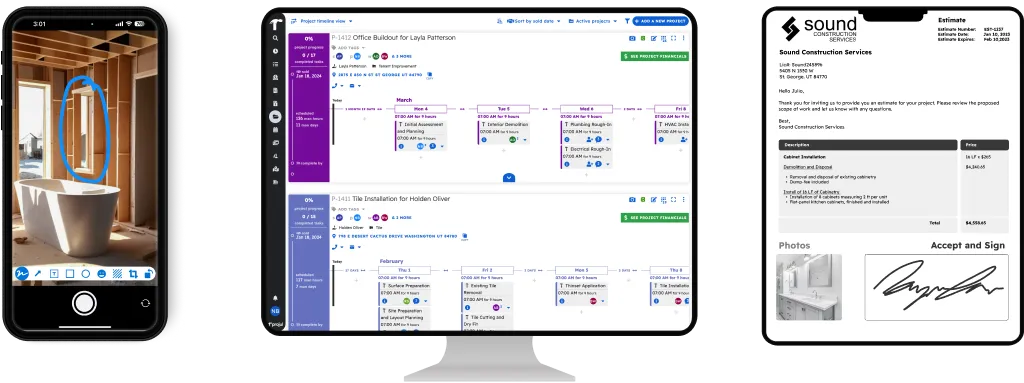
Projul shows all your landscaping crews on one scheduling board. Assign and move teams across sites with drag-and-drop simplicity. If your hardscape crew finishes the patio base an hour early, drag them to the irrigation job that needs extra hands. Every crew lead sees their updated schedule on their phone immediately. No group texts. No confusion about which site to hit next.
Landscaping contractors using Projul save 2+ hours daily on scheduling alone. When you multiply that across a full season, you are looking at hundreds of hours your office staff gets back for actual productive work.
Handling Weather Delays Without the Phone Tree
Weather runs your schedule more than you do. A three-day rain stretch does not just push one job. It cascades through your entire week. Grading cannot happen in mud. Sod cannot go down on saturated soil. Even hardscape work stalls when you cannot compact a wet base.
Projul lets you shift an entire week of work forward with a few taps. Every affected crew gets notified instantly on their mobile app. Your clients see updated timelines through the customer portal, which cuts down on angry calls after a storm. Landscaping software that handles weather delays without a phone tree is not a nice-to-have. It is how you keep a 20-job schedule from turning into chaos.
Estimating for Design-Build Landscaping Projects
Design-build landscape projects involve dozens of material types, each with different units and pricing. You are calculating tons of base material, square feet of pavers, linear feet of edging, cubic yards of topsoil, and counts of individual plants. A mistake in any of those calculations costs you money on a project you already bid.
Projul’s assemblies calculator lets you build reusable material lists for your most common job types. Enter the square footage for a patio and it calculates tons of base, number of pavers, and bags of polymeric sand. Build a planting bed template that figures mulch yardage from the bed dimensions. Create a retaining wall template that scales block count and geogrid by linear footage and wall height.
Estimates go out to clients looking professional and detailed. When the homeowner sees itemized line items for every material and labor component, they trust your number. When they see a single lump sum with no breakdown, they start shopping for a cheaper bid. Landscape contractor software that makes your estimates look sharp wins more work at better margins.
Hardscape vs. Softscape Estimating
Your hardscape and softscape work have different cost structures and different risk profiles. Hardscape materials like pavers, natural stone, and retaining wall block have predictable pricing and low waste rates. Softscape materials like plants and trees have variable pricing based on availability, season, and nursery supply.
Projul lets you build separate estimate templates for each service type. Your patio template includes excavation, base, pavers, edge restraint, and polymeric sand. Your planting template includes plant materials, topsoil, amendments, mulch, and installation labor. When a project combines both, you merge the templates and the client sees one clean proposal. Landscaping software that handles this split makes your bidding faster and your margins more predictable.
If your company also handles tree removal or trimming, our free tree service estimate templates can help you bid those jobs faster with pre-built line items.
Plant Material Ordering and Lead Times
Plant availability is one of the most frustrating parts of running a landscaping company. You bid a project with specific varieties. The client approves. You call the nursery and find out the 3-inch caliper red maples are eight weeks out, the boxwoods are on allocation, and the ornamental grasses you specified are not available until fall.
Projul helps you track plant material orders alongside your project schedules. When you know a tree has an 8-week lead time, you can schedule the order the day the estimate gets approved instead of waiting until the week before install. Attach supplier quotes and delivery confirmations to the project record. When the nursery delivers 24 shrubs instead of the 30 you ordered, log the shortage and reorder immediately. Your project record captures everything.
Over time, you build data on which materials have reliable lead times and which ones cause delays. That data makes your future estimates more accurate and your project schedules more realistic. Software for landscaping companies should help you learn from past supply chain problems, not just track the current ones.
Irrigation System Planning and Tracking
Irrigation installs are a high-margin service line for many landscaping contractors, but they come with their own scheduling and estimating complexity. You are calculating zone counts, head spacing, pipe runs, valve locations, and controller programming. A missed zone or an undersized mainline means a callback that eats your profit.
Projul lets you build irrigation estimates with line items for every component. Heads, pipe, valves, fittings, wire, controller, and labor. Schedule the install in phases: trenching, pipe and head installation, backfill, and programming. Track each phase as a separate task so your foreman knows the full scope and sequence.
When you add irrigation to a larger landscape project, it appears on the same schedule as your grading, planting, and hardscape work. Your crew sees the full project timeline and knows that irrigation trenching happens after grading but before sod. Landscaping software that integrates irrigation into your project workflow prevents the scheduling conflicts that cause delays and rework.
Managing Recurring Maintenance Contracts
Maintenance contracts are the steady revenue that gets you through slow install months. But managing 50 or 100 recurring properties alongside active install projects is an organizational challenge that breaks most systems.
Projul supports recurring job templates. Set up weekly mowing routes, biweekly trimming schedules, and monthly full-service visits. Each visit generates its own checklist and time tracking record. Your crew knows exactly what to do at each property, and you know exactly how long each stop takes.
When a maintenance customer requests an add-on, like a mulch bed refresh, seasonal color planting, or a drainage fix, you create a separate project linked to the same client record. The install work gets its own estimate, schedule, and invoice. The maintenance contract keeps running on its normal cycle. Landscape contractor software should separate one-time project work from recurring service without losing the connection to the client.
Tracking Crew Hours Per Property
Knowing how long each maintenance stop actually takes is the key to profitable routing. If you bid a commercial property at 2 hours per visit and your crew is consistently spending 2.5 hours, you are losing money every single week. Multiply that across 30 properties and you have a serious margin problem.
Projul’s time tracking ties crew hours to specific properties. Over a season, you build data on actual time per stop. Use that data to adjust your routing, renegotiate contracts that are not profitable, or identify properties where scope has crept beyond the original agreement. Landscaping software that gives you this level of detail turns your maintenance division from a break-even operation into a real profit center.
Seasonal Crew Management
Landscaping is one of the most seasonal trades in construction. You might run 30 crew members in July and 8 in January. Scaling up in spring means hiring, training, and equipping new people. Scaling down in fall means deciding who stays and who goes. Through all of this, your core team needs consistent work to stick around.
Projul helps you plan crew sizes against your project pipeline and maintenance contract volume. When you can see your booked revenue for the next 90 days, you make better hiring decisions. You know whether you need two more laborers in April or whether your existing crew can handle the load. Landscaping software that shows you the big picture prevents both overstaffing and understaffing.
Snow Removal as Off-Season Revenue
Many landscaping contractors run snow removal in the winter to keep crews working and revenue flowing. Snow routes work just like maintenance routes in Projul. Set up your commercial properties with per-push or per-event billing. Assign crews and equipment. Track salt and material usage per property.
When the first forecast calls for accumulation, you have your routes ready. Your crews know their assignments. Your billing is set up to invoice after each event. Software for landscaping companies that handles both summer maintenance and winter snow removal on one platform saves you from running two separate systems.
Commercial Property Maintenance and HOA Landscape Management
Commercial properties and HOA communities come with their own requirements. Regular inspection reports. Specific mowing heights. Seasonal rotation schedules for annual beds. Irrigation monitoring and adjustment. Tree and shrub care programs. The property manager wants documentation that the work was done, not just a truck driving through the parking lot.
Projul lets you build detailed task checklists for commercial and HOA properties. Your crew checks off each task as they complete it. Attach before-and-after photos to every visit. Generate reports that show the property manager exactly what was done and when. Landscaping software that provides this level of documentation wins commercial contracts and keeps them long-term.
Job Costing That Tells You Which Services Make Money
Not every service line in your landscaping company is equally profitable. You might make 40% margins on hardscape installs but only 15% on weekly mowing. You might lose money on irrigation repairs but make it back on full system installs. If you do not track profitability by service type, you are guessing about where your money comes from.
Projul tracks estimated versus actual costs on every project. You see labor hours, material costs, and equipment charges against your bid. Over a season, you can compare profitability across patios, plantings, irrigation, maintenance, and any other service you offer. That data tells you where to focus your marketing, where to raise prices, and which services to drop.
Contractors using Projul report a 32% average profit increase. For landscaping companies, a big part of that comes from finally understanding which jobs make money and which ones just keep people busy.
Mobile App for Crews in the Field
Your crews are never at a desk. They are in a truck, at a job site, or knee-deep in a planting bed. Projul’s native iOS and Android app was built for the field. Big buttons. Simple navigation. It works on a dusty phone with one bar of signal.
From the app, your crew leads can clock in with GPS verification, check their route for the day, mark tasks complete, take and attach photos, log materials used, and send messages to the office. Everything syncs in real time. When you reassign a crew to a different site from the office, they see the change on their phone before they start driving.
Rated 9.8 on G2 for ease of use, Projul’s app is something your guys will actually use. Most crew leads are using it comfortably by the end of their first day. No training manual needed.
Invoicing and Cash Flow Management
Landscaping companies deal with complex billing. Maintenance contracts bill monthly. Install projects bill on completion or at milestones. Snow removal bills per event. If you are not sending invoices promptly and consistently, you are giving your clients a free loan.
Projul lets you invoice from the office or the field. Send a deposit invoice before an install project starts. Bill maintenance contracts automatically on their billing cycle. Add change orders for scope additions on install jobs. Your clients pay online directly from the invoice, which speeds up your cash flow.
Projul integrates with QuickBooks so your invoices, payments, and customer records sync automatically. No double entry. No end-of-month reconciliation scramble.
Client Communication Through the Customer Portal
Your clients want to know when their project starts, when their next maintenance visit is, and whether the rain delay is going to push things back. They do not want to call your office every other day to find out.
Projul’s customer portal gives your clients visibility into their project schedule, estimate status, and invoice history. They can approve estimates, sign change orders, and pay invoices online. Landscaping software that makes your clients feel informed and in control builds trust and wins referrals.
Why Landscaping Contractors Switch to Projul
Most landscaping companies come to Projul after outgrowing their current system. Maybe they started with a spreadsheet for scheduling and a separate app for invoicing. Maybe they tried a generic project management tool that could not handle recurring maintenance routes. The story is the same: disconnected tools create disconnected operations.
Here is what makes Projul different for landscaping contractors:
- Built by a contractor. Kurt Clayson started Projul after running his own construction company. Every feature exists because a real contractor needed it.
- Flat-rate pricing. $4,788 per year for your entire company. No per-user fees. Your office, crew leads, and seasonal workers all get full access.
- All-in-one platform. CRM, estimating, scheduling, job costing, time tracking, invoicing, and client portal. One login. One place.
- Rated 9.8 on G2. For both ease of use and quality of support. That is landscaping contractors voting with real reviews.
- Over 5,000 contractors. From two-truck operations to companies with 100+ seasonal employees. The platform scales with your season.
Honest Pricing for Landscaping Contractors
Most landscaping software charges per user. That pricing model destroys you in peak season. When you scale from 8 to 30 crew members in April, your software bill triples right when you are already spending on hiring, equipment, and materials.
Projul starts at $4,788 per year for your entire landscaping company. No per-user fees. Your estimators, crew leads, seasonal laborers, and office staff all get full access without inflating the bill. Over 5,000 contractors use Projul to manage their operations, and landscaping contractors consistently report saving 2+ hours daily on admin work. G2 users rate Projul 9.8 for ease of use and 9.8 for quality of support.
Grow Your Landscaping Business
Looking to scale your landscaping operation beyond your current crew capacity? Our guide to growing a landscaping business covers seasonal hiring, route optimization, commercial contract acquisition, and the operational systems that separate growing companies from stagnant ones.
Scaling Crews Up and Down With the Seasons
Every landscaping company deals with the same problem every spring: you need more people, and you need them fast. By March, your phone is ringing with install requests, your maintenance contracts are kicking back in, and the two crews you kept through winter are already booked solid. You post a few job listings, call back some seasonal guys from last year, and hope you can get enough bodies on board before April hits full swing.
The challenge is not just hiring. It is getting new crew members productive without slowing down your experienced teams. A new laborer who does not know your expectations on site cleanup, truck loading, or material handling creates drag on the whole crew. Multiply that across three or four new hires per crew and you lose real hours in the first two weeks of the season.
Projul helps you manage seasonal scaling by giving every crew member, new or returning, access to task lists, job site details, and daily schedules through the mobile app. New hires see exactly what is expected at each property. Checklists spell out the scope for every stop on a maintenance route. Your foreman spends less time explaining and more time producing.
When fall arrives and you start scaling back down, Projul’s reporting tools show you which crew members logged the most productive hours, which ones had the highest rework rates, and which seasonal workers are worth calling back next spring. Instead of guessing who was good and who was not, you have data. A crew of 6 that bills 45 hours per week is more valuable than a crew of 8 that bills 40, and your time tracking records prove it.
The real cost of bad seasonal hiring is not just wages. It is the callbacks, the property damage, the client complaints, and the supervision time your experienced foremen burn babysitting instead of producing. Landscaping software that tracks individual performance across the season gives you the information you need to build a better team next year.
Planning your crew size also means planning your equipment. If you are adding two crews in April, you need two more trucks, two more trailers, two more mower setups, and all the hand tools to go with them. Projul’s project pipeline view shows your booked and pending work for the coming months so you can make equipment purchase or rental decisions with real data instead of gut feel. When you see $180,000 in confirmed install work for May plus your existing maintenance contracts, you know whether a third crew pencils out or whether you are better off subbing out the overflow. For tips on managing crew dynamics during rapid scaling, read our crew management guide.
Tracking Irrigation Projects From Bid to Final Walkthrough
Irrigation installs are one of the highest-margin services a landscaping contractor can offer, but they also carry more risk than most landscape work. An undersized mainline, a missed zone, or a head layout that leaves dry spots will all result in a callback that eats your profit. And unlike a planting bed where you can swap a few shrubs, fixing irrigation problems means digging up finished work.
The key to profitable irrigation projects is tracking every detail from the initial bid through the final walkthrough. Projul lets you build irrigation estimates with specific line items for every component: controller, valves, mainline pipe, lateral pipe, heads by type, fittings, wire, and trenching labor. When you bid a 12-zone residential system with 85 rotary heads and 40 spray heads, every piece is accounted for in the estimate.
Once the job starts, break it into phases using Projul’s scheduling tools. Phase one: trenching and mainline installation. Phase two: lateral lines and head placement. Phase three: backfill and sod repair. Phase four: programming, adjustment, and client walkthrough. Each phase gets its own task list and timeline. Your crew knows the sequence, and your client knows when to expect each stage.
Material tracking matters especially on irrigation work. PVC fittings, couplings, and adapters add up fast when you are running 1,200 feet of pipe across a property. Log materials used on each project through Projul so you can compare actual usage against your estimate. Over time, you build accurate material factors that make your future bids tighter. If a 12-zone system consistently uses 15% more fittings than your template estimates, you adjust the template and stop losing money on fittings.
After the install, use Projul’s photo documentation to record head locations, valve box positions, and controller programming before everything gets buried under sod. When the client calls next spring about a dry spot, you pull up the as-built photos instead of guessing where you ran the lines. For more on managing your material costs across all project types, check out our construction material tracking guide.
Scheduling Hardscape and Softscape Work on the Same Project
Most landscape projects that involve both hardscape and softscape require careful sequencing. You cannot plant shrubs along a patio edge before the patio is built. You cannot lay sod next to a retaining wall that has not been backfilled. And you definitely cannot run irrigation laterals through an area where your hardscape crew is about to excavate for a footing.
The problem is that many landscaping companies schedule hardscape and softscape crews independently. The hardscape foreman plans his week. The planting foreman plans hers. Nobody coordinates until both crews show up at the same property on the same day and realize they are in each other’s way.
Projul puts both crews on the same project schedule with task dependencies. The hardscape crew completes patio excavation and base installation. That task triggers the irrigation crew to run laterals in the adjacent planting beds. Once laterals are in, the softscape crew handles planting and mulch. Finally, the hardscape crew returns for paver installation and polymeric sand. Each step is sequenced so nobody is waiting on someone else or tearing up completed work.
This coordination matters most on large residential projects where the total contract might be $40,000 to $80,000 across hardscape, softscape, lighting, and irrigation. A scheduling conflict that costs you even one day of wasted labor on a project like that can wipe out $800 to $1,200 in crew costs. Over a season of 15 to 20 combined projects, those losses add up to tens of thousands of dollars.
Projul’s Gantt view makes the sequencing visual. Your office manager or project coordinator sees the full timeline for every crew on every project. When the hardscape crew runs two days behind on a retaining wall, the softscape tasks slide automatically and both foremen get notified. No phone calls. No surprises. Just a schedule that reflects reality and keeps everyone moving in the right order.
Turning Snow Removal Into a Real Revenue Stream
For landscaping contractors in cold-weather regions, snow removal is not just a way to keep a few guys busy through winter. Done right, it is a standalone profit center that can account for 25% to 35% of your annual revenue. The contractors who treat snow as an afterthought lose money on it. The ones who run it like a real business line make serious margins.
The first step is setting up your snow routes with the same level of detail you give your summer maintenance routes. In Projul, create recurring schedules for each commercial property with trigger conditions (2-inch accumulation, for example), billing terms (per push, per event, or seasonal contract), and material tracking for salt and de-icer. Assign crews and equipment to specific routes so everyone knows their territory before the first flake falls.
Material costs are where snow removal margins get tight. A 50-pound bag of rock salt runs $6 to $10 depending on your supplier and the season. A single commercial lot might take 200 to 400 pounds per application. If you are not tracking salt usage per property per event, you have no idea whether your per-push pricing actually covers your costs. Projul’s job costing ties material usage to specific properties and events, so you can see exactly which accounts are profitable and which ones need a price adjustment.
The billing side is equally important. Snow events happen at unpredictable intervals, and your clients expect invoices that show exactly what was done, when, and at what rate. Projul generates invoices tied to each service event with timestamps and property details. Send invoices within 48 hours of each event while the work is still fresh in the client’s mind. Faster invoicing means faster payment, and snow removal clients who get clear, prompt invoices are far less likely to dispute charges.
Equipment tracking rounds out the picture. Plows, spreaders, skid steers, and loaders all have operating costs that need to be factored into your pricing. When you track equipment hours per route in Projul, you build real data on your cost per push that includes fuel, maintenance, and depreciation. That data makes next season’s pricing more accurate and your snow division more profitable. For tips on managing your crews during seasonal transitions, read our crew scheduling guide.
Building Maintenance Upsells Into Your Workflow
Your maintenance crews visit the same properties week after week. They see the retaining wall that is starting to lean. They notice the irrigation head that sprays onto the sidewalk instead of the lawn. They spot the drainage problem that turns the back corner into a swamp after every rain. Every one of those observations is a potential project sale, and most landscaping companies let them slip by because there is no system to capture them.
Projul connects your maintenance operations to your sales pipeline through the CRM. When a crew lead notices a problem or an opportunity at a property, they log it in the app with a photo and a note. That observation creates a lead tied to the existing client record. Your sales team or estimator follows up with a proposal for the repair or upgrade. The client already trusts you because you maintain their property every week, which makes them far more likely to say yes than a cold prospect.
The numbers on maintenance upsells are compelling. A typical residential maintenance client pays $150 to $300 per month for mowing and basic care. A single upsell project, like a drainage correction, a small patio, or an irrigation repair, might be $2,000 to $8,000. If your crews identify just two upsell opportunities per week across all your routes and you close half of them, that is one extra project per week at an average of $4,000. Over a 30-week season, that is $120,000 in additional revenue that you would have missed without a system to capture it.
The key is making it easy for your crews to flag opportunities without disrupting their route. A foreman should be able to snap a photo, add a one-line note, and move on to the next property in under 60 seconds. Projul’s mobile app is built for exactly this kind of quick field input. No forms to fill out. No paperwork to bring back to the office. Just a photo, a note, and a tagged client record that your sales team picks up the next morning.
You can also use Projul’s templates to build standard upsell proposals for your most common add-on services. A drainage correction proposal template, a seasonal color rotation package, or an irrigation system upgrade estimate can go out to the client within hours of the crew flagging the opportunity. The faster you get a proposal in front of a warm lead, the more likely they are to say yes. A homeowner who sees a professional drainage proposal the same day your crew mentions the standing water problem is far more motivated than one who gets a call two weeks later. For more on converting leads into booked work, check out our lead management features.
If you are still managing your landscaping company with a whiteboard, group texts, and a stack of paper route sheets, you already know it is not working. You are losing time, losing details, and leaving money on the table every week.
Landscaping software like Projul is not about adding technology for its own sake. It is about running a tighter operation so you can take on more work, manage more properties, and actually know which jobs are making you money. Over 5,000 contractors have already made the switch. Your competition is probably one of them.