Remodeling Contractor Software. Built by construction pros with honest pricing.
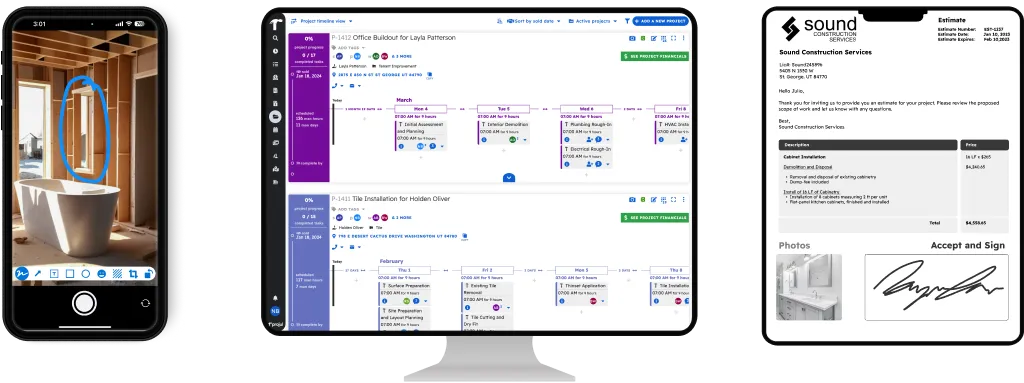
Your client just changed the tile for the third time, the plumber can't come until Thursday, and the homeowner is working from their kitchen table ten feet from demo. Projul gives remodeling contractors one place to manage subs, track selections, process change orders, and keep clients informed. Over 5,000 contractors use Projul to cut the chaos and protect their margins.
- Track client selections, approvals, and change orders in one project record
- Coordinate subs across multiple active remodels without scheduling conflicts
- Give homeowners a client portal so they stop texting you at 9 PM
- Build punch lists with photos and assign items to the right trade instantly
- See real profit on every job - not what you think you made, what you actually made
What Is Remodeling Software?
Remodeling software is a digital platform that helps remodeling contractors manage every project from the first client meeting through the final punch list. It connects estimating, trade scheduling, selections tracking, change orders, and invoicing so nothing gets lost between the office and an occupied home.
Projul’s remodeling software helps remodeling contractors manage estimates, trade scheduling, change orders, and client communication from one platform built by contractors who have run renovation projects in occupied homes. Projul offers flat-rate pricing with no per-user fees for construction companies of all sizes.
If you run a remodeling company, you know the hardest part is not the construction. It is managing ten trades, a homeowner who changes their mind, and a project scope that shifts every week. Remodeling contractor software exists to keep the chaos organized so you can deliver on time and on budget.
Keep Remodels Profitable and Clients Sane
Your client just changed the tile for the third time, the plumber cannot come until Thursday, and the homeowner is working from their kitchen table ten feet from demo. Projul gives remodeling contractors one place to manage subs, track selections, process change orders, and keep clients informed without a hundred text threads. Over 5,000 contractors trust Projul to keep their remodels on track.
Most remodeling software on the market was built for new construction and then loosely adapted for renovation work. You can feel it when you try to manage selections, change orders, and homeowner communication in a tool designed for tract homes. Projul works for remodeling contractors because it handles the messy reality of renovation: scope changes, occupied homes, and overlapping trades in tight spaces.
Whole-Home Remodels and Room Additions
A whole-home remodel is the most complex residential project you can take on. You are touching every room, coordinating ten or more trades, and managing a client who is living through the disruption. Room additions add structural engineering, foundation work, and roofing to an already complicated scope.
Projul lets you break whole-home remodels into phases. Demo. Structural. Rough-in. Insulation and drywall. Finish work. Final punch. Each phase has its own tasks, trade assignments, and timeline. When one phase finishes, the next one activates automatically.
For room additions, add tasks for foundation, framing, roofing, and tie-in work alongside the interior trades. Projul’s scheduler shows all the phases on one timeline so you see the critical path and catch scheduling conflicts before they cost you a day.
Remodeling contractor software that handles multi-phase projects keeps you from losing track of which trades need to be on site and when. Contractors running five to ten remodels at once say Projul is the only reason nothing falls through the cracks.
Trade Coordination: Managing 10+ Trades on One Project
A kitchen remodel alone can involve demolition, plumbing, electrical, HVAC, framing, insulation, drywall, tile, cabinetry, countertops, flooring, painting, and trim. That is thirteen trades on one room. Miss one in the sequence and you are ripping out finished work to fix something that should have been done earlier.
Projul lets you schedule every trade with dependencies. The electrician cannot start rough-in until demo is done. The insulation crew waits for rough-in inspection. Drywall follows insulation. Each trade sees their start date on the mobile app and gets notified when the predecessor finishes.
For remodeling contractors coordinating with subcontractors, this scheduling eliminates Monday morning phone calls. You are not calling six subs to confirm the week. They check Projul and know when they are up. When the plumber runs a day late, drag the dependent tasks and every sub downstream gets updated automatically.
Remodeling software that handles trade sequencing saves you from the most expensive mistakes in renovation: ripping out drywall because the plumber forgot to run a line, or tearing up new tile because the electrician needed one more outlet. If you coordinate with drywall contractors regularly, Projul keeps their schedule synced with every other trade on the job.
Selections Management: Tracking What the Client Picked
Selections are the headache that never ends on a remodel. The client picks a faucet, changes their mind, picks another one, then asks about the first one again. Meanwhile, you need to order materials, price the job, and keep the schedule on track.
Projul lets you log every client selection directly in the project record. Attach photos, spec sheets, links, and approval dates for every item. Flooring. Fixtures. Tile. Paint colors. Cabinet hardware. Countertop material. Light fixtures. Plumbing trim.
When the client claims they never approved the brushed nickel hardware and wanted chrome instead, you pull up the selection record with their approval date and the spec sheet. This documentation prevents disputes and protects your margin.
For design-build remodelers, selections tracking is even more critical. You are guiding clients through hundreds of decisions across every finish in the house. Remodeling software that keeps those decisions documented and approved prevents the most common source of conflict between contractors and homeowners.
Change Order Workflows That Protect Your Margin
Remodeling projects change scope more than any other type of construction work. The homeowner wants to add a built-in bookcase. The inspector requires additional structural support. The client upgrades from laminate to hardwood after demo reveals a beautiful subfloor they want to keep.
Projul creates and tracks change orders as separate line items tied to the original project scope. Document the additional work with costs and a description. Send the change order to the client through the platform. They approve it digitally. The project budget and schedule update automatically.
No more verbal agreements that never get documented. No more eating the cost of an upgrade because “the client said to go ahead” in the hallway and you did not write it down. Remodeling contractor software with formal change order workflows is the single biggest margin protector on renovation work.
Contractors using Projul report a 32% average profit increase. A significant portion of that comes from capturing change orders that would have otherwise gone unbilled. On a typical remodel, two or three undocumented changes can wipe out your entire profit margin.
Living-in-Place Challenges: Remodeling Occupied Homes
Most remodeling projects happen in homes where people are still living. The family is eating takeout in the living room while you demo their kitchen. The kids are doing homework ten feet from a tile saw. The homeowner works from home and has a video call at 2 PM.
This creates challenges that new construction never faces. Dust containment. Noise restrictions during certain hours. Temporary kitchen setups. Bathroom access during a full gut. Daily cleanup that goes beyond construction standard.
Projul helps you manage these constraints by documenting them in the project record and building them into the schedule. Create tasks for dust barrier installation and daily cleanup. Note quiet hours and restricted access times. Your subs see these constraints when they pull up the project on their phone.
Documenting living-in-place requirements in Projul prevents the complaints that damage your reputation. When the drywall crew shows up at 7 AM and starts sanding next to the nursery, it is because nobody told them the family needs quiet until 8:30. Projul makes sure that information reaches every person who works on the project.
Permit Management for Renovation Projects
Remodeling permits add complexity that new construction does not have. You might need a building permit, electrical permit, plumbing permit, and mechanical permit for a single kitchen remodel. Each one has its own application, plan review, and inspection schedule.
Projul lets you create tasks for each permit stage. Application submitted. Plan review complete. Permit issued. Rough-in inspection. Final inspection. Certificate of occupancy. Tie each milestone to your construction schedule so you do not start work before the permit is issued and you do not close up walls before the rough-in inspection.
For remodeling contractors working in jurisdictions with strict permitting requirements, this tracking prevents the expensive mistake of building ahead of approvals. An inspector who shows up and finds unpermitted work can issue a stop-work order that costs you days.
Remodeling contractor software with permit tracking keeps you compliant and keeps your schedule aligned with the inspection timeline.
Design-Build vs. Bid-Spec Remodeling
Design-build remodelers handle the entire process from concept through construction. You are the architect, the designer, and the builder. Bid-spec remodelers work from plans provided by the homeowner’s architect or designer. Each model has different workflow needs.
For design-build projects, Projul manages the full lifecycle. Track design consultations, concept sketches, client revisions, and final approvals in the project record. When the design phase wraps and construction starts, the approved scope converts directly into your schedule and budget. No re-entering data. No details lost between design and build.
For bid-spec work, Projul lets you build your estimate from the provided plans, convert it to a project, and track construction against the architect’s scope. When the homeowner wants a change that was not in the original plans, your change order workflow documents the revision and adjusts the budget.
Handling both models in one platform means you do not need separate tools for your design-build projects and your bid-spec work. One platform. One login. Every project type in one place.
Aging-in-Place Modifications
Aging-in-place remodeling is a growing segment that brings specific scope requirements. Wider doorways. Zero-threshold showers. Grab bars rated for 250 pounds. Non-slip flooring. Accessible countertop heights. Lever-style hardware. These modifications require knowledge of ADA guidelines and an understanding of how the homeowner’s needs may change over time.
Projul helps you build estimate templates for common aging-in-place modifications. A bathroom accessibility package might include a curbless shower, grab bars, comfort-height toilet, and wider door opening. A kitchen package might cover lowered countertop sections, pull-out shelving, and touchless faucets.
For remodeling contractors who specialize in aging-in-place work, these templates speed up your estimating and make sure you do not miss scope items that affect the homeowner’s safety. Template libraries for specialty work types let you bid faster and more accurately.
Give Homeowners a Portal Instead of Your Phone Number
Projul includes a customer portal where homeowners can view their project timeline, approved selections, invoices, and change orders. This is critical when you are remodeling an occupied home. The client sees what is happening next week without interrupting your crew.
The portal also reduces evening and weekend texts. When a homeowner can log in and see that tile installation starts Monday, they stop texting you Sunday night to ask. When they want to review their selection choices, they check the portal instead of calling the office.
For remodeling contractors, the client portal also serves as a documentation trail. Every approved selection, signed change order, and paid invoice lives in the portal. If a dispute comes up months after the project is done, you have everything in one place.
Rated 9.8 on G2 for ease of use, Projul’s client portal sets you apart from every remodeling competitor who still communicates through a chain of text messages.
Punch Lists That Close Out Projects
The punch list is where remodeling projects stall. The baseboard in the hallway has a gap. The paint touch-up in the bathroom does not match. The cabinet door is slightly out of alignment. These small items pile up and the homeowner holds final payment until every one is addressed.
Projul lets you build punch lists with photos and assign each item to the right trade. The trim carpenter gets their items. The painter gets theirs. Everyone sees what they need to fix on their phone and marks items complete as they go.
For remodeling contractors, closing out punch lists quickly is the difference between collecting final payment this week and chasing it next month. Remodeling contractor software that makes punch list management simple gets you paid faster and frees you up for the next project.
Job Costing That Shows Real Profit on Every Remodel
Remodeling jobs have more cost variables than almost any other type of construction. Material prices swing with client selections. Labor hours fluctuate when you discover hidden problems behind walls. Sub costs change when the scope expands.
Projul tracks estimated costs versus actual costs on every project in real time. You see where your labor dollars are going. You see which selections came in over budget. You see whether the project is on pace to hit your target margin or heading for a loss.
The real value shows up mid-project. When labor is running 15% over estimate at the rough-in phase, you catch it while you can still adjust. Add a change order for the unforeseen work. Reassign tasks to a more efficient crew. Remodeling software that shows you the truth about job costs is the difference between a profitable project and one where you wonder where the money went.
Run Every Remodel From Your Phone
Your crew leads work inside someone’s home all day. Projul’s native iOS and Android app lets them check task lists, snap before-and-after photos for the client portal, and clock in with geofencing at each address.
When the homeowner approves a change order, your lead sees it on their phone and adjusts the work plan without a phone call. When a sub finishes rough-in, they mark the task complete and the next trade gets notified. Offline mode keeps everything running even when the Wi-Fi is down during demo.
Remodeling contractor software with a mobile app your crew actually uses is the foundation of everything else. Scheduling, time tracking, documentation, and communication all depend on your field team engaging with the tool. Projul’s mobile app is rated 9.8 on G2 because it was designed for contractors, not desk workers.
Remodeling Software vs. Managing Projects Manually
Still tracking selections in a spreadsheet, scheduling subs through group texts, and documenting change orders on scraps of paper? Here is what that approach costs you.
An undocumented change order on a $50,000 kitchen remodel can cost you $2,000 to $5,000 in lost profit. Multiply that by three or four changes per project and you are working for free. Remodeling contractor software that formalizes change orders with digital approval prevents this from happening.
A scheduling conflict that puts two trades in the same room on the same day wastes a full day of labor for at least one crew. That is money you pay out and never recover. Remodeling software with dependency-based scheduling prevents trades from overlapping.
A homeowner dispute over a selection that was verbally approved but never documented can cost you a week of rework. Projul’s selections tracking with timestamps and client approval eliminates the “I never agreed to that” conversation.
The manual approach does not save you money. It costs you money on every single project. Most remodeling contractors make back their Projul subscription in the first month from captured change orders alone.
Honest Pricing for Remodeling Contractors
Most remodeling software charges per user. On a remodeling project with a project manager, two estimators, five sub leads, and three office staff, that is eleven seats. The per-user math gets ugly fast.
Projul starts at $4,788 per year for your entire remodeling company. No per-user fees. Your PMs, estimators, crew leads, sub coordinators, and office staff all get full access without inflating the bill.
Over 5,000 contractors use Projul to manage their operations, and remodeling contractors consistently report saving 2+ hours daily on admin work. G2 users rate Projul 9.8 for ease of use and 9.8 for quality of support.
Managing Remodels in Occupied Homes Without Losing Clients
The majority of residential remodels happen while the homeowner is still living in the house. This is not a minor detail. It changes everything about how you run the project. Your crew cannot start demo at 6:30 AM because the family is sleeping. You cannot leave exposed subfloor in a hallway the kids use to get to the bathroom. You cannot shut off water to the entire house for three days while the plumber roughs in the master bath.
Managing an occupied home remodel means building extra tasks into every project plan that you would never think about on new construction. Dust barriers between the work zone and the living space. Temporary plumbing connections so the family has water. Daily cleanup that goes beyond sweeping, because the homeowner walks through the space every evening. Floor protection on every route your crew uses to carry materials in and out.
Projul lets you build these living-in-place requirements directly into your project templates. When you create a new kitchen remodel project, the template automatically includes tasks for dust barrier installation, temporary kitchen setup coordination, daily cleanup, and floor protection. Your subs see these requirements when they open the project on their phone. The tile installer knows to lay down ram board on the hardwood hallway before wheeling in boxes of tile. The demo crew knows that quiet hours start at 8 PM, not midnight.
The client communication piece is equally important. Homeowners living through a remodel have anxiety about their space, their timeline, and their daily routine. Projul’s client portal gives them visibility into what is happening each day without calling or texting you. They see that plumbing rough-in is scheduled for Tuesday and Wednesday, which means water will be off from 9 AM to 3 PM both days. That advance notice prevents the panicked phone call at 9:15 when the shower does not turn on.
Documentation also protects you legally. If a homeowner claims your crew damaged their hardwood floor in the living room, your project record in Projul shows that you installed floor protection on day one and replaced it after every phase. Photos with timestamps prove the protection was in place. Without that documentation, it is your word against theirs, and the homeowner usually wins that argument.
The best remodeling contractors also build buffer time into their schedules specifically for occupied-home logistics. A task that takes four hours in an empty house might take five in an occupied one because your crew is working around furniture, protecting finishes, and cleaning up after each work session. Projul lets you adjust task durations in your occupied-home templates so your schedule reflects reality from day one, not the ideal scenario where nobody lives there. For more on managing client expectations during renovation work, check out our client communication guide.
Phasing Kitchen and Bathroom Remodels for Livability
Kitchen and bathroom remodels are the most disruptive projects you can do in an occupied home. The family needs to eat. The family needs to shower. When you gut their only kitchen or their only full bathroom, you are taking away something they use multiple times per day. How you phase the work determines whether the client loves you or fires you.
A well-phased kitchen remodel breaks the work into blocks that minimize the days without a functional cooking space. Demo and rough-in happen first, and you set up a temporary kitchen station in the dining room or garage with a microwave, mini fridge, and a portable countertop. The family can survive on that setup for two to three weeks. Cabinet installation and countertop templating happen next. Once countertops are set and the sink is connected, the family has running water and basic counter space even before backsplash and finish trim are done.
Bathroom remodels require similar planning. If the home has two bathrooms, you phase the work so one is always functional. If there is only one bathroom, you plan the rough-in work so the toilet and shower are out of service for the shortest window possible, ideally two to three days. Some contractors set up a portable restroom in the driveway for that window, which costs $150 to $250 per week but prevents the kind of client frustration that leads to bad reviews.
Projul’s scheduling tools let you build these phasing sequences into your project templates. Each phase has defined start and end dates, trade assignments, and dependency links. When cabinet delivery runs a week late, you adjust the phase timeline and every downstream task, including countertop templating, plumbing trim-out, and backsplash installation, shifts automatically. Your subs get notified. Your client sees the updated timeline in the portal.
The difference between a remodeling company that phases work well and one that does not shows up in two places: online reviews and referral rates. Homeowners who felt respected during a disruptive renovation tell their friends. Homeowners who came home to a demolished kitchen with no warning tell the internet. Projul helps you be the first kind of contractor.
Phasing also affects your sub coordination. When you split a bathroom remodel into a two-day rough-in window and a separate finish phase two weeks later, your plumber and electrician need to know both dates, not just the start date. Projul’s scheduling with mobile notifications ensures every sub sees both their rough-in and finish windows, along with any changes that affect their timeline. A sub who shows up for trim-out and finds the tile is not done yet wastes a half day and charges you for it. Proper phasing in your scheduling software prevents that.
Budget tracking per phase also matters. When you break a $65,000 bathroom remodel into a $20,000 rough-in phase and a $45,000 finish phase, you can monitor costs against each phase independently. If rough-in comes in at $23,000 because of unexpected plumbing rerouting, you know immediately that you need to find $3,000 in savings during the finish phase or process a change order for the additional work. Projul’s live cost tracking gives you this visibility in real time, not at the end of the project when it is too late to adjust.
Tracking Permits and Inspections Without Missing a Beat
Permit management on remodeling projects is more complex than most contractors realize until they get burned by it. A kitchen remodel in many jurisdictions requires separate building, electrical, plumbing, and mechanical permits. Each permit has its own application timeline, plan review period, and inspection schedule. Start work before the permit is issued and you risk a stop-work order. Close up walls before the rough-in inspection and you are tearing out drywall at your own expense.
The problem is that permit timelines vary wildly by jurisdiction. Some municipalities issue permits in three days. Others take three weeks. Some require a plan review appointment that you need to book a month out. If you are running five active remodels in different cities or counties, you are dealing with five different permitting offices, five different inspection departments, and five different sets of rules.
Projul lets you create permit-specific tasks for each project with due dates tied to your construction schedule. When you submit a building permit application for a bathroom addition, create a task for “permit issued” with the expected approval date. Link that task as a dependency to “begin framing” so your schedule does not show framing starting before the permit is in hand. When the permit comes through, mark the task complete and the framing task activates.
Inspection tracking works the same way. Create tasks for each required inspection: rough-in electrical, rough-in plumbing, rough-in mechanical, insulation, drywall, and final. Tie each inspection to the construction milestone it gates. Your framing crew finishes and the task reminds you to call for the framing inspection before insulation starts. Your electrician completes rough-in and the task prompts you to schedule the electrical inspection before drywall goes up.
The real value is avoiding the expensive mistakes. A missed rough-in inspection means opening up a finished wall to show the inspector what is behind it. That rework costs $500 to $2,000 depending on the finish materials, and it is 100% your expense because you are the one who skipped the step. Projul’s task dependencies prevent these gaps by making the inspection a required step before the next phase can begin.
Permit tracking also protects you during final closeout. Many jurisdictions will not issue a certificate of occupancy until every permit on the project has a final inspection sign-off. If your electrical final was never called in because your electrician forgot, the entire project stalls at the finish line. Projul’s checklist approach ensures every permit has a final inspection task that must be completed before you can mark the project as done. That single safeguard can prevent the kind of last-minute scramble that delays your final payment by weeks. For a deeper look at permit tracking across multiple projects, see our guide on construction permit tracking software.
Historical permit data also helps you estimate timelines more accurately on future projects. After tracking permits on 30 remodels in your primary service area, you know that the local building department averages 12 business days for plan review and 3 days for inspection scheduling. That real data, stored in your completed Projul projects, replaces guesswork with experience when you are building the schedule for your next job.
Managing Material Lead Times on Finish Selections
Material lead times are one of the biggest schedule risks on any remodeling project, and they have gotten worse in recent years. Custom cabinets run 6 to 12 weeks. Specialty tile can take 4 to 8 weeks if it is coming from overseas. Stone countertops need 2 to 3 weeks after templating. Even standard items like interior doors and trim packages can take 3 to 4 weeks if your supplier is backordered.
The mistake most remodeling contractors make is waiting until the client finalizes selections before placing orders. By the time the homeowner picks their cabinet style, approves the stain color, and signs off on the hardware, you have already lost two weeks. Then the 8-week cabinet lead time starts. Your project, which should have taken 10 weeks, now takes 14 because you waited to order.
The solution is front-loading your selection process and tracking every material order as a project task in Projul. During the design or pre-construction phase, create tasks for each major selection category: cabinets, countertops, tile, flooring, plumbing fixtures, lighting, and hardware. Set deadlines for client approval that account for the lead time of each item. If cabinets take 8 weeks, the client needs to finalize cabinet selections 10 weeks before the install date to give you a 2-week buffer.
Projul’s task management lets you assign these selection deadlines to the project timeline and send reminders to clients through the portal. When the countertop selection deadline is one week away and the client has not approved, they see the reminder and understand that a delay on their end pushes the entire project. This shifts the accountability for selection delays from you to the client, which is where it belongs.
Track every purchase order and delivery date in the project record. When cabinets ship, log the tracking information. When tile arrives at your warehouse, note the quantity received and compare it to the quantity ordered. A shortage discovered at delivery is annoying. A shortage discovered the day your tile installer shows up is a schedule disaster that costs you a full day of labor and pushes the project by a week. Projul’s purchase order tracking keeps every material order visible so you catch problems before they become expensive.
Some contractors also negotiate early delivery and warehouse storage for long-lead items to take them off the critical path entirely. If you know your cabinet supplier takes 8 weeks, order the cabinets during the design phase and store them in your shop or a rented storage unit. The $200 per month storage cost is nothing compared to a two-week project delay that costs you $3,000 in idle labor and pushes your next project start date.
Building a lead time database over time is one of the most valuable things remodeling software can do for your business. After 20 kitchen remodels, you know that your preferred cabinet supplier consistently delivers in 7 weeks, not the 6 they quote. You know that the imported porcelain tile from your go-to distributor takes 5 weeks, not 4. That real-world data, captured in your Projul project history, makes your future project schedules more realistic and your clients less frustrated by delays they were not warned about. For help managing material costs across all your projects, read our material price escalation guide.
Stop Managing Remodels With Text Messages and Spreadsheets
If you are still tracking selections in a spreadsheet, scheduling subs through group texts, and processing change orders on the back of a napkin, you already know it is not working. You are losing money on undocumented changes, losing time on scheduling conflicts, and losing clients to competitors who look more organized.
Remodeling software like Projul is not about adding technology for its own sake. It is about running a tighter operation so you can take on more work, protect your margins, and deliver a client experience that generates referrals.
Over 5,000 contractors have already made the switch. They are spending less time on admin, catching budget problems earlier, and getting paid faster. Your competition is probably one of them.